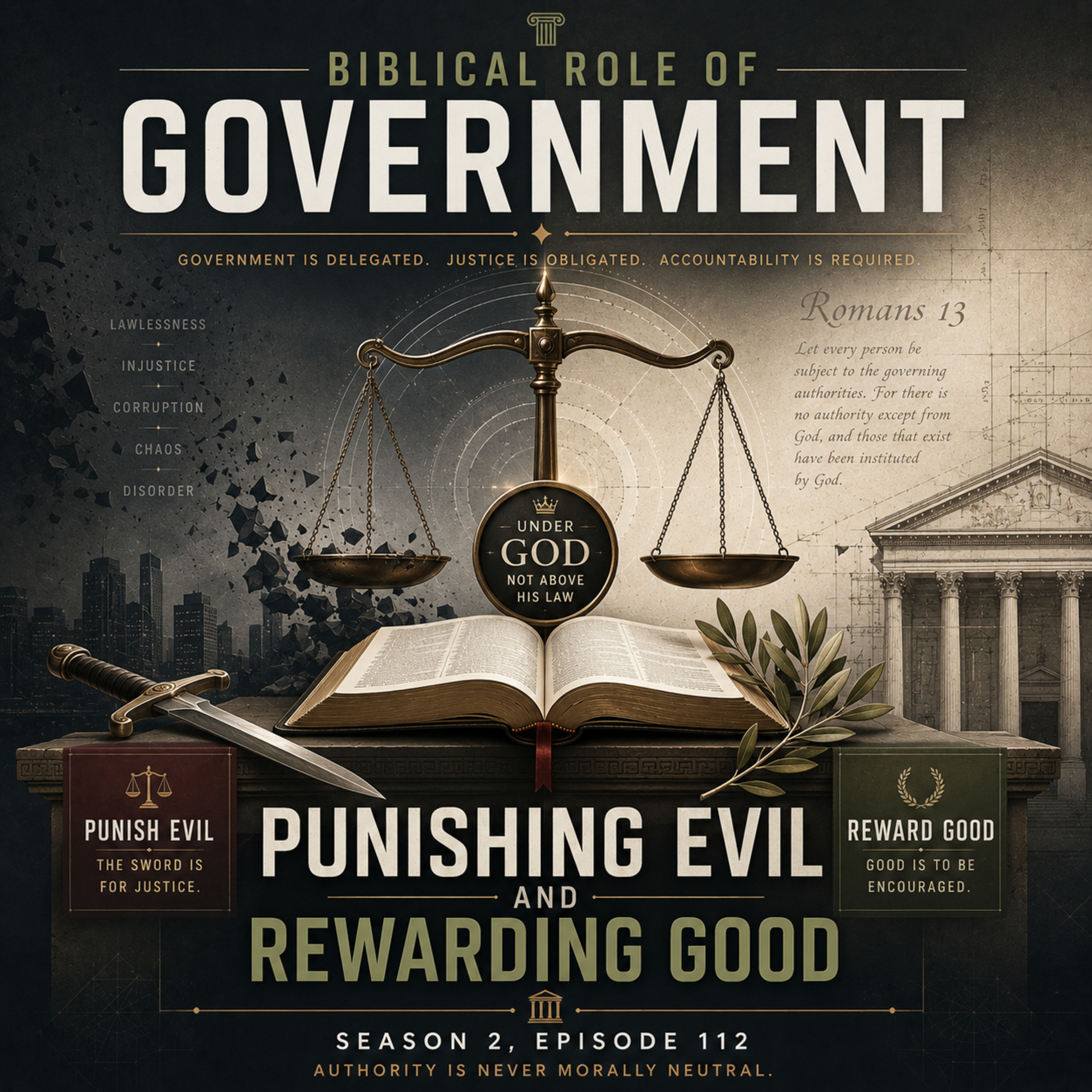
Biblical Role of Government | Punishing Evil and Rewarding Good



 RSS Feed
Season 2, Episode 112
In this episode, Michael and Zach examine one of the most foundational political questions in Scripture: what is the actual God-given role of government? Beginning with a social media debate over abortion and state responsibility, the discussion moves into Romans 13, Genesis 9, and the broader biblical framework for civil authority. The episode argues that government is not morally neutral, but instead exists as a delegated institution established by God to punish evil and reward good. Along the way, the conversation explores capital punishment, the relationship between sin and crime, the impossibility of separating law from morality, and the difficult question of which moral behaviors governments should or should not enforce. The discussion also examines modern assumptions about liberty, secularism, family authority, sexual ethics, restitution, and the limits of state power.
Find our videocast here: https://youtu.be/b9uqFVNxciw
Merch here: https://take-2-podcast.printify.me/
Music from #Uppbeat (free for Creators!):
https://uppbeat.io/t/reakt-music/deep-stone
License code: 2QZOZ2YHZ5UTE7C8
Find more Take 2 Theology content at http://www.take2theology.com
0:00 All right, I don't know if you saw this news on Facebook. California is now going to start providing diapers for all newly born babies. Wow. Every baby, no matter what. That was the news. That's what. At least that's what Gavin Newsom said. Nice. California's just killing it. I mean, they're, they're doing so good. Maybe people will move back there, you know? I saw this thing about how long it's taken for them to build their high speed rail. And it's like at this, it gave all these historical things that have been built faster. But. So I commented on the story and I said, well, I have it down here. It isn't government's job to take care of us. Wow.
0:41 So, so rebellious. Yeah. And this guy comes behind me and he says, also, not the government's job to force you to carry a fetus, but here we are. Wow. Oh, OK. And that kind of that I would like to call it a righteous indignation, but it was, it was at least an indignation. And so I copied my exact comment here, which I know that some people might be. It's a little bit fiery, but I feel like sometimes we need to publicly call out. Bring the. Fire. So I say what a ridiculous response and I want to call it out as such. Shame on you. Yes, it is indeed the job of the government to enforce laws that stop the murder of anyone, and especially the most vulnerable and anyone, including and especially the most vulnerable and innocent among us. The government exists to punish evil and reward good. Abortion on demand is an evil.
1:37 A fetus is an unborn human and has the rights thereof. Full stop. What an evil man you are. Nights and he responds. He did not. Shut it down. Shut it down. I guess I, you know, I was expecting like, OK, I'm about to catch some heat, but I'm willing to to, to go to bat for the unborn and call evil for what it is. Now that may be harsher than what you would think. You know you, you, but I was like, this is this is so. Well, that's good. It begs the question, yeah, what's government there for? Is it for handouts? Is it to quote UN quote, force you to carry a fetus? Is that the right way to frame it? What, what is the force or what are we protecting? I think that's really good things.
2:18 Those are good things to think through. Cause a lot of us probably haven't, I mean, a lot of probably have since COVID-19 and stuff. But you know, it's good to. I thought what is the proper role of government? What's the proper role of government? And what makes it tricky is you look at Scripture and government was different under Caesar Augustus and Cyrus, and you know what I mean? So it's like hard, it's like America looks a lot different. There's a lot of things, a lot of principles you have to draw from. But I'm I'm excited to talk about this. All right, well, with that, let's take it to the next level. Let's fire up that twanga music. From the hearts of the Low Country in South Carolina.
3:02 It's the Take Two podcast where we take theology to the next level. All right, so I said it in my opening comment when we talked, and I said it in my comment on Facebook, that I think the core purpose of government, I'm pulling this right from Scripture. It's has delegated authority. It's established by God to punish evil and reward good. And, you know, some of the central text we would pull this from is Romans, and we'll read that in a little bit, but it goes all the way back to Genesis, to the foundation. You know, creation, order of things is reflected in the Mosaic law. So you might hear people say sometimes you should.
3:45 You can't legislate morality. Yeah, that's heart change. Or, you know, you can't. You can't. You know externals, you know that kind of thing. Yeah, it's crazy because marijuana has become legalized. Surveys indicate that more people think that marijuana is OK to do, but when it was illegal, more people thought it was OK. So perhaps the law is informing people's heart and consciences. Oh, that that's a good way to put it. And it's here in the notes. I think this is like totally gets up the crux of it. It's not should morality be legislative? But who's morality? Because there's no, you know, take it back to our lovely presup thing.
4:25 There's no neutrality. Everyone's there. There's some sort of morality being enforced. When you think of every law and implications, it's good to think through those. And you have it here. Laws or moral judgments backed by force. This is what we have government as Americans, we don't like to tell, you know we don't. We, we don't like people opposing force, but we all know that's what governments there to tell you what not like. Don't do that or there will be consequences. Because if you disobey the government, eventually it's going to be some type of force, even if you're just put in jail or up to, you know, the death penalty. That's right. So the the government is forcing you to do certain things. And so the question is, is that good?
5:06 Is that OK? And if so, what are those types of things? So some key text maybe you can read for us Romans 13 one through 7. I put DNASB in the notes so that we could have that. That's great. I'll, I'll just, I'll suffer through it. Every person is to be in subjection to the governing authorities, for there is no authority except from God, and those which exist are established by God. Therefore, whoever resists authority has opposed the ordinance of God, and they who have opposed will receive condemnation upon themselves. For rulers, not a cause of fear for good behavior, but for evil. Do you want to have No Fear of authority? Do what's good, and you will have praise from the same. For it's a minister of God to you for good.
5:49 But if you do what's evil, be afraid, for it does not bear the sword for nothing. For it's a minister of God, an avenger who brings wrath on the one who practices evil. Therefore it's necessary to be in subjection, not only because of wrath, but also for conscience sake. For because of this you also pay taxes for rulers or servants of God, devoting themselves to this very thing. Render to all what is due them tax to whom taxes due custom, to whom fear, to whom fear honor to whom honor. Sounds pretty positive for government. I don't like hearing this as an American. I know and it says pay your taxes. Do you know how many people I I I read all the time taxation is bad? Sometimes taxation can be.
6:34 Especially without representation. Especially. If it's without representation, but you can't just say blanket all taxes are theft because you're not reading your scripture if you do so Key ideas from what you just read. Government is instituted by God. It's a great starting point, yeah. Yeah, and we, you know, just a caveat 'cause we have this in our notes below as a caveat. In our previous podcast, we talked about it. That doesn't mean that everything that government does is sanctioned by by God and is morally upright. We recognize God knows that some governments are better than others, and some governments do some really evil things, but government as a whole is sanctioned by God. I think it's going to see in Scripture pictures of really positive governments and picture where it's not positive and how you know what God thinks of that. I I like it's we mentioned it's not all the same as America today, but we do have examples that are said this is good, this is bad.
7:31 I will judge this. I will bless this. That's good. Civil rulers possess delegated authorities, not ultimate authority, and some of the key things government exists to reward good and punish evil. Yeah, it gets I'm I I love that. Like in a perfect world, I, I'm gonna like, like talking about this more as we apply it to real world application because sometimes you look at you're like government, you're doing the not just missing the mark, but. It's very opposite and and you know, there are scriptures that's like woe to them who live in the days where good is called evil and evil is called good. We we see that sometimes it. It it is tricky too in a quote UN quote, you know, so much Christian influence.
8:11 It's like, you know, you look at the things in courthouses and stuff and you're like, man, you're just like missing the mark so much. But I like that the whole purpose, reward good, punish evil. That's great. All right, and then it also says it bears the sword. The sword was an instrument of death. You know, Jesus said to his disciples, do you have a sword? Like go get a sword. You need a sword like we've got two. I'm like that's enough like so you know that that is swords were not foreboden to Jesus, but they for us to have. But that's a side point. But government, but government is directly said to bear the sword in it.
8:54 You know, I don't know if it says it directly, but it implies on behalf of God, like they are the servant of God to bring about this justice. So Romans 13, does this mean no matter what the government says, like buckle up, Like, hey, we will support your government wholeheartedly no matter what? Yeah. So that, you know, we kind of also addressed this in our previous how not to read the Bible. They just happen to have some overlap there. But we talked about, you know, the Hebrew midwives, they disobey, They paid Pharaoh, they didn't follow the law. Daniel prayed and God blessed him for that. He didn't follow the law. Peter told the Jews an act, you know, we must obey God rather than men. So. Yeah, Talk about governmental structure that embraced, you know, Judaism, but its practice was so against the God of the Old Testament. That's a yeah.
9:46 So we're not saying that just because government is instituted by God and it carries delegated authority, that means that we should always obey it. There are times when we will have to necessarily disobey it when it will order something evil for us to do. And you know, there's different way, you know, different people had different thoughts throughout history. Sometimes, you know, we call it like civil disobedience where you say, hey, I'm just going to disobey. I'll take the punishment. Some have been more of rebellious and we've seen God bless some of that too. I'm not saying that you I'm, I'm not trying to start an insurrection or anything like that. But but you have seen throughout history both of these responses where people have submitted to the punishment but refused to obey.
10:31 Sometimes people have, you know, rebelled against government in in a forceful way, and it seems like that is definitely a wisdom issue. Yeah, I I think you're right. Another foundational text, Genesis 9. I'm going to read verses 5 and 6. And for your lifeblood, I will require A reckoning. From every beast I will require it. And from man, from his fellow man, I will require A reckoning for the life of man. Whoever sheds the blood of man by man shall his blood be shed, For God made man in his own image. All right, so this passage occurs before Abraham. It's early. Yeah, very early. There's no Abrahamic covenant.
11:12 There's no Mosaic covenant. God has not selected out a certain people to himself, and God has just basically destroyed all the people except for Noah and his sons. And so you could say that God is telling this to all of mankind right now. That's good. So that we would say that this is like a universal principle for humanity, that human life possesses dignity because man is made in God's image. Therefore, the death penalty for murder is rooted in just justice, image bearing, protection of society. Yeah, this is good because I, I feel like, you know, you hear this argument sometimes, like Christians, you're just OK with killing people for the death penalty. You're like, you're kind of missing like the whole point of something like that, right?
11:59 Right, especially in context of like the pro-life pro-choice discussion. Like if you're pro-life, how are you for the death penalty? And here's how I value human life so much that if you take it in a in a bad way, we're going to take your life because to not value it would be like, oh, you killed. Someone. No big deal. No, this is a huge deal. And so we we're going to follow you're going to take out an image bearer than government should take take you out. So by this I think we can see biblically the legitimate, the legitimacy of civil punishment, of capital punishment, and the human responsibility to restrain violence, like we're supposed to stop violence occurring in our societies.
12:43 Now that that that is so good, I, I can't wait for the next part of this 'cause I think this is where you get into some of the practical matters and where there's a lot of people on different sides saying the same thing. We're trying to do good, and what they say is good varies greatly. Yeah, so if government is to punish evil and reward good, then you have to know, or at least have a definition for your government, what is good, What is evil? What are we basing that on? What does justice look like? Is justice a $20 fine for every crime that it probably doesn't seem to fit certain crimes definitely need more than that. What is harm? So, you know, is me holding up a sign saying I'm praying for you?
13:26 Is that harm? Because if we define that as harm, then we're going to need to, right? And then what are those rights? And so if you go back and look at our Constitution talks about, you know, having inalienable rights from our creator, that we're endowed with those rights. So that's even a better conversation too. Like if you have rights, what are they based in or where do you draw them? Because then that come, you know, opens up different, different thought processes. Yeah. So not this episode, but we should probably at some point talk time talk about like positive rights versus negative rights in our Constitution. So, yeah. And this, this will be a series, but we don't, I don't have all the notes ready written for it, but that remind us and we'll talk about that.
14:07 All right, so we talked about this earlier, the statement, you can't legislate morality. It really is a vacuous statement because we are going to legislate someone's view of what is moral. So all legislation reflects morality. So our laws against murder, against theft, against fraud, against discrimination are environmental laws or tax laws, obscenity laws. Those all are based in some type of idea of what's good and what's evil. No, so so good. Doesn't matter if you are religious or secular moralities. The name of the game. That's right. OK, so I thought for this first episode we could really hone in on this idea of legislating morality and see how it works because there's big discussion right now.
14:59 Texas is putting the 10 commandments in the public schools. And I don't, I don't know that that's a huge deal. I don't know that that that alone is going to bring people to Christ. I'm not against it, but I'm not, it's not like something that I'm going to. It's not a hill to die on for me. But, you know, it causes a whole bunch of stuff. I guess the first three I I mean, the only one that would be somewhat controversial, I think is have no other gods before me. Oh. Yeah, yeah, I could see. That don't make a graven image, don't take the Lord's name in vain. Go to church, keep the Sabbath day holy. That's not keep Sabbath day holy is not even really go to church. It's something different, but I thought we could look at something as innocuous as lying. Is that your legal?
15:44 Yeah, lock everyone up. They're just things as a white lie. Yeah, so there are some lies that you can say all the all the time. Like, you know, I could say, man, the Steelers, they're a great team. Like the the Patriots never cheat. Yeah, there's a lot of things you could try. Just kidding. Yeah. Right, right. So lying is on a continuum because there are different levels of lying. One of the 10 commandments is thou shalt not bear false witness. And you might think, oh, well, lying's not, it's a sin, but it's not criminal. But there are instances of it that it is criminal. So let's talk about those.
16:32 So you could have examples of exaggeration. Like, man, I threw that ball 60 yards. You're like, you really threw it 45. Yeah, yeah. That's. Great politeness. Oh, you look great. Great job today on that spot. It's like perfect. That's right. Fictional stories that you know, you just make up something to bolster. Maybe even Santa Claus. Wow man, that's the lie of all lies. The government's not looking to punish those lies. We're not. We don't have policemen out there like putting you into the ground. You only threw that ball 45 yards, you know? Yeah, come on. But some lies are socially destructive. Talking, talking about the Pats, Have you seen Stefan Diggs?
17:16 Have you seen the result? I saw some footage of the trial 'cause we talked about this in one banter previously, but this video released of his cook dancing. I saw a testimony of and she just not a credible witness. At all. And everyone's like, you know, she should be punished with whatever punishment that Stephane potentially would have gotten for falsely accusing him. But so that's a lie. That's and so we would call that perjury lying Underoath. There's fraudulent lying, there's embezzlement, false reporting, like on taxes or returns. You could forge someone's name, you know, defamation. So if I, if I go out and I start saying, you know, this PT, you know, company, they did this and such and such, I could be sued or held criminally reliable for lying. There's also some civil suits like slander, libel, breach of contract, fraudulent inducement.
18:16 So these things, we do recognize this continuum where we're taking this commandment and we're codifying it in some instances, we're not trying to catch it all. That's right. That's unrealistic. No one wants that anyway. It's drawing that line to what rises to the occasion. Man, this is destructive to society. And anyway, on some of these things you listed, you get in trouble to a lesser degree than something else. And even the same thing, depending on how high profile or how much slander or what the effects were, you would have different punishments. That's right. So lying. One of the 10 commandments is codified in a law. Obviously not all of it. So here's this other one, murder and violence. Obviously we have a commandment you shall not murder and lying. It's kind of, you know, bearing false testimony is probably the worst if you're in court.
19:09 And so murderer is probably the worst. But there's this whole continuum of physical harm that we can cause people and like at the lowest level would be like justifiable self-defense. Like that's fine. Have you seen these cases of like Canada or England where like someone breaks in their house and they're like they've got a weapon but you can't, even if they're in your house, you can't defend yourself? United States, I think it was Gary, IN. OK, yeah, just recently two people broke into the house. A guy open fired on them and he is getting charged. Not the people that broke into his house. Maybe the people who are broken the house are also getting charged, but he's getting charged. For it seems weird, like I understand like not like hunting someone down to miles away, but if like there's still if there there could be a threat like you just don't know like. And I've heard some Texas sheriff's like, hey, don't go into someone's house at night.
20:06 You're basically signing a death warrant for yourself. Yeah, don't do it. Because they have no idea of knowing. The on the other side of things, I've seen, I've seen stories of people like, and I do it all the time, 'cause I'm driving a lot, like turning around in someone's driveway and getting shot because they're on their PowerPoint. Don't shoot people. They're just doing it you. Turn. Yeah, there has to be reasonable, you know, a suspicion of death or bodily harm. But yeah, we would say self-defense causes physical harm, but it's at that spectrum like that's fine. Whereas negligence could also cause physical harm, battery, aggravated assault, manslaughter, second degree murder, first degree murder. And we see some of this codified in the Levitical law. Self-defense is there, accidental death is there, there's a different penalty for, you know, someone lying in wait versus someone who kills in in the heat of the moment. So those are codified into our law because we have different punishments for different levels of those actions. And we try to, you know, measure intentionality. Was it reckless?
21:12 Was there negligence? You know, we try to keep it all fair. I'll let you take this next one. Sexual ethics, Everyone's favorite commandment, You shall not commit adultery. You look at laws on the books. There's a lot of adultery laws, sodomy laws, obscenity laws. And you know, it is interesting as you look towards, you know, what government should do. I think all these are good thought experiments. Like maybe you don't agree with homosexuality. Do you ban marriage only and say homosexuality's fine? Do you say, you know, it's like you've got all these different things to think about about, you know, at what level is it OK or bad or enough to rise, you know, being criminal anyway? Modern governments, you know, they'll criminalize rape, sexual assault, exploitation, trafficking, abuse of minors. There's all of these different levels, but not every sexual thing is criminalized.
22:07 If it was, there'd be a lot of people locked up. That's right. So I think it is a good thought experiment of cause. Government can be permissive, it can promote it. Right. Yeah, maybe don't for sure. You would say don't, don't promote or glamorize or give all these incentives at the very least. Or yeah, or you could punish that. Yeah. So and it's like there, I think especially in this area, there's some practical issues. It's like do you want a government that's like barging in in an apartment with two guys? Like OK, are y'all just roommates sharing cost or is there something more going on here that seems a little heavy-handed to me?
22:50 Agreed. Agreed. But at the same time, I don't think we should be legalizing same sex marriage or same sex unions. So I think there's a fine line here. I I think that adultery should be, you know, and there are still some laws on the books and people still get caught up with them. Like if you ruin a marriage. I saw some, some news story where there's some law where if you are a marriage ruiner, like if a gal starts like, you know, flirting with a guy who's married, that gal can be, you know, and, and, and have some financial liability and, and all that as well. Yeah. And, and we don't see this. Well, you kind of see this, you know, you know, if like the United States is trying to promote marriage, you might say, hey, if you're married, you get a tax break. Like it's like the opposite of criminalizing and try to, you know, give all these incentives that that's good because presumably families are are good, you know, but then yeah, it gets.
23:50 And then the other thing even further, it's like, man, if you ever thought like Michael, you were king today, what would you do? It's hard maybe to do a 180 in some circumstances. But you know, like, you know, I don't know, you know which hills you die on, which ones you don't, how far you push things, how far you incremental, I don't know. But. Yeah. And, and that's one of the the complaints about, you know, some of the Old Testament laws are like, well, they didn't get rid of all slaves. Well, one thing most slaves back then came from conquering another nation. And so you're owning that land and you have to do something with the military age guys. But slaves were treated well under the Mosaic law. I mean, maybe not perfect. They didn't have the same status as a citizen, but they had better status in the surrounding. And so you can say you can see how God is incrementally, you know, helping to change culture, which kind of goes to, you know, like if you were a king of the day, you probably couldn't change everything immediately, but you could kind of start turning the ship in some areas.
24:48 That that, that's great. All right, another one of the 10 commandments don't steal, you know, and so this is codified into our laws. Petty theft. I like this. Too, If you ever watch Ray Comfort, he'll be like, what do you call someone who lies a liar? What goes on to steal people half the time will be like Steelers, Yeah. The Steelers are, they're bad, right? They know, they know it's. But you know, we had different levels. Petty theft, shoplifting, robbery, armed robbery, Grand Theft, embezzlement, identity fraud, fraud. So biblically, the solution to this is often restitution, unless there were some like harm done. And we'll, we'll talk about that in the next episode. So Exodus 22 goes through different types of repayment. I think there's different reasons why you might have to repay.
25:36 Sometimes it's double, sometimes it's fourfold, sometimes it's fivefold. And I don't want to get into this too much, but I do want to talk about next time, you know, in the Levitical system, there's really not a prison system. They. Didn't have for profit prisons in the testament. And so you really, we kind of balk at all of the capital punishment, but it's really either capital punishment or some type of payment or restitution. That's so interesting in ultimate next time, 'cause it's like it's the industry of the prisons. It's like, it's like it's a whole separate problem, you know, not saying there's not a place for it, but it's, it's interesting that that wasn't in the Mosaic Law. But government and family, you know, you think of the commandment to honor your father and mother and you think, well, that couldn't be, you know, we couldn't codify that in the law. But there are some instances, you know, if you think about the theme of that, you know, truancy laws, not going to school, juvenile crime laws, child abuse laws. So this is more on the parents child neglect laws. So again, there's a spectrum where you have this, the government recognizes a parent child relationship, the duties of the parent to care for the child, the duties of the child to kind of be underneath that government, the parents authority, you know, all the times where you have to have parent permission to do stuff.
26:58 Yeah. Totally. Yeah, so it recognizes it, although again, we're not saying that if a toddler tells their parent no, call 911 and get the cops there. You know what I'm saying? So there's a spectrum where we're not trying to codify every sin, but you can see that it is in the the the warp and woof of our society. Maybe some things that government shouldn't enforce. And, and this is a good conversation, you know, idol worship should should we arrest people who worship an idol? Right, right. Yeah, like you mentioned before, like, yeah, practically what?
27:40 What would this look like? Are you like, you know, just on idol patrol, like, you know, all these things and then no other gods, like, right. Yeah. I mean, it's hard. It's hard to nail nail that down, taking God's name in vain. Yeah. It's like one of those things that it's like, man if. You said it in public in the 1950s, you probably would spend a day in jail in some, in some places. Whereas today we, we, you know, we are very invested in the 1st Amendment. In some ways, some, some ways, it's still getting trampled on. But, you know, we would say, hey, that's protected free speech. You may not like it, and I and I like the fact that it's the the speech that we disagree with is the speech that needs to be protected. We don't need to protect the speech that we agree with because if the government is in a position to say this speech is bad, this speech is good.
28:35 Be careful, Christians, because sharing the gospel could become hate speech, you know? So I'd want the governments to allow me to, to speak freely as long as I, you know, this is a classic yelling fire in a theater, you know? Yeah, yeah, yeah. Yeah, that kind of stuff. That's right. That's. Right. Or making threats that are that are that are viable threats. OK, Sabbath laws. Yeah, man. There's some blue law still on the books, like liquor stores aren't open here in certain counties in South Carolina or in certain counties on Sundays. Yeah, I think there was a time where you couldn't buy lottery tickets on Sundays or something like that, man, It's. Chick-fil-A's not open. Chick-fil-A.
29:16 It's against the law. So I can't do it. So, you know, there, there, we're not saying that we're not trying to make America a theocracy. I don't think that's either one of our goals. And I'm not saying that we should try to make America a theocracy or, or, you know, ancient Israel. But we, I, I think it is a little bit nonsensical for the 10 commandments, especially, you know, the last, you know, six of them to get as much hate as as they do. All right, I I think that's a good, a good, a good stopping point. We we had a couple different places, you know, depending on how long that took, but I think that's that's good. I.
29:57 Think that's good? You can tease it up. We got some good stuff to cover. Next time. We'll we'll talk about prisons next time. What else? We're talking about next time. Well, I also want to look at some principles that we can extract from the Mosaic Law, even though we wouldn't, we wouldn't implement some of the laws, but like what? What purpose did this law have in their society that may inform us on types of laws that are OK for us to have in our society? I like, I like that. Yeah, look at it. Because some people might say let's just let's get it all back. Let's do it. You know, if it's not explicitly rejected, like why not? But I like where you're going at probably more of the substance or the principles, like what? What's what's really there?
30:42 I love it. All right, final take. Final take What's going on with you, Michael? Well, we talked a little bit. So I have been so right at the beginning of the year I was working out and then it's like we got into crazy life and there was like, you know, maybe six weeks where I didn't go into to the gym at all. We were still. So I've been back in the gym regularly. I think I I'm going to work out tonight when we're done here. Hey, it is a I'm a late night work lifter. So but I've gotten up. So I normally do progressive loading. So I'll like always start out with 135 S, play it on each side. I'll do 5 reps of that and that's for bench and squat. And then I'll add like 30 lbs and then add 30 lbs and keep going up.
31:31 And I I typically do will do 5 total sets. I'll get up to whatever my highest left to. So my most recent one was 235 five times on the bench, which is pretty, pretty good. And then 255 squatting. You know, the bench I'm, I'm pretty happy with coming up that fast. I think my Max in college was like 280. 5 So so we're gonna. So maybe, you know, six months from now, I'll be. That's pretty cool. Yeah, Yeah. Deadlift and squat got, we got some work, we've got some ground to cover, but I think it will come back faster 'cause I see my squat, you know, coming up faster. So squatting with 255 by 5.
32:20 Are you able to work out? You probably. Are you able to work out like during the IT probably doesn't make sense. You come back at night like you can't fit it in, can you? Are you able to fit it in or is it being used like like right after school? Yeah, yeah. Yeah, probably. Now I could, but football's starting to get in there for offseason and I always try to do it. I'm not to interfere. If there were there, there's another. I like free weights. Oh yeah, Yeah, I don't like a lot of machines. Yeah. If there was a gym that was close by, that was. There is a gym that I think it's like on somewhere near Walmart between Walmart and Taco Bell or something. You should just use like Walmart's like fitness section, just like a. Little in here it. Doesn't work out.
33:02 I cancelled, you know, as part of my New Year's resolution, I cancelled my membership to Planet Fitness. It was crazy. Like I was like, you know, I was coming in. It was January and everyone's in there and like I'm coming in to cancel my my. But I just never used. It so you. Have to do it in person at Planet Fitness. Yeah, yeah, yeah, in person. That's a smart business model. I got to come in in person. Unless you're live in California. Oh, then you can. Yeah, there. You go. So I saw some people say if you change your personal record to some address in California and and then you can cancel it online, but I I didn't try that. I just went in. So yeah, goal is 1000 LB club. Yeah, that's a good goal, yeah.
33:43 Getting there for for a guy my size, it should be 'cause I was talking to a Co worker and he was like kind of kind of balking at me already benching that much. I'm like. Oh yeah. Yeah, yeah. I'm a six, four guy. I'm a big guy. So that means for me to lift 235 is not as impressive as if you were to lift 235. Yeah, I am not. I would not do well on maxing out which I'm not maxing out. Well, I'm, I'm been working out. I work out. If you can imagine you probably blows your mind with not super heavy weights. Michael, I've been doing a lot of kettlebell work, a lot of like ring pull ups of I just my shoulder. My shoulders hurt when I use a barbell. I just don't have good range of motion.
34:25 I end up getting injured from lifting from lifting. 'Cause that was my friend was talking about my Co worker who was saying, you know, for do a back squat. It really I'm like, well, you got to, you got to stretch your shoulders out and stuff. And you totally have to have good. Yeah, I do. I do some stretches and stuff where I before I start squatting. That's good. I've got I've got scoliosis and I I think the way my frame is it if when I start loading it, I and it no matter how much a painted to my form. But so everything I I do is like I've got range of motion in my arms, but it's not like a. Chiropractor I I. Should see a professional. The downside is you can move much less weight when you're, you know, doing a, you know, a dumbbell versus a barbell.
35:08 So, you know, there you go. I don't know. Well, squatting doesn't bother me as much. It's more like overhead press or bench press or those kind of things. I end up just getting injured. I don't do overhead press yet. I've, you know, that used to be like the press, like bench, like if you go back to like the 50s and 60s, it's like no one cared about your bench press. It was your, they just called it the press. So you're over. And they still call it if someone says press. Yeah, yeah, yeah. I'm assuming it's shoulder press 'cause I'll they'll say bench press they'll say bench. Oh, gotcha. Yeah. Press. Yeah, yeah. Comma, even though it is bench press and I've impressed, but yeah, I I've only been doing the big three so far. Well, I actually added, what did I add? I added Romanian.
35:49 Deadlifts, yeah. Get those two is rolling 'cause my wife said that I should fill out my glutes some more like, you know, the typical old man, your glutes go away. And so I asked Chad, I was like, what should I add to, you know, build back some, some glutes? And it was like Romanian. It does. Romanian deadlifts. That's good. I've been going hard. It was beautiful weather this weekend for frisbee. It was not like. It was nice. I got a cool 6 miles in of like you know, Sprint like slow, fast, slow, fast. I did. I did not run 23 miles an hour. I, I decreased I was like only 20 miles an hour for my fastest, but you know, can't, can't.
36:33 Run them all but the Garmin can be believed. Yeah, the Garmin. What a Yeah. I can't, can't trust it. But yeah, fitness is good. That's great. Yeah. So you're teaching? Class on this some some point right? Yeah, I, I would like to teach one. I would have loved to teach 1A theology of exercise or maybe make it a little more broad. I was thinking there's a book with this title, basically, I didn't know this, but I was like, as I was researching, I'd like to do call it a call it fearfully and wonderfully made a biblical theology of the body or something like that. You know what I mean? Like something like that. I. Think that'd be? Great, and just look at some definitions and move towards practical stuff. My radio it's currently set to is it BBN? Oh, OK.
37:20 Is that the the radio station that's kind of got the old stuff you don't? Know, maybe I I don't know. Yeah. Oh, OK, I don't. Know. But it but it had a John MacArthur. 'Cause I'm Oh yeah, yeah, yeah, yeah, yeah. Yeah, I mostly just get right to podcast or audio book, so it's just there. It's been a very long time now. I know what you're. I don't know, but yeah, yeah. So John MacArthur was was on there and I just caught like a little bit of it. But he's preaching out of Esther, OK. And he talks about the beauty treatments and he is like. Note that the Bible does not speak negatively of the beauty treatments that Esther went through. Contrary. To this this.
38:02 Current thought and feminism that you can do nothing to your body and expect to have a man be attracted to you. He's like, obviously physical beauty is not the focus of the Bible, but the Bible does at point different points talk about, you know, basically taking care of yourself and and and so I thought, well, that's interesting for Johnny Mack to Johnny be saying that. Rowan. Yeah, that's good. I'll have to steal that from him. Yeah, I like it. Well, great. Anything else you got? That's all I got. All right, that's our take. Thanks for listening to Take 2. Find us wherever you find podcasts and on YouTube for those who want to watch our video cast.

