Cults | Black Hebrew Israelites: Ethnicity, Law, and the Gospel


 RSS Feed
Episode 2.92
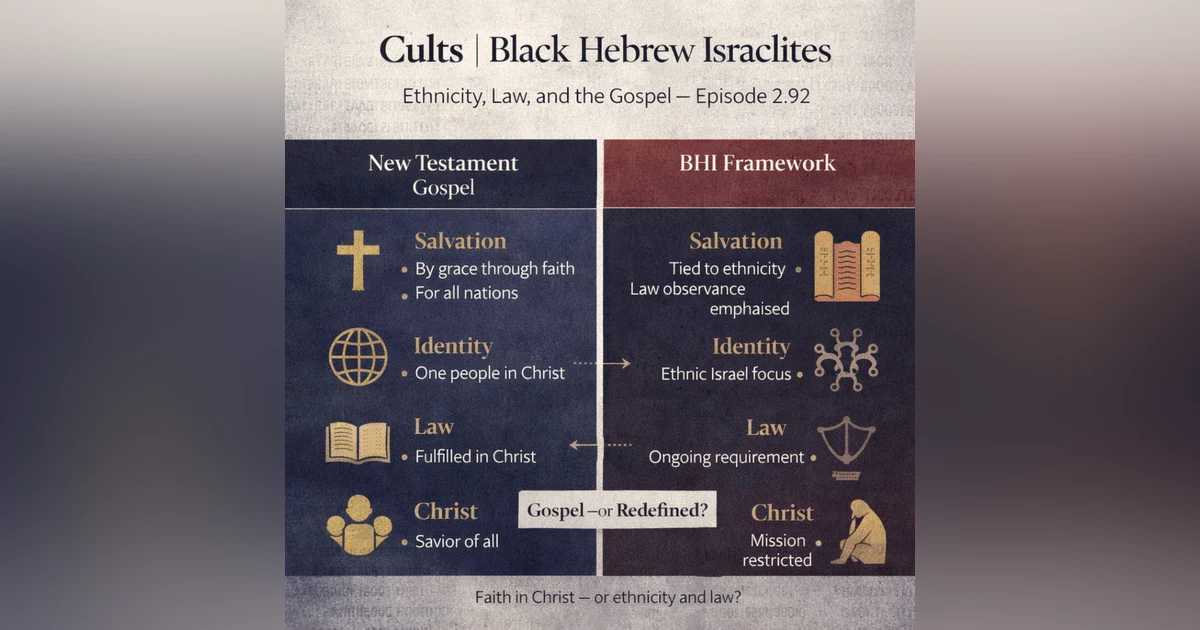
In this episode, Michael and Zach examine the theology of the Black Hebrew Israelite (BHI) movement and ask a central question: does it align with the gospel of the New Testament or redefine it? While BHI groups vary widely, several consistent themes make evaluation possible.
The discussion focuses on key doctrinal issues, including the denial of the Trinity, a restricted view of Christ’s mission, and—most significantly—claims that salvation is tied to ethnicity and Torah observance. These ideas are weighed against the New Testament’s teaching that salvation comes through faith in Christ alone and is extended to all nations.
Along the way, the episode explores how Scripture is often interpreted through an ethnic framework and how this shapes conclusions about identity, covenant membership, and judgment. The result is a system that, in many cases, mirrors the very issues addressed in Galatians.
The takeaway is clear: the gospel does not create a new ethnic hierarchy—it creates a new people united in Christ. Any system that conditions salvation on race or law departs from the apostolic message.
Find our videocast here: https://youtu.be/NR7T2oICky4
Merch here: https://take-2-podcast.printify.me/
Music from #Uppbeat (free for Creators!):
https://uppbeat.io/t/reakt-music/deep-stone
License code: 2QZOZ2YHZ5UTE7C8
Find more Take 2 Theology content at http://www.take2theology.com
0:00 The cults, I feel like there's stuff that I say every episode because I assume our audience may change with every episode. So for you, Zach, and for our regular listeners, it's, I know it's repetitive, but. Hey, it's got to be said. It needs to be said because you know, you might have someone who subscribes to this faith that we're talking about who hasn't seen all of our other stuff. It's true. Get served up this. Yeah, and they they don't have the three episodes of go context at. All right, right, right. That's smart. So Zach and I take to theology. Welcome to the podcast.
0:41 We are doing a series highlighting differences between what someone may call classical creedal orthodox Christianity and other belief systems that also where the label Christianity and we're highlighting differences between what we believe and what they believe. And we are using the term cult because in most cases, maybe not every day, every 7th day Adventist, they weren't like clearly outside the fold to me. Maybe if I under if I investigate them more than maybe might find something, but just on our, you know, investigation that we had there, it didn't seem like it was like crazy they had that profit.
1:22 But but anyway, for the most part, we're investigating belief systems that are different enough from Christianity that maybe they shouldn't be using the term Christianity. I like it. You're gonna you're gonna use similar terms that kind of to the untrained person, it just might same seem like, hey, we're all on the same team and we're kind of taking that knife and like separating. This is what they mean. This is what we mean. There is a difference and even using their source, this is what they claimed it mean. They you know, and and kind of unraveling some of this web. That's right. And while we might have like we've had some videos have a lot of discussion trying to show that they're what they believe is true and we've kind of enter into some of that discussion.
2:06 I think that discussion only kind of proved our initial point. Like there are differences. We don't agree on these things. And we're using the term cult in the academic sense, not the, you know, slang sense or pejorative sense. So we're not saying necessarily that you're like in Charles Manson's, you know, like that, that abusive, you know, social psychological type of cult or anything. We're using it in the academic sense. So if you go to like a seminary, they're going to refer to belief systems that we're the name Christianity, but that are different than Christianity in these big, big areas. They're going to call them cults. And it's not like we're like, trying to be nasty or anything. Putting people down and so today. Today.
2:54 What? What cult are we discussing? We're talking about Black Hebrew Israelites. And this is a group I was not super familiar with until maybe it was like, 4 or five years ago. I don't know what it was like. I felt like they were jumping on the scenes. I occasionally would listen to, like, James White's apologetics, and he would, like, interact a little bit with them. And then I was just looking up, like, where do I know this kind of stuff from Kyrie Irving? Do you know the basketball player Kyrie Irving, Like, you know, he's tweeted some things involving Black Hebrew Israelites. He's kind of got like very eclectic belief system, including that, that the earth is flat. And then he, he also has like some, I think I might, I might totally be right.
3:38 This like Buddhist, Hindu influences. And he just like kind of is like eclectic in that way and was pruning some of their stuff. And then I was looking at someone else who's very eclectic. Kanye West, I think was pruning some other stuff. But you know, he's kind of all over the place. And this was maybe 3 or 4 years ago or something like that. But it's, you know, around like a little resurgence, a little bit that kind. Do you watch? Do you watch a lot of reels or no? Are you doing the thrower? Yeah. Yeah, yeah, sometimes, sometimes. You hear that background, everything that has breath, praise and all I actually love. You ever hear that? That's Kanye West. I I, I like that album and there's a couple little Yeah, it's good. It's. Good. All right, so today, Black Hebrew Israelites, let's take it to the next level. Let's fire up that twanga music.
4:28 From the hearts of the Low Country in South Carolina. It's the Take Two podcast where we take theology to the next level. The term Black Hebrew Israelites refers to a loose collection of movements that claim that people of African descent, particularly descendants of enslaved Africans in the Americas, are the true descendants of the biblical Israelites. And I, I think you nailed it in my like, especially like four or five years ago, looking it up, what I came to the conclusion it was challenging because it was not unorganized, but it different groups, I think is a key theme. It's probably a key theme with a lot of these things we're talking about.
5:09 There's different shades that are similar in some ways a little different. It makes it hard to you know, you can't paint with a broad brush, but they all do revolve around at least that central core theme. Yeah, and even that central core theme, like in the Bible, if you read through it clearly, there's a time when God has treated a race preferentially, but he treats them preferentially in order to bring salvation to the entire world. And that's what the Abrahamic covenant was all about. You can go back to Genesis, 12/15/18, I think again and 21, and you'll see these repeated themes and then those get spread all through. So any belief system that is going to on this basis, say here is a direct descendant, basically you had to be a direct descendant to be a true heir.
6:00 That's gonna be problematic, especially when you get into New Testament scriptures that will say, you know, no Jew, no gentile, no female, no male, you know, no free, no, no slave in Christ, you're all you're all equal. So that that might be already be kind of given. You. Yeah, it starts narrow, gets very broad, and even when it's very narrow, everyone's welcome into the fold if you embrace these beliefs and that kind of thing. Yeah, 'cause if you look at the descendants of or the ancestors of Jesus, you know, there's females listed there, there are a bunch of Gentiles listed in there, and there's all these provisions in the Old Testament of how a Gentile could convert to Judaism.
6:44 And so it wasn't exclusive. It was just, you know, I'm gonna use you to bring this about. And what makes it more complicated, you think about that. There's plenty of instances where it's like one descendant went wayward, 1 descendant went godward. And so maybe it gives you an advantage in the, in the way you're exposed to it. It doesn't guarantee anything, you know what I mean? But good. I'm excited to kind of talk about this group and so kind of on that theme of not, not one flat denomination across the board, not necessarily a unified doctrinal confession, but independent congregations. And where I've seen clips, this was like years ago, they were St. preaching and that's what I would see. That's what I saw too, and that's what put them on my radar.
7:28 You know, people would come by and interact with them. They would say some things that clearly, if you really weren't up on Scripture, might trip you up. So I thought this was interesting and and that we should engage. They try to be Torah observant, which is a little bit different. So I guess no pork, no, no shellfish, no clothing of mixed fabrics. So if you got like 60% cotton, 40%, you know, something else, you got to get that out. And then there's a lot of online teaching. So they got, it's not your traditional church with, you know, this, you know, maybe a creedal doctrine in locations. It's it's more scattered. And I think it's had, and I might not know this totally, but a little bit of resurgence where there's been so much emphasis on ethnicity and this kind of thing where I think it gets maybe a little more play with the reels and that kind of stuff too.
8:19 'Cause it is a little bit inciting to the people like us. Yeah, yeah, yeah. So some groups you're gonna run the gamut are gonna be more moderate. Some are gonna really emphasize this ethnic identity toward observant. Some might even appeal appear to be like militant and exclusivistic. So all that would be kind of taken into account. Historical origins. So most movements trace their roots to the late 19th and 20th century American religious movements, especially among the African Americans seeking to interpret their experience of slavery in exile through biblical category. So we do see, you know, the Jews go into slavery in Egypt and then they're exiled back.
9:03 And so they're looking at that, and they're kind of, you know, looking at that experience that they had and seeing how it mirrors with what Moses, you know, did with the Israelites. And, and for me, like with some of these other groups that we're talking about, it's like man, just from school, like I recognize Joseph Smith, I recognize Mary Baker, Edie, these kind of Edie, whatever. I don't I'm not familiar with the origin of them. We see Frank Cherry, late 1800s, what what he emphasized and taught were that black Americans were the true Israelites and that the whites were descendants from Edom. And you know, you can see some of this in in like key texts that that they use as kind of at least the origins. And and I'm so fascinated at some of this origin stuff because, you know, in the case of the Latter Day Saints, Mormonism, it's like you can make all these claims and then, you know, with modern archaeology, you kind of understand, like I wonder with ancestry and this kind of thing, like we got 23andMe.
10:02 Does that show like Edomites? You can kind of like figure some of this out, I don't know. Yeah, I, I mean, just just on looks alone, you would think, you know, I you would say, well, probably white Americans and African Americans. Neither one of them were in that line off of Abraham, right? Like it does take a Bible scholar to look at like Shem Ham and Japheth and just like make your best guess. Maybe you can't nail down everything, but you can maybe get ideas of differences or something like that. Right. And so Edom would be, you know, from Esau. So what? What they what this guy's claiming is that, you know, white Americans descending from Esau, black African Americans descending from Isaac. Yeah, that's something it.
10:47 It seems very strange. I'll be like neither one of those lines really line up. Another one of the key early figures, William Saunders Crowdy, also from the late 1800s, Eighteen 90s, founded the Church of God and Saints of Christ. And this is one of the earliest to actually bear the name Hebrew Israelite. And they had, you know, Crowley's documented teachings in his own movement and historical publications. And one of those was the doorman in Dorman Chosen People. So there we go. Later on, you know, as you kind of progress through the 20th century, we see we talked about in the street preaching groups. I feel like street preaching became more popular across, I mean, a lot of it was like kind of a thing to to do. And particularly in in the 1900s, late 20th century and these urban environments, we kind of see this more and more and more.
11:42 Yeah. And so I want to go back to this mention of Doorman. So a lot of what we're going to become talking about does come from a book, Chosen People, The Rise of American Black Israelite Religions, written by Jacob Dorman, and that was published in 2013. OK, so this is like a recent text that presumably would be. Scholarly to go back and all right, so now we have a little bit of their doctrinal or pardon me, a little bit of their historical background. Let's talk about the doctrinal issues and we're going to be talking about these in the same order that we did our last one. So we want to talk about what do they think about God proper, you know, kind of the, you know, theology proper. What do they think about Jesus Christology? What do they think about salvation soteriology? And then finally, what do they use as their authority? And then we'll, you know, if there are any other issues, we'll look at those as well.
12:34 So beliefs about God make it a theology proper kind of as you they're kind of splintered. So it's not like they have one single, but some of the common things that they affirm, Some of them are what you might call a biblical monotheist, while others will reject the doctrine of the Trinity. So some of the common denial tendencies, they'll subordinist views of God in Christ. Emphasis on strictly Old Testament conception of God, where you don't really see the Father, the Son, and the Holy Spirit all together. And that kind of makes sense with the emphasis on the Torah, even in the name, you can see like all that focus is kind of on Israelite side of things. You look at this group, the IUIC, the Israel United in Christ doctrinal statement, they they basically teach that the Father and the Son, though distinct, it's not in accord with your what you would classically orthodox or from an Orthodox perspective, think of the Trinity in the Trinitarian formulation.
13:39 Yep, they also deny the Trinity outright and they teach a hierarchy between God and Christ. So similar to what you might have like a Jehovah's Witness, like maybe God the Father is the only one that's truly God. Kind of like more of an Arianism type thing where you have the Son being like maybe the first highest created thing, but still created. So there is a hierarchy there. And of course, those conflict with what we would, you know, common scriptures that we would say John 11 in the beginning was the Word, the Word was God, the Word was with God. Matthew 2819, baptizing in the name of the Father and Son, the Holy Spirit. So they show that there is, you know, this link between the Trinity.
14:21 So obviously goes against that the Nicene Creed. Great. Let's move on to Christology beliefs about Jesus. And again, just like with a lot of these, it kind of varies across different groups, but you can, you know, identify several common patterns, including that Jesus was a black Israelite Messiah and that Jesus came only for Israel, not for all nations, which that one perplexes me. Well, not only does it perplex, is it perplexing, But then you would say the people who are espousing this are not true descendants of Israel by any, any real, you know, physical and verifiable method. Matthew 1524 is frequently cited by Black Hebrew Israelite teachers where it says I was sent only to the lost sheep of the House of Israel.
15:11 This verse is interpreted to mean that Christ's mission excludes non Israelites. We should read the full context of that. So maybe while I'm pulling that up, you can kind of talk to our our next point is that. Yeah, yeah, I'll keep moving along. So obviously in in their view, they're they're looking at this verse and saying, you know, Christ's mission, non Israelites were not part of it. He was only sent to the lost sheep of the House of Israel. Kind of a little bit more, a little bit confusing. It kind of plays into this Arianism mindset. Some groups will say, yeah, Jesus was the Messiah, but not fully divine. So there's kind of this ordering of, you know, not as great as God the Father, a little step down, which would be in line with that Arianism, where maybe he was, you know, a purely human messianic figure. We got the context.
16:01 Yeah, we got the context. So it is when he's approached by this Canaanite woman, she asked for him to heal her. And basically he says some things that I think are when you look back at the text, are not in keeping with other things he said. And a lot of scholars believe that he's repeating common phrases that the Jews used that day to kind of test her because then he says, you know, your faith is extreme. And then he goes and heals this Gentile person who is not an Israelite. So it kind of goes if you read the context, it's not going along with what what is being said. Here that context is is good, good to good to read the whole whole chapter. At least you know a verse before verse after because you know, I don't know if you've ever heard of this verse before John 316. It's one of those like no name verses people don't really know. Yeah, and it says he came to save the world. You know the, you know, all those who believe all the believing ones.
16:57 Yeah. Great. And then if you want to get more explicit, Acts 1034 and 35 says that God shows no partiality, but in every nation, anyone who fears Him and does what is right is acceptable to him. And so, you know, we could probably pull passage after passage. Yeah, it seems tough to accept Jesus and maybe even quote Matthew, but then not try to harmonize it with the rest of the New Testament. So it seems odd. That that that that does. I wonder how they try to reconcile some of this Christology problems that they have. Yeah. All right. So moving on to beliefs about salvation or soteriology, and this is kind of the central issue with the Black Hebrew Israelites theology, many of the groups teach that salvation is restricted to ethnic Israelites, which again would be an would be a problem 'cause if you did some DNA testing, I don't think your your average African who was brought here in slavery in the sixteen 1700s is going to be a descendant of Abraham.
17:59 Yep, and and and I feel like even today, there's so much, you know, made between African American, African, Caribbean there there's a lot of distinctions that you know, everyone's from different it it it would be interesting to get some. Well you do see some videos of non Africans, just Africans. Yes and yes, exactly. Interacting with African Americans and there's a huge cultural divide. Huge, huge that that's that's for sure. So claim that Black Americans, especially descendants of enslaved Africans, are the true Israelites. European Jews are imposters. This is a whole different can of worms. But you know, this Jewish identity is confusing because there's an ethnic component and like a cultural component and a religious component. And you look at the modern state of Israel and it's like, I what most Jews live in, like New York. It's, it's interesting.
18:53 Even that side of things is kind of confusing. Like, what makes you a Jew? Covenant promises belong exclusively to Israel. And I think, you know, maybe a lot of Christians would say Amen to that. You know, be like, hey, you know, what do you mean? What do you mean by this term Israel? They clearly mean that ethnic side of things, which to them means Black Hebrew Israelites. And some militant groups will even go further and teach that non Israelites will serve as slaves. Or, you know, what's the other indentured servants in Israel, in the in the Kingdom. And they also teach that non Israelites cannot be saved at all. So you know, some of those pretty, pretty, pretty odd if you're in the normal Christian faith to to kind of hear that kind of exclusionary term.
19:45 For example, teaching materials from again, the IC, the Israelite Church of God in Christ Jesus. I guess it's a different one. Interpret Isaiah 14 one through 2 and Revelation 1310 is teaching that other nations will serve Israel. I got the Isaiah passage right here. It says for Yahweh, we'll have compassion on Jacob, and we'll again choose Israel, and we'll set them in their own land and so generous rejoin them. And we'll attach themselves to the House of Jacob. And the people will take them and bring them to their place. And the House of Israel will possess them in Yahweh's land as male and female slaves. They will take captive those who were their captors and rule over those who oppressed them.
20:27 So you see, oppressing slaves, It's like this reversal here, really. Hang on to that. Very strongly, it sounds like. The Revelation passage. I'll scoot back to Revelation 8. All who'd will on the earth will worship him. Everyone whose name was not written from the foundation of the world in the book of the life of Lamb, who has, who has been slain? If anyone has an ear, let him hear. If anyone is destined for captivity, to the captivity he goes. If anyone kills with a sword, with a sword, he must be killed. Here is the perseverance and the faith of the Saints. So let's see who the hymn was. I'm just going back. I don't think this is, oh, it's the beast. So the hymn is the beast there.
21:12 So again, it's hard to imagine why, How to, to land on that verse and assume that that is the proper interpretation of it. Yeah. Totally going back to the Torah emphasis this Torah observance that to be, you know in covenant membership, you have to observe the Torah. That includes things like Sabbath keeping, you mentioned it, dietary laws. On top of that, the different feast days these for for some of these groups are binding requirements for salvation for membership, covenant membership in their community. And and so, you know, if you're thinking New Testament Galatians comes to your mind, this Judaizers, we're keeping all these things.
21:55 I'm sure they've encountered this before. You would think this is like a classic New Testament text that is a little bit at odds with their belief system. Yeah, I mean, this is the consistent. Yeah. Theme of the New Testament is that we are one in Christ, and you see that all, all through. There's one spirit. So whether you're reading Ephesians or Galatians or Romans, those are all Pauline. I'm sure if I thought long enough I could find something that's not Pauline. But we consider Scripture to be Scripture. We already reference. There's no Jew, no, no Greek in Christ. We're all one Romans 10. There's no distinction between Jew and Greek for all the same Lord as Lord of all.
22:36 So again, we're kind of showing why we think they're wrong. But but even if they think that we are misinterpreting these passages, the fact is that we are on very two different loci, loci 2 different areas of beliefs. Let's talk authority. This other area that really tells you a lot about, you know what, where their true belief lies, you know, is it the word of God? Is it a person? Is it a publication? We've kind of talked about these different areas for the Black Hebrew Israelite groups. They strongly emphasize the authority of the Bible. So that's a positive as you picking up on a theme throughout this that they really skew heavily toward the Old Testament being kind of given that priority. The way they interpret Scripture is is shaped by this pre committed ethnic framework.
23:28 So believe in the Bible, that's good. But you can kind of see in a lot of their beliefs, this ethnic lens, like everything is very heavily emphasized through this interpretation. So we read about the prophecies. When you read about Israel specifically, that's going to apply to black populations and then these curses that that's really going to directly apply to transatlantic slave trade. Things to keep in mind. Yeah, I'm just reading this passage. Are you familiar with this Deuteronomy 28? 60 I I'm not not cold like, yeah, like I know this. I'm ready to go. Yeah. Well, I I'm just reading through skimming through, and it looks like it's a long passage about the consequences of disobedience.
24:16 Oh yeah, It's almost like we were talking about Joshua at the end. This is like Moses at the end. Mount Evil, Mount Garrison kind of thing. Do do bad, bad things will happen. Do good, good things. I've been kind of recounting some of that kind of stuff. So I'm going to start back in 66 So your life shall hang in doubt before you, and you will be in dread that night and day, and shall have no assurance of your life. 67 In the morning you shall, you shall say, would it were evening, and at the evening you will say, would it were mourning, because of the dread of your heart which you dread, and for the sight of your eyes which you will see. And here's the key. Verse 68. The Lord will bring you back to Egypt in ships, by the way, about which I spoke to you. You will never see it again. And there you offer yourselves for sale to your enemies as male and female slaves, but there will be no buyer.
25:01 So it's this I, I mean, you can see how someone could read that having been, you know, if your ancestors were brought over in slave ships to a new world. And you might see yourself in there. And maybe there's a principle you could guide on. But even then, like this is this is righteous discipline for covenant disobedience. And so you'd have to say somehow that you'd almost have to bless off on the trade slave as God's righteous disobedience. That's true discipline for covenant disobedience, but that doesn't even make sense in that framework. Yeah, you read something like this and I'm with you where it's like the broader perspective shows something different.
25:45 But at the at the same time, I can, I don't think they're right. I can sympathize with them trying to find like a promise because this is the same kind of thing that might be levied against like a dispensationalist or something like that, like, oh, they're reading this old, you know what I mean? But I mean, this is different than that. Like I can sympathize with it. I don't think they're. Right would make that claim against the covenant theologian maybe. Maybe that's it where it's like they read stuff about the land and they're like this is physical land versus or something like that where I can sympathize with it. But I don't think this is like that hyper specific to that, you know, prophecy. But I I appreciate the commitment to scripture, even though I feel like maybe we're missing missing the point here. All right, So those are the big ones. They do have some other aberrant beliefs. Some of these we've already touched on white people as Edomites.
26:32 Some militant groups will teach that white people descend from Esau or Edom. Edom is eternally cursed. Future judgment will involve the subjugation of Edom. And so they would might refer to some of these minor prophet or these passages from the minor prophets, like Obadiah 118. The House of Eshall shall stubble shall be stubble. I thought that Herod was an Edomite, right? That is interesting. Like he had roots in different places. I think it refers to him as an Edomite, right? You might be right, yeah. Anyways, 'cause I always wondered, you know, was Herod's line like the last of the Edomites and then like, he was filled out. I don't know.
27:16 But we read Ephesians 214. He himself is our piece. He's made both 1. He has made both 1 and has broken down the dividing wall of hostility here. He's specifically talking about Jews versus Gentiles. So, yeah, so it seems like a very odd and and also demonstrably false belief. Yeah, and kind of on that same point, this emphasis on ethnicity, you know, Romans 96, not all who are descended from Israel belong to Israel, where if everything is literally read through that lens, you are you are missing the bigger idea that faith in Christ supersedes all of these things. Romans 9 through 11.
28:00 We've covered it in the past, you know, some complicated texts, but the the focus is you know, you're grafted in, you know, based on faith all. Right. So conclusions, we've said it, maybe this will be the third time there's not a centralized doctrine of someone who's Black Hebrew Israelites. So your best bet when talking with a with someone who claims that or any religion that you're wanting to learn more about what they believe, ask the individual questions. What do you believe? How did you come to that conclusion? What did you mean by that? So that you're drawing out their answers and that's all you might have to do. Oh, that's interesting. I'll give it some thought and then go on. If you don't feel like you're prepared to to talk to them, you know, when you make statements, then you have to defend them. But if you just ask questions, you don't really have anything to defend.
28:48 So that might be your first bed if you end up interacting with this someone of this stripe or or another belief system, but they do raise some, you know, concerning patterns. Totally, you read. I kind of recap some some of the things that they emphasize ethnic, ethnic exclusivity of salvation. Justification is conditioned on how well you adhere to the Torah. Paul said if it's works, it's not grace. If it's grace, it's not works. Yeah, yeah. Yeah, can't get more clearer than that. You know, we did say many, some at least do a firm orthodox Trinity perspective, but many have this kind of hierarchy of, you know, Arianism light maybe or maybe full blown Arianism where the Trinity is not not explained the same way as as Nicene or these these different creeds where Christ is maybe a step down. And then Christ's mission is very narrow and not not wide to all the nations you can think of going back to Abraham. If all the nations are gonna be blessed like how does this how does this work?
29:55 Well, and then Christ double S down. He's like take it to Jerusalem. Those are the Jews and to Samaria. Those are the half Jews who are hated and then to the uttermost parts of the earth. So it's like, you know, it would be nice to have, you know, a conversation that would be a conversation. Although I've seen some of the street folks not be so polite. It gets kind of caustic. And St. preaching in general, I think even if I agree with the street preacher some, sometimes with like the crowd atmosphere, sometimes it's done like beautifully, sometimes it's not done. It takes a special person to be patient and gracious. And it kind of depends on the grouper. There's a lot of things that have to go right. I think it can't be done. OK, but. There's this guy that shows up on my feet every now and then who's a street preacher and does apologetics.
30:38 And I agree with what he's saying. And sometimes he makes some really good points, but he always seems very angry and like shouting at the group around him. I'm like, I don't know if that's the best look. I I I cringe a little. Bit it is tough and it just takes Yeah. And it's. It's and. He's someone I agree. With and it's someone you agree with. Yeah, no, that's that's good. So in in contrast, the the gospel we read about in Scripture speaks of salvation as being through faith in Christ alone. The covenant people of God includes all nation. We look at revelation and all nations. That's kind of the trajectory where everything is going. And your ethnicity does not determine entrance into the Kingdom, doesn't determine covenant membership. And it really doesn't even necessarily determine it totally in the Old Testament.
31:23 You know what I mean? Like at this, you can be in or out. If you don't, you know it's crazy. Yeah, Pastor Joel often pokes fun at me. If I get a little. That's great. Love it. I don't think I've gotten too emotional. Bring it back next. Time I guess I was talking about recent death in one of our families Sunday. So I did get a little teary. But one song, you know, when we start singing like Izzy Worthy. Oh yeah. And there is that talks about us joining with every one tribe, every nation in tongue. And you read those passages and you think of a throne room that has Cubans and Americans and Filipinos and Denisuelans and Colombians and Russians, Chinese, Japanese, like people from every tongue, every tribe.
32:14 We are one in Christ. That's the beauty of the gospel and for you to have people who are basically turn that on its head and say, no, we're not. Christ didn't come and die for everyone who just died for this select descendants. It just kind of reverses, you know what I think Christ came for? Oh. Yeah, totally. And I think we've been able to show even briefly here, New Testament passage for New Testament passage. You know, a lot of times we're just in Galatians hanging out 'cause it's a, it's a great, great one to camp out in. That's good. Black Hebrew Israelites. Here we go. What what? What else you got about them? No, I think I, you know, if I always want to throw out an olive branch if we've gotten one of the beliefs wrong.
33:00 And note we've already said you could be use this label and not fall because there's more than one type. So, yeah, let us know if if you are a Black Hebrew Israelite and we've gotten anything wrong about how you believe or, you know, we'd be, we'd love to have some comments that would say, Harry, here's what we believe, here's something you miss, here's something new. Yeah. Please do I would like to hear more especially about like the E don't like the ancestor stuff like that's interesting to me, like how that like pans out or there's different, you know, maybe different passages they appeal to and that kind of thing. But yeah, I'm, I'm all I'm all ears for that. We've had some pretty good interaction, you know how much, which is cool. I like that. All right, final take.
33:42 Final take. Last take weeds final I was. Just gonna leave it at final. Yeah. And I keep just second. Guessing, I don't know what it is, we I don't think we declared definitively. Man, I love it just every, every episode. We'll just go back, back and forth, which is great. I will bring up this. Our podcast got mentioned in Sunday school. I wasn't there for it. Yeah, it was great. It was basic. Pastor Joel, I love the plug. It was good. He said that we've been talking a lot about Ethan and Jacob Lowry. It was great. And after in between services, I was talking to different Ethan, not Ethan Tanner, but Ethan Gwynn and Ethan Tanner came up to me and was like, Oh, is and that was like the whole he was like, Oh, I got to check out this podcast now and I was like whole podcast was Ethan slander. We were just slandering.
34:26 That was a big point we were about. Apologetics. Apologetics for both Ethan Tanner and Jacob Lowry were instrumental in the coming of faith. It wasn't like us, but I made it seem like it was a whole about him. It was a series called Ethan Slander and I was like, next week is Ethan slander on Gwen. So we're just going down all the Ethans of Ethan Hughes is next. We got a lot of Ethans we can work our way through. You know that's. Good. Yeah. And I think the well, the apologetics that Ethan Tanner was into was basically kind of what we've been doing in this cult series. He had a family man where he get caught up in a cult really focused him. Yeah, that's. A real world, real life example, yeah. Really kind of read know scripture to see what scripture said and out of trying to rescue his brother from this cult, realized I don't even think I'm a true Christian. Became a believer.
35:13 And I think the kind of apologetics that Jacob was in was more of your traditional apologetics that you might give to an atheist or a New Ager. Yeah, and that's something the different, you know, different areas, how they appeal and how they work in real life situations or, you know, what's going through your mind and these kind of things. It's pretty cool. We're doing a apologetics adult asylum class coming up. I. Thought it was going to be. Like second, I don't know, it was mentioned in Sunday school that it was apologetics, but but maybe that was said incorrectly and that was like for later on down the road at all. It was it was a great it was a we were talking about like everything that's happening. So there's a lot a lot said. Last thing I'll say, I think you have one of these. Do you have I I bet you guys do.
35:58 I just bought one of these because I just am a sucker for these. My wife is going to be such a hard time, but it's one of these cups that you pour cereal and milk in and it like keeps it separate. You have one of these, don't you? Guys, I don't have one. Chloe does. Chloe asked for it for a gift and Juju got it for her. For Christmas, I just got it today. I've been eating cereal all day. Actually, I I got to get used to it. I don't like it. I like my cereal to be a little bit wet. I don't like it to be soft. Yeah, yeah, yeah. I don't like, I mean, what's it's like, yeah, I'm not a fan. It's good. I got, I got, I bought 2. OK. It was not super thrilled I bought 2, but I was like, hey, this is great. You can have it. She's like, I don't, I don't want it. And so I had the boys have it and we're just really hyping it up that yeah, Sierra, it's it's great. It's great.
36:44 We're loving it takes a little getting used to like, you know, how fast do you want the milk like dial on that? And I think I'm trying to dial it in a little bit, but it takes and. You can change. It's like something you can change to. Or is it just how much you flip it back? The, the one I have, which might be different than the one Chloe has, there's like a little like hole on the back and put your finger over it. It like prevents milk from coming. So I kind of get like cereal in and it's like, yeah. And then I'll let milk up and try to it. It does take a little bit. I was like spilling a little milk here and there. But I, I, I love the concept. It's good. So I've only tried it out a couple times today. I guess you could, in theory pack that for lunch. That's right. Yeah. Yeah, because it would keep the cereal. Dry. And you could put like some little lunch box ice blocks type.
37:29 Thing, but you're right, it would be ideal if you could like make it like a little bit. I prefer I am like anti soggy cereal, but like a little bit's OK, so I prefer this over the soggy. So it's like good if you I think it's great if you're like watching T you're doing something and you're not committed to the cereal. You know what I'm saying? Like it's. A second like every now and then. Yeah, yeah, You know, kicking back. I can't wait to use this a lot. I've been making already in the two hours I've had it, I've had it more than that. I'm making a lot of references to it, just like how easy it is to do things. Like look, I'm doing, I'm working on my laptop and I'm eating some cereal and that spilling is. Great. It's funny that you mentioned cereal. Yeah, because I was thinking about mentioning cereal from a different topic for a banter and but I'd forgotten about it.
38:11 But since you mentioned it on the radar, Jill and I just ate it. Rotolo's. Yeah, Yeah, pretty good. I went into the use a restroom because my hands were dirty. OK And then I don't know if you've ever done this, like you walk into the restroom to wash your hands. You're like, well, I should actually use the restroom. So I get over the urinal. And if you're not a guy, you don't know this, but guys in urinals, they always have those like little circle things that try to like keep the keep the urine smell down. And it smelled so delicious. It smelled like Fruit Loops. Now, you're not a Fruit Loops fan, are you? Actually, do you like Fruit Loops? OK. It was just like that fruity fruit. Loops. That's a good point. We need more different good scents than they're traditionally employed.
38:54 That's a good. One yeah, I was like man that's I mean you don't normally go to a guys restroom and go this smells great this. Is yeah not not. The word. Yeah, there's something there. Fruit Loops. There you go. Yeah, I'm not a Cinnamon Toast Crunch fan that usually. I knew that. Cinnamon toast, on which there's two that you're like down on. Yeah, there probably is. I know Cinnamon Toast Crunch, fruit Pebbles. I like Fruity Pebbles, but I I refer to that as literally a 32nd cereal that you have to eat. Yeah, yeah. And I like it, but if I wait longer those get soggy too fast. So that. Might be the ideal candidate for this thing where some are very crunchy and could use a little bit of soften. Up. You know, you wouldn't want to use your new gadget with Grape Nuts.
39:35 Those gotta soak, yeah? Yeah, yeah, yeah. So it's, you know, maybe it's it's finding finding that out. I kept I'm trying to think of the other one. I'm not, not how, but Cimatos crunch like people gasp at it. They're like a Lucky Charms. I'll eat it. Some of my favorite people gasp at that. You know, it's fine. It's good. Captain Crunch. Captain Crunch I'm super high on. It's great. It's great. Not, not the oops, all berries. What about Honey Bunches of votes? Oh, honey, Bunch of votes is good. Yeah, yeah, yeah, I like it. Special K Berry. It's fine. Yeah, it's good. It's good. I I like, I like this is like not my favorite here, but they're like a good getting the rotation. I've actually gone away from cereal, which has been probably good for my health.
40:17 And now I'm just opening that door and I'm just like going to be, it's not going to be good. But it's, you know, I'm, I'm excited for it and I'm committed to it. And I've talked it up so much that I've just got a, I've got there's. No, going back. It's like you can't let Leanne's, you know, claim that you made a bad purchase. Of course, of course not. So you have to, you have to go above and beyond this show. No, this was a great purchase. You know, maybe want another banter. I should, I'll recount all of the, I have a tendency occasionally to get like off the wall, not off the wall. Things like this that are like, you know, a little bit random. Sometimes I see more of A use for them than my wife does. And I was like, why? Why are what are we doing with this? So you got it. Got to play it up.
40:57 But yeah, that's the serial corner. So any anything else we want to add? Well, probably we should say this is going to go out Thursday. What would that be? The 19th? Is that right? Yeah. And we're recording this on Monday, the 16th. And man, just a massive storm that came through just wreaked havoc across the whole state of South. They just like ran back. I heard Goose Creek got some hail this morning or overnight. Maybe not. Maybe, maybe, maybe, maybe I. Maybe I. Dressed it. Next one has some hail. Yeah, that's. Right, that's right. That's pretty good. But yeah, it was a whole lot of nothing like especially in the morning, beautiful day to be out of school.
41:38 Like what a life. I know they, they called, they they reached out to all the chess sponsors and like, what? What about pushing the lower school to Tuesday? And I was like, we can do it. I was, I was like, I'm fine going Monday and then turn. I was like, OK, well, I guess I'll get to teach 'cause I was going to be out. And then I was like, oh, no, school's cancelled. So I don't know. I, I, there's been like one of these cancellations where I've been like, OK, that day was good to cancel, but most of the time I'm like, this is crazy that we cancel. I know I feel like the incentives are like dis aligned where I do think it's in the best interest of new stations and meteorologists to really hype it up. Like, I get it.
42:19 And it's like their passion where I'm not saying they're they're hyping up for no reason, but they're probably in their heart of hearts thinking there's a 2% chance that could save someone's life or something like that. It's like a good thing to do, but it's like out of proportion. It's just like all the time. It's just your classic cold front moving across the continental US in a line. And in this stage of the game, there's not enough energy in the atmosphere typically that you're going to get, you know, tornadoes and stuff like that. I mean, the wind, it was windy, but it wasn't like, yeah, it wasn't crazy over wind or anything. So I I don't. Know, you know what on the side what we should do, we should start weather station weather podcast and it can be like today is March 15th to March 16th. People are talking bad weather.
43:05 It's not gonna be that bad. Put it out there and just be like we were right. We could like recount all the times we were right. So something to think about. You know, yeah, that'd be good. Man. Well, until next time. Until next time, that's our thing. Thanks for listening to Take Two. Find us wherever you find podcasts and on YouTube for those who want to watch our video cast.

