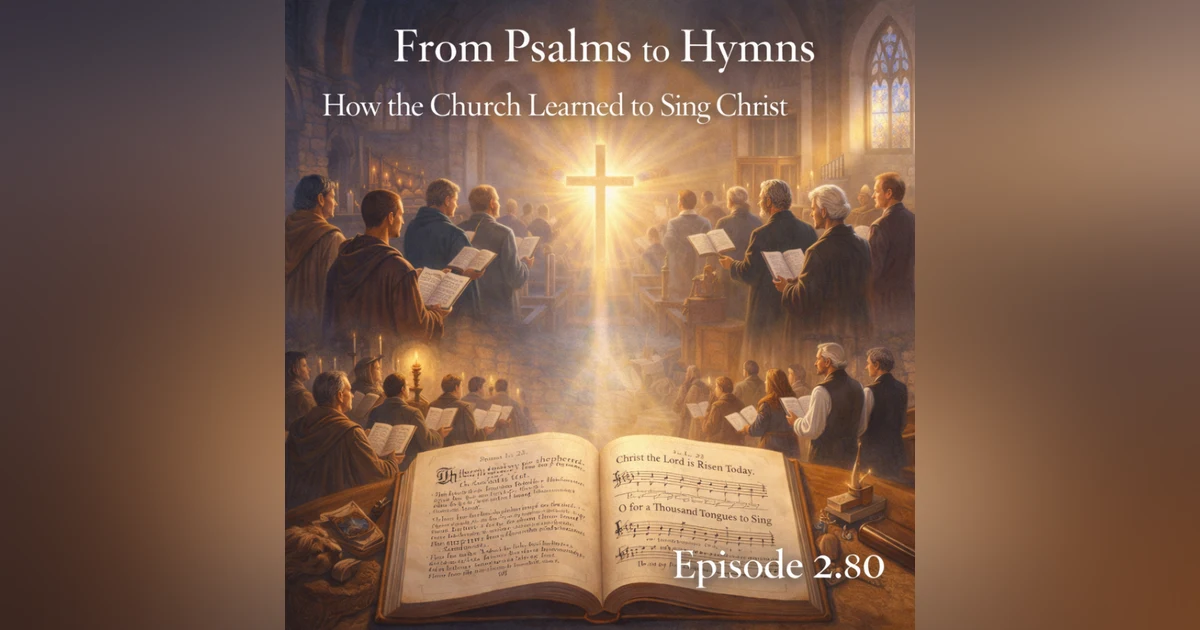
From Psalms to Hymns: How the Church Learned to Sing Christ


 RSS Feed
Episode 2.80
Why did the church move from singing only Psalms to writing and singing hymns—and was that shift faithful or dangerous?
In this episode, Michael and Zach trace the history and theology of Christian hymnody, from the psalm-saturated worship of the early church to the rise of Christ-centered hymns, the Reformation divide, the golden age of hymn writing, and the modern praise movement. Along the way, we examine why hymns emerged in the first place, how they were used to teach doctrine and defend orthodoxy, and what was gained—and lost—as worship music changed over time.
This is not a nostalgia tour or a critique for its own sake. It’s an attempt to answer a deeper question: what do our songs do to us? If worship forms belief, affections, and theology, then the church must think carefully about what it sings. Psalms anchor us in God’s Word. Hymns teach us to confess Christ clearly. Songs, for better or worse, shape the kind of Christians we become.
Find our videocast here: https://youtu.be/-qx2wDD8CsE
Merch here: https://take-2-podcast.printify.me/
Music from #Uppbeat (free for Creators!):
https://uppbeat.io/t/reakt-music/deep-stone
License code: 2QZOZ2YHZ5UTE7C8
Find more Take 2 Theology content at http://www.take2theology.com
0:00 Music. Music to my ears, yeah. We we've been talking a lot of music. Where? Where are we at in this series if you count Tim? Yeah, so we've talked with Tim and we really were looking at the wisdom behind music selection for, you know, what a congregation might sing. And we're looking at a couple of pointed questions, like could you sing what you might consider a well written song? Even if it was. Even if it came maybe from a yeah, a reckless source. And then we even talked about maybe some songs like that, like reckless, you know, the wisdom of that, you know, and maybe just the philosophy of how you pick out a good song. Like what what, what would be a song that would kind of meet that criteria of what you would want to sing versus a song that you wouldn't want to sing.
0:51 And it's not necessarily the same that some songs are bad. It's just like you, you got 456 depending on who you are, songs in your service and you have limited space. So let's put the best in. That's great. And so then we went from there and did we go to exclusive psalmody from there? Yes, yeah, yeah. And we kind of went down this pathway, you know, some some churches out there like we're gonna sing the Bible and nothing else to prevent some of that issue. We talked about the rebel Isaac Watts and his revolutionary hymn and the his view was we want to sing about Christ, but in his day got a lot of pushback. We look at it from our vantage point, we're like, that's crazy. It's almost like why we got to sing hymns like they're so old school.
1:34 It's funny thinking they're rebellious and in the spirit of the good hymn writer, we you might call this one when I survey. Worship through the years. And so the wonders cross. So, so the episode today, today, yeah, that's right, is a survey kind of on music and music in the history of the New Testament church, would you say? Perfect. We're going to hit, you know, every maybe couple few 100 centuries and March our way up all the way up to the 2000s. And will we see like ACDC or Def Leppard in this list? Probably not, even though I think if you're familiar with Perry Noble at What's the Church in Greenville? New Spring.
2:16 New spring, Yeah, Yeah. On Easter Sunday, they always made it. They wanted the stand out and one way they opened up their service with good old highway to hell just to really set the tone. That's what you want in worship. So we that might be the extent of ACDC, you know. I was preaching at my home church and this was the previous pastor, so it's not the current pastor, but I asked the song person I was preaching on the Jars of Clay passage. And if you were a fan of Jars of Clay, there's that hidden track at the end that started out with like the couscous car. And like we have this. And I said, can you play that kind of like in the And like the pastor came back to him 'cause he didn't know.
3:01 He was like, what are we doing? Like turn that off. Like that was just the two rock'n'roll or contemporary. He's like, well, Michael like this goes with his sermon, so. Well, yeah, so we'll we'll get into, you know, what was in at what time. So we good. I think we're good. Let's. Go ahead. Take it to the next level. It's great. Let's fire up that twang of music. From the hearts of the Low Country in South Carolina. It's the Take Two podcast, but we take theology to the next level. The early church we're going all the way back to just right after Acts because I'm sure they we should emulate exactly what they. Did.
3:46 That's right, Right. Same culture, same time period, same, you know, traditions. Yeah. And I, I, I, I think that's the right way to think about it. Everyone's got their traditions. And you think of the early church, they weren't, you know, in a vacuum. They inherited, you know, some of the synagogue life, this temple life like that, that would have been in the culture on their mind. And so when it came to worship, I'm sure some of those things played an effect, just like, you know, today, instruments, things in the culture. It's not like you're coming to worship in a total vacuum. So very Jewish in their roots. You can imagine book of Psalms they were they were singing a lot of these Psalms scripture saturated very structured had corporate singing a lot of times led to memorization and they would use this this worship of songs and psalms and prayer confession and these kind of things. And so the early Christians kind of continued this, but incorporated Christ into this a little. Bit right, they couldn't.
4:48 Like, this was good, this was good. But very early on we saw the inclusion now of what we might consider hymns or songs that are even sometimes captured in our scripture. Oh, that, that's good. And I think that basis is good. These these familiar passages. Do you want to look some of these up? I'll look some of these up. Sound like a plan sword drill. You want Philippians or Colossians? I will take Colossians. Oh, OK, I'll hit Philippians 2. And when you think of Philippians 2, I think, you know, people's minds are probably already going to, you know, Christ's condescension. I will read verses 6 through 11 and it reads, Who, though he was in the form of God, did not count equality with God a thing to be grasped, but emptied himself by taking the form of a servant's being born in the likeness of men, and being found in human form, he humbled himself by becoming obedient to the point of death, even death on a cross. Therefore God has highly exalted him and bestowed on him the name that is above every name, so that at the name of Jesus every knee should bow in heaven and on earth and under the earth. And every tongue confessed that Jesus Christ is Lord to the glory of God the Father.
6:04 And, and really that that is a hymn of sorts. And so that makes sense that that would just be carried over into singing. And we know that because of how it's structured in the original language and how it's kind of set apart stuff. Here's another one. Colossians 115 says For he is the image of the invisible God, the first born of all creation. For by Him all things were created both in the heavens and on earth, visible and invisible, whether Thrones or dominions or rulers or authorities, all things have been created through Him and for Him. He is before all things, and in Him all things hold together. He is also the Head of the Body, the Church, and He is the beginning, the first born from the dead, so that He Himself will come to have first place in everything.
6:51 For it was the Father's good pleasure for all the fullness to dwell in Him and through Him to reconcile all things to Himself, having made peace through the blood of His Cross. Through Him I say, whether things on earth or things in heaven. Nice that that you know that's one of the passages we'll talk about a lot in worship to same thing got some of that poetic language. One more passage, first Timothy 316 says great indeed, we confess is the mystery of godliness. God was manifested in the flesh, vindicated by the Spirit, seen by angels, proclaimed among the nations, believed on in the world, taken up in glory. And the way that one reads is kind of like statement after statement.
7:33 It's all connected. And so I think, I think these passages are very structured, poetic in language. I, I would be curious to talk to a native Greek speaker about how just memorable, you know, you say these things and there's kind of like maybe a rhythm to it. You can just kind of memorize these things easily. And therefore it would have lend itself to public worship, corporate confession, these kinds of things. Probably similar to a catechism. There you go. In a verse structure that you could repeat. No, I, I think, I think, I think that's great. And so that the early church was in this kind of tension where they wanted to hold on to the Scripture, you know, Scripture, they inherited Old Testament and as you know, New Testaments coming into being and joyful proclamation of this fulfillment of Christ, which we just kind of read about several times in in the New Testament. So they didn't totally do away with the Psalms, but they felt called that they they needed to sing about the truth. And maybe that's instructive for, you know, what Isaac Watts was doing many years later.
8:33 Yeah, because you there is a basis for wanting to do this. We kind of talked about this a little bit last podcast, but there's been a kind of shift, a cosmic shift you might say, in Judaism slash Christianity. The Messiah has come for the first time. And so Christ is set forth into history and the gospel, you want to proclaim it and it wasn't. You know, Paul has talked about it being a mystery before, but now it's revealed. That's right. And you want to make sure that what you're saying and singing reveals that history. And so you would have these challenges, I presume, if you're there like, oh, we've already sung these psalms with the shafar and now we're doing these new hymns with the tuba, you know, so it makes it.
9:19 Got to stink the tuba and there's somewhere but but I like I I think this is good. I and, you know, they were thinking these hymns that they functioned not just to like carry a nice tune, but to teach doctrine. You know, particularly there would be those, they're illiterate, but you could like sing and get this song stuck in your head, be able to confess certain truths, like the Trinity, like the incarnation. In doing so, you protect orthodoxy and you bring unity. You know, when you know, you probably find yourself, you're walking around, you get like the song stuck in your head or whatever. Hopefully it's a good song, you know? And you're like, oh man, you can like nail down, you know, really good truths 'cause you're singing it over versus like you're like, oh, why is it stuck in my head, you know? Right. Yeah, I have.
9:59 Should I should have confession time? Apparently there's this song from this anime I don't know from Demon Hunter. I've got a great. Game. But I've heard it and I've heard some people singing it on some reels, and now it's stuck in my mouth and I don't even know what all the words are. It's just the melody going over and over again. And I, like, start humming in or whistling it. And like the math students are like, no, Mr. Martin. No, don't do it. They they know too much. So that's a good example of a bad example. Yeah, yeah, it just. Like, but if you have like a hymn stuck in your head, that's good 'cause it's gonna instruct you. I like, I like that a lot. So that really fly over you first through 4th century, really we're kind of transitioning more, you know, out of the 4th century through the 8th century, the patristic era a little bit. See.
10:49 See what? What were they all about? South during this time, we've had another shift more like socially now because before then Christianity was illegal and we had, you know, if you study this that, you know, the first 3 centuries, it's kind of hit and miss. There's pockets of like great persecution versus not as big persecution. So it's hard to like label it all. But we do know, like there was those big times when Christians were being thrown into the Colosseum. Now with Constantinople here and, you know, the establishment of Christianity as a legal religion, now you kind of see like the whole Roman, you know, world start to turn on this worship music.
11:34 So, so you get like these major figures that that stand out. You may have heard of some of these, maybe not Ambrose of Milan if you're thinking 3 hundreds. He is credited as introducing congregational hymn singing. You know, from a Western church perspective, he used hymns on purpose, very specifically and purposely to combat Arianism. You know, hey, if you're going to come attacking Christ's divinity, we're going to have some of these songs are going to be built around that to help strengthen our church. So Saint Nicholas used his first to combat Arianism and Ambrose used songs. I love it. There you go and and he was very firm in thinking, you know, the congregation, they should sing theology, not just hear proclaimed, but participate, confess it and sing it, which I like a lot. I love you got to give everyone everyone against, you know, all all these heresies and that that kind of thing. And it makes you wonder about our songs today. Like, you know, how much doctrine is in there. I think a lot of times have a really good doctrine. Some songs out there, not the one, I'm not saying the ones we sing yesterday, but some out there are like, man, make you feel really good, but you're like, what did what did we talk about?
12:41 Even if it's nothing bad, it's just not substantial. Sometimes. All right, Next up on our list is Gregory of Nasiensis. I love that place. I've been, I've been there a couple times, wrote some hymns defending the Nicene orthodoxy. So you see a trend here. They're kind of motivated by this theology to get it right, use poetry to articulate the Trinitarian theology. So both these guys so far are really trying to use hymns to help shape the doctrine of the congregants. Yeah, and his next guy, Ephraim the Syrian, kind of moved it to that mode. You mentioned it earlier, catechesis, catechism, that his songs kept teaching doctrine through things like metaphor, repetition, beauty, and and we just kind of keep building and building and building where most of these hymns or a lot of these hymns would revolve around things like the Trinity, Christ, divinity, and humanity.
13:35 Things that were going on in the culture. They were made so they could be memorized easily, very repetitive, accessible, meant to be sung in community and in this kind of maybe this catechism idea often got this like a call and response kind of sing method to it. It's like, is he worthy? But. That's a call and response. That's right. Yeah, so hopefully kind of a summary of the what we've seen. We see these songs are teaching that we're, but they're kind of even weaponized against some heresies of the day to to combat those. And the pastors use those for formation and their congregation. And like we said, corporate worship.
14:17 So it's not just hearing someone singing or teaching a song, but we're all going to sing together. Yeah. Are there any places other than the church that you would say you're we'll just leave it to Americans? Yeah. Get together and sing. Corporately, the only thing I can think about is like a sports game, you know what I mean? Like you get and you sing like a fight song or you sing a chance of sort and it's different. But. Yeah, I'm trying to think like where else there would be like. Yeah, maybe some popular songs that they play and everyone starts singing them more. Yeah, that's right. 7th inning stretch, maybe. Yeah, Take Me Out to the ballpark. Yeah, those kind of things. Yeah, you're not. Really doing a lot of yeah. There's not a not a lot of options here. We're going to move on into the medieval area where everything the dark ages because no one knew anything, right?
15:03 I'm just kidding. If you've been listening at all, you know, and you know, Michael in particular, you know, gotta get Aquinas and all this stuff there. There are some there are some bright spots in the medieval era. We're looking at the 9th through the 15th centuries and we see this shifts as the church became more institutionalized, worship move towards being conducted in Latin. You think of this era, you think of monasteries, this kind of thing, the clergy, clerical leadership performance where you do have this performative aspect on one hand. And the congregation that are almost like spectators, they're not participating. And I think even if they are participating, they might be like, I don't know what I'm doing. And so you can see how that would change the dynamic quite a bit. So you want me to take this next one? Go.
15:47 Go for it. You, you want me to get there? You go. Yes, that's what I was looking for. All right. So we see the birth of the Gregorian chant. Yeah. Theologically rich, musically sophisticated. They emphasize the transcendence and reverence. And you kind of get that from the musical style, kind of has that emotion laden with it. But you're going to have to be trained. It's not going to be something you can just come in and sing. And so it's like limited congregational involvement. So you think that we have an entertainment issue here today with, you know, art, But this was yeah, it.
16:28 It's funny moving through these different eras and you kind of see, you know, what tracks with today, what doesn't? You've all probably walked into that service where it's like, this is entirely too high. I'm not gonna be able to sing this or that kind of thing. Or you walk in, it's like, oh, all the lights are on the stage. Everything else is dark. It's, it's almost like this like you're, you know, not saying all that is, is bad necessarily, but you can see like when it is performative versus engaging and there's different ways you can do it and nothing's perfect. And, you know, think about, do we have choirs? Do we not have choirs? All these things? Do we have a band? Do we not have a band? Do. We let females sing or not. That's right. Is it like one person in the middle? The band to the side is the whole band. On this day. It's like, there's a lot of ways you can go with this, right? Yeah.
17:12 All right. So a little bit of irony here. Hymns were preserved with great care. The theology remained intact, but worship became less accessible to your average believer because of this performative aspect of it. And, and you also think of like this Latin stuff, Latin and stuff. It's probably not as much as in those days, but you know, I could see like a newish believer singing some hymns And you're like, I don't know what this word means. Like, oh, there's like a little bit of it. And it's like still English not that long ago. But things to think about as you're engaging in worship. And I always love it when a worship leader might be like, this is a weird phrase. We're gonna sing the song. This is what it means. And it's like you kind of like bring the people into it, you know, But we're gonna transition into the Reformation, which you might think, man, all the reform folks against the Catholics. This is great, but there's a little bit of disagreement within the Reform community, right? the Reformation, they kind of asked this very important question, who is worship for?
18:12 And then a follow up question, how does God teach his people? So I'll start with Martin Luther, the strong willed guy, very strong advocate for hymns. He was a big, big into music. Believe music was a gift from God for proclaiming the gospel. We're all probably familiar with a mighty fortress is our God. It is kind of like a strong. We had a comment about like strong hymns. This is a strong hymn which not to make a too much of an aside, but I would love to do he he made the connection of it seems like once World War Two hit. Softened up. Softened up, you know, when it it and I I think there's a lot of truth to that where you can kind of see things change a lot in in America where it's like, man, that that's interesting to explore.
18:57 Yeah, and I was even thinking I did not put this one on the list. Eternal Father strong to save it. It's it's like a prayer for all those in harm's way. And I, it's a good to him, but it's, it's a little bit on the meek side. It's not like we're going to go, you know, do something. It's like, hey, there's people out in harm's way to pray for them, be, be with them. So I was like, is it, I mean, it's, it's a kind of about a masculine subject, but it's not from a masculine point of view. It's almost written for the women back at home to pray for their their men that are out in harm's way. Yeah, it is so, so, so interesting. Like I made a Really good point. I forget what his name was like his his handle, but. Yeah, I don't. Remember, maybe maybe one day we can explore that a little more. But back back to Martin Luther, he emphasized things like congregational scene.
19:46 Let's get the congregation involved. Let's use the common language. Let's speak speaking the people's vernacular. And then let's get back to this catechesis. Like not only are we gonna sing what they can understand, we want to use it as a teaching tool where they're very connected, very engaged. He would say something like. Music hymns are sermons for the mouth, which is pretty cool. It's good. All right. So that was one kind of prong of the fork. The other one is John Calvin setting up in Geneva, performed Psalm only singing. And if you listen to our last episode, you would have heard that. And he was really concerned about doctrinal drift because, you know, if you look back at the Roman Catholic Church, I think you could say somewhere around 800 or stuff around there 6-7 hundred 800, and that you start to see that doctrinal drift.
20:33 So you can kind of be like, yeah, I can understand what his viewpoint. And he was concerned about our human creativity kind of overshadowing what the words were saying. So let's say it. Let's just get back to the words of God. So good, good emphasis there. Emphasize reverence, simplicity, scriptural purity in what he wanted to do. So you can see how that that's all good things, but you know, if we're talking about like Isaac Watts, you're going to, if you're true and only Psalms, you're going to miss some of the truths that are later revealed. And so you kind of got the two paths that that emerge from this Reformed tradition, the Psalm only churches, exclusive psalmody or Psalm plus hymn churches, both really trying to be faithful.
21:17 We kind of talked about the rationale, but it kind of manifest expresses itself a little bit differently. And that leads us up to the 1700s, really through like the 1900s, at least the early 1900s where it's the golden age of hymns. Yeah, through the 1900s. If you ask anyone's grandparent, it's like, man, give, give me the hymns. You know, you go to any nursing home, long term care living, assisted living people, people just want to hear the hymns, man. You know. So hymns flourished in this era because it was coming out of this theological clarity of the post Reformation where doctrine again was like, we need to know this stuff. So we, you know, we, we stay on the right path. We don't have to break away.
21:59 Put it in. The looks of the common people. And people have to be able to read scripture and sing scripture. And, and so there's this emphasis on personal faith, conversion, assurance of salvation. All these things are kind of, you know, coming, coming together and more and more, you know, for better or for worse. I think we also see you have Catholicism, this big institution, and it starts becoming more personalized where you know, which in some ways is good, you start owning things, but other ways you can get all these little splinter groups as well. You know all. Right, some key figures of this golden era I'm looking through here. I'm surprised Fanny Crosby didn't make the list. Yeah, but Isaac Watts already talked about. So he was kind of the father of where where we aren't seeing Christ. And so he, you know, kind of really pushed our modern hymnody and he wrote hymns that paraphrase Scripture, but he wasn't afraid to go, OK, here's an illusion of Christ. Let's make that explicit.
22:58 And you see that like enjoy the world or or the wherever the. Sun may shine. That's exactly right. Charles Wesley wrote a ton of hymns. He he really was more on the experiential side. What? What's the lived experience of salvation? You know, we have theology, but we're bringing some emotion into it as well. And then John Newton kind of trying to balance both of these things. We'll talk a lot about grace, You know, we know John Newton's hymns, repentance, sanctification, where we're staying very grounded to the these themes. But in a way that is, you know, maybe you don't like hymns. They are very emotional, you know what I mean? Like they, like they, they, they jump into this a lot, you know all. Right. So some characteristics of those hymns of the Golden Age, deeply biblical.
23:43 They are theologically dense. So if you read Hearth, the Herald angels Sing, Yeah, it's fairly theologically dense stuff. You hope you probably have some memorized. I have some memorized because they're kind of memorable things so much. There's like more continuity with hymns than and today. Like a good song comes out every year and it's it's kind of hard to keep up in the same way with hymns. It's like, man, I mean, most of us know at least the first and the last verse in a lot of these hymns. Maybe some of the middle ones we don't, but you know, it's like you're singing and the last whatever you. Know hymns are musically less complex than what you would have gotten from the Catholic Church, so they're easier to sing now.
24:26 I think they're probably more complex than our modern day contemporary Christian music, but they were it. They were less complex. So they put it more in the everyday person's ability to sing. They functioned as this doctrinal instruction and confessions of faith. And really they were used by the pastors as tools of spiritual formation. You know, stand up, you know, oh, Church of God. Yeah, it's so easy, like nothing. But the blood, like there's, it's like, it's amazing just how ubiquitous this kind of thing was across like denominations across a lot of this. I guess it's similar with songs now, which is interesting. I just feel like you ask any like person over 70 and it's like man they'll have like 5 hymns locked and loaded. Some that we don't know, yeah.
25:15 Exactly. Well, let let's talk a little more. Why did the church embrace hymns? What was the theological rationale? We mentioned a little bit of it, but but you, you say any of these hymns, you know, most of them are very explicit in, in terms of their Christology Christology where there's a lot about the cross, like every hymn talks about the cross, grace, resurrection, redemption. You know, in this catechesis mindset that you, you can learn a lot of doctrine without reading a systematic theology book. You know, you can really pick up on, on a lot of good stuff. The congregation congregation just love hymns. That's what I, you know what I mean? I just, I just feel like like older, it's like you're very involved, like the hymn book.
25:56 You have like 800 hymns and you know, you're always like picking out your hymns, that kind of thing. And and so, and anyway, it's one, one of those things. It's like when I was a kid, I didn't did not love hymns. I loved it because I was a music guy. So I would, you know, get there and I would, you know, sing the bass part for sure. But that, that's the thing I've appreciated more as I've gotten like older. I'm like, oh, I kind of miss like it's really hard just winging a new song versus like, at least I'm not good at music, but at least you can kind of know where it's going versus like, maybe we're holding this out or not 'cause every now and then a song will be like the last word on a phrase means nothing. It's gonna bleed right into the next one. You're like, I don't know what to do. It's very hard.
26:36 Yeah, yeah, yeah, yeah. And I think that we're probably talking about some of what we're gonna talk about in the next section and the decline of hymns. But yeah, you as a song leader, I am sensitive to not giving the congregation a whole bunch of new songs, especially in one single sermon. And if I do introduce a new song, I try to say, hey, we're going to introduce a new song before, like maybe even the Wednesday before. And so I put it on our groove. Like you can be listening to it and thinking of it and kind of getting it into your to your mind. That's good. Yep. So kind of rounding out this period, the hymns also, you know, shape your affections, help you think about, you know what I love, what I what I drawn to when I survey the wonders cross were whole nature mine.
27:28 That would be a gift far too small. Like you just have these great word pictures in there and emotion flowed from truth. It was grounded there instead of, you know, replacing truth. It wasn't just about emotion for emotion's sake. Yeah, that, that's the trick. It's almost I feel like you're more hard pressed today to really get strong doctrine because I think people are just like afraid They're like, Oh, I can say Jesus, I'll say resurrection, but I don't like develop these a whole lot because then you, I don't know, it gets hard to understand or maybe you like start splitting hairs too much. I don't. Know we need a song that talks about you know well, I can't think of the word that's when you're justification yeah, yeah, yeah, yeah sanctification, you know glorification and then adoption like maybe a verse that deals with each one of those different parts yeah, you.
28:19 Hit you hit all all of that. Well, you know good things can't last forever. Hymns had to decline. You'll get the late late 19th and mid 20th century and you know hymns were on the way out. Unless you're an independent Fundamental Baptist Church than they were. They might be still coming strong to me. Yeah. And it's, I think if you're tracking musically, there was this, you know, not to call the Gaithers out, but, you know, Gaithers wrote songs that were kind of like. Hymns, but they were. Kind of contemporary. So you start to see this evolution of of not just like this four part Fanny Crosby song. It's more stylistic. And then you can see that kind of evolve into more of what we would consider a modern, you know, spiritual song or, you know, what do we call those what we call it?
29:07 I don't, I don't know, I'm blanking. But no, that, no, that that that's good. And I think, you know, it kind of dovetails where where culture was going faster pace of life preference for immediacy of brevity. We can see that's continuing into today's culture just kind of keeps on going. Revivalism was this shift from doctrinal depth to emotional response. And you kind of see this bridge everything here where it's like really, you know, I don't know, it's kind of like in in the culture we have revivals, evangelists, all these things. And I think all this stuff kind of goes together. We see that in hymns, but then you kind of see it as we transition out of it. And hymns at the end of the day are kind of like, oh, they're so formal, they're so outdated, they're so stiff.
29:49 They're not. They just don't seem modern and and eventually kind of fade over time. All right. Next phase, the praise and contemporary worship era, kind of 1960s to present. We probably blame Elvis Presley for this, but you kind of see music across our whole culture changing. And so probably in an effort to keep up with that, we've also changed it so we get our praise and worship movement influenced by some of our charismatic friends and the Kind. Of yeah, even today, like when you say all the kind of leading songwriters, I feel like it is those on the charismatic side where you think like Bethel, Elevation, Hillsong.
30:33 It just seems like that's like the people that are producing like songs that are super popular. Yep, them and like we said, Elvis like popular folk music, you know, you hear different type of music, you go, you know, that kind of stretches what you like in music and go, we could probably write some Christian words to music like this. No, I I think that's good. I think someone's got a bad rap is the repetition. I feel like some of these Chris Tomlin just knows how to take a chorus and make it go a million times. The worst one ever was I could sing of your love forever because I think that they wanted to make simulate like you were singing of his love forever 'cause that line would repeat. I remember it seemed like for 5 minutes I could sing of your love forever, I could sing of your love forever, and then that would just repeat and repeat.
31:22 Talk about repetition. A lot of it revolved around emotional accessibility, intimacy with God. So focus on some good things. Maybe it could be at the expense of other good things. And, you know, you're trying to balance the pendulum and can run so much on this where, you know, you also hear the the criticism. It's like, are we singing about God or a girlfriend or what are we doing? You know, it's like, you know what I mean? Like, yeah, yeah. You hear this kind of thing. So eventually songwriters replaced hymn writers, band LED worship that that kind of becomes the norm. And you know, like we could have a very conservative church. Like I'm sure I don't, I don't know when the change happened, but I'm sure it was like weird or it's like where I.
32:02 Can have a guitar. Or drums. Yeah, that's probably. Just like. Yeah, it's like little things like that. And now it's like no one cares about drums. But 20 years ago, people really cared about drums a lot. More. It's actually kind of funny. It's kind of crazy, like how much the same people won't Care now, but they care 20 years. Ago or go man, it seemed like a little flat today. We didn't have drums, we didn't have a drummer today. So you didn't feel the the beat. So you just get. You just get velocitized to. It I I feel like I remember it like Satan uses like syncopation is just like that that is like Satans weapon. Like that's like, like, I don't know, I've heard these things.
32:43 I have heard I went to this a conference on the evils of rock music Amen. And it talked about, you know, how putting the bass drum on 2 and 4 was wrong and kind of goes along that syncopation thing because it's not on the strong beat. So it's, you know, uplifting the weak stuff. And then it was all about, you know, the, the bass, like the bass guitar and how it could injure your internal organs and stuff. And it was. It was all over the place. Well, on on top, on top. That's so funny. Some of that stuff. Songs became shorter theology and more simpler the language more effective, more emotional and relatable. On the positive side, much more accessible. You do have that emotional engagement and you know, it's quote UN quote fitting in with the culture where it's not, you know, so stiff and wooden and and old school. But on the negative side, maybe the doctrinal robustness is not there.
33:37 It comes off shallow. It's more individualistic. It's not corporate and worship is more of like a vibe, an atmosphere, you know, and, and there are problems with that where you can see people kind of drift. Yeah. So where does that leave us today? I think you can go to 10 different churches and get 10 different worship singing experiences because there's a lot of different options out there. And even churches that are kind of would be in the same option might do things slightly differently. So you could have, you know, we have a, what we call a blended service. You're going to get some hymns, You're going to get some praise and worship songs. We try to get the best of both worlds so that we are, you know, like we talked about in our episode with Tim, that we are helping connect the heart and the mind as we sing forward. But you're going to find your Psalm only churches that they're out there.
34:38 You're going to find some people that are like hymns only, and then it's funny what they define as a him, like his eyes on Sparrow as a him. And you can. You can see that all over the place. No, that, that that's like so good too. And it, I think maybe this is more popular a little 1020 years ago, but I, I think it's a, it can be a mistake when people are like, Hey, we're going to have the him traditional service and then the contemporary service. Because then I'm like, man, are we just like artificial artificially segregating our church? Is that weird to keep the older people here and the younger people there? Like I feel like that's what other segregation. Would be good do everything for Unity's sake, right?
35:18 Yeah, yeah. It's like, man, if you can combine them, great. And it's like, man, if you have to separate them, it's just like, it'd be weird to be like, hey, here's a sermon just for, I don't know, it's like it's weird when you break up the church in that way based on some of those preferences. I know, I know there's good reasons behind it, but that it's just like, why would you do that? You know, a lot of churches do that and people like it. People like, I know I can get my music that I want. It's very, you know, consumer driven. And it's like, you can get your stuff at church. That's. Great, selfless and caring for one another, you know, and stirring one another up. I can just get what I. Want everything handed to me. No, I, I, I, I think, I think that's good. But you're right, everyone churches, even if you're saying I want to go to a conservative church, you're going to get much different experience everywhere, right? Yeah, yeah.
36:02 So Psalm only, hymn only, contemporary only. Like, you know, just the concert or you can have some blend of that. But I think comes down to one question that we should be asking, you know, what is worship about? And you should, especially if you're in a leadership role, it's hard if you're a congregate in the the seat, maybe you could, you know, humbly, you know, bring some concerns to your leadership. But if you're in leadership, this is something you should really be evaluating. Like, are we, you know, focused on transmitting the truth of our faith in a way that is authentically emotional? Because there's nothing wrong with emotions and worship, but you don't want them to be contrived. You want them to just be ginned up. And so you you need to ask those questions. No, I, I think it's good.
36:51 Just be, be intentional. I think even going through the survey, you can kind of see strengths, weaknesses, pros, cons like where, where does your church land? You know, how does worship affect you? But I like, I like it. This is this is rounding out our worship series. I think so, unless you have another one you know up your sleeves. We'll see. I don't think I do, but you know, I, I feel like I, I learned a little bit through this. I was good, Tim kicking us off and we could run with it a little bit. So just a quick recap. Yeah, we talked about from the very beginning kind of bridging that Judaism to Christianity. Then we had the rise of the hymns as the Roman, you know, it was legalized. Then we got into the Middle Ages and we started to see it getting more like what you might hear, you know, at, at a concert, really.
37:46 And then the Reformation, 2 prongs, hymns only with Martin Luther, Psalms only with John Calvin. Then Isaac Watts came in and kind of broke that up. And we had our golden ages of hymns leading into that and then slowly went into our praise and worship that we see today. Yeah. There you have it. That's the survey of worship through the years. Thanks for hanging in there with us. That's our take. Sweet you. Don't want to talk about cold weather? Oh yeah, I totally forgot our final take final. Wow man, I just got off there. Should we just roll into it?
38:26 Yeah. Just roll into it. Yeah, you can just say I'm an idiot. Yeah, that's great. That's good. We have had cold weather. School's closed today. Treasure, we need to have our schools closed today. It probably was good to close church Sunday because it was still an icy Sunday morning. This is why America will finish last. This is why I might have said this before. I've heard this. It's hilarious. It's like China kind of deserves the win. All their kids are playing violin and getting tutored and we're just like saying it's old. It was cold the other day. No school. You know, you'll get the average drive of the American. You're like, I don't know if we should do good as a. Nation, I think well for, well, I would say for our school and probably with the other public schools, we kind of build in some extra days for hurricanes and we didn't take any of those this year. So they probably, you could say, hey, out of, you know, out of abundance of caution, it's probably going to be mostly dried up and stuff.
39:22 But we didn't use a hurricane day. So just out of abundance of caution, we're going to take my day off. Just take it. Just take it off. Yeah, Yeah. No, no pipes burst or anything for you. You're good. It got really cold like down in the 20s, maybe 19. It's crazy in the teens, high teens for us. I don't like it being that cold. I am when, you know, we duck hunt in that type of weather, but you get layers and layers. So you're not you and you're not normally I don't get cold until I'm like standing around a lot. But like when you're first setting up, there's a lot of movement, so you build up that internal. Oh yeah, I get rolling a little bit. I did go to my closet and. Oh, you went to your closet?
40:05 I got. Yeah, I got out our, like, coat closet and dug up some cold weather gear. Pats, Scar Pats. We called them toboggans girl. We call them toboggans too. OK, Yeah, that's not that resonates with me. Yeah. Yeah. I don't think my I don't, I don't think Leanne gets that. She's like a tobogging. You have to sled and I'm like. Yeah, I know it's a sled, but even my Michigan family called it that. So it's not just a South southern thing. I don't know. And my Pat's toboggan and I wore that into Walmart into last night. I think it was last night 2. Mistakes you wore pack your and you went to Walmart. Wow, over 2. So I'm walking in and there's this guy walking out and like friendly. And I noticed before he notices me, he's wearing like a Steelers coat, Steelers hat.
40:52 And he looks at me and he's like. And then he, just like his whole expression, changes. He probably thought you were spying on me. I thought you were cheating. He probably was like, I'm getting out of before I get like cheating. Oh, there's this this big guy in line, he didn't have the exact same toboggan, but he had a Pats toboggan on too. And we just fist bumped and he's like one more game, one more game. I was like, yeah, it's good. So yeah. You were like, let's let's get accused of some all. We should talk about Bill Belichick. What a not a first belt Hall of Famer that's. What I've always said, would you say? Not a first belt Hall of Famer. I've always said that myself, Belichick, you know, but it makes you think how much should, I'm not saying it should, but how much should like being like you might be a hard worker and competent, successful, but if people like don't like you, like you just rub everyone the wrong way or are constantly accused of cheating even maybe you're doing everything totally above board.
41:53 How that can affect you? Yeah, it can affect you. Clearly it affected him now. On paper he is obviously great coach, one of the best and it's. Like some would argue the best. Yeah. On paper. On, on, on paper, Yeah, yeah, yeah. So it's it's interesting that you can be that good, but just your relationships, you're so poor with others. Yeah, I, I guess it's your. I don't know. I wouldn't say his relationships are poor with everyone, I don't think. Yeah, yeah, the story that has come out is this Poland guy. I didn't even I, I, I really didn't tune into the NFL until 20 tens. So yeah, I was kind of watched some, but I was not like tracking it not. And there by all means there are people who track it even more than I do today.
42:40 So I'm not saying that this might, but I'm saying I'm really paying attention. Started, you know, 2010. So it just wasn't a huge thing growing up. I was in to band to, you know, even when I played football, I wasn't like watching NFL, you know what I'm saying? Yeah, Yeah. So. But apparently there was this guy that was with the Giants, maybe for. Something I can't. Remember. And then the Colts and just couldn't stand Bill. The word is that he instigated some of the the negative press on Bill even while he was coaching. So interesting talking about the guy that used to coach the Steelers and Jerry Johnson.
43:22 The guy used to coach. They were on some talk show and they're both saying, yeah, the, the Spygate, we all did that. We don't know why. Like Bill got highlighted for this and some people are in the comments like, well, why didn't you say that back in the day? Yeah, it is. It is weird that like yeah, that if it's so common, like why were they the only one that got penalized and why did it's interesting that it wouldn't got leaked that any other team did it or you know what? I. Mean And there was also just there was also a very long news article that detailed all these things that Bill had done and his fines. And then like a year later, the same publication they just hid. Like we retract this news article. Like it wasn't even like parts of it, like we retract it in full.
44:13 So it's like, it's very weird. It is a strange situation because it was like that's all people talked about. Like it just weird that like none of this it's like so under the radar and then I don't understand the voting, how they do Hall of Fame stuff because it's like. Apparently you get 3 votes and there's people that like first get in there and like you have a window to get enough votes. And then if you fall out of that window then there's like a special seniors Commission who can go back and look at people that for some reason didn't get in. But like everyone agrees they should get in and then that takes something special to get them in that way.
44:55 So some of the people have been like, I assumed Bill was going to get it and I'm trying to save these these 3 senior coaches I feel like also deserved it, which I think is somewhat reasonable. But it sounds like your system is flawed. Yeah, it seems weird. If it, But not everyone deserves me in the Hall of Fame. You know, so that's the problem that it that, you know, Basketball Hall of Fame is pretty like everyone gets in. It's like not really that special. Like, I mean, it is special, but it's like, what are we doing here? So I don't, I don't know, but it is I. So you're saying, 'cause I'd be interested, like he didn't get in because they were trying to preserve other people or because people didn't like him, but people might really like. Him. Probably combination. Too 'cause it is so interesting.
45:37 Like, how you can just be like, like, it'd be weird to be like, hey, we don't like Michael Jordan, let's not vote him in. Like, who would say no? But maybe there'd be enough people. Who? That's what people are like. What, Tom Brady? Is he not going to be the first, first year? Yeah, He's like the most winningest guy ever. It is very crazy and it's like, how do you yeah, I don't know how they and it's so hard. It's like you could be like, what now, I guess, I guess results matter most importantly. But it's like you think about someone like, you know, some of these players that are so good that are like not on a great team. It's like, man, yeah, you know, but. Yeah, you can be a good player and find yourself on a bad, bad team or with a bad online.
46:22 You know, what's that guy that was at the Colts, Luck and. Oh dude, what was his first name? Andrew. Lucky, yeah. Yeah, it is crazy. And I even think of like, have you read these thoughts about Larry Fitzgerald when he played for the Cardinals? Like, great receiver, caught everything. He actually has more tackles than he has drop passes in his career, which is amazing for a wide receiver that played that long. It's like, how do you have more tackles than than drops? But if you look at the list of quarterbacks, it's like just the worst quarterbacks you've ever. Seen. It's like you're like, man, just get that guy on a good team. I did see like a print out of like the recent, like last 20 years Hall of farmers who've been getting in and the Patriots are under representative, underrepresented.
47:02 Hey, maybe they should just be kind to people. I I do unto others. Well, I mean, there's like, there's the Kindness Hall of Fame and the Football Hall of Fame, you know, which one do you, which one are we trying to get people into? Yeah, it it is interesting that people have to really like you have to. And that is, is the media make up a lot of the holiday voters 'cause if so, I could cause Bill Belichick's kind of the worst of the media. Yeah, I think there are 100 voters. Is that what I saw? No, no, no, there's 50. Voters and then I can get. 40 of those votes and 70%, so you're talking about so. 3570% of votes. No, no, no, 70% of the 50 are like media people. Oh, I see. I. See, and then the other 30% are like former coaches or former players or something.
47:45 And you have to, you have to get 80%. So you have to get 40 votes out of the 50. Yeah, maybe I could see media doing it 'cause it's so interesting. It's like players feel differently than media on so much. It's like if you go to the NBA and you like talk about Kobe, LeBron with players that like played with Kobe, like LeBron stats are way better, but they'll always be like, oh man, like like they'll always go to maybe everyone in the media's like, well, Lebron's got the longevity, these kind of things. But it's interesting a player's perspective versus like media perspective on some on some of these things too. I'd be curious to see how they've. Done that. Yeah, yeah, yeah. And they're like, well, this is what I saw. Maybe he did technically win more, but it's like, man, that guy just doesn't get it or doesn't, you know, shit, you know, I don't know. But that, yeah, that was great.
48:31 When I saw that, I was like, man, what a what? So. Good. Yeah. Made major Steelers heart proud. Oh, it's great. Anything else you got about this cold weather? Well, no, I, I will say, I mean, I do have thoughts on cold weather. I don't know that the audience wants to hear my anti global warming rants. I'll just say this is our second year in a row to get snow to stick on the ground. And it's not normal global. It's not normal global warming is the trend of average global temperatures and it doesn't count for individual storms. I I get all that stuff, but when you look at the trends, I just don't think they're there. Check the data set it. Yeah, you heard it here.
49:13 That's our take. Thanks for listening to Take TWO. Find us wherever you find podcasts and on YouTube for those who want to watch our video cast.

