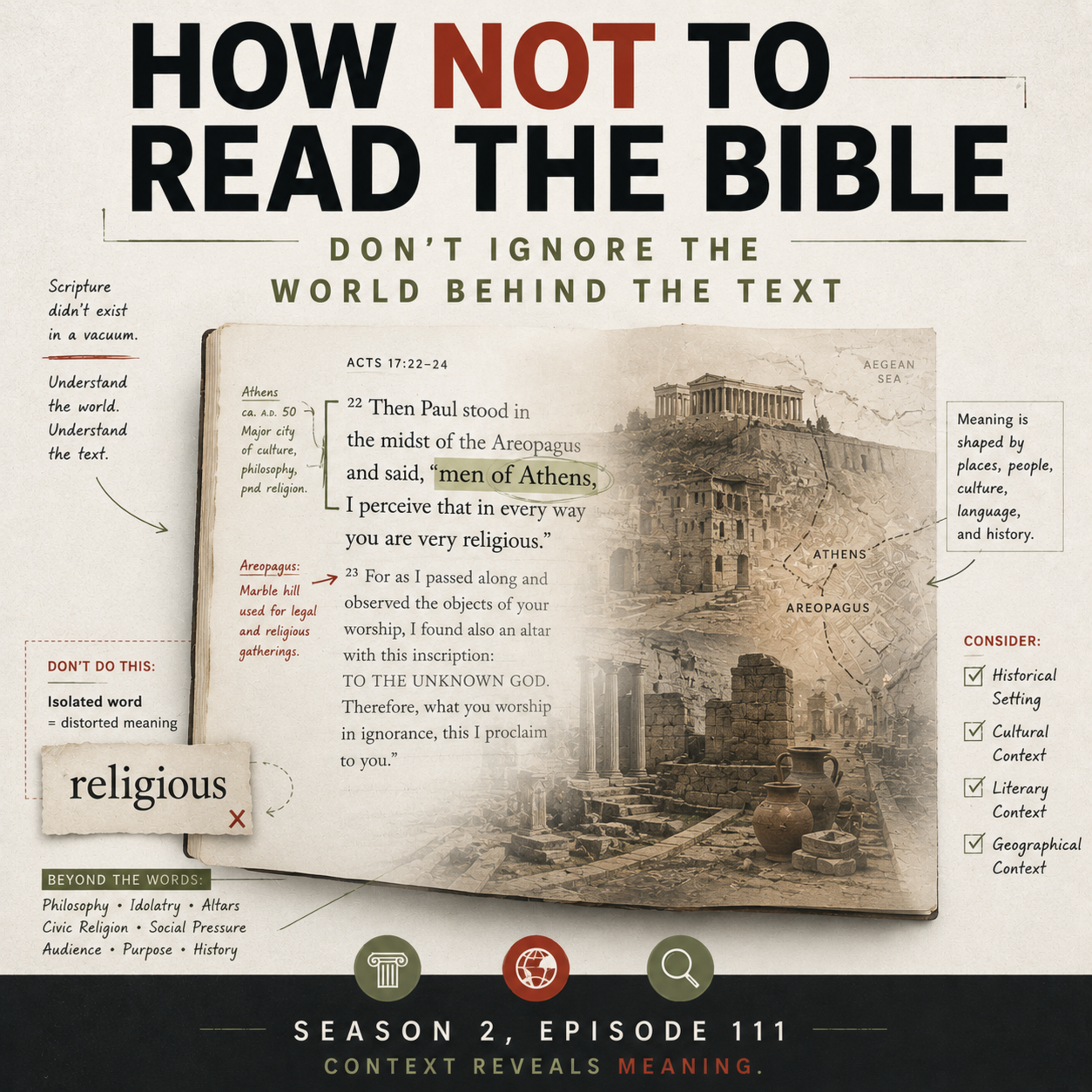
How NOT to Read the Bible | Don’t Ignore the World Behind the Text



 RSS Feed
Season 2, Episode 111
In this episode, Michael and Zach continue their Bible interpretation series by exploring one of the most overlooked tools for understanding Scripture: historical and cultural context. The Bible was written to real people in real places facing real circumstances, and ignoring that world can easily lead modern readers toward confusion or misapplication. Along the way, they ask an important question: how much background information is actually necessary for understanding the Bible?
Find our videocast here: https://youtu.be/k57orBFi7uk
Merch here: https://take-2-podcast.printify.me/
Music from #Uppbeat (free for Creators!):
https://uppbeat.io/t/reakt-music/deep-stone
License code: 2QZOZ2YHZ5UTE7C8
Find more Take 2 Theology content at http://www.take2theology.com
0:00 Are you reading your Bible? That we we should say that that's the first good stuff. Just read your Bible. Yeah, that's good. There that that's the first thing you can do, right? So in, in some sense, I don't think we're being overly picky 'cause these things are important. But big picture, read your Bible. Read your Bible. Don't want to discourage anyone and pray everyday. And you'll. Grow, grow, grow. Oh, it's great, children. Some children don't just have that staying power. I know, I know, it's good. I love it. Well, we are in episode 2 of How Not to Read Your Bible. Last week we talked about word studies. Word studies are good. I'm a pro word study guy. Just be aware.
0:40 Did you see Eros Phileo and? Yeah, made me think what we talked about it was. Great, almost almost pecked you on the shoulder. But you know, Jackson was so he was pretty busy Sunday, Jill says. Like I never noticed, but he's he's always he's right in front of me. Yeah, I know. It's just like. That yeah, he's always like wondering, counting. He's he's much more like that than Jayden's. More like to himself. Quiet, like, not distraction. It's great in episode 2. Sorry. We're going to talk about historical and cultural context. Don't don't ignore the world behind the text. It gives you a lot of insight and and that's a two way St. Don't ignore it.
1:22 Also, we might not talk about much. Don't over emphasize it. Yeah, there is a balance here. You should because sometimes maybe, maybe we'll, we'll say this because I haven't read through all of these notes, but but sometimes you could like, oh, it has to be exactly the same way as what this was. And that's not like sometimes you are. Coming in, yeah, there, there might be a difference. You can't know things, maybe 100% certain. But what we do know is that the Bible was written to real people in real places, in real situations. And if you ignore that you you're going to miss a lot of what's going on. I think that's really good. 'Cause I think, I think we've all thought this at one time or another.
2:03 You've read something in the Bible and thought like that seems like a weird thing to say. Why would anyone say that? Maybe you would even say like that kind of seems out of place or random or kind of weird. I got some examples I'm thinking of right now, but I'll say. That, oh, that's good because we know God's word is inspired. It's infallible. It's it's not random. And if you know, a little, even just like a little bit of digging helps paint a picture. And and that's the difference between reading the Bible as this arbitrary quote book versus a real letter or, you know, a real narrative or poetry based on real things. So with that in mind, let's go ahead and take it to the next level. Let's fire up that twangy music.
2:52 From the hearts of the Low Country in South Carolina. It's the Take Two podcast where we take theology to the next level. All. Right. It's a question for you, Michael Mott. And I'm taking a lot of this series from some of DA Carson's work. And a guy named Andy Nasali, he worked closely with DA Carson and he asked this question. It's kind of a loaded question. Is background information ever necessary to understand the Bible? And that's is it necessary? Yeah, I think so. And in fact, I knew someone attended our church a long time ago, and he made the claim that really, whatever interpretation you came up with, and however it was translated, like, you didn't really even need to know the original Greek, like, like, God would never let a bad translation happen, and God would never let a bad interpretation happen. And this guy stood by it, like me and Joel sat down with this guy and talked to me.
3:49 And he's like, yeah, so this would be counter that like so there are people out here there who might say no, background information is not. Necessary. Yeah, yeah, yeah. But but we would say that it it is necessary. It's not like you have to have it to get the big. Picture. Totally. You don't. Yeah, yeah, the we believe Scripture is clear. You can get a big picture, but like I think you're gonna say. Yeah, if you want to get some of the details or understand like some of the nuances or some of the word play, then the more you read it and the more you understand the culture, the easier those things are gonna come to you. No, that that's great. And Andy Nasali in one of his books How to Read and nurse in the New Testaments, he would agree with you and say, yes, he writes, he has this cautiously caveat cause what we mentioned at the top that sometimes the backgrounds it it should. It's background information, not foreground information. And this might be just me, but I think some really helpful resources.
4:41 I really like the Bible project 'cause they help with context, but I think they do this sometimes where it it that runs the show more than the text. Right. And then you could have. So they're not the only people. Not the only people. So, but there are others who might say like Job is midrash, it's just a long story that's like an Aesop's fable. You're supposed to learn from it. And they kind of give some information as to why that might be the case. But I think it it would be totally fitting for someone to write a real story that kind of matches that and says, hey, we're going to kind of ride this genre. But this is real, this is true, and we want you to learn from it. Yeah, and and it's it's just balanced because I will listen to Bible projects stuff all day, even stuff I don't 100% agree because I think I can gain some stuff. But you just got to be careful of like teasing out where they land.
5:30 I think, you know, a lot of this excitement about, you know, the unseen realm can fall into this. Some of it's really well done and some people are good to say like speculative, whatever. Some people run with like 1 little anecdote and that's like, man, this is everywhere. And it's like you, you should take that into account. But the other thing to keep in mind too is also you've got to like interpret these historical sources. Like, you know, that's another like you might be reading the historical sources wrong. So anyway, it's importance when when posed with this question, it might surprise you that someone like Wayne Grudem, he caveats it. He says, no, I don't think you need background information, but he's trying to guard the clarity of Scripture. And if you dig into his comments, they're actually saying the same thing.
6:18 He's just like hedging his bets really hard one way, other people, the other way you. Know, and like we said, it is readable like you are going to build to pick out the main themes, understand what's going on, even though some things are going to be weird. And I think the more you can read it in a long time and things are still gonna be there's gonna be those little odds and you're like, that just doesn't make sense. But you know, I'm sure it did to them. We'll, we'll dive into it more. Why does historical context matter? Well, every passage you read that there's an author or speaker, there's an audience and they're talking about something, there's some sort of situation. And if you don't totally grasp all of that, maybe not totally might be overstating.
7:00 If you if you miss those, you're gonna miss some meaning. So let's look at an example. This is a a a controversial text. That it just came up on our Eastern Orthodox did it, Yeah, yeah. Well, there we go. Maybe. This is I responded to it. I need to, I need to catch up on YouTube. First Corinthians, 11/2 through 16. We're talking head coverings. Everyone's getting excited. Who doesn't? Love the talk head coverings. I wear ball caps all the time. Is that, is that what we're talking about? Ball caps? We'll, we'll dive into the context and we'll try to understand this a little bit better. Some things to keep in mind and some of this stuff, you know, I think you can quibble with a little bit. But you know, during religious ceremonies during this time, it was known that Pagan Roman men with high social status would maybe sometimes pull their togas over their heads when they prayed up for sacrifices.
7:55 It was like associated with a Pagan thing. That's something that you can find. You can find instances of that. You also find instances that if a woman covered her head socially in those days, that indicated she was married and might symbolize things like modesty and chastity and submission to a husband In this way, you know, a wife could honor her husband in a historical context, historical cultural context that Paul was writing in. You could even make the argument that, you know, there is a new kind of wife emerging in the Roman world, you know, one who was more rebellious against husbands. You know, in that day, it was more allowable for men to be promiscuous and the wife wasn't allowed to. And maybe there was some pushback there where Paul was saying, don't act like this.
8:39 You know, they seem to be debated which one's like the primary kind of thing. But but things are going on that you want to pay attention to that that are pertinent to this conversation on should women wear head coverings Not. And part of that interpretation will help you understand not only the passage but also, you know, play into this conversation. Does that mean everyone should be wearing this stuff today or not? Is it totally cultural or is it bigger creation order stuff? And yeah, I think that's good because I think there are definitely creation order items that are being discussed there, but Paul's application of those creation order items may not be applicable to us today. And I think I, I always want to be very cautious before I come to God's word and say, oh, this is cultural. This doesn't apply to us today.
9:26 So I, I would not recommend, you know, you coming to that conclusion without a very, very strong reason. But I think even the Bible gives us some of that because you have priests in the Old Testament who are wearing coverings and they're offering up prayers. And so it is like. It's. Opposite of what Paul's command is in the New Testament. So I, I think Paul's going to talk about the men coming 1st and the woman coming 2nd and those are definitely creation order things. But then he's going to apply those. I think he's going to say in this culture, you should do this. Another thing is that, you know, if a husband is making his wife wear a head covering, think it kind of does what it's saying because she's supposed to wear the head covering out of as a symbol of her own submission to her husband. So if we had a couple that attended our church for a while and she wore head coverings and I don't have any. No, you haven't really thought about that. No, like I'm not about kidding.
10:22 I'm totally. Kidding, that's I think that's fine to do that, but I think it's you should also recognize that that this not necessarily a sin that's more of a symbolic. Yeah, that that that's good. And this is just not a throwaway note, but also which adds to some of maybe not the confusion. Context is always king. But you know, you read this passage in the NIV and the word that's translated wife and the ESV will just be women and NIV. And so, you know, do you make that you know what some of that stuff you got to pay attention to that's. Tough because it's the same word in the. It's the same, yeah. And so you got to make that the translators are making a judgment call. Right. And so you we probably don't have time to get into it, but for, you know, just the, the the word Paul.
11:07 I think he's talking to Timothy where he says I do not allow a woman to speak, but she should be in all submission to men or something like that. And that might should have been wife and husband. Yeah, and that and that gives a a different flavor to it than like a random guy in a. Yeah, exactly. It's very weird for every woman to be in total submission to every man in the church, right? That doesn't make sense. But very good for a wife to be in total submission to her husband. Yeah, exactly. So just to know that's a different kind of context, but important. Another example, one that we've talked about a lot, you love going to this one, Michael. Revelation. Three, we're talking hot, cold or lukewarm because what what people say is the ideals to be spiritually hot toward God.
11:51 That's what you want to be. And it's better to be totally spiritually cold than to be this middle hypocrite, middling person. I think I I heard that so much growing up and I think it's well-intentioned, but it's wrong because of the historical, cultural context. Right. So this is Laodicea, it's position between Hieropolis and Colossi. And so if you go back there, it got, it had no water source of its own. Hieropolis had warm water springs, and Colossi had cold water springs, and they had viaducts that would bring that water to Laodicea. But by the time it got the layout of Sia, the hot spring water was cooled down and it was just tepid.
12:32 And the cold spring water of Colossi was warmed up and it was just tepid. And so you didn't get the cool refreshing or the warm invigorating. You just got blah from both sides. Yeah. So he's, but it's like useful versus useless versus you might as well worship Satan. That's not what he's. Saying that's not what he's saying because both hot and cold water have useless. Yes, they're both useful. It's just that, yeah. I wish you would be something other than just this. Nothing. Yeah, that's. Great, one more that we'll talk about in a future episode, Romans 13, all about the government. You know, you could read this and you can miss to the point and walk away saying, well, whatever the government says, says what I have to do. Oh, yeah, I'm totally silent.
13:16 I've got no, I've got no agency at all. I just got to go along with it. They didn't work for the Egyptian midwives, didn't work for rehab, didn't work for the guys that stood trial at Nuremberg. No, that, that, that that's so good. So you even look at other parts of Scripture, like how does this line up? And if you look more closely at Romans 13, you got to take into account the Roman Empire, the minority Christian movement, the risk of persecution, where Paul in effect is, is more saying God's sovereign even over Pagan governments, not saying every government's right, no matter what they do, it's got to fall in line. And so having, and I think, you know, that kind of makes sense. But if you're not paying attention, you can miss the point. If you don't know what's happening, you'll, you'll just make these assumptions that it's about, you know, what's going on in your life right now or you're not, you're not taking these nuances.
14:03 So that that's Section 1, looking at historical context, why it matters. Let's talk about cultural distance, because America's very similar to the ancient Near East, right? We're not even, you know, I think most people assume that we're very similar to the Roman culture. But the. Roman culture was much harsher than American culture. Obviously we get some of our principles from Roman culture, but those have been vastly influenced by Christianity. In fact, there's a couple books out right now that where there's an atheist and I can't remember the name of it, but he basically went back to Roman culture, was studying it, thinking that he would find, you know, we don't need Christianity, but how harsh of a culture it was and how much that Christianity had influenced it. He's like, I really thought I love Roman culture, but what I do love is Christian culture.
14:52 He's not. Saying he's just a. Lever but he likes the culture that Christianity has brought about. Man, that's good. This is like, I think maybe a little teasers for this government episode. Like you know how you're thinking about this kind of stuff. There's plenty of examples. We we could go to you talk about something, you know, as simple as foot washing. We see this famously in John 13. You might read that and say. Everyone needs a wash feet. Yeah, it's a nice act of humility. Like you cut, you get the gist of it, but I think it's hard to understand like how dirty the roads were, how it was really, this is a servant job in a way humiliating for someone. This is just not this is not what you're supposed to do. And it really does redefine leadership, reverse status expectation. I mean, I think that one, you kind of see it on his face.
15:34 But if you dig into it, maybe you're like, oh, this is more than what you might see if you thought about it today. Michael's favorite verse? Greet one another with a holy kiss. You know me, I'm just going around smooching everyone in church. You might read that and say, man, I wanna, I wanna be a Bible believing Christian. I'm gonna start kissing everybody. But that, that's a cultural thing, right? But you're right, you. Need to that that still exists, there's still certain. Cultures might, yeah. Our culture? Not so much. Yeah, it could. It might not be great in certain cultures, very great sign of unity. Affection in America might be a little bit a little bit rough diving into parables about lost sheep, coined sons, everyday life experiences that, you know, we don't have those interactions with sheep as much this, this the even father son relationships in certain contexts. It's like you just need to dive in, get a little bit of context and it allows you just to see what what, what the author's driving at a little bit more clearly. Now let's look at look, interpreting through the world of the text, like some questions to ask, things to think about, and we'll have a few examples.
16:45 Good things to ask yourself is we'll look at this next week even more. But what's the genre? Have you ever heard DA Carson speak before? I have not. So he is Canadian? OK, Does he pronounce it Jean Ray? So he he, I think he even says like Jean, Jean just like, yeah, Jean. And I was like. Jean Paljean. Yeah, And I'm like, I was like, what's this guy talking about? But he was about genre. He does this. It's really frustrating this, of course, the revelation and it's online, but like every, it's like from the 90s or something. So everything's like out of order. It's like missing a couple lectures and it's like just the good part you want to listen to. It's like the mic cuts out. Yeah, my only caveat to genre. Yeah, and it is true because you want to you want to let the genre speak for itself. But you I haven't to kind of piggyback on our our end times. I've been in a conversation where someone was like, well, you know, the thousand year is is figurative. Well, how do you know that?
17:37 Because it's apocalyptic? Well, how do you know it's apocalyptic? Well, because it uses apocalyptic language and numbers like, you know, and I'm like, so it can be a little bit circular in some of those things. I'm not saying that Revelation is not apocalyptic scripture or because it is in that genre. But, you know, again, you want to, you want to not push these so far that you stop the text from saying what it's clearly trying to say, you know? I, I, I think that's good. Additionally, we talked about it, who wrote it, who's speaking, when was it written, Where was it written? Who was it written to? Who's listening? Why did the author write it? What problem are is being addressed? We talked about these a little bit. Let's look at, I don't know if you want to turn to Matthew 19, verse 24. And I'm curious your take on this cause I've heard all sorts of things, but we're talking.
18:27 Five, I was curious how you're gonna come down because I've heard this a couple ways too. So just 24, it says again. I say to you, it is easier for a camel to go through the eye of a needle than for a rich man to enter the Kingdom of God. Great. So the question is, is he talking about an actual needle or is this a small opening maybe in a gate of ancient Near Eastern cities that were often called Needle's eyes? Because I've heard both. I've heard both of these. Things I've heard people like, no, people just made-up the gate thing and then I've heard people say no, this is an actual thing. So either way, yeah, yeah, it would be hard. I guess the point of it is that this is a difficult thing. So this.
19:07 Is a good example where sometimes you think you could be uncovering more, but maybe you're not. Maybe you are. I'm I'm taking the some of this from Andy Nacelles. This is how he talks about it. So we we all familiar with an actual needle you would sew with and then what some people call needle's eye. It would be in the gate of an ancient eastern city that was too small really for a camel to go through with all its supplies on and and people on it. But potentially maybe if you unloaded it got on his knees, you could like squeeze it through. Still not easy. What Andy Nasali goes on to say is if you check the sources, like the first time you see this is like in the 9 hundreds, he says not, not that it couldn't be true, but likely fabricated.
19:49 But I think your point is the larger point. Like zoom out. What's Jesus trying to say? You can't take historical cultural context and overlaid on the text and say this is what Jesus meant. Is he saying it's totally impossible for a rich person to be saved? He's saying it's it's it you need God. You can't do it on your own. Likely using some hyperbole 'cause we know Abraham, Jacob, Isaac, Solomon, rich guys, a lot of people are rich. Likely saying things like material wealth is not necessarily a sign of God's blessing and actually it can be an impediment of being saved. You need it's even impossible without God's power. It's good to look into so-called stories for truth, but you don't necessarily like need it to be one of these things where it's important but not to end all be all. And and it's not like there is some hidden meaning behind. Yes, that's.
20:41 True Jesus point is riches can hinder your your entering into the Kingdom. So beware of riches, not that they stop you. That's right. That's exactly, exactly right. We've talked about James 2 and Romans a lot. What? Which James are you talking about? Or who is James talking to? This Jewish Christian audience, they're kind of struggling with maybe dead orthodoxy, cultural pressure of hypocrisy where James is not, you know, redefining what it means to be saved and justified through before God. He's exposing a fake faith that that's dead. You say one thing, but your life does not back it up. So anyway, context take it away.
21:26 Also, what a great what? It's my life first you were about to talk about first. I, I typed into the notes, so the Zach, 'cause he's like, hey, 'cause I didn't, I didn't want to steal Thunder from a, a future episode. But in this vein, you know, you're talking about every scripture has an author and has an intended audience. One place where I think this can be difficult is when those audiences can be mixed. If you read through the Upper Room discourse, Jesus is talking to the disciples, and I think sometimes it's very clear he's talking to them as apostles. You know the Spirit's going to lead you into all truth. OK. Yeah, Yeah. Yeah, right, right. If that is a promise to every Christian, I I hate saying this, but the Spirit has failed because Christians disagree. But what?
22:07 I think it is is a promise to those apostles when they are writing Scripture and they are, you know, saying basically thus saest to the Lord the the Spirit is going to keep them from speaking error. But there's also times when he's talking in that upper room that it seems clear he's talking about Christians at large, not just apostles. So some sometimes the audience can be you got to you got to use a little wisdom to try to figure that out. That's a supply really does a supply just to Peter, James, John, you know, Matthew. So here's a passage. It's graduation season. Not difficult to figure out who it's written to Jeremiah 2911 for. I know the plans I have for you, says the Lord. Plans for a future and for a hope.
22:48 It's for like someone like finishing school and they're like going into like a nursing program that's. Right, right, right. And if you keep going, he's like, he's going to restore my land that I lost and he's going to restore my money and my fruit trees and stuff. Like, wait a minute, I don't have land that I lost or fruit trees that I lost. Because this is clearly taken from a letter that Jeremiah wrote to those Jews in exile in Babylon. It's not to me and you could you extract some truth for it for us, yes, God is sovereign. He has plans. That doesn't mean that the plans for everyone is that because if you keep reading, he talks about the Jews who, you know, intermarried with the the surrounding culture. And he says, and for them, I've got calamity for them. And, and, and so people always want to claim the good one, but they don't want to claim the bad one. We should start putting calendars with some of the bad ones on there.
23:42 I love it. Yeah. Honestly, be consistent. So I think I think that's good. And I think you nailed it. Like some of these principles you can take from it, but you can't. You got to be careful about claiming these things. Both. Yeah, 'cause you're right. Goes goes both ways. Anything else you want to read about historical, cultural context? I what I find very helpful, it's like it's perfect amount. You get like a good study by, but it's got like 2 pages on a letter. That's really like that helps you tremendously without doing a 80 minute deep dive. You got to get enough and you can always dive more, but those are wonderful like the date, a timeline, what else is going on, What's the problem? Who wrote it? You can unpack a lot in a very short amount of time.
24:23 Yeah, one other one you mentioned Ancient Near Eastern Cultures 1 The interpretation of Genesis is that people will say that Moses is just writing another creation story and because he uses some motifs that the ancient, you know, the the Babylonians or the Canaanites use 'cause they could. We have those and we look at them. But there are also some stark differences that Moses. And I think it's the differences, not the salinity, that counts because the son doesn't have a name. It's not wrong. It's not. Oddly missing. Right and and all those other ones, you know, all these prominent things had names because they were gods and Moses just saying it's a greater light. It's the lesser light.
25:08 It's the stars like these things are are in and objects and God creates from X Neo in Genesis 1. Now there are some, you know, the the was void without form. I think if I'm remembering correctly, that phrase may be used in other places. And so Moses does say, you know, the earth was void without form and then God's going to change it. But previously that he said it created it from nothing, which is starkly different than those others. So another place where you want to know, like, I think knowing the ancient Near Eastern culture and knowing it well enough could help you say, OK, Moses is saying it's similar but different. Yeah.
25:49 'Cause something like flood accounts, everyone's, you know, you hear these things all the time. But it's not exactly the same. Yeah, there's there's huge differences. Cause 'cause that's you talk to an atheist when they'll, they'll already be like, well, there's a ton of these accounts. There's a ton of these things. It's just like one out of a dozen. But that's right. I good rule of thumb in any debate or anything is like just drill down in specifics. Be like, you know, yeah, that that's really good. I like it. That's good. Know your context. We're going to continue the context conversation next week and talk about literary context a little bit more, but that's good final take. Let's do it. I'm wearing I I found a very old Arsenal English Premier League. Did you know you had it and you just were like looking for? It or I was.
26:33 I knew. I knew I had it. I got it for my birthday probably when I was probably circa 2005 Arsenal. The last time they won the English Premier League was the 2003, 2004 season. So. Huge Manchester United fan. They were, yeah, those, those were the 2 Wayne Rooney and Ronaldo against Andre. And it was, you know, I all my, I, I feel like everyone was on the Man U bandwagon, man. I was like a lone a loner on the Arsenal. And Arsenal's good. They they are likely going to win the EPL again for the first time since 2003 and maybe the Champions League. Yeah, we have a soak adopted son in Burma and he's a huge Manchester United.
27:17 Oh seriously? That breaks my heart, man. Manchester. Because that was like the mortal enemy. But I've been watching Arsenal this season a little more and man, they, they, they actually get a lot of, a lot of hate. But it's so fun to watch. Like the soccer culture. Cause I've just been like so far removed from it. Like the celebrations, the pregame and postgame songs. Arsenal's got such a good one that they didn't have when I was in high school. It's new. Can you sing it for us? I cannot sing it. You should look it up though. It's it's it. You can look under the title North London Forever. North London forever. It's so, it's so good and it's like you just got thousands of people like singing this anthem before every home game and then after every home game. It's good, so good.
28:00 It's kind of like an alma mater or something. Yeah, yeah, For a fight song, it's like, it's like a fight song, but I don't know why I don't like college fight songs. They're I don't like that genre of music that like pep, like. On, on, on to victory. Yeah, it's our. Team is second to none. Yeah, exactly. I know that's a lot of people's things. It's not. It's like this is more of like Anthem. It's like slower and like. Is that what it is? It's like the haka. Yeah, yeah, yeah. That's great. It's not, it's, I can't, I can't describe it. It's almost like you wouldn't think it would be good 'cause it is like slow and drawn out. But it's, it's been good and we'll see if Arsenal can pull it off beat. See the 2nd place I think is Manchester City.
28:42 My Oh my hell Manchester United has fallen. They have their glory days, you know I. Don't keep up with it. So I don't know, is Manchester United not doing very well? I think they're fine. They're probably middle of the table. For understand like if you're really good it's the same team that moves up into higher levels, but if you're bad you move lower. There's relegation and divisions like so if you are at the bottom of the table, you risk, yeah, being bumped down out of the Premier. Like you want to be in the highest level of the Premier League. Man U is always usually the big clubs are always there in some of these little clubs like you know, will fall in and out. So like for baseball, it would be like our river dogs, river dogs, river dogs. I was like thinking River City dogs, but river dogs and.
29:26 Maybe the Yankees would drop down where there's always a set number, but you're incentivized. If you're good enough, you can go up. And that helps people prevent tanking because you don't want to be bumped down. You lose TV games, all of these things, your fans aren't going to be happy. It's a really good system, but you can't do it in America because no one's going to agree to being bumped down. Like at this point, they're like, we're already in the league. We don't want to, you know, lose that or, you know, lose our status, so. America's League is MLS, is that right? Oh yeah, yeah, yeah. Yeah. And so how, how do we, this is good education for me. So how does an MLS team go play in the FIFA World Cup? Or does that not happen? It's. Only countries in the World Cup same thing like Arsenal is not going to play the World Cup but England will like their team in north like maybe.
30:14 They just take the best out of menu Arsenal, so they just take the best out of all these teams and form an English team. Yes, exactly. They'll have English team, something else that's really fun. They have the Champions League. I wish we would do this in other sport. Maybe they do. And America, I guess we're isolated, but the Champions League takes the best teams from the English Premier League, from the Bundeslig, from the La Liga, Spain, Bundesliga, things. Germany, Syria, Italy, and they all play throughout the season. And right now Arsenal, if they the final, they're playing PSG, French team to win. But it's kind of cool because you kind of see how you do the Champions League. You have like multiple tournaments going on.
30:55 And for soccer, it's like you want the most points. It's not necessarily always like a playoff in bracket, but it's, you know, over the course of a season, so. So when you're going to someone's home to help them with physical therapy, you're like, hey, let's just turn on the. Game yeah, let's because. The time difference is they're normally playing during the middle of the day, right? Yeah, a lot of times they play like Wednesdays and weekends, like they play a couple games a week and it'll be, they have like a pride, like a late game, like a 8:00 PM England game being like 12:00, you know, right in the middle of the day kind of thing. If they have like an early 5:00 game, it's like kind of early or whatever. Or real late, depending on your. Yeah, depending on yeah, where you're at. So it's it's been cool. And I was like this, you know, where this jersey a lot. It's, you know, there you go, Tieri.
31:36 Tieri Henry was the man. Very nice and and soccer known as the beautiful game, The beautiful game. There you go. Yeah. I saw there was a clip of these two guys like like it was slow motion and they're like, you know, they were like returning it was it was pretty like cool looking thing and someone just commented that's why they gave it the name and someone else said the beautiful game. I was like, OK, there you go. I'll. Tell you a lot of people, not that there's a lot of Arsenal fans listening, they Arsenal gets a lot of. Hate. I bet there's a lot of Arsenal fans listening, yeah. We got the market cornered in North London. They're not happy with how Arsenal plays. They I think they think they play 2. They win a lot of games 10. Like they kind of like bolster it down and they're really good at set pieces, but not necessarily like scoring in the flow of game.
32:23 They kind of game the system in a way where people are like, I don't necessarily like. It so they're it's like a baseball team that really puts in a lot of defense and they win by like. Just yeah, it's like they barely win and they always win off a corner kicks or free kicks. It's not like building up and scoring. They play and a lot of honestly, soccer has changed. Everyone is so conservative. When I grew up it was like Cristiano Ronaldo on the wing and doing like 18 step overs, all these fancy things. And now it's like you start dribbling and if someone guards you, you like Autumn, it's like you do a lot of pass back, more possession, more like you're scared to lose the ball. It's like more punitive conservative. They probably run the metrics and it's like it's it's way worth it to not take those chances until it's obvious or something.
33:07 Could a star player change those dynamics or are we saying even if you had a star player, I, I mean, I don't even know who's still playing today. Are are is Ronaldo still playing? Ronaldo is he? I think he's in a Saudi league. Like he's old and mess. He's playing MLS and they're so they're older, not as good. You're probably right. I don't. I don't know enough where like Ronaldo's like such a talent. Beckham was he? David Beckham, Sir. David Beckham. Yeah, he was on Man U as well for a little bit. Yeah, man. There you go. Tom Brady, Did he play any? Tom Brady, Yeah, great, great football player. It's good. I'm learning. It's it's it's great. It's great. Well, I don't want to bore people more with Arsenal, but.
33:47 Well, I mean, we do have all the Arsenal fans, so they. North London forever. I love it. There you go. That's our take. Thanks for listening to Take Two. Find us wherever you find podcasts and on YouTube for those who want to watch our video cast.

