Joshua 4 | Taking the Land: God Fights, God Judges, God Keeps His Word


 RSS Feed
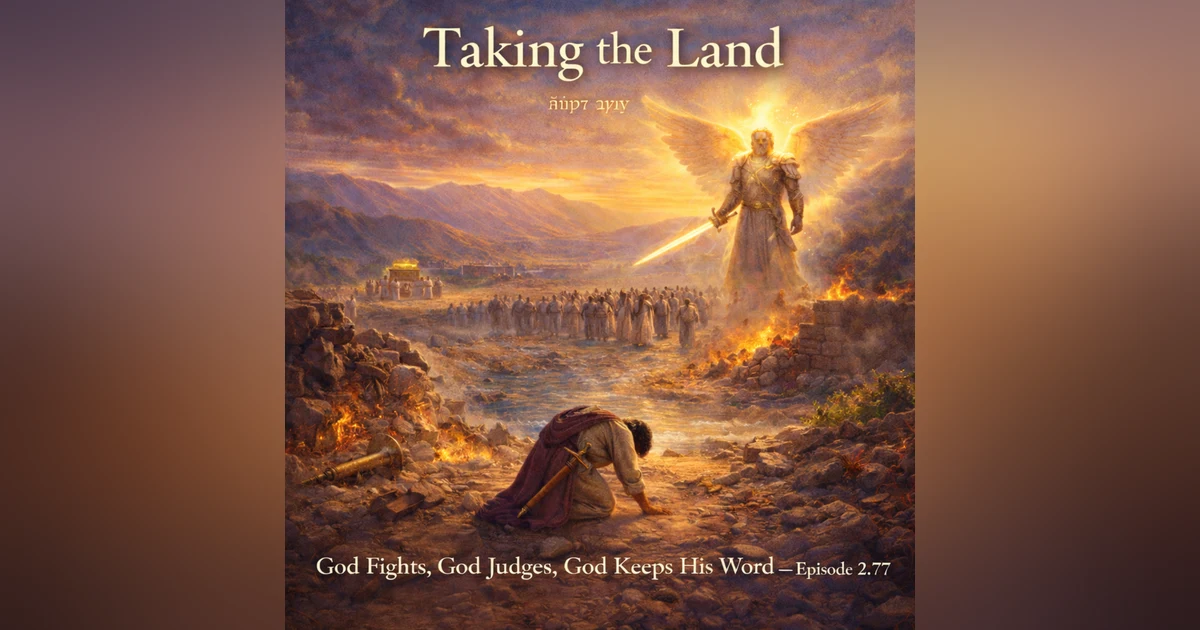
Episode 2.77
How does God give victory—and what happens when His people forget who the battle belongs to?
In this episode, Michael and Zach walk through Joshua 5:13–12:24, the heart of Israel’s conquest of the Promised Land. Beginning with Joshua’s encounter with the Commander of the LORD’s army, the episode makes a crucial point: Joshua never wins by strategy or strength—God fights for His people.
From the fall of Jericho to the defeat at Ai, the text shows that victory depends on obedience and dependence, not confidence or cleverness. The sin of Achan reveals the seriousness of God’s holiness and the corporate weight of covenant faithfulness. The covenant renewal at Mount Ebal reminds listeners that conquest is never separated from worship and God’s Word.
The episode also addresses difficult questions—divine judgment, total warfare, archaeology, and the justice of God—while keeping the focus where Joshua does: Yahweh as Divine Warrior, Judge, and Promise-Keeper. Even as Israel “takes the land,” the book makes clear that the victory is partial, pointing forward to a greater rest still to come.
Joshua isn’t about how great Israel was—it’s about how faithful God is, even when His people stumble.
Find our videocast here: https://youtu.be/RSksvCyu3zM
Merch here: https://take-2-podcast.printify.me/
Music from #Uppbeat (free for Creators!):
https://uppbeat.io/t/reakt-music/deep-stone
License code: 2QZOZ2YHZ5UTE7C8
Find more Take 2 Theology content at http://www.take2theology.com
0:00 I posted this on Facebook on Christmas Day. Oh, yeah. So this is a little bit passed in, but I got a gift that was truly out of this world. Wow. Yeah, yeah. Man this seems. It is something I asked for so, but, but when you get it, you're like, oh, it was a good thing. It was. It's a piece of a meteorite. Well, it is a meteorite. I guess they're some place in Columbia, not South Carolina. Columbia, the country. Columbia, there's this huge meteorite field. Wow. Oh yeah. Where this the and they they. There's a large section of the meteorite that's like 13 tons that's still there.
0:40 That's still there. I think I think I have that number right. But then, you know, as it's coming down, like, it splinters off. And so like, there's this whole field in this. Well, I don't know if I could go, but people go there someone and they rescue him. And then they. So I have AI have a meteorite. Yeah. And I also asked for, I watched this guy Avi on YouTube. He's a jeweler. I think he's in Chicago. I think he's Jewish. OK. Because they say what they like, make a deal and they say huzzah, maybe. Oh, yeah, yeah, yeah, yeah, yeah. There you. Go. But he's he. It's kind of piqued my interest in Jim's some, but you know, he always is like and I know how to tell if it's a lab grown gem.
1:30 Yeah. What's the telltale sign? So you have to look at the inclusion. So inclusions are small defects in the stones. And if they're like struck that they're linear inclusions or like crack, like those are natural. But if they are like little small bubble inclusions, those are those are lab grown. But to me, he's like in lab grown, they're not really even worth anything. And I'm like, I don't care. Like to me, if it's the same chemical formula and one of them happened to occur through natural processes and one happened to occur because we put some chemicals in there, we grew the crystal. I don't know. I don't know. I even told my daughters and after I said it, I looked at my wife and I thought, oh, I hope she because I bought her a natural diamond. But I was like, girls.
2:18 Just be happy. Why would you make your husband spend all this money on a naturally occurring diamond when you can get one that's going to look better, be larger and it's lab grown. It's still a a carbon. It's still the same chemical structure. And you know, sorry to go off on a tangent here, but you know, the De Beers company has a monopoly on diamonds, and there's lots. And. Lots and lots of them, but they only let out so much to keep the prices artificially high. Like diamonds are so actually common that it's not. But there was this around the turn of the 1900s. They had this big marketing campaign because I guess before engagement rings could be just gold or maybe gold with any type of stone, and they made this thing like it has to be a diamond if you truly love so.
3:09 Yeah. What's the, what's your girl's take on it? Are they, are they like, yeah, I'm with you, It doesn't matter. Are they like, come on, Dad, I think. They just, they considered it. I didn't get an answer, but I know I put like, at least a, you know, a, a stone in their shoe. Hey, there you go for them to consider. But yeah, nice. Yeah. Because some people do get, like bent out of shape about that a little bit. Like I would never take a yeah, you know what I mean? I kept. I've heard these things. Yeah, now like a cubic zirconium. Well, yeah, it's a different chemical. Compound, yeah, but if it's truly, you know, a, you know, the, you know, you have carbon graphite, OK and then you have there's a couple different forms of pure carbon and diamond is one of those so. Yeah, what's the big fuss, ladies? Like, just be.
3:55 Just be thankful. Women are not thankful. I think I'm I'm reading what you're really saying. No to me. So I did get AI think a emerald lab grown emerald. I got a green, a blue and a Redstone. I have to go look. I think the Redstone is a garnet, not Ruby. Oh yeah. But garnets are deeper red than rubies. So. I like them better than January birthstone. It is January birthstone and it is the stone that was in my class ring because my birthday is October and it they put in a pink this pink. Stone and you're like who? Wants that give me a strong deep Redstone so that's what I that's. What I got? Yeah, man, October. Yeah. What is October? 'S it's Opal Opal.
4:38 And then they'll put in like this, they put in this, this rose, a true Opal. They're they're kind of good looking, but they're not very sturdy. Like they're very susceptible to being damaged and cracked. So yeah, kind of like your personality, you're very fragile. No, I'm just kidding. Also, I just to say this is the best. It's like we're in, we're in the middle of January on January 11th, we're at home groups. Karis walks and is like, hey Chloe, hey, Lydia just got done mom's Christmas shopping. I was like, wow, you got an early jump start. She's like, no, I got a late start. We're wrapping it up. I'm like, that's great. I love it. Yeah. Well, traditionally the past two or three years, we, Jill and I have had a late start because what would happen is Juju, Jill's mom would ask for the kids Christmas list.
5:30 They would give their list to her. She would buy stuff like in September and then wouldn't remember what she got off there. And we're like, how do we? So this I was last year, I was like, girls, give us the list. First we'll buy off of them and then we will give it to Juju and and we'll take off the things that we we bought for you. So we were, we were on the Michael and Jill were were on time. This year duplicate like because you gave the list to her afterwards. And but Karis was she's in a crocheting, so I already know what my gift is. I I picked out the yarn. I was like crocheting, crocheting me a scarf with this. But she's behind. So I'll get it eventually, probably like July. The rice wings need it, you know. I've always been like, man, I could use a scarf right now. Very cool, Very cool.
6:20 Yeah. Honestly, I like the Christmas gifts late because it it spreads it out a little. It's like. The season that keeps on it. Keeps Yeah, because it's like I've got little kids where like they get a lot of like small gifts and it's like it's just good to do not all the gifts in a 20 minute span or whatever. It's like it's good to spread these out. It's like too much. No one appreciates anything. You know, I, I feel myself getting older, kind of like these kids, they've got it so easy. I grew up, but it's just, you know, it's not what it used to be. I know I I always wanted a full like what I, I didn't care what it was, but like a Constructicon was this Autobot that had all of these, like the dozer, the concrete mixture, the crane, but you could put them together to form one giant guy. And I was like, give me all of those. I just want to form one of those. And I'd always get like just the dozer. Like I've got the left leg.
7:18 You're like, yeah, I can't. You can like make the arm, but you're like, I can't fit it all together, man. That's like such a good kids thing. Like our powers combined, it's like, that's great, Like Power Rangers did that, you know? Captain Planet. Captain Planet. Voltron. Yeah, yeah. It's like, man, it's a it. It clearly works. People kept using it well. It's a good, I know you're trying to transition here, but it is a, it's a good, it's a good object lesson for spiritual gifts. Hey, there we go. There it is. There it is. I love it. I like it, Joshua. Yeah. I would love, you know, know what what Christmas is like for Joshua. I'm sure he's a really big Christmas guy. Right. We talked about Passover, you know, last time a little bit. We're at this transition point.
8:05 We just crossed the Jordan, right? We're getting into it. And we had to cut. We did. That episode short, but we're going. We'll pick up where we left off. Yeah, right where we cut it. Right where we cut it. That's right all. Right, fantastic. Let's go ahead and take it to the next level. Let's fire up that twangy music. From the hearts of the Low Country in South Carolina. It's the Take Two podcast where we take theology to the next level. So we're in Chapter 5 and This is why a lot of authors, commentators, however you want to put it, they make this a new part of the outline. Go ahead and read verse one for us. Now it came about when all the kings of the Amorites, who were beyond the Jordan to the West, and all the kings of the Canaanites who were by the sea, heard how Yahweh had dried up the waters of the Jordan before the sons of Israel, until they had crossed that their hearts melted, and there was no spirit in them any longer because of the sons of Israel. Thank you.
9:14 I love that we're doing the Yahweh thing. I think that's like good. It's like, man, that is like such a such a good move. As soon as all the kings of the Amorites heard this, you'll see this kind of phrase happen in Chapter 9, in chapter 10, Chapter 11. It's a recurring theme in this section of Joshua where these kings heard about Josh, Israel and Yahweh and people are hearing about it. And normally the response is this ain't good, whether it's their heart melted or we got a band together and fight against them. But it's like the word is spreading. We kind of talked about that last week, but. These are would be some of them would be the literal giants that they saw the first time around. Yeah, and they're scary. Exactly. It's like, man, this all we're hearing about Yahweh, It's pretty, pretty basic. I like that. We're putting this in the next section, so to speak, because Chapter 5 kind of kicks that off. But before they really get into the fighting and the conquest, like at this time, got to get circumcised. They got to make a cut.
10:08 They. Got to make a cut and it's it is so interesting that God's people here were not circumcised. It is weird. Like it is very weird because it was it was big enough that the Angel of the Lord comes to Moses and is like, you're going to circumcise your two sons and Zipporah does it throws the foreskins at Moses and it's like you're a husband of blood. Crazy. And so it's like this weird, we're in this transition period. They haven't taken the land, but it's like God's. People, what's this, the second time? Second time, yeah, I know. What does that mean? Like these aren't circumcised guys who are getting re circumcised. And took up a sense of Israel a second time. That's great.
10:51 I need I'll pull up the commentary on on that one with the second one, but maybe it's saying I don't know if we've moved down a little bit versus 4 through 6. Gives us a little more context. As all the males of the people came out of Egypt, all the men of war, they were dead. They died in the wilderness. The way after they had come out of Egypt, though all the people came out had been circumcised, yet all the people who were bored on the way after they had come out had not been circumcised. And so, you know, you're wandering around, maybe it's not the best time to circumcise everyone. You're like, we got to get this out of the way now before we're fighting battles for years and. Years, yeah, we need a three day recovery and then and then we can go into to to battle. Because you're right, this is important. This is God's covenant sign. They're about to be in the land and it's like interesting that they or not, but it again is connecting God's promise, he's word, Abraham, Isaac, Jacob, God's provision. We also see that this is when the mana ceased. They lived off the land that that you know, two different ways God provides again, supernaturally versus more naturally.
11:52 God's still in control. But it's, you know, different seasons, different times in history. God works in different ways. So this is like that demarcation because they, you know, are going to go to this landfill and with milk and honey and and all these things. Great, got that going. They had their first Passover in Canaan. That's actually when they have the Passover is when the mana ceased and the day after that into the produce of the land. There was no longer mana for the people of Israel, but they ate of the fruit of the land of Canaan that it was probably was a pretty, pretty big deal. Like they crossed over the Jordan, the fruits there, they're not planting vineyards and all those. Forget and turn away from Yahweh. It was smooth sailing from here. Great.
12:35 And that really sets the stage before we get into conquest. Is this figure, this prominent story, the commander of the Lord's army? Maybe some of the why behind Yahweh's command to Israel to conquer gives us a little more information, a little more context. You've talked through this a lot. If you go back to Genesis 15 chapter 16, you know, did Abraham get the land like right away? Right. No. What? What was the reason why? Why didn't he? Well. What was wondering, I know there's a lot, probably a lot of reasons, but but you know, Yahweh and his patience was like. Yeah, and he's like, hey, you're going to go down into slavery for four years.
13:20 The that sends the. MRI to go out. They're going to increase, but really what I think God's doing is moving Abrahams family out of Dodge and kind of protecting them through slavery because the Egypt, Egyptians didn't want anything with them. And so they can kind of incubate and grow in number and kind of. Like have a structure to hold on to, kind of. And then, you know, nothing's out of God's control or, or he's surprised about. So I think he knows that the 10 tribes are going to give a bad or the 10 spies are going to give a bad report. And so really not, he's grown a people, but the people he's going to take into the promised land are not the people he took out of Egypt. It's a whole new generation that has spent basically their whole life depending on Yahweh as they've moved through the wilderness.
14:12 And so they've kind of been conditioned to, all right. I never grew up in Egypt. I'm not an Egyptian, I'm an Israelite and we follow Yahweh. So I I think that's kind of God's plan to bring them into this land. I, I, I think, I think that's good. And when you compare like you look at the Amorites and you look at some of these people who are occupying Canaan, they're guilty of a lot of these sins that are outlined in the Torah as well. When we talk about, you know, their iniquity, it hasn't been built up yet. It's amazing that Yahweh's like, I'm pretty patient guy 400, four, 400 years with the patients like it's, it's pretty, it's pretty crazy that that judgement of the MRI.
14:53 So it's not the time, it's not complete yet. You look at some of the things they were doing, they were practicing sexual perversion, magic divination. There's a long list in some of these commentaries And you know, at at some level, you know, I think what people grapple with is, you know, why, why did Yahweh, why did God command them to kill all these people? And part of it's like a it's pretty patient. Like it's not, it's not like judgment were there. And then the other answer is too, it's not. The other answer wasn't like, Oh, Israel's great and deserves all this and they've earned my favor. Really. A lot of it was to highlight how good God is. And actually it kind of shows God is really just if people always attack his justice. But you, you look at the wickedness of the Canaanites if we were to turn.
15:43 I don't have it in our notes, but I'll see if I can read it quickly. Deuteronomy 9 verses four and five. I don't even know what it's going to say off the top of my head, but I'm sure it's good. Says don't say in your heart after Yahweh your God has thrust them out before you. Oh yeah. So when we get into the promise and don't say it's because of my righteousness that the Lord has brought me in to possess this land. Actually, whereas it's because of the wickedness of these nations that the Lord is driving them out before you, not because you're upright And so in in a way, not that Israel's anything but he it's being just in judging these wicked nations, which is always like one of those things. It always gives you a pause with like your nation and the trajectory of it.
16:24 And you're like man, God's been so good and patience, but there's so many bad things. You know, it's like, you know a. 100 years to turn from the ways and I know you kind of went through the list, but these are the people who worship Molec and they would you know, so if you don't know, you know, that's child sacrifice on the burning red, burning hot bronze arms of a statue. So think about putting a baby up up on that and just basically, you know, and. Everyone would say that's not just like today, like you would. No one would have a problem with bringing judgment on those people, you know, if you were. On it and then the the sexual sins on down to like basically pedophilia and bestiality mixed together and they're like they they had they've uncovered like laws on the books that they had that basically said you can't have sex with an ox because an ox will get, you know, used to this and gore people on the street.
17:17 But these other animals, you, you're fine with it. And it's like that society is like it's, it's just very, it's very debauchery, you know? And, and so I think when you frame it that way, it's not just like senseless killing with no bait. It's like, you know, and it's interesting that that in Deuteronomy, Moses like, hey, it's not because you're great. It's you know what I mean? And we'll see the same thing when Israel goes into exile. It's not because these Chaldeans were like the most holy people, but it's like, hey, you know, being used of God. And it is not as though they it was genocide because they could flee to another land. It wasn't like he was just like, I want every single person of this, you know, ethnic group to be killed. It's like you drive them out of the land. They're not supposed to share the land. If they don't, if they resist, then you're going to kill. Kill them all.
18:06 Yeah. And so we get to the end of chapter 5 verses 13, what to go to 15. But a couple commentaries I I was reading, I'm curious to get your take on this as we kind of read through it. They'll point out that 6 verse one maybe not necessary like upon first reading it can go either way. Maybe not the best place for a chapter division. In verses 13 through 15 we see the commander of the Lord's army. I'll read this really quick. When Joshua was by Jericho, he looked up his eyes and looked and behold a man was standing before him noticed these characteristics is his drawn sword in his hand. And Joshua went to him and said to him, are you for us or for our adversaries? And he said, No, I like, I like that answer. No, but I am the commander of the army of the Lord. Now I have come.
18:50 And Joshua fell on his face to the earth and worshipped and said to him, What does my Lord say to a servant? And the commander of Yahweh's army said to Joshua, take off your sandals from your feet, for the place where you were standing is holy. And Joshua did so. And. He doesn't say get up and don't worship me. I'm a servant just like you. Yeah. That's important, right? Yeah. So clearly Christophany. Totally. I'll, I'll go ahead into. So this is probably Michael. Maybe, maybe I'm not. I'm not rolling it out. A lot of you know, in our Bibles that in chapter 5, chapter 6 is like a new story. What a couple of these commentators I was reading says really 61 might just be a parenthetical and six two picks up. So I'll read it.
19:37 You tell me what you think they would say. This is a parentheses. Now Jericho was shut up inside and outside because of the people of Israel. None went out and none came in and it's like picking up. If you're thinking he's talking to the Angel of the Lord and Yahweh said to Joshua, see, I have given Jericho into your hand with its king and mighty men of valor. I could see it being a separate account. Or it's like he's with the commander of the Lord and he's like continuing on. You're in the holy ground. I'm still talking to you. I'm giving this to you. Yeah. It seems like it's one. Could it could be it's not it doesn't need to be artificially broken up. We see the drawn so like you painted all the things this is this is Christophany like you can you can get that the worshipping all of this purpose of this gives instruction but more likely to show like this Yahweh is here and the instruction is Jericho's been given into Joshua's hand. The city was shut, which begs the question, you know this unskilled, at least at this point, unskilled, you know, fighting people conquer this like shut city. We know the story of Jericho.
20:35 We know the songs, probably maybe maybe able to sing it, but it's a weird method to conquer a city. I saw this thing that had this little kid who had like this little plastic instrument and he was like playing it and he'd laugh at it was like the children of Israel before. That's great. Like what's going on? It's such a great way to like kick things off because it is like demonstrating. This is different. This is way different, yeah. It's great. So we got some armed men, we have 7 priests blowing ram's horns, we have the ark, we have the rear guard circling, and all these people are circling Jericho each day. So this is these are shafars. They're they're. Blowing Shafars. Yeah, yeah, yeah, exactly. Yeah. Did you, did you bring this on the podcast one time? And did you, did you blow Shafar? Yeah.
21:19 No, I I didn't I I don't own one. I've said I. OK, I do I. I would want to. There are some that are short and they're kind of just you can't do a lot musically with them. But the longer ones have you can do like basically all the the stuff. Yeah, yeah. And then on this and then seven times on the 7th day, you read this again, you read a lot about the Ark of the Covenant. Just like in the crossing of the Jordan, the Ark is mentioned extensively. It's mentioned 9 times and 10 verses and 10 times total in the chapter in like a short section. It's like a lot about the Ark fits with this thing. Yahweh's present people are called to do some work, but you always at the center of it and that there's some conditions, you know, the people at the shouts. Yeah, this this is interesting too. What's maybe maybe we can read Let's read verses maybe 17 through 19.
22:19 Says The city shall be under the ban, it and all that is in it belongs to the Lord Yahweh. Only Rahab the harlot, and all who are in with her in her house shall live, because she hid the messengers whom we sent. But As for you, only keep yourselves from taking the things under the ban, so that you do not covet them, and take some of the things under the ban, and make the camp of Israel cursed, and bring trouble on it. But all the silver and gold and articles of bronze and iron are holy to Yahweh. They shall go unto the treasury of Yahweh. Yeah, again, this is interesting. And there is, like in Joshua, there's a lot of these, like parentheticals that's kind of like a parenthetical, maybe not a parenthetical, but you're reading a story. Joshua was saying, and on the 7th time, on the 7th day, you're going to shout for you, always giving you the city. And then he says what you said.
23:09 And then he says then it records. Then the people shouted. The city was destroyed. It's like weird. It's like the story's interrupted for this very important detail. You go on and you finish out the chapter. You see more text is devoted to some of this this instruction more than them actually doing the, you know, destroying. It's more it's like all these instructions, it's pretty clear that you wanted to devote all the city to instruction foreshadowing. You see this see this a lot and Yahweh, you know, saving of rehab amidst this judgment. Rehab comes out is the oath is, you know, upheld and that's kind of where the story. And so Yahweh was with Joshua and his fame wasn't all the land.
23:55 And it's a really high point. Everyone loves talking about the battle of Jericho. I know I do. It's like that kids really resonate with that. You know, it's like a great, great thing. Anything else on Joshua? 6 things and things are going good. No, Yeah, things are looking good. About to take a turn? About to take a turn at the great city. Heard it several ways. Artificial intelligence. AI taking over the world and tell me if you've heard this interpretation of Chapter 7. I have heard this AI. It's a negative example to teach us what not to do. These people, they didn't, you know, pray to God, they were overconfidence. They were they were cocky a little bit. They sent small numbers.
24:40 They weren't and and they failed. And I've heard that said before. Honestly, I've not known what I've not known what to make of AI or I, I've. Heard. I know. I've heard it, yeah. Because I'm always like, I guess, did they send small enough numbers that 36 was just a massacre? Because in that the number that they lose. It's something. It's something small. Yeah. Yeah. It's not. Yeah. And I'm like, I think we kind of touched on this before maybe 2 episodes ago, like 36, like every life is precious. But when you're fighting more, if you can win something with only 36 loss, then that's pretty good. And it's weird to me.
25:21 Maybe this is God teaching them like, hey, you're going to have to do battle tactics. Like it's good. Doesn't he tell them how to like basically draw them out of the city and ambush them and. Stuff like this, Yeah, totally. Yeah, totally. What I want to point out is again, and I think chiasms are overused, but if we take a chiastic approach to this, what's interesting, chapter 1 says, but the people of Israel broke faith in regard to the devoted things. For Akin, son of Karmi, the son of Zabi, the son of Azera of the tribe of Judah, took some of the devoted things, and the anger of the Lord burned against the people of Israel And then? That's verse one. That's verse one kicking it off where yes I say chapter 1 you did say doing this like. Chapter 7, verse one, yeah.
26:03 Chapter 7, verse one, and then the end of it says the Lord turned from his burning anger. And so we see God. It starts with God's anger. Yahweh's anger ends with Yahweh's anger. That's like the bookends. That's probably framing all of it where what we're going to see later on, what I don't want to get ahead of myself. If you go in, we see two different disasters, Israel's disasters. They lose the AI at the end. It's pretty disastrous for Aiken and his family does not end good. You keep going into the middle there. You can break it down all the way, kind of I think gets to the heart of it, which centers a lot around Yahweh's wrath. But let's go through.
26:44 We'll go through it leading up to the middle. Can you actually go ahead? I read verse one. Can you read chap verses 2 through 5? Yeah, 2 through 5 says now Joshua sent men from Jericho to AI which is near Beth Haven east of Bethel and said of them go up and spy off the land. So the men went up and spied out AI. They returned to Joshua and said to him, do not let all the people go up. Only about two or three, two or three thousand men need to go to AI. Do not make all the people toil up there for they are few. How long? 2 through 5 S About 3000 men from the people went up there, but they fled from the men of AI. The men of AI struck down about 36 of their men and pursued them from the gate as far as Shabaram and struck them down on the descent. So the hearts of the people melted and became as water. So you, you said it, the last 36 people. Out of 3000.
27:35 Out of 3000, there's some people will say that overconfidence thing. I think you know, you read verse one it it's interesting. It's all about they broke covenant Yahweh's anger no matter what they did probably wouldn't have gone well and that leads to the next section. Joshua is very perplexed. Joshua tours close. He says like why did you bring us here Yahweh if we're just going to, you know, lose to the Amorites like what like what, what's the point? I'm just trying to do, you know, what will you do for your great name? And he's he's really confused reaching out to God. And I think, you know, as far as Joshua knows, like this is weird. Like everything's been really great. You've told me to. Realized that he's like, you just sent this guy out and talked to me, which was you and said, you know, be courageous.
28:21 You're going to go destroy all these people and now we go up. We should have taken them and we didn't. I don't know what to do. He's totally caught off guard. He's totally strong and courageous. He's actually doing a great job of doing that right. He's not doing anything wrong here. Where you know, if you ever hear it's like overconfident or didn't talk. It's like he's actually reaching out talking to God. These are good things. Maybe later there isn't some of that which brings us to kind of that center point I'll read versus I'll just read verses 10 through 15 or 10 through 12 maybe quickly here. The Lord Yahweh said to Joshua, get up. Why have you fallen on your face? Israel has sinned. They have transgressed my covenant and I commanded them. They have taken some of the devoted things they've stolen. They have light and put them among their own belongings. Therefore people of Israel cannot stand before their enemies.
29:08 They turn their back before their enemies because they have become devoted for destruction. I'll be with you no more. And the less you destroy, the devoted things from among you gets to the heart of it. It's like, hey, you've got, you know, some problem in your midst. They they cast the lots. It comes to Aiken. I always wondered, like, you know, I can just see Aiken's son going. Dad, just tell them no, no, no, we're gonna see this through. And it just gets like narrower and narrower. You know it's coming for you, right? Yeah. That's crazy. Yeah, and it's one of those things, I don't know if you have this like the severity of Gottrap. It seems like Aiken's end.
29:51 It almost seems like the whole thing's kind of severe, like 36 people die, they lose the AI because of like one person. And then at the end it's like this high guys, whole family, his livestock. It's not just this one person. Well, I thought it was severe when I was younger, but if you read what he did, he took it and he dug a hole underneath their tent and hit it. You'd think all the family would have known, right? So they're kind of complicit in it. That's the, that's that's the. Even the horses, even the the horses, I don't know, but whatever they're, they're goats, whatever their lifestyle. But yeah, no, yeah, that, that's a good. Parallel between him and Ananias and Sapphira, you know, starting off the this new man thing, this new, you know, theocracy for the Old Testament, the church for the New Testament.
30:39 There's like these people that kind of mess it up. They're used as examples of like, hey, this is a serious thing. It's exactly and I think it's good to we probably, you know, look for like excuses to like downplay it all, but all of this. It's like how a sin can just affect the whole people, where it's like man, when it's something like that, it's like. Little Levin. A little Levin at the end we see talking about about this place they call it the valley of Achor. Achor means trouble doesn't sound unlike Aiken maybe some word played. You know man, if you do something bad in the Bible or good in the Bible, your name sometimes goes very closely closely with it. So kind of ends on this negative. It ends you know good.
31:24 But now, you know, you know, there's some judgement here, but things turn around. Chapter 8. We have AI, the small city. We kind of have the, you know, right side of it where Israel is getting right on track. When I'm looking at this, there are, you know, Joshua is one of these places where archaeology, archaeology is like fascinating. It's like this proves the whole Bible totally supports the Bible. There's like, I feel like there's these swings. Yeah. You know, I was just listening to William Lane Craig's podcast today and it was on Bart Ehrman, and he basically said that there's no archaeological evidence whatsoever to support the exodus and these people moving around in the desert.
32:04 I'm thinking, but if there were nomadic what you know, I guess what, what would you expect to see there that's not already there? Broken pots and stuff or you know, it's not like they're going to have these dwellings that are going to last. And how would you know that broken pot is Egyptian or yeah, how would you know? It seems does seem weird to me, but I've not heard of any. I think if there was something that disproved. Oh, we would hear, you know. You would, you bet your bottom dollar, you know, or even even cast some doubt about it, you would know it would be blown up. And then we would be looking at like, well, and you know, we would, we would look at and try to interpret it in light of what's here.
32:44 Like, can we make sense of this? But, you know, you just don't hear those things most of the time, not ever that I've heard, you know? No, I, I'm right there with you. Here's some, you know, archaeology background for AI. You know we read Joshua AI is painted as a small city near Bethel, you know, militarily insignificant when it's compared to a city like Jericho. Yeah, AI is east of Bethel near. And I like there's a lot of detail in all of scripture, but like they like they like map out like this. This place is West or east or north or whatever. AI in as portrayed by Joshua near a valley suitable for ambush. Traditional location is this place called Ettel, you know, tells a ruined heap.
33:25 AI, you know, is a heap of sorts. This Nettel is located east of Bethel. It's this large impressive ruin. So it doesn't necessarily line up with AI. But this is like where people thought it was, you know, everyone thought that was, but it, you know, was. And so people critics are like, oh, the dating doesn't match up, but it's like actually probably not AI or you make these guesses and they put all their stake on there. And I think semi recently, maybe in the last 20 years, there's been, you know, archaeologists like, hey, actually this doesn't seem like I say, yeah, this other place seems like AI and and the dating kind of lines up where actually this city wouldn't have been around in the 1400 or whenever, you know, it's. So all that to say, I think there's something similar with Jericho in the 90s. People are like nothing on Jericho. And then it's like, oh, this is actually a problem. Jericho is such a big city, but then they found stuff. Archaeology is like the one thing I just don't trust because it's it's too much of that kind of stuff. I mean, I trust it when but it's like. And I think and just to because I was thinking about this too, I have in times past made some slurs, you could say slurs against the Book of Mormon because there's no archaeological evidence like, but this is a vast culture that supposedly existed for thousands of years on the North and Central American continents.
34:45 And you would and there's not one shred of evidence of that culture living. So I think that's vastly different than a nomadic people living 40 years in a desert and moving through and make basically taking with them all their stuff. So like, I don't know what you would expect. They didn't build any cities and stuff. So I think Bart Ehrman's claimant is not is not as good. Yeah, I'm right there with you. And when it comes to this thing in Joshua, it's like you take a lot of assumptions, what you think the text says and you're projecting it there or vice versa. Where like this at Tell City. It's like if you actually compare it to Joshua in hindsight's 2020, you're like, actually the city would be too large. It's during the wrong time period. It doesn't fit Josh. There's no place to do ambushes here or whatever. And you know, most conservative scholars, archaeologists, like we found this other place, Kerbet El Mcateer that actually lines up.
35:34 But it's like they could be wrong too, but it's more plausible and they're finding things like this all the time. If none of it lines up with AI, then guess what? You're probably right. It's not AI and talking about someplace different, yeah. So let's get into the account here. It starts off in verses one. We'll go ahead and read verses 1 and 2. And this is of chapter. 8 of chapter 8 that's. Right, it says now, Yahweh said to Joshua, Do not fear or be dismayed. Take all the people of war with you and arise. Go up to AI. See, I have given into your hand the king of AI, his people, his city and his land. You shall do to AI and its king, just as you did to Jericho and its king.
36:17 You shall take only its spoil and its cattle as ponder for yourself. Set an ambush for the city behind it. Great, We got some. Don't be afraid. Don't be dismayed. We'll make it happen this time. It's like it. All of your men. I'll pull the mic and just nail. Nail the mic. Interesting. Here, he's like, hey, livestock. Yeah. You don't have to devote all this to destruction. It's like, you know, trusting God in different areas. You know? It's not, you know, don't take matters into your own hands, you know, coming out of out of these things. And there's a little bit, I don't know what your take is on this. There's a little bit of discrepancy of how many groups there were in ambush. You know, the ambush was there's two ambush groups and the main group was there one.
37:00 You know, there's talk about 30,000 Mighty Men of Valor. Is that like the collective there was 30,000 total or that was just like one group over here and 5000 over here and then the main army somewhere else? But they actually do a pretty like elaborate, you know, military tactics here. It's pretty, pretty smart. Yeah, seems seems smart. Seems like whoever told him what to do knew what he was saying. Yeah, exactly right. And the plan here was Joshua sent out 30,000 mighty men of Valor at night to lie in ambush West of AI. There were 5000 men. And the way I'm taking it is there's a couple different ambush group, 5000 men positioned AI in Bethel maybe to cut off support. And then there's like the main force north of AI with a valley between them and the city and Joshua's with, with the main force.
37:44 And, you know, the king of AI sees Israel, leads me. He's like, oh, we're going to do this again. They're back for more. We, we destroyed them last time. And they do the, the fake out temperature. What that's going to be like, wonderful to be like, we know what we're doing, like we're just luring them out. And, and then, you know, Joshua raises his spear and the ambush force enters AI, captures it, sets it on fire, seeing the smoke, you know, not not good news for AI. It seems like a total total defeat, like a total 181 of these. And, and I don't know, you know, we'll talk about this more, but this is one of the few cities that is set on fire. There's not a lot of fire because that's another, you know, attack against Christianity. Like wouldn't they have like put all these cities on fire? Like, wouldn't we see like all these burned down ruins? And it's like really, at least not that they couldn't have done more, but there's only three of these battles. That or using fire.
38:38 But anyway, total, total destruction. Total, not total. The total defeat of AI, the kings captured, hanged on a tree until evening, buried under a heap of stones at the city gate, left in ruins. And there's some, you know, they'd be familiar with the Torah. There's some connection here where the one who is put to death, it could be hanged on a tree to serve as a warning to others. Yeah. You Fast forward to the New Testament. We see, you know, the one who's hanging on a tree is cursed. It's like all of these things are coming together, you know? Are you are you pulling to some of this stuff? Yeah, it says if a man, this is Deuteronomy 2122. If a man has committed a sin worthy of death, and he is put to death, and you hang him on a tree, his corpse shall not hang all night on the tree, but you shall surely bury him on the same day.
39:24 Or he who is hanged is a curse of God, so that you do not defile your land, which is the Lord your God gives you as an inheritance. Great. And that's you. You made the illusion. You know, this is quoted in Galatians 3 verse 13, saying that Christ redeemed us from the curse of the law by becoming a curse for us. For it's written cursed is everyone who was hanged on a tree. And so this is like a, you know, part of Israel's history that you would be very familiar with. I was also thinking about, you know, we look at Joshua and we're like, man, those brutal Barbarians. Yeah. And you look at the 21st century, the 20th century, there's a lot of brutality. The two atomic bombs.
40:06 Yeah, like when you look at that, you're like, OK, I mean, humanity is humanity, right? Yeah. Have you seen the video of like the Russian soldiers trying to hide from the drones and the drones, like freaking them out? And it's like, it's like, so. So it's like, does it make it more humane if there's a guy there pulling a trigger? I don't know, but it's like you've it's. Crazy. You can just imagine like you're getting in this and it's I think it takes them out. So it's pretty, pretty bad. They got, you know, they like the word commanded. They could keep livestock in the spoil of the city. So and then Joshua burned AI and made it forever, a heap of ruins as it is this day. So when you read something like that, you're like, OK, there's got to be archaeological evidence. I think we have some. It's just not everywhere.
40:48 And then you get to the end of Chapter 8, and this is probably a good way to close it up it it clearly is an end of a section. It's probably, I don't know if it's worth totally reading because it's a little bit of text here, but it's a big shift. It talks about that, you know, the king of a he hanged the king of AI on the Trancel evening. There's sunset that sunset Joshua commanded and they took his body down from the tree. They threw it at the entrance of the gate and they raised it over a heap of stones, which stands there to this day. That's verse 29. We get to verse 30 and it says at that time, Joshua built an altar to the war to Yahweh, the God of Israel on Mount Ebal, which is not at AI. We're I mean, we're not super for we're 20 miles north.
41:31 So it's like this story is not just continuous. There's like a gap here. We're in a different place. We're on a mountain near Shechem. It kind of goes from this war movie to this worship service. So it's it is a it stands out, it is different. Joshua builds an altar to Yahweh, offer sacrifices, writes the law of Moses on stones, right right then and there, reads. How much of the law? It, you know, 'cause that's what I was thinking to, I was like, are we doing, we're doing 10 commandments because we've been there a while. 10 commandments. Not easy, but doable. All 613 commands on stone that you're going to be there for a bit. It it says, I don't know what it says about writing. It says he read all the words of the law. I don't know if it says that that he wrote all the words. It might just say he wrote the law, but blessings and curses, we got mount gears in Mount evil to the entire assembly, including the women, children and sojourners. But it's it's so different.
42:26 It, it's a good kind of capstone to the end of this section because if you zoom out really chapter we talk, we start with Chapter 5 into Chapter 8. It's really a unit because where do we start with Chapter 5? In a way we started, maybe not started, but we talked a lot about circumcision in the Passover. Then we kind of end with this covenant renewal. There's like this continuity. Like a picture of the big picture of totally Abraham, Moses, and then, you know, get in the land. It's connecting everything. Chapter 9 starts out as soon as all the kings who are beyond the Jordan, you know, heard of this. It's kind of that same initial pattern that we started in verse 5. So it's kind of like this different Chapter 5, Chapter 5, yeah, yeah.
43:07 Chapter 7 started with Yahweh's wrath. Chapter 8 shows Yahweh's blessings. It kind of fits with this blessing, cursing. End of this chapter highlights and emphasizes what's all under the conquest, this covenant obedience. It's more than merely military might. And maybe something I highlighted here. We don't have to read it all, but if you read, I'll just read chapter 33 onward. It says all of Israel was there, sojourners as well as native born. If I skip down to verse 34, it says afterward he read all the words of the law, the blessings and the curses. According to all that is written in the book of the Law, there was not a word of all that Moses commanded that Joshua did not read before all the assembly of Israel, the women, the little ones and the sojourners. So there's this emphasis that we talked a lot about the law to a lot of people.
43:52 It's like no one was missing. We didn't skip a chapter. No, no excuses. That's right. Everyone's there. It's a big deal. Like you said, Genesis 12, Abram received promise of the land. Jacob returned safely after a long exile. When he was coming back, Moses read this at the same place. Joshua doing this is this imagery of this very prominent part that everyone had to be there. No one's going to miss out on this. And that kind of is a good kind of end. It's a halfway give or take through of taking of the land. That's good, that's good. We're getting there. Conquesting. Conquesting, yeah, all the all these campaigns and we start to really get into it more.
44:33 Maybe a little teaser we can talk about on the next episode is this, you know, the sun stood still. What's this mean? Another one of those, you know, that people go back and forth on and there's like all these different ways. But anyway, we spend a lot of time chapters 5 through 8. That's what I'm doing. Thanks for listening to Take 2. Find us wherever you find podcasts and on YouTube for those who want to watch our video cast.

