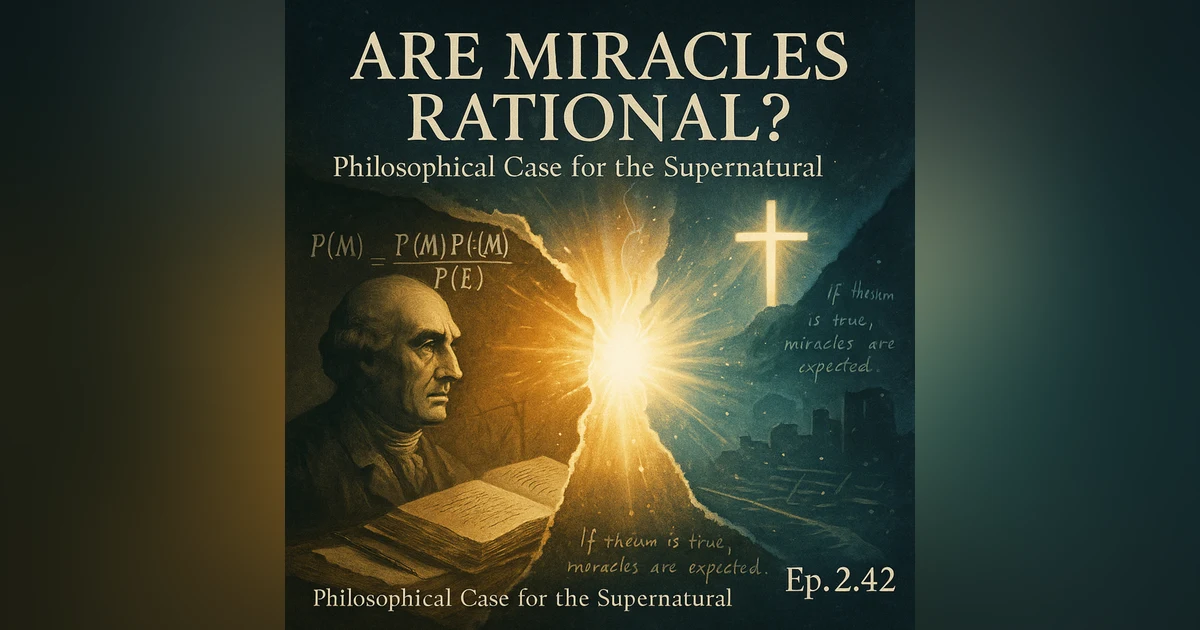
Are Miracles Rational?


 RSS Feed
Episode 2.42
Philosophical Case for the Supernatural
Can miracles be intellectually defended—or are they just wishful thinking in a scientific age?
In this follow-up to the theological case for miracles, Zach and Michael explore the philosophical foundations for believing in the miraculous. Drawing from the work of C.S. Lewis, Alvin Plantinga, Richard Swinburne, William Lane Craig, and others, they address classical objections from Spinoza and Hume, explain Bayesian probability, and unpack why Christianity stands or falls on historical miracle claims—especially the resurrection.
Covered in this episode:
– What qualifies as a miracle (and what doesn’t)
– Why miracles are necessary for Christian faith
– Whether natural laws rule out divine intervention
– The failure of Hume’s argument against miracles
– How probability theory supports miracle testimony
– Why Christianity’s claims are evidential, not blind
If theism is true, miracles aren’t just possible—they’re expected. This episode shows why the miraculous still makes philosophical sense.
WLC discussing Bayesian Equation: https://www.reasonablefaith.org/question-answer/P90/do-extraordinary-events-require-extraordinary-evidence
The Book Michael Referenced: Miracles: The Credibility of the New Testament Accounts, https://a.co/d/hjzHvWL
Find our videocast here: https://youtu.be/dshfk_jyXj0
Merch here: https://take-2-podcast.printify.me/
Music from #Uppbeat (free for Creators!):
https://uppbeat.io/t/reakt-music/deep-stone
License code: 2QZOZ2YHZ5UTE7C8
Find more Take 2 Theology content at http://www.take2theology.com
0:00 Hey, Zach. Michael. Oh, boy. First off, you're smiling too big. I don't. I don't know where this is going, but I'm a little worried. What sorry for those at home or on you know, even if you're watching YouTube. So I think clay and reformed MD are probably are are and maybe corn wraiths Bane. You know who you are are our most faithful YouTube watcher, so you all just have to catch this in person at some point in time. But I did a thing today. Oh, what'd you do? I got a tattoo. No, you did not. Yes, I did. Razook. Yes. Are you serious? I am 100% serious.
0:42 Wow, it is. On my leg it's a Jerusalem cross. Are you serious? Yeah. Wow, he got it. There we go. Man, let's let's get a let's get a camera zooming in on the thigh. That's amazing. Yeah. Where'd you go? 2:30 this afternoon. Man, I was supposed to go today. I'll tell you my sad story. Yeah, let's hear. It I've got a kid that's sick, that's a different we let's zoom past that. My wife said, please do not talk about this. So we'll talk about this later. But so I'm staying home today because my schedule's a little bit lighter today with work. It's easier for me. She's like trying to get in the swing of things. I have my appointment today like midday. I emailed them and I'm going back and forth and I'm like I, I don't think I'm keeping this appointments. Can I make another appointment and you take my deposit and apply it to that?
1:30 I think they're slammed. They get back to me like every two hours 'cause they're so busy probably. They get back. It was, let me just say, it was chaos in there. Was it cancelled? OK, I'd like to hear your perspective. I bet it was. And they responded like, hey, we cancelled your appointment. Just book a new appointment. I was like, no, you missed my point. I want my money credited to it. Can we do that? And as I'm doing this, like more spots are filling up. There's like less options than when I first did it. And I was like, I don't know if I want to like keep spending money on this. And eventually they got back to me. They're like, Yep, we'll just you got you, you pay both 50 bucks, but we'll credit it towards you. I was like, great book you. So I'm booked tomorrow. And as you know, our boy Clay, he got he got tatted up today. And I think you guys have a very similar tattoo. I don't want to steal his Thunder. So but it looks it looks good.
2:14 And I heard Gabe Faust had an appointment today. So Charles and. Bible. Well, let me just say, OK, yeah, is more than 50. Oh yeah, no, I looked at the price Clay. I didn't see the prices and and I expected it probably a little more than. 50 I was like this is a steal. Like I didn't 'cause the website not great at communicating. These things. Yeah, but anyway, tell me about it. This is. Exciting. So Chloe went today. Oh, did she? Yeah, and I, I and y'all will have a. Y'all will. Not the exact same but y'all have a similar one. Oh, is she is she's getting she did she get the can I could we talk about it or not? Yeah, yeah, yeah. You can't, Lamb. No. She she got the lion. Oh nice.
2:55 On the back of her arm. Where's she? I got like right above the elbow. Yeah, yeah, right above the. She's like, I want it there. Except for maybe. Sorry Chloe, if I'm spilling too many beans. Well, this won't. Air for another week or whatever, right or what? Yes, yes, she got some. Time. Yeah. Yeah. But you know, I'm concerned about my wedding dress. I'm like, well don't get it there. Right. Yeah, yeah. But I guess you can always put foundation or something over it and not concealer and and do it. So she went for me, but I was not there when she was going 'cause our our appointments were like an hour or a half apart. So I think hers is at 1 -, 230. Cool. So I went in. It's pretty, you know, it felt like 2 cat claws just kind of just kind of like clawing into you. I thought I would be able to go, OK, he's making this cross.
3:37 Oh, you could like feel it, but now? I was like, I could not tell what was going on. I. Did tell clay this clay was like I'm I wonder if it's going to hurt. I was like, I've heard it's like dead lifting 510 lbs so you probably wouldn't understand but it's clay. You're much stronger than I am. But I was gonna get the small one and they're like, oh, that's too small for a thigh. And they wanted me to get like this Jerusalem cross. And I was like, no, I'm not or whatever. So I did go up to like the medium one. So the one you saw was like the medium sized, or maybe maybe there's like a small, medium, large and extra large. I got the second largest one. I mean the second smallest one. I'm so conflicted on what to get I and I don't know where to get this. Yeah home groups.
4:19 I I was anxiety and I still do not know what to. This is what I think I'm gonna do. I think I am going to get a lamb tattoo. The problem is the bigger lamb one kind of looks like a dog. Like some of these are just but it's fine. So maybe we should explain these tattoos. Some context would be good. Yeah, yeah. Maybe some context? So this this tattoo shop is in the Old City in, in, or it's in Jerusalem, like right inside. I think it's the Jaffa Gate. And it's like they've been in operation for like 28 generations since. 1300. So it goes back, yeah, over 700 years. So and like their oldest and they use stamps from that time period that are that old. Some of them are 300 years old, some of them are 700 years old. Everything in between, probably.
5:04 So really cool, really historic. A lot of people when they go to Jerusalem get a tattoo as like a pilgrimage tattoo. That's like a very common thing. Like if you say I don't know if it's Rozuk or however you say it's a common, it's like people have those Jerusalem cross being one of the more famous books. I think their oldest 1 is a Jerusalem cross. Yeah. So mine is the Jerusalem cross and it has, I think they're olive branches that go around it. And then there's three crowns for the Trinity. I like that. Yeah, yeah. And then there's the Jerusalem star above it, so you can find that. So you can look that up and you'll you'll see the one that. Goes it's it's really cool and it's so historic. Yeah. So I was debating between Jerusalem Cross, debating from the lion, debating from the lamb, and I'm debating where to get some of these are small and like a lot of people get them on their wrist.
5:51 I think that's like some history tradition. Like I saw them like photocopying one. OK, so a woman wanted it a little bit larger. Oh, and so they can change it a. Little change they they were able to scale one up. For her and just not the stencil, but it's like cool. Still, it's the design. Yeah, it's so you're not physically getting. Stamps. Did you physically get stamps? Yeah, See, that's like so cool. That's. Like, yeah, they took the stamp and he had like, this marker that he inked over it, and then he's like all lining it up. And then he's like, all right, go look at it. I can take that ink off. Yeah. Yeah, yeah, yeah, yeah. Once I do it, I, you know that ink's not going off. It's a done deal. So I don't know. I don't think I want it on. Obviously you do not want it on your arms. I was like debating do I want it on my arm?
6:33 I don't know if I do. Chloe's want it mine lower my leg. I was like, you know what I want and if if I want someone to see it, it's I don't want it so high that it's like, you know, that's a little bit feels weird, but I don't want it so low that it's just showing all the time. Yeah. So it's it's like mid thigh for me. So you probably won't see it unless you ask to see it. Yeah, I said. I'm wearing shorts. Yeah, the the combo. Hey, you catch Michael on the Speedo at the pool, you'll see that. Jerusalem you will see the Jerusalem class, but I Unless something radical changes in both my body composition and my mindset, you will not catch me in a Speedo at a. Me either so I'm debating.
7:14 I think Clay went like mid forearm on his. I'm debating I've got like this Cairo on my right shoulder. I was debating getting like the lamb like but well, not it's it's the problem is the the lamb is so small. Yeah, I might get it. Like blow that. Thing up. Yeah, I could blow it up. I was thinking I'll, I don't know what looks good aesthetically. I'm not a a graphic design kind of person. Look at the shirt you're wearing. You graphically designed that. So what I was thinking, I've got my Cairo and I was thinking down the road maybe I would get like a crown of thorns around the Cairo. I've got nothing. It's very simple. Cairo Alpha Omega. Now I was thinking about maybe bottom right getting this little lamb tattoo and then maybe later down the road getting like a lion, like, you know, the two and it kind of goes with cry right there. But not the Razook versions.
7:58 But I, I don't know, I kind of see how it, how it is. I'm sure they are like great. My other concern about the lamb is like it's so tiny. Like when they're that small, sometimes tattoos are hard. They'll give. You the picture of the stamps that that would be cool that she took. Now there, this is the main case. There's a there's a smaller case to the left in this case, it's on display there that has bigger stamps. So I don't, I don't think you're missing out on those, but there's maybe like 5 or 6 that aren't aren't in this picture. 'Cause really, out of all the stamps, I don't want any really with like Jesus on there, that's like half their stamps, or with Mary, that's like half their stamps right there. Yeah, what about Joseph and Mary in the Nativity? Not I don't know.
8:38 So Jill's Jill, they do have a nativity and Jill's all excited about that. I was like, you didn't get one. She's. Like no. Did she go with you? No, she's working, but there's there's people at our school. So there's a teacher at our school that two teachers have been to Jerusalem, one who leads like trips over there every now and then, and she's got like two or three of the Razooks and she's both of them are going back. Oh that's cool. You should take take a put it in the take two or chat Chloe's tattoo and I'll see what it looks like right above the elbow, you know? Yeah, yeah, yeah. I don't know, I'm like a private person where I don't like want tattoos super visible. I don't have a problem against it, but I'm just like, I don't, I'm always like, I don't know you. Know that's me. I like, I don't mind having a tattoo and I don't mind people seeing a tattoo, but I don't want to be on display 24/7.
9:21 You know, whenever I'm out, you know, because I'm, I'm thinking about also getting a Cairo. Nice, yeah. So it would be the Cairo, which is the I think everyone knows what it is, but it's the X and the R looks like AP in the in the be the first 2 letters of Christ name and then the alpha Omega. You have the alpha Omega on the same. And then if you were to extend that row like the stem of it and then put a Navy fouled anchor like that's pretty cool, you know, anchored above, you know that that kind of. Stuff are you thinking like on your chest, on your back? Probably on. Your back for that one and that would be cool. You know, Christopher says he would love to design. Oh. Yeah, yeah, yeah, it's time waiting. Oh, that's so cool.
10:06 That's like super cool. You Clay get and then if you know Kelly Graham from Grace on the Ashley went he got some when we were in Israel, he got it just like that's maybe also some people I know too. You know, it's that's like so cool, but how was it efficient? I know we're running along but. The tattooing itself was efficient. My appointment was at 2:30. I probably did not get the the the process didn't start till probably like three O 5. Oh yeah, so they're 3. 10 they were they were behind at that point in time and. I had appointments. I had an appointment and there was a chess lesson I had at 4:00. But you made it though. 2:30 I was like, I was 15 minutes late, but thankfully this is the one that Jonathan's son was going to like.
10:48 I was like, I'm going to pay for this lesson, but I want you to go. And he reviewed a game between me and Emerson. And so I was like, I told them I'm like, hey, this was supposed to start at 2:30. Yeah, it hasn't started at 2:30, so I might be late. So if y'all are fine, go start without me and I'll show up when I get there. Oh. That's so cool, I didn't tell him I was. Excited too, I just. Said wait, did you? Have you had this planned for a while? I had it planned well. I was like, man, I might do that one because I didn't know anything. About it till Sunday night. Oh yeah, so. Yeah, yeah, yeah. And then. And then because I, well, let me say this. When I heard you talking about Rezoos and I heard the teacher at school, I was like, that is something I would want to do in the future. Yeah.
11:28 Yeah, It's cool. When will I get to Jerusalem? Yeah. But, you know, they packed up and came here. Yeah. Crazy. Yeah. So I was like, this is kind of a once in life. It's pretty cool. You know, unless I'm going to travel there, you know, you know, you got to cut hay while the sun's up. So I was like, let's figure this out, you know? Dude, that is awesome. Man. I was so, so surprised. Wow, that is really cool. Yeah, mine's like tomorrow afternoon, a little word, and mine's later in the day than yours was, so it's probably going to be back. It's actually possible. It's going to be like mayhem. Getting there early and they'll probably get you worked. In because they take yeah walkins they stay at least but cool nice. Well, I'm glad I could get my I was worried I wasn't getting mine rescheduled like all this there's like literally like 3 spots to pick from tomorrow when I signed up so sweet. Well, that's a 12 minute mantra right there, but totally worth it.
12:13 It's a miracle. It was a miracle I got a tattoo. We're talking miracles type Take two, our second episode, the philosophy side. Michael's got to get the philosophical side, so let's take it to the next level from the hearts of the low Country in South Carolina. It's the Take Two podcast where we take theology to the next level. All right, so miracles, we talked maybe 2-3 Thursdays ago. Yeah, about miracles from a theological perspective. That's right. And I said then I was like, we should also look at that, you know, philosophical perspective. I like that round.
12:54 It out. Yeah, yeah, yeah. And so we want to kind of present some of the atheistic arguments against miracles and we will do our best at not strong manning those. I love it. That's. Right. And go through those. But Alvin Plantida Plantinga famous philosopher, said that if theism is true, then of course miracles are possible. Indeed, it would be astonishing if the God of theism had never performed 1. Yeah, that's kind of the deal. Like miracles happened or you can't explain. It's like I think you're right. This is like a don't want a straw man, but I feel like if I were an atheist or what you commonly hear, we can we can get to more specifics and do a better job is like then show me a miracle or it's like, you know, like you can do these things. Show me.
13:39 Or, you know, yeah, yeah. And if deism is true and if, you know, God created everything, then you are living in the greatest miracle that God created something from nothing, right? So if that happened, then really a, a snake that's talking. Not a big deal. Not a big deal. Not a big deal, yeah. Everything else, Yeah, becomes a little bit less crazy. Even though probably a talking snake is not the best translation and interpretation of what? Don't try to make snakes good, Michael. No, I'm just. I'm not kidding. I think you're right. Yeah. All right. So we kind of did a little bit of this last one, but just as review what is a miracle. It's not an anomaly. It's not just Providence. You know it's not. You know you went through an accident and survived. Yeah, not an unlikely scenario.
14:26 That is totally explainable. It's not a what's behind your ear. Yeah, Yeah, there's 1/4. Or the OR card trick or something. Or yeah. Yeah, that's right. It's not magic, it's not illusions, it's not preternatural either. Fancy word. You know what preternatural means? School me. So preternatural would mean that it is like outside of nature. So what we would describe things that angels do as a credit naturalist? It's yeah, it's not natural. It's outside of our nature, but it's within their nature to do that thing. So. And this, this actually came out of the paper I had to write or yeah, paper and some slides I put together. But this, you know, is how I'm going off of their definition of things.
15:16 So. Yeah. Very, very good. So we've got this quote, my favorite guy, Richard Swinburne. What's his background, you know? Yeah. Did you quote him in your paper? Is this like, is this from your paper? And he was like, oh, very cool. I may not remember all of the quotes, but you can just read it, it's good. Great. A miracle is an event of an extraordinary kind brought about by God and of religious significance. And I like that because there's like a few conditions there that kind of help paint a picture that God's got to bring this about. There is religious significance. It's not just random. And it is an event of extraordinary, kind of extraordinary in the real sense of that word. Right, right, right. And I'll just say Richard Swinburne, William and Craig refers him a lot.
16:00 So I'm familiar with the name, but I couldn't tell you more. He is a philosopher of religion somewhere, maybe in in the UK somewhere, but don't quote me on that. All right, So why are miracles necessary? Yeah, what's the big deal, 'cause? If, if you can show miracles are not possible, then you defeated Christianity. Yeah, 'cause our whole story revolves around, that's right, going on. So without miracles, Bible lacks credibility 'cause there's miracles in there, you know, there's a guy. It undercuts the veracity right there. There's a dead guy that lands on Elisha's bones and comes back to life. Yeah. What? Yeah, yeah, yeah, there you. Go Jesus claims lack any validation. He didn't rise from the great day.
16:41 Because this is what gets me is if you know, some people will say, I believe the Bible, but it's like all totally spiritualized where it's like, oh, it's like a good story. His his life lives on in US or something. And I'm like, man, I don't want to believe that. That's it. Like there's no appeal, right? Right. Yeah, yeah, yeah. And and ultimately we only have these kind of here and now meaning, but there's like no ultimate meaning. No ultimate, That's exactly right. We talked about the resurrection collapsing. Christianity is falsifiable. Christianity makes a lot of claims. If you could stipulate that someone found Jesus bones in the grave, guess what? Christianity is false. I'm not saying that there's no God, but there are lots of parts of Christianity that you can test and potentially falsify. They've stood the test of time for 2000 years. Although I'm not saying everyone has, but there's been no knock down.
17:36 Oh, Christianity is obviously false because of fill in the blank. Yeah, that, that's the crazy thing about the Bible is that it is a historical record where and there's, it's a big book out if you looked at your Bible, very thin pages crammed where it's like, you know, you comb through that and there are, yeah, if you can prove these things are wrong, that that goes hard against the truthfulness. All right, we got another quote. I don't know who this is, so don't, don't ask me. I assume he's some my, my guess is he's some German philosopher Wolf Hart Panenberg said. The resurrection of Jesus is a historical event that can be investigated with the means of historical research. So. I love it.
18:18 So, Mr. Philosopher, why are miracles philosophically possible? Well, if God exists, then he can act within his nature and he's more powerful than we are. So he can do things that, you know, if he created all of this, then he can, he can interact with it in ways that we can't. One of the analogies, and maybe further down here in the notes, but you know, if we see it later, we just, we'll just get over it, is that, you know, a computer programmer can interact with his code and do things like if you were in the code, it would look like it's miraculous. You're like, yeah, you're in the program. You're like, what's going on?
19:01 It's just those programmers making it, making it happen. And and So what you're saying too is the like at some level the code is not holding the programmer hostage. That's right. So since God is the one who created what we see, He's not bound by those laws. He's not necessarily breaking those laws. You can say, is he breaking the laws of nature or is he outside the laws of nature? I don't know that that's a fruitful conversation. He's not bound by those laws and he can act outside of that. You've got this guy. I'm not familiar with him. CS Lewis. Lewis, CS Lewis. Nice always got away with words, he says. If we admit God, we must we admit miracles. Indeed, indeed, you have no security against it. That is the bargain.
19:47 You got to have one. You can have the other. Yeah, yeah. All right. So we're going to get into some of the objections here. And obviously we are not going to do full academic work on this. We're going to give you a thumbnail sketch of these objections and why we think they fail. And then if you want to interact and say hey. Maybe later on. Yeah, Yeah, maybe we've that's. Good. We could. We could expand one down there. That's smart. I like it. So Spinoza, was this a Jewish guy in Spain who was forced to like outwardly convert to Christianity 'cause he lived kind of during the. Spanish imposition, but he was. Really. Probably an atheist. He's he is a idealist like Rene Descartes, but he's on the other side of the fence. Renee was the Christian Spinoza, not a Christian, and he made the claim natural laws are immutable and therefore miracles are impossible.
20:43 If if laws are in place, they govern the it's like you, you can't just Willy nilly. If the laws are laws and it's nature, it's not like we can break the speed limits. If it's like it rained, the water cycle is the water. Cycle if it could be broken then it's not a law, yeah, type of thing, right, right. And of course, we even see, you know, some of what Hume would say would go against and we'll get to what Hume will say in later would go would go they invey against this. But we see like even the the law of gravity is sometimes still called the theory of gravity because we are looking at it and we observe it over and over and over and over and again. But it's not like we are we can peer into the the things that actually make gravity work.
21:24 Like we know that mass attracts to each other. We have mathematical equations that describe gravity, but it we are, we are describing A phenomenon we witness over and over and over again. So they're descriptive, not necessarily prescriptive. And like we said above, if God offered them, then he can act beyond them. Yeah, that's that's good for God to feed A5, for God to feed a 5000 by multiplying loaves. There's no more violation of the laws of nature than for him to create loaves in the 1st place. Yeah, there you go. So, you know, he's God. Do either or. It's kind of the same thing. This is John Lennox. Johnny Boy.
22:05 He's a mathematician and philosopher from Ireland. He's probably the. Best people to listen to because it's called this Irish accent and tell you about God. But yeah, that's that's John Lennox. Really good. David Hume, Yeah. So David Hume, he wrote a lot. I actually had one professor who thought David Hume was actually a devout Christian who wrote. He was like, I am going to take your philosophy to the end and show you how. Absurd or yeah. He's the only person I ever know who. Yeah. But I think that was Richard Howe who who believed that. But most people take him as an actual atheist. Like they take him at his words.
22:46 And he had a couple different arguments. Well, he wrote a whole book, I think called Against Miracles. And so we're going to just kind of summarize some of the main ideas out of that. He would say we have uniform evidence. We never have uniform evidence for miracles, but instead we have uniform evidence of like the mundane, like the the regular, OK, and so, but this kind of assumes what you what you want upfront. Like if he's, he's going to assume that all of our experiences, not miracles. Well, the only way you could come to that conclusion is that you've already rejected everything as not a miracle. That's not from the Yeah, right.
23:29 And so this is not necessarily a great response and we're going to get we're going to dive more into some of what he has to say, John Ehrman said in response. Humes argument against miracle is an abject failure. That's in 2000. So most philosophers don't buy into. I hear this a lot. I'm not in the philosophy game, but it seems like a lot of what Hume did, like that's where people land, like not where that one guy who said he's like trying to prove the absurdity, but they're kind of like some of his arguments, kind of like where they lead is not the best, like even atheist, that kind of thing. Admit some of that. It was really good to kind of shake up the the thought of that day and make people reconsider assumptions, Hume would go on to say.
24:14 Stuff that you could really not know. Cause and effect. Yeah, that's. Kind of on your cuts. It's his correlation, yeah. And the example that he used was like billiard balls, Like you see one ball rolling and hit another ball, and you assume that this ball caused that other ball, but you don't really know that. You're just correlating this action with this result. And So what he's guarding against is the prompter hawk fallacy where something happens, therefore you assume that's the cause. Correlation is not causation. But you know, at some level we got to. We see billion balls. I think we can. Safely assume yeah yeah, all right probability argument Hume says evidence for regularity always outweighs the rare events.
25:02 And so he's he would basically in conjunction with his previous thing that we have uniform experience of the regular. And then so I have all this regular experience, regular experience, regular experience. Then you try to give me evidence of of a miracle. My overwhelming experience of not miracle will lead me to almost dismiss out of hand. I have all of this experience of not miracles. Your evidence is not is not going to be good enough to persuade me to believe it's an actual miracle. Yeah, And I think on a practical level, I kind of get this like some some people are always trying to tell me there's a miracle and I'm probably more skeptical maybe than I should be. And I'm like really, you know, and it tends to be the same people have like all of these miracles and that can so you know, but it doesn't, I think that can that can be true on one level that most time it's not miracles, but it to me that's not like overwhelming that most of the time it is not miracles. Doesn't mean maybe some of the time miracles could happen. I don't know.
26:05 One of the biggest the way, like one of the ways that we can kind of show an argument is not good is if we kind of take it to its logical conclusion and say it shows it proves too much and so therefore it can't be good. And so a lot of what Hume argued about miracles is that they're singular events. And so a. One and done. It's a one and done. You're not. And it's like, even if, you know, you observed it and you tried to give me the evidence for it, I mean, I'm going to be skeptical, you know? But any singular event now falls prey to this. Like Hume's own birth was a singular event, you know, can we trust that? Why should I trust that Hume ever existed? Like you? You give me a book that he supposedly wrote, but there's I have a whole lot of experience of Hume not being born. Right.
26:51 That one time Hitler like exterminated the not or the Jews. It's like that wasn't like happening a lot. I don't know. Yeah, yeah. So any singular event would fall prey to that. So William Lane Craig says if we were to rule out singular events, our priority, which is before we even kind of look at the evidence, we would have to give up much of history, cosmology and even evolutionary biology. All right, So I, I wanted to talk a little bit about Bayesian probability. There's an equation for Bayesian's probability. If you're interested, go look it up. Wikipedia has a good article on it. We're not going to go over the equation itself, but we're going to kind of tell you kind of the principles that you see in that equation. And basically the equation says that we have to, in order to determine if anything is true, we take the background evidence into account.
27:49 Like what's you know, if we have a lot of background evidence that birds fly. Yep. And you told me the other day you saw a bird fly. OK. Yeah, you're not I'm. Going to accept that, yeah. But if I have a lot of background evidence that tells me birds don't fly and you told me a bird fly, then it's less likely I'm going to believe that. And so we have our background evidence and then we have the evidence of the individual event that's happening. I don't listen. I'm kind of going, not going off of these. That's great because I don't like how when I told chat what to to write, it didn't follow my address on chat.
28:31 Do better. So I'm just I'm just going to wing it summary of this. So basically on Hume's argument, he's basically really looking at that background evidence that it would have a variable on Bayesian equation and saying it rules the day. But Bayes equation shows mathematically that given proper evidence of an actual event, then it can change our background evidence. You know, we can go, OK, then we have to reconstruct it. And so you can show that even an unlikely event, if no other good possibility, good explanations exist for it, then it you can have a miracle. Gotcha.
29:14 OK. I like that. That's good. So it's like looking at it from more of like an equation perspective where statistics like these things. And you can put actual values in like and even if something was very very improbable and improbable given background evidence, if it is the best possible explanation and you have good supporting evidence for it, then the equation can come out to to an improbable event on the background evidence still being a probable likely of that occurred. I like what we tried. What we tried to do in the past is kind of hit these different areas of this. So it's like the mathematical side of it. I like it. I see we've got some other skeptical arguments. I, I can resonate with this first one, psychological explanations because like going back to my thing, it's like sometimes people are not reliable.
30:01 Like it's like the crazy people who like miracles and maybe you just assume like okay, hallucinations, that kind of thing. Or it's like they really want. So you're saying you're a Christian and maybe there's other Christians who have said something and you doubt it? And and maybe it was true, but I'm like, I'm always like default skeptic, even if I, if I don't know you probably it would mean a lot more if Pastor Joel or you were like, this is what happened. I know you. You're a logical person. Either you got caught up in the moment or this what? And so I'm still leaving some doubt. Even as someone who believes miracles. Happy source matters to me. Yeah. But like if 500 trustworthy people right all said something and then some of them died for if it was a lie, they would know it was a lie because the people die for a lie sometimes, but they don't know what's a lie.
30:52 But people don't knowingly die for lies. Yeah. So 500 people did that and they were trustworthy. That'd be good evidence that. Wow. More than good evidence. Maybe this there was something that happened? Compared to like someone who's like in a loony bin who's like I saw, it's like that's a one up versus 500 people. I just put this bread in my toaster. It came out and it had the picture of Jesus on there. You know, it was a miracle. Do you not believe that? Yeah. So I like the way you framed it because there is Christianity is not one person saying this random thing. It is it is so much more thoroughly documented and attested to.
31:33 And so that's, that's basically what you'd have to say 500, you know, whatever you know, that would be that's good. And there are, you know, enemies of Christianity, not just people who are eventually converted, but people who are never converted, who said, you know, in, in history said, you know, this person who worked miracles and what, you know, supposedly rose to the dead or something. Like even if you wouldn't say that's enough to attest that it's a miracle, you'd should say, well, it's enough that there was something here that people weren't just making up. It was kind of known in that area. So you can't explain away a group appearance and this is, you know, it's come to your psychological effect. You know, it's hard for 500 people to have the same, you know, hallucination.
32:23 You know, we don't have any evidence of that. You know, other religions miracles, you got to test Christianities miracles for themselves. You know, you can't. Just because we could show other miracles are false doesn't mean that Christianities are false. Craig Keener says to dismiss all miracle claims out of hand is to ignore the testimony of hundreds of millions of people worldwide. And there is a book of well attested miracles. And I think he and it may be this Craig Keener. I gotta, I, I should look it up, but from what I'm told, it's a fairly large book. And like, all the documentation is there. And he just says, here's the claim, here's the evidence to support it.
33:06 This is what people thought about it. And you can kind of like make your own decision. Here's the claim, here's the evidence to support it. And it kind of goes from, you know, the 2000 years between US and Christ. Yeah, that that's probably pretty amazing because to your point too, there, a lot of people in there are not necessarily all Christians. Like, we saw this thing and it was weird and it was crazy. And yeah, I I like that a lot. So what are some counter arguments that would be like hey miracles, we can get behind them? Yeah, so if you had good testimonial evidence like you were saying, someone who's trustworthy, maybe even from hostile witnesses, so sorry, I got it. So we know like Paul dead set against it. Peter denied the Lord Jesus's half brothers were converted, and we know that they were hostile to Jesus. So there are people who were were hostile but still were converted in light of the evidence. Miracles can function as meaningful signs, not just random stuff.
34:08 So we think that miracles authenticated the word. We said that they were distinct from improbable natural events. And you know, if, like we said, if theism is true, then you really shouldn't have a problem with, Yeah, they kind of go hand in hand. Lee Strobel said. To be an atheist, I had to believe that nothing produces everything. Non life produces life. Randomness produces fine tuning. And those leaps of faith were too big. So you're not getting away from like you can't have an equation for everything no matter where you land. Yeah, you got to have some type of magic, some type of miracle in order to explain, you know what we're what we did here. So again, broad brush here, it's good we're not, you know, this is not an accident paper.
34:53 So but some of the things that that Hume and Spinoza kind of famously, you know, brought up against miracles and kind of the framework like, well, how can we believe in a miracle? Well, we believe that there is a personal God who can act and can involve himself in creation. So. I love it. We have Miracles 3. Maybe. Maybe a response. We'll see what it. Would be a miracle if we do right. I love it. This is good to take 2 miracles, 2 in the books. Any parting words? Oh, good. All right. That's our take. Thanks for listening to Take Two.
35:33 Find us wherever you find podcasts and on YouTube for those who want to watch our video cast.

