The Septuagint, Explained | Fact vs. Fiction: How the Legend Grew


 RSS Feed
Season 3, Episode 18
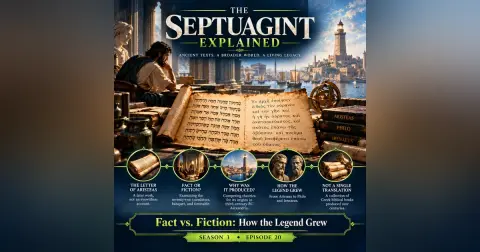
In this episode, Michael and Zach continue their series on the Septuagint by asking how much of the famous origin story is history—and how much is legend. They begin with the Letter of Aristeas, explaining why scholars generally regard it as a later pseudepigraphal work rather than an eyewitness account from Ptolemy II’s court. The discussion then separates the likely historical core—a Greek translation of the Torah produced in third-century BC Alexandria—from the story’s more elaborate details, including the seventy-two translators, the royal banquet, and the exact seventy-two-day timetable. Michael and Zach also examine competing theories for why the Septuagint was produced in the first place. From there, they trace how the legend grew through Philo and Irenaeus, each adding more miraculous elements to the story. The episode closes by showing that “the Septuagint” was never one single translation, but a collection of Greek biblical books produced over centuries by different translators.
Find our videocast here: https://youtu.be/rTBDvYLXEz0
Merch here: https://take-2-podcast.printify.me/
Music from #Uppbeat (free for Creators!):
https://uppbeat.io/t/reakt-music/deep-stone
License code: 2QZOZ2YHZ5UTE7C8
Find more Take 2 Theology content at http://www.take2theology.com

