Celebrity Pastors, Paychecks, and the Purpose of Ministry


 RSS Feed
Episode 2.11
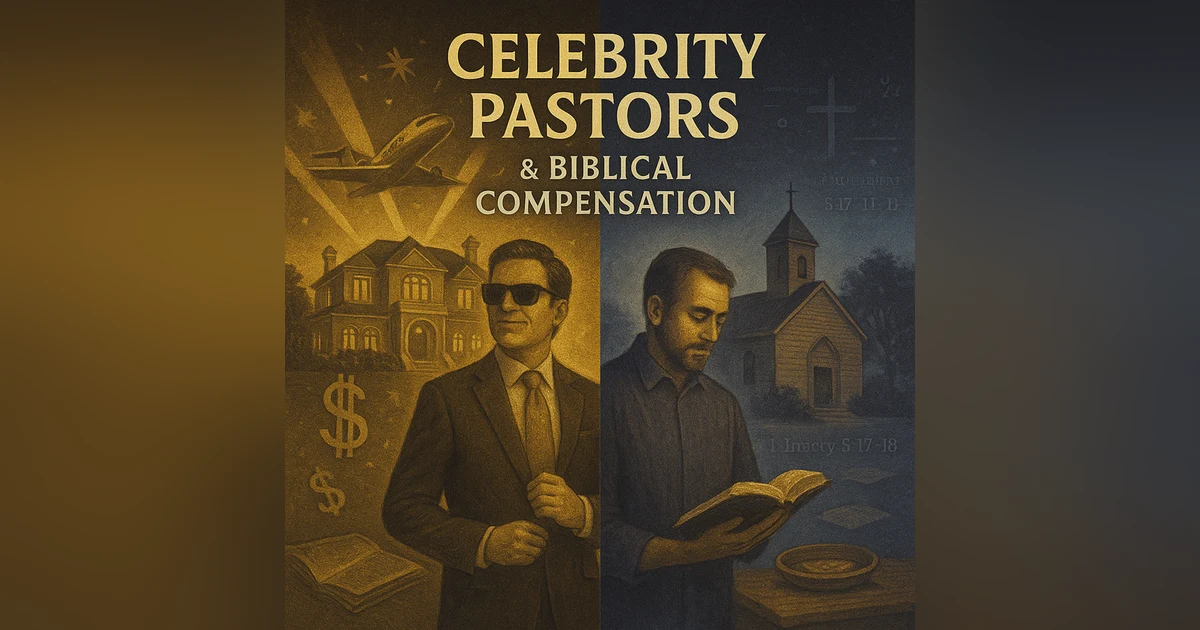
From million-dollar mansions to private jets, the rise of “celebrity pastors” has sparked questions about fame, finances, and faithfulness in church leadership. In this episode, we explore the complex topic of pastoral compensation, beginning with high-profile examples like Joel Osteen, Creflo Dollar, and Carl Lentz—and what ethical concerns their lifestyles raise.
Then we turn to Scripture: What does the Bible actually say about paying pastors? We look at clear New Testament teaching on the right to financial support, examples of abuse and warning, and Paul’s model of both receiving and refusing support. We also tackle modern questions: How much is too much? Should married pastors be paid more? What about book deals?
With biblical clarity and practical wisdom, we call churches to avoid both extremes—underpaying faithful shepherds and enabling lavish lifestyles that damage the gospel witness.
National Snakebite Support: https://www.facebook.com/share/g/1GD3uyThiy/
Find our videocast here: https://youtu.be/-nvRLVHmFvA
Merch here: https://take-2-podcast.printify.me/
Music from #Uppbeat (free for Creators!):
https://uppbeat.io/t/reakt-music/deep-stone
License code: 2QZOZ2YHZ5UTE7C8
Find more Take 2 Theology content at http://www.take2theology.com
0:00 Summertime. Summer starting to warm up. Getting hot out there. That means that there are creatures that are out there. Yeah, that some good Like butterflies. OK, that's good. Yeah, some that are also good but do don't have some danger. I don't think I like what you're gonna say next. Snakes are out. There. Wow. Straight from Genesis 30, man. So crazy enough, my almost youngest daughter Julia has really taken a liking to trying to identify. Snakes, Julia, Don't do it. Say it ain't. So, so we've been working through like we started out with the six venomous snakes of our area.
0:42 As you do. And like, hey, I'd build identify these. And it is crazy how like, you know those really well, then you start to learn other ones, then you go back and you're like, start misidentifying the ones you should know, really. Well, I know what you mean, I can totally relate. But she's been doing pretty good. Because there can be some. I'm gonna. Quit. So if I had to see her next time, what's like a quiz? I could. I could be OK. Have you seen the orange rattler? Like what's a snake name? I don't. I'm not. Yeah, you should probably like pull up a picture store area, occipital maculata, OK, AKA common name, red bellied snake, OK. And just, you know, show a picture of that and say, hey, can you identify the snake? I will, cause those are highly variable. Very, but very pretty snakes.
1:24 Yeah. Wow. Small, like adults get, you know, 12 to 15 inches long. That's as big as they get. They're fossorial snakes so that I can live underneath leaves and clutter. And they eat soft bodied invertebrates like snails, slugs, worms, that type of stuff. Boy, good for gardens. Snakes. Hey, I'm growing a garden. Maybe I should throw a few red bellies in there. Yeah, if you see one, definitely don't kill them, but it is possible. If you're not watching where you're going, you could get, or if you're messing with 1 you could get nipped by a venomous snake. That's a bad day. It is a bad day, could be a costly day, but PSA just and this is no hit against some of our listeners like Cordell.
2:12 But is he not like snakes? Oh no, he's a doctor. Oh, yeah. Oh, yeah. Oh, you're about to slam the medical profession? I'm just saying that that there's a lot for a doctor to know and snake bags are relatively rare actually. Yeah, yeah, yeah, yeah. I don't know that many people have been by even non venomous like snakes in general. Yeah, well, you know Phoebe, she's been bitten by a non venomous snake. Wow, so that's like the only person I've ever met in my life. I probably. I've been there. OK, maybe two. Yeah, yeah, I just. I don't know. But I guess I guess you relocate them a lot. It's about. To happen if you pick up a non venomous snake, Well, if you pick up any snake, you you, you're saying I'm OK with you biting me 'cause that's their only that is their one defense. Well, they Musk, so they can't kind of get stinky, but that's their one real defense.
2:59 They Musk. Yeah they do water snake Musk. Horrible. Anyways, PSA there is a group on Facebook so you have to join Facebook called National Snake Bite Support. NSBS baby how? About it, yeah, just national Snake Bite Sport and I can actually put a link to the group. Oh. I hope you do in our description. Well, The thing is you might want to join this now if your, your parent, if you or a close loved one are bitten by a venomous snake, because there are doctors on here who are specialized in the treatment of snake bites. And they will talk, you know, your ER Doctor Who this is the first snake bite they've seen.
3:46 And they're trying to remember everything they've learned in, you know, Med school. And they're looking at, you know, they have, they actually have like they can go look up like a little computer system, like what should I do? Like remind me what I learned in Med school. So that's what they're probably doing. But they'll walk them through like what test, blood test to run what to be looking for indications, proper treatment, not proper treatment. A lot of doctors, you know, anti venom is expensive. Yeah, and a lot of doctors. Will tariffs, What's that? No, just keep going. Yeah. No, Yeah, we can talk about how it's made. That's how it's made is. Sorry I brought it. Down, you know, you, they have to basically milk the venom glands of venomous snakes.
4:27 So there's someone who just had a whole bunch of venomous snakes, you know, every 3-4 days they extract the venom and then they'll inject a little bit of that into all these horses cause horses are pretty robust against them. And so then that horse blood will build up antibodies against the enzymes in the venom and then they can extract that horse blood, you know, centrifuge it out and get the anti the anti venom out of there. But anyways, Long story short, if if you're your loved 1 is in a situation where you find yourself having been bitten by a venom a snake, get in contact with them. There's no need to bring the snake in to I've always. Heard that.
5:12 Got to bring, got to catch. Yeah, got to catch. So you know which one it is and then that results in more bites and then you know the the ER staff does not want that there. There are two types big categories of snakes that you could get bit from Vipers or the coral snake and and we have coral snake anti venom and then any other Viper has the same anti venom 'cause they're closely. Related. So, and that means your cotton mouse slash water moccasins, same snake, your copperheads, your canebrake slash timber rattlers, your diamondback rattlers, your you know, if you're over on the East Coast, your Southern Pacific rattlers or your red, you know, back I'll. Tell you what, copperheads I feel like, I feel like everyone's like, oh, there's a bunch of copperheads under there.
6:05 Like that's like the go to if you don't know a snake, just say copperhead 'cause they're everywhere. They're very. Common and they're probably they are because they're so common and they're in the South where there's more you know, there are other common snakes out in the deserts, but the people aren't there. So they're probably the most common where people are. They do account for the the most bites, you know, and some people discount the copperhead because it does probably have a lower toxicity of venom. But that doesn't mean you don't need to get it treated. If you get bit by a venomous snake and you have any systemic issues like temperature, swelling, you know, pain, you know, other than just the puncture pain. But like you know, systemic pain, you need some anti venom. Man, PSA watch out for the same way. Speaking of snakes.
6:53 Yeah, snakes. There's a bunch of snakes out there. They're all about that filthy lucre and mammon. We're talking money today. Oh, and. Are they? They're serving the Mammon. They. They're all about the mammon, which you know, you can't serve God in mammon. That's right. And they're serving the mammon just real quick if you had to pull I ChatGPT this top salaries for pastors out there use pastor very loosely false teachers or their fair game. You got any guesses who would top this list? Out of the top 10. Top ten. Yeah, just just. I bet you would do. Well, I'm looking at these names mostly. And this is just because we have talked a little bit, so I know like some people get, is this including all sources of income basically? Yeah, yeah, yeah.
7:40 This is also book sales count which. Skews things a. Little bit, yeah. So I mean, let's start with some of The Who would say legitimate top salary getters. Piper, is he on there? Oh. See all This list is almost exclusively non conservative. Non legitimate. OK, yeah, almost. This is chat. You see what they pulled? OK, Driscoll. Driscoll is not on there. Think. Think more more out there. More out there is it? Think about having your best life or whatever it is. Joel Osteen. Joel Osteen is #1 like, his net worth is like between this is broad range 40 and $100 million. But obviously his books are like, you know, so that's like #1I. Can't remember any any of these names. The guy that like speaking in tongues back and forth. Who has the big jet?
8:29 Oh, yeah. So I'll I'll just run through some of these names. Maybe. So TD Jakes is on there as you you would probably he's just I saw some Benny Hinns on there. Benny Hinn. Creflo Dollar. What a name Creflo Dollar. He was meant to be a health. Wealth and prosperity is that is that a stage name or is that his birth certificate name I. Either way, it's like not good. Like if he like chose this name, but maybe it does fit the brand. Like, hey, I trust God, so I'm rich. I don't know enough about him. I just Kenneth Copeland who had that interview you were thinking of, probably it was great. He just just some of these people, the way they look. So a little more conservative. Not saying he's my guy or anything. He's still out there. Rick Warren purpose, I mean a purpose driven church or purpose driven or whatever. Joyce Meyer, which Joyce Meyer, that smile looks awfully like the Joker. I don't know.
9:13 It's, it's very, it's too much. And then the most conservative guy, bottom of the list. Most of it's from nonprofit salaries, not church necessarily Franklin Graham High, but from Samaritan's Purse and stuff like that. He does, he does pretty well for himself there, but his annual salary is closer to 1,000,000 versus like 10s of millions. You know what I'm saying? So it anyway. Did you know that Rick Warren was actually pulled over one time for speeding? Yeah, but he was in the backseat and there was a dolphin driving his vehicle. Seriously. Yeah, and the officer was like, what is up? He's like, don't you know my whole life is purpose driven? Porpoise I, I was like, where's this going? But it kind of fits because I'm pretty sure they have an aquarium at their church.
10:00 Like I'm not joking, like a like a experience that like you can like buy tickets to. Yeah, yeah, I kind of like the ARC encounter. Yeah, yeah, yeah, yeah. That's so good. But I bring that up because we're talking money. How much should a pastor make? Because I think opinions are everywhere on this. Yeah. Do they make a lot? Should they? Should they be poor? But anyway, we, we, we'll, we got the definitive answer. Here, Yeah, we're going to, we're going to give you the formula. You just plug in the size of your church, your zip code, yes, and a couple other things and it will crunch you what you should be paying your pastor. That's the biblical number. Now I love it.
10:40 Well, let's jump into it. Let's go ahead and take it to the next level from the hearts of the low country in South Carolina. It's the Take Two podcast where we take theology to the next level. All right, what should you pay a pastor 'cause we're talking about finances? And I saw this recently on a Facebook post 'cause people were pretty upset about Joel Osteen. We. Had Joel Osteen was something recent happened with him or just it was just recirculating? Something just recirculation. And I, I believe there are group of pastors who have sold quite a number of books.
11:25 I think Joel Osteen is there, John Piper, Rick Warren, who actually don't take a salary from their church, but obviously their church has platformed them so that they can make money in these other ventures that they're doing. Yeah. And, and what's tricky about some of this too, It all gets wrapped up together. You know, if you're at that level, you're probably pretty entrepreneurial, like, like you're, you're like, probably, I don't know. And, and on some level, I think you in the other profession, if you're like in the top 100 engineers in the world, you probably should make a lot of money. Or if you're in the top, I don't know, you know what I mean, where a lot of that like goes hand in hand. But how?
12:07 Much do the top 100 podcasters make in the world? We wouldn't know, but with your help, every subscriber help, maybe we could know one day. But so and, and it, it's one of those things where, yeah. And it's like you're in the ministry, so should you make money? I don't know. It's like it's and I honestly, I think past a pastor's role is tough because so much of it is semi public or public and some churches hide this stuff. That's a red flag. But it's like, oh, that's like just a tough, it's a tough situation or conversation to have, I think. Yeah, and here's another thought about before we dive into the notes proper. You know, I have often, well, yeah, I have mixed thoughts about public education. My kids, your kids are both in private school. That's I think we've said that more than once. And our and the private school teachers, they don't make as much as the public school teachers. But I, you know, I think public education is a good thing, but when the government gives it for free, then it kind of brings down what people are willing to pay for it or. Even value, it's like they, you know, if you get something for free, you tend not to value it.
13:14 I think that's like a thing that happens. And so I, you know, I am for, you know, let's take some of the money that we're spending on all of the computer hardware and the screens that we're putting in front of the kids face and put that to teacher salaries. Not because I think necessarily that every single teachers in the public school system is doing such a good job. They need a raise 'cause I think, but I think that the more you pay them, the more you are going to attract higher quality people and will be able to compete for those jobs. So if you take that paradigm to pastoring, you know, you don't want someone who is just in it for the money, obviously, but there may be someone who might be otherwise highly qualified. But it's like with my, and you could argue, I'll argue against this, but you might have someone who could. But it's like with, you know, my number of kids and everything like that, it just and can't make it financially work right now.
14:13 And I think what's complicating, you know, inflation, it's everyone really hard. And then it's like, yeah, do you do you want your pastor commuting an hour to your church? Like for some of the people you have on a coastal city or something? Is that like ideal or not? How do you think about maybe some of that place? For us, it'd be like saying you go get a house in Jedburg. Where the? Property prices are lower because it's not as developed, but commute in an hour or or longer. Or or longer, yeah. And I think I don't know if we'll get into it, but you know, do you want your pastor to be bi vocational? Maybe you do. I mean, maybe it depends on your church. Maybe that's a good thing with the maybe it's like, no, we actually want to protect his time so he can give it to the flock. A lot of good things to to consider there. So I, I think this is a fascinating topic and people are just, I think, all over the place. All right, so there are some ethical implications that we should consider when we're talking about this transparency or the lack thereof.
15:09 Should everyone know what a pastor is making? I know what for our church, you know, we put out a budget and you can see what you know who all's getting paid what some of this plays into your understanding of doctrine or theology. So if you have an understanding that someone who is living right with God is promised to be, you know, prosperous. Your pastor better be making money. Then you got it right. Or it's gonna, it's a House of Cards, right? Like I'm coming here to make money and you're not making money. You must be not right with God. That's a good point. That bleeds into it. And then there's some accountability issues that, you know, without the proper checks and balance, there's a risk of, you know, some, you know, someone being money focused.
15:56 And as you know, we're in this sermon series, we're not doing sermon recaps. But you know, Joe will often say we all think about, you know, finances all the time. It's something that we're all thinking about, but are we thinking about the right way? And so I would never say a pastor shouldn't be thinking about finances 'cause he has to, you know, take care of him, himself and his family and all those things. So. I love all this because and only the worst things, maybe not the worst things, but it's like with social media, all these scandals happen and nine times out of 10, whether it's financial or not, it's because there wasn't a lack of transparency. It's because there was no accountability. Someone just had all the power and they went and you're kind of like, how did it get there? But it's always these personalities it seems like that are very successful, good at what they do. But you're like, man, why was why did there's there's no way there was transparency or this wouldn't happen. So I think those are good things to bring up. All right, so we have this model and we talked about, we did our Old Testament tithing and offering podcast and all of those went to support basically the theocracy of Israel. So you had the priesthood, the Levis who were being supported by those tithes and offerings that were coming in. New Testament model isn't tithes and offering, but it's cheerful giving.
17:15 But then we do have some scripture that points to the idea that those who are teaching are in an elder role perhaps should be compensated for that. So we got First Timothy 517 through 18. You want to read that one for. Us, Paul writes, the elders who rule well are to be considered worthy of double honor, especially those who work hard at preaching and teaching. For the Scripture says You shall not muzzle the ox while he is threshing and the laborer is worthy of his wages. Classic verse. That's great. For like the Bible is inerrant and all these things, you know, you'll look at these quotations, but also good that, you know, pastors, especially those preaching and teaching, should be compensated in some capacity.
17:58 Yeah, and so we we even see this thing Double honor. Yeah, what's that mean? What does that mean? I, I had a teacher in my undergrad Bible doctrines class who he was like the way he took this was you should take, you know, the average of your congregation and your pastor should be compensated twice what is average or like what's median for the area. And that's what you should shoot, whether you can do it or not. That's like the goal. That's what you should kind of shoot for. And then, you know, your pastor can, that preaches and teaches regularly, can devote that time. He's not like, you know, worrying for how his needs are met and, and he can kind of be in that position. That's kind of that. That was kind of where he.
18:39 Yeah, that's good. And, you know, elders are called to exercise hospitality and that takes resources to do. I know that our our local pastor Joel, you know, meets with a lot of folks and some of that is taken off in his, you know, if he has lunch and is under the, the, you know, he's meeting with someone to cycling someone. I think he has part of his salary package devoted to those expenses so that those can be tax free. I don't know exactly how, but. But that is an expense. That pastors make because, you know, they're going to visit people, they're talking to people. So they, you know, they need to have those resources. Yeah, I, I, I, I like that there is at least some part of Scripture that considers this because, man, I, I mean, Can you imagine like Pastor Joel, like not being able to do those things or you know what I mean?
19:29 It's like that. That impacts his ministry tremendously. Yeah, because, you know, a huge amount of, you know, people would show up, but if no one's ever, you know, reaching out to them, talking to them. And obviously there's a role that the body at large should be playing. But, you know, Joel does a lot of that for us. And it, you know, helps weave things together. I, I mean, I don't think this is speaking poor, that this is not a bad thing to say. But like Pastor Joel, he, he's got a nice in ground pool put in his yard, but you, but he uses that all of the time. It's like it is a ministry thing where he's like everyone's over at his house. So we got some of the kids are doing it. It's, and it's like, it's not like, you know, he's got a $18 million house.
20:14 It's, I mean, it's a nice area of town and probably, I mean, probably with appreciation of them doing really, really well. But it's like that. That's a really nice asset to have that he is stewarding very well. No, that's good. All right, next passage that speaks to this First Corinthians 9, seven through 14. This is not in our notes. Do you want to? Should we just read through those? You want to pull it up. Oh, yeah, for the for the whole, whole 7 or 8 versus whatever we got there. First Corinthians 9. Yeah, 7 through 14. I got it here. Who serves as a soldier at his own expense? Who plants a vineyard without eating any of its fruit? Or who tends A flock without getting some of the milk? Do I say these things on human authority? Does not the law say the same?
20:58 For it's written in the law of Moses. You shall not muzzle an ox when it turns out the grain. Is it for oxen that God is concerned? Does it not certainly speak of our sake? It was written for our sake because the plowman should plow in hope that the thresher thresh, in hope of sharing in the crop. If we have two sown spiritual things among you, is it too much We reap material things from you if others share this rightful claim on you too, not we even more. Nevertheless, we have not made any use of this right, but we endure anything rather than put an obstacle on the way of the gospel of Christ. Do you not know that those who are employed in the temple service get their food from the temple and those who serve at the altar or share in the sacrificial offerings? In the same way the Lord commanded that those who proclaim the gospel should get their living by the gospel.
21:41 This is extensive. You know, Paul, I think, I think this helps give some context where Paul, and it's funny if you read this and you're like Paul didn't take money, that's like your take away, right? Right. Because did you get? That was through 14, right? That was through 14. 15 now. 15 says, But I have made no use of any of these rights, nor am I writing these things to secure any such provision, for I would rather die than have anyone deprive me of my ground for boasting. Yeah, so Paul is like saying he's going to lay down the letter of the law, like this is the natural way of things. Soldiers, they should make, they should be able to make the living off off of soldiering. Vineyard workers should be able to make their living off of the Vineyard Temple Priests back in the Old Testament were able to make their living.
22:25 So the people who, you know, are teaching and preaching and serving in that way. And really, Yeah, you're, if you're asking them to do it at full time, then it should be a full time job where they're getting paid. Yeah, I, I, I think that's great. And I think, you know, Paul's going so far to say like, hey, this would be OK for me to ask, but I'm not going to ask because I, I don't want you guys. There's no obstacle. But you're right. The point stands that he's like listening this this the example after example that no one thinks those things are weird. No one's like, oh, you're going to pay your troops like, no, so, so why not? Why would this not apply in this case? No, that's great. All right, Galatians 66, the one who is taught the word is to share all good things with the one who teaches him. So I actually hear this most in the context of stand reason. So Greg Kochel doesn't make financial appeals often. Normally towards the end of the year in August, they'll have they try to get 100 new strategic partners every August. But he'll say, you know, yes, you should be giving to your local church.
23:31 And we always give before we ask to receive. But if you have been profiting from us, you know, we're going to ask that we can maybe profit from you some. And so there may be ministries out there like Standard Reason or Answers in Genesis or whatever, you know, wow. Wow, Ken Ham, throw him a bone. Wow. If if there are ministries that you are profiting from, then maybe you should consider, you know, giving them some amount. Not, you know, I'm not trying to say equal to what you give to your local church, but supporting them in some way because you are learning. From gaining something, it's like, yeah, you wouldn't just take a candy bar for free.
24:12 And you know, it's a little bit different on my point. But yes, I I the principle. Yes. Numbers 1821 through 24, an Old Testament principle Moses writes to the Levites. I've given every tithe in Israel for an inheritance in return for their service, that they do their service in the tent of meeting, so that the people of Israel don't come near the tent of meeting, lest they bear sin and die. But the Levites shall do the service of the tent of meeting, and they shall bear their iniquity. It shall be a perpetual statute throughout your generations and among the people of Israel, for they shall have no inheritance. For the tide of the people of Israel which they present as a contribution to the Lord. I've given to the Levites for an inheritance. Therefore, I've said to them that they shall have no inheritance among the people of Israel.
24:56 And so not that we live by the Old Testament, but we see this kind of pattern, this principle that's, you know, Levites were set apart. They, they didn't have land. They, they were kind of and, and on top of that, they, they bore the sin and, and were at risk for dying like they, they had a little bit of risk in here that they went on behalf of the people that they kind of deserve some of this contribution. That's good. All right. So those are kind of our positive, some of our positive biblical passages towards paying our pastors. Whoa, couldn't talk there for a little bit. Here's some biblical warnings and abuses are examples of them. I think if you've read through your Old Testament, you're familiar with Eli, his sons Hofni and Phineas.
25:38 And you know, there were certain ways, I guess they were supposed to dip a hook in this pot and it would basically whatever the hook came up as what the portion was for the priests. So the priests were kind of still dependent on God for, you know, their daily sustenance. I think it was a reminder of that. But. And they were kind of just like, give me, give me, give me. I get all this. They said give me the rib eyes, you can take the New York strips, you know, type of thing. But yeah, so they were they they took me from offerings before a sacrifice. They practice sexual immorality, abused a role. And we'll see that all of Eli's line were snuffed out so that he didn't have any descendants, if if I'm reading scripture right. Yeah, yeah.
26:19 And if we're kind of applying that principle, you know, someone's overindulging themselves or, you know, someone's abusing the church fund. Not not when I call anyone out. But we're not afraid of controversy. We were talking about this before, Mark. Mark Driscoll was like, he has this book, Real marriage, that New York Times bestseller. But a lot of it was like using church funds to try to prop it up. I don't know if it was illegal or legal, whatever, but it was. It's like over $200,000 of church funds, which seems excessive. I mean, it's a big church. I can understand if Pastor Joel wrote a book, if the church was like, hey, let's get 100 copies for everyone. 200 copies like that seems like. In the ballpark. Reasonable, yeah, whether like just trying to artificially do something or something that would just benefit. Let's buy $1 million worth of this book. Right all.
27:04 Right, so another bad example, Micah 311 says her leaders pronounce judgments for a bribe. Her priest instruct for a price and her prophets divine for money. And so you see the, the motivation there, obviously for your there's lots of proverbs that talk about, you know, being weary of a bribe and, you know, and there's nothing actually wrong for priests to obviously be paid or for maybe a profit to be taken care of. But when the motivation changes from let's do what's right and I'm going to trust God to take care of me before it, but in changes for, you know, your money focus. And then that's a.
27:47 Problem. Yeah, don't like that at all. Staying in the Old Testament, Malachi 3, eight through 10, whole whole section. We've got, you know, this diatribe really on robbing God through tithes and offerings. You know, Pete, they're like, what do we do, God? And God's like, well, you, you were actually robbing me. They're you're withholding what truly belongs to me. And God calls them that. Hey, you need to actually bring your full time into the storehouse, not just, you know, say you're doing this and cut corners and all these things. Not not a good practice. Nehi Maya, one of the shortest in in the Old Testament records were Levi's and singers had to stop basically their work in the temple, go back out to the fields because the tithes weren't coming in.
28:34 And so Nehemiah rebukes officials for neglecting God house, God's house, and tries to get that back set in order. So all that to say, you should support your, your church, your pastor's salary through giving. Right. Very good. All right. So going back to Paul, we see Paul was kind of bivocational in some sometimes. So it's like, it's hard to say that that is not, you know, anti biblical or. Or something. But he basically makes the argument that someone should be able to make their living from it, shouldn't have to be bivocational, but there may be situations where they were. I think that sometimes Paul worked and, you know, was making tents but was also supported by another church. I believe I recall that.
29:26 So like he's saying, you know, these people supported me during this time even, you know, I was making. So he's kind of getting some money from his tent, making some money from another place that he had already established while he ministered to a new place. Because I think Paul's, especially as the gospel's spreading, he doesn't want people to think he's just doing this to, to get money. Yeah, yeah. It's always tough to like you. Look, you want to emulate Paul. Maybe not the pattern for most pastors either. Like, like, hey, you know, but I think I think that's good. He did talk a lot about, you know, don't be idle. Set this example. You know, he wrote in his letters, if you don't work, you don't eat, you're worse than a believer, all these things. So he his goal was, yeah, I'm not, not only am I, you know, doing what I'm supposed to be doing.
30:11 I'm not being lazy. I'm doing my job really, really well. Yeah, and I should just look at my nose. Philippians 414 through 18 details where Paul received financial support from the Philippians while he was ministering elsewhere. So they had supported him while he was ministering and maybe that was when he was in jail and and maybe tent making was less of an option. But yeah, all right, so practical wisdom, how much is too much? Is $1,000,000 a year too much for a pastor? You know, this is funny because I'll compare and contrast this. My guy, John Piper. I, I might be making this. I don't know if he lives off of book sales or not, but he takes a very modest salary. It's probably because of book sales. John MacArthur, a guy who I respect a ton, He makes a lot of money.
30:55 He I was looking this up. I don't know if these are totally true but he's making like $400,000 off of grace to you for like 20 hours or less of work a week. He's making money from the master seminary like over 100K. He's making over 100K at his his church Grace. And so you had this together making any. I don't know if he takes money from booksells or not, but he's making a lot of money. But his stuff is, I mean, especially when he go away from the pulpit, like I think grace to you just like repurposes all of his sermons and like little devotionals and things. Anyway, So and I I would not put John MacArthur in this Benny Hinn category, right? But I I think so basically if we kind of total it, there's three different ministries, 400K for his primary, 100K for the masters seminary, and then 100K for something else.
31:44 Yeah, so Grace Community Church that that's the salary that's a little bit hazy. We don't know. Grace to you over 400,000 a year, Masters over 100,000. The church might be maybe maybe he's like, hey, church don't pay. The Grace Community Church is what we don't know but could be around 100,000. We let's just so some he's making somewhere let's say between 500,000 and 700,000 for his 40 hours plus 'cause I'm sure he may not be today working that much, but there was a time when I'm sure he was putting in more than. 40 I'm sure he was, yeah, when he was a young man, probably just like booking it. And so then if you look at the median salary of someone in that area of California, that's probably not, it's definitely within the double, right. If you do the double honor, then it's he. That's probably not unrealistic.
32:33 So you're what you're telling me is context makes a difference? Maybe if you're in a fifty person church in rural Missouri is different than being like in New York City out of, you know, 500,000 person church, that'd be a really big church, But you know, like you got to take some of that into consideration. What do you think about, you know, do you take like the average church member into consideration? Like what or that doesn't matter, You know, is it like, you know, your your ministry is to, I don't know, physicians like does that change the calculus a little bit? I don't. Know yeah, the first Physicians Church we only administrative physicians and lawyers or whatever yeah. That's funny.
33:15 So here are some maybe things you should consider when trying to weigh. And obviously, we've been touting this equation. We're not going to give you spoiler alert. We're not going to be able to give you an equation that gives you the exact number. But here are some things to consider. Is it too little, you know, if your pastor is having to be by vocational? Yeah, and maybe, you know, if it's a thirteen person church in rural Arkansas. Probably makes sense. Maybe it does make sense for it to be bivocational. But but if he's bivocational and you're in a 300 person church, that that might be a problem of the congregation. You're like, wow, that's just that's kind of shameful. Like you need to support your pastor. If your pastor is struggling to support a family at a normal level, like we're not saying they should be able to go get the Bentleys, but if they're if they are struggling to keep a car that's working, then that's and and they're, you know, being, you know, good stewards of what you're giving them, you may not be giving them enough.
34:15 Yeah, I think, I think all. And it's like you, you probably know, you probably know it when you see it to some extent, like it's OK to live a normal life. I think some people have this idea that like you're supposed to suffer in ministry. You know what I mean too? Where it's like, man, if you I would, and I think it's everyone's in a different perspective. I, it'd be so it'd be tough to be primary preaching pastor. I would probably, this is probably a pride thing on my part. I probably would buy like a notch or two lower car than I needed to just because you don't want to be like, oh, look at Zach strolling up in this car. You know what I mean? Even if it's like, no, it's actually pretty. This is like normal. You know what I mean? I made the finance as well. It's just you're in such a position where I think people can nitpick stuff, you know, it's. Funny that you say that because I think one of Joel's hopefully not oversharing about Joel's financial situations, but I think one of his brothers was a like a manager, head salesman or something at a Lexus dealership in Michigan and just doing OK and just wanted to bless his brother with, I don't know if it was a new Lexus, but it was a nice good Lexus vehicle. And, and Joel would always say, yeah, my brother, I got this from my brother because he didn't want people to, to be thinking that he was maybe misusing his money. But you know, it's, it's sad that you'd have to, you'd have to think that way.
35:36 Yeah. No, I, I think that's right. And you and it's like to me, and maybe this is judgmental, probably is, but it's like when I look at like the Kenneth Copeland's of the world and stuff, it just like hits me in the face. But that is so excessive. Like it's, you're not even trying to, you know? Yeah, you should go look up this video, if you haven't already seen it, where Inside Edition finds him. And I think he's like, kind of, you know, open to, oh, more media attention. Then she starts hitting them with these hard hitting questions and it's like he looks like he's demon possessed there for a little bit. You know, it's crazy. Then he kind of he I think he you can sell like the the gears are shifting in his mind, like you better control your reaction here because this is this is being recorded type of thing. But yeah, if if if you're buying 2 private jets, nothing wrong with private jets.
36:27 Yeah, yeah, yeah, yeah. But maybe you're on the the too big of an end of of your salary there. Now it's good I like these guiding principles consider the cost of living like where you are that that's gonna make a huge difference. Our church is in Charleston high cost of living. That's why I live out in out in Summerville where the houses are affordable but it's like crates that's. Why we live in North Goose? Creek and and South Carolina's like not an expensive state to live. I mean, like when you think about Cal Ford and you think about something like how is that a thing? I'm like, this is crazy. Yeah, there are, like when you're driving through a lot of rural South Carolina, you're like, how could I live out here and still make the same income that I make, you know, inside the suburb of Charleston? But yeah.
37:11 We have this known on comparable roles, you know, you kind of look at similar things like a school principal, nonprofit director of a similar institution. Like, you know, there's some give and take there, but you should be able to see, especially if you're if you're the congregational LED whatever and you're trying to like develop the budget. These things are important. Does the pastor have like 5 like grade school kids or like one kid out of college? Yeah, we have a whole section here to ask that because there, you know, some people will look for, oh, we want a single pastor. We don't have to pay them as much. You know what I'm saying? Have you ever heard this? That's wild. It makes it. Kids ain't cheap. Kids are not cheap. Kids aren't cheap. And so should you know, should you just pay the pastor for the job?
37:55 Like you're doing a good job? Here's what this job is worth? Or should you take into account he's single so we can pay him less? Or maybe on the other end, he's married with five kids, should be in their own private school. Should we consider paying him more? You know, those are, I think those are legitimate questions to ask. Yeah, that's a great question. And part of it is too, like our pastor, his kids are out of the house, right? So she would pay less. On the other side things he's got whatever 55 years of experience or whatever it is, it's like, well that's valuable too, you know right. Versus someone who maybe has 10 years experience but they do have 8 kids or. Whatever. Yeah. So it is it context, like you said, matters because you know how long they've been there, faithful, doing a good job.
38:40 You know all those things should be part of of of the calculation. Now that that's and so I think if you're not thinking about it or I think it's, it's wise for a church to be re evaluating this often. I mean, like especially in today's climate, it's like you got to be thinking about this, you know, don't, don't just like, oh, it's been like this for 10 years or whatever. You know that that's a kind of scary place to be. All right, so kind of final thoughts and practical wisdom, just some guidance, you know, you want to and and you may not be in a leadership role, so you may not be able to act this, But if you are in a leadership role or if you have a voice into this, you know, it should be a non.
39:26 I know salaries are always kind of touchy, but it should kind of be, you know, transparent, non touchy issue where you have some type of clear policies or thought process on how you're going to compensate a pastor. You know, Joel is 72, I believe. So you know, he's told us, you know, in the next three years, you know, I'm going to be looking to transition out of the pulpit for full time ministry. That means we're looking for who's going to replace him and we're going to be front central trying to answer these questions like how do we, you know, pay? How do we find someone? And then what? What do we pay him? Cool, now that that is a good something. I would hope that you do know what your pastor makes. Like if you don't, you should ask there's that should be like not the most top secret thing in the world. If it's top secret, you should worry like is it excessive or people like keeping this under wrap? I mean, on the other end too, something transparency is great. Like you said, maybe it's a little more touchy, but it's just good for that accountability aspect. Yeah.
40:29 So it promotes accountability. And obviously we want the his focus to be on his mission. Yeah, yeah, yeah. And so if you've selected the right person, then you should be able to pay them a reasonable amount so that they're not having to focus on finances all the time. They're able to, you know, build a focus on the church and, and what's what, what needs to be done. Couldn't set it better myself. All right. Any closing thoughts? I think we just need to find a pastor who has major bookshelves, then their salary is good. John Piper, you look into yeah, some of these people are kind of at the end the, you know, the, the end of their careers. I don't know how many years John Piper has left, but you know, probably does not want to come to John to Charleston. Down.
41:18 Well, yeah, I got nothing else that does this conclude our series. I think this concludes our series on finances. Joel may take, you know, he may last a week or more, but I think, you know, we're good. We're we're good sweet, alright, unless, unless there's some great, you know, user comment that you know, you want us to maybe we'll pick up. Yeah, maybe we should talk. Michael tells me that he like sports. Gamble's a lot. He's like really big on that. We shouldn't talk about it anymore. Just with that. I'm just kidding. He does not. Do you know anyone who supports gambles though? I used to dabble a little bit. I I have cut. I have, I have. I don't anymore as a young man, you know. Yeah. Do do you? Were you overall up or down on? It, you know, I, I thought I was doing really good. I looked back at it and I was overall like, it's like $50. Like I didn't gain a lot of money, but it's like a lot of time and effort for nothing.
42:11 Like, I mean, it's more, it's more and I viewed it as like, hey, instead of spending $3 a day on a cup of coffee, this is Speaking of your finances. Have you ever heard this? Like, Hey, if, if instead of buying a cup of coffee, you save that money, you'll have like a Corvette or, or it's like, and I'm like, where's your like it's. What coffee are you buying? Yeah, yeah, yeah. It's like, you know, I don't know, it's like everyone's got their, got their, you know, you want to be responsible, but it's like if you're, if you're not, if you're not, like, hey, here's my mortgage, just put it all in black. That's a bad place to be. But you know, I think, I think, you know, you there, there's a little, little leeway and you know, there's a difference between, you know, millions of dollars in pennies or whatever. But so anyway. All right, that is our take. Thanks for listening to Take Two. Find us wherever you find podcasts and on YouTube for those who want to watch our video cast.

