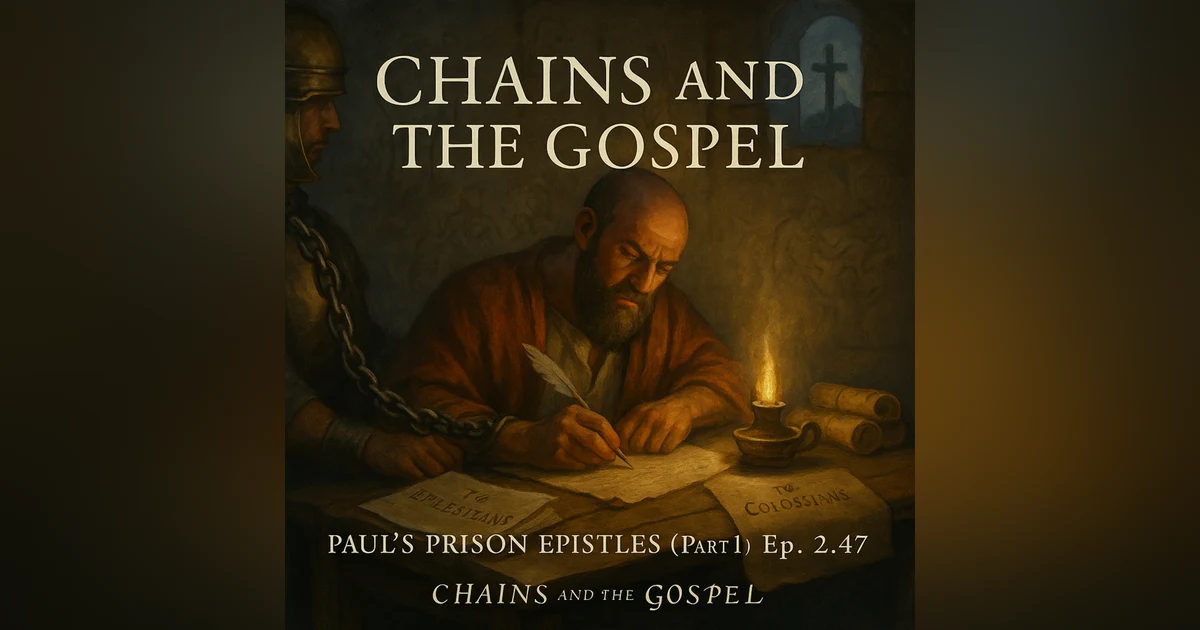
Chains and the Gospel: Paul’s Prison Epistles (Part 1)


 RSS Feed
Episode 2.47
What would you write if you were chained to a Roman guard for your faith? Complaints? Regrets?
Paul wrote joy.
In this episode, Zach and Michael explore the first half of Paul’s Prison Epistles—Ephesians and Colossians—letters written not from comfort but from captivity. These epistles remind us that Christ’s lordship isn’t limited by our circumstances, and that the gospel still advances even when the messenger is confined.
Covered in this episode:
– How Paul’s imprisonment shaped his theology and tone
– The supremacy of Christ in Colossians 1 and the unity of the church in Ephesians
– Household codes and how the gospel reshapes family and work
– The connection between Paul’s chains and the church’s mission
– Why the church remains God’s “Plan A” for displaying His glory
Next time, the journey continues with Philippians—Paul’s letter of joy in suffering and the great Christ Hymn that reshapes how we think about humility, glory, and worship.
Find our videocast here: https://youtu.be/64F7cOg2m10
Merch here: https://take-2-podcast.printify.me/
Music from #Uppbeat (free for Creators!):
https://uppbeat.io/t/reakt-music/deep-stone
License code: 2QZOZ2YHZ5UTE7C8
Find more Take 2 Theology content at http://www.take2theology.com
0:00 Is it offense? When will this air, by the way? Tomorrow. Tomorrow maybe stick free. I is it offensive if I like ask like during my Sunday school? Hey, if you're a Lord of the Rings fan, can you raise your hand? Just trying to see where the nerds are at Think I'll lose the crown. I'm not going to do it, but I thought about it. I just I. Don't think this is going in the podcast. Totally kidding, I would do this. I would do this. Most of us wear the badge nerd proudly, so we're not going to be offended that's. Right, you know it just. Means we know how to get it done, yeah. That's what nerds tell themselves. Yeah, no, just kidding. I don't want to get beat up after church by angry mob either 'cause I'm sure there's a lot there. Are quite a few Lord of the Rings. Fans and I would not say that like meaning like I don't really mean it.
0:44 I don't know if people really know my sarcasm that well. So I might, I might lean away from it, but I thought about it, you know, just spice up Sunday school, you know, get it, get it spicy. In there, I think that they they would appreciate that you can say, OK, Michael, can you like go teach a different class or something take take them away I. Also, I will put this out there. There is also I'm I'm debating throwing in a snake joke in there. So you're going to want to be there. You're going to want to be there. It's going to be a clap. Crowd pleaser. Just think Lord of the Rings and Snakes. What more could you? Hope tubas. You throw that in and it's like you got the trifecta, you know? I don't know why I forgot about tubas, man.
1:25 I I should, I should, you know, weasel in tubas some way, but good. I've got something I think is going to really resonate with Lord of the Rings fans. You know, either resonate or repulsive. Like, I don't know what the right word is, but it's something like that. It's good. I'm excited. It'll be great. You ever been to prison, Mike? Prison, Mike, Yeah. Yeah, I like that. Prison. Have I ever been to prison? Yeah. No. Have you? You don't know me. You don't know my my background. Maybe I spent 10 years in the clink. Clink No, I have been. To prison in college we would go to. Do prison ministry.
2:07 Prison and play. It was really like, you know, juvenile detention center and play like football with them, like, you know, so you know. By football you mean soccer? No, no, I know I wish soccer played some American football, but yeah, you know. Flag football. Yeah, but yeah, it was it was like tackle. No, I'm. Trying to do the logistics of like everything that's 'cause when I when I think football, it took me a while to go. Oh, they were were not in helmets and pads. Oh, gotcha, 'cause I just like pick up, like throwing it around, throwing the old pigskin, you know? Yeah, what you do at recess kind of thing is what we we kind of did. It was fun, but that's my extent really of prison.
2:49 Yeah, I mean, I was in elementary school like most of us. Oh yeah. That's a prison. It really is a prison. I've never those elementary school teachers. They have arbitrary rules that just lock down behavior and freedom. They enforce those rules that that don't make any sense and they just. All personality, you know, uniformity. Yeah, yeah. And obviously not all of them, but yeah, by and large that I mean, and you get it, they're dealing with a bunch of. Kids. And then Leanne. He gets it. He gets it. But you know. Yeah, I've never. I just don't understand why I feel like everyone we talked to or everyone everywhere says what a bad system to have kids sit for 8 hours.
3:40 I don't I don't understand. I guess there's no alternatives. Like if everyone says it's so bad, I don't I. Yeah, I've never. Even like that's when it's like this is like ideal for a 10 year old just to sit and not move and learn rote facts about, you know, the mitochondria being, you know, the powerhouse of the cell. Are they learning that at in 4th grade? I don't. I have no idea I. Don't know. Yeah, but it's not. It's like, I feel like everyone's got a criticism and they're like, studies show that people learn better in this, but I we just don't do anything, you know? Yeah, it's hard for me. I I was one of those kids who I did well in school. Yeah, yeah. But I still bristled at the, you know, the the things that just didn't make sense, Like this is just a rule for the sake of a rule. And I and probably most I, I don't know, I, I don't want to sound probably most kids are not thinking that way. I know that I was weird, you know, different. I wasn't the, so, you know, I remember being in kindergarten and just talking all the time and let my mom sit down and it was very like, you have to decide. And like, I don't know, like she turned to switch at me somehow, 'cause I got from there on out, I was like, OK, I won't, I won't talk.
4:59 I'll just learn. I don't know how it's like. They just switch. Yeah. It's one of those weird things. It's like such a system where, you know, I bet, I bet I would have learned way more like doing more hands on stuff, being active, more back and forth. But at some level it's like, you know, just sit there and take tests and stuff. Like to, to me, I probably did better in life because that was the system versus like actually doing stuff and learning stuff where I can like learn a lot. But I can reflect on a test that I know way more than I think I actually do. Or I could know something superficially, but not know it on a deep level, but test really well. Do you know what I mean?
5:41 Even it's like, it's like I don't know. And other people I think know this stuff better, but they just don't test well or something. You know what I mean? I don't know but. So it's prison. Just a prison. Yeah, yeah. And Paul was in prison for a while. Yeah. Do you think he would like the comparison between, you know, elementary school? What you went through, I'm sure his was a little bit tougher than elementary school. Probably so, but yeah, wrote, wrote, did a little bit of writing in in the prison. We're on the series on Paul and we just don't have the the time to go through every single letter he wrote. We can group them, you know, nice, nice and neat in different different categories. So quick, the books that fall into this category, what are they?
6:25 We got the a lot of the IANS kind of go together, you know what I'm saying? Like Philippians. Well, I guess a lot of the letters he wrote were IANS that aren't prison personal. But I always think of the ones that go together like Colossians, Ephesians and Philippians are what I think of. And then if you want to throw in, we talked about Philemon already, but those are like the three that kind of go together. They they sound pretty similar, especially Ephesians and Colossians. Is there anyone in there that I missed that's like additional? Yeah. I think that those are it some well, we've talked about Second Timothy, yeah, under the Pastorals. That's true. Probably he may have been some type of locked up when he wrote Second Timothy, but I don't think people normally consider that a prison epistle. Yeah, I don't.
7:09 I don't. I don't think so either. Buckle up. Yeah, we're going to get into the prison epistles. Let's go ahead and take it to the next level. From the hearts of the Low Country in South Carolina. It's the Take Two podcast where we take theology to the next level. All right, Well, let's jump into these prison epistles. We've kind of talked about the books at hand, Philippians, Ephesians, Colossians get thrown by Lehman in there. But why do we call them the prison epistles, Michael? Because it feels like prison when you're reading them.
7:51 Is that it's? Not correct. Yeah, if you yeah, not not the right answer. But Paul was was in prison and and he's like, you know, I think they stand out. You, you, you know, Ephesians, I feel like it's a lot of play like this great book. Philippians also, you just think like joy when you think of Philippians, you think of these books and you're like, man, some pretty, pretty great things. Maybe not totally what you would expect if you were in prison. Yeah, and just because I'm probably more of a theologian than a historian. OK. Yeah. So are these all written from his Roman imprisonment? I I mean, that's what you got here. So I assume that's probably it. Not his.
8:33 Yeah, not his Caesarea Maritima. Imprisonment. That that that, that that's what I would think. I think that these were all generally, yeah, written around the same time, give or take, especially Ephesians, Colossians, like so similar kind of they're carried off. You know, if you read the different books, they're carried off by different messengers. You know, he's writing from prison and messengers are kind of delivering it. And these do a really good job of focusing on what's really important to Paul. It's like, man, you're in prison. You don't know what's going to happen. What's he write about? Some pretty some pretty weighty eternal truths that it's like man, that that I think we some of our like our go to passages are in these epistles. And so good to look at these together. A lot of similarities, a little bit of, you know, differences between the books, but a lot of things kind of stack up together.
9:26 So let's talk about what what are some of these major themes that we find in the prison epistles? Yeah, and I see the first one here, the supremacy of Christ, Colossians. Those those opening verses are some of my favorite because you see most clearly, you know who Christ is as creator. You see him as a sustainer, you see him as the image of the invisible God, the first born of all creation. So if you're in prison then that helps you look vertically probably. Yeah, I feel like such a such a go to text beginning of Colossians, Yeah, that that stands out in a major way.
10:09 If we were to look at Ephesians 2 and Philippians 2, we see an emphasis of Ephesians, you know, 4 as well a little bit this unity in the body of Christ. You can imagine that Paul sitting there in prison really thinking about what's what's important. And I think of Ephesians particularly, you think of Jew, Gentile, this division. He knows, spends a lot of time on that. Right. And then I think you did mention Ephesians 4 because that's where he starts going through, you know? Yeah. All the ones, yeah. And you know, we have diversity of gifting, but we should be 1. And this is like for counseling. You'll hear Tim a lot of times go to this, you know, as much as it's, you know, to to the unification of the body and and stuff. And he'll ask, you know, are you doing this? Is this unifying to the body?
10:53 If not, then we probably should double check ourselves. Yeah, you kind of see what's what's really important and we see supremacy of Christ. Colossians 1, Ephesians 2, Ephesians 4, Philippians 2. Unity. And then when I think of Philippians just as a whole, I just think joy, you know? The joy, joy, joy, joy. There you go. You read a lot about him rejoicing and joy kind of you see this word like all over the place, kind of unusual when you, you know, juxtapose it against his situation. But it kind of shows you that when you're suffering, that joy is still to be had. I. Think there's a couple songs that come out of this because there's rejoice in the Lord always. Again, I say rejoice, yeah.
11:34 And that's like a direct quote out of. That that is. A feat for. Yeah, that's great. A lot of good, good stuff here. And then we already talked about 5 Lehman. But you just wanna, we're not gonna talk about 5 Lehman a lot 'cause we already did. But just, you know, keep that in your mind that the gospel can transform this these relationships. So let's maybe get into the book. We can go, you know, brief outline talk through, you know, that not only the outline, but different themes that kind of pop up. And we're going to start with Ephesians probably. I don't know, out of all all of these books, to me, it feels like the best known just because of chapter 2 alone or the one that gets hammered. It's like the verses you memorize so much. But that's not we.
12:20 It doesn't start in chapter 2, he starts in chapter 1. Also very, very profound. He didn't just start like, hey, I'm going to start in Chapter 2. What a move, what a power move that would be. Honestly, Paul should have thought about it. I maybe I'll write a book and just start like chapter 3. Be like boom, like more productivity. Start in Chapter 3. Ephesians is Tim's speaking Tim again. Favorite book? Yeah. Yeah, that's right. He's he's talked through Ephesians a couple, I mean several times I feel. Like and he says I can never remember this word when I need to, but it's doesn't have an it's it's a non occasional book. Oh, because it doesn't have an occasion. I, I, I, I, I I'm familiar with this categorization. Yeah, it's always like weird to me, like just the just the framing of it. But yeah, that's.
13:02 Good. That's good, because it's not like he's there's something that he's trying to address in the. Like Galatians, there is an occasion with these Judea. Isers right and like with the Corinthians, lots of occasions. I'm always thinking like, is it Christmas? Like like what? What? You know what I mean? I know what it means. But in my mind, I'm always like, you know, the fancy occasion, you know, and. It breaks down really nicely into the three Geology 3, You know, doxopraxy, orthopraxy. Oh. Yeah, there you go. Yeah, that's right. Breaks out so nicely. After he gets through his greeting, we get to this, you know, section verse 3 through verse 14. And it's like famously known for just being like, not an English person's favorite thing, 'cause it's just one, one long sentence. I don't.
13:45 Know you know well, but I think it's a Greek person's favorite thing. That that's true, that's true, that's true. Where in our English translation we do punctuate it and we have sentence breaks and stuff, but in the original Greek it just keeps. It just keeps running. Yeah. And I well, and and you know that because you've studied Greek, your Greek scholars. Yeah. But. Like the words are so much exacting somewhere because, you know, you can tell what's the subject and Oh yeah. So it's not as difficult because if you have even a name, it's going to have a suffix on there that will tell you if it's a suffix or if it's a subject or a predicate or a direct object. It's such a good way to do language where you can like just the order is more of emphasis, but everyone you always know there's not like a sneak attack, you know, makes sense. So it's it's OK in the Greek.
14:37 But yeah, so lots of times we talk at the battle of spiritual blessings, like all the blessings you have in in Christ. And, you know, I know we're going book by book, but this first chapter in Ephesians wraps up very similarly to Colossians where it talks about, you know, everything being wrapped up in, you know, in Ephesians. I think it says footstool. You know one of them it says footstool. We'll see. That that that's right, while while you're looking that up too. And if you find it, feel free just. Yeah, and you put all things in subjection under his feet and gave him his head over all things in the church. Yeah, so. And you're in this chapter 1, you see, like specifically in this verse 3 through verse 14, this, you know, in him in Christ, it's like every other phrase you like counted up and it's a bunch of of these times you can't you can't escape all these blessings being in Christ.
15:33 Anything else you want to hit on Chapter 1 before we just kind of keep moving through this book? It's a favorite chapter for sovereign grace people before the foundations of the Earth. Yeah, I love, you know, hey, it, it is hard to like read it and be like, well, well, it's really means something different because it's it's pretty, you know, strong. Yeah, there's one friend. I don't, I don't even know if he still listens. Maybe he'll comment if he does. But he takes all those in Christ to say that the Father just predestined Christ and that any who happened to be in him. I'm like, I don't think that's what the text says. Crazy. You got to judge for yourself, though. But. I don't. Think that's how the text reads. Well, that's a good point. That's chapter 1.
16:14 Chapter 2 Saved by Grace through Faith I I just feel like man, it is just all of scripture is just great. But man, it just like you read all the way through and it's just like hitting it's setting it up and then it brings it just it the whole way through. It's great. It is great because it talks about our our condition without Christ and then how? Also, Sovereign Grace, people like this too, you know, I mean, I think everyone, I don't think, you know, our minions are like, I don't, you know, but we really lean into this Children of Wrath kind of stuff. Yeah, because it says, but God be much of mercy, you know, while we were even dead in our trespasses, made us alive with him. And then it goes through basically Our Calling as believers. 9 and 10.
16:59 And then he talks about how believers, and these are the two biggest categories that you can talk about again at that time, Gentiles and Jews, how they are separate. But the Gentiles are now brought in near and they were once far off. And now that dividing wall has been brought down so that there's one body, a Jew and Gentile. And he talks about, you know what? This is where we get the imagery of, you know, building on a foundation of the apostles and the prophets with Jesus as a cornerstone. And then all of us, Jews and Gentiles alike are like this building, you know, so that we're all the body of Christ that he's a head over. So I love how. All of that is like connected like that. He starts with your dead, saved by grace alone through faith.
17:41 And then he just all that flows together. This is an aside, but RC Sparrow has like this class where he's like teaching seminary students and he, he spends like literally like 10 minutes, like it's a long time where he asked a guy to like come up to the front of the class and he's like, OK, you are gonna act. I don't think it's this text. I think it's a different text. But he he's like, OK, I think it's systematic theology course. But he's like, OK, you were dead in your trespasses. Act like a dead man. I'm gonna try to do whatever I can to like, engage with you, just pretend you're dead. And he just like belabors it for like 10 minutes straight, like doing different things. Like if you're dead, you can't do anything. But it like really like hits the point. But it's like incredible because it's just like, OK, we get the point, but he just like, keeps going.
18:23 With it, yeah, you're not going to get around this. That he's dead, like he's not going to do anything halfway. Sounds good. Anyway, that's chapter 2. We kind of in our, in our outline here bridges chapters 2 to 3 because it talks about this mystery and we see this word mystery in Scripture. We have no idea what it means, right? It's just like a total mystery. Yeah, yeah, yeah. It's like we got to wait. Maybe the Pope knows. The Pope knows real really speaking to this Jew, like how is God going to work in redemptive history? We can kind of see that on our side of things. But you know, looking at it it, it was mysterious. Like how is God going to reconcile all these? Things my understanding of Paul's use of the word mystery is something that an Old Testament person would not have understood but now with the revelation of Christ, it's been made clear at least more clear than what it was how it's going to work.
19:20 And I like, you know, it's Paul interrupts himself because it seems like he's going to start praying in verse one for this reason. I Paul, the prisoner of Jesus Christ for the sake of the Gentiles. And he's like, you know what, I need to talk about the Gentiles more. And he goes into this like interruption between verse 2 down to verse 14. And then he picks up with his prayer again, for this reason, I bow my knees, you know, because he is just reveling in his call to minister primarily to the Gentiles. You know, he'd always go to the Jews first, but he recognized that really his calling is to share the gospel with these people that that didn't know that's.
20:04 Great. And then he kind of ends this chapter now to him who's able to do far more abundantly than all that we ask or think according to the power at work within us, to him be glory in the church and in Christ Jesus through all generations, forever and ever. This kind of ends the prayer there. And that's like you were saying those first 3 chapters laying down the doctrine, like laying down the groundwork, like why? Why would we live a certain way? And then we kind of we we see a little shift coming soon in, in this letter. Yeah. And The thing is, it's not like, hey, therefore go, you know, do this, go, you know, it. The, the, the very after all that great theology, his very first application is to be humble and gentle, 'cause he says, therefore, I, the prisoner of Lord, implore you to walk in a manner worthy of the calling which you have been called, with all humility and gentleness, with patience, showing tolerance for one another and love, being diligent to preserve the unity of the spirit in the bond of peace. That's the thing that Tim will always diligent to preserve the unity of the spirit in the bond of peace. Man so so good kind of keep as we keep making our way through this chapter.
21:21 He talks about speaking the truth and love all of these things for, you know, to equip the Saints for the work of the ministry, all these things and then halfway through chapter 4 talks about the new life that that these Ephesians have no longer walk as the Gentiles do in futility of their minds. They're darkened, alienated, all these things, hardness of heart. Again, kind of talks about the state they were in, callous, greedy, full of sensuality and impurity, but you learned Christ. And so something we see in Paul this this put off and put on. It's not just like don't do these things, but let's replace these things with with different actions and and behaviors as we learn to walk worthy of of our new life in Christ. Yeah.
22:09 And he continues that idea with you know, our hatred like anger to take off, you know, the malice and clamor clamor replace that to take off our lusts and to lay those aside take off speaking falsehoods, but and said, you know, speak truth which one another. So just a lot of practical stuff. There's a gal that was in our youth group that anytime she said anything that had that wasn't nice or that had a curse word in it that her parents she got to to write down 29 Let no one wholesome word proceed from your mouth. Always such a word as is good for edification according to need the moment so that it maybe give grace to those who here she had to write that verse a lot.
22:57 Nice, yeah. Not Jill. Not Jill. Different girl. Good, I'm glad, I'm glad you clarified. Great. Chapter 4 ends right on going Michael is saying dealing heavily with with our speech. And then chapter 5 tells us to walk in love and and what that looks like. He kind of goes into different, different ways to walk in love as children are the light and then gets to wives and husbands, which, you know, a lot of people love this. A lot of people love how it starts. Hot wives submit to your husband's film and then he stops. Right. Well, yeah, just point out the verse above that because you know, those those pericopes weren't in the original. So the verse above it says be subject 1 to another fear in the fear of Christ.
23:46 And then he's going to go, he's going to kind of get down South in some sense. We're all supposed to be subject to one another. And then he's going to lay down some more specific relationships, the husband wife relationship, the parents versus children relationship. He'll get to that in six and they'll get to employer employee relationships or master and servant. You know, I was reading the sorry shorter side parable of the talents to my math class because it was like, you know, where it says those who have more will be given because there was this bonus project and the people who had the best grades of the bonus and the people who didn't didn't.
24:30 I'm like, it was just like this, but it used the word slave. I'm like, I'm going to read this as servant because it was kind of more in line with what was there, but yeah. But it's it's great gets Paul gets very practical. He's not just saying, hey, walk in love with everybody. He like, he like is ironing out what that looks like. Yeah, and it might be different than what the New Agers would think. Love is in in the Bible because it's actually, you know, the fulfillment of the law. Yeah, absolutely true. So hits all these different categories and then chapter 6 we're hitting the Armor of God. That's right. It's like I feel like Armor of God is just like classic VVS and school memorization. It just like lends itself so nicely for something like.
25:11 That and for all of you who like Zach, I, I only give this one for because not me, but for people like Zach who like to like play fantasy games or something, you know, you can think of like a character who's like leveling up their belt of truth, you know, through the study or leveling up their breast prate of life righteousness through sanctification or leveling up their shoes of the gospel for the, you know, as they go and they share the gospel around. So you can think of it like you all have it, but you're. That's right, yeah. As you grow and mature, you're leveling those up. I I don't really get that. You're like, I don't understand. That type of idea. But I know, Zach, that, yeah. You know, I'm not totally anti sci-fi. I'm actually I'm pretty anti.
25:57 I don't know what it is about sci-fi. That's what gets me. You don't like sci-fi? It's not my favorite. Yeah. You like? Fantasy more than sci-fi I. Like both equally tip. Not very much like when I was little. I mean, I could there's certain things I could get behind. Yeah, I don't know. Yeah, I would. I'm trying to find. Like football movies? Yeah, yeah, yeah. We're dealing with that next. So I am. This is a little behind the scenes action here. Where are we at time wise? Because of where we started. Yeah. I mean, should we tack on another book or should we sever this into a different pod or what? What's the move based on our how fast the pace we're moving? Yeah, I was looking at that too.
26:43 We spent quite a bit of time on infusions. We Colossians is pretty parallel. That's true. You wanna you wanna hit Colossians. So it's like, let's do that. We'll skip down to Colossians because it is so parallel. We kind of gave you a teaser with with Chapter 1, so we'll jump in right there to talk about the Supremacy. I know Michael, you kind of almost like quoted this a minute ago, which was great. And the prayer in chapter 1 is my personal favorite prayer of Paul's, you know, so if you want to pray a prayer, prayer for me and you want to be 1 of Paul's prayers. But yeah, there's the prayer there. And then at the end, it closes out with this lifting high of Jesus.
27:24 And then it talks to start talking about in chapter 2, you know, us building being built up in Christ and you know, this idea of us being rooted and grounded in him and us having this, you know, this heart of love that flows out of of knowing him. You know, I, I will say this too, I don't know what your take is on this with the Colossians Church in particular, if we are in chapter 2 when it talks about see that no one takes you captive by philosophy and empty to see according to human tradition, then it says according to the elemental spirits of this world, you know, are, you know, some people are like philosophy, Some people are like actually like demonic worship is underneath some of this. And later on it talks about asceticism and these kind of, maybe it's kind of vague, but maybe it's more nefarious than just like I'm going to engage in worldly philosophy, but it's kind of like more undertones that maybe are a little darker. Have you heard this before?
28:20 I've heard people talk about it. And so it says, see to it that no one takes you captive through philosophy and empty deception according to the tradition of men, according to the elementary principles of the world, rather than according to Christ. So some people have used this verse to try to say philosophy is bad verse. Verse 8 that's. What I use it for and I'm like, no, that's not what Paul is saying. He's saying our philosophy needs to be aligned to that what Christ believe. So if our philosophy is what in the line with what Christ would believe, then we're good. But we don't need to have philosophy that is according to empty deception or traditions of men or the elementary principles of this world.
29:07 Now. Yeah, go ahead. What those are is probably anything that's not in accordance with Christ. So obviously anything that's demonic or anything that is. And when I was saying philosophy, I wasn't meaning like sound philosophy, but I was meaning like, not like necessarily the discipline of philosophy, but like, you know, like people should love each other. So we're going to be accepting of this like, or, you know, like that kind of thing. Later on in chapter 2, it will say, let no one disqualify you because they insist on asceticism and worship of angels going into details about visions. So some people like connect those kind of things with what we were just saying. And like, maybe there was a lot of this in Colossae where people, which would be like too far down the road that they're worshipping false gods or whatever. But some people are like people having visions and, you know, leaning into this.
29:52 And Paul is really combating this. Although I, I think there's good and I kind of blame that that stuff's probably going on. It's kind of hard to say exactly, exactly what and how much 'cause it's a little bit vague, but it is interesting, you know, connecting those dots that that was where I was going. I wasn't really trying to say like, philosophy's a waste of time, you know? But I think people do that. Probably, but people do. Yes, yes, yeah, that's. I was. I wasn't saying you were saying that, but I was wanting to 'cause I have heard that and it. Yeah. And when you have a master's in philosophy? Yeah, you gotta like you, you like. You know, yeah, yeah, yeah. No, that that's great there. There's a lot of other stuff we could spend time on. In chapter 2, a big overarching picture is being made alive in Christ. Then we get to chapter 3 where we put on the new self that this, you know, we've heard this a lot. If you've been raised with Christ, seek the things that are above.
30:43 Set your minds on things that are above. We kind of have again this idea of putting on, putting off, or putting to death the these contrasting thoughts. And I was thinking I start, I was some of what I was saying is in chapter 2 is actually in Chapter 3. This is the first I was thinking about let the peace of Christ rule in your hearts to which indeed you were called in one body and be thankful. So this idea of being putting on love, seeking perfect the bond, perfect bond of unity, so very similar to the main ideas that we talked about in ejections Chapter 4 and following. And then maybe being in in subject and subjection to one another because the end of Chapter 3 would start talking about those family relationships again wise. Be subject to your husband's children, be obedient to your parents.
31:32 Slaves obey. You know everything that your masters say. Masters, you know, be good to your slaves and be fair. So all of these, you know, how we interact with each other. And I feel like we always have to disclaim that this is not, you know, 17th and 18th century. Yeah, good. You know, chattel slavery, you know, it's not. It's not. What it is, Yeah. And then from there, really, he's closing out the book, gives, you know, this list of instructions. Yeah. We read continue in prayer be even Thanksgiving. I'm walking wisdom. Let your speech be gracious seasoned with Saul and then he's just greeting people left and right. You know name dropping a few people and I like how he like ends.
32:13 I Paul write this greeting with my own hand. Remember my chains Grace be with you. Sounds good. Ephesians. Colossians. There you go. There it is. Next time. There we go. We'll bring. We'll close out the prison epistle with some joy. That's our take. Thanks for listening to Take 2. Find us wherever you find podcasts and on YouTube for those who want to watch our video cast.

