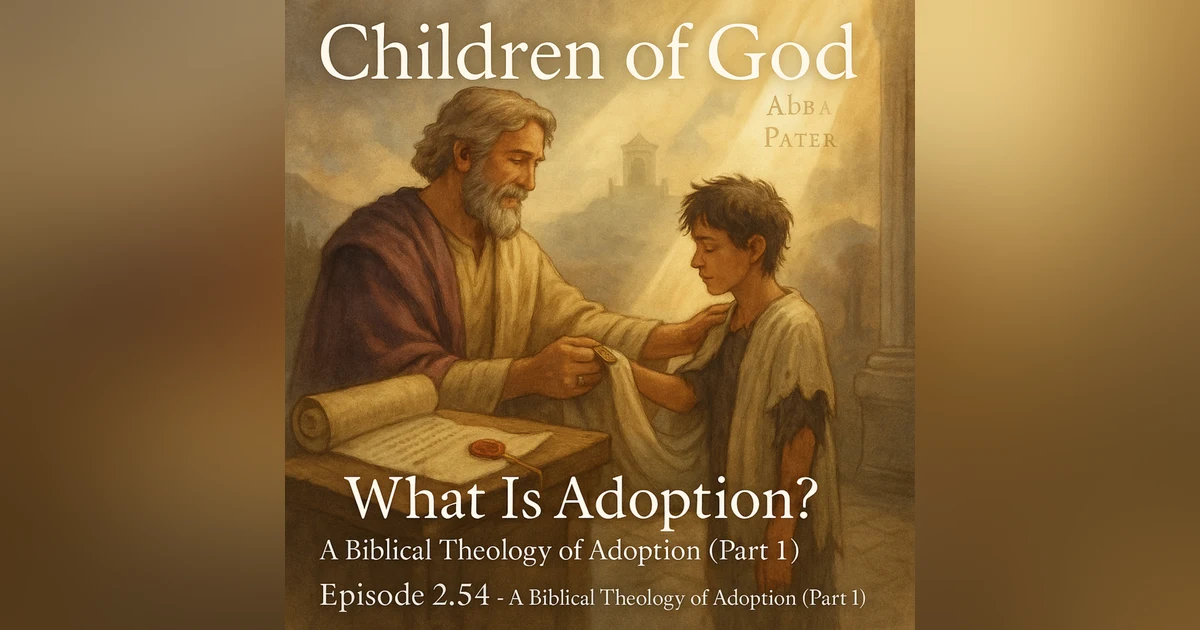
Children of God — A Biblical Theology of Adoption 1 | What Is Adoption?


 RSS Feed
Episode 2.54
Adoption isn’t a side note to salvation—it’s the summit of it.
In this opening week, Zach and Michael explore what Scripture means when it calls believers “sons of God.” Drawing from Ephesians 1, Romans 8, and Galatians 4, they unpack how adoption is both legal—a new standing before God—and transformational—a new likeness to Christ.
The discussion follows the ordo salutis to show why J. I. Packer called adoption “the highest privilege of the gospel.” A look at first-century Roman adoption sheds light on Paul’s language: adopted children received full rights, name, and inheritance, not as second-class heirs but as true sons.
Takeaway:
Adoption reveals the Father’s heart. Through Christ, we’re not just forgiven servants—we’re beloved sons invited to live like heirs of the King.
Find our videocast here: https://youtu.be/zi95UDXfklo
Merch here: https://take-2-podcast.printify.me/
Music from #Uppbeat (free for Creators!):
https://uppbeat.io/t/reakt-music/deep-stone
License code: 2QZOZ2YHZ5UTE7C8
Find more Take 2 Theology content at http://www.take2theology.com
0:00 What's up, Zach, Michael? The styling. Yeah. So sometimes we do some things that are visual for YouTube audience. We kind of had to do some description. Zach, you are wearing a fedora. Michael, you were wearing a fedora. And it's very odd. I just got mine, just arrived today. Nice. And you just got yours. Like last week they look to be of different quality. Mine may have been 649 like $6.49 off at Amazon. Yeah, yeah. Mine was like in the $20. OK, yeah, it looks nice. I was. I was amazed how affordable they were. Oh yeah. Oh, gotcha. I thought this was a a decent looking hat.
0:41 Like this hat probably cost someone $20 back in the 1920s. That's right, inflation. All the hey, you should where is the church next week? You should just be a Fedora guy, you know, Embrace it. So what was the occasion for yours? I got mine because for work at one of the assisted livings that we do a lot of business in, I try to participate in the events. They invited me to a murder mystery party with their stuff, which is great. Good for, you know, I was like great to get the invite cause mostly with their employees. It's good, you know, and my person I'm supposed to like wear like supposed to be kind of like nerdy got a fedora, supposed to have like a corduroy Jack. Yeah. I was like, are you typecasting me? And so yeah, my name is, I guess I'm a piano player too at a Speakeasy. My name is Hey.
1:24 Can I change it to saxophone player? Yeah, my name. I got to change my name too then it's my name is supposed to be Teklin Ivory. Tackling ivory knives and. But then they cancelled it Friday. They're going to do it in a couple weeks. So I had this in my car because it was supposed to be this past Friday. I gotcha. And this was my character, you know, I did talk. Was it did we say because we talked about maybe recording and you're like Friday, I can't? Yeah, that's yeah. Because I don't know how long this is supposed to last, but I was. It was going to be a big part of the afternoon. I think so, but you. Yeah, so I got mine was I'm surprised at how fast it came in. I ordered this yesterday. Wow, Amazon. Just. Getting it's just as crazy. It's like it you think about it, it shows up. I am singing in house for the holidays and I'm closing the show like and it's kind of one of those traditional, you know, belt it operatic kind of classical sounding that my wife doesn't really appreciate. But then I'm also opening the show. Wow, the open hand clothes.
2:25 I know I was just so I guess I was supposed to say I'm so blessed. I'm so blessed. But I'm singing a Michael Bublé version of Jingle Bells, and there's some, there's three ladies who are like, singing like. Oh yeah, that's. Cool. And and they were like, hey, you need to get they wanted me to get a bowler. And I was like, look at I was like, I don't know, that bowler is the right 1. And I was like, oh, I think Fedora is the look that we're going for. So yeah. So if you're in the Charleston area, I think it's December. I should know this offhand, I think. Sell some tickets. Maybe, I don't know, it's either the second or third weekend in December. So you don't have time from when this. Yeah, we've got.
3:08 Plenty of time. Oh, that's cool. Yeah, 'cause last time it was like a mini church event kind of it was like, you know what I mean? Like went to see. That was cool. Yeah, we're not having the Sunday afternoon 1, so it's only Friday evening, Saturday evening this year. It was just too, too much. I don't. Know I know the house for the holiday, the house. So house started as like for all the homeschoolers in the area. They didn't have, you know, especially if you're not a Fine Arts kind of person, it's hard. You know, like you can find someone to do math or you know, it's hard to do Fine Arts, especially if you're wanting to do it like as a group.
3:49 So they were started to provide a service for homeschoolers who wanted coral stuff or some band stuff. And then they also do some community stuff. Now they've grown. So this house for the holidays is a community thing and then they have house in the summer most summers. They didn't have it this last summer where they do like a musical gotcha. Yeah, just yeah, keep there's things going on. Yeah, you do the summer one or? No, you don't. I can't remember if you did. It or not So what what happened what happened was 2 summers ago I watched the little house on the Prairie and I was like I want to be a part of this and so I was like what's the next thing that's happening House for holidays So that's why I tried out last last year so this summer they were going to do Prince of Egypt the musical and I I don't know I'm I'm at a distance there were some changes in leadership I think they're trying I don't know I think they're trying to maybe they thought they were doing some too much or they were trying to like really hone in on the vision and so they just took a pause last summer from that so that they could kind of relook at everything that they're doing you know and so I I've been told I think they're going to do Prince of Egypt again this summer so.
5:10 There you go, Prince of Egypt, man under underrated animated movie. Yeah. And so the there is an animated movie and I think some of these songs are in. There, I think so too. And then there's also a movie musical that I think will be more true to what we'll be doing over the summer. Gotcha. Yeah, You're not doing the animated movie. That makes sense. Yeah. Yeah, yeah, yeah, yeah. I haven't seen it in a long. I haven't seen that in a long time. I remember when it came out, like I think I saw it in theaters as like a kid or something, but. So I would, who knows? There's a couple parts in there that I think I'd be well, who knows, Who knows? I don't think I'm going to be Moses or the brother of Moses who's like. The but the. Father of Pharaoh, that's the part I'd like to to be. And he sings this song one week link where he's like trying to tell his son like only it only takes one week link to ruin our dynasty.
6:09 There's also Zipporah's father, the priest of Midian. That may be another role that I might be in. Well, and a third role, the priest of Egypt, like the bad priest. Yes, yeah. I can see them wanting me to do. That I could. I typecast, you know, evil. I'm just kidding. Yeah, yeah, yeah, yeah. So I might do that too. That's cool. If he sings some stuff, it would be difficult for me to sing because it's like blasphemous. But he's but he's an evil. Character. Yeah. So it's like, how do you deal with that? Yeah. Yeah, man, maybe that's podcast episode. Yeah, as you, as you work yourself through that, you know? Yeah, I love it though. I know we should have just had the yellow hats too. We could just keep cycling through the hats, you know? You love the hat, the yellow hat. I mean, I, you know, I was wanting to serve, wanting to be, you know, rallying the team of the coaches for. Soccer.
7:07 It is a great concept. And great concept. Did you hear that? Great. Concept. No, I did. You let me just ask this. Did you wear it yesterday during the game? I had. I had a house for a holiday. Rehearsal know if I did or not. I have I. Have I? Have eyewitnesses reported that you did not? Wear that was a setup entrapments. I had it with me. If it makes you feel any better, which it won't. I wore my yellow coaches jersey for like all of the white team's game. Oh. That's good. That's good. Yeah, 2 wrongs don't make it right. Right. So but three lefts do. 3 lefts do make. That's the title of the Reliant K album. 2 lefts, 2 wrongs. I make a right, but three lefts do well. Our topic at hand maybe do a short series on adoption.
7:49 We're we're kind of running through this in Sunday school, so maybe we'll we'll. Do maybe at the end of this short series we will finally get that interview that we've talked about since the very beginning with with you and. Because when will this air? This will air not this Thursday, but next Thursday. See, this is beautiful because November is adoption. Month. Oh, there. Yeah. So this will be the first Thursday in November, Yeah. If it's really great, I'm super excited. Just a sneak preview, November 9th, it's like all the stars have aligned. It is adoption month. It is Jayden's birthday slash, Joshua's birthday slash. We're having a special speaker in Sunday school who is speaking 'cause she's from an adoptee's perspective.
8:30 She was adopted. It's her birthday and November 9th is. Someone at our church. Christ Daniels. OK, Jason Pretty And then it also is a special Sunday that many churches celebrate as Pure Religion Sunday, thinking of specific like orphans and foster care and a Dodger. So it's like all of it like on a Sunday, which is pretty cool. So I'm excited. Also side note, it's why I'm playing this service for this time because I've lined up really well. So it's it's pretty cool. So anyway, we won't belabor it. Let's go ahead, take it to the next level from the hearts of the low country in South Carolina.
9:14 It's the Take Two podcast where we take theology to the next level. Adoption. When was the last time that you sat in a study on adoption or heard a sermon series on adoption or something or something of that nature? Last Sunday. Before that, Before that. Probably I'm trying to think maybe it was you. It seems like maybe two couple of years ago there was something on did maybe maybe was there something in Romans that was like adoption as sons? Is there a passage in Romans that? Probably. Oh yeah, no, there is Romans 8 and Romans 9 talks about that, yeah.
9:54 Yeah. So probably when Joel was through there, but yeah, that's probably the last time. And and a reason one of the, you know, thrusts of this series. Well, I, you know, personal bias and experience with adoption, but I do think as a general rule, most Christians, especially, you know, Protestantism in the West, a lot of people when they study salvation, a lot of time on justification, probably a lot of time on sanctification, far less time on other aspects of the Bordeaux salutis. So we'll talk about that a little bit. So just to get the mind pumping 'cause I think we're all, it's one of those things everyone knows that we're adopting to God's family if you are in Christ, right? A lot of people think everyone's a child of God.
10:36 That's popular in culture. And and in some sense. It's true. Like an ex. 17 Creator, right? Yeah. Yeah. And to your point about, you know, what you focus on, I taught a whole series on salvation. I don't think adoption was in that at all, because I was talking about, you know, sanctification. I was talking about justification. I was talking about, you know, whether we choose or we're chosen. So there's a lot of different facets. And one of them, like you said, is this adoption. We sing a song at church called Jesus. Thank you. Oh, yeah. I like that song. Yeah. And one of the lines is once your enemy, now seated at your table, Jesus.
11:17 Thank you. Yeah, yeah, yeah, yeah. That's that's like such a it's like a classic song. It has a good rhythm to it. Like I like that song a lot, but but I think this is a good thing. It's like justification important. What we don't want to do is minimize things like justification and sanctification, right? Just want to kind of elevate adoption. I think I've got some good reasoning why we don't talk about adoption. And I don't think it's anything malicious like. We hate adoption. We're just. Not going to talk about it, but you know, it's that time of year. It's almost, you know, Reformation Day, material cause of the Reformation, Justification by faith alone. We recently did a Sunday school on justification, faith alone. We probably do 1 you know, not all the time, but but semi routinely 'cause it is an important concept.
11:58 We we see it a lot. When when I was teaching that were you like, man, he's just missing adoption. Oh yeah, I was like, oh, I can't no. And and this is one of the things I I'm pressing on adoption hard. I would hate for someone to wait this class and be like adoption is the only thing I don't think anyone is. I'm like hitting it hard to kind of balance counterbalance, but it's not like the you can make the same mistake with with anything else. And I should have done this for the banter. Maybe we'll do it one time down the road. Did the, you know, generics what, what's your view on generics name brands when it comes to food or these things? I know that's a broad subject. I think there are certain products that the generic is fine and there are certain products you better not bring the generic in.
12:41 Yeah, I think you had, you know, cereal is a a good one. Yeah. Although some cereals we do do the malto meal like shredded, frosted, shredded wheat. It's hard to do that wrong. That's true. But I mean, I guess you could probably do that wrong. But there there's certain things you would you would want the the the true thing. Yeah. Well, looking at the Ordos Salutis, I, I made a point of this, not to go into it in depth, but there's a lot of different things going on. I threw up a graphic and I'll, I'll run through it quickly. Election calling, regeneration, conversion, justification, adoption, sanctification, perseverance, glorification. There's a lot going on. There's probably several aspects that we probably just don't think about as much. Not, not saying they are our primary importance, but it's good to consider the scope, even highlighting how Paul talks about salvation sometimes it's not totally a past tense thing, right?
13:34 I think we think about it a lot. As you know, I'm saved, done with that. There's no, you know, ongoing aspect to our salvation. Yeah. And I, I remember. So you're going to, you're going to reference the generic versus brand name thing again, right, So. At some point, yeah. So it makes sense to the to the listeners while we said that. Oh, yeah. Yeah, yeah, no, that that's good. Yeah, we'll get that in the clear. The one of the overarching themes in this study is using pictures. Pictures are powerful object lessons, talking about what I'm calling horizontal adoption, the talk about which I would say would be like our earthly tangible physical adoption we see in our culture and comparing that a little bit with vertical adoption or adoption in Christ, because there's so many layers and pictures that we see that I think help us understand our adoption. So as good as horizontal adoption is, it's the generic. Exactly right.
14:28 And the name brand is our adoption in Christ. And that's like, wow, that has all the bells and whistles that that you would want. That's right, horizontal adoption greats. Vertical adoption, infinitely better. Just like marriage, great. Christ and his bride, infinitely better. It's like all these pictures we have. It's good that our world is just surrounded with these metaphors and pictures that we can relate to and see, and we can learn something about our God and how he's revealed himself. And we're also going to talk a lot about Scripture as well. But before we do, I was really Tim. Tim, did you know who this guy was? I would not have known this. You showed me earlier that day and I was like, I, I think I guessed is it is Tozer.
15:14 This is Ji Packer. Oh yeah, I guess. TW But J Yeah. Yeah, Tozer, and this is Packer. But he was like, that's Ji Packer. Right away I was like I would not have known this guy by his face but Ji Packer. Great book. Classic book. Knowing God, written in the 70s on the character of God, has a great chapter on adoption and he's got some really just powerful quotes that if you have not paid attention to or maybe if you hear him, you might say, wow, I see overstating things. It seems like he's giving a lot of credence to adoption. He says that adoption is the highest privilege that the gospel offers, higher even than justification. And to kind of follow that he would say to be right with God the judge. That's a great thing, but to be loved and cared for by God the Father, that's even greater. That's a good picture when you think about yourself in a judge. And if you can imagine, I don't know if you had any trouble with the law in the past, but to be like, I'm guilty, but now I'm declared righteous.
16:10 That's great. Tim has has kind of used the same thing. He's like, you know, what if you got pulled over by a policeman and you have that interaction with the law and how that feels, But he's like, now imagine that policeman is also your father and how it feels. And then obviously, if you add that to, you know, maybe a judge who is going to say, Hey, you're forgiven. But now that judge is your father and he's like, you're forgiven, but it's you're forgiven because I care for you and I'm going to take the punishment myself. And so this this adoption ideas is strong. All of these metaphors and pictures roll roll up together. And then I like this last one, he says. Our understanding of Christianity cannot be better than our grasp of adoption. We we should know.
16:55 It's like adoption. We're all familiar with it. You know, it's something we should talk about, talk about more. So let's talk about it. This Greek word, who we Ephesia is the word in our Bibles that is translated typically not just as adoption, but adoption to sonship or adoption as sons. The whole phrase is captured in this Greek word. And when you're looking up this Greek word, you read the different, you know, commentators on it. And then This is why I think we don't talk about it as much as justification or sanctification because it really at some level encompasses both. And especially there's a guy, David Gardner, he is like the systematic theology chair of at Westminster Theological Seminary, which it used to be held by a guy named John Murray, who I think people have heard his name.
17:41 He's a popular theologian. He, John Murray would say that adoption is the apex of the Christian life. He kind of has the same thing. And this guy, David Garner, he's kind of breaking down this word. We have to see. It's a compound word from to place as a son, adoption to sonship. And he says that it is illegal. It's forensic, just like justification, but it's also transformative because of God is your father. If you have a loving father who teaches you how to live, who teaches you right from wrong, you naturally begin to resemble your father. That's like kind of both of these things and I think it just in some level easier. To like, so I, I think that's perfect.
18:23 If you think about your adoption of Jayden or Jackson, a legal transition transaction has happened, but clearly it wasn't just OK, now you're gonna, whenever I die, you'll have part of my will or whatever like that. It's like you're building into their lives and they're being transformed, in a sense, into your image. Yeah, no, that I I love the way you put that words like there is some there, there is some change that that is almost necessary. If you truly are a child of someone you know much more with God than humanly speaking. Great, great points. We see this word in five different instances by Paul, Romans, Galatians, Ephesians. And so you know, these are passages you probably have see or have read at some point in time. We this whole series in Romans, like we've read, we've read you've you've heard these before. And it's in Romans 8, like this popular chapter talks about, you know, we didn't receive the spirit of slavery, but we received the spirit of adoption.
19:23 A few verses later it talks about that we wait eagerly for adoption. What's interesting about Romans is that you see also this dual nature. When I think of adoption, I think of past tense as. Well adopted. Done. It's done. But like pressing on this word, there's a part where we wait for it eagerly, like we wait for the redeem or redeems bodies. Romans 9, Paul talks about adoption as Israel, as God's adopted son. And in Galatians 4, Ephesians one, we'll we'll kind of dive into those later. But as I was reading this, I was like, man, adoption's so important. Ji Packer's saying all these things. It's only mentioned five times in Scripture. Even adoption, Septuagint, Hawaii, Ephesia.
20:05 Yeah, OK. Even in the Septuagint, not in the Old Testament, in the Greek version of the Old Testament. And you're like, well, if it's that important, like, wouldn't we be talking about? Right. It's like, well, I don't want to steal any Thunder. There's go, go for it. Yeah, that's like, you know, the Trinity. It'd be beautiful. Yeah, that's what I was thinking too. Very, very important. Like so that's like so important. Like, that's like a test of orthodoxy, right? Right, but you don't find any word that actually translates as Trinity. And so, so adoption has is, is up because at least it occurs, you know, four or five. Times yeah. And, and if you you know, reading, I've I've been reading a lot on adoption and specifically I'll talk about this guy David Gardner. He's got a great book.
20:45 It's almost like really strong theologically, it's just kind of like a not a drudge to get through, but it's like, I would probably not recommend it unless you're like really wanting to like deep dive in the fine details of adoption. But he makes the point like we were saying the Trinity incarnation. We don't see these words in Scripture, but we see a lot of passages in Scripture that mentioned that mentioned sons of God. We see a lot of passage that talk about children of God being a child of God. We see a lot of passages that talks about our inheritance or being an heir who are heirs. Sons are heirs that that should automatically and and daughters can be heirs. I'm.
21:25 Looking out for you ladies and. This is that's right. And and this will be important too. I will, I will mention this next week in Sunday school. But, you know, maybe we can read into things. Yeah. Why is it adoption as sons and not sons and daughters? Like, is there anything? There's all just a major sexist, you know, like, you know, but. Probably in that culture it was only the sons adoption. Here, you're exactly right. It's actually elevating the status of of women in that culture. Yeah. So wow, wow, because he's talking to ladies and saying you're going to be adopted as son I. Think so. And even in Galatians 3 we see that, you know, slave free Gentiles and then later on just in chapter 4 verse 4, he's saying adopted to sonship. So slaves are everyone's getting that. Right, everyone's getting an inheritance. Wrongly cut.
22:07 It's like pretty. Crazy, right? That, that, that, that that's right where it's like, wow, when you think of it that way, you're like, actually, it's probably better he didn't say sons and daughters. If you're trying to be, and some of our translations smooth it out. Consider both those things, you know, and then the clincher is really God as father because that's like everywhere in Scripture, particularly Jesus is talking to his father. And I asked this quiz question because I didn't know this, but God is explicitly referred to as Father in the Old Testament like 12 times, like 15 times. Maybe you can read in some implicit a little bit more, not a lot, but it's there. It's like, not that it's absent, it's definitely there, the New Testament, the usage.
22:48 Goes way up, yeah. So if you're a listener, kind of think in your mind how many times you think Goddess Father is used in the New Testament. Just kind of think what that number is. 12 or 15 in the Old Testament New Testament Jack White shout out 300 and he was sure he was on the right track. But it's over 500 times I was. Amazed by that when you said that and and Sunday's claw was like wow, 500 that's crazy. It's a lot, and obviously a lot of those are the gospels, but a lot of those are everywhere else as well. It's like, and there's a lot less text, you know, it's all kind of crammed in there. So, so all that to say, it spaked into the text like it's, it's almost on every single page of our New Testament, right? You can't, can't escape.
23:30 And we know this is true. It's like one of those things I don't think anyone's saying I didn't know about adoption, but it's like we don't think about it through that lens. Do you know what I mean? The paradigm is all slightly different. I don't. Know that is good because you know, every time we pray, probably you probably pray to the Father. I mean that, you know, and then you may say that's right in Jesus name, but you know, I open all my prayers. I always think about and I don't know if I'm giving Jesus a short thrift, but I'm always thinking I'm praying to the Father, you know, through coming to the Father, through what Jesus has done. But really, and I should be when I when when we pray and we do that, we should be like, I'm doing this because I'm adopted. Yeah, yeah, really. That's the whole, yeah, exactly right.
24:12 And I should have, I think I brought a book with me. I'll show you this afterwards because I think it's too confusing to put on a slide or explain, but it's the way this David Gardner guy at Westminster Theological Seminary wants to like diagram adoption. It gets a little bit, it's a little bit too much, but how do we define adoption? I won't get into it, but I just put on this, this great paragraph by 1689, the London Baptist Confession of Faith that talks about really all these privileges, all the liberties. We'll kind of get into that at a later a later time. Maybe we can take more time. I didn't talk about this as much in our Sunday school. But I thought this was very interesting. Adoption. In the ancient world, there is a lot of scholarship, like in all directions. Not some scholarship that's like clearly not great, but a lot of people want to say like Paul was his primary focus was Old Testament.
25:02 He's a Jew steeped in Judaism. You think of the Old Testament and, you know, Moses was adopted, obviously, you know, not not in Israel, like and then maybe Mordecai adopted Esther some the the scholarship is like, oh, we think Jacob adopted Ephraim and Manasseh, 'cause he's doing these blessings, he skips over Joseph. I'm just, I don't think this is a good scholarship, but this is like what they say and. Doesn't really make sense because I think of when you said adoption in the Old Testament an Israeli laws, I was thinking about kinsman Redeemer, which really has nothing to do with adoption, but it's kind of like you're still kind of substituting, you know, 1 you know, person in place, you kind of get adopting them as a wife, but that doesn't really make sense. That's kind of the.
25:52 No, you, you, you nailed it because the reason adoption probably happened in their instances recorded, but it's like not a legal institution. It's not social cultural. It maybe happened here and there, but like you're saying kinsmen redeemership, like that's way more prevalent. Leverite marriage way more prevalent. That's how family lines were preserved, not through adopting children or other cultures. It was preserved a little bit more Greek adoption. There is a lot of good literature out there on the Greeks did practice adoption looked a little weird, like there was some adoption that it was not permanent and irrevocable. It was like you're part of both families now.
26:33 It was like, not the same thing. And then, you know, Greek has a bunch of autonomous city states. What happened here didn't happen there necessarily. Maybe it was similar. Maybe it was a little. Different and they ward against each other a lot. And they ward. So yeah, yeah. So it's like they're not exactly the same. Cohesive. The scholarship would say, well, Paul is from Tarsus, heavily Greek, influenced a lot of Greek law still on the books in his upbringing, so maybe he's drawn from that. So there's some things there. But did. But did he have a citizenship somewhere else, Paul? And so most like the overwhelming scholarship points to Roman adoption, especially when you think about he wrote this in the letter of Romans, Galatians and Ephesians, these are all Roman provinces. So it kind of like makes sense his readers would have known this kind of stuff.
27:15 It wouldn't be like. Greece a couple times, he says. Hey Paul, a Roman citizen. Yeah, yeah. You could tell he leans into that in his writing a lot. And when you look at, you know, Roman literature, it was well known. It was baked into their illegal, their culture, their social fabric, so much so there was different levels of adoption. I can't pull the source, but I was even reading like in the legal contracts in Rome, you would see language like ABBA father like that was like a thing like in their culture that they have found where it was like so much there there's different types. They have this adoptio and a dragatio, which is basically a small child being adopted and a grown man being adopted, which we don't think about in our culture, right?
27:56 I'd like to be adopted by some wealthy wealthy, wealthy families. And it and it happened a lot in Roman emperors. So like Julius Caesar adopted Octavian AKA Caesar Augustus and Luke 2 adopted the carry on emperorship and actually Julius Caesar and then the next 5 emperors all adopted not biological. And so they basically they wanted and there's some ties into here where they hand selected who they wanted. They saw traits like there's some of that in there, too. And you know, you go down the line from Claudius, Caligula, you know, Tiberius, all these people, they were all adopted. They were not, you know, biological. So much so Nero was adopted as well.
28:38 And it was so ingrained in the laws, like Nero wanted to marry Octavia, who would have been his not biological sister, but his adopted sister. And Roman was like, you can't do that, that that's like your siblings, even though it's not biological, that's the law. Yeah. Nero, like, did a work around, ended up doing it anyway. But you know, but it was like, it's like so much in that clearly this is probably what. Paul's and if if you've seen Gladiator. Oh yeah. Yeah, yeah, Russell Crowe was trying that guy, tried to adopt him. That's right. Yeah. Yeah. And to to lead on. And his son did not like that and. It was. It was, it was and that that's probably, you know, you look at the scholarship where it's more divided is like is Paul talking about what type of adoption? Is Paul talking about a lot of debate there in our Western culture in America, it's more of, you know, family, domestic situations versus like, I want to carry on the family name, which was a big deal.
29:32 Either way. Both adoptions and our adoption that we have here today come with full rights, irrevocable, permanent status, a new identity. A lot of the Roman adoption actually had a religious or cultic element to it where you had to get like the priest of the day to be involved. And it was like a ceremony with witnesses giving it credibility where you couldn't just, like undo it. Like that was you would have to pull these witnesses. And it was a big, big thing where it was legal, forensic, done. So what I hear you saying is you need to go find some guy who is just cream of the crop, adopt him to carry on the Mott name since five daughters. That's right, 5.
30:13 Daughters. Yeah, that's so funny. And it was like when you were adopted, it was like you sever and the Roman culture sever ties with the old family. You're part of this new family. It was it was similar in that way to our adoption, but not a perfect parallel. Like some people want to just make it like, oh, Paul was talking about the same thing as a mayor. I know it's not necessarily a lot of similarities, not the exact same thing here. And as we kind of go through this series, want to talk about some analogies. You know, we're talking about adoption involves planning, involves love. It involves a cost. There's benefits, there's a change, you know, one family to a new family. There's, there's a lot of these parallels that you see that I think help us kind of focus our minds on what we do have in Christ.
31:00 And then, you know, got some, got some pictures of. Yeah, Jill made it in the slideshow here. You know, but adoption day, I kind of ended with this. It's a big deal in in families who have adopted, you know, almost, you know, on the same level, if not more sometimes than like a birthday where it's like this is the day you became a hail or you were in our officially the judge said you are part of our family. It's a really big day, really important milestone and it's something, you know, we could think about with, with our adoption in Christ too, you know? If you slide that picture over one more, see a guy there like was there that guy there in the orange shirt, in the brown coat was like he walking around when the judge was trying to proclaim.
31:40 He's he's trying to photobomb like that engagement. That'd be great. That was like, that's like his thing. He's like, he's just like always gonna. Yeah, your brother will forever be remembered on the podcast for photo bombing the engagement. Classic, but that you know, a little overview of adoption. One book I think is really good. I'll I'll get your take on this because I'm going to recommend people if they want to read different resources. Probably the best book, thankfully slightly better than Osteen, but still problematic. It was a different world in 2015 than it is in 2025. One of my favorite books is this book Adopted for life. It's written by a guy named Russell Moore. I don't know if you're familiar with him.
32:21 His trajectory isn't like the best, right? Like, but it's like it was like a whole different like this book is actually super solid. It's. Like 1 of Beth Moore's early early early studies, probably still OK to do. Yeah. So I want to make that caveat clear where I don't think he's like in the best place right now, but this is like really good he uses, he's kind of doing kind of ripping off his thing where he's like comparing and contrasting his adoption where it's like theological. He was adopted. He adopted 2 two children from from Russia, and it's like these. He does a good job of weaving the parallels. Some of these other books are really strong, but they're very theologically heavy. And then some books, there's one by Sinclair Ferguson and Joel Beeke, both really good. They're more devotional, they're theological. But anyway, good, good mix of books. Maybe I'll talk about them down the road and my goal in this series, which is going to be a little bit problematic, but it's like I want to emphasize different persons of the Trinity.
33:16 You can't really do that. All these passages really talk about the whole Trinity, but trying to emphasize different aspects of our adoption in that way. I'm gonna have some testimonies along the way. Had a great testimony by Steven and Emily Bostick and have some good ones. I think really lined up because again, it's like we all know. Adoption also have been on the podcast. Also have been on the podcast, yeah, talking about Foster. That's really cool. I forgot about that. Where it's like we all know it's true. Like I'm, I'm trying to weave this line where it's I'm not really giving anyone any new information, maybe a slightly different angle to look at very familiar information. And then really having these testimonies to bring some of this doctrine, like flesh it out, like bring it to life a little bit on the practical side. So trying to weave, weave that together. But anyway, that's kind of the intro, yeah. So we talked about putting these on our channel so they may show up on Saturdays.
34:13 I also did a series and I've been so busy. I think I got two of them to sermon audio, but not so we might see. We'll put the adoption ones first because mine are not timely. We'll make sure yours try to land in November. So that'd be good. And then maybe this recent, I did a recent thing basically for kind of my goal was if you're not very familiar with the Bible and you wanted to start reading it, I wanted to kind of give you the broad overview primer so you might see those land. On what was the name of that class? I'd like a catchy name. Bible Fast. Forward What was? What was Jonathan White's name of his class? It was like similar but different. It was something like. That it was an hour later or something like that. It's.
34:58 Great, man. Yeah, it's good. And I'll just, yeah, full transparency, Bible Fast forward is not original with me. Oh, OK. Yeah, it's a good name. Greg Covell. Has a series on it. And I, it was, I was trying to think of something because Joel kept on saying, oh. Like we needed to. He kept on saying covenants, covenants, covenants is like, please don't advertise it as covenants because it's not just covenants, although we will be talking about the covenants. And he's like, well, what would be a good name? And I was like on the spot. I was like Battle Fast 4 is good name, but there is a study by Greg Kochel that he really does look at, but it's it's much longer, more in depth than what I did.
35:39 Yeah. And I don't think he does the textual stuff that I do either. So kind of same overall thing, but different. That's cool. Sweet, well kick us off week #1 Adoption. Adoption Month is here now in November, but look forward to going through this a little bit later. That's our take. Thanks for listening to Take Two. Find us wherever you find podcasts and on YouTube for those who want to watch our video cast.

