Cults | Is the Roman Catholic Gospel the Biblical Gospel?


 RSS Feed
Episode 2.94
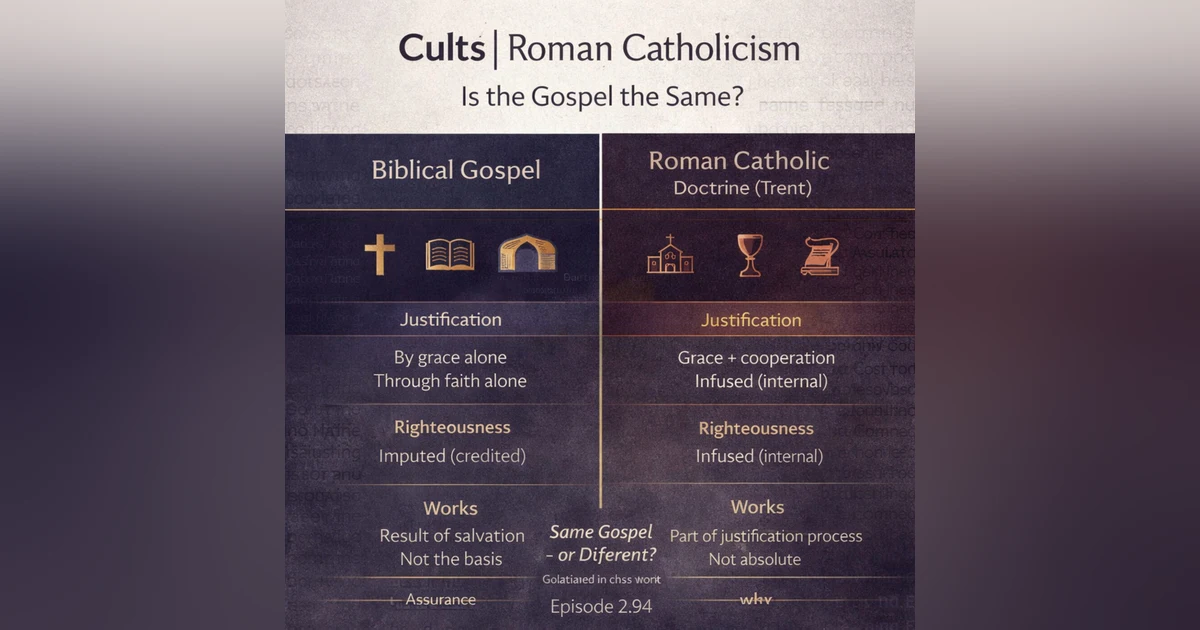
In this episode, Michael and Zach examine a central theological question: what must someone believe about justification to be included in the family of God? This is not a discussion about sincerity, the Trinity, or belief in Jesus, but about the content of the gospel itself—measured against Paul’s standard in Galatians.
The conversation walks through key biblical texts, showing that justification is by grace alone through faith alone, apart from works. From there, the episode compares that teaching with the formal doctrine of the Roman Catholic Church, particularly as defined at the Council of Trent, where justification involves infused righteousness, sacramental grace, and ongoing cooperation.
The distinction is not minor. If grace and works are combined as the basis of justification, the gospel itself is redefined. The episode concludes by clarifying the difference between individuals and systems, while maintaining Paul’s warning: when the gospel is altered, even by recognized authority, it must be rejected.
Find our videocast here: https://youtu.be/ek2nyGz5R-c
Merch here: https://take-2-podcast.printify.me/
Music from #Uppbeat (free for Creators!):
https://uppbeat.io/t/reakt-music/deep-stone
License code: 2QZOZ2YHZ5UTE7C8
Find more Take 2 Theology content at http://www.take2theology.com
0:00 All right, the Colts. We're back at it. This one's going to hit hard. Boy. I know that we were probably of all of them. I'm guessing we're going to get some comments on on our next series, because we're gonna do three. Yeah, on the Roman Catholic Church. Yeah, and this one's a tough one because most people probably know someone, maybe a family member, Co workers, that kind of thing. And so this, this does hit closer to home where you might not have as much interaction, which I was witness Mormonism, whatever, just by sheer numbers you're gonna interact a little bit with, with Roman Catholicism. And so I feel like we had to do our. This is a good time. Normal disclaimer, we're using the word cult not in the cultural sense or a derogatory since we're using it in the academic sense. Important distinction.
0:49 Yeah. So and that and that sense is if you have someone who is using the main label, but they are significantly different in primary areas. And so and so in what we are talking about here is the formal doctrine of the Roman Catholic Church, not the individual doctrine of a single Roman. Catholic, that's a good point. And I think what's nice about doing a series on this it is it the dogma side of things. It's much easier than Protestantism where you know, and that's and if you're talking to a Catholic, they're probably gonna point at Protestantism and say everyone's got a different everyone.
1:33 It's it's the book of judges. Everybody was writing his own eyes versus like, but by that same standard, we can at least accurately and faithfully to what they say, be OK, This is this is what your book says, man. This is what? You know, yeah, like our last episode we did on Black Hebrew Israelites, we're like, it's a loose collection. There's not, but it's kind of the opposite end of the spectrum, Roman Catholic. So we're going to do 3 episodes. The first one's really going to be on how, how am I saved? It'll be on the Gospel itself. That that's a good, good thing to highlight because probably just more than any other, like we talked about some of these other cults and it's like we're talking a lot about the Trinity and Christology and, you know, obviously we'll probably hit on some Christology stuff, but it's like Trinity looks pretty good.
2:18 Yeah, yeah, yeah, pretty good. We could check that box, right? Yeah, you know, the doctrine of God himself really good authority might be an issue. Yeah, that's right. That's right. And so we will do an episode on authority. Yeah, yeah, yeah. And but this one is mainly on the Gospel and, and similar to Mormons, Catholics will use a lot of words that a Protestant would use and but what they mean by them are different. So we're going to dial into some of those because when we say justification, when they say justification, those are two they they have different definitions behind that. So let's look at that. Yeah, yeah. All right, let's take it to the next level.
3:00 Let's fire up that twangy music. From the hearts of the Low Country in South Carolina. It's the Take Two podcast where we take theology to the next level, the golden standard. I love it. Sound like a broken record in a good way. In a good. Way there's a take away from this Cold series? This is a great take away. That's right where Paul says I imparted to you the gospel and I gave it to you. And then in Galatians 18 he's going to say, but even if we or an Angel from heaven should preach to you a gospel contrary to what we preach to you, he is to be accursed.
3:41 And that is the word anathema man. So it's, it's a, it's a huge important thing that if we're distorting the very way someone goes into heaven, someone reconnects with God after sinning, it's a, it's a vitally important thing. And that's why, you know, even though we love Catholics, we love is not, not, not that we're hating on the people or anything, but it's important that the Gospel gets delivered correctly. Yeah. And and so any other gospel contrary so so there's not many things that can really override the gospel that was presented. It's really in there. Even if an Angel came and said it to you, that's great.
4:23 Straight straight out of Galatians standards pretty high. Right, All right, so further on in Galatians, Galatians 5. So we really kind of, we want to really precisely nail down what the gospel is. Galatians 5, two through 4. Again, if you're not familiar with the book of Galatians, these Judaizers have come in to Galatia and the Jews that were there and the Gentiles that were there who were not necessarily trying to keep the law. The Judaizers are now saying you have to keep the law if you want to be justified. And Paul is going to come in and say if you receive circumcision for justification, then Christ will be of no benefit to you, because if you are going to earn salvation through works, it has to be perfect. Yeah, you don't.
5:15 There's no margin for error. Right, and so that you can't mix grace and works, Paul, Paul gonna say you have been severed from Christ, you heard me, who are seeking to be justified by the law. You have fallen from grace. So it's either it's either grace or the law. Yeah again, strong words like before it was accursed here it is severed. It's not like oh, we'll see what happens. It's it's pretty cut and try yes, it's not you're a little confused. It's no, it's, it's the, the stakes are much higher. I just alluded to it Romans 11/6, Paul's going to say, if it is by grace, it's no longer on the basis of it works. Otherwise, grace is no longer grace. So if I'm giving you something and I owe it to you, then there's no way that I'm just giving it to you out of out of goodness of my heart because I owe it to you.
6:03 That would be you earning it by it works. But if you haven't done anything to to earn it, I'm just giving it to you, then that's grace. And it's like you can't have a mixture of of those. Yeah, Grace plus works. If that's your equation, then at at some point you are earning it. Right. Yeah, yeah, All right. So what does the Roman Catholic Church officially teach? Council of Trent in 1547, so I'm assuming this is after. Yeah, have you? Did you listen to this Wes Huff on Diary of a CEO? I did not. I heard. I know he just came out. Yeah, he alluded to Council of Trent Session 6. He was just on that episode.
6:46 He didn't come out breaking news. Yeah, sorry. But he, he, he, he cited Council of Trent Session 6. So exactly what we're going to say, which is for you now. So Rome says justification is not by faith alone. Righteousness is infused, not merely imputed. Cooperation with grace AKA works is required. Canon 9. Here's a quote. If anyone says that a Sinner is justified by faith alone, let him be anathema. And in the context is really important because this is coming on the heels of the Reformation. Obviously the statement's clear and it's supposed to be clear because it's supposed to be kind of squashing this this movement. So it's not like you're taking this out. We didn't mean it's like directly facing this idea of solafide faith alone.
7:40 It's it's purposely calculated, premeditated. That's what they're trying to say. Yeah. And it's not fringe Catholicism. This is center Catholicism. So if you're a Catholic and you believe other than this, then you're not, you're not a good Catholic. And so you may have heard us jokingly say, hey, there's gonna be Catholics in heaven, but they're not the good Catholics because the, the, you know, gospel is, you know, directly contrary to what this particular council would say. So let's let's get into maybe some of the nuts and bolts of where there's a difference. Let's look at what we would say is biblical justification, talking a lot from Paul, drawing a lot from these ideas, the Reformation, which were heavily based on places like Romans and Galatians. All right, so we would have declared righteousness or imputed righteousness or legal righteousness. So God, you know, when you are regenerated, we know that we're still sinful.
8:37 But on the books you've been justified, AKA you've been legally declared righteous with God's righteousness. That is Pauline Christine theology. OK, Yeah, that, that, that's good. We're declared that. Yeah, that important. That's going to be a good declared righteous stuff like that. All right, what's next? It's based on Christ finished work, so Christ life builds up positive merit and his death takes away our demerits. So you could say, so he lived a righteous life that we couldn't live. He in his death, he took the penalty for our unrighteous life.
9:18 So it's a swap where we get seen with the merit of Christ, and Christ, at least for that time when he was on the cross, is seen and punished for our unrighteousness. So I like both of those emphasis because, you know, it's not like Christ just magically appeared and then died. It's like, man, that act of obedience was really, really important. And then the the suffering as well. All right, what do we got next? It's received on the basis of faith alone. You think of Ephesians 28 other passages so that no man may boast. Yeah, 'cause if it, if it, if it's based on what you did, then you're like, hey, I'll take my bow, right? Yeah, I was declared righteous and then I kept it, you know, or something like that.
10:01 You or something? That. Yeah, that that's good. So we would almost think like Abraham believed God and it was counted to him as righteousness. Yeah, reckoned to him, counted to him, and that has that legal language into it 'cause we know Abraham wasn't righteous. Just keep reading after. That that's a good point. He makes, he makes mistakes. Works follow as a fruit. So we're not saying, so we could bring Paul and James right next to each other. We could give them both a hug. Paul's going to say you enter through faith. James is going to say once you're enter in through faith, that faith is going to be displayed through works. Paul's going to say in Galatians 5-6 that Christianity is faith, working through love. And so we have faith, but it's a faith that's living and active. And because we're no longer living our own lives, but Christ lives through us, there are works that come about with that faith.
10:59 And those works are motivated by love, not motivated for justification. That's a huge dividing line. It's great that you brought up James, because it's probably one of the objections that might be brought up from the Catholic side. Be like, well, this is what James says, yeah. So that's good, Matthew 24, where Jesus says where you fed this person, where you closed this person. That's how you know. And so if that's all we had was James and Paul and Jesus statement there at the end of his life, you might go, OK, we got the doctrine wrong, but we have so much more there that helps us understand those in a better light. And then finally our assurance rests in Christ.
11:41 John 10 would say, you know, I have you in my hand and the I'm in the Father. No man can take you from my hand. So this idea of perseverance. If someone walks away from the faith, John would say, they're showing that they never were really were a part of. Us yeah, it goes back to the works and the as being a fruit it's like man just wasn't wasn't there. Right. Yeah. So if someone definitely shows, you know, there's another famous podcast where I quote every now and then he says if you're living like hell, that's probably where you're headed just 'cause you walked an owlet when you were 12, that that that work of walking an aisle isn't enough to save you. It's that saving faith in Christ.
12:24 And when you have that, then good works will naturally follow from that. Yeah, I, I like this. And and when we look at this compared with Catholicism, I think you'll see like all these kind of fall in line together. Like they kind of all go together. This is trying not the place for it but I saw on the Babylon Bee was like quarterback throws a hail in Christ alone pass. That's great. That's great. It was great. I laughed at it. One of my Catholic friends shared that and. That's so funny. That's good. Well, let's let's turn to the Roman Catholic view of just because. Because again, same word, different underlying structure. So now grace is infused through the sacrament. So for what I understand, you are baptized at a young age and that kind of like strips away everything and but then you're going to become more and more like Christ. So their idea of justification is actually what we would call sanctification.
13:27 They'd switch those like the verses that we would be like, this is the yeah, they almost like flip flop them, yeah. And so their justification through through grace is that over time you will become more and more like Christ. And only if you're really like Christ when you die will you enter heaven. Yeah, that, no, that, that's good. And you know, this would be, I would we get a lot of good feedback. This is a good time for feedback because I like you, You know, my understanding is this big difference between imputation and infusion, like, like these words mean different things. And like you said, like with the baptism, you're a child, You're kind of infused with this grace, and you're almost like, I don't know, Clink Slate's probably the wrong word, but you're like, you know, in good standings, don't mess it up, but you can, you know, build onto it kind of. Exactly, righteousness is progressively formed. We would call that sanctification, not justification.
14:20 So you know, your traditional you probably if you grew up Protestant in in I would maybe a quote UN quote good Protestant church. You may have heard this phrase. You know you are initially saved from the punishment of sin. Then as you live your life, you are saved gradually from the power of sin. That's sanctification and then glorification. You're saved from the presence of sins. That'll preach that is like I feel like a lot like the church like there's always like good like sayings like that. You know what? I. Mean. Yeah, Yeah. And so we would say, you know, once you're saved, you should be slowly being sanctified. That's the that's what we just referenced, Galatians 5-6, that your faith is working through love.
15:03 You're becoming more and more like Christ, but that is not your justification before God. That is your sanctification through the Spirit as you're as you are walking and living your life. Catholics also say your cooperation is requires, IE that your good works cooperate with the work that God is doing in your life in order to bring about. Yeah, that that's so important. Like everything, we're saying it like, I know we're being at a horse, but it's like the justification. Yes, yes, justification, IE what allows you to enter into heaven. Mortal sin forfeits justification and what we would say is all sin is mortal sin. A constant would say a sin is.
15:49 A sin is a sin. Some sins are worse than others, but all sin breaks us from being able to be perfect. And Christ would say you have to be perfect in order. But so they have this venial versus mortal sin. And what we would say is that that's a that is not a a good dichotomy. Yeah, and I was, I was trying to look up, you know, can I get a list of these mortal sins real quick? Be nice. And they very probably wisely say there's not necessarily a particular list of sins, but it's a category of sin that would destroy a person's soul that has to deal with is it a grave matter? Is there full knowledge, deliberate consent? So there's like, nuance to it.
16:33 Like, do you know what you're doing? Do you understand it? How serious is it? You know, I think something's automatically would fall into that. They might say like, oh, you commit suicide or something. That's like, you know, maybe under different pretenses. It's different. I don't know. But yeah, these these big time sins like murder and these kind of things. All right. And then the last point, final justification is contingent on perseverance. And we would probably in some sense agree from, but it's like, are you looking from man's perspective or from God's perspective? Because if you are saved, Paul would say in Galatians you're a new creature, creature, all, all things are new and you've been sealed with the Spirit.
17:19 Ephesians would say there is a down payment of the Spirit. He's a surety for us that we we can trust. So if you are actually saved, regenerated, then you will persevere. Not that you can't have a falling off at the end of your life or something and then die, but you obviously you don't want to. I'm not encouraging that. But from God's point, either you are in Christ or not in Christ. From man's point, we might say, yeah, this person fell off the Cliff. That calls into question for us whether he was ever saved to begin with. Not that he was saved and he lost it. No, that, that, that's good. So as we are kind of delineating all these different things there, there's there's definitely a difference in what it means to be justified in a Protestant perspective and what it means to be justified under a Catholic paradigm.
18:10 Right. And well, you know, if there's some Roman Catholics listen to this and you want to argue that your way, that your understanding is the right one, that's fine. And and we, and I'm we may look at that and you know, interact with it, but what we're we are trying to highlight that there is a difference. There is a difference that that's that's exactly right. So let's talk like, what's the point? Why does this matter? And like we've done so many times, we're going to look at Galatians. Yeah. Well, Paul gives us the argument in Galatians. If we add 1 covenantal requirement, yeah, you've nullified Christ. Severed. Circumcision was not evil. Obedience to the law, it's not evil.
18:51 But making those a part of justification, that is a fatal mistake. Yeah. So if you want to maybe take that paradigm and overlay it to Catholicism, we're looking at, you know, this cooperation. We're looking at the sacraments as being necessary. It's kind of like if circumcision was, you know, enough to nullify grace, you know, all these other stipulations. So like, is that kind of the same thing? Yep. All right. So we kind of already said this, but it's in our notes, so it's probably worth repeating. There are undoubtedly. For sure true. Believers in the Roman Catholic Church, right?
19:31 Yeah, many are trusting Christ and Seeley for their salvation. They may not understand the official dogma, or they may not consistently hold to all that Rome teaches. There's a, you know, there's plenty of Protestants that they know the basics and after that maybe not even know the basics. Great. And that's different than someone who's like going just going deep, like in everything, you know, So that, that, that's a really good point. Yeah, but if you are a Roman Catholic. And you're fully embracing the Council of Trent that we just talked about. Yet we cannot give a nod to that. We can't say, oh, it's all good because of what the Bible says. And obviously, the Bible for us is the ultimate authority. It condemns justification by faith alone. The Council of Trent does.
20:20 And that seems a. 100% counter to what we read in scripture places Sacramento mediation as necessary for saving grace. It makes final justification contingent upon works or cooperation. That that that's good. I like, I like that you put this in the notes, this Angel parallel because it it it does make make make a lot of sense because if you look at the history of Roman Catholicism and we'll kind of get into this more even as we talk about things like Mary and these kind of things that there is this development where something was not true necessary. I mean, you know, I think they probably say it's always been true. It just wasn't, it's like something there wasn't like a Harris or there was something that we needed to make it clarified.
21:03 But it is interesting. Some things like posted as late as the 1900s are like very very different than what you read where there is some sort of development. Right. And for me, for Michael Mott's take on things, there was, and we're gonna talk about this in the next episode about authority. But there was this line of the church before it became quote UN quote, the Roman Catholic Church. And there was this Pope that said, no, I'm not, I'm not the Bishop of all bishops. I'm just the Bishop of Rome. And then like 2 or 3 popes later that I, Oh no, I'm the Bishop of all Bishop. So like you said, there is this morphing, or at least it may be, to put it charitably, like, like you said, more, further revelation, more clarity in their eyes. But Paul says forget about Pope, forget about another apostle. Even if an Angel were to come and say something, it's going to be wrong because it is counter to what Christ said and what He taught.
22:05 Now that, that, that, that's always good to keep in mind. Something you'll probably hear us saying a lot. So probably just important, you know, as we say what we are saying, what we're not saying specifically, we're not saying, man, the Catholics drop the ball in eternity. We're just saying, hey, nice job, thumbs up. Good. Job on that. Good job on Christ's deity. Yeah, yeah. There you go. You know, you can't walk into a a Catholic Church or talk to a when I see a Catholic patient, Christ is emphasized heavily. And there's so many pictures and so many, like crucifixes everywhere. And again, we said it a million times, but we should say it a million more. We're not saying Catholics cannot be saved. Or are not saved.
22:47 Or are not saved. That's right. Yeah, necessarily. That's exactly right. But. If you fully understand the Trent Council, Trent and that's what you're living by, then I would call into question like you should, you should be concerned about about it. Because what Paul says, we are saying that the Roman Catholic system teaches a gospel that is counter to the gospel that we see in the New Testament. And Paul says that Grace Plus works. No longer grace. Man, that that is good. I like it. I think it's a good way to kind of start this series where we would talk about the gospel today. We're gonna talk about authority and then we'll kind of get into Mary. Prayer to the Saints, these other things, maybe.
23:28 Yeah, Mary in prayer to the Saints. I think it, I don't think it would be something that would negate like we're talking about, you know? Yeah. So I guess I'm kind of stumbling. So if we kind of step take a step back heresy, formal belief that if you really believe it, then you could not be saved and believe that. If you believe that, you know, Jesus was just another man, we'd say that's a formal heresy because there's no way he could save the sins of the world. Then if you just get something wrong, we call that heterodox. So I'm I would probably tend to put their the practices revolving around Mary.
24:11 It's not on the same level as what we just talked about. It I mean it maybe. I mean, depending, yeah. Because there's a broad spectrum, if you hold Mary in high regard, if you think Mary can help save you from your sins, those are like two different ends of the spectrum. One of them might be like, that's probably heterodox, like I don't agree with it, but you know, Mary's a Sinner just like everyone else. But if you think that she can help save you from your sins, and now you're pushing another element into the. Doctor Yeah, yeah, then you're. Actually in this podcast, right. But we will treat, you know, we will kind of at least look at the doctrine of Mary in prayer to the Saints and why we think that that they got it wrong there too. Yeah.
24:54 Yeah, this is interesting. This is not important to this discussion. It's a broader discussion. What is it? What's it called? It's called I, I don't think I've read the document, but it's like Catholics and Protestants together or something like that. No, I don't. It was, it was maybe written, I don't know, I might be making this up like 80s or 90s, maybe early 2000s, I don't know. But it's it was an ecumenical document that was more, I think talking about social activities, about coming together for things like abortion, these kind of things. Actually, I'll, I'll read it in case we want to tag it on to the end as a practical application. It's not, you know, as if it's with this Colts, but it was a document that people like John MacArthur and RC Sproul felt like, Hey, we cannot sign this because it's almost like we're endorsing it. On the other side, people like my man, I forget knowing that Ji Packer said I could sign it and sort of like Chuck Coulson was like, I'm going to sign this.
25:50 So it was a little bit like divided. And so it's it's interesting like, and I think it was geared more, but they felt John MacArthur are still thought they were giving credence to certain doctrinal beliefs. But anyway, that might be A tag on discussion about, you know, I need to read this document when it wasn't written in that. Kind of thing. But that'd be interesting because we have stood shoulder to shoulder with the percent of the unborn. That's right. And some of the, you know, there have been some cave in, especially among political Catholics on like sanctity of marriage. But your average Catholic has been strong on the sanctity of marriage. Yeah, when you look at the Catholic position, you know, on things like abortion and marriage stuff, it's like, I mean, a. 100%. Holding the line in a way a lot of Protestant denominations are not.
26:34 Yeah, right, Right. Yeah, a lot, a lot better overall track record than like the Methodist Church. Yeah, very, very much so. Well, I'm excited to continue to explore this series. And again, it's like correct, as we said something wrong too. It's good to like fine tune this, you know, I'm sure every if we get some feedback every episode, we can speak to it a little bit. But I got this, you know. But anyway. And we're happy to justify why we believe what we believe. But at the end, we're just saying, hey, there's some big differences here. What was the topic you were you were trying to track down a Catholic priest and it was not super helpful. Do you remember? This Yes. I sat down with a Catholic priest, Jonathan Hyatt. Oh yeah, just to long time ago, Jonathan, he's still listening, asked us to do an episode on whether the sacraments really computed grace or what is it.
27:28 Oh yeah, yeah. What were the? What was? That greatest? Yeah, something like that. And so we didn't, we were trying to like not straw man 'cause whenever you, I don't think, you know, obviously it's our never our intent to straw man. In fact, I, I want to steal man. Yeah, I want to give it the best OP, you know, light that it possibly can and then show that, alright, this is still wrong. But I sat down and he just would not say, like the Catholic priest I was with, he would not say anyone was wrong on anything. He would just say this is what we believe, but we're not going to say that you're wrong. Is that, is that in like Vatican 2 or is that one of their account councils where they're like, if you're sincere in your belief, like you're cool? I mean, it's probably not worded like that, but it's something like that. I think that's the case.
28:12 This guy is also from South America, Latin America. And so I think what he, or actually this guy was from India, sorry, he's from India and he's probably spent his whole life defending against, you know, both Muslims and Hindus. And so this inner, you know, Protestant versus Catholic discussion may not even be like in his wheelhouse type of thing. So I did, I did feel kind of bad. I, I, I was, I was just trying to, I wasn't trying to put anyone on the spot. I was just trying to like, Hey, what is the I? I want to make sure that we represent Catholicism well, but it was hard to get him to make some clear statements on stuff.
28:52 So yeah. Can't, can't win them all. Great. Well, do we transition? I think so. To the final take. Yeah, man. Final Countdown. The final countdown Play some music. You know anything major on your mind? Michael HMIS. No, is just in my taxes. Did you? Yeah, we're paying it a little bit in to South Carolina, but we are for some reason, I haven't even figured out why. We're getting a. Lot back unexpectedly. IRS, you might want to check up on this guy. Yeah. I don't know. We just maybe 3 or 4 years ago, we started using used to do online through H&R Block, I believe. Yeah, online thing.
29:34 And it was just, yeah, I mean, and so I, I had done it all on H&R Block. And my friend that I was in the Navy with, he's a tax preparer and he'd gotten out of the Navy and kind of went full time. And he's like, hey, just send me what you sent to the H&R Block and I'll see if I can get you more if you want to go if you can. And he got me more than what his fee was. So that's a win, but you know what to say. No money, no problems. You know what I mean? But hey, I'll take him. Yeah, it's good. I, I do my, I'm like one of these guys, I try to do my taxes as fast as I can and I take it to some guy and it is amazing.
30:16 Like they're so efficient and quick and somehow I'm, I'm always like, I don't, I always err on the side of caution. They're like, oh, they, they like know the rules so they can like push it and they're like, oh, you're totally inbounds where I would be like, I don't know if this counts or not. And they're like, well, did you do this? X? OK, no, it doesn't count or yes, it does count. They can just, they're just like flying through this stuff and I, we do this thing I this, I know this is not good like really good financial way to live, but it's good for me. I always like claim like 2 dependent like I, I always expect a big return. It's like mandatory savings. I know it's like loaning to the government for free but. I just had this conversation. Yeah, because it's not a math equation.
30:58 If it were a pure math equation, then you should try to get your return down to nothing owe, or maybe you slightly. Owe. That's right. Yeah. Yeah. Yeah, because if you slightly owe. Then it's a negative interest. Rate then it's a negative. Yeah, it's. Like you wanna, you would wanna owe, Yeah. But it's not a math equation. It's about human behavior, and if you've got money in your hand, you're probably gonna spend it. Exactly. So it's it's better, it's better financially to put the money in the government's hands and then get a huge return because it's like forced savings. Exactly, that's that's my mindset too. 0% interest, but. That's right. It's better than spending everything. It's better than spending it and we use that money like, hey, we're going to go to Maine in the summer. We're going to like that's going to purchase our it's like it's like built into our budget.
31:43 Like, you know, I, I have a rough idea of where we're going to be. It's not make or break if it's a little bit higher, a little bit lower, but there you go, you know, yeah, taxes, man, taxes and pollen and the spring and all the all the fun stuff. Cool. Lemonade stands. Yeah, man, we ate a lot of Rice Krispie treats for the last day. Yeah, 'cause we had quite a few left. We were gonna do a lemonade stand yesterday. Oh yeah, yeah. Chloe got her tires changed yesterday. Finally, that's. Good. Like what the heck. Like. So you can buy tires from Amazon, have them delivered. They have like partnerships with different shops around the area, at least in the greater Charleston area.
32:26 So they deliver the tires to the shop and it was like $20 per tire to put on, very reasonable. So I think for all four tires it cost us right at what's 4 times 5 * 8400. Dollars that's a steal for oh that's like 1 tire. Right, it was. It was like $80 per tire plus $80.00 for all four tires to be installed. That's a. Deal. It was like crazy deal. And this tire is well rated and stuff. It's not a name brand. But it's probably just as good. Yeah, honestly, I got to look into this. 'Cause she's just driving around like she's not doing like cross country trips or anything. She's like, that's funny. 'Cause she's probably doing cross country and fought like, yeah, she's doing.
33:08 Cross country, but not cross. But. Yeah, yeah, yeah. That's good. She helps coach cross country, so she's not. Yeah, that's the joke there. Yeah. Yeah. So anyways, we scheduled that at 3 thinking that the oyster roast was like 5 to 7. Oh yeah, yeah. And the oyster roast was 3 to 5, which then he said 3:00 to 6:00. So we may have gotten, I don't know if he extended it now or not. And so with all that we was like, I don't think we're going to do do the neighborhood lemonade stand, but we might do this this weekend. Just price of retreats are not hard to do and it's pretty cheap. I mean the most, I think probably the most expensive thing is your half a stick of butter in a single batch.
33:49 People talk about the price of oil and gas on it. The stick, A stick of butter is going up, man. Inflation. I'm just kidding. I don't know. That's great. The After Church Bake sale 280. Bucks. I was like, we should, I mean, I know that would get old fast, but like our church should do something like that once a quarter because or, or something 'cause I'll be like I could user Rice could be treated after school, after church and I would have loved to. There's an extra 20 bucks towards a good 'cause that it's like I don't have the 20 bucks anyway. Like you know what I mean? Like I know that can we can't probably do it every week without it'll get old and you do too much. But it's like that's like I like having like a Simon roll before the service or something. You know I would. I'd rather do that. Than get to Starbucks. Had it before and after. Walk in, get your coffee, get a Simon roll. I was thinking there's something there where like for missions or something, it's like, you know how many people would love to like John Peters brings his like espresso machine and you know what I mean?
34:44 It's like people, it's like. You might wait a while though that. That that's true. Two people can get it. Yeah, it's like that. Yeah, nice. But it's like, that's something that's like, man, I wouldn't, I might as well do that then spend my money somewhere else that doesn't. It's not going towards anything. But yeah, great, great work. All right, until until next time. Till next time. That's our take. Thanks for listening to Take 2. Find us wherever you find podcast and on YouTube for those who want to watch our video cast.

