Cults | Roman Catholicism: Who Has Authority in the Church?


 RSS Feed
Episode 2.96
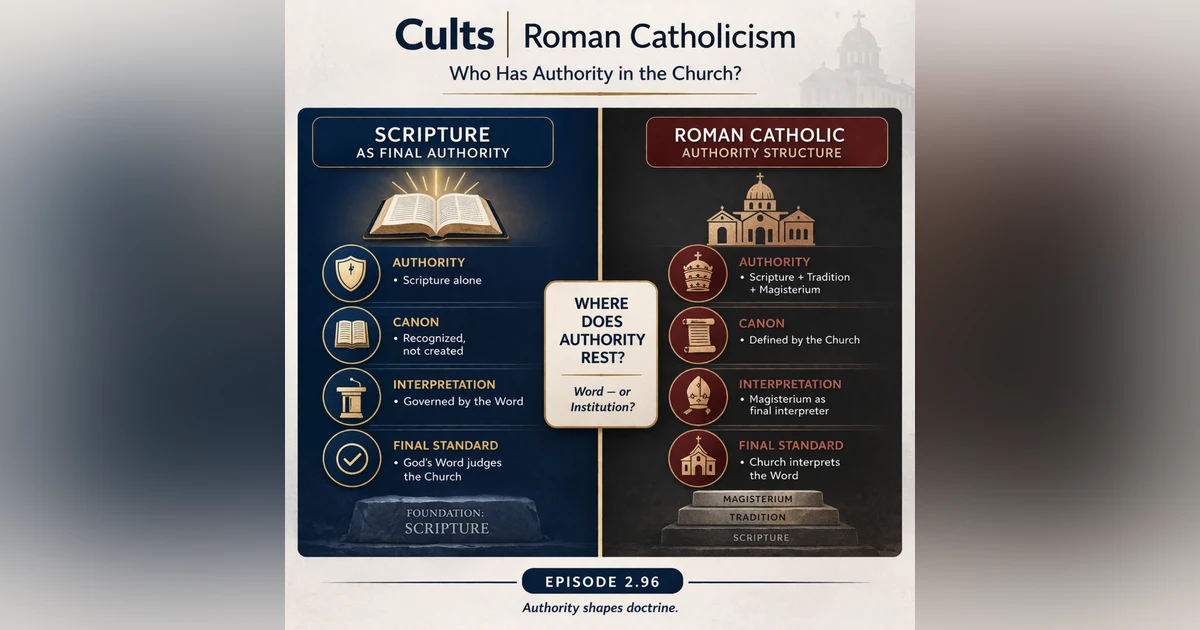
In this episode of Cults, Michael and Zach shift from the gospel question to a foundational issue beneath it: authority. Who has the final say in matters of faith—Scripture itself, or an institution that interprets it?
Tracing the development of papal authority from Gregory the Great to Vatican I, the episode examines whether Rome’s claims represent legitimate development or a departure from earlier church history. The discussion then turns to the formation of the biblical canon, challenging the idea that the Church created Scripture and instead arguing that it recognized what was already functioning as authoritative across the early Christian world.
Finally, the episode addresses the role of the Magisterium, the nature of interpretation, and key texts like Matthew 16. The takeaway is clear: the core divide is not structure versus chaos, but where ultimate authority rests—within the Word of God itself or in a centralized interpretive authority.
Find our videocast here: https://youtu.be/Nz7KSt1zdNA
Merch here: https://take-2-podcast.printify.me/
Music from #Uppbeat (free for Creators!):
https://uppbeat.io/t/reakt-music/deep-stone
License code: 2QZOZ2YHZ5UTE7C8
Find more Take 2 Theology content at http://www.take2theology.com
0:00 Roman Catholicism, Yes, it's a cult. Definitionally, I feel like we always have to. We always have to, you know, define our. That's right, that's right. Now we happen to be recording on the day that our first Roman Catholicism video hit. So this is Thursday, so it just hit this morning. Expected. Honestly, I was surprised we have 1 positive comment from Reformed. MDI was expecting to get, you know, beat up, but maybe maybe they're so used to kind of like another, another video. Because it almost a lot of the other episodes have garnered like at least a handful, with one garnering much more than a handful. Right.
0:43 Yeah, a recent one on the Black Hebrew Israelites had a lot and I was one of them commented, Oh, thanks for letting me know. I'm not a Trinitarian. And I'm like, and I offered like, hey, you're Black Hebrew Israelite. Like I'd love to hear what you believe. Because in our show notes we said that one of the weaknesses of this podcast show is that it's hard to nail down theology because they don't have a centralized doctrine like the Catholics do. So. Yeah, this is great. And we're hitting on the really $1,000,000, you know, authority and they have an authority which, you know, if you talk to the Catholic that that's what they appeal to you. Like you silly Protestants believe a million different things or you know what I mean?
1:30 Like they're like, we've got. So the benefit of them having a source is that you can be talking the, you know, hopefully be talking on the same wavelength. Yeah, that's really good. So we kind of alluded to it, but we're using the word cult in the academic sense, not pejorative sense, not the cultural sense, but just to talk about a major religion that goes by a name that has differences in their major doctrines. And last time we said, hey, their view of God, great. Their view of the Trinity, great. But so our last episode, you can check it out, was on the gospel and how we believe that they distort what the gospel is in the Bible.
2:14 And then this episode is on authority. Like, what is the ultimate authority? Good question, good question to ask all of these things we've been asking it. That's right. I'm excited to like Deep Dive. In this episode, All right, well, let's take it to the next level. Let's fire up that twang of music. From the hearts of the Low Country in South Carolina. It's the Take Two podcast where we take theology to the next level. Roman Catholicism. What is their authority? And this I guess you could have, perhaps one could argue you could have a separate authority and still not be heretical. It's still not be a cult because we believe all the same things. But the the problem is when you have a separate authority that is equal to or maybe in some practical ways higher than scripture, then that leads to abuse. You know, I think you nailed it.
3:17 It's like everyone can say they have two or three or four or five authorities, but like who? It's like mom has authority and dad has authority, but it's like who has the final say if things aren't lining up? Because I think as we maybe progress in the series, we, you could argue, hopefully you would argue things don't line up like what who wins? Because that's where I think it breaks breaks and there's a clear winner in Catholicism. And so in some of our previous episodes, we kind of just delineated the difference and said, hey, there's a big difference here. We didn't necessarily argue for our side this episode. We are going to, in the previous Catholicism episode, we do spend a little more time arguing the Protestant point of view on all this. So let's just jump right into it. If you know your history, oh, 'cause this is what this is. You know, if you are a Roman Catholic and you're listening to this, I'd love for you to respond to this because there was a Pope Gregory the Great.
4:17 Because the claim is all the way back to Peter. Oh yeah, yeah, all the way back to. Peter, like all the way back to Peter. So Peter he has. No. You've heard of Peter. Yeah. First Pope. Yeah. Right. Right. So there was a Bishop of Rome and maybe maybe he didn't call himself Pope, I don't know. But there was a Bishop of Rome, Gregory the Great around 590 to 6 O 4AD and in an epistle 5.18 he wrote around 595 he said whoever calls himself universal Bishop is the precursor of Antichrist boy and he makes this argument. No Bishop should claim universal jurisdiction. Such a title injuries the unity of the episcopate, and Christ alone is the head of the Church.
5:02 He was the Bishop of Rome, and he rejected universal supremacy. Seems like Rome's an important place in Catholicism, that universal rejection. And yeah, that'd be interesting to see. You know, a, a strong Catholic knows their history. Like, what's the deal with the argument Be like, oh, well, you know, and he wasn't, he's speaking for himself there. He was not speaking ex I'm guessing. That's what what how the response would be like. We didn't say popes are infallible, just the magisterium and says since it wasn't a council he wasn't speaking ex Catharida then. These don't necessarily help, but it seems like he had a very different idea of what his role was than what it became to be.
5:44 Yeah, seems explicit. So I like tracing some of this history. You want to Fast forward about 150 years, 100? And 50 years, six O 680 Emperor focus. I guess that's how you pronounce. That you don't hear about this guy a lot. Gregory the Great heard of Focus? Not as much. Recognized the Bishop of Rome as the head of all churches, Pope Boniface the Third accepted it. And from this point on, Roman primacy language shifts towards universal jurisdiction and the concept of papal supremacy is strengthened. That's great. So this is kind of like this is at least an explicit line in the sand where this happened.
6:26 I'd be curious for if you're listening Roman caps point to earlier sources, that kind of thing, 'cause that's what it appears at least very in your face like this is we can start seeing this trajectory. Yeah, if you're a Roman Catholic and we're missing something, let us know. Or we'd also like to hear how, if how you understand these two things working together. OK. You may have heard of someone say Vatican 1, Vatican 2, Vatican 1 being much more strict. Vatican one came about 1870, and it dogmatically defined these two points, papal universal jurisdiction, papal infallibility, when it is ex Catherine of statements like speaking from the chair. And so this would be, yeah, you know, very different than what? Sounds like it.
7:13 The first Gregory would be like, what are we? What are we doing? Yeah. And so the, you know, the question that might arise is how did this develop? And is this like a reversal, you know, was there, were there some confusion? What's what's going on? Cause 'cause at least when it comes to the first few creeds, it's like some people ask, why did this happen? You know, quote, UN quote so late. A it really wasn't that late. And it's when controversy arose. Seems like controversy arose before 1870, or you know what I mean, too. So this is this. I like this. We'll dive into that question about the Canon. This is, like always a argument you might see. Right, so if you talk to a Roman Catholic, they may say we define what the Bible is That and I I guess they would have to argue that that I don't know if the word is power, but authority resides in the church to put their stamp of approval on certain books as being in the Canon and not but that's not actually how the Canon work. Well, because we had list of what was in the Canon, you know, 200 and 300 years before this, Pope Boniface the Third finally accepted this role as the universal Bishop. So if you were to read, I think it's called Canonicity, but it's by Michael Krueger.
8:35 What a guy. I love that guy. So you can go out and find he's got a couple books on how the Canon developed. But yeah, so you can go out and find more detail than what we're going to give you. We're going to give you a broad brush overview. So we know the apostles wrote Scripture. And really, if we could tie Scripture to an apostle, then. They're covering a lot of bases. Yeah, then then that was almost universally accepted at that point. So all of Paul's letters, Matthew the first Gospel, John the last Gospel, Mark got accepted because he was companion of Peter. Luke got accepted because he's a companion of Paul. So you could throw in Acts, Yeah, Revelation, John, it's like Hebrews.
9:24 Hebrews was assumed to be Pauline and so it was initially added on that basis. We look back at it and we go maybe not Pauline, but it sure does seem like scripture. James Jude were on were questioned at first because they didn't know necessarily could we be for sure along with I think Peter's epistles were questioned because we couldn't be for sure because there were a lot of people writing about, you know, during this time and so but a Brown 150. I think maybe we should look at our notes. So the apostles wrote letters and gospels. These writings were copied and circulated between churches.
10:04 Paul's letters were already being collected and treated as scripture by the time Peter wrote his second epistle, 'cause if you read Second Peter 3/15/16, he talks about some of Paul's writings and he refers to them as scripture. Yeah, that's big. The Gospels were read publicly in worship alongside the Old Testament. So they have this peer relationship in the synagogues and stuff and in churches. So we see Scripture functioning as scripture way before any formal list came around. Super organic. It just seemed like like we're we're saying kind of goes together with with these apostles. It made it made a lot of sense. There's really not one you can be like, hey, that was way out of left field. You know what?
10:49 I. Mean. Yeah, yeah, yeah, there's none. Yeah, there's. I mean, I guess if there was, we probably wouldn't. Have they didn't accept, right? Yeah, yeah, exactly right. So this is what I was talking about. By the 2nd to 3rd century, around 180 or so church leaders across different regions, they you know, were citing the same core books. Irenaeus firm the four gospels and the Mercurian fragment. I'm sure I'm saying that wrong. Meritorian fragment late 2nd century lists most of the New Testament there Tertullian origin reference and emerging widely accepting septic collection. So you see this organic development around what's actually in the Canon. And it wouldn't be until whenever Martin Luther, what was that, 15 something when they had the Council of Trent where they would say, you know, these books are the the other books are in. Yeah, so.
11:45 Yeah, that is, that is interesting that it like we were saying these creeds are in a response that was directly in response to reformation and then they're adding in, you know, these different deuterocainen or whatever. Not only that, it was diverse across geographic regions. We're kind of recognizing these things too, whether you're in Rome and North Africa, Asia, Asia Minor, which is modern day Turkey, Alexandria, Egypt, very diverse where it's not like Rome was driving. All of you know all this is kind of what's happening in the early church. That's very good. All right. So as you mentioned, there were some local councils that convened 4th century council, such as Council of Hippo and 393, Council of Carthage, 390-7419.
12:32 They formally listed the 27 books of the New Testament that we have today. These councils did not create that scripture. They did not say something like by our authority we are putting these in here. They were recognizing the authority that was inherent in Scripture. So we believe that when an apostle, capital A of Jesus wrote and it was inspired by Scripture, his writing was different then you know, Josephus's writing, you know, Josephus, that's right. It's fairly historically accurate. You know, even if you had something that was 100% accurate would not make it Scripture. So what these councils is, they looked at these books, these books from God's apostles, and they said they recognized this. Is scripture it like measured up and in some sense you would think.
13:28 I'd be curious as we dive in more to Catholic dogma, you would think a lot of what they would say at councils would be like, hey, this has always been the case. We're just like ratifying it as well, you know what I mean? Like. Yeah, yeah, yeah, yeah. So what? What's the criteria? What? What were the parameters that the early church applied as they were seeing which books measured up? Yeah, it's good. We kind of did already speak a little bit to this. We talked about Apostolic authorship or close Apostolic connection to the authorship. Obviously if there was a book that said, you know, had Paul's name written on it, but it just seemed totally antithetical to other Pauline and other scriptures, you'd go, this doesn't make sense.
14:09 There's no way we could marry this up. So there had would have to be some type of consistency there. As you mentioned before, you'd want widespread recognition of this North Africa, you know, Europe, Middle East, you know, Asia Minor, all those places that the church was spreading, you know, you if they all said, Oh yeah, this, this is scripture, that would be good. And then, you know, some doctrinal coherence with received Apostolic teaching kind of goes along with our second point. So those books were recognized because they bore inherently in themselves Apostolic authority. Now I like I like this next point. It's kind of like a practical outworking of of these books, you know, really big.
14:54 The big picture is the church did not stand above scripture. If you look at how it actually practically bore out. The church submitted to the writings that it recognized as as being books, had divine authority. And what what you see is that Scripture shaped the church before the church was like, this is scripture because it wasn't formally until much later. It wasn't like, oh, now we have to listen to Galatians. It was kind of like we're submitting to that now. It was binding on us when it was written. What? Do you think about Paul's letter to Tim and Titus, two young pastors, and like, hey, you need to go have your members do this and you can, you know, I'm telling you to do this. It was like. And they weren't like, well, Rome didn't tell me yet. Like I'm waiting on Peter to give you the thumbs. Up probably Paul May.
15:39 Yeah, right. At least by second Timothy and secularity problems. So when you do look at the, you know, so if you talk about Peter being the first poem and stuff, and we don't, obviously we don't take that scripture that they use about Peter being the rock. We don't interpret it the same way. But even if you did, you do have a circularity problem because they're looking at that scripture to say this is what appoints our Pope. Peter was installed. We know that because of the Scripture. It's by the scripture that the church gets our authority. But then they're saying that through the church's authority, they are telling what the Canon is. So just to read it formally, the church establishes the Canon, the Canon and establishes Petrine authority. That's Peter Petrine authority at establishes the church. Therefore the church's authority validates the Canon. And obviously, hopefully you can see the the circularity there. If Rome's authority is required to validate Scripture and scripture is required to validate Rome's authority, then neither stands independently.
16:50 And I'm sure someone will say, yeah, it's they're like they're the three legs of the stool. It is. But there is a logical circularity issue there. Flip it to Protestantism, you know, authorities. We would say authority's a good thing. There's different levels of authority. Fathers have authority, elders have authority. Word of God stands more authority. We would say Scripture is that Apostolic revelation itself authenticating in the church. It's kind of a custodian, not not the source. We want to carry out what the Word says, and so because of that, the Word of God creates the church, not vice versa. So you can kind of see the way it actually out works. Yeah.
17:31 So kind of the key point that we're saying here is Scripture functioned as an authority before the Roman Catholic Church ever really got off the ground, before papal supremacy claims, before universal just jurisdiction, before Vatican One, and before infallibility definitions. So the Canon was recognized by the early Church as a whole, not decreed into existence by a single Bishop of Rome or a council. Nice. Well if we move on down to interpretation, this is like the key with everything. Even when you see things to me go wrong almost anywhere. Protestantism not excluded from this. It's because the one doing the interpreting is is faulty with it.
18:15 So a good question to ask like who has final authority? And when it comes to the Catholic position, it's the Magisterium gives its binding interpretation. Scripture must be interpreted within the Sacred Tradition. Private interpretation insufficient. You know, I think that can be a weakness on the Protestant side of things where someone's like, hey, this is what this means. No, no, it actually can mean that, you know, there's a little bit too much of that. But the church is the final Court of Appeal when it comes to doctrinal disputes and, and nails them. So they, they have a, you know, every passage I I guess is through the lens of the Magisterium and that's like it or not, that that's where you're at. Yeah.
18:58 And I want to be fair here because I think even in our Constitution we have a line that says something like, for our local beliefs and practices, the elders are the final authority of the interpretation of the Bible. And all we're just saying is that, you know, we are trusting the elders of our church. If there is something that has to be interpreted from Scripture that would be, you know, applicable to how we act as a local body, that they're going to have basically the final say, not that we're not saying. And that means they're definitely right all the time. It just means for our local practice, you have to have someone that says, well, this is how we're going to do it here, but we're not saying. And if you do anything else, you're, you know, out, out. Out yeah, and there's methods to remove elders if needed is there?
19:50 And one of these in the Vatican 1 is there something to remove the Pope if you need to? I I wonder what the rules are like, like if like you're like, he was great when we started, but he's a little bit off his rock. You're off the chair. You got to stop through the chair. I'm. I'm sure. Well, yeah, I don't know. I don't even know how that works. I'm sure the Cardinals around him that's. True have, some have. Some influence and it can't just. Be like ex cathedra, I'm here forever. I said it all, right? So. Really, what it comes down to is the unavoidable reality that interpretation cannot be eliminated because no matter what you're doing, communication requires, no matter where you're at, it requires some interpretation. Yes, because if I wrote you a a a long paragraph that explained all of Rome, the book of Romans to you, and you read that, you'd have to interpret what I said.
20:40 Right, right. You can't. You can't escape that. That's good. So if a priest explains the passage, the listener must interpret what the priest is saying. The priest must interpret the magisterium. The magisterial Magisterium must interpret Scripture. Councils must interpret previous councils. The Pope must interpret prior papal teaching. So you have this problem with. Communication. No matter what yours yours, you're moving the target a little bit. And we're not saying that the God has not, you know, God has gifted certain people to help teach Scripture better than others. We're not saying that that's not the case like you have. Some people are gifted and teaching and preaching and helps and mercy and so there's a plethora. So we're not saying that there couldn't be someone who can read and understand and interpret and help explain it better to people, obviously, but we're just saying that's they don't have a lock on just because of their position.
21:33 This is the interpretation. And that, that's so good 'cause it's, you know, if we disagree about something or, you know, you disagree with Craig Coco or I disagree with John Piper, most of the time it's a hermeneutical like work. At the same passage. We're still holding the word. I've got up. It's like, well, I, I think you're not explaining this or taking this context or this word into account where they're doing the same thing. But with what the Magisterium has said, they're like, well, they use this word, but this is what I think the word means. You're still making that. You're still executing something. We just our focus on the Word of God versus an interpretation of the Word of God. Right. Yeah. And so in that system, the Word of God is the final authority. That's right. So if you tell me this is what the word of God says, and I look at the word of God and I don't see that there, which is what Martin Luther was saying is like, unless I'm convinced by my conscience and Scripture, I can't, you know, recant what I was saying.
22:22 So that's that's the final authority. All right. So the biblical pattern is that the word is self-sufficient. It tells us its authority. We do have some scripture from Scripture. I love that. To demonstrate the self-sufficiency, Psalm 19, seven through 8, The law of the Lord is perfect, restoring the soul, the testimony of the Lord is pure. Making wise is simple so you can notice your scripture itself restores Scripture makes the simple wise. The power is in the word and reading those ideas and having them impact you and and not the preacher or the teacher. That to me, that is comforting, where you're just a conduit. And I think we see this even more laid out in Romans 10. This classic text says, how were they here without a preacher? So a preacher's involved that man that means really important. But that being said, the power does not reside solely in the preacher.
23:22 Faith, If you know the passage comes from hearing and hearing through the word of Christ where the gospel is what does the work. The preacher is the servant, the custodian, the one who's carrying out the word. It's not the source, it's not infallible, but just a person reeling what is infallible. Yeah, another favorite passage that you might hear a lot at, well, at any church, but whenever we have promotion Sunday, Jack will will often do this because Paul links Timothy's youth to his maturity. And he says the thing that links those together is Scripture. Second Timothy 315 through 17 Paul says from childhood you have known the sacred writings AKA scripture which are able to make you wise for salvation. He would go on to say all scripture is God breathed so that the man of God may be complete equipped for every work.
24:13 And so really this linking from being simple to wise comes about through scripture. And there's no, you know, Magisterium in in the middle there. And even maybe more explicit than that is, if you will look at Colossians 316 written to the it's not written to Timothy, the script. Maybe you're thinking like Timothy, that's the Magisterium light or something. It's like this is written Church of Colossae. It says let the word of Christ dwell in you. You all richly the commands to the congregation. It's not to be filtered exclusively through the higher ups down, but the average congregate should really know their scripture and I'm curious to hear from Catholics on this. I've got several patients who have retired down here that are Catholic by background and I, this is anecdotal, picked up on a shift where a lot of my older patients like did not know scripture like at all like alarmingly did not know scripture. They knew like catechism things did not know scripture. I don't think they were.
25:12 I don't if they were just not encouraged to read Scripture on their own, so they would make interpretation. Some of my younger patients of like they're like 50 are like much more. I, I read the Bible. My ones that are like 80 or 90, like they're like they just, they never, they're like devout Catholics never read Scripture. And now the younger ones, they're like more familiar. I don't know if that's just anecdotal. I'm curious if that's like a shift in the thinking or not. I don't know. Yeah, that is, that is, Yeah, It'd be interesting to hear. OK, the New Testament pattern, the New Testament was written in Koine Creek, OK, not high Greek. Yeah, the common. Not in Latin, not. In this. Yeah. Well, yeah, in the Vulgate, because we're going to talk about this. The Vulgate was put in the vulgar language, the language of the people, so that everyone could read it. Now, it's crazy that there were people like, no, don't translate it into the Vulgate.
26:02 We got to keep it in the Greek. And the argument was no one's speaking Koine Greek. This these days, put it in Latin so everyone can read it. Well, Fast forward 1000 years. No one's written. Fast forward more King James. It's funny, this thing that keeps happening, but. Anyway, yeah, it just keeps on happening. But you know, do not translate it into German. Do not translate it into English. And you know, I think it was Witcliffe or Oh yeah, one of those. What's the other? It starts with a Tyndale. Tyndale. One of those was like, you know, I want every pile boy. I think that's what they read. I don't. Know Scripture, it's good. And so it and then like you said, then we have King James like we have to keep the King James. Don't put it in and it's like guys, we want scripture to be written in a language that people can understand. We want to be accurate to the original, but also accurate in the original in the current languages. So the just go back to our notes. It was written to ordinary believers, circulated among churches, read publicly, expected to be understood and obeyed.
27:07 That's the expectation, is that the average congregate could live it out. Yeah, that's crazy. Apostle assumed that the Spirit works through the Word, that the Word carries inherent authority, and teachers are accountable to the Word. You and these people are always going to shout out like, you're going to find these people in heaven and they're going to be like, hey, I'm from Berea, so give me my Pats on the back. Because they were taught by Paul. I think it was Paul. Yeah. By by Acts 17. That's really Paul. And they're like, oh, we're going to go back and oh, yeah, it is Paul. Examine the scriptures to test to see if what Paul said was true. Like we're going to go back. So Paul, an apostle. And they still.
27:50 And they still like, hey, we want to check this out and make sure that it's right. So they examine him by Scripture as the ultimate authority. Well, so let's go over some of the structural the the, the key, actually the singular key structural difference, OK, looking at Protestants versus Catholics, Protestant understanding is that scripture is the final norm. If you are a teacher, you are serving, you are placing yourself under the Word of God. The Church, same thing has been created by the Word and so authority rests in what the Scriptures say. Roman Catholics believe Scripture must be interpreted by the Magisterium. The Magisterium is the final binding interpreter in the Church stands as authoritative guardian and interpreter. The issue is really not about do you need teachers? Do you not need teachers?
28:34 The issue is, does the Word of God authenticate itself as God breathed revelation, or does the institution? Is that the one the thing that authenticates it? Yeah, and I just added this little section to our notes because just I think yesterday or today I saw a real where a Protestant was reacting to a Catholic, but the Catholic was saying, Hey, we have a three legged stool of authority Protestants, you have A1 legged stool that easily falls over and and there's a we've said by how we are, are you Protestism does lend itself to someone reading the Bible and going hey, I understand it to mean this and going off and living in a crazy.
29:18 Direction where we get some of these cults we talked about. Start with that and make it way off the rails. Yeah, but. There are, you know, to be fair, there are some churches that fall underneath the Roman Catholic umbrella that, you know, I, I, I hear stories, I've not been there about some animism down in Latin America stuff. So it doesn't just because Roman Catholic tries to say, oh, we're uniform doesn't mean there's not variety there. But all right, so to the three legged school stool, the first one, the sacred scripture, what it is, is the word of God. Obviously the Canon is there and and then they would use as the same scriptures that we just read through. And I always hear this. You can correct me wrong that Catholics, they really look at the they would not call it the Apocrypha.
30:01 They would say the Deutero Canon. That's like a that's like the Catholic name. It's like better it's got Canon in there versus like Apocrypha is more like Protestant, like not pejorative, but kind of like that's the apocrypha. If you're like talking to someone and they're like, oh, the Deutero Canon, you probably know where they stand. Versus like Apocrypha, maybe I don't. Know just by using that word yeah, that that's good. The second, the layer of authority is sacred tradition. It's the oral teaching of the apostles that's passed down through the Church. So what qualifies here are teachings believing that are believed to have originated with the apostles, not necessarily written down as Scripture practices, doctrines consistently handed down in the Church's life.
30:44 I just like it when things are written down, you know, so, so when you're thinking about this, they'll say like things like the doctrine of the Trinity, It's not like spelled out in the New Testament, like, you know, systematically formulate articulated things like infant baptism, the structure of the church, like bishops, Apostolic succession. And then the I can't wait to talk about these, the Marian doctrines. It's like, you know, these things need, you know, tradition to help out with. And we might say you can systematically define the Trinity, but you're, I mean, you're taken from Scripture. It's not now the Marian doctrines. You're, you're pulling that out of somewhere else, right? Yeah, there's. Yeah, I I'd be curious.
31:26 I'm not a historian buff on the early church fathers, but do any of them have any type of high marks for Mary? Like does she even show up there in the like? And yeah, I'd be. Fascinated to know any of. That stuff. And then, you know, even you look at yeah, it it that we could do deep. We're talking about Mary and Doctrine's next episode, right? So that. So let's hold that. We'll hold that again. Make sure we sharpen our pencil for that. All right. And then the third stool is the magisterium. What it is, is the teaching authority of the Church. It consists of the Pope, AKA the Bishop of Rome, bishops in communion with him. So anything, these are the things that qualify official interpretations of scripture and tradition. So if they write something out, doctoral definitions, authoritative teachings on faith and morals. So there are different levels within the magisterium, the extraordinary magisterium.
32:19 These are a communicable councils like the Nicaean Council, the Council of Trent, Vatican 1, Vatican 2. When the Pope speaks ex Catherine, which is rare, and these are considered infallible. Then you have ordinary universal magisterium, consistent teaching of bishops worldwide over time, also considered infallible when it's universally held. And then you have like the encyclidal pastoral teachings, etcetera, authoritative but not guaranteed to be infallible. So they act as a system to interpret and authenticate scripture and tradition. Gotcha. And so they would say these things come together, We got a written scripture, we've got, you know, this transmitted tradition. And then the Magisterium interprets these things together.
33:06 And they might say the Magisterium is not above the word of God, but serves it. But and we're saying maybe in the interpretation where and again, we'll probably head almost more with Mary and Doctor, except that's like a great one because it's it's different than the trend. Yeah, yeah, yeah, yeah. It is very different. OK, let's so just going down in our notes, the bottom line for for what we're saying here, the New Testament consistently presents the Word of God as living, powerful, sufficient, able to mature believers, Teachers serve the Scripture, the word. They do not stand over it. In the moment an institution becomes the final interpreter, then that loot, that locus of authority suddenly shifts away from the word to that institution.
33:56 So, all right, so we do want to end on this question. Good question. Did did God come? Did Jesus come as the God man to establish an organization or an Organism? Now I get this question from my boy. Boy. Who grew up as a Catholic under Vatican One and he would say, you know, did God establish an organization to carry out all these things or did he establish a body, an Organism that and. I would love if the New Testament like gave us vivid pictures to think about does the New Testament.
34:38 Yeah, yeah, so it does. 1st Corinthians 12 talks about us being a body. John 15 Vine and branches First Corinthians 3A temple. Ephesians 2 talks about us being a household or building this build up with the foundation and the the the Jesus cornerstone and stuff. So there's this headship language. Christ is our head. Nowhere does the scripture say anything like a single Bishop is the head of all bishops, or one governs the universal. Church, if one does, it's Christ. Like, there's not this extra and all of these things. You know, you look, I think a place Catholics appeal to sometimes is this Jerusalem council in Acts 15 because they're like, there were council or, you know, this was going on. But what's so interesting is Peter's not calling the shots. No.
35:28 Like, you know, you see people stand up and talk that maybe you like, oh, I wouldn't, you know, I don't know about this. You know James is talking, Peter does talk, but this decision is collective among apostle. James the brother. That's right, not. Jesus, not even the apostle. So it's kind of crazy to where, you know, it is, it is more collective and not being driven by, you know, one person in particular. Yeah, all right. We did say this. My longer episode. Was Peter the first Pope? Was he established as the Bishop of the church? Obviously the key texts, Matthew 1618 through 19. You are Peter.
36:10 And upon this rock I will build my church, and the gates of Haiti shall not prevail against it. I will give you the keys of the Kingdom of heaven. So this is kind of the central text where we would, you know, base if you're a Catholic base this authority claim. 'Cause you would say clearly you are Peter and on you on. I mean, it's like that, that you're making that connection. Up there, yeah. So do you know where they were when this happened to be said? Oh, I've been here. Yeah, you've been there. I've. Been Caesarea Philippi, Mount Hermon, you can see like the Jordan River is just starting. It's crystal clear. I think I might be Ethan Hughes might have got in trouble for like playing in the Jordan. Like it's like it's so hot.
36:51 The driver, they're like, it might not, but it's got the gift shops and everything right there. But yeah, that I'm glad you brought that up 'cause that's like changes a lot of understanding. Yeah, because at the base of Mount Hermon was this well known center of Pagan worship, a cave known as the Gates of Haiti. Or the gates like man insane. And so Jesus references the gate of Hades, and it has symbolized spiritual rebellion and death. Yeah, vile plays, like people would go certain times of the year, these cultic rituals involving all sorts of like terrible, terrible things. If you go back and look at Jewish tradition, you look at Mount Hermon, that that place is associated with the rebellion of the sons of God, you know, of Genesis 6 and 2nd temple interpretation.
37:44 And in this area, clay throat, clay throwers getting goosebumps right now, you know, associated with giants, hostile spiritual powers thinking Deuteronomy 3, Psalm 22. And this place, like you would know, it's like very well known for all this crazy stuff where in in those days you just look at that and be like, oh, this is clearly like Pagan death rebellion. This is clearly not, this is not Jesus. This is not Yahweh. Very different. So Jesus is standing at this location symbolic of all the Pagan world, Death, spiritual decay, spiritual rebellion. And he asks his apostles, who do you say that I am? And Peter responds, right, So we're going to give Peter credit for this.
38:30 He says you are the Christ AKA Messiah. You are the Son of the living God. And then Jesus says you are Peter. And upon this rock I'm going to establish my church in the gates of Hades. Not going to prevail against it. So that context helps a lot if we kind of drill down on this rock a little tricky because there's some word play here. Peter Petras rock Petra. So so when you're thinking this, you don't. The good news is there's not 100 options. The options are you talking about Peter got this word play. So you might be able to draw that connection. It's a reasonable. Connection it's definitely an option. You have Peter's confession. We, you know, just just mentioned, then you have Christ talking about.
39:12 So we look at grammar, grammar, context, all these things will help us kind of get to the bottom of what we're trying to figure out. Yeah, so context helps clarify. Standing at the so-called gates of Haiti, Jesus declares that death's stronghold will not withstand his assembly. The emphasis is not on institutional succession here. The emphasis is on the revealed authority of Jesus Christ, the Messiah. So the rock, we would say, is best understood as the revelation that Jesus is the Christ, the Son of the living God. And we are a reference to Scripture. But we'd say that aligns with scriptures like Ephesians 220, where it says that we are built on the foundation of the apostles and the prophets, Jesus himself being the cornerstone.
39:59 Jesus cornerstone apostles and their teaching foundational, but no single apostle is singled out as the Supreme. And when you go there, like a lot of I think where this Pagan worship was happening is like right inside of like a cave mouth where like the Jordan starts and all this kind of stuff. Where I think like if you they were such an abyss, like you throw a rock, it would just take a long time. You know, you think some of this, some of this. Stuff you're Lord of the Rings fan. It's like where Pippin throws the rock and it just goes. Trouble for a long beat. Me too. I took the words in my. Mouth that being said too, there are like giant rocks here. It might be like I'm building my Kingdom like in the face of all like it was like there's like other there's things going on where a lot of options, but but that's good.
40:43 The next question is, OK, the keys binding and losing it seem, you know, a Catholic might say Peter's got these keys and he's doing all the binding and losing. He's got all this power. What's it actually say? Well, in Matthew 1880 says whatever you bind on earth shall have been bound in heaven, and that is given to all the apostles. It's the authority given to all of them and the keys are not yet necessarily uniquely Petrine in an ongoing jurisdiction. They represent a pause Apostolic authority to proclaim the Gospel. And I would say that if you have a local body that's following the outline of Matthew 1818, then you have a local body exercising. That context.
41:25 The authority, right? Yeah, yeah, yeah. That is so good. Galatians too man, Galatians getting a lot of play in this cult series. Yeah. Peter gets a post to his face. Yeah, so it's very odd. And I want to give, you know, so I think if we had a Catholic here, they'd be like, yeah, Peter's not infallible, he messed up. But it does seem very odd for this guy who is supposedly wearing the face of the Church, who is the Bishop of everything in Galatia. He starts going back into these Judaizers and kind of going following their customs. And Paul has to say, no, no Peter, no Barnabas, this is not what Jesus Christ came for. Yeah, what you're doing is out of step with the Gospel. That'd be interesting to say.
42:13 The Pope today. Hey, what you're doing out of step with the Yeah. We talked about the Jerusalem Council, Acts 15. Peter speaks, Paul and Barnabas speak. James renders the concluding judgement. The text says it seemed good to the apostles and the elders. It's a joint decision even. Do we have this here? I have to go. It's been a while since I put these notes together. I'll say it in case we don't see even the first Council of Nicaea, Bishop of Rome doesn't even go. He sends 2 representatives. What's going on, man? What's going on? Peter's self understanding first Peter 51. I exhort the elders among you as a fellow elder. He doesn't call himself Supreme Bishop, Universal Shepherd, or the head of a church.
42:57 He just identifies himself as another. Elder Yeah. And I think all this together. Christ as the Chief Shepherd. Yeah, that's good. I feel like we're hitting text after text after text. You think about all this, you know what, what's what's the point? It doesn't point to 1 universal like power holder in in Peter. Yeah. So I think we do have some other things here. I think we can summarize what we're saying here. Protestant, you know, just we kind of argued for our position, but I think, you know, the Roman Catholics that they could say, yeah, we disagree with your interpretation, but I think you will agree with this statement. The Protestant position is this scripture is the only infallible authority.
43:40 Councils and leaders are subordinate so they could get something wrong. We always have to measure them by scripture and the Church is an Organism underneath Christ, whereas the Roman Catholic position is it's scripture plus tradition. Magisterium is a binding interpreter of those pet papal, papal, papal infallibility under defined conditions. So I think you would agree probably with that. So what we're saying is there's a clear delineation between our authority structures. We think that's problematic. Yeah, I would love to get some feedback your Catholic person on that thing, Michael said. That kind of summarize because at least I think we, you're right, we can at least say that maybe you quibble over some details, but it's like you see that divide is pretty, pretty clear where there is a division. Right, right.
44:27 Yeah, All right. Great. Anything else? Do nothing else. Final take clothing fiasco. Clothing fiasco. Yeah Yeah, I I should should tell tell you you I I cannot cannot and and this this is is on on me me. just got some coaching gear from Northwood that's great I need to I didn't I clothing sizes are so hard when you don't like try on stuff like what do you normally wear also I'll say for the lower school like when we coach in these coaching in the shirts Also, I'll say for the lower school, like when we coach in these coaching in the shirts much different sizing. Yeah, yeah, than these clothes. I just got like much. Different. So you asked for a small and I'm guessing it's too small. It's very snug, very snug. Because when you said that day that we were out there and you your first, it was the missions kick off.
45:10 So it's like the first Saturday in March. So like 3 Saturdays ago, almost four or five Saturday, 4 Saturdays ago. I was like medium and you're like a medium would work. But I don't even take a small. I'm like, OK, I mean, he's not a big guy, but I thought, you know, Medium was probably. Well, so this is the thing too, The thing, the person you talked to that has the printing shop. Yeah, yeah. Got me this small windbreaker thing it. Fits fine. Perfect. OK, great. Yeah, this. Thing that Northrop has it's it's really nice gear, but it's like it's like performance gear that is like tight. Yeah, I didn't realize this. It's like really tight and it's it's uncomfortably tight. Yeah, yeah. Which probably is fine.
45:51 It's fine to be uncomfortably tight if you're fit. It's not fine to be uncomfortably tight when you're not fit. Because I have, I know exactly the type of. Stuff, it's really nice. I really wish I got a medium. I was like, oh 'cause these. It's really nice clothing. It's just a little snug, but I have a couple. Of those shirts and I just gave them to Jill 'cause I was like, Oh yeah, they're not too actually fine and it's. Like I wish there was like a because most of my clothes, like if I'm wearing a polo or something small like and for the Northwood lower school stuff like the small was like they're like big. They're like shirts, like the sleeves. It's hard to hard to know. But the good news is the shorts they gave me are larges. So I've got I've got like a very tight shirt and that's like I asked for medium shorts. Like I know I'm sure medium shorts will be good got larges.
46:34 The good news is they're like not long. I just have to. They look like the basketball shorts of like the 80s, late 80s, early 90s that we wore. Down yeah, it's it'll be fine get away with the shorts. I can't really get away. The shows fine, but it's a it's a good it's a good combo. The large shorts with the with the extra small shirts. Great. So the fiasco continues. It is crazy how kind of to take that an adjacent topic, how length of basketball shorts do change from being like crazy short to very long back to crazy short. And then there is some place in Charleston that has a picture of the pineapple fountain in Charleston. I don't remember where it is, said some restaurant and it's taken from I think from the 70s.
47:24 And you just walk by. I'm like bro though, like everyone is wearing like very short shorts. I'm like, this is crazy. Like dude, just like it looks like everyone's wearing boxers, boxers or. Something it is pretty crazy where man, yeah, in the early 2000s, maybe like this 2003 range, man, shorts very much below the knees, like all time high. Like in the NBA, they had to make rules like shorts can't be this big. Like you gotta you gotta make them shorter. It's Allen Iverson was wearing some like. It's like we had to rein it back. In the late 80s or 90s, we call those jams. OK, they. They, you know, I was like Dad, mom, I gotta get some jams 'cause they would like they were these huge things that like were like oversized for your legs and they hung down past your knees.
48:10 And then by, you know, 9697, those were out like you did not wear like you would be. Oh, yeah. Yeah, yeah, yeah. Laughed if you wore those, but then 2310 years later, 2004 five. Yeah, yeah. And then yeah, man, shorts like, and I, I, I do appreciate a short that goes to like the top of the knee, right. But man, I don't, I don't like it a ton shorter than that. Like I do a little bit shorter than that. But once you're like halfway up the time, like now, now that's not, not for me, not the look. I'm going. For yeah, yeah, yeah. But these kids, man. So it's, yeah, it's it's insane. Well, good. We're at a pry an hour here. Yeah. Look back. Yeah. Well, we do have some time in there because. We've looked at some stuff that's good that. Was much better.
48:52 So it's not quite an hour, but yeah, we should probably be quiet. Get out of this episode, get to the next one. All right, I love it. One more Roman Catholicism episode. Yeah, on on the doctrines of Mary and praying to Saints. I think I like this. This is good. All right, Well, that's our take. Thanks for listening to Take Two. Find us wherever you find podcasts and on YouTube for those who want to watch our video cast.

