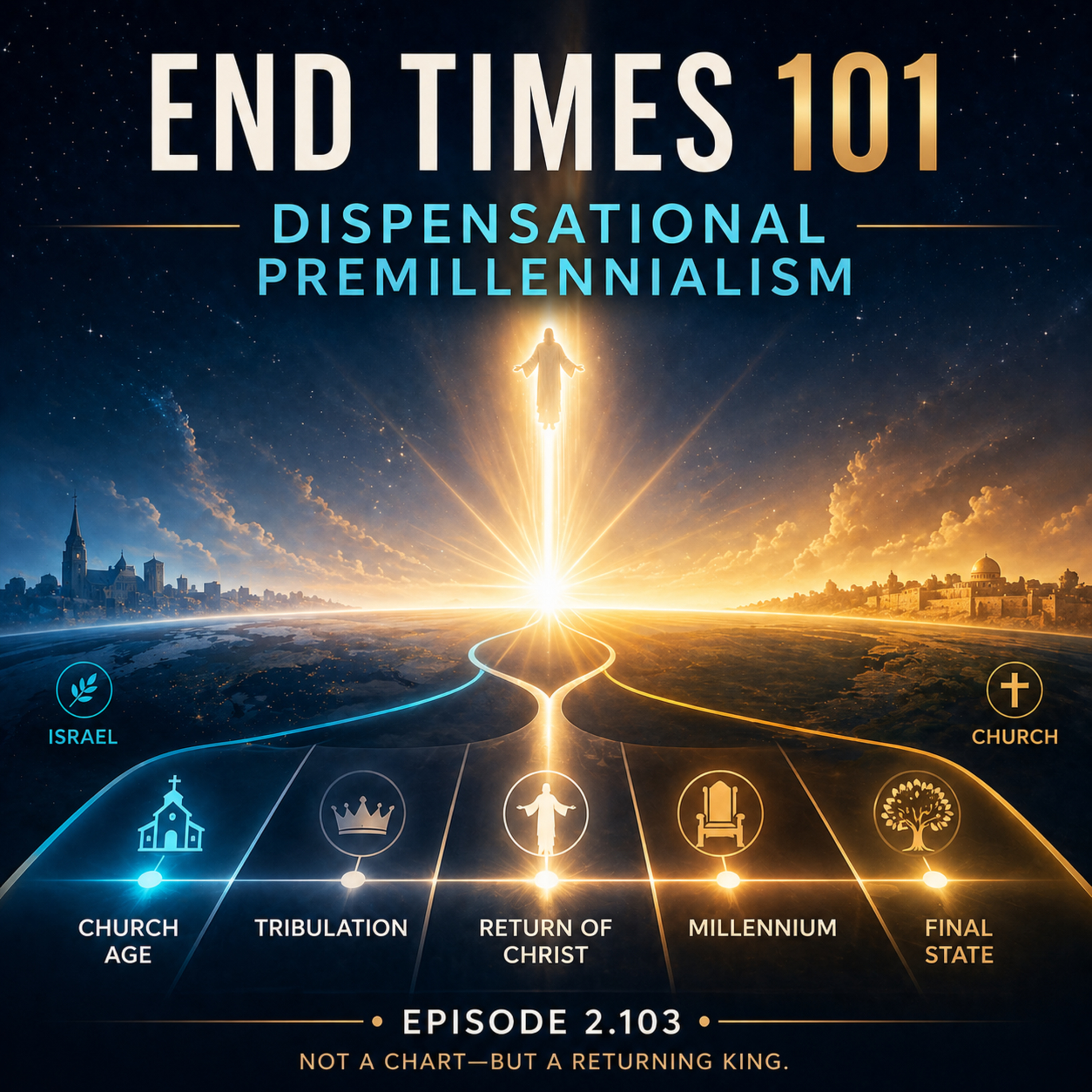
End Times 101: Dispensational Premillennialism



 RSS Feed
Episode 2.103
Postmillennialism: Hope for Gospel Victory
In this episode of End Times 101, Michael and Zach continue the series by exploring one of the most influential modern views of eschatology: Dispensational Premillennialism. Though often associated with rapture language, prophecy charts, and popular fiction, this episode slows things down to ask a more important question—what does this system actually teach, and why has it become so widespread?
The discussion explains the core framework of the view: Christ returns before a future thousand-year reign, God maintains distinct purposes for Israel and the Church, and biblical prophecy points toward future fulfillment. Key passages such as Revelation 20, Daniel 9, Romans 11, and 1 Thessalonians 4 are examined, along with questions surrounding the rapture, resurrection, tribulation, and the timing of end-time events.
Michael and Zach also trace the historical rise of dispensationalism through figures like John Nelson Darby and the Scofield Reference Bible, while noting how the system has developed over time. The episode closes by considering both strengths and challenges of the view—including its desire to honor God’s promises, its structured reading of prophecy, and ongoing debates surrounding Israel, the Church, and internal diversity within the system.
Whatever view listeners hold, the central hope remains unchanged: not a chart, but a returning King.
Find our videocast here: https://youtu.be/0eMIvQfxDNw
Merch here: https://take-2-podcast.printify.me/
Music from #Uppbeat (free for Creators!):
https://uppbeat.io/t/reakt-music/deep-stone
License code: 2QZOZ2YHZ5UTE7C8
Find more Take 2 Theology content at http://www.take2theology.com
0:00 The world's coming to an end. It is. It's the end of the world as we know it. Yeah, and, and we're trying to make it simple, you know, eschatology, End times. We're in episode 4. Episode. 4 So we had our intro and then we covered aw mil pre mil, which I'm still reeling. Oh yeah, sorry, post mil. I'm still reeling over the fact that I thought that. I don't know how long I thought this. I thought that they had that's. How simple we're making it. I know that Michael, his whole world view's been shattered. I know some somehow I thought they still had like a a literal millennial or a little reign of Christ that happened like they ushered in and. That it was early.
0:42 Reign of Christ somehow. You know, it's crazy. I mean, I think that goes to show you too. Just like the limited interaction with post meal, like I read about post meal, I don't talk to a lot of people, like talk to some people that are all mill much less better post meal, you know, where it's like you don't have those interactions quite as much. So it's a little bit like both eye opening and like shocking. Upset how? Upset how? Did I not know this, 'cause I always thought, you know, 'cause they always talk about we are ushering in that's the reign of Christ. So I just assumed that they meant like the physical, literal reign of Christ. That may or may not be 1000 years. Crazy. We're now taking a shift and in this episode, the next episode, we're gonna hit the pre millennial side of things.
1:25 Pre Millennial. Starting off with dispensationalism, which, you know, I think it's gonna be exciting. I think it's been like so ubiquitous and a lot of like, especially on the Baptist side of things. And then I, I do feel like lately in like the last like 10 years, it does get some unfair name calling. I do. Yeah, I think that too. But to be fair, when I was going through these notes, a lot of the stuff I disagreed with because I'm not a first or second wave dispensationalist. And so I I even put together like, 'cause I was reading your historic premium. I'm like Zach and I are almost exactly the same in what we believe will happen.
2:09 Yeah. It's just some of the nuances that are different. Yeah. So. Well, let's jump into it. Let's go ahead and take it to the next level. Let's fire up that twanga music. From the hearts of the Low Country in South Carolina. It's the Take Two podcast where we take theology to the next level. This one, dispensational premillennialism, I feel like I think it's a challenge with all of them. This might be the hardest one to explain simply because of what you kind of alluded to, this first wave, second wave, 3rd wave. There's progressive, there's classic, there's some nuances that's hard to explain.
2:53 Yes. And I don't think we can try to cover all that, but they're like the very first wave of dispensationalists thought that in eternity the Jews were an earthly people and separate. They lived on an earthly plane and separate from the church that would live on a heavenly plane and ne'er the two would ever meet. And I was like, this is so radically crazy. So strange parts of scripture applied to Jews, parts to Christian, gentile Christians and it's very confusing. And I, I, I talked to someone years ago who was classic dispensationalist and they were like, Zach, it's kind of like you've got a dad with two sons, loves them both the same, but you treat treat them a little differently, like they're different, they've got different interests.
3:39 So like, you know what I mean? I was like, OK, that's not help me a ton. It's kind of, it's weird. Yeah. But anyway, let's try to get into it and try our best. And for most listeners, are you about to say something? I can tell I was just. Gonna say I I will try to not color all of this with my progressive thoughts, although they will be there because I think, well, I don't want to steal any Thunder. There's a key tenet of dispensationalism that I think ties all dispensationalists together. That will cover. But then post that there there are some some differences. Great. And dispensationalism is, is one of those things that if you grew up in the American church, especially on the Baptist side who mentioned it, it's it's kind of like baked into the fabric.
4:27 Talking about the rapture. You've read the Tim Lahaye Left Behind series chart after chart after chart. I I read like 11 or 12 of those books. They were and they were well written. I feel like I've read like a kids version of it and I was like going through them all. I. Finally got to the point where I was like, are they really trying to do something or just make a lot of money? So I was just like, I, I stopped out, you know? And, and, and so it's one of those things I think for a lot of Christians, certainly at least 10/20/25 years ago, it was something I think that was almost assumed that these other, there was no other options Orthodox. I mean, there were, but it's like, it's like so in the culture. Right, like to to say that you were pre meal, but post Trib boy was like that was a huge deal like that Like oh, I no, I still believe Jesus is going to have a millennial reign. I just think it's post Trib.
5:20 It's like you may not believe mindset. Yeah, it was rocking the boat. So, so let's let's zoom out. We've kind of talked about this before, but if you're focused on that pre millennial aspect, we're thinking Jesus returns pre, everything's in reference to Christ before the Millennium. And then dispensational, you might have better ways to describe this talk about all these dispensations and the way God works. And this is also, I think a part of confusion. I feel like some people say there's a certain amount of dispensations versus a certain amount of dispensations. I've heard you know different things that way. Yeah, like how many dispensations were there? Yeah, Yeah, exactly. Like those different dice differently. They're, they're closely tied to the covenant. The word dispensation really just means a managerial style.
6:06 So you like assume that you were had a startup company, you might be very aggressive upfront because you got some capital capital venture, you know, funding in there. And then if the economy turned down, you might change your managerial style. So you could, I think it's, you know, it's consistent, believable to have like one person at the helm, like in this case, God that might have different managerial styles depending on what he's trying to accomplish through salvation history. But that's all dispensation means is God relates to his people and the world at large differently depending on the time, you know, the the what he's trying to accomplish in that in that time frame. And like I said, closely coupled to whatever the current covenant is.
6:52 I know I feel like, and maybe This is why I was saying that I feel like a lot of probably creates more confusion. A lot of, you know, less disgruntled people, if they would have just called it covenant soul for millennialism, then it's then it's a whole different ball game, Right. Yeah. Yeah, yeah, yeah, 'cause I, when I studied this, I was like, oh, 'cause you know, I, I grew up in that tradition, so I didn't know. No one said dispensational when I was growing. Up that just was not. Mentioned it was just like this is what we. Pre meal, yeah, yeah. And so it wasn't until we came to CBC and like, well, we're dispensational pre meal. Like, what does that mean? Well, Israel has a place and like, oh, that's all the things I believe. Well, well, you're, you're good. And so I didn't even know that dispensational.
7:33 So when I heard people saying like covenant theology, like well, how do the covenant theology people value the covenants more than dispensational? And I'm like, well, they, they don't dispensational. People in a way, yeah, totally. And then probably one of the most important distinctions we have here is that this is between Israel and the church. You kind of alluded to that, this difference and you know, that can be a huge chasm that can be not quite as a big chasm depends on what you're talking to a certain period in time or like for all of history, all these different things. But something to keep in mind as you know, really at least at the root of that system that started and maybe it looks a little bit different, you know, but that is a hallmark. That is a hallmark and your first wave dispensationalists are going to have a huge break between Israel and the church just near the two shall ever meet for me, I would you know, so these definitions, as you know would be how I define it. The church is all New Testament believers, Jews and Gentiles together.
8:33 So it doesn't matter. Another word for church would be spiritual Israel. It's, you know, most of the language that is applied to the church. It's the Jews who are saved plus the Gentiles who are grafted in, to borrow Paul's language in Romans 10 and 11, Israel could mean, you know, ethnic or national descendants of Abraham if it's not specifically said spiritual Israel. So we do have those distinctions because we think that there are covenants that God has promised that he is still going to fulfill in a literal age of the earth, not necessarily like spiritually or you know, in the eschaton type of stuff.
9:15 I I think that's good. They're just definitions are good because I think if you would ask someone who would say they're, you know, into covenantal theology and all mill, they would be like your definition Church is all New Testament believers. They would be like Adam and Eve. That's when the church started or, or you know, Genesis 315 beginning of the church. Like like some of these are some also like hallmarks that people are talking about that might be like, oh, they're probably not Presbyterian, be more Baptist. You kind of see some of these giveaways with how they talk and and use their terms. Yeah, 'cause I think a prosmo would say they, they may, they would say there's a covenant of works. Basically, if you can maintain your salvation and the the garden.
9:56 Of Eden Yeah, yeah, yeah, yeah, yeah, yeah. 'Cause you haven't sinned yet. So that's the covenant of works. Just keep being good. And then when they sin, you have the proto evangelium, you know the what that's given to Eve. And they would say that starts in the covenant of grace, as far as I understand the that system. Yeah, yeah. And I, I, I think you're right. So these terms carry weight and mean different things. Let's dive into some of the key scriptures. We, we've almost touched on this one every single time it's Revelation 20 only place in scripture that talks about the Millennium. And there's a few, you know, big ticket items that happen in this passage. You want to go through those, Michael? Yeah, so we see Satan being bound, and we're told that he can no longer deceive the nations. It's like, what's that mean?
10:41 How strict or broad is that? And, and it's I, I think most people, especially if you're of the stripe, would say there are nations definitely being deceived today. So it's hard for us to imagine that this has been fulfilled, yet we would see this still as a future event. The Saints will reign with Christ. That's what we're told. And the thousand years is going to be there. So it's it's there mentioned a couple times. So we would say that this that Revelation 20 speaks of a future earthly reign of Christ sitting on the seat of David, filling that Davidic covenant.
11:21 That there you go. And also another important component is this 70 weeks of Daniel. Again, I think I don't like this. We're going to explain it simply because I think there are nuances and some people take like this view versus that view and it gets kind of confusing. But 70 weeks And for all those people that say dispensationalists are overly literal, here's one place where they're not. So I guess, you know, that's like a mark for them to be like, hey, we can be, you know. Symbolic when we need to. In fact, I even changed, you know, because you originally came with these notes and I tweaked them and there was one place that's like dispensationalists try to read everything very literally. And I'm like, well, I don't know that that that's the case, but we try to read it as best we can and I'm sure other folks do the same.
12:02 But. We try to read it for what the original author and the audience would have understood it to me like what did this mean in the context when it was written? But like you said, the 70 weeks of Daniel, from what we can tell there were 69 of those weeks. So each week is A7 year period. There were 69 of those from a proclamation to rebuild the temple to the Palm Sunday when Jesus comes in and and then he's crucified. And so then the question is, well, what about Daniel's last 70th week? And we would say, we would say that the prophetic clock has stopped during the age of the church or the age of the Gentiles. And then that last 70th week will kick off with the great tribulation or the, if you want to break the tribulation into parts, the beginning tribulation which is the 1st 3 1/2 years and the great tribulation which is the last 3 1/2 years. And there are some scriptural support for this. Romans 11/25 says, talks about a partial hardening has happened to Israel until the fullness of the Gentiles come in. So we would see that fullness of the Gentiles coming in as the what we call the Church age.
13:20 Yeah, it would be interesting to maybe maybe we'll never there's but to do a 70 weeks of Daniel like podcast and go through the different things because it is that passage I think is confusing. Is it talking about the anointed one or it's talking about like the one that's gonna cut against the it's like some of the verbiages. It's it's very fascinating and you know, you can read 100 different things about it, but that but you explained it well and that's important. You'll you'll hear that a lot more being emphasized in a dispensational framework rather than like awe mill or post mill. You know, you're not gonna hear that quite quite as much. Another thing that you will come across is the rapture and resurrection and dispensationalism. The classic view has the rapture as the secret coming of Christ. I don't know if you, I grew up in a church all about the rapture and you're always kind of like, like you wake up in the morning and you see like clothes on the ground like, oh, did my brother?
14:12 Was he raptured? The the, the, the church come like it's, you know, these kind of things that you think. About that is exactly the the culture that we grew up with and you know, the idea is that you have to remove the church, yes. That distinction is so important. Yeah, you, you have to yank the church out. It's a secret return of Christ. And then that will kick off that last week where God renews his close action with Israel and he completes, you know, that that prophetic week. Now that that's really important. So Rapture, very big dispensationalism, where in the other ones they might say there is a rapture, but there's not a secret rapture. They would say that would be the same as Christ returning versus like a secret rapture before Christ's returns, if that makes sense.
14:58 And to be fair there, I think based on at least my this is just from Michael Ma's experience growing up and also being going from my church in Arkansas to the church in CBC. I think there are a growing number of dispensationalists that would be post Trib. Yeah, that's probably good. That's good. So that would be me. That would be like my youth leader growing up. I think some. So then we would see very similar to, you know, we would see that rapture and resurrection being simultaneously like, you know, a premium or an AMIL would see that. Good, good clarification there. There's there is a lot of developments and like Michael is saying, like you read some of the like the more recent stuff, stuff on progressive dispensationalism and it's not that really much different.
15:45 A lot of these things are kind of like flattening. I think they are flattening out from the big differences like of the 1950s. There are some texts that I'd like to quickly go over to support my view that the Rapture and the resurrection are the same event. Great meaning a breakaway from like classic dispensationalism. So you would you would call yourself a dispensationalist just based on we'll get like there is some distinction. The main, so I think the main thing that makes the dispensationalist a dispensationalist is that we believe that the land promises given. To Abraham. Oh yeah. And the kingship promises given to David will be fully realized during a literal 1000 year plus 100,000.
16:29 Plus, yeah, yeah, yeah, yeah, yeah. It could be 100,000 years. I don't. Know. Yeah, yeah, yeah, yeah. There will be a literal reign of Christ on the. Earth, and it will be. He will be like where Jerusalem is right now, correct? That's it. Will not shift or be. Different. So Jesus reigns as the king of the earth, but he's a Jew, right? Jesus Jewish, but the Gentiles and the Israelites who are part of the church, we're all part of his reign. And then we, as the Saints, will judge with with him. Yeah, yeah, yeah. And I don't think that's too different than even. I think we'll get into it more. I think historic premium would be OK if it was like the Kingdom looked a little different and it was like bigger than Jerusalem or something like that or is like more grand or something. Like that.
17:19 So what? Yeah. And so maybe this this is like where semantics matter, Like you would say that Trump reigns. OK. Yeah, yeah. From DC, His DC is the capital. But he spent a lot of time Mara Lago on the golf course or whatever. Yeah, but his reign covers all of America, right? So that's the same like. So Christ reign. Covers the whole globe, but the capital is in Jerusalem. That's that's the distinction that we had made. All right, so some key texts first. That's 413 through 18. We're not gonna read all these, but you'll see the Lord descends, there's a loud command, a trumpet, the dead rise, delivering or living are caught up in the air, happens in a twinkling of an eye. So shall we ever be with the Lord, and so shall we be changed, right?
18:05 And, and I 'cause I think this is a also a primary text people would do to support the rapture, which I think the response is, it doesn't seem that secret with the loud trumpet and the voice of an Archangel. You're like, is that secret or not? I don't know, you know, But in a way you can see where they get like thief in the night. Like it comes unexpectedly but there is like proclamation. It comes unexpectedly for those who have not read Matthew 24 and. 25, yeah. 1st Corinthians 1550 through 40 you'll see an event where all are changed is the last trumpet. The dead arise, and there's a living trance are transformed. The perishable put on imperishable, the mortal put on immortality. Matthew 2430 through 31, The Son of Man returns in glory. A trumpet sounds, the elect are gathered. John 528 through 29 and Daniel 12/2 both talk about a general resurrection tied to judgement.
19:00 So all of these events, they are public. There's an audible like you were mentioning, there's a resurrection of the dead, there's a transformation of the living. There's a gathering of believers. There's a visible return of Christ. The last trumpet suggests finality, not like a preliminary stage. Now that that's good and you know, these texts together, which would be in line with really all the other systems we we've taught on one unified event, resurrection of the dead, transformation of the living, gathering belly, return of Christ, where if you say rapture in these other systems, you just don't mean the secret rapture. The only time you would ever mean that would be in some parts of dispensationalism. But like we're mentioning here, not all schools of dispensationalism. Yeah, and I I to be fair, most, I would say the largest percentage of dispensationalists are probably still pre Trib rapture.
19:51 So I am the the Unicorn among the the the pre mill dispensation list. I grant that. But yeah, yeah, I think the unicorns are growing in. Number and to be fair, yeah, not to paint everyone just totally in in that camp. So we mentioned it. Resurrection equals this rapture view Christ's returns visibly dead and living gathered all receive resurrection bodies. Believers return with Christ. We read many texts and you mentioned Christ's range from Jerusalem and believers will reign with him. Yeah, for the Lord, First Thessalonians 5:00 we we see this sudden judgment, clear separation. It's again kind of connected with with these different things as this big, big event.
20:38 Yeah, and this is one of the reasons why I would split from some of your other pre meal dispies is because I've read both first thess and 2nd thess. I mean, meaning to get to the second one and it's just like I never got there. And it's like, to me, it's like it's clear that Paul says, hey, some of you've already heard that the day the Lord has come, but before the day the Lord ever comes, the man of lawlessness is going to be set up. So whatever that means, you know, I take that to be a literal Antichrist that is going to come onto the scene. Yeah, it's also tricky too. We should look this up, you know, how many times like the word Antichrist is in Scripture? Not as many as you think. I mean, here it's like man of lawlessness, which people connect with Antichrist, you know, you know, that kind of thing. But it is interesting.
21:23 It's really, it's same thing with Millennium. It's like, not that much. You got to do something with it, but it's, you know, yeah. It's not that much. So I would just say that yes, I do believe that the rapture resurrection are the same thing, and they occur after after those things. All right, let's talk some more key terms to become a rapture, tribulation, this period of intense judgment often linked with Daniel 9. This is another area that there's some variance, but in most of the systems that we're going to talk about, you know, believers are going to go through suffering and tribulation. Dispensationalism is kind of unique in that believers like not your stripe, but your particular are like escape the judgement. That's like a thing a benefit of being.
22:04 It's when you separate them, they kind of get out of that intense, you know, tribulation or maybe all of it too. Some people aren't mid trips on our pre trips. Yeah, and I remember my church just haven't most of the folks having a very laissez faire attitude towards tribulation. We're not going to be there. We're going to escape it. And then when I would, you know, me and the other guy were like, no, I don't know that that's the case. Why don't you believe that? Like there's this visible palpable fear on their face that we're going to have to go through tribulation. Like, but the church has gone through tribulation the whole time and we could go through really, really bad time and it not be the great tribulation. So that's right. We should be prepared because you know, Jesus says in the upper room discourse in this world, you're going to have tribulation.
22:47 Take heart of I've overcome the world. So no matter what you believe, you should be ready to suffer for Christ. So we have tribulation, we have Millennium, there's 1000 year reign and then this Israel versus church distinction. This is also painting with A broad brush that maybe is unfair dispensationalist. They'll often be like critiqued as like Israel could do no wrong. We're supporting Israel at all costs because you know, if we bless Israel. Recent news that's has come up. And so I'll just say as a dispensationalist, I, I don't think that the current national Israel is necessarily the Israel that has, you know, was that Abraham? Was that not?
23:29 Abraham, Israel. And I'm not saying that that they can do no wrong in the same breath, I don't want, like I've said this, I don't want America to be the country judging them. Let some other country judge them. Just, you know, just to be safe, 'cause there have been countries in the past God has raised up to judge Israel and then it's not good for. Them not a good track record. I think if you know, you want to be super simplistic, it's like, you know, you've seen clips of who, who, who's the guy, nice guy politician, who's like, not Marco Rubio. Ted Cruz. Me. I don't know. It was Ted Cruz.
24:10 I can't remember. I'm getting, I think it might have been Ted Cruz. Keep naming people. I don't know why I'm blanking, but like in an interview being like my whole foreign policy with Israel's based on Genesis 15 or whatever. You know what I mean? You're talking about the former governor of Arkansas, I think maybe. But it's like some, some of that, like wholesale stuff is wrapped up and I think it comes from a good place. I would say it's a wrong place, but it's like, you know, it's one of those one of those things. I, I all that to say, I think Israel versus church has made a much bigger deal in dispensational framework versus these these other ones. Yeah, Mike Huckabee. My probably Mike Huckabee's probably who I was thinking of. I I, I can't remember exactly, but it's like whole, it's kind of funny, like.
24:51 'Cause his daughter is the current governor. Hey, there you go. So a simple timeline. We have the church age. We are currently in the church age now Christ's return, resurrection, rapture. We've got a lot of things. How much you you explain the timeline cause where some people be like the rapture happens. Well, I'd say there's two there's. Let's talk about the classic timeline, OK? Let's do it. Classic timeline is 'cause this is not necessarily it is straight, which is why you're struggling. The church age, the rapture, the tribulation, then the visible, you know, public return of Christ. So we are, this is like Christ's return to A, Christ's return to B, and then the millennial Kingdom. And then Satan is loosed and there's the final judgement. For someone like me who believes rapture equals resurrection, IE the the post Trib church age, tribulation, rapture, resurrection.
25:57 We rise in the air, we meet Christ, we come right back down with him. He sets things to write. He rules for a long time. There you go. And then there Satan is released, his final judgement. And then the eschaton. There you go historical developments. If you've heard of John Nelson Darby, you know, very, you know, instrumental. You think of the Schofields reference Bible, the study Bible that really did spread like wildfire. And then you know, more as things progress. You've got Ryrie, John MacArthur, probably like most famously here and and something I'm. Sure, like I was thinking I was going to add some I forgot but Coho would be right in line with me.
26:40 He's a post Trib, so pre mill, a dispensationalist. So I, we, I, I share a lot of views with Coho, not just I feel like that doesn't. Talk that much? Yeah, that's. Good. Like David Jeremiah. Oh yeah, David. Jeremiah. That's right. Yep. Yep. Who's that guy who was a pastor? Charles Stanley. Yeah, yeah, yeah. So there's. There's probably a lot in the South of your normal Baptist. Times I think that. Would hold the this some version of these views? And I'll say this for his, I was going to say this for historic premium, but I think it falls in line with dispensationalism as well. It's more, I think, and this might be prejudice against the other views. So it's great.
27:24 It'll be good. I think it's more maybe not maybe expository driven rather than system driven. Where we take text, we deal with it. It seems to be the straightforward reading of the text versus a system. They probably would have some qualms with that, obviously, but I I think it's more like you think of a John MacArthur, a great expositor and you see like you look, maybe things don't the system doesn't make as much sense, but the text he's just like pulling apart the. Text. What does the text? Say correct? Yeah, I would. Say that's that's generally the case. Now all of us can get bent by our system because read MacArthur's stuff on alcohol and you're like, bro, that that is not what the scripture is saying here.
28:05 So we can all get get hemmed in. Yeah. So why would people find this view compelling? Well, it seeks to look at prophecy according to what the author was trying to say. What you were just saying I think. Straightforward reading. It seems like the easiest, plainest reading. It takes God's promises to Israel seriously. It doesn't just, you know, spiritualize them or algorize them. That's like usually the critique of something like Amil. It provides a very structured framework. You see the charts and charts and charts and you're like, this is like, OK, we've got all these things. And it does encourage what I think the Bible encourages and vigilance and readiness and the be on the lookout. I think that's negative with this view too. Some people can be like looking for the boogeyman under every corner.
28:48 It's like all these views, there's pros and cons, you know, how much are you gonna? So anyway, I think that that those are the compelling side side of things when it comes to dispensationalism. Yep, some challenges, Israel church distinction especially I think in your first and 2nd wave, it doesn't really make sense of like passages like where Paul says there's no Jew, there's no greed, there's no slaver free, you know, So you're like, well, but there is in this system, there's a huge difference and in what you're doing. And I think the criticism of a system like this would be like, you know, the pejorative thing to say about dispensationalist would just say like, oh, you think that the church is Plan B, that like Israel was plan A and this is like a this is like just like a parenthesis.
29:41 And they might say like. That's not pejorative. All that was preached when I was from the pulpit, the church ages of parentheses and God's plan with Israel. So you would say that to, you know, you're probably second wave dis bees and they would be like that's not pejorative at all. That's what I believe. And from their side of things, they might be like, oh, you guys, this is replacement theology. You're just replacing everything. And so they're, you know, that kind of thing. So this distinction can be a problem. Internal diversity disagreement on rapture timing as we we discussed you know, I think we. Didn't even talk about mid to mid. Trim. Which I think comes from that that Mark 2425 passage where it says except for some of the elect.
30:26 He. He. Cuts the day short. So I think some people read into that a little little more so they get to the mid Trib. Millennium. Stephen Brinson's Mid Trib What do you say Stephen Brinson is Oh is. He Oh yeah, we should in the home groups. We'll we'll break it down Millennium questions. We'll probably hit these more on the historical premium. It's like baked into some of my notes because there are some like weird things that happened that seem out of place but. Yeah, 'cause when I was looking through your notes and it had some other concerns, this one wasn't even in there. And I was like, I, I think the biggest problem with my own view, the thing that that doesn't make sense to me about my own view, and I'm like, this is where I don't understand how it works, is that if the rapture equals resurrection and that happens before 1000 year reign for a long, long reign, what about people who get saved during the millennial reign?
31:18 Yeah, it's when do they get their new bodies? It's confusing, yeah. Is there a rapture resurrection 2A and 2B So, so the the omil position does make that cleaner. Yep. You just go right into the, the spiritual, you know, reign of Christ and there is, there's there is no one that's getting saved after he returns. Yep, that's totally right. That leads into the next weaknesses, the complexity. It is a little bit like all these different nuances. It's just short and sweet with with omil. And then historically big criticism of the classic dispensational movement is it's like you start seeing it maybe in like the 1800s, Don't see a lot of it in the don't see, you know, reformation, that kind of thing. It's kind of like, obviously they would say we're recovering this from long time ago, just like, just like, you know, the Reformation's.
32:05 Recovering these principles. Yeah, it it, it. Yeah, Straight the bloodline. Yeah. There you go. So anyway, that's good. I thought we navigated through it. It could be a lot crazier, so not bad. Yeah. And so, you know, I've said this before, no systems perfect. Like I think each system has the little loose ends that don't really make sense of what we're reading, but we're trying to do the best. And I think it really is kind of going back to the intro podcast we had on this where, you know, you're looking at the mountains. What's the timing is? Is there a gap between this mountain and that next mountain? You know, where do we land in that already? Not yet. Oh, I love it. That's good. Do we dare transition to the final take?
32:47 I think so. Nice. Yeah. Spring break, man, what's going on? Who? Well, we mentioned Top Golf. You've gone a couple times. 3 * 15 times I've been, I've been alive when it first opened one a lot. Just you know, just it, it's involves you if you go during the middle of the day or something, it's not too bad. You know they get you with like the surge pricing. Yeah, man, I was trying to get us to go during the day, but I don't think. It's Chloe and Kerris didn't want you to. Yeah, I think it actually was Chloe, 'cause it was like, can we not go in the middle of the day and like, well, Lydia now works until 3:00 on Thursday. Carry on the family business. Let's say again. She she's staying in the family business of Old Navy. Yeah, it's great.
33:30 That's like, I love it. It just ever. Phoebe is destined for this. She cannot change her fate. That's right. That's right. But so I think it's going to be Friday afternoon. I'm like that's going to be the worst. It's going to be the worst. So we'll see if we can. Make a. Little different time. We got a lot of Top Golf, always a good time. Yeah. So when this airs, we may or may not still have this, but just yesterday we added something to our mattress. We added a wedge to like kind of slightly elevate your your head and just because I was having a little bit of nightly reflux and Jill, she loves the way.
34:13 Oh. Yeah. She's like, this is the best thing, man. We've, you know, ever. Wow. Ever. Yeah. Yeah, that's pretty. Good. Yeah, Yeah. Nice you have you, have you noticed a difference? Well, in your sleep. Last night was her first night to sleep on it. I, I slept fine. Jill said she did not sleep well, so. She'll get used to it. She'll learn to love it, you know? Yeah, it's great. Just give it some time. How much how how big is the wedge? Is slight. 7 inches, so it's 7 inches at the tall end. And then it goes down to basically nothing. And basically just, you know, the idea is you don't want to just bend at the waist because that's bad for your back and it can actually like put pressure on your stomach and stuff and make reflux worse. But yeah.
34:57 And so we'll see. And I, I do want to, this is kind of out of, I don't know that we addressed this or not. Oh boy, let's but we had a lot of comments too from two different videos when we did the Roman Catholic stuff. Yeah, and we were talking and you were like, fight me. Like fight me in the back alley. Let's Duke it out. There are two different commenters that basically said as soon as you said Roman Catholic, I knew you didn't know what you're talking about, 'cause there's 24 churches in the Catholic Church and the Roman Catholic is only one of them. So your whole podcast is just aimed at. We should dump that out. What about the other 23 churches within the Catholic Church? I'm like, that's what you're going.
35:38 To push back, that sounds like a 24 part series coming up next. I'm like, and I did some searches and it's like every maybe it's all Protestants that do it, but all of us refer to the Catholic Church as the Roman cause. Guess where it's headed Up. Yeah, it seems like Rome. Rome. I feel like that's an important part of the Vatican. Catholic yeah, yeah, it seems like dude. Vatican. This is probably not great to say. I I there's like no rules on the Vatican, right? Like they're like, they're sovereign, autonomous. They do whatever they want, right? Yeah. I think they, yeah. Man, yeah, their own. Little I would, I've never, I've never been to Vatican City, but I would love to go just to like see all the, you know, everything's like so fancy and, you know, crazy, all this stuff. Sing a mighty fortress there, there you. Go.
36:25 That's one of their favorite hymns. Probably love that one. Love that one that that is interesting. I have we have appreciated the engagement. It's hard to keep up. I'm not like a YouTube. I I do like watch stuff on YouTube but I don't it's hard for me to like keep up with if. There are comments, especially if they're snarky. Zach is the one doing all that online. I I just sit back and don't really even do anything. It's great. So I might say something couraging from like a Kobe Bryant text user handle, but Zach is the one that's doing all of those interactions. I like calling people out. Get back, get back, get back on it. I like it. We'll see. Sarcasm. This is good. Hey, you know, we'll, we'll keep it, keep it on. I'm curious if we'll get any pushback on the end times. On the end times, yeah.
37:09 Probably not as much as the Colts, but we'll see what happens. Yeah, yeah, yeah. Anything else you got? That's all I got. All right. That's our take. Thanks for listening to Take 2. Find us wherever you find podcasts and on YouTube for those who want to watch our video cast.

