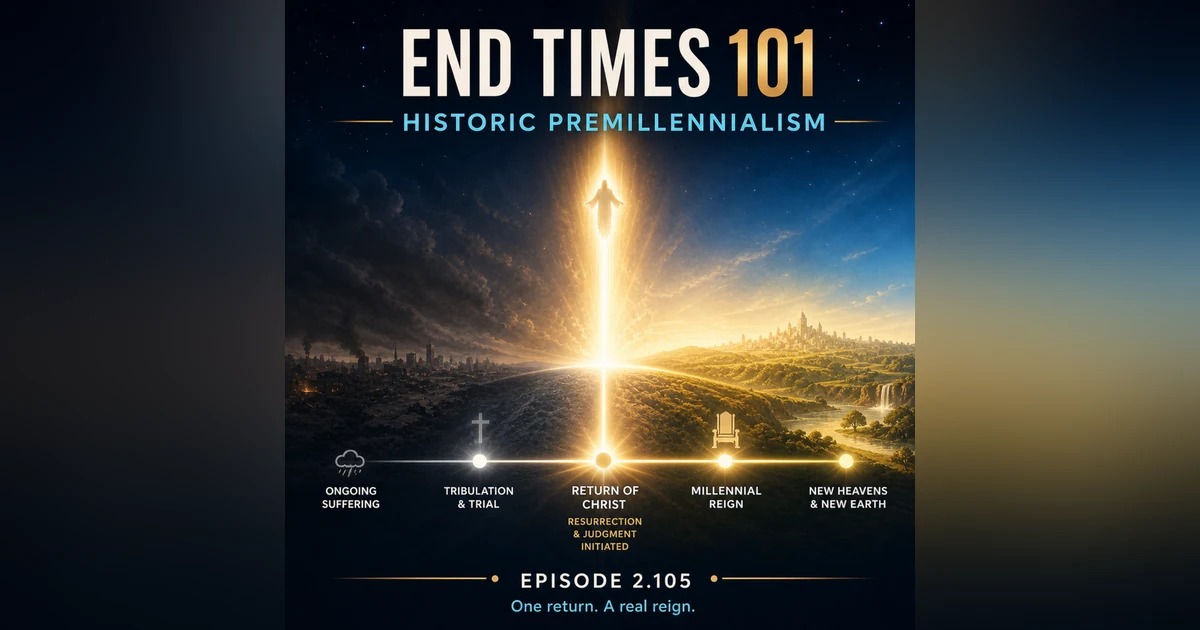
End Times 101: Historic Premillennialism


 RSS Feed
Episode 2.105
Postmillennialism: Hope for Gospel Victory
In this episode of End Times 101, Michael and Zach examine Historic Premillennialism—an older and often overlooked view of the end times that predates modern dispensational systems. While many associate premillennialism with charts and rapture timelines, this episode presents a simpler framework: Christ returns once, after tribulation, and then reigns on earth before the final judgment.
The discussion highlights key differences from Dispensational Premillennialism, particularly the unity of God’s people across history and the absence of a pre-tribulation rapture. Walking through passages like Matthew 24, Revelation 19–20, and 1 Corinthians 15, the episode builds a case for a single, visible return of Christ followed by a real, future reign. The conversation also explores how this view handles the millennium, resurrection order, and the ongoing presence of suffering prior to Christ’s return.
Michael and Zach also trace the historical roots of Historic Premillennialism in the early church, noting its presence among early Christian writers and its later decline as other systems developed. The episode closes by weighing both the strengths and challenges of the view—its simplicity, its realism about suffering, and the interpretive questions it raises.
At the center remains the shared hope across all faithful views: not a system, but a Savior who will return, defeat evil, and establish His reign.
Find our videocast here: https://youtu.be/4HyMYiR7xNE
Merch here: https://take-2-podcast.printify.me/
Music from #Uppbeat (free for Creators!):
https://uppbeat.io/t/reakt-music/deep-stone
License code: 2QZOZ2YHZ5UTE7C8
Find more Take 2 Theology content at http://www.take2theology.com
0:00 Wow, 18 pages. The granddaddy of the mall, historic pre mill. Buckle up, right, we're gonna have to fly through some of this and you might have to be exact time to move on. This is my the view I would hold to and you know, I'm hoping we don't get lost in the wizard. Keep it simple. But my tendency is gonna be like, let's look at this detail and this detail. Doesn't it just like, make total sense? But honestly, not as different as probably our last episode than I initially thought it would be. I thought there'd be more stark differences. Yeah, I think probably 'cause you're, you got a progressive just be next to you versus. You're so progressive, Michael.
0:41 That's what, when I think of Michael, I think it's just progressive. I mean, if you had others, you know, you, you could have another consistent dispensationalist sitting next to you and it would be a much different discussion. Yeah, so and that's why it's almost especially after I learned that pre or post meal, there's no actual little historic little rat. I don't know like how did I miss that? Did either when it was first explained to me someone was playing wrong or I just misheard it, but I always thought that like there was this almost like a pseudo millennial reign before he came and then they usher him in to rain on earth for some time before the eschaton so I didn't.
1:25 But someone like it's, it's 'cause there's not a lot of post meals out there. I mean, reformed MD maybe. I guess you're, you're on the fence. What I would love to do. I don't think we'll ever do it. It'd be great to have a podcast with me and you reformed indeed. If he leans post mail, I know he's like he was kind of I think he was talking to comment like he's like in between and then I was thinking about someone else that we run circles in to represent the AW mill view and just like talk talk about. Family in Memphis anymore? I don't have, I don't have any family in Memphis. Yeah. So that means you either have to come out to Arkansas or Reformed MD has to come here. It would be cool to get like different reasons to talk about in it.
2:06 Like one thing I really appreciate about reformed MDI. Don't know him, but I read his comments. His comments are thoughtful. They're measured and they're never like like sometimes they're funny like they're not like they're. Not off he sent me a a video today and I actually have not watched the video yet but I could tell from the video what it was and it was like it said this be when they're explained the end times and it was. Like that, all the crazy, It's always sunny or yeah, yeah. Yeah, I just sent him AI rolling emoji, but it happened at work, so I didn't haven't I, I wasn't like purposely not watching and I just couldn't. But I was like, oh, I know what this is going to be, but yeah. He he was saying something. I was like, yeah, when in doubt, when in doubt, we can.
2:48 You can always make fun of the hardcore dispensational. I mean I not. You. No, yeah. Not you, not. You agree? No, I agree. We can make Yeah, yeah, yeah. Yeah, it's great. When in doubt, we can all go there. Just kidding, but I'm excited for historic pre mill so let's go ahead and take it to the next level. Let's fire up that twangy music. From the hearts of the Low Country in South Carolina. It's the Take Two podcast where we take theology to the next level. I and I almost titled this one. You know, not all premillennialism is the same slash. This is not your mother's pre meal because it's probably not your mother's pre meal cause 'cause you think of pre meal you almost in in American evangelical culture.
3:35 I think dispensational dispensational had the the chokehold for a long time. Yeah. And I think if we can have a podcast on a mill and post mill and there is no mill there, I know that you know what I'm saying there. Yeah, yeah, yeah, yeah. Then I think it's fine to have even differences distinctions between historic progressive or a hard line despy. I like that. Yeah, though that that is good. I think the series has been good for that. I will at the outset say a lot of the thoughts I am sharing come from George Eldon Ladd, the one of my favorite guys with already not yet kind of breakdown. A lot of it's coming from a guy named Fred Zaspel.
4:16 He writes really well. And then also a guy named Michael Schultz. He's one of my seminary professors and he has such a great presentation. He has such a great first name, Mike. Let me get behind that, borrowing heavily from some of his materials. But the big idea, historic pre mill teaches that Christ will return before a real literal future reign on earth. Compared to dispensationalism, hardline dispensationalism does not have this stark separation between Israel and the church, does not have a pre Trib rapture. We talked last week. Dispensationalism doesn't necessarily have to have a pre Trib rapture either. For someone who is historic pre mill, you know, Israel could construct the Third temple tomorrow. They could start offering sacrifices. Israel could cease to be a nation tomorrow. And I don't think a whole lot would change about their viewpoint.
5:13 It wouldn't affect things in the same way that like a hard line dispensationalist might be like everything has changed or that kind of thing. So pre mill, a lot of similarities but some differences. Of the first wave or hardline dis bees, whatever we want to call those who do believe that the sacrificial system will get started again 'cause I do remember being younger and my preacher reading something about them breeding for red heifer again yeah and so that was like signs of the end times and. I think that's going on like heavily right now. And they were like so close, but there was like one blemish on this red heifer and they keep like trying to get closer to and they've got. To be a pure red heifer like no spots. Pure and I think like the they're getting together like all.
5:56 The is this? Is this prescriptive in the Bible? Have I missed it or is this like in the Talmud or Masoretic? Like where did the red heifer come from? Have I just missed it? I, I, I think there is a red heifer. We should, we should look this up. But I, I, I let's, let's do a little search while I start talking about some differences in hard line dispensationalism from historic pre mill. Historic pre mill sees more continuity between Israel and the church. Not this strict separation. You know they would look at passages like Galatians 3. You know you're 1 if you are in Christ. There's no male nor female that that kind of thing. No pre trip rapture typically big difference really where I want to spend most of our time is looking at just a couple of passages.
6:44 I want to look at one. We've looked at a few times Revelation 20 because I think a deeper dive. I know you don't want to base every not not you, but I know like people don't, you don't want to place put all your eggs in the Revelation basket. But I'm like, Revelation is clear to me. It's clear. There's a lot of things I don't know about it, but it's like, man, it cannot be more clear. So let's go ahead and open up Revelation 21 through 6. I know you've read this for us a few times. I'll set some, set up, some background, and then we'll read this maybe a couple verses out of time and work our way through it just. To note, it is number 19. Oh. Numbers, I say. OK, there you go. Good, good catch. Institutes to red heifer I I mean, I guess I just need to study numbers more.
7:29 You don't do your you're not you're not near like a numbers. Deep, I mean, I do the read throughs, you know, and I get the big pictures, but I, I, I can't say I've graphed it all out so. And got to got to brush up on the red heifer theology. Historic pre mill differs from Ahmil in the fact that it's 1000 literal real future reign. It's not not symbolic for the present age. It's not a Millennium going on in heaven right now. It's a future phase of history that's literal in nature. One thing I do want to say too, because we've talked about this on the podcast, you read Revelation and I, I agree that probably the most natural way to read Revelation is through this lens of recapitulation where you're seeing the same view, same scene like over and over and over and over again do.
8:15 You think reading Revelation as recapitulation or straight through, do you think that would affect your theology? Because I could see any of the views that we've talked about potentially reading it either straight through or recapitulation and still coming maybe to the same conclusion. And that's the point I'm going to make. I think you can. I think the charge is if you're pre meal, you probably just read revelation chronologically and if you're like aw mill and smart and you can like see the recapitulation and you can you know, I I think that would be like how a lot of people frame it, but I think.
8:59 I mean there's even if there are like 7 recapitulations, yes. Right. There's there's bad things that happen and Jesus returns and sets things straight and he reigns for 1000 years. Yeah. And I want to make the point that if you read I, I listen to a lecture. It's free from Reformed Theological Seminary. Actually, not a lecture, but a class by Doctor Michael Krueger, who does a lot in apologetics. He has this great class on the Book of Revelation and he uses William Hendrickson's More than Conquerors. I think that's like one of the 30s or 40s commenters, Revelation that that really talks about this recapitulation in detail. And one of the go to texts, if you look at like go to texts you got to read and they always put a recapitulation in between chapter 19 and 20.
9:44 And I want to show exegetically. That's bad. Hermeneutics. That's a. That's like a. Forcing a system on there. Forcing it where you can look everywhere else in Revelation and you don't have to force it. It fits naturally. And that's when I want to spend a little bit of time talking about. For more context, if we were to zoom out, look at Revelation 19 and 20, I think, I think the average person would not put a break there. You can read a lot of other Revelation Revelation and put a break there, but I think you'd have to be taught to put a break there. Honestly, 'cause if you go through all the scrolls and then you get to the all the trumpets, like there's a natural blank in between those. Exactly, exactly right. We're here. It's very very strange and historic pre mill and dispensationalism would see continuity and sequence between Revelation 19 and 20. Revelation 19 ends famously with this rider on a White Horse, you know, coming back.
10:36 Revelation 20 is this Millennium. I wish I wrote down the guy this quote I came across and and in these notes, and there's a couple on mills that were basically like, man, and this is not a recapitulation. You kind of have to be his, you kind of have to be a three meal. But but they're like, but there is so we're on mill or whatever, you know, but so so that's like what's at stake here? Is it clear? Is it not clear? So real quick, I don't want to get bogged out in the weeds too much, but three, this is from Michael Schultz's presentation because I think it's so good. There's three criteria for having a new section, a new recapitulation, 1A new vision is introduced. We we'll look at some of these two. There's a major language change.
11:17 The scene has changed or a clear narrative shift. These would give you an indication, hey, maybe it's a whole new scene. So look at the look at the first one. No new vision. If you want to pull up, pull up Revelation 4, verse 2. I'll pull up While you're doing that, I'll look at Revelation 17, verse 3 and just just read that verse. Sorry, I am feverishly turning 4. Verse 2 says immediately I was in the spirit. Behold, the throne was standing in heaven, and one sitting on the throne. So John's in the spirit, chapter 1, he's in the spirit, 4 is in the spirit 17 he was carried away in the spirit. And, and with this carrying away, you're kind of in this new scene, you see something a little bit different happens again in 2110 after 19/20/21 or kind of all together. You kind of see him carried away in the spirit with a change in the location.
12:03 It's very, very clear. So first thing, we don't see chapter 20 in the spirit markers. Like that's not, there's definitely not a change there. Is there a language change? Actually, I would argue that it's the opposite. You actually see a lot of continuity in language. You see this in the Greek, it's a Kai Eiden. That's basically Then I saw or and I saw and in chapter 19, starting with the rider on a White Horse in verse 11 it says then I saw then verse 17, then I saw chapter 20 verse one. Then I saw 21 seven or 2111. Then I saw 20-11, then I saw 21 one, then I saw. So you kind of see the sequencing that seems like this all is kind of like the same thing and going in some sort of order. You read a lot of the Ahmil commentaries and they kind of say, well, these aren't necessarily in order. They're not chronological and they kind of like flip flop them around, which seems strange.
12:58 I'm saying it could happen, but it's it seems like it is flowing. Reading into something and. Reading into when it's like it's a continuous story, yeah, it kind of signals because. If it makes sense this way, what what would indicate other than your system to change it? That's exactly because if order, if order doesn't matter. Like. Yeah, what? You just change it, whatever. But what are we doing? And so there's no language change for a new vision. And lastly, there's no narrative break. It's actually a very a continuous storyline. If you look at Revelation 12 and 13, you read the story about the beast, the false prophet, and Satan. They're all kind of together. Some people have called this the unholy Trinity or something like that. In Revelation 19, we see the beast and false prophet judge, Revelation 20, Satan's judged. Kind of seems like we're just recapitulating what 12 and 13 is saying again.
13:48 Again, we're making like, why are we breaking this up? Kind of, Johnson? Knew that this would be a problem when he put when he wrote chapter 20 and he broke it up. Yeah. Also good to know the chapter. Yeah, these chapters are not inspired. The chapter breaks that. That's great. So what we see is the same setting, the same characters, the same progression. Not really a good reason to make a change. And without these presuppositions, it's really one continuous story. Again, I think you'd have to be taught. You'd have to study to learn that you should break these up. Similar to the pre Trib rapture. I don't think you find it in scripture beautiful. You have to. You have to be taught that it's there. It cuts both ways where that's the kind of thing a presbyterian's gonna make fun of a dis be all about. But we're kind of doing the same thing here. You know what I mean?
14:34 So I'm so glad you you brought that up. And cause honestly, I think it's simply just bad hermeneutics. It does not let the text speak for itself. You're really, I know Revelation's like tricky, it's apocalyptic, whatever. But on some of this stuff that's not even like you're just, you're just putting your framework over. So anyway, long winded intro. Let's read verses one through 3 and talk about the binding of Satan. It says, Then I saw an Angel coming down from heaven, holding the key of the abyss, and a great chain in his hand, and he laid hold of the dragon, the serpent of old, who is the devil and Satan, and bound him for 1000 years. And he threw him into the abyss, and shut it, and sealed it over him, so that he would not deceive the nation's any longer until the thousand years were completed. After these things, he must be released for a short time. So we've talked about this before, but I think it's important to know we we start out seeing an Angel descending from heaven to earth.
15:28 Also, this is happening on Earth. This is not happening in heaven. If you're kind of thinking Millennium, it's weird, you know that John is not saying this isn't heaven right now. It's actually on the earth, very clear, the nature of binding. Like just read some of these adjectives and descriptors. He seized, He's bound. He's thrown into a pit, shut and sealed. I get the argument that it's like he's bound but still has some leash. But when you read all these words together, why are we saying this so much if it's like it seems dramatic? And like we've said in previous ones, I, I 'cause I couldn't stop myself. It does seem like he still is deceiving nations right now. It's see, no, I'm so glad he brought that up.
16:10 Fred Zaspel, in an essay I was reading by him, he says, if you're reading these words that someone sees bound, thrown into a pit, shut and sealed, you would think Satan's incarcerated. He's not on parole. And I like that. It's like, it's not like he's on house arrest and he's like moving around. It's like, no, this is like a big deal. He's bound. He can't be on this awfully long chain. Also, what Fred Zaspel notes is that you see, you see this, the dragon, the ancient surface, who is the devil? Satan. He's like using all the different names for Satan and putting them all together. And that's all bounded that, that that's sending a message in and of itself. You read Revelation 12 that talks about Satan's defeat. You, you read First Peter 5 walking about seeking whom he may devour. Second Timothy 2 says that Satan takes men captive currently at his will. 2nd Corinthians 4 The God of this world who blinds the minds of those who are lost. 1st Thessalonians 2 Paul talks about Satan opposing him.
17:05 Matthew 13 Jesus tells a parable that Satan has permitted to snatch away the gospel seed that is sown. It seems like Revelation 20 would be on a totally different page than all of these New Testament texts that talk about Satan if he's really bound sees throne. It just seems very at odds with the rest of scripture. When you mentioned it, it just seems this is not the best argument, but I think it's a good argument. There seems to be a lot of global deception. Yeah, a lot of global evil especially like I think maybe in the, well, there have been probably different times where you see a large, I use the word superpower rise up, especially if it's Christian based. And you think, all right, here it is. We're about to usher in the golden age. And it really reminds me of the series we did on Ezra and Nehemiah.
17:53 I just like you think this is it, we're doing it. And like God reminds you, no, you're not going to be able to achieve this on your own. I am going to send my son to set this right eventually. Yeah. And so the Roman Empire, good at the first, gets corrupt America, some might argue, good at the first. Obviously, we had our failings at the first, too. And and then we maybe gone through an old age and you look at the debauchery that we're experienced, right? Now it's it's. Crazy. It you look at that, it is insane. I read this stack that in the last sorry 70 million individuals estimating. I don't know how you estimate this since the time of Christ have been martyred half of that or more in the last 100 years like like crazy that that that's escalating that much. Would you and this is an emotional argument. Would you tell the spouse of a Christian who was martyred for their faith.
18:41 So glad Satan's bound, glad he's not, you know, deceiving the nations. Things are going great. That would be a hard thing to say, Amil individuals will often say what Christ accomplished on the cross was the binding of Satan. Is that going to be undone at at one at a future date? That's a weird thing. Is there because, you know, I don't have all the scripture memorized. So maybe there's a, there's an argument that maybe I don't know, but I, I thought what Christ did on the cross was pay for our sins. And then then it talks about taking captivity captive. But to me, I understand that to be Abraham's bosom rescuing in that and like basically bringing that to a more fuller relationship with God so that Paul can later say to be absent from the body and to be present from the Lord.
19:30 That's good. But I don't see. Am I missing some scriptural argument that would say that he? Maybe you know, Reformed D or someone can talk about the am I and I could be wrong 'cause I'm not on mill if it's Christ on the cross or something shortly thereafter is associated. I I have read and it might not be representative of everyone's views that in Christ out on the cross. One of the things that was accomplished is this binding of Satan. And that's why the Millennium is essentially, you know, ushered in right now. And maybe people don't believe that. I hope they don't because you're, they're basically saying one day that's going to be undone. And if if you're kind of tying it to what Christ? Your argument is if Satan's going to be bound unbound, we're undoing something. Christ.
20:13 That's not the strongest argument, but I feel like that's kind of weird. Anyway, also something to think about. Well, anyway, let's move on. We're going to get bogged down. Let's read verses 4 through 6 talking about the first resurrection and reign. Then I saw Thrones and they sat on them, and judgement was given to them. And I saw the souls of those who had been beheaded because of their testimony of Jesus and because of the word of God, and those who had not worshipped the beast or his image and had not received the mark on their forehead and on their hand. And they came to life and reigned with Christ for 1000 years. The rest of the dead did not come to life until the thousand years were completed. This is the first resurrection.
20:53 Blessed and holy is the one who has a part in the first resurrection. Over these the second death has no power, but they will be priests of God and of Christ, and will reign with Him for 1000 years. Great. Really what I want to hone in on is the nature of this resurrection Amil individuals are going to really lean into there's a spiritual resurrection, not necessarily physical. You know that's why they're raining right now, right? Word study this is from Michael Schultz's presentation is basically every time that word resurrection is used. It's a physical, literal, bodily resurrection and you kind of do want to be careful with saying that that's can be spiritualized really nilly there, you know, because then you run into all sorts of sorts of different problems.
21:41 Ultimately you they wouldn't do this, but you know, you could run into like some liberal trying to undermine Christ's resurrection as being Oh yeah, he was resurrected, but it's merely a spiritual thing, not a bodily thing. You look at other places in the New Testament. I don't think there's any good reason to think that specific word resurrection is used merely spiritually. Every other use of the Greek word is literal. There are, however, they concede there are like in John 5. It doesn't it's not the word resurrection, but it's saying let's, let's pull up John, turn to John 5. We'll see. I'll see if I. Can find this the Gospel of John? The Gospel of John that, that, that's. Right, I guess probably first. John may not even have 5, right? Five chapters, perhaps I'll. See if I can find this. 2 resurrections. It this is an example I think that someone who all know might. Let me read that section.
22:29 John, 525. Maybe it's 525. Yeah, read that. What's that say? It says truly, truly, I say to you, an hour's coming, and as now is when the dead will hear the voice of the Son of God and those who here will live. For just as the Father has life in himself, Even so he who gave to the Son also to have life in himself, and he gave him authority to execute judgment, because he is the Son of man. Do you think this is it? No, I think he nailed and my point was there is language in scripture talks about dead to life that is spiritual. The word resurrection however though is always like a physical resurrection. So I. Think he would say we are dead in our trespasses and sins, but God has made us alive in Christ, but he doesn't say he has resurrected you in Christ. Exactly because I think the Amil argument would be like, well, we see these other places, but if you're trying to not that that's then they'll be all but trying to, you know, hit hit a lot of these different, different areas where I think exegetically, exegetically, you must take it as a physical resurrection. Revelation 6, it talks of martyrs with Saints in heaven like this looks like it's the intermediate state since the Lord is still going to carry out vengeance for them. That's different than Revelation 20. If you can see these difference in the scenes Anyway, we also will keep, we'll just keep moving on. Can you read well?
23:49 And then we'll just summarize 7 through 10 is the final rebellion that that's the big stuff I want to read because I think if you're arguing from the texts, that kind of stuff. See, I know you can't nail on everything Revelation, but some of this stuff seems like it at least goes together. You shouldn't isolate it, tear it apart. So 7 through 10. Yeah, 7 through 10. It's great. When the 1000 years are completed, Satan will be released from his prison and will come out to deceive the nations which are in the four corners of the earth. Gog and Magog to gather them together for the war. The number of them is like the sand of the seashore. And they came up on the broad plain of the earth and surrounded the camp of the Saints and the beloved city. And fire came down from heaven and devoured them. And the devil who deceived them was thrown into the lake of fire and brimstone, where the beast and the false prophet are also. And they will be tormented day and night, forever and ever. So you see all three of them together again. It's like it's the end of the narrative that started in 19. I, I, I think that makes a lot of sense. And I've got this Bible 'cause this is the Bible I was reading or studying in when I was listening to Kruger go through his stuff.
24:57 And he does have a note here. The binding occurs likely at the cross. He's like, we can't know it definitively, but that's what Reformed Theological Seminary would kind of put forth, which I think is a fairly good representation of what a lot of all male individuals might think. Let's move on to 1st Corinthians 15 and talk resurrection order. And we'll try to move through this quickly 'cause I think this is helpful too, where Paul says more than just, you know, the resurrection happens. But I think he's helpful in giving us an order. And this is a good thing to talk through because I think each of you would look at this and say, yeah, I affirm this. But they would kind of ascribe different, different things, different different terms. So let's hone in on this word order, each in his own order. It's gonna imply sequence or stages. We read this a lot and Paul's writing, even in verse five and seven has this kind of word where there can't, there can be gaps in between.
25:56 I think he like appears to see. It's like he's not appearing to everyone right away, right away, right away. There might be a few days here, a few days there. All that to say, it's more of the order rather than immediacy is what we're going to try to argue for historic pre mill. So go ahead and read for us verse 23 of chapter 15. And before it is. So the point you're making is, yeah, clarify even if things are in order doesn't mean like that it was immediately this, then this. There could be gaps in that order and it still be in order. Exactly. Yes, that's the argument that historic promote Treadmate. Alright, so 23 says, but each in his own order. Christ the firstfruits after that, those who are Christ at his coming.
26:39 So let's focus on Christ the firstfruits, Jesus's resurrection. That's the beginning. That's the down payment, that's the guarantee of what follows. That's not the whole harvest, just the first part. And I think most people would say that could happen and there could there there is a large gap between that and the second part of that verse that you read Those who belong. Let's see how how it says those who belong, then at his coming, those who belong to Christ will be resurrected. So there is a huge gap. Cause 20/21/22 the subject is clearly being raised from the dead, what we would call being resurrected, not the being spiritually made alive in Christ. So you have Christ resurrected, first fruits, big gap. And then when Christ returns, more resurrection will happen. We would all say there's time period between that there. You have to, right?
27:29 Yeah, yeah, yeah. Let's keep reading verse 24. Then comes the end, when he hands over the Kingdom to the God and Father, when he has abolished all rule and all authority and power. So this is where it gets a little bit a little spicier between all the different views. Then comes the end. Allmil might be like, hey, we're good, it's over. Then then comes the end. A lot of the interpretive questions arise from here. What happens between Christ coming and the end? So for historic pre mill, the time the the sequence is gonna look something like this, Christ is raised. That's past tense already happened. When Christ returns, believers are raised, there'll be a period of reign, this millennial reign to follow.
28:13 That's really verse, verses 24 and 25 that we might read in a little bit leading to verse 26, the final defeat of death. And then everything is kind of the end because you read then the end. What I want you to read next is is more of what follows because there's like qualifying statements about what that looks like. For he must reign until he has put all his enemies under his feet. The last enemy that will be abolished is death. So, so me as a historic prima looking at this, I would say Christ reigns and then comes the end. But but the end doesn't come until all enemies are defeated. And that that's progressive.
28:55 It's a phase. It's not in one decisive moment that could look like the Millennium, where maybe you have some unsaved individual. You know what I'm saying? Like if you're eventually conquering and then when death is conquered, then the end. Yeah. And you might say, I, I can hear someone say, well, why like Christ could God could defeat everything. But there's if, if according to Revelation 20, we just ran read that the Saints who were faithful and the martyrs are reigning with him. There's probably growth that's they're going to experience and they're also going to see sides of God that are going to bring him glory. Like just like this life right now, we are growing in a certain way and we see God's glory revealed in certain ways.
29:38 I'm assuming that when we get a resurrection bodies and we see Christ reigning literally, that there are going to be things that we can't even imagine. Like, oh, that makes sense. We get to experience this here. And we would not have known that if this particular phase did not happen. I think that's really, really good. And looking back at verse 26, the last enemy to be destroyed is death. Death is destroyed really at the end. And so the implication is there's a period where death still does exist, but there is conquering. This fits naturally with the millennial reign prior to the final state. Be fair to Ommils. They would say, yeah, I agree there's an order, but you got to make it a little more more tightly. These long gaps, like they're they would say you're reading those long, long gaps into the text. I would say you might be right if there wasn't like all this qualifying stuff at the end.
30:26 If it just and. Then there's already a gap. So it's like the the thing, it's not, you know, the precedent has been set. So the three markers on this timeline, Christ's resurrection, Christ's return, the ends. And we mentioned gaps between this. So anyway, that's First Corinthians 15 'cause I think that is hotly contested. Very briefly running through some other passages that I think are pertinent, Luke 1911 through 27. We probably don't have time to read the whole passage, but if you want to read verse 11 while you're turning there, this is like the parable of the 10 talents, the 10 Minas. Some did well, some did poorly with what they were given. Very familiar story.
31:09 Go ahead and read verse 11. While they were listening to these things, Jesus went on to tell a parable because he was near Jerusalem and they supposed that the Kingdom of God was going to appear immediately. Great, great. So what's the reason he's hey, think about it. Why is he telling the story? Because they supposed that the Kingdom of God was going to appear immediately. He wants to correct this misguided thinking, and he's gonna go on and kind of tell the story about a nobleman who went to another country far away to receive a Kingdom and then return with power to reign. Go ahead and read verse 13. And he called ten of his slaves and gave them 10 Minas and said to them, do business with this until I come back.
31:49 Great. So we look at this and I think the implication, not that we're deriving all of our theology for this, but the fullness of the Kingdom won't come immediately, but will come after the king has gone away and returns. And when it does, those who are faithful will be rewarded in reigning with him. I think we see some of these peril. It's not that I'm basing my whole end times on this, but I think some of these gospel accounts really mesh well. Jesus told it for a reason. Yeah, and the reason was they thought the Kingdom was coming right away. And that this isn't just a narrative where we see, you know, Jairus doing something. This is actually Jesus teaching. He's teaching in a parable. So we got to be careful, but but it's not for nothing. It's yeah, exactly. That's I really appreciate a lot of what Omil says in Part I there.
32:33 I really want to believe Omil. A lot of times all the cool kids are doing it, but it's like at some level you make everything mean nothing. And I'm exaggerate. I don't really think that. But it's like you really smooth over a lot where it's like, I guess we can't know a lot or you know what I mean. And that, that's the thing I wrestle with. Probably the will. Our beards get better. I I don't mind us. If if we become omil. Probably that's what's holding me back. It's so patchy, 'cause I'm off mill. Can you turn to Daniel chapter 12 while you're turning there? We talked about Revelation 20 has a category. It's explicit, the two resurrections. First Corinthians 15 has a category, at least to work with, where you can see two resurrections happening. I want to make the argument we also see this in the book. I know that's right you.
33:22 Wouldn't expect this. Go go ahead, read chapter 12, verse 2. Verse 2. Many of those who sleep in the dust of the ground will awake these to everlasting life, but though the others to disgrace and everlasting contempt. So, so I don't you can tell me if I'm reading into the text here. This comes from Fred Zaspel's essay This word in verse 2. Many of those who sleep in the dust of the earth shall awake would imply that not everyone will be resurrection. There's a subset of all. If many are being resurrected, the Day of Resurrection is a partial one that's mentioned there. Yes, and so would he.
34:03 Is he just making the distinction between the resurrection of the living and the resurrection of the dead? Or is he even making a distinction between early resurrection of living and late? Because I've often said I feel like that is the weakest part in It's not. Explicit. You because it's like what happens to someone who gets saved during the millennial? Do they have to die and then they immediately pop up? That's that's a little weird. That that is. That is also we don't know how that. Works. I would say that's the weakest part too. It doesn't. It's hard to conceptualize that and just kind of think back to perspective 15. It's like progressive, but it is. Weird. Maybe there'll be someone who says, I, I revealed to you a mystery. Behold, this wasn't known.
34:43 And now we do know how it's going to work. Yeah, maybe something like that. Yeah, so you're right. So I don't know if he's really breaking up into all that. He's just making the point. Hey, there is there, there are multiple places that talk about multiple resurrections. You can't just always flatten everything out. There at least are places where, you know, what's, what's the Angel talking about here? I don't know exactly, you know. Well, even if you you just take Revelation 20 as a recapitulation, it still says there's a break between the different resurrections. No, that that that I think you're right. Probably the most clear. And then the lastly, I'll talk about Philippians 3 verse 11. If we're familiar with Philippians 3, Paul's talking about all these earthly credentials. He's the best of the best, but ultimately these count for nothing. And the end of this big long paragraph verse 11's, Paul writes that by any means possible I may attain the resurrection from the dead.
35:32 There were just one resurrection. Weird just to say resurrection of the dead. Like why not just say resurrection more? And if you look at the literal Greek, I'm relying on Zaspol again here, he says it almost says the out resurrection out of the dead, meaning that Paul anticipates A selective resurrection, what he'll be taken out from again, which resurrection you're talking about. It just gives a category of it's not weird to think that there will be multiple resurrections. So anyway, that that is the most of what I wanted to say. Oh man, we still have more Michael. I'm trying to work a way like fast through this. So what let's do this. Let's talk about this weak spot. We'll Scroll down to death still exists during the Millennium. We talked about first Corinthians 15. So I'll keep scrolling and let's let's. Go to.
36:25 That's the. Last, there's a progressive until all the defendant enemies are defeated. So I think it can fit into there also. I I think what you have to do, if we look at a passage like Isaiah 11/6 through 9, the wolf shall dwell with the lamb, but the earth shall be full of the knowledge of the Lord, We read in Isaiah 65. No more shall there be an infant who lives but a few days, or an old man who does not fill out his days. It's weird 'cause there is some it it seems like not well. Now someone who dies at a 100 will be considered like, you know. A young man or whatever, or yeah or yeah. It's weird because it doesn't seem like here and now. It doesn't seem like the eternal state.
37:06 It does seem like some mix in the middle. I know it's prop. You don't want to base everything on Isaiah, but there's a lot of Isaiah 53 says a lot. Or you know, like I I can feel pretty confident about some things in Isaiah. Another passage is found in Psalm 72. Seven through 8 says in his days, death is cut off. We should let's let's turn, let's turn to Psalm 72. It kind of echoes some of this stuff that we read in Isaiah where it's like, it's a weird category. It's not like the here and now, but it seems like it. It shouldn't be the eternal stay either.
37:48 I don't know if you want to scan through here, Michael, and see what I'm talking about. Or maybe I'm going crazy and I just wrote down this reference out of nothing but it seems. It says in his days may the righteous flourish in the abundance of peace till the moon is no more. May he also rule from sea to sea and from the river to the ends of the earth. So you're talking about like that, that those ideas of him reigning a long, long time because the moon till the moon. Is no more let's see if I can find what I'm looking at this. Yeah yeah, exactly The mendency to sea yeah, I I think you're right. Everyone fall down before him. He deliver.
38:29 Yeah, he delivers. The needy, the poor and him have no helper. Yeah, he's ruling and it. And it seems like there are there's still violence, there's still oppression. There's these things that seem strange that maybe he's eradicating, you know what I mean? That seem in the same vein of Isaiah. Right. He will rescue their life from oppression and violence, and their blood will be precious in his sight. So it sounds like maybe there are deaths, but then he eventually. Yeah, deaths. Yeah, there it's like, again, this weird in between to again, it's a song. You don't base your whole theology on this one chapter, but there's multiple places I think. It seems in concert with other verses, yeah. Wonderful. That's exactly right. And then the last piece I want to hit on is let it's called historical premill for a reason.
39:17 We got some historical backgrounds of historic premillennialism. And I think this this isn't everything. You don't want to base everything on church history, but it ain't nothing. Adjective historic. Is it like a young Earth creationist saying, well, I am a biblical creationist? Is that is it kind of the same thing? Yeah, yeah, yeah. Well, this is where they get it. People where there's documentation of of pre mill and they would say their pre mill there was, you know, they would write of a literal millennial Kingdom. People like Polycarp, people like Papias. What's important about them is that you know. Pretty close to the. The guy who wrote Revelation. The. Guy who wrote about Revelation 20 I mean so if if they were parroting things hopefully that that John would believe I mean and.
40:04 Maybe they weren't no guys. Y'all really misunderstood John, he told me. This is We're already in the Kingdom right now, yeah. It it it would it's kind of interesting that their view was a pre millennial view. Papis has a quote that he's carrying on the words of Andrew, Phillip, Peter Thomas and other disciples. He's carrying on their cheating. I mean their teaching. Irenaeus origin, Tatulia and Justin Martyr, all historic pre mill. Very interesting. Not that that's a slam dunk argument, but you're hard pressed to find many before the year 350 AD that believed anything else besides a pre mill view. That's not everything, but it's not nothing. 1st 300 years nearly universal in the church. The didoky assumes historic pre mill and then a lot of these early Christian writers.
40:48 The shift where everything changes. Augustine. Man, that the guy who? That that pesky Augustine. Who got the grass named after him? Exactly, he it originally was historic pre mill and made this move towards Ahmil. He kind of considered pre mill too materialistic Killianism there there. I think there were people in that day that were very hedonistic. It's like all about the prosperity and less about the savior. Like it kind of and I think some of that shifted to the spiritualizing. It was a better way to go where honestly pre mill was on the decline. He kind of set the tone, if you can imagine. So if we lived in 400 in the 4th century, yeah, we could say stuff like, you know, the majority of the church, the history of the church has held this belief. And now this is new.
41:38 It's brand new, it's perspective. And we don't trust anything that's new 'cause if it's, if it's new, it's probably not. It's. Probably, yeah. And and I, I, I think so at 431, a little bit after this, there's the Council of Ephesus. You know, the emphasis I think was on the on Christ, like many of these early councils were. And I think some of the pre mills that had it'd been the popular thought and there were some pre mill that were de emphasizing maybe the divinity of Christ and focusing on his human nature. I think there was some of that going on. And so I think pre mill kind of got caught in the crossfire where I don't think it was officially banned from the research I've done, but it was heavily discouraged. I think it later was officially banned by the Catholic Church, which honestly, this is I'm stealing this from Michael Schultz. The Catholics are saying no.
42:22 I'm saying as a reformer, I'm saying this is I'm on the right track. You know what to what not to believe by knowing what the Catholics believe. The Roman Catholics just just the one of the 24. Sorry. And so all that to say, when Council of Ephesus really discouraged, it really fell out of favor for for like 1000 years where that just wasn't even an option really. And this is great. This is great. What Michael Schultz's presentation he talks about William Tris. He was the president over the construction of the Westminster Confession pre millennial. That's weird. He's like you're welcome. Presbyterians for the Westminster confession 1689. Largely based on the Westminster confession of faith. Francis Schaeffer historic pre mill. You're looking for AI always mess up how to spell the Scottish guy's name that has like the Bible plan named after him.
43:11 The Meshayan. Do you know what I'm saying? I, I, Yeah, I'm. Not sure where you are. Sorry, I'm just like Cotton Mather. Yeah. What's the guy's name? I don't know. He has this, like, great Bible plan where you read a ton of the Bible. I don't know. Puritans. John Bunyan, Cotton Mather, Thomas Goodwin. Anglicans. JC Riley. You've heard of this? Good Anglican Baptist. John Gill, Charles Spurgeon, Benjamin Keach. Keach's Catechism. Both Wesley brothers. Historic. 3 mill we're getting. We're getting all the all the angles here. Contemporary. We've probably talked about this before. John Piper, Wayne Grudem, DA Carson, Al Mohler, you know, it's not like, you know, I think the trajectory now is like, oh, awe, mill church history, these kind of things.
43:53 But I think historic pre mill does have a good foundation. It doesn't prove it's correct by any means, but I think it shows that there are historical roots to it before some of the more theological systems develops. George L Milat, I've mentioned to him a lot. He talks about this already. Not yet paradigm. So anyway that that's what I wanted to cover so do. You think, but you do you do. So I guess I would I would agree with with everything you said here as a progressive dyspie. Now maybe some some of your hardline dyspies wouldn't. And I would just add, Jesus is a Jew and he's going to reign from his Jewish land, the whole world and the Jews and Israel's ethnically one people underneath him, right? Paul would say there's no more, you know, spiritual Israel reigns with him.
44:50 Yeah, I'm, I'm a Jew. Yeah, yeah, yeah, yeah, I got ya. OK, Alright. I, I think, I think there is more continuity than discontinuity with all these systems, honestly. Like, you know, more so than maybe there used to be some weaknesses. We talked about some of this I I think a weakness of historic premium. I think it is less systematic. It doesn't tie everything into a nice tight system. I do think it's more expository than systematic, because what you're. Saying is it takes scripture seriously. It takes Scripture seriously. Yeah, that's the nice way to start saying it. Timeline questions. I think you know what happens during the Millennium. I can't answer those who is there. How does you know all these things are are are tricky anyway? Why is there 1000 in your face before the final state? I just think it's there because that's what the text says. Like, you know, I don't have like good reasoning for it. That that's that's it.
45:42 There is something I'll talk with you offline. It's it's probably not worth doing its own episode. But I came across in researching and listening that I don't know if you've come across this. It's called new creation Millennium millennialism. It's like an offshoot of this. It's kind of like what you were talking about with like posts. It's kind of like I'm going to butcher because I haven't studied enough. But it's kind of like, you see, like I think even John Gill or some of these Baptists are almost like there's a Millennium that usher. It's almost like you usher in the new heavens and the new earth, versus it's like it's more of a bleeding together. Yeah, I, I, I, I think I have heard someone say something that they did believe, like there's going to be like a new creation that he reigns from. Yeah, it's.
46:29 It's different. It's a little. It's a little different poity toity, but to try to distinguish that because heaven is used so many different ways in the Bible. I just mean when I say Escaton, I just mean that final end heaven state, you know the. That's great. Whatever the end is. Doug Wilson, post millennialist, has this great, you know, you know that him, this world is not my home, I'm just a passing through. He rewrote. He's like, heaven's not my home, I'm just a passing through. That's great. You know, You know, it's provocative, gets you thinking like, you know, 'cause that wouldn't like rock people's world, right? You know what I mean? Like heaven's not your home. Yeah, just the intermediate state. You know, I'm trying to, I'm moving on to different. I would say this, the state that my mom is in is intermediate, right? Yeah, exactly.
47:10 And that's what Paul would say. That's what they're not all going to sleep. They're going to rise the twinkling of an eye, and then they will be forever changed. If that's not Speaking of the resurrection, what is? Because my mom's without her body right now. That's right. That's right. It's not, not the state. Yeah, exactly. Yeah, exactly right. Well, good. We can you want to transition to the final take? Have we took enough airtime? I think so. I mean we this will be I'm sorry. You give me a hard time about how long my episodes are and the apologetic stuff off camera. He was like my computer just don't want to listen to that stuff for that long. But so how many more? So, sake sake soccer coach Shortenaire? How many more games do that?
47:56 How many more games? Two more games, we got Porter Gout on Thursday and then Camden Military. You ever play Camden Military? No, yeah, that's good. Yeah, yeah. We all have a crazy to me, like in football, American football. Yeah, yeah, yeah. The public schools seem to be generally better than us. I guess they have more hopes to draw from. But my experience with both volleyball and association football, AKA soccer, that we're we have been better than the public schools. I don't know. So you may have a Do y'all know how good they are? Or no, I, I don't know. And JV it's so you can't tell if people get pulled up to varsity 'cause there's injury.
48:38 It's like it's wildly different. From what you know if is it gonna be like a middle school game or is it gonna be. AI hope it's a middle school game. That would be great. I think to your point, I think unfortunately soccer in the United States for the most part is pay to play or if you have money, you'll play club and therefore be good versus basketball or football. I think there's a lot more avenues where you're trying to pick talent or everyone can play. And so I think soccer is not quite there where it's a bunch of maybe not necessarily your most athletic kids getting opportunities, but the people who can play Four Seasons a year and pay 3000 bucks a year for club. And it's like he's doing this you. Know I saw a real recently that said something like just to hit you with reality, soccer parents, recruiters are not looking at high school games. They're going to club games.
49:23 I'm like, well. Yeah, it's so interesting. It's it's so we have there's a similar problem. I think there's more access in basketball. Not that we need to get on this rabbit trail, but man, AAU compared to school, it's like it has totally like messed everything up and everything is so like about getting you recruited and stuff. You just jump from team to team. It's harder to do that school to school. It is like not a good system. It's like the and the clubs, they make money for me paying a ton of money to them. So it's like they're gonna, you know, try to make you look good if you're paying. It's it's where a school might be more like we're playing a team sport, playing the right way. And it's like, but that's not gonna get you the highlights and that kind of thing. But anyway, two more games. Yeah, yeah. Had the girls varsity had a disappointing loss last night to Pinewood man to all of our Pinewood listeners.
50:08 Yeah, we probably have a lot. I've got a couple of patients. Their grandkids go to Pinewood, so I'm sure they're. Yeah. There you go. But you know, they're rival. I just like I, I, it's like one of those people you love to hate. You want to beat them like. On the other side of Somerville, it's like, it's like the perfect rivalry. It's like the other side of their tracks type of thing, but the other side of Somerville. Yeah, they may actually be on another side of the tracks, but anyway, literally. Yeah, yeah, yeah. Yeah, but yeah, was talking to Karis afterwards and she made the statement, you know, not that this is our first loss and and I think I told you, she's averaging 23 saves a game. Man, that's insane. That's. A lot of action, but last night she's like, this is the first game where like even though we've she was, she said previous games, even though we've lost, I can always say I felt like I had a good game and she didn't feel like that. And that's tough 'cause when you're the goalie, a mistake literally means a point on the board where and any almost any other position you can make mistakes all night. It's so true.
51:10 And like at goalie, if you were like, there is a, there's a big difference like you should make routine saves. Or it's like if you're in midfield, you might make like when I'm playing and I'm locked in, I'm making passes, I might hit like 80% of my passes, right? But you it's like routine. Different. Yeah, it's exactly on the. Especially on those ones I kind of get to, not really. Now, some of these are impossible, but it's like, even if you just like you should have got to it, it's just like it looks bad even though no one's going to be 100%, you know? Right. Yeah, it's tough. It's a tough, tough place to play. So yeah. 23 saves a game. Yeah, that's that's all it says. How did how did playoffs and stuff work for? Well, you know the this is the first year maybe ever that the girls are going to make playoffs. I'm really excited one other time before, but it's been weird.
52:06 Like we've been in the situation where like they're seven teams in our and you just have to be not the last team in order to make playoffs. So I think maybe there was one year when maybe when Chloe was a junior or sophomore, they made playoffs. Like they went to one game and lost. But I I don't know. We haven't done it. We haven't. Done a lot. I was talking to Paul today and Paul was like, they're not going to go to playoffs. But I think like varsity guys might have made playoffs because of the because of what you're saying, the numbers Like I think in our region or our area, whatever the terminology is, like everyone goes to playoffs for the guys athletes maybe. I don't know, right? So he's saying we by the numbers, we made it, but we're not going.
52:48 To go, but we're not going to travel 2 hours to. Just go lose. Yeah, yeah, yeah. In a, In a like against the number one seed or something, you know what I mean? Because they would be on the lower end, but it's like interesting. It's like, oh, that that is. Interesting. I think we're like, I think it's, I had to look, but like Porter Pinewood and probably Ashley Hall are the top. So we're probably around 5th. Right next. Yeah, yeah, yeah. 4th or 5th in the region, Maybe 6th somewhere around there where we beat PCA and First Baptist, both of them on both. Are home and away. So that is, yeah, that's good. So we're at least, you know, not the bottom, which is nice. Yeah, that's, that's very exciting. It's cool.
53:32 I've caught a couple, I've caught a lot of PK games between JV and Marsh. They like either coming out of practice or we're playing next or they, you know, whatever. So that's been and I think they've all gone positive that I've seen on all of them. It's pretty cool. Yeah, I think the trajectory is really good for. And. And they got this new announcer and it's just. Like. Crushing it. Crushing it I well, both my daughters, they, I don't know if it's because I'm, it's just the ick factor, because I'm their father. And if it was like some other father, they wouldn't really care 'cause they could just write it off. But Julie came to me and she's like, yeah, some of the girls don't like the songs you play. And I'm like, I'm not playing them, especially maybe in warm ups. I'm playing them for the ladies. And I try to find something. They want warm ups when the fans aren't there.
54:12 But when it's like halftime or something, I'm not. I'm playing for the people in the stands. That's right. And then we were, yeah, I was playing Sweet Caroline. I I heard it. We were practicing. Yeah, yeah, yeah. And I had them sing along with it. That's great. And that's so funny. Another coach caught Karis's face when I said, all right, let's, let's hear you sing along. She was like, she just kind of wilted. But the ref during the halftime was like getting into it, like he was recording us singing. And he really. Actually, we saw the ref like we were practicing, like the ref is going crazy, like I missed it, but I bet that's what they were. Talking about yeah, yeah. He was like, you know, so the adults and the ref, we were enjoying it. Sorry. You're bored on a Thursday night coming over to the Northwood for the halftime show, you know.
54:59 We were we were having a good time. So I love it. Oh, that's I. Ended with Dusty Sleigh's phrase. We're having a good time. It's just naturally coming out. It's a good place to wrap it up. Historic pre mill. That's a wrap. That's our take. Thanks for listening to Take two. Find us wherever you find podcast and on YouTube for those who want to watch our video cast.

