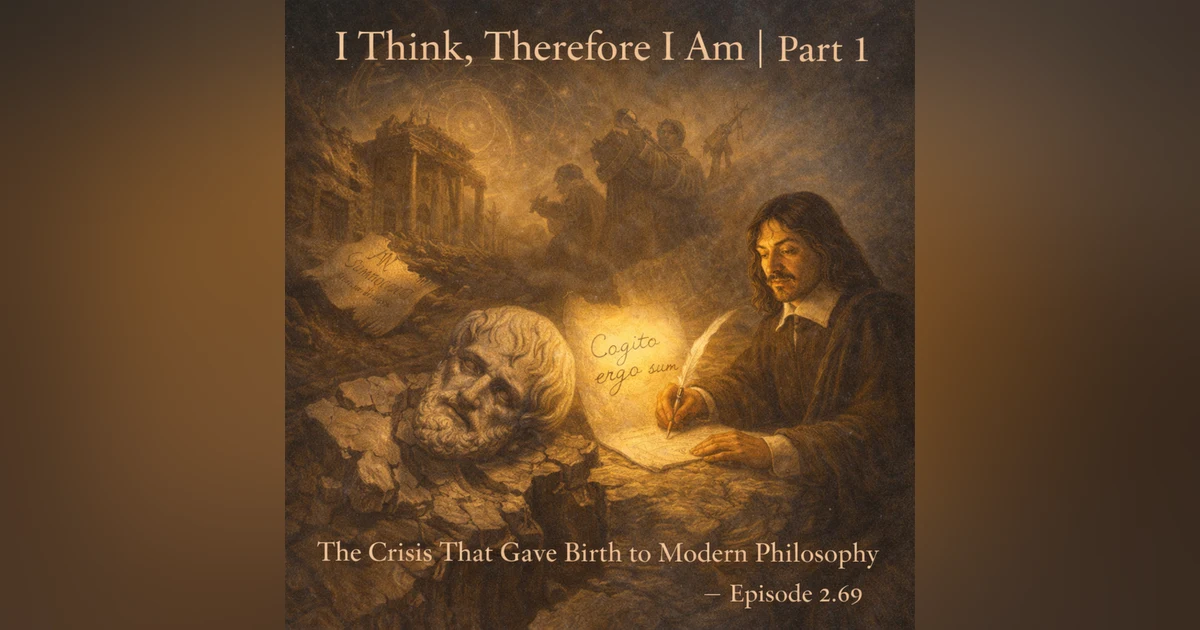
I Think, Therefore I Am | Part 1


 RSS Feed
The Crisis That Gave Birth to Modern Philosophy
Episode 2.69
Before René Descartes ever said “I think, therefore I am,” Western thought was already in crisis.
For nearly two thousand years, Aristotle’s philosophical system shaped how the West understood knowledge, reality, ethics, and even science. But between the 1500s and 1600s, that system collapsed—undermined by the scientific revolution and shaken by the realization that trusted authorities could be wrong.
In this episode, Michael and Zach trace:
-Aristotle’s dominance in medieval thought
-His rediscovery and integration into Christian theology
-The cracks introduced by nominalism and internal scholastic tensions
-The decisive blow dealt by Copernicus, Galileo, and Kepler
-The resulting crisis of knowledge that split Europe into empiricist and rationalist camps
This is the story of how the West lost its shared foundation for truth—and why Descartes’ famous line was not arrogance, but desperation.
Part 1 sets the stage for the modern philosophical divide and prepares the ground for Descartes’ attempt to rebuild certainty from the ground up.
Find our videocast here: https://youtu.be/kATTI-geLws
Merch here: https://take-2-podcast.printify.me/
Music from #Uppbeat (free for Creators!):
https://uppbeat.io/t/reakt-music/deep-stone
License code: 2QZOZ2YHZ5UTE7C8
Find more Take 2 Theology content at http://www.take2theology.com
0:00 All right, Zach, you know, we, we see a lot of each other every now and then. Never, you know, had a sleepover or anything. Basically did almost the only thing that would have topped it would have been bunk beds. Yeah, well, yeah, I wasn't AI think. Were those originally bunk beds that were just split apart? Maybe, Yeah, maybe could have been, yeah. Maybe just twin beds. Yeah. So recently Zach and I and the other elders and wives, although my wife was in Arkansas at a close friends funeral at a retreat for for the elders. It's a good time. The younger elders and Jill was like, well, Aaron's our age.
0:41 I was like, yeah, but Tim, it's not. The younger elders were. Banished. Banished to. To the out the. Yeah, I. Don't know what, what you would call it, but we were on a, you know, by ourselves in the, you know, close quarters. Yeah, yeah, we had one bathroom, but between between us. So I, you know, I took one for the team. I would just sleep in late and let everyone get their showers and stuff in and then. It's great. Pastor Joe was always very worried about are you going to make it to the first session? It's great. He wasn't really worried, but it's great, you know, he. Would show up maybe like 15 minutes early and he'd be like, you know, OK, I can go on. I'm like, yeah, I'm, I'm here. It's great.
1:23 Love it. Yeah. The bathroom to bedroom ratio, that's always, that's always a tough thing when you're like on a, you know, Yeah, yeah. Yeah, yeah, yeah. There was a big pond out and back. Worse came to worse you. Know that was good. We ate at that place. I was not impressed that place. Were you impressed? Yeah, I I've only, I've been to Tupelo Honey before. Not that one, a different one. It was really good. That one was, it was overwhelming. Second experience, you know. Yeah, I and then. I realized how breakfast heavy it was. Well, and I I I tried to get steak and eggs as I think Danny did too. This was the best. And and then Sarah ordered some type of flank steak. So they only had one type of steak on the menu, flank steak, but it showed up in like a couple, two or three of their different dishes. She comes back 5-6 minutes after we ordered, 7 minutes have ordered.
2:13 We are out of flank steak. I'm like, how can you be out? Like we just ran out of steak 10 minutes ago. That was great. So then I ordered what you had, which was the black and mahi, and it was it was the, you know, mahi is known for like just a very light, no fishy taste to it, just as flaky and it wasn't. And Michael actually sent it back. He caused this scene. I. Just I should have not eaten it. I was like, I'm just going to power through this 'cause I don't want to eat it, but I have this like clean my plate mentality, which I should get rid of. So I was like, I powered through it and then I enjoyed my sides that night. I was like, I should not have, like I was. My stomach was a little bit upset from string that fish, but yeah. Man nap out of out of stake is is great, is like oh man.
2:57 And then people are scrambling to order. It's it's a thing. Yeah, yeah, yeah. It's good. Saw some Christmas lights. Yeah, from, from outside the fence, yeah. So for those who are local to Charleston, yeah, imagine all of the James County, James Island County park lights in one big arena so you can just walk around. That's basically what this was. Other places do this too. I didn't, I did not know this, but my brother, he lives in Charlotte. He was going like 20 minutes north of Charlotte to like their like Motor Speedway where they do like NASCAR and stuff and they did the same thing. They like put it there. It's like that's a good idea. Just got a big open. You know, it's, it's kind of.
3:38 Contains you can ticket. It. Yeah, yeah. And it seemed like they did have like a little train going around a track or something too. So yeah, yeah, not as good as going through the woods and almost hitting people. We did the Festival of Light and it is different with it's like that. They keep separation of church and state. Just keep keep the train 'cause I always felt like there's always. I'm surprised there wasn't more injuries. With the training, that was my favorite thing to walk was the the path that's now cordoned off 'cause it had like the little Angel light that would come out and it had like a snake, It had a rabbit that was jumping around back and forth, you know, and it's like you're only going to see this very fast on a train 'cause you're not going to get a little. The train is go goes by too fast for you enjoy it and you can't walk there now so.
4:24 You went before Thanksgiving? Yeah. Would you recommend this? Was that the move like as far as crowds and. Stuff it's hard to know what your crowd was, but ours was was still crowded, maybe less crowded than yours. And so maybe that's still the move, but it, it's still, it's like these people keep moving here from like Memphis and Maine and stuff. And it's like, Oh my goodness. Dude, it's like we went. It's probably about, I don't know, we went the Friday after Thanksgiving. In my mind that would be a busy time on their little calendar. It was like a yellow like AI don't know if you did you look at the calendar. So they they pre select days based on history as yellow, green, red. If you go on a red day, which is basically every weekend after. Not the Friday for Thanksgiving, but the week after weekend. We're going to be busy.
5:09 Too busy and tickets are like more expensive on the red. Days we have a, we have a annual pass, so we just get scanned and so. The elites, they don't know how. The peasants and then the yellow or moderate, it's like a mid price, which is basically, I don't know, like there's certain days and then the green is you like weekdays, especially early in December and it's like $10 cheap. It's like it's a good way to do it. And so it was a yellow day. So it's like if this is a yellow day, I don't want to see what a red day is. And like we got there like right when the park open. It was like as good as you could time it, but man, it's like crowded. You're waiting forever to get on the train. It's just like, it's not, I've only lived here for like 13 years or something, but it 10 years ago, man, not like this at all.
5:54 Even when it was like busy. It's crazy, man. Not like it used to be, you know? You're thinking about it. Therefore I am, I think. Oh man, yeah. Good. You're always good at the Segways Connect connecting every. Time you say a Segway. I always think of that song. Chimpanzee ride on the Segway. You know the song. I don't know the song. I want another song. Yeah. You should look it up and listen to it man. Yeah. I don't think I've ever have you. I've never been on a Segway. I don't think I've. Not been on a Segway either. I. Wonder how hard it is to? If you're at a golf course near a Cliff, I hear it can be pretty dangerous, yeah. Yeah, be careful. Be careful out there. PSA Well hope you're excited for some philosophy. I am.
6:35 'Cause we're gonna tackle it hard. This will be good. I'm sure I'll learn a lot as well. It's like we're talking a little bit about Descartes. Like everyone knows Descartes, but I but I could probably exhaust what I know about him in like a 2 minute span. You know what I mean? You don't. Ever want him standing in front of a beast of burden 'cause you don't want Descartes before the horse? See, this is This is why you come to this podcast for puns like that. Don't say we never did nothing for you. Let's go ahead and take it to the next level. Let's fire up that twanga music. From the hearts of the Low Country in South Carolina. It's the Take Two podcast where we take theology to the next level.
7:23 Well, Michael, we should probably just start right with Descartes. Let's get into it right? But. Well, so I was thinking about this, 'cause we were talking about other arguments for the existence of God, and I was thinking about this argument that Descartes puts for Rene Descartes. You might know him from math, the Cartesian plane when you did XY. Yeah, yeah, he's that. He's that guy. Yeah, he's mathematician, philosopher and he see this will be good. Maybe we can get into it later because I, I think a lot of times he's, at least from my perspective, not knowing a lot about philosophy, he's always cast as like not an enemy of Christianity. Like I think he's a Christian.
8:07 But it's like to me, I think some people maybe circles I run in sometimes it like sets the stage for this basis that May is not you know, I don't know. I can see you're. You're not. I'm interested 'cause I haven't heard this. Yeah, I'm interested in hearing. Where I feel like it's like almost divorcing theology. It's like you're, I don't know you're not you're, you're not using theology to inform 'cause you can doubt all the I don't know. Anyway, good things to talk about. I don't know, you know, is everything a deception or I don't? These are things. You hear? But that's good that that is good to raise those questions and we'll address those second episode. So. Yeah, so there's so much here and maybe this will be 3 short episodes, which is probably better than one super long episode.
8:52 But I thought, you know, before the carts could even make sense 'cause I could just we could just launch right into it. I think it the background of how we get to Descartes and what he's saying would be good. So if you've ever taken a philosophy class, maybe you took philosophy 101 or something. If you've ever studied it, you probably talked about dailies of Miletus, the very first kind of recognized philosopher. These are the so-called pre. He's one of the so-called pre Socratic philosophers. So you have these, you know, this starting of philosophy in the Greek city states, maybe some that are over like in present day Turkey.
9:34 That's one of our favorite phrases. And then kind of the the big turning point is Socrates, his student was Plato. Socrates didn't write anything down. So everything we know about Socrates, we know because Plato wrote it down. So we learned about Socrates through Plato. So you kind of have to emits, you know, kind of think through, is this Plato's talking here through what he's writing? Is a Socrates talking to what he's writing here and then 'cause. Plato's probably. I haven't read Plato's Socrates really that much. Plato's probably not saying everything Socrates says is the best. No, no. 'Cause he's like, you know, refining and taking different.
10:16 Yeah, the Socrates, Plato and Aristotle are all different, but there's a, the sorry, there's a chain there shows Socrates. His student was Plato, his student was Aristotle, and then his student was Alexander the Great. So. Yeah, that's true. I always forget this. Yeah, that's right. That's the time period. That's good. Yeah. Sorry, I'll get my throat clear in just a second. Can we clear the throat into the mic a little bit more? So Aristotle, huge impact on philosophy. Some people would say Plato's impact was bigger. So, you know, one person famously said that all philosophy is a footnote to Plato, cause Plato did help establish these kind of these categories of philosophy, but he kind of thought about things different than Aristotle. If you've ever looked at the painting, it's called Oh, the School of Athens.
11:10 And it's, and it's famously, it's got all these different philosophers there and in the center is Plato and Aristotle. And Plato is pointing up with his hand and Aristotle's pointing down. And if you know anything about Platonic ideals, Platonic figures, I'm probably losing Platonic forms. There we go. It's this idea that, you know, we have a physical microphone here, but there's a form of a microphone that exists abstractly and it's the perfect of microphone. And there's a this microphone instantiates the universal of microphone and this chair instantiates the universalness of chair. And Airsoft said that's crazy.
11:51 We don't know. We learn instead of the forms being defined from above, they're defined from the particulars. So we interact with a lot of chairs. We learn what it means to be a chair and then we we know what we mean to say chair, even though not all chairs are the same, even these two chairs that are kind of sold in a set should be, they're different. They're differences between these, but they still instantiate cheeriness. So Aristotle would be called an empiricist because he would say you have to learn from below to kind of get these ideas of these ideals. So the universals are abstracted from particular things.
12:32 Aristotle today would be known as both the scientists and a philosopher 'cause he talked about physics and metaphysics. So he has a book called Physics. He has a book called Metaphysics. Not creative with his names, but yeah, no, I'm just kidding. Yeah, that's good. And he made some biological observations. He kind of starts this idea of taxonomies, which we don't keep his taxonomies, but you know, this idea of, you know, Kingdom, phylum, class or family, genus, species, that type of thing. That way of thinking about it could just kind of started with Aristotle, and he also had some physics there, so a quote about him. Russell was critical of some Aristilians categories, yet he still admitted Aristotle's influence is so vast that it would be difficult to exaggerate it. You could try to exaggerate how big his influence was. All right, so why are we talking about Aristotle so much? So Aristotle defined all these different categories, helped redefine them from what Plato started. Epistemology, how we know what we know, metaphysics, what is really real.
13:46 And I'm skipping over some of these subcategories. Logic. So he invented formal logic as a discipline, you know, the syllogism, you know, he helped build that ethics. Udai Udai mania was one of those virtue ethics, politics, although Socrates definitely, you know, talked about politics, Aristotle did as well. And then also natural philosophy, like classification, animals, observation of biology, early theories of motion, causation and cosmology. So I've been talking a lot so keeping track of everything so far. Nailing it. My take away. Aristotle. Big Deal did a lot of things. He's important, foundational. Yes, yes.
14:27 And really, you could say that about Socrates, Plato and Aristotle. But here's your favorite. You got a fave. Aristotle. Clearly you're not like bring let's bring back. Plato had everything right. Yeah, well, Socrates thought, I'm not going to write anything down because you won't understand. Like I will say a you will get a prime and something will be lost. So I won't write anything down, Socrates thought. I can really only you you'd understand what I'm thinking by asking you a whole bunch of questions. Socratic method. Yeah, yeah. So the Socratic method was there. Plato was really famous for these Platonic forms. And, you know, he talked about, you know, he's also famous for this cave analogy where. Yeah. Yeah, yeah. Yeah.
15:07 And so Aristotle, I think, really starts to give us practical philosophy that we can use and. And that makes sense. So Aristotle dies. You probably knew that. Yeah. Yeah, he did die. And eventually, as you know, classical Greece, you know, Alexander the Great, the four kingdoms are separated. You know, the Kingdom is separated for Rome's takes over. His writings are kind of lost. They are rediscovered. Well, they're kind of preserved through Byzantium and they're, it goes down to some of the Arabic areas. And so we hit some translators, Avencia and Avaros are there. And so there's this kind of resurgence of of Aristotelian philosophy and you know, you're Muslim countries at that time. But he gets rediscovered in the West, in Europe, around 11 hundreds.
16:03 And so there's these major translations of his works into Spanish, into Latin. And so those translations spread rapidly through Europe's universities, Paris, Oxford, Cologne, Bologna. And so I'm assuming that's how you pronounce it. It looks like baloney, maybe like the meat, but so sorry if I'm mispronouncing that that. Italy is so mad. Yeah, yeah. So there's this huge, huge adoption of Aristotle, so much so that you could write and you would just say the philosopher. And you know. You know that like, you can pick up Saint Thomas Aquinas's Summa or his De Mallo on evil, and he would just say the philosopher says this, the philosophy says this. There's other books that I read when I took medieval philosophy where they just call him the philosopher. Like that is his status.
17:02 And he really forms a backbone of scholasticism and shapes basically all of our Western intellectual life. And so we could agree with Bertrand Russell, you it's hard to overstate his influence on what we have today in every area of thought, metaphysics, ethics, logic, theology. All right, So that's a lot of history because we're leading up to a crisis, because what happened? Well, we're going to get to a point where we discover Aristotle's not right on the physics. Oh yeah. That's a big deal 'cause physics is not right. And so I just got going through some of this. That's repeated.
17:43 We'll get to down to internal strain, signs of trouble for the collapse. So around the 1300s, we get this. William of Occam may have heard of Occam's razor before. He's the guy that came up with it. But he starts to, you know, think critically about what Aristotle has to say. He rejects Aristotle's way of dealing with real universals. We don't have to get into all this, but he denies Aristotle's ideas of causation. He emphasizes God's absolute freedom where resilian logic would say there's some cosmological necessity. So all I'm saying is there's you get start to see some cracks here in the scholastic mindset.
18:24 And this is before, like, everything got upended, like, you know, take AI think of like the Enlightenment and everything's changing, but it's happened well before. This, this is like around 200 years before that. And so 1300 to 1500 you, you know, there was this in the first hundred 150 years, this full on adoption of Aristotle as he began to spread and then people start to go, oh, well, does that really make sense? Well, this is what he said, but what about this? So you can see how that might happen. The real big thing happens 1500 to 1650. Copernicus in 1543 proposes heliocentricism. The nerve. The what I mean, come on, if you don't, that just breaks down into sun centered. So he had the nerve, like you said, to say that the sun is at the center of our solar system and the US and all the other planets revolve around the sun.
19:17 You know, received a lot of heat for this, but it became kind of the basis for scientific revolution. And we saw, we see that this is probably the biggest scientific revolution we've had in that we that's ever been documented, the Einsteinian revolution from Newtonian physics, probably the second Kepler. So when he does this and people adopt it, Aristotle's geocentric cosmos collapses. That's a pretty big paradigm. Kepler comes along, he takes a lot of these observations, maps and realizes that the planets are not traveling in perfect circles.
19:58 It's actually ellipses close to perfect circles. But but now Aristotle's perfect circles are gone. Man, Galileo does experiments on motion. You know, you might think a heavier body falls faster to the Earth. It's kind of intuitive. But it's not true. As long as there's no appreciable difference in air resistance, a heavy body and a light body, they fall together. Galileo does experiments showing that, showing differences in inertia. Mathematics replaces qualitative nature. So this idea of like a rock falls because it wants to be, that its nature is to be towards the center. And that's what So all of these things happen and people begin to go this Aristotle didn't know what he's talking.
20:45 About Yeah, seriously, what's going on? And so his physics gets rejected and the baby goes out with the bathwater. His metaphysics gets rejected. Yeah, it's like we're starting all over like this was our guy, this was our rock, and he doesn't know anything about physics. Like, can we even like it makes sense when you think about the cart, no one knows if you know anything about the cart. I think they're, you know, it kind of that's like, why do we have to, you know, what's getting at the basics or whatever? So there's like this crisis of how do we know? What do we know? Do we just accept that on authority? Because that's what we were doing. We read this guy who spoke authoritatively named Aristotle. We called him the philosopher.
21:29 We trusted him, and we found out that he was false, at least in his physics. So how do we know what we know? And so we really get this panic from like 1600 to 1650, and the schism starts to form in the universities about how we know what we know. So the empiricist response is we're going to start over with our senses. Seems like a good place to start if you can experience it's got to be true. You can taste, feel, smell or touch it. What could go wrong? So you know, they're, they're rejecting scholasticism. Nature must be interrogated through experiments, not syllogisms, Advocates, inductive reasoning, systematic observation. Oddly enough, these are the same things Aristotle said. Aristotle is a form of empiricist. He's the one who said this is how many teeth a human has and never has time to count them.
22:24 Like, why would you go? He would say things, but then not follow his own. His own. Yeah, yeah, yeah. So. So the underlying claim of the empiricist is that knowledge begins with experience, so we're going to trust our observations. Not dusty books. Not. Honestly sounds a lot like 2025. Yeah, yeah, yeah, yeah, we probably. Anti authority, my experience rules, but yeah anyway, might be for the most part, you know. They tend to win the day. So another group are the idealists, and they say we start over with reason. OK, so empiricism. They're worried about empiricism because the senses are unreliable.
23:07 And so there were a lot of these experiments They showed where you could put one hand in a a bucket of relatively cold water, one hand in a bucket of relatively warm water, let them sit there and kind of acclimate. Then you could put them both into the same bucket, same water so you knew at the same temperature and it felt like those two different. Temperatures totally. You know, or, you know, like you put a fish and pole through or pole through the water and it looks like it's, you know, split. So all of these optical illusions, they're like you can't trust your senses. Galileo just proved that you can't just trust your senses. So, you know, we the what we see, we can't really get to what we see.
23:48 So we need to start with certain truths. So if you did you take geometry in school? I did, did not like it. You didn't like it? The proofs. Wait, just draw a square. Fine, you know? Yeah, I'll. I don't. I did not like the proofs. Yeah, so you would. The idea of geometry is that you agree to certain basically undeniable axioms and then you build up from there. And so that's what the idealists want to do. Like let's just rationalize what are these axioms that we can know for sure and then reads them, reads them up from there. And then once we know that, then we can kind of maybe make sense of what our world is around us. Yeah, so it can you give a good example of one problem or one thing? Each approach looks at it differently. Yeah, that is a good question.
24:36 Maybe even, you know, as simple as I don't know why trees always get invoked in philosophy, but they seem like they do. But like, how do you know what a tree is? So, you know, empiricists would say you go out there, you measure it, you define it, you may make definitions of it where it a idealist might try to reason from certain facts about the world, about life and stuff, and then define what a tree is. That might be different approaches that might be more simple. So there's these big words in philosophy a posteriori or a priori, which is, are we going to come to a conclusion after we've interrogated facts or come to a conclusion before we've interrogated the facts?
25:28 So the idealists are a priori because they want to like come to these conclusions before they enter it. So big names in the empiricism, Locke, John Locke, Berkeley, I think his name starts with I think it may be George Berkeley, but George last name here. So maybe we can look it up. And then Hume is also a big name in in this. So and then for the imperial empiricist, we have our big names are I just had them here, Descartes, Descartes, Spinoza.
26:08 And it seemed like there was one more Leibniz. Sweet. Yeah. So they're going to claim that, you know, you, you, you got to obviously you can't just start with what you what you see. So that is kind of the where we're going to stop for this this session. So. Painting this colliding of two different viewpoints that are at odds with each other. Yeah, hopefully you come, you come away with that eventually. Can't. So if you've decided Tanta is going to try to merge the two together and he's going to say it doesn't really matter if we can't get to cause one side, you know, the the idealist is going to say you can't really know the real world.
26:52 So empiricist, you're wrong. And the empiricist is going to say you by just you will never get to the real world just from your idealism. So Khan is gonna say it doesn't matter if we can't really know the real world. What we what we experience becomes the real world for us, even though it may not be the actual world. It's like perception is reality. Essentially. OK, exactly, exactly. So and and so then you have all these, you have Kant, then Hegel, then Marx and all the you know from there. OK, yeah, little history lesson. I like it getting to So teaser for next week. Next week we'll we'll talk about why, how this divide is here, and then why Descartes does what he does to get to.
27:38 I think therefore I am. Yeah. Sweet. I love it. Philosophy episode one of three. That's our take. Thanks for listening to Take Two. Find us wherever you find podcasts and on YouTube for those who want to watch our video cast.

