Is James 2:18–19 Mistranslated?


 RSS Feed
Episode 2.50
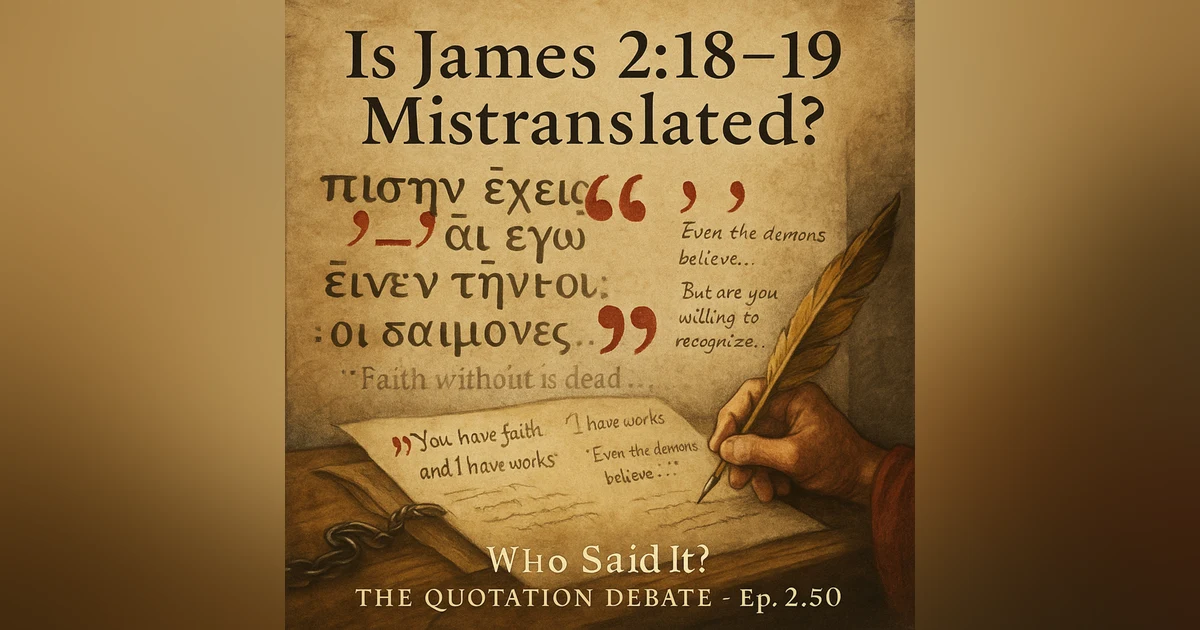
Who Said It? The Quotation Debate in James 2:18–19
What if a single pair of quotation marks changed how you understand faith and works?
In this episode of Take 2 Theology, Zach and Michael unpack one of the most overlooked translation debates in the New Testament—who’s actually speaking in James 2:18–19?
Since the original Greek had no quotation marks, translators must decide how long the “someone will say” quotation runs. Does it end quickly (like in the ESV)? Continue through verse 19 (NASB)? Or include both verses (NIV, NRSV)? Each choice changes how we hear James’s tone—rebuke, debate, or diatribe.
Covered in this episode:
– How Greek manuscripts handled quotations and voices
– The short, medium, and long quotation theories
– Why modern Bibles make different punctuation choices
– What leading commentators (Moo, Davids, Blomberg) argue
– How punctuation affects tone but not theology
In the end, James’s message stands: “Faith without works is dead.”
But understanding how he said it might change how we hear him.
Find our videocast here: https://youtu.be/O_swkautrVs
Merch here: https://take-2-podcast.printify.me/
Music from #Uppbeat (free for Creators!):
https://uppbeat.io/t/reakt-music/deep-stone
License code: 2QZOZ2YHZ5UTE7C8
Find more Take 2 Theology content at http://www.take2theology.com
0:00 Well, our our episode today is going to be heavily dependent on context. Context determines a lot of things when it comes to translation and that kind of thing. So context for you, what would you think? Maybe you saw this. I saw this. It caused some division to people. There was a post Vodi Bakkam recently passed away. Vodi Bakkam, Bakkam the man. He's got a book. I didn't agree with him on everything, but I really he's got really good. You don't. Agree with him on everything you you got to you just got to distance yourself from him. If he's wrong on one thing, you got to have that, you know what is it called Holy separation or that's.
0:40 Right. He had a way with words, the way he could, like, deliver words. They like packed a punch, you know what I'm saying? The bike Tyson. The Like a bike, Tyson. That's right. He had a couple of the books that I had read by Bodhi Bakkam 1 is he's got a couple on like family worship. He's like a huge advocate for. I might be overstating it, but he's like, hey, if you don't homeschool, you hate your kids. Like he's like really big into like if you give your kid to Caesar, don't be surprised when. They come out Roman. Yeah, yeah, yeah. I. Saw that quote. And so he's big on that. So he's big on homeschooling, he's big on family worship. He's big on multi, like in the worship service, you have a baby, everyone's in there. We're not having children's church. So like he's big on that family worship context, which I really can appreciate.
1:22 So he's got really good materials on family worship men taking leadership on that, which I'd really appreciate. And even if I was like, I don't land everywhere, you do. It's like really good stuff for just leading well as a man in the context of your family and your church. And that's why his church falls out certain places. But oh man, so. He's gonna have a bad quote. Is that what? I mean, no, no, no, no, when he died, someone quotes, someone said, Oh, I'm going to I'm, I should have looked up the quote before I, I did it. But it was like, oh, how the mighty have fallen. And a lot of people were like, whoa. And so that was the first thing. Second thing was John Piper did this quote. People like filled up, you know, his ex Twitter, whatever. Like, oh, you know, you're not being kind. Like you're, you're like, 'cause when you hear that, you might take that as like a sarcastic comment in our culture. Oh, oh, how the mighty have fallen. Yeah, I I might be butchering it. I might be giving.
2:17 The the the heart of the fall type of thing. But what John Piper was doing, he was quoting David's lament of Jonathan, how the mighty have fallen. And it's like, so that's where we get it. It's like context is so important 'cause you can say mighty fallen, you can be like, oh, you're being direct. You're you're kind of like saying, oh, you thought you were big stuff and you but it it's really the origin of that quote is I love that he fell mighty guy. So you could be like proverbs, like pride goes before a fall. You had a big head and you were prideful, puffed up, and now you've fallen up just observing that. Or you could be like, genuine, like, hey, this was a mighty guy and he was used well for the Kingdom. And I'm lamenting his fall. Yeah.
2:59 So in Second Samuel 1, it says David lamented, oversaw and Jonathan his son. And it says your glory of Israel is slain on your high places, how the mighty have fallen. And it goes on to, you know, Jonathan, beloved, lovely in life, all these like nice things about Jonathan. But people read that and they didn't know it was a Bible quote. And everyone's like, man, John Piper in his old age, just like coming down hall. Like they're like, oh, he just I thought he got a long voting back. And I guess they had differences. And he was like, no, I'm lamenting like David did for this person. He loved Jonathan, you know, not it was like the opposite meeting. It's so funny. But context is important. Context is important. Yeah. Yeah, I it's reminding me.
3:42 You talking about being old off your rocker? Sorry, grandpa in heaven, but he preached like this anniversary sermon one time and he was probably it was past the time for him to have him up and he was talking. It was just like a 30-40 minute ramble of like old memories and like he was he two or three times he talked about this whip they used to get four of these mules had like these balls on the end of it that they would. I'm like, what are we doing? What are we doing? That's great that that's the best. I had like some like that at this high school I went to that was just a little bit past. And it's like, what's he going to say today? And then when I went to college, the chancellor was past his prime and we're like, I wonder if something racist is coming out of his mouth today or not Has.
4:31 He did he did he say racist stuff? He he said like, hey, I was walking through the dining room like he was like trying to be nice, I think. And he was like, I made sure. And I said, hey, to the yellow table. He's talking about like Asian people. And people are like, oh, this is like 2010. You can't. You can't call it the yellow. Table that's. Racist and there's a high Asian population at Bob Jones where yeah, it was. Did not go over well. There's this podcast. Racist jokes may be making a comeback. Oh, I think so. I think, I think the pendulum has swung where people can appreciate it. And no, it's like it's and I don't. Know this guy? He's Korean or something. Do you know who I'm talking about? Probably Johnny or something. Yeah. Yeah, I know who you're talking about. Yeah, yeah.
5:13 Yeah, and he's something, he said. Something like why do people always call me yellow on the guy next 'cause you are yellow. Yeah, it is good to see comedy. I feel like it's, you know, we can live. He's, he's a guy that was like, well, you know, over in Asia, we never had slavery. And they're like, what are you talking about? He's like, he's like. Oh. Yeah. Did I miss something? He's like, what country are you from? He's like Korea, and they like, look up. And I was like, Korea was like probably the earliest culture to have slavery or something like that. Was reading through like thousands of years of slavery. He's like how did I miss this? Yeah, humanity, you know, we're all the same on some level, you know, it's. You know, made in the image of God, and we are all marred. That that, that we are all marred. That is good.
6:01 Well, podcast episode today, a little off the beaten path. This might be your cup of tea. This might not be your cup of tea. I didn't know this was my cup of tea until. You tasted. It I, I took a drink, a big old sip, and I said, man, this tastes pretty good. This is this is my cup. Is this Earl Grey tea? This I like. I do like Earl Grey. Tea. I love Earl Grey tea. Yeah, nothing like. Do you pour a little milk in there? I I I would I like that better but I don't because I try to be like. No dairy. I try cut out car. I mean, I try to like drink coffee like if, if I'm like. So you don't want any calories in your beverages, is that? What, you're trying, Yeah. Cause 'cause most of the time I'll drink it like in the morning and I'm trying to intermet fest or intermet fest. I my parents love Diet Coke, right?
6:41 I know we're all over on this banter, but we drink, you know, bubblies like the flavored soda water. And I tried a Diet Coke the other day and I was like, this tastes great. And I don't know if like my taste buds got have gotten used to like the the, you know, so far from, you know, the sugar. Overwhelming I. Was like and I'm scared now because I've had like 3 diet cokes I'm like no that's why it starts man don't drink diet cokes but they taste really good to me and when they never tasted good to me in the in the past. I can't wait. Like turning into my mother. I see you like sneaking a Diet Coke in the car. You like I got you like get out of the church service to get a. Car my mom drank diet cokes all the time. I was like mom those cause cancer stop drinking them and then now I'm like I've drank 3 and I feel like my. Parents used to drink so much.
7:26 It was like, I did not drink coffee or anything. It was like first thing in the morning, crack the can like of Diet Coke. Like that's what I remember, like waking up to like Diet Coke. So you need to drink tea in the afternoon with a splash of milk. Once you've broken your face, that's. True. That's true. Yeah. I should do this, James. 2 quotations grammar, punctuation. All of the grammar and the punctuation that was in the original Greek, it really helps us. Is that what you're saying that? I will, absolutely. So I get excited for James to 18 through 19 and quotations. Let's take it to the next level from the hearts of the Low Country in South Carolina.
8:11 It's the Take Two podcast where we take theology to the next level. Yeah, I like what you said, Michael, 'cause I got a picture of one of the earliest manuscripts that we have on James to be like when I was, we were going through James and Impact and I was like, yeah, let's just check the manuscripts and it's all just capital letters strung together. It's even harder and. I I So the danger is cause 'cause I've read this book when I was in college called Hey Mom, What About the Dinosaurs? OK. And it's kind of the first person that gave me permission to be an old Earther. Wow. To be, you know, inconsistent with. I thought, OK, here's a way to look at Scripture because I always kind of had this cognitive dissonance. But he was going over how, you know, Hebrew doesn't have vowels in it.
9:01 And mostly we, you can tell from the context what it is. But he was like, here is an alternate way, like these words might be different. And I was, I was excited about this and I was explaining it to Jill. This is while we're dating. She's like Michael, This just tells me that we can't trust anything in the Bible. Wow. Yeah, yeah, yeah, yeah, yeah, yeah. And you can see how someone could go there. And like you're saying, context drives everything. And for large majority of Scripture, it's very apparent and for major doctrines, very apparent. There's a couple places where you can't nail things down totally, but it's really not consequential. It's it's really, it's almost like gives you more confidence that there's so much that that you know what I'm saying, where you kind of make your best guess. We've covered some of this stuff. This one is fascinating because it all centers around quotations.
9:58 If you know anything about James, you probably know Faith without Works is dead. I'm going to. Read that right straw epistle. That that's right, Martin Luther himself, you know, coming down hard on on James. I'm going to read some of this and then I'll kind of pause where the divisiveness comes in. You might be like I've not heard of this divisiveness. When you hit when you hit the quote, say quote. OK, OK. Yeah, there. You and then you want me to read from NASB? Yeah, yeah. We'll, we'll read different translations. I'm just going to set the larger, the broader context because most of us are probably familiar with this. If you start in verse 14, James writes, what good is it, my brother's if someone says he has faith but does not have works, can that faith save him? If a brother or sister is poorly, poorly clothed and lacking in daily food, and one of you says to them, go in peace, be warm and filled without giving them the things needed for the body, what good is that? So also faith by itself, if it does not have works is dead. So first few verses, faith of that works is dead. He's like reinforcing his points. Verse 18, he's going into something, you know many people will call the rhetorical device of a diatribe. He'll say, but someone will say and universally this is where the quote starts.
11:08 No one disagrees with that, but someone will say introduces the quote. The problem is where does the quote end? You have faith and I have works. ESV End Quote. How about you keep reading in an ASV? And it mine keeps going. The whole thing isn't quote. So it says quote. Someone may say quote, you have faith and I have works. Show me your faith without the works and I will show you my faith by my works. End Quote. The NLT does something slightly different. It kind of falls on the same line but NLT will say now someone may argue quote, some people have faith others have good deeds. End Quote.
11:48 But I say new quote. That's kind of how the ESB goes to how can you show me your faith if you don't have good deeds? I will show you my faith by my good deeds. NIV kind of aligns with ESBCSB as well if you read if you go by rules and grammar, let's see what NKJB is. NKG most align with ESB because that's the most natural way to do grammar in this kind of situation. So if you're putting quotes somewhere else, you're doing that based on, you know, you're given a little bit of what are we trying to say? Like you're interpreting a little. Bit you're adding your interpretation. And so NESB translators have, they're trying to prove something. And this kind of gets to the crux of it, because we all know the broader points is faith without works is that James is saying your faith must produce works or it's not sincere, genuine faith, right?
12:40 Living faith produces living works. Dead faith produces dead works. So if you we'll start with the ESV and then we'll get to the NESP. But it so the ESVNIVA lot of translations will say, but someone will say you have faith and I have works. If you take that literally, if you assign meaning to the pronouns you and I, James is propping up this hypothetical individual that's looking at James. A hypothetical interlocutor. That's right, interlocutor. That's great. Yes, exactly right. And he says, looking at James, you have faith. But I have works really undercuts James. He's really agreeing with James. Why is he arguing with James?
13:22 Because James is saying I have marks. You just say you have faith. So that's the confusion where the NESB tries to draw this out more because because I might not be doing a job of articulating this. You can clarify, Michael, because if you assign the quotes to the hypothetical person versus James, you're saying opposite things. Does that then what James would say yeah, yes, I've I've always the interpretation of Michael, which is probably the the most important I've always taken it to be someone saying like, hey, some people have faith some people have works like it's it's it's you know, not everyone has the faith. Not everyone.
14:07 That's how I've I've taken the the interlocutor to to push against what James is saying by saying, you know, faith works, the kind of equal type of thing. Oh yes, so say say that again, like saying like some of faith. It's like it's two different. Yeah, like, hey, you're, you're getting all in a fuss about nothing. Some people have faith. Oh, I see some people have works. Yeah, you can say. Either way, yeah, yeah, it's either. It's OK. James, what are you? What are you fussing about? And then in your version, are you saying then it goes. Then James clarifies and says, I'll show you my faith by my works whereas. Nas. That's not what NASB. Said but that's what.
14:48 But that's what Michael's mind is. I've never really paid attention to these clothes. Before, I never have either and it's fascinating. I've just steamrolled by them and just made the. Concepts. Yeah, the concepts, yeah, yeah. Yeah, because the other place you'll see this probably the most it's and it's not really controversial, but if you look at something like John 316 where. Does Jesus stop talking? Yes. Is Jesus saying that? Is it John like summer or like doing like an aside? Doesn't really change the meaning, but it it changes like that conversation. I mean, it's not as consequential. This is a little bit more consequential. The overall point stands 'cause you can tell what James is driving at pretty easily. 17 and 18 are red in my Bible, so I know Jesus said said those. Yeah, yeah.
15:31 Great. That's good. We should do it on Red Letter Bible and that's like so good. That's how you know, just get the red letter Bible answers all the questions about when Jesus talking. Quick quick aside as well, if you look at translations like the NLT and the NIV, this is not related to our topic, but when in our version says works, they will translate it deeds even though it's not the word for deeds. Do you know why they would say that? It's also another translation choice and and it goes to if you're explaining. Because you're trying to not make him be seemingly against Paul. Exactly they're like Paul is works of the law. Maybe you're earning salvation through circumcision, keeping the Sabbath versus deeds. Paul is talking pre conversion works to merit salvation. So, so they they, they pick a word that that's not what it means to prove a point, which some might say you don't want to do that, but but to make it more clear. So it's another translation they're trying. To clarify the argument.
16:29 Even though they use a different word where ESP like, oh, don't do that. We want to, we don't want to change the word because then it you can't just pick and choose what. But anyway, but it does try to illustrate, but I think all that's fascinating like what goes into trying to make a clear translation where you want to communicate what is being said. So, so anyway, the because the difference with, you know, the other thing to keep in mind, I guess what I'm trying to say is when you have this diatribe, most of the time you're propping up someone that opposes you, right? In ESB it almost seems like it's an ally it it's someone that so he's like, but someone's gonna say I totally agree with you James, which seems weird, but that could happen. I guess you.
17:18 Know So what are the ones you're looking at? NLTESVNASB Is there another one? I'm trying to see where the if there was another one or if I I it might just be two. I got NIV, so NIV ends it after you have faith I have deeds. OK, NESB is all the way through 18. ESV. Is the same place that the NIV does where you. Really get to a, you get about 10. If you look at commentaries that obviously the translators don't, you get a lot of different things where people are trying to different scholars are trying to posit what they think is right.
18:00 And you start to get into more options where some, you know, you get kind of crazy, but they have not been adopted by translation committees for probably good reason. You start getting like cute with it and you're saying these things where the part of the ES, what most translations are the short quote. What is not good about it is I guess there's the Michael version where he just said there's like two ways you can go about it. And then I guess James is saying show me your faith apart from your works. And I was, I don't know, it's, I think each view has some limitations. It's not perfect. The problem with the ESV views is that the you and I don't really carry any weights where, you know, it'd be nice if the pronouns like lined up really well. But he might be saying, someone says this, someone says that. What would have been really nice? As if it had said but someone will say I have faith you have deep that would.
18:53 Solve anything? Why didn't you say it? That way that. That is the. Confusion 'cause then it would fit perfectly and then you'd say show me your your faith without your deeds. So it's. I don't want to overblow it, overblow this. It's not really a huge deal. It's just more fascinating to me that I just never saw this before. And I was looking through it and like, several commentaries will like pause here and say, hey, here's like the two main options. Here's like 4 subset of options that, you know, different scholars are putting forth. And I just never thought of the you have faith and I have works. Yeah, sorry. To interrupt. You're good. No, that's all I. Was saying I preached a sermon on. This and this quote did not, did not. My mind just went right over the fact that all this was in one quote 'cause I attributed some of what this was saying to James.
19:41 It's so the NSB was no, it did not deter me from proper exegesis of what was there there you. Go because some people, some scholars, I don't think any major translation does this. Maybe alt alt to look, but they'll take the quote, they'll propose. Hey, the quote goes all the way to the end of 19 where it says you. Believe that God. Is 1 you do well, even the demon shudder where it's not James saying that, but there's like and and it you know, that's a that's a proposed thing by by some people. Anyway, it's a, the more I learn about translation, to me, it reinforces how much we can have confidence in our scripture.
20:23 Also reinforces that, you know, they do a lot of hard work, but this hard work, all this contextual work that goes into it, I think the short quotation is. Right, that's the most. Natural way and like if you look at ancient areas, the problem is there's not AI mean if you look at all the ancient nearest literature, when they do a diatribe, most of the time it is an opponent. And that shorter quote that's just like what you see is what the scholars say. That's like that's like the most natural. You almost wouldn't do it only if you have a really good reason. Oh, some, some people have posited this is not our translation. This is the other one. But someone will say you have faith quotation and then James saying I have works and that kind of makes sense because James is saying my faith produces works even shorter.
21:10 Even she. Even shorter, the problem is I guess in the Greek that and I is an awkward way to start a sentence. It would be like you have faith. I have works. You probably wouldn't say the and I it's like some rule in Greek to start. Maybe it's with a diatribe, but they're like it technically could happen, but it's very unusual. So anyway, the quotes aren't there. Yeah, yeah. So. When I've read this I have always take. I've not paid attention to the pronouns and but I've always taken it to be someone saying I kind of, And I, I after looking at it, it's good to look at it, but I've always said basically someone's saying, hey, faith works, James, what's the big deal? And then he's going to reply. Show me your faith. By your works.
21:53 You know you, that's you. Your faith is demonstrated through your deeds. So I mean maybe your trans. Your way as well, where he's kind of like you have faith, like throwing out different things and then James is getting to it because the other problem people point to you have faith is we don't get this in our English Bibles. I might I don't think I'm misspeaking. You have faith, you singular have faith. I have works. Then he says show me your faith without it works and I will show you plural. And you like switch. It's like they don't they don't line up good. They keep switching back and forth. It's weird. It's not what you would expect to see and that's part of the confusion. Is he talking to a congregation or is it this hypothetical person? He shifts back and forth. He doesn't keep consistency. Maybe James didn't. Have an amanuensis.
22:38 So, so I think, 'cause some people try to rely on, OK, if you're going to be consistent with EU pronoun UI, guess I should look this up in the King James and see how it goes because they, you can see that a little bit better. But there's something like people make mistakes because EU is not consistent. It's the versus King James. Yeah, A. Man may say, and there's no actual quote there Oh yeah, they. Don't do quotes thou hast. Faith and I have works semi colon I think it's. Colon. Show me, shoe me thy faith without thy work, comma, and I will show thee my faith by my works.
23:24 And and maybe the problem is backing up, so this should have a. Yee though, yeah. And and I. Might be wrong, I might OK, it might be in 216, but maybe it's before the There's somewhere either directly following or definitely or directly after. Where's the Yee? It it's where P that's. What in a commentator? The commentaries make note of this, saying This is why this way is not a good way. They basically show you all these versions have something that's not wrong with it, but something that make you not. There's not a. Slam dunk. As you can see, ESP and ESP very similar probably on punctuation everywhere almost, but it goes to show you like a this is different, but something I think of you know, when it comes to this kind of thing. Ephesians one this passage that most of us are familiar with. Paul does this this prayer, if we read verse four, he writes even as he chose us in him before the foundation of the world that we should be holy and blameless before him. Period.
24:25 Then it says in love. Next verse, he predestined us. So like the KJV thought it ended in love and some people still do think that. But where does that preposition? What's it modifying? It's like reading on context. Most people think that sit and starts a little bit before verse 5, but we don't get all those right. Not that that changes dramatically. You're what it means. It does change it a little bit. You know, where does that love? But you could probably say God lovingly did it both ways. You know, you know what I mean? But it kind of goes to show you, you know, KJV wasn't inspired these chapter. And sometimes you read like chapter 32 and then you get to you're like, oh, those two verses went with chapter 31. And then there's a big gap and it's like a new paragraph, I think the verses.
25:07 Were there before the KJV translation right so. It could have been before. Before they were translating into English. I'd have to look that up to see the timing. What's pretty amazing? Is overall, those people did a really good job. They did, yeah. Like, they didn't nail it every time, but they nailed it a lot of the time. Yeah, yeah. If all you had was a KJV, you can know what you need to know. No, it's. It's great. So I'm kind of random might this might not be everyone's cup of tea, but I was like, it's I can't think of another place where it's like I've been so familiar with the passage and like never heard of this. You're like steamrolled. Over like, how did you, how did, how did you come across this 2. Commentaries on this that I was looking at 1 was by my watching this.
25:50 Yeah. Through an impact, OK. Doug Moo. Who has a really good, He's like got a good commentary on James. He spent some time talking about it and then a guy. Do you know Craig Blomberg? He does a lot on the Gospels. Yeah, he's got one of, he's been, have a lot of time on this too. And so those are the two. Well, I have the Craig Blomberg one I, I go through and I listen to videos of MU teaching at the Master Seminary to like MacArthur's seminary students. And he uses his commentary, but he's I can listen to it in the car and then I can read Blomberg's and they both spend a lot of time talking on it. And it's hilarious because like all the students are like asking questions and he's just like, let's move on. It's hard. It's like it's just he's just trying to move. On. He was highlighting and it's like everyone's trying to come up with stuff and he's just like, it's and MU is one of these people.
26:36 He teaches at Wheaton College, if that gives you any context. Like prestige, like good school, maybe a little bit more. Craig went to Wheaton. OK, great. Grade school, especially going back in time a lot and it's still a really good school, but maybe a little bit more progressive than like thought we did Wheaton. Close recently. Oh, I don't think. So yeah, let me just. Check that. Yeah, let's, let's fact. Check this and he's a little bit more like I like he's very humble. Sometimes I think he gets criticized for being like, like he'll lay all these and be like, we can't really know. We have confidence. Some people like feel like he doesn't have enough. He's too like giving to all the ways or like he gives these reasons. He's like, I'm 80% sure of this 20%.
27:17 I think people wish he would be like, I'm 100% sure of this all the time. But it's yeah, he does a good job teaching through There's like a on the Gospel Coalition has like a course where he's teaching through James that's really good. He's basically using his commentary. And then Craig Blomberg's got a little tiny, I think he he wrote like the Zonder Finn series. He's the guy for, for James. And they both hit this a lot and just give like 5 different reasons. Is Wheaton closed? No, but I I saw let's go back because there was some reasonable faith podcast that was talking about some college that recently.
27:58 Closed. Closed. I thought it was Wheaton. It was someplace that William Lane Craig went, or maybe he taught there. Maybe he went one. Maybe I'm confusing where he went and where he taught. Yeah, because Wheaton. I think is like where he did go. He did. Go to Wheaton for his undergraduate man, Trinity. Sorry, we're off. We're off topic. I I'm trying to Yeah, so. Anyway, I was trying to because I was basically trying to figure out where else I've seen this kind of stuff. And I don't think I've seen this kind of stuff too much, but it is it to me. It's so interesting, especially like works of the law, deeds, like why are we making these decisions?
28:39 What's going through? Oh, yeah. And Doug Moo, he is on the translation committee of the NIV and the TNIV. And so he talks a lot about, hey, we were in this meeting and I voted for this and I got voted down and most. And where the NIV goes wrong, he's always like, it seems like he gets voted down for those things, but he's always like he's talking a little bit transparently about these meetings. And I think that kind of helps, you know. And he's like, he's like, you have, I mean, to get things changed from like the status quo, you have to like bring a lot of information because it's, you know, it's that's kind of, you know how it's been. You have to like really show and demonstrate. And he's always got some good examples. Why can't we get? That changed, yeah, that that. Seems like a super easy 1 based on how he's talking because 'cause he would be 1, he'd be like, I voted not to translate it deeds because I, he's like, I feel like he can't just change words, but he's like, I lost that one. And he's like, I get why they did that. It's not the same audience, you know, the NASB, but it is like, he's like, oh, how can you just change a word? Yeah, you know, but, and, and maybe a lot of people, you know, that is a stumbling block.
29:43 You know works and works are works and deeds. Synonyms enough that you could say that they're the same words. Like what makes what makes deeds the translation of this word and works the translation of another word. I guess. I guess, yeah, I don't know. Yeah, I'd be. Curious if like in the NESP or ESP do we have a place where it does say deeds that are not works? I'm trying to think off the top of my head. Like I feel like there might be a place I'm just saying in English. Would you say deeds and works are synonyms enough that you would say that you're translating from? You know you never. I don't. Translators don't just take. Yeah, that's right.
30:24 And. There's not like a single word that every word in the original language gets translated to. That's right. Yeah, Yeah, there's sometimes it translates. That's right, because if you had RK. In Greek, sometimes you're going to translate that as ruler, sometimes you're going to translate it as beginning, beginning and stuff like that because it has shades of meaning. So you, the translators, the problem with the translator's job is you do have to interpret some because you're trying to figure out which shade of meaning was was intended. And sometimes it. That's a good point. Sometimes like. Useless. Yeah, you. You lose it. You. You. You there's like a play on words that you lose. Yeah, you lose. Some of that there was, I'm trying to think of the other. We had a good, yeah, good. The play on. I wish there was more footnotes for plays on words because there's one in here.
31:08 I think the word for works and the word for, I don't know, it's like ergo Argo. There's like some like play on words when you're when he's like doing some of these phrases over and over again. And it's like in James, in James and maybe in Galatians too, But it's like some of that you're like, oh, that's like, that's like helps you remember stuff that you just can't, you know, you can't, can't catch it all in our English translations, but it makes, you know, translation is, you know, not, not a total, not a total science. You know, I got this college. Closing afterwards and we'll talk about it. I got to figure it out. I love it. Well, that's enough. On James, you know, you liked it. You liked it. You didn't, you know, come at me, you know, we'll talk more. But anyway, that is our take.
31:53 Thanks for listening to Take Two. Find us wherever you find podcasts and on YouTube for those who want to watch our video cast.

