Jeremiah, Zedekiah, and Ebed-Melech: When the King Won’t Act


 RSS Feed
Episode 2.95
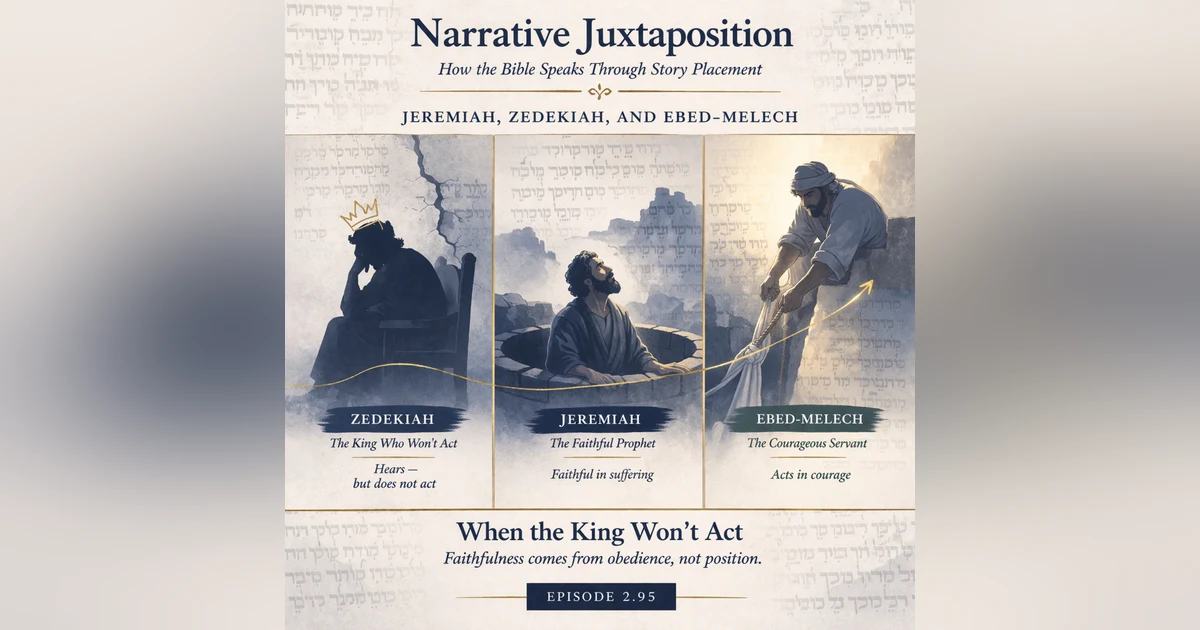
Narrative Juxtaposition: How the Bible Speaks Through Story Placement | Part 5
In this episode of Narrative Juxtaposition, Michael and Zach examine a striking contrast in Jeremiah’s final days: a king who refuses to act, a prophet who faithfully suffers, and a servant who steps forward with courage. As Jerusalem collapses under Babylon’s siege, the story reveals that true faithfulness is not measured by position or power, but by obedience.
Zedekiah hears God’s word but lacks the courage to follow it. Jeremiah remains faithful even when abandoned and thrown into a pit. But the unexpected hero is Ebed-melech, a foreign servant who risks everything to rescue the prophet—demonstrating the kind of trust and action the king himself failed to show.
The episode traces how this pattern echoes across Scripture: God often advances His purposes through outsiders, the overlooked, and the powerless. The takeaway is clear—God’s kingdom does not move forward through hesitant leaders, but through faithful servants who act with courage when it matters most.
Find our videocast here: https://youtu.be/P3pQLQYm2F0
Merch here: https://take-2-podcast.printify.me/
Music from #Uppbeat (free for Creators!):
https://uppbeat.io/t/reakt-music/deep-stone
License code: 2QZOZ2YHZ5UTE7C8
Find more Take 2 Theology content at http://www.take2theology.com
0:00 And today, tonight, we are recording the closing, the final episode of the series. I like starting series and I also like wrapping up series. Yeah, yeah. It's it's good. The middle, sometimes I get like I you got to go through, there's got to be a middle. But sometimes I like any good book, the beginning is good, the middle the the it's like, especially if you're following a character, he or she's going through a bunch of hard times with developing him or her, and then at the end triumphs over the evil one or something like that. That Yeah, it Yeah, that's right. Every good book. And so we're gonna end this series on narrative juxtaposition by talking about one of everyone's favorite Bible characters, Abed Malek.
0:45 It's just. Like it's like bedtime stories. Everyone's like David and Goliath, Adam and Eve and Abed Malek. And I like this story because it's a lesser known Bible story and, you know, it's maybe juxtaposition is the wrong word. I think it fits here. It's more of a contrast between and, and I think you'll see this, you've seen this in a lot of what we've talked about. The person you expect to do the right thing does and the person you might not expect does the right thing. We saw this in Jonah. We saw this kind of with Ruth and Judges. It's kind of like a different way. We see these Gentiles responding in a way. Some of these Jewish leaders in Matthew, you just, you would expect them.
1:28 They know more, to be more. So that's what we're going to talk about today. We'll talk about the Bible characters, Jeremiah, Zedekiah and Abed Molech. This is the king who would not decide, and the servant who did. Sounds good. Let's take it to the next level. Let's fire up that twanga music. From the hearts of the Low Country in South Carolina. It's the Take Two podcast where we take theology to the next level. All right, We're talking Jeremiah Zedekiah and Abed Malek. And as we were saying some of these names, Michael made this timely connection right through my face. Didn't you see it?
2:14 We just talked about a lot of Maleks. Abimelech. Elimelech. Ebed malech and ebed means slave or servant. And I, I remember we had said, I said Eber, I think, 'cause I misremembered. Obed but it was ebed and then. Yeah, yeah, yeah. So Ebed Obed, that's even closer. And Ebed Malek means servant of the king, so man. Just keep an eye out for those maleks. They will. They will like pop up king. That's so good. Well, kind of the thesis. The central claim in this episode, not unlike some of these other ones is that true faithfulness is measured by things like obedience encourage not what you would expect all the time position, power or status that God we know works through the marginalized look works through the overlook the powerless.
3:02 While those often times that are in the strong positions in authority often fail. And we'll see this story and we'll see this at play in this story of Jeremiah, Zedekiah, and Abed Malek. So what? Let's set the stage, because this this comes from the book of Jeremiah, which most people know who Jeremiah is. They might know a few facts about him. What is what's like the one thing everyone knows about Jeremiah? He's a weeping. That's like, yeah, yeah. Yeah, because like a lot is not the one. I always think about him. Another thing that people probably know is he got thrown down into a pit. And that that's very timely for this story in particular. So you know, a couple things.
3:42 You probably know some contextual things, but just for fun, let's set the context and go back in time to Jerusalem around 586 BC. One of those, you know, there's not like a if you're thinking major dates, that's one that should kind of hitch you in the face. Not a not a good time for Jerusalem. Yeah, there was a king maybe 50 years before this. That was visit. They had just staved off the Assyrians. The Babylonians visited and remember, he took them all through and showed them all and the prophet that that time was like basically everything you showed them. God's going to judge you for this because you have pride and it's all going to go to them. It's like, oh, and so now 586, that's what's happening.
4:24 Babylon. The Bills come and do, yeah. Under Nebuchadnezzar coming to the to take them out. Man into the picture is exactly what you said. Babylon's army surrounding the city, There's a siege. It's not going well. It's, it's, it's you know what the siege does? It's going on and on months and months. Food's disappearing. People are losing confidence. You know, everything is rationed on this great city of David is now starting to give way. And the king we have is King Zedekiah, the final king of Judah. And what we do a lot of these podcasts talk about what what names mean. His name means Yahweh is righteous.
5:06 And so he's the guy. He should be doing the right thing at the. Right time. You would think so. You hope so. You want things are going bad. Is he going to do what's right? If you read the story, he fears, you know, the people he rules. He fears the the people from the outside Babylon who are coming to take over. He fears his own officials. And really, it's like analysis paralysis. He's not deciding anything. He's kind of just freezing in in his track. And we've got this prophet Jeremiah that like we mentioned the weeping prophet and, and he's declared that because. If only Jeremiah had told him what to do. Yeah, if if only he's given this message over and over that Judah just refuses to hear.
5:54 It's not a pretty message. Judgment's coming. Even saying things like you know Babylon will conquer the city, the only thing to do is surrender like you need to surrender. Fighting this is is not going to go anywhere. Which seems counter it doesn't. You can understand like hey, I trust in God, I don't trust in you, I don't believe you. But I think God showed more than one time that Jeremiah was a true prophet. Exactly. So this message of Jeremiah, like Michael said, it's making these leaders enraged. They'll say things like, hey, Jeremiah, you're a traitor. You're you're committing treason. Not only you're being discouraging, but you are showing us disloyalty. And so they they seek to silence him. He's going to be thrown in this pit like you said. And then this other guy, Abed Melek, he is a Kushite Ethiopian servant in the king score his name like you so athlete pointed out, means servant of the king.
6:53 And what's going to happen is this king Yahweh is righteous, doesn't act rightly and the servant of the king is the one this guy from Ethiopia Cush the right thing. So let let's get into the story. I don't know if you want to pull up Jeremiah. We'll look at chapter 21 and I'll have you read verses 8-9. And this is really Jeremiah's message that he consistently is preaching year. It's not just like once or twice, but it's like year after year after year. And this is not the one who was a bullfrog. Common misconception. What a what a song that just everyone knows as well. All right, Jeremiah 21, eight through 9, says, You shall also say this to the people. Thus says Yahweh, Behold, I sit before you, the way of life and the way of death.
7:41 He who dwells in this city will die by the sword, and by famine and by pestilence. But he who goes out and falls away to the Chaldeans who are besieging you, will live, and he will have his own life as booty. Yeah, and we mentioned this. This would be shocking. This is not like good military tactics, Jeremiah, to be clear, he's not like siding with Babylon. He's just like the prophet. He's just revealing what God's saying it's. Like when Paul says, hey, if you jump off the ship, you're gonna die. Stay on the ship, you're gonna live. And people try to start jumping off the ship and it's like he's just telling you. The fact, yeah, don't, don't shoot the messenger. He's proclaiming God's judgement specifically on Judah's rebellion and idolatry that you know, if you've read Scripture, generation after generation has ignored the covenant of responsibilities, turn their back on God.
8:32 They've rebelled and now judgement has arrived. So let's talk a little more about Zedekiah, who at this point like knows Jeremiah is a true prophet. Jeremiah is validated, but he is very, he's terrified of like what his officials are going to say. And so he says one thing public, one thing publicly, but then he wants to meet with Jeremiah secretly. And in Jeremiah chapter 37 verse 17, he's like having this like aside in private with Jeremiah. Says Now King Zedekiah sent and took him out, and in his palace the king secretly asked him and said, is there a word from the Lord? And Jeremiah said there is. Then he said, you'll be given into the hand of the king of Babylon.
9:17 Something to tell. OK, Yeah, I heard back. All that being said, Zedekiah, like knows Jeremiah speaking truth, but he's kind of like in this halfway, halfway point where he, like, wants to, he like, wants to side with Jeremiah. He knows that's the right thing. It's almost. Like part of God's punishment to Israel was a weak leader. Oh. Man, yeah, I, I, I think you're exactly right. And it's like being stuck in this middle zone where he, like, acknowledges y'all. It's like he's like knows all the facts but is not acting on it this week, leader not not following through with what he knows is to be right. So his response is just to not listen to Jeremiah.
10:02 The, the officials, they, they're getting sick of Jeremiah and all these warnings they accuse him of like hurting morale. All the soldiers are like, you know, not doing well, hearing that everyone needs to surrender. It's not good luck even saying things like, hey, you're actually trying to hurt our people. And they they actually say, Hey, let's execute Jeremiah. Zedekiah again responds weekly. And he he basically takes the easy way out and says, OK, hey, well, you can read it Jeremiah 38. Let's look at verse. 55 S King Zedekiah said, Behold, he is in your hands, for the king can do nothing against you, yeah. He's like, hey, I'm, I'm just the king. What can I do? Like that's a weird. Just a figurehead. So you guys figure he abdicates his responsibility and in the very next verse 6 basically say, hey, you can lower them to a cistern.
10:52 You know, you, you know, it's an empty cistern. There's no water there. It says in verse 6, there is no water in the cistern, only mud. And Jeremiah sank in the mud. And so Jeremiah hares in this cold, muddy cistern. It's probably dark, No food, really nothing he can do. He's just basically. Wasting away. That's he's probably like, I'm gonna die. Here, not Margaritaville. Not no, not Margaritaville and the king does nothing very next verse, verse seven were introduced to Abed Malek, the Ethiopian who was a servant in the King's house. He was a things of no like we get these details about him. He's a foreigner, he's a serpent. We actually hear he's a eunuch as well, yet so he's like, he's like the unlikely person to act cause what? What's he got invested?
11:42 All the things that are not highly esteemed in in the Jewish economy, yeah. But we're gonna say he's the one who acts. Go ahead and read verses 8-9. This is kind of what we just saw Jeremiah load in the system. This is Abed Malek's response. And Abednalek went out from the King's palace and spoke to the king, saying, My Lord the king, these men have acted wickedly in all that they have done to Jeremiah the prophet, whom they have cast into the cistern. And he will die right where he is because of the famine, for there is no more bread in the city. Very, very. He's kind of saying everything's like this is not right. Like honestly, the at some level the King's like asking Jeremiah to say what happened.
12:22 Jeremiah says what happens and then he he's really basically, you know, LED down the cistern to to his. So this, you know, servants confronting the king. He's he's going against these officials accusing them of injustice. He's advocating for Jeremiah when no one else would. And what what maybe not surprising we see and this is actually all happens very fast. Verse 10. We're like going in order here. This is Zedekiah's response. Yeah, and. I've. Even though it happens fast in our Bible, is there some? Time, there might be 8 years. I mean, like, you don't, it's not like you're reading 5 chapters, but yeah, yeah, yeah, it's like, easy to follow is what? I easy to follow, but I think that Jeremiah does stay in there for a little bit.
13:03 Yeah, yeah, he says. Then the king commanded, commanded Ebed Melek the Ethiopian saying, take 30 men from here under your authority, and bring up Jeremiah the prophet from the cistern before he dies. Great. Kind of, you know, he's again saying, hey, do what you want to do. I know. I guess I'm just again, I can't do anything. Abed Malek organizes this rescue and and helps bring Jeremiah up out of the cistern. He's lifted out of the pits. You wanna read verses 12 and 13? There's like some like, you know, imagery. There's some details here that are good 'cause you know then ebed Malek the Ethiopian, said Jeremiah. Now put these worn out clothes and wraths rags underneath your armpits under the ropes. And Jeremiah did so obviously, so the the ropes wouldn't, you know, hurt his skin that's been in this mud for forever. So they pulled Jeremiah up with the ropes and lifted him out of the cistern.
13:53 And Jeremiah stayed in the court of the guard house. Great. Jeremiah will dive the pit. He survives because of this servant, Abed Malek. What's so interesting is God's message he gives to Abed Malek in Jeremiah 39, verses 15 through 18. Now the word of Yahweh had come to Jeremiah while he was confined in the court of the guardhouse, saying, Go and speak to a bed and elect the Ethiopian saying. Thus says Yahweh of host, the God of Israel. Behold, I'm about to bring my words on this city for disaster and not for prosperity. And they will take place before you on that day, but I will deliver you on that day, declares Yahweh. And you will not be given into the hand of the men whom you dread, for I will certainly rescue you, and you will not fall by this sword.
14:41 But you have your own life as booty, because you have trusted in me, declares Yahweh. Yeah. Because of how he acted, he's like, hey, Jerusalem is going to fall. God's people are being judged, but you are gonna be saved through this. You're gonna be OK. And it's kind of this, you know, reversal of, of fortunes where Abedmelek is gonna experience salvation, at least in this immediate sense. And so again, you look at you look at the names and zoom out, you've got Yahweh as righteous. Zedekiah does not act righteously, does not act in accord with Yahweh's ways. Abedmelek, the servant of the king really behaves more like more like a king should then then a servant we look at Jeremiah's name means something like Yahweh will exalt or Yahweh will lift or raise up. And so though he's, you know, thrown down in the pit, he's vindicated.
15:33 And his message eventually is. When I got out of the Navy, yeah, yeah, I was with, it's a headhunter and I had some interviews and one of the interviewers asked me, does everything fall and rise on leadership like the saying says, And this is what I was trying to communicate to them. I don't think I did a good, good job communicating it and I did not get an offer for a job. But what I was trying to say is everything rises and falls on action of leadership, but it doesn't. That doesn't always happen at the time. If you could have a weak manager, but someone that's like a good, you know, middle manager or something who actually exercises the leadership that the shop workers needed. That's what I was trying to communicate. But this is, I think, an example of that. You have a king who's not doing what's right, and yet there is someone in a lower position rising up to the occasion to provide the leadership that at least Jeremiah, you know, needed at that time.
16:30 And, and it's so interesting. It's like we see this kind of story in other places, you know, not too much in the future. We see like, you know, Daniel and his friends are like foreigners in the King's court. The king like listens to him. This is like the opposite kind of thing, but it it's like you can be seemingly on the outside, but working hard. I mean, obviously I've been like had to be respected in some sense to be able to get have given this this leeway. But yeah, anyway, another one of these juxtaposition. And and so if we're kind of rounding out this series, I think I think it's maybe helpful to kind of talk about everything just just a little bit. Some of this pattern we talk about Ruth and a lot of it is, you know, it's like God's got these people, but then it's not. It's almost flies in the face of this Black Hebrew Israelite cult series we recently or episode we did where it's like, you know, it's more this Galatians idea where, you know, it's more about the substance like where where is your faith rather than what your, you know, ethnic identity is because Ruth, this Moabite widow preserves the line of David while Israel has collapsed morally and judges just going down this bad road and Jonah, these Pagan sailors fear the Lord. They act faithfully while Jonah's like. And the people on Nineveh and.
17:51 The people on Nineveh, everyone except for Jonah is doing the right thing. Judges, national chaos, civil war, really terrible thing. And then we had a couple episodes on the Gospels where the Gentiles, the outsiders, they recognize Jesus more significantly than the religious leaders, where Jesus looks at some of them and says, I have not found such faith even in Israel. He marveled at at some of these sayings. And so faithfulness is often found. And the ones you would, at least as you're reading the story, it's like not not who you would tee it up to be. And the kind of the juxtaposition that we didn't do a separate that. Really, that really was the catalyst for all of this. Right was Judah and Joseph.
18:36 Yeah, 'cause we're like Joseph, Joseph, Joseph, Joseph, Joseph. Oh, and here's Judah and all of his sins with Tamar and how he acted treacherously. Joseph, Joseph, Joseph. Weird. Yeah. And it's like right in the part where I think it happens right around Potiphar. 'S wise, I think exactly. Yeah. And so it's like this is a juxtaposition that most I think I've heard of that one. Before, Yeah, yeah, you. See it? It's a little bit more clear, but if you're not paying attention, you're just like, oh, this is just the next part of the story. Like no, it was put there for reason to contrast the sinfulness of Judah, who eventually is the one who Christ comes through. Yeah, totally. But. And and that of Joseph. So yeah.
19:16 See him in there so good. There's a million more we could do, but I, I think a. Million. We have them. We have them all numbered. We have them radio. It's good to yeah. Be mindful as you're reading Scripture. Some of these overall biblical connections, because they're like all over the place. You, the more you read, the more, yeah, you see them. That's good. Help me try to read with with more of an eye for these things, you know. Yeah. And something that I've done before and it's difficult to do because it requires, especially if it's a long book, Yeah, is copy out all the texts separate from the chapters, maybe even verses. OK, Yeah.
19:58 And just read it all as one narrative because sometimes chapter and verse breaks. They your mind shuts off or something? Yeah. It it really shuts off like you know, Paul wrote Roman 7. About him? Struggling with sin. That's my take because chapter 8 one verse one says, but now there is no condemnation for those who are in Christ Jesus like even those of you who are you know who are justified and are trying to become fully sanctified. You're going to struggle with sin. But guess what, no condemnation for you. That's good. And but if you just like, oh, I'm at the end of seven. Shut the book. The next day I wake up and I open.
20:38 Up. It's like a. Whole new thought. It's like, yeah, that Paul put those like, so, yeah, if you can, you can go to something like Bible Gateway, copy out the text. You can have it actually leave the numbers out and just like put it in one long document and then read it and you can write it up on it and stuff. That's good. And they have I, I have one, I think it's just the Gospels. I, I'm not read it that much, but you know, I've got like a Matthew, Mark, Luke and John. That's just like a reader's Bible where there's like none of that in there. It's like a book. And it's like, oh, this is Matthew. And then you read till you get to Mark and it just says they make. Paragraphs. They put Matthew first in that book. Yeah, surprise, surprisingly. One other thing I'll say, just kind of like in that Ruth story, it's like you kind of have echoes to or even in the like that judge's story, it's like you have echoes to like lie, like all these things are connected.
21:27 When I read about Ethiopian eunuchs, I can't help but think of acts or it's like, you know, there's like, I mean, not that it direct, but it's like, you know, someone who hears this message and is believing and is, you know, it's just, you know, interesting. That it's the unit coup is with Esther Oh that's a. Great. Great question. I don't totally know. Maybe Ethiopia was just the place you go get eunuchs. I don't. Know maybe it is and all the stuff I was doing this was like a while ago, but it's like I don't it might be like Cush or Ethiopia just refers to like a very broad area of Africa. There are places I think it's in Jeremiah. There's like a proverb that Jeremiah says or someone says it's like, can a leopard change his spots or Cushite the color of his skin?
22:21 Like supposedly they had like very, very dark skin. Like they were like very, very, very dark. So, you know, I, I, I don't know. And then I don't know if this is true or not, but some different scholarship I was reading about specifically the, the Ethiopian eunuch in Jeremiah is like, you know, maybe when it says eunuch, it doesn't really mean eunuch. It means it more means official. Yeah. Yeah, exactly. It's like, it's hard to know because some, you know, so I, I, I don't know, it's people like maybe in the Old Testament it, I don't know. Yeah. So there's a lot of different thoughts. I don't. I had a hard time teasing out what is like actually. Book of Ester does not indicate the origin of the eunuch there. Gotcha.
23:03 You know, yeah. So there you go. That would be really cool if you know this, this, you know, connection there. Anyway, anything else before the final take? No, that's, that's, this is a good episode. It's a good reminder to read the Bible with questioning. Not like you're questioning authority, but like, ask questions of the text and observe, stand back. And sometimes you've seen a text so often that like you know it, so you don't really read it with fresh eyes. But it's hard to read with fresh eyes when you don't have fresh eyes. But you're trying to. That's right. Yeah, yeah. It is really, really, really tough to do that. But that is yeah.
23:43 Man, I love looking at little series like this. We'll up the, you know, keep you in suspense. What's the next series on this? You know, on this day of the week that that runs. So we'll see. We'll see what happens, what's going on and you're I did watch that Wes Huffer. I listened to the Wes Huff Diary of the Ceoi. Need to listen to Wes Huff on Joe Rogan. Oh yeah, and this diary of the CEO, some Have you heard that Joe Rogan has basically said he basically believes the Christian story and he probably counts himself as a Christian now. Yeah, I've read some of this stuff and the way he talks is very much less dismissive as it like used to be like you, you can see a progression and things he says is, is different. I've read things about him I don't listen enough to. I I like cherry pick his episodes. If there's like something on health or fitness or on really, it's like something that catches my eye. So I like won't listen to anything. I'll listen to 1.
24:44 But it it the way he talks is different than it was like years ago. Yeah, because we had mentioned when Wes Huff went on there, I was like, well, I don't know, I don't know if I want to listen to it because when Meyer, Stephen Meyer went on there, it was just like the what if question forever. And someone commented on that video and was like, hey, it's it's a different attitude with Joe Rogan and and Wes like he has. Shipped, Yeah. And he, Wes does a good job. Where I think where Joe Rogan is going to have trouble is in some of the like sciency stuff. He's like, he said something that was one podcast. Maybe it was on the Wes Huff. It was one podcast and he's like, you know, Adam and Eve, like like that kind of stuff. I I don't know if he's like there with some of that like is that literal?
25:32 Like that's just like we came from monkeys and like that's like his thing. I think he like that whole conversation. He's a harder time with versus like some of the questions with Wes Huff and what Yeah, it does seem like it is different and a lot of like where he's waning like politically and stuff. He he's really big on if something is true, just say it's true. And there's, you know, with all of COVID and you know, you know, politicians saying things and act like, you know, So I think that's like shifted him as well. But it is interesting where I have a hard time like knowing exactly. I think Jordan Peterson, who I'm not sure you know, we would say he's a Christian either, but it's like he's like all wrapped up in the all these stories in the way when they talk.
26:20 But it is it is interesting that I don't think he would have had he wouldn't have like the interaction with Westheff was like very well, I wish with this dire CEO. It's really positive with this dire CEO guys like clearly not not a Christian, but he handled really like he would ask Wes like so would you say I'm going to hell like or you know, and Wes would like answer it like in a pretty good way. Greg Kochel did a little bit of cover on this, and he was very happy with Wes's response. And he was like, he didn't move away from the objection, but he was very kind in what he said. But it's very straightforward in what he said. So it was great, yeah. Yeah, he, he's, he's killing it and gave like, whatever that guy's name is, like a little manuscript he made kind of thing, you know, doing his thing. So it was good.
27:05 And I, I don't listen to a lot of the Dire CEO podcasts, but it seems like I could tell more on this one, how edited they are, where he like cuts stuff out and compresses it. I think you mentioned, like Greg Kochl said, I never knew that, but even I was, I was like, oh, I bet. It seems like he cut a lot out. Greg said, yeah, I gave 2 points on something and I have my main point and then I have kind of my point that kind of back that point up and like my main point was totally gone and what was released and only you got like my backup point. So it kind of seemed out of place a little bit. Yeah, I. I could. He's like, I could tell. He's like, and I don't think that they necessarily do it on purpose, that they just have certain time constraints and they're trying to. 'Cause it's already a long podcast and if you don't know they edit it, it almost sounds like they don't edit, it just flows.
27:52 So they probably just like try to make it flow. But knowing what he's about Coco, I was like, oh, I bet he cut out something because I was like, why didn't he say this basic thing? But it seems like he was alluding to it. But overall I thought it was like really well done. He does come off. Maybe it's like the Canadian in them that like comes off as like being very like kind and not aggressive. You know what I mean? That probably helps out. Canadians. Well, I wasn't, I wasn't going to say Canadians are more kind, but that I've seen, you know, especially with this, the curling. Oh yeah, and the hockey thing. I was like, well, not all Canadians are. Dude, that curling thing. Was crazy. It is crazy. He's like, I'm not cheating. And then like, then there's like they said, oh, we got a camera set up.
28:35 So what's the deal? I I only saw that part of it. Yeah. Like if it happens, you just police yourself, like, no. Or they, like the ref, could call it. Seems like the ref should do. Something. Yeah. Yeah, I was. Like why are you not disqualified? Because. It's on. The whole thing is you're let go of that handle and you're not supposed to touch it again. But if you kind of see, oh, I'm just a half a degree off, I can just give it a little nudge and it'll help. And of course, that's a that's a huge advantage. That's great, 'cause I was like, I feel like unless it was like so subtle, but on all the camera stuff I saw, I was like, oh, it's like clear. It's not like maybe he touched it. Maybe there's like he touched it. That was great. He was not happy. He was very strong in his conviction. Yeah. I was going to look for this and I don't know if I can find it.
29:17 Maybe we should do a whole episode on it. So I'll just allude to it now, But obviously you wouldn't use AI to do your thinking for you, obviously, but you can use AI to as a tool to help you. We use AI like we'll put some stuff in, right? Hey, organize this and do some notes and stuff. But there was a person who was using Claude, a new AI, and basically said, hey, no bias. So don't you know, try to. But out of all the world views, if you were a human, which one would you be? And you said, I would be a Christian. And he gave some reasons and they were just eloquently put. And one of the reasons was he was like, the Christian view makes the most sense in what I see of mankind.
30:02 People who can do noble, self sacrificing acts of goodness because they're made in the image of God and yet can also be capable of some of the most evil that you see because of their fallen nature. That's crazy. Yeah, yeah, yeah. And then he said had this one paragraph, he was like every other religion says you have to climb up the ladder. And this one, you know, the ladder is brought down and you like, it's like the work is done for you and you. And so it's like it's very different. It is crazy. It's like that, like fundamentally just like reaches to every impulse in you like it. To me, it like reconciles all the stuff you see that's wrong because I feel like everyone wants to help the Marge. It's like, man, everyone has a heart for it, but it's like, this is like the perfect way to reconcile all. All the things.
30:50 So maybe we can go through his answers and and maybe an episode and and kind of see if we like him or not, if I can find the original document. I love it. Yeah, that's good. A lot of good stuff to think about the series is rap. See you guys next time. That's our take. Thanks for listening to Take TWO. Find us wherever you find podcast and on YouTube for those who want to watch our video cast.

