Joshua 6 | Dividing the Land: Faithful Obedience, Partial Possession, and God’s Unfinished Work


 RSS Feed
Episode 2.81
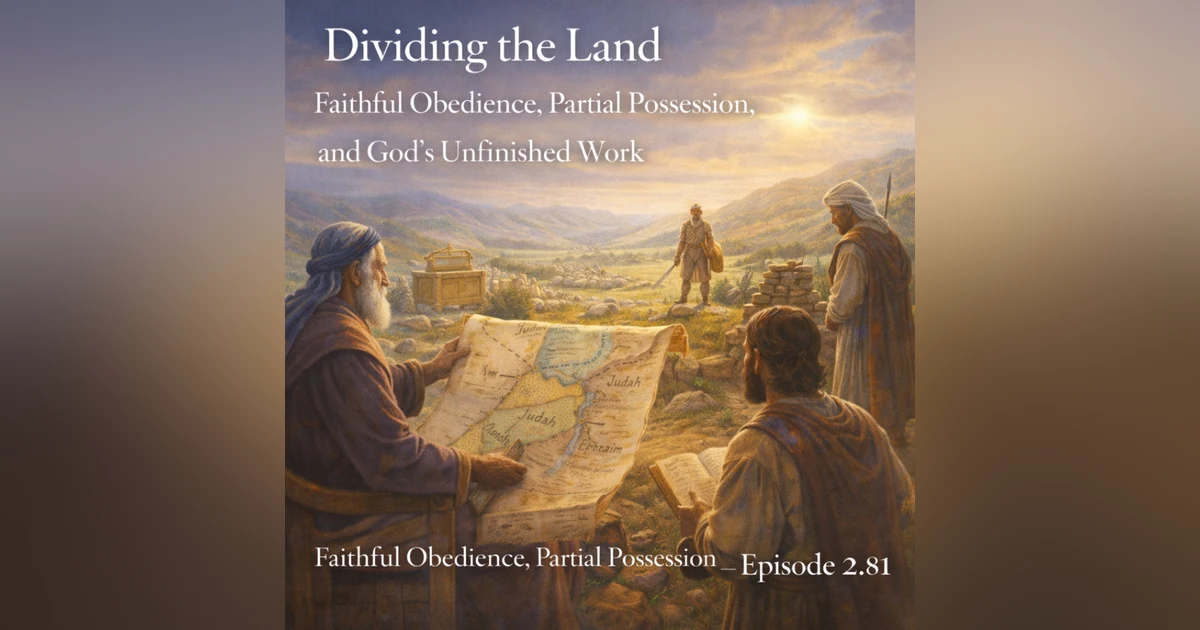
In this episode, Michael and Zach walk through Joshua 13–21, a section of the book that often feels tedious on first read but proves theologically rich on closer inspection. As Israel moves from taking the land to possessing it, the narrative slows down to show how God’s promises are fulfilled in real places, through real obedience—and real compromise.
We examine Joshua’s advanced age and Yahweh’s command to divide land that has not yet been fully conquered, setting the stage for long-term faithfulness rather than immediate triumph. Caleb emerges as a living example of wholehearted trust in God’s word, while the allotments of Judah and the Joseph tribes reveal both courage and hesitation that will shape Israel’s future. Along the way, the text subtly shifts the storyline from Joseph to Judah, preparing the reader for kingship and pointing forward to Christ.
Throughout the episode, we address key theological and biblical themes:
• Why land is divided before it is fully possessed
• Caleb as a model of persevering, word-centered faith
• The significance of Judah’s prominence in the allotments
• Partial obedience and its quiet but lasting consequences
• How Joshua prepares the reader for the failures of Judges
• God’s faithfulness despite Israel’s unfinished obedience
The episode closes by showing that Joshua 13–21 is not about geography for its own sake, but about covenant faithfulness lived out over time. God keeps His promises—but His people must trust Him enough to walk in them fully.
Find our videocast here: https://youtu.be/E-a1GXL9yuw
Merch here: https://take-2-podcast.printify.me/
Music from #Uppbeat (free for Creators!):
https://uppbeat.io/t/reakt-music/deep-stone
License code: 2QZOZ2YHZ5UTE7C8
Find more Take 2 Theology content at http://www.take2theology.com
0:00 We're we're at that point in Joshua Michael. Wow. Where everyone puts their Bibles away and they say those Bible stories were great, but I'm done. Yeah, let's move on to judges. It's the IT we'll we'll kind of give the big overview and kind of zoom in to where we are at. But you know, not not what people would call the exciting part. But I think as we look at it really, really important and there's little themes that that you clearly see that I think it's easy and daily Bible reading to start like skimming through and just turning the pages, you know? You're saying God put that in there for a reason? Can you believe? It and we're maybe supposed to glean some probably easier for the Israelite of the day to glean those pieces being. Familiar with the geography and the kings. And than us, you know, separated by thousands of miles and thousands of years.
0:50 And that's. True. It's like, where's this place? Like you're like, I need a map if I'm going to know where that maybe I know where Judah is, maybe Benjamin. But then you start like losing it. Well, because the 10 tribes are lost, right? That's right. You're like, what are we doing? You don't get a map and you're like Simeon was there. That's weird. And it's like it's like you just have no context because you know why? Why would you? So in anyway, we are going to talk today. We're going to cover a lot of ground. We're going to start in chapter 13 and we are going to go through maybe up to around 17 through 17 this episode. So to recap chapters one through 4, where we're entering the land, we're coming into the promised land.
1:33 Chapter 5 through 12, we're taking the land and then where we're starting here, we're possessing the land, we're dividing the land up where we're going to do our best to bring little. As I was going through, it's like, oh, I did not realize this. I did not realize this. I, I felt like learned a lot 'cause it's, it's kind of where it goes from this like epic movie with all these battle scenes to like you were saying, lots monotonous land surveys things that they they don't make it into the. Of the tribes, right? Do we get some numbering? Like they talk about the sizes of the different. That's true. Yeah, we get, we get all this stuff, but like you said, let's pretend like we're an Israelite and try to get that that meaningful perspective on. So starting in chapter 13.
2:18 And, and if we're looking at a big picture and probably in your Bible, it's divided up into a couple different sections in mind. Did we want to, did we want to take it to the next level? Our new format is really messing us up. Yeah, yeah. So, yeah, yeah. So we are going to take this Joshua study to the next level. Let's fire up that Twanga music. From the hearts of the Low Country in South Carolina. It's the Take Two podcast, but we take theology to the next level. Joshua chapter 13, this this chapter can be divided into two sections.
3:00 Verses one through 7 kind of talks about the land that's still to be conquered, conquered. It's going to be an introduction to this whole section. And then the end of the chapter we're going to start talking about the 2 1/2 tribes on the east side of the Jordan. That would be the tribe of Reuben, the tribe of Gad, and the half tribe of Manasseh. That always gets me the half tribe. All of Manasseh, but it's like Manasseh and Ephraim. Or is it really half of Manasseh and half of Manasseh? I I am, as we're talking, going to see if one of my maps. Here we go. So the way this is 'cause it helped me to look at a map, you can see there's like East Manassa is huge. What like if you see how big Manassas land is?
3:42 Wow, it's a lot And even on this map you can see Judas big, but Simeon's like right in the middle of it. So it doesn't Juda's not as big as it appears. It is very big here, but take that's good. Everyone should pause that I'll. Take a picture of that. There you go. Maybe we can put it on our green screen. That'd be. Good because it does help. Because it is half of Manassa, half of Manassa. And not so because one thing that is confusing because Joseph has two kids. So is it like, you know, 11 and and then Manassas 11.5 and Ephraim's, you know, brings us up to 12, but we're really talking about Manassas huge and half of Manassas on one side of the river and, and the other halfs on the other side of the. River it exactly right. So starting if we back up to the beginning of chapter 13, go ahead and read verse one for us.
4:26 Now Joshua was old and advanced in years, when the Lord said to him, You are old and advanced in years, and very much of the land remains to be possessed. I love that, you know, very straightforward, always just telling it how it is. You are old. And so Joshua end of his life advanced in year and he's kind of charged by Yahweh there. There's some land still to be possessed. Talks about some of the Philistine land in the southwest, some of the land that was in the north. It's kind of pointing out, you know, you've taken a lot of this land, but but there's more work to be done, more stuff to possess. If we were to read this whole section, we would read that God promises the drive out enemies for Israel and God commands that this land is going to be divided by the 9 1/2 tribes. And then we flip to the second-half of the chapter where we get those 2 1/2 tribes, Reuben, Gad and the half tribe of Manasseh.
5:23 Some of this would, I think, be a little bit laborious to read, but go ahead and read verse 13. Right, verse 13 says, But the sons of Israel did not dispossess the Gershirites or the Makahites, for Gersher and Mccoth lived among Israel until this day. So is that? Good or bad? Probably bad. Not great. So it kind of talks about these tribes, Manasseh, half term Manasseh, Reuben, Gad, you're going to possess the land on the side of the Jordan. But they did not do they did not drive out everyone. Then it kind of goes and talks about, hey, Reuben, this is for you. Gad, this is for you.
6:06 Manasseh, this is for you. And, and we see that phrase that you just read, we see it repeated in Joshua chapter 151617. And maybe more famously, we see it at the very beginning of judges, like kind of recapping all all that happened here. And if we were to take time to read all of this, you might be able to guess or it'd be curious to think about which victories would you highlight? And it seems like some of the pictures that get highlighted a lot are OG Sihan and Balaam gets shout out. You see Balaam a lot throughout Scripture, like mentioned, you know, some of these things that those are the those are the victory illusions that that are mentioned.
6:49 And then we also mentioned that Levites, they don't get a lot of land. No, just like little pieces of land in all the land. That that's right. Their their inheritance is is Yahweh and these offerings and these kind of things. So that is 13 in the nutshell. Well, can you remind me and the listeners, because they're the name is very similar to the name we just read, but the people who tricked Joshua early on, what were they? Was it the Gibeonites? Gibbeonites. Gibbeonites. Yeah. And not the. And so just to keep those clear from the gestureites, Yeah, the gestureites, Yeah, yeah. That's the other thing. It's not like it'd be so much easier if it was like the Canadians or something, then we would like get it. But it's like these like Randy, like OK, I heard these, but don't have a great context for him. For them.
7:31 Chapter 14 is great because it talks. What we're going to see, I think in the coming chapters are different examples, some very positive, some very negative. We're going to talk First off of Caleb. Probably a good example. Yeah, great. Good example. That's that's right. What Israel should have done everywhere is what Caleb does. So if you're zooming out for chapters 14 through 19, we kind of see a unit that emphasizes 2 faithful spies, Caleb and Joshua, Caleb now Joshua in chapter 19 and then kind of sandwiched in between or some of the the not so. Good. No Buenos. No Buenos it exactly. So let's see, if I were to summarize verses one through 5, it's an overview of the inheritance for the 9 1/2 tribes West of the Jordan.
8:20 And then we get to verse 6 and we get to Caleb's example. Let's can you read verses 8:00 and 9:00 for us of chapter 14? Nevertheless, my brethren who went up with me made the heart of the people melt with fear, but I followed Yahweh my God fully. So Moses swore on that day, saying, Surely the land on which your foot has trodden will be an inheritance to you and to your children forever, because you have followed Yahweh my God fully. Also read verse 14. That says, therefore, Hebron became the inheritance of Caleb the son of Jefuna the Kinezite, until this day, because he followed Yahweh, God of Israel, fully. So I don't know if you picked up on some repeated phrases in those three verses talks about like holy following Yahweh and it's what Caleb's on for.
9:14 It's like emphasized over and over and over again. If we were to read through it, you would also see this theme of Yahweh keeping his promises in verse 6/10/12. Really five other times Caleb in this speech is saying I did this because I knew the promises were this was promised to us. And so at at this time, Caleb's also advanced in years. He's probably in his mid 80s, lived through a lot of fighting. But just looking back in his like guys, if I had to tell you anything, it's that I wholly followed Yahweh and and it turned out really, really well. One other verse to read and maybe we can comment on it. Sorry, we'll read verse 12.
9:54 Verse 12 says Now then give me this Hill Country about which Yahweh spoke on that day, for you heard on that day that Anakim were there with great fortified cities. Perhaps Yahweh will be with me and I will dry them out as Yahweh has spoken. So this like senior citizen 85 year old guy is like asking for the smoke. He's like Anakim potential, you know, giant connections. He's like I, I'm happy. Give this to me. Yeah, he wants it all. Which is crazy 'cause we know Israel doesn't drive out, but Caleb's like I'm all I'm all about. This I'm all in.
10:35 And it is interesting, like just looking back, it's like this has been Caleb and Joshua from day one, and it's been everyone else from day one. It's kind. Of we saw what the Lord can do, who's going to hold back the Lord? If I were to say the word the name Fido to you, what would you think? I don't know, it sounds very familiar. I can't. Like if I said oh Fido, naturally nothing. I don't know a dog. Yeah, I was going to say a dog. I was. So Fido is actually Latin for faithful. Oh yeah, yeah, yeah. And Caleb has those that double meaning of faithfulness. And dog. But it's like the. Good side of your dog. Because dogs are so faithful, like they just want to serve.
11:17 Them by your. Side, they'll be there. They'll be there, man. You know, they want to serve you fully. And that's what that's what Caleb's doing here. Oh, that, that's great. We'll remember. Remember this response by Caleb as we get to Chapter 17 and we hear Joseph's tribe's response, not as favorable. So that's chapter 14. Big take away is Caleb is this good example doing what is right. Chapter 15, another tedious chapter of promise geography. Verse 12 verses are tracing this, the inheritance of Judah, talking about the boundaries. It seems boring, but like you said, if you were an Israelite, this would be like Genesis 12 and Genesis 15 fulfillment.
11:58 As far as the geography it mentioned. It's like, oh, this is like where Abraham was and you're, you're, you're putting this together. Yeah. For us, if someone's like, yeah, so you're gonna have from the West Ashley over to, you know, the Marion National Forest, like those boundary markers would be like, oh, that's a, that's a big swath of land, Yeah. Totally. And so kind of just tracing out the different boundaries, then we move into some more victories by Caleb him, him actually actualizing fighting at Hebron and Naber. Caleb, if we didn't know from the tribe of Judah. That's interesting because Joshua, do we know what tribe Joshua's from? Do you know this it? Should Levi? That's a good guess. I'm I used to look this but I think he is from Manasseh. But I need to look this up before I just yell it to a microphone.
12:45 I'm pretty sure he is. We can make it be a user. Look up like that's your homework. Comment on what what tribe Joshua's from? And then we get this laundry list, verse 20. Verses 20 through 63 are all the towns that belong to Judah. Can you read verse 63 for us? My Bible's in my vehicle failed to bring it in, so I am on my phone. So it says Now As for the Jebusites, the inhabitants of Jerusalem, the sons of Judah could not drive them out. So the Jebusites live with the sons of Judah at Jerusalem until this day. Not great. So we start seeing even Judah as like, you're like, man, if I had to like write down the tribes, I probably would get Judah.
13:27 And you're like, God, I didn't even do do great here. Not not a strong start. And so that brings us into the last two chapters we're going to look at on this episode, chapter 16 through 17. And these are both chapters together serve as bad examples of Joseph's tribes. And I thought this might be worth talking about if you were reading the Bible up into this point. Joseph's killing it, man. Joseph. That's the line that you're just like, for the most part, not everywhere. You're like, it just seems like everything's breaking their way. Judah. Not. Not quite as much. Yeah. That whole episode with Tamar and Oman and you know that. It it.
14:09 It's not nothing. Stop the highlight. Yeah. So if we were to go to Genesis chapters 37 through 50, that that's all devoted to Joseph, that's a lot of Genesis. So it's like you read Genesis more of Genesis talks about Joseph than Abraham. You're like, it just seems like Joseph's like got got a lot going on for him. We look at Genesis 3738. Joseph is this moral exemplary person, you know, Potiphar's wife, he flees, he saves Israel, his brother Selman, a slaver, he's exalted. All these things happen. You said it. Judah, on the other hand, chapter 38 of Genesis is sexually immoral.
14:53 He's actually like, you know. It's put in the middle of Joseph's stuff. Like, it's almost like we're going to call Judah out here. We're going to yes, exactly. It's like put right next to some of this show like this is very strange. Also Judah is one of the brothers like mentioned, obviously, like selling Joseph, like it's like man Judah. Joseph's got the right actions. Judah not so much. The key text, the one text, if you were going to say man, something appeals for Judah. Can you read Genesis 49, eight through 10? And I bet you could before you even turn in there. But you can guess what passage this is. This is Joseph or Jacob blessing his children. Eight through 10. Eight through 10.
15:33 It says Judah, your brothers shall praise you, your hand shall be on the neck of your enemies, your father's son shall bow down to you. Judah is a lion's whelp from the prey. My son, you have gone up. He crouches, he lies down as a lion, as a lion who dares rouse him up. The scepter shall not depart from Judah, nor the ruler staff from between his feet, until Shiloh comes, and to him shall be the obedience of the peoples. Now that's good. You see this royal language of the future. The scepter shall not depart from Judah, not really based on Judas virtue up until this point, but on God's sovereign choice of note in Genesis 44, there is this positive turning point for Judah.
16:22 He actually he he he's the one who says, hey, taking me into the Benjamin. Like you see it and you're like, OK, that's, that's good. That seems positive. You see repentance. You see even in Tamar, he says this famous phrase, she's more righteous than I Like there's he did wrong, but he owns it. You know, he doesn't like hide from it. So yeah. Yeah. And so you see this very redemptive quality in that. And so you see Joseph, at least the way Genesis portrays things, he's kind of the savior figure, Judah. We see this kingly line, you read Exodus, you read numbers, you think Ephraim and Manasseh, If you look at numbers and if you look at that map, I just looked at Manasseh by itself, gigantic. You add Ephraim to it. Very blessed numerically.
17:03 Joshua, I do have it here in the notes is, is actually from Ephraim, not Manasseh, but he's from Joseph at least. Joseph's bones are like carried from Egypt. It's like an emphasis. You know, it's not, it's not saying like you know, Judah's bones, it's like Joseph's bones, right? And Joshua, this is where this flip becomes visible and marks a decisive shift. When you look at the land allotment, Judah gets slightly more land. It's actually in the best location as far as strategy goes, got some strongholds. It has Jerusalem, the future place of the temple. It it really becomes the geographic backbone of Israel. And here Caleb, not Joshua, the tribe of Judah, Caleb's the one who gets highlighted here. And that's interesting 'cause we always talk about Caleb, we do talk about Joshua, but it's like, I mean, Caleb, we do always talk about Joshua more than Caleb. But Caleb is very prominent here. He drives out the Anakim.
17:58 He's kind of the hero in verses 14 through 15 of people who actually does the driving out at least himself, maybe not his tribe. And so anyway, we we see this more developing judges, but it's interesting where where we see kind of this flipping scripture. It is interesting to, to look at the, the different tribes and the role they play 'cause you would, I think Levi has a great role too with the priestly line and stuff. But clearly, like you say, coming out of Genesis, Joseph kind of has a spotlight on him. But we see like, like if you, it's one of those passages that if you're not paying attention, you can go right through what I've read about Joseph blessing his sons 'cause it's like, yeah, Reuben, you're going to be a wild boar and blah, blah, blah, blah. And you're like, what are we, what are we saying here? Like what's going on?
18:46 But you, you see this prophetic stuff on, on Judah. So very, very interesting stuff. And it's very interesting that Joshua and Caleb come out of these kind of the two strongest tribes, Joseph and Judah. And and so chapter 16 and 17 are going to talk about Ephraim and Manasseh 16 start with Ephraim and it it follows a similar pattern of chapter 15. Also something to remember, it's like the birth order was actually Manasseh and Ephraim, but Jake, the blessing got flipped and and you know, just like actually you, you met, you crossed your arms and you know, just like, no, no, I got I got or Jacob's like I got, I got this right. So it anyway, something to in mind.
19:27 Can you read verse 10 of chapter 16? Yeah, that reads. And and there's a theme going on. But they did not drive out the Canaanites who lived in Gazer. So the Canaanites live in the midst of Ephraim to this day, and they became forced laborers. Not for long, not not. For long. That's right. And then the rest of that chap that was the end of chapter 16 in short, talked about Ephraim. Then we flipped to Manasseh and I. They actually have a verse about Michael Mott in verse three if you want to. Oh. Sweet, I've never seen this verse before verse 3. However, this is in chapter 17. However, Zelophah had the son of Heifer, the son of Gilead, the son of Maker, the son of Manasseh had no sons, only daughters, and these are the names of his daughters Mahala and Noah, Hakla, Milka and Tirzah. If your daughter's ever back talk, you can like I should have named you.
20:28 I should have named you So Craig, just trying to stay, you know, true to true to Scripture. Five daughters, too. Yeah, that's, that's what I was like. That's what I was like. This is insane. Yeah, it's so funny. And this is really a if you look at the background, you look at Numbers 27, Numbers 36, this this person who had no sons died and the daughters asked Moses for an we want an inheritance. We're not we don't want to give it to the closest male relative. That was the custom. Moses asked Yahweh and yeah, I was like, yeah, they asked for it. What? We're going to honor that in verse 4 here, that family reminds Eleazar, Hey, remember this promise like we're ready to now we're realizing. So that's like a lot of faith, persistent. It's like calling back on things that happened years and years. And one more similarity.
21:16 If we had a son, we're going to name him Noah for a long time, really. And one of the daughter's names was Noah. That is so 'cause we. Remember, we were like, is it going to mean nowhere Chloe? Nowhere Chloe Lydia or Chloe Lydia. I mean, Lydia or Noah, yeah. There you go. Go ahead and let's can you read verses 12 and 13? Yeah. It says But the sons of Manasseh could not take possession of these cities because the Canaanites persisted in living in that land. It came about when the sons of Israel became strong. They put the Canaanites to forced labor, but they did not drive them out completely. And you think forced labor sounds good? Right. Yeah, but. But we know, like, you know, during Saul and David's time, they're just going to be a thorn in the side. Totally.
22:00 This is like paving the way for Judges 14 through 17. I'll read this very quickly here. The people of Joseph spoke to Joshua and they and they kind of say, you know what, why did you give me one lot and one portion as an inheritance? We've got a lot of people. We're numerous, The Lord's blessed us, but we don't get as much land as we think we should. I'm paraphrasing here. Joshua says, if you're so numerous, go in the forest, clear some ground, the land of the perisites and the rifeme and the Hill Country of Ephraim, if it's too narrow for you and the people of Joseph said, and the whole country is not, not, is not enough for us yet all the Canaanites who dwell in the plane have Chariots of iron. So we don't want to, we don't want to fight them. And and Joshua's like, you got a great power. You got so many people go fight this. And so again, where we see it kind of flip is they don't want to, they want to complain, but they don't want to carry out the test because they're like, Oh, it's going to be too hard. And so we start seeing that more and more echoes of Deuteronomy 7 and Deuteronomy 20 where where we failed. So that kind of closes out on a negative note. We see like the highlights of Caleb, low lights of Joseph's tribes.
23:07 And the next section, we'll kind of see some more low lights and then a highlight with Joshua at the end of this this little section. So how many, how many more in Joshua do we have? I think we might have two episodes more and we'll be done. We'll go 18 through 21, then maybe 22 through 24, then call it a day. All right. And then we'll just pick up right there with judges. Just keep on rolling, go through. We'll go through the whole Bible, but so in this to recap a little bit, you look at this section of dividing up the land and there's actually a lot baked in here with individual tribes and their attitudes. And like the trajectory, like the overall trajectory is pretty negative. But that bright spot with Caleb and Judah and and the negative with Joseph, it kind of it, it tells you something more than maybe what you would normally pick up. Yeah.
23:52 And you can see how this is setting up for problems down the road, even when the 10 tribes kind of go, go rogue, you know, you know that that kind of attitudes from hundreds of years before. Totally, these things weren't decisions weren't made in the day, but time and over time and over time and we're getting, we're getting there. Joshua, any anything else on this section you want to highlight before we go to our last take? Our last take, Our final. Take whatever. I don't know what sounds better. Yeah. Final Countdown. Final count to get the music going, yeah. Yeah. No, I think this has been good. So you taught this to the impact group, right? Now I didn't.
24:32 I was going to, but then we didn't. We're not doing impact. We killed I. Like to joke land on this if y'all separate back. Maybe, maybe. So we'll see. Maybe. Or at least, you know, maybe down the road. Save it. For a little bit likes combined, but she prefers separate. Oh, there you go. That's good. Yeah. Let's let's let's banter about decisions. That'll be good. No, it's good. Yeah, I impact started impact in 2020 coming out of COVID and we I like the joke. We killed a killed a six year old, just put it to death and now we're a young adult fellowship. But it was good. 6 year old program. A six year old. Program not a six year old human. Yeah, don't just say 6 year old.
25:14 That's great. So this should air on February 10th. Oh. OK, Yeah. So if something so either in real life, yeah, I'm kind of happy, really ecstatic, or you're kind of bummed from what happened on February 8th. Man, yeah, if you know, if I had to guess, like I I'm not, I won't say I've never wagered on a sports game in my life. Haven't done so in a very long time, but if I was a wagering guy, I I would put money on the Patriots just to hedge my bets because it just seems like things fall their way. You know what I'm saying Sam? Someone's going to get injured. It's or or going to fall apart. Like Sam Darnold's going to throw like 3 interception and look terrible and spiral and that's just what's going to happen.
25:58 I keep seeing more stats and I'm like, plus the stats, the numbers kind of go, OK, we're we're not the underdog that people make us out to be. Oh yeah, I went. And we kind of got some momentum, I think. I think I, I think so too. I think with Seahawks, they played well, but it's like they've been home. Like the Rams played on the like, I kind of was hoping the Rams weren't. They played on the road like every game and we're playing really. It's hard to do that. And it's like Seahawks have been comfortable at home. It's like now they're gonna have to travel. It's like some of that stuff is like, I wish they would have like for the Patriots to go into Denver and play well, that's like, great, they can go somewhere else and play good, you know what I mean?
26:40 So we'll, we'll see. We'll see what happens. Sony score predictions. Let's see, man, Patriots offense has not looked super great as of late. They have some, you know, weather concerns that won't be there in the Super Bowl. So maybe like, I don't know what 2824 Patriots beat the see, I know it's been so low scoring, I feel like on the AFC side. Yeah, I was thinking about maybe 2114 or maybe 2417 or something like that. Probably get some field goals kicked by both sides.
27:23 I I, I think it's going to be an interesting game. I don't think it'll be a. Blowout. Yeah, yeah, I think, I think it tends towards that too. Yeah. I hope it's a good game, we'll say. I just hope Sam Darnold doesn't like Fall apart because he's played so good. You don't want. You don't want him to go there and see J Stroud. Don't pull CJ Stroud. Don't pull CJ. Don't pull, Stidham. Don't pull, you know. I'd like to see a backward shuttle pass of the football to no one with two Patriot defenders there. I mean, if we could, if we could get that, I would. That'd be fun, yes. Stidham Stroud, who did the Patriots play in the first round? Totally blank.
28:04 I do know I just had to had to rewind it the chargers. The Chargers. Oh, so Herbert yeah, yeah. With one armed, 1 armed Herbert, It's like, you know, was his. Left arm injured. I I don't think it was like dramatic. I think it's wearing a cast, but I don't think, I don't think a cast. Maybe, yeah, maybe he made this up well. I I mean, maybe I I pay attention but I I don't pay. I think he had like, not on his throwing hand, obviously, but like a small fracture in the wrist or something. Yeah. So we'll see. Because Sam Darnold played so bad in his. He played so good for the Vikings and then that playoff game like total meltdown. Some reporter asked him about seeing ghosts because, you know, he made that comment.
28:46 What was it four or five years ago when he said? That. When he's playing the Pats. We see and we shouldn't throw it in his face. We, I wish more, more athletes would speak in like those terms, but now that no one ever, it's like you say that you're going to get punished. Right. Yeah, yeah, yeah. And he was saying it to himself. Yeah, yeah, It was like. He was up at a press conference. Like man, I was seeing ghost. He's like just kind of like talking to himself, like kind of like, man, you're seeing ghosts. Like let's shake it up, like let's get your head in the game. I just. I don't trust Sam Donald at all. I have no confidence in him. I have confidence in the Seahawks. But Sam Darnold, he's played really good lately. But when I think of him, I just think of a bad quarterback for. Well, he got the Vikings GM fired. There's lots, there's lots of people getting fired this year. That's it's.
29:33 I wonder if it's a record We probably should ask. Yeah, it's, it's interesting. Man, I was so bummed. Yeah, the Steelers got rid of their special teams. Coach, You should look up this guy. He chews so much gum. Have you? I I. I've. Seen that he's great. Yeah, yeah. It's like second to Pete Carroll only. Yeah, it's it's so good. I think he got a job with Atlanta, but you know, going strong. He's like in his mid 70s. I don't know at what time you need to like. Yeah, that's like that guy Ernie for the Pats. He retired eventually, but he's the one that would watch all that film that was illegally procured and draw up plays like he's he's the one that drew up and made sure that we we practiced that play because the Seahawks had done it a couple times where they had the two guys and the outside guy, you know, goes in and the inside guy kind of comes out. And that's been successful.
30:29 And that was the one that Malcolm intercepted on. Which is so weird because it's like, I think, and I know nothing about football, that's probably why. But like, everyone I knew in my life was just like, should have handed off Marshall Lynch. Seems like he's done pretty good. I can't remember, have we talked about this? I don't know, maybe we. Have on the. Probably I have. No, I can't. Remember, well, pardon us, you, you turn it off if if you, if you heard, but I heard one of the Pats lineman's, I think it was the former left tackle back when I can't remember his name right now. I should know it. But back in the Brady era, the left hacker for that. And he was saying, I think it was him that was saying his theory is that whoever like the biggest thing that happens after the Super Bowl is the MVP ceremony. And if you're an offensive coordinator, you want your quarterback getting that.
31:22 And so he's like, I think he's like, in the past, we didn't do that. You know, you'd see us pass, pass and then we get the goal line. We run, we run like, you know, Michelle or James White or someone's running that in and he's like, you know, hands down that they called that play 'cause they want Russell Wilson to get the MVP, not March. On the Oh, what you saying for the Super Bowl? Yeah, 'cause if if you hand that off and he scores, that's a big moment right at the end that secures the game. He's the MVP. 'Cause he's pretty. He was pretty unstoppable all season. It's like. I don't think Pete Carroll liked him. Maybe, maybe not. I could see him being a wild card a little bit like personality wise, but man, he can run the ball. And they said the same thing about when we played the Falcons in 51, you know?
32:15 Yeah, it's like simple if you just run the ball you like, win the game. It's easy as that. Like literally it's like so. And I'm not an opposite coordinator, but it's like, why are we like doing weird? Why are we like taking sacks out of field goal range like when we could just knee it like it seems common sense that's. What I was going to talk about, like that sack that took them out of field goal range, you don't range, you don't have that if you've just run the ball, like you at least get a field goal and you win the game. Yeah, that's if I won't understand because I know it's a lot harder in the game, but it just seems like man basics. Well, there's the game, and then there's the game within the game. Like who gets the award, who gets the bonuses, what happens? And sometimes if you're focused on that, you lose the other game. Yeah, it is crazy, man.
32:58 So all I have to say, I don't trust Sam Darnold doing something terrible. It's just like just do the easy thing. And I think Drake's been a little bit shaken, like it's his first time here. So I, I, I wouldn't be surprised. I think Vrabel has overemphasized ball security 'cause like, there's a clip where Vrabel and Josh McDaniels are talking to Drake in the Broncos game. And Josh is like, you got to trust yourself. Like, you got to see it and hit it. And Vrabel's like, yeah, yeah, you're doing great. Just ball security. And he's like. Yeah. It's like you got the the two people on each shoulder. Yeah, quarterback has to do both of those. He has to.
33:39 See it and trust it and have ball. Security position because like, it seems like, yeah, people are open a lot, but you got to be looking for it's like, but then you know what I mean? It's like you're going to be looking at the right people at the right time. It is. Tough, yeah, because it's it's easy for us to look back at film and go this guy's wide open. But you're trained that play is developing. And so you're looking for you. You expect this person to be open first, and then this person is. So let's talk about your check downs. And a good quarterback is going to see someone come open. Your best ones will. But it's not it's it's I I'd laugh at all the people on Twitter or whatever. You know, this guy was wide open. Yeah. But he had a lineman in his face running at him. And you know, he's trying to, you know. It is crazy.
34:25 Well, we'll see what happens in the Super Bowl, and yeah. You know, if you're listening to us. You know. That's right. Yeah, that's crazy. Oh, all right. Anything else you got? That's it. That's our take. Thanks for listening to Take Two. Find us wherever you find podcasts and on YouTube for those who want to watch our video cast.

