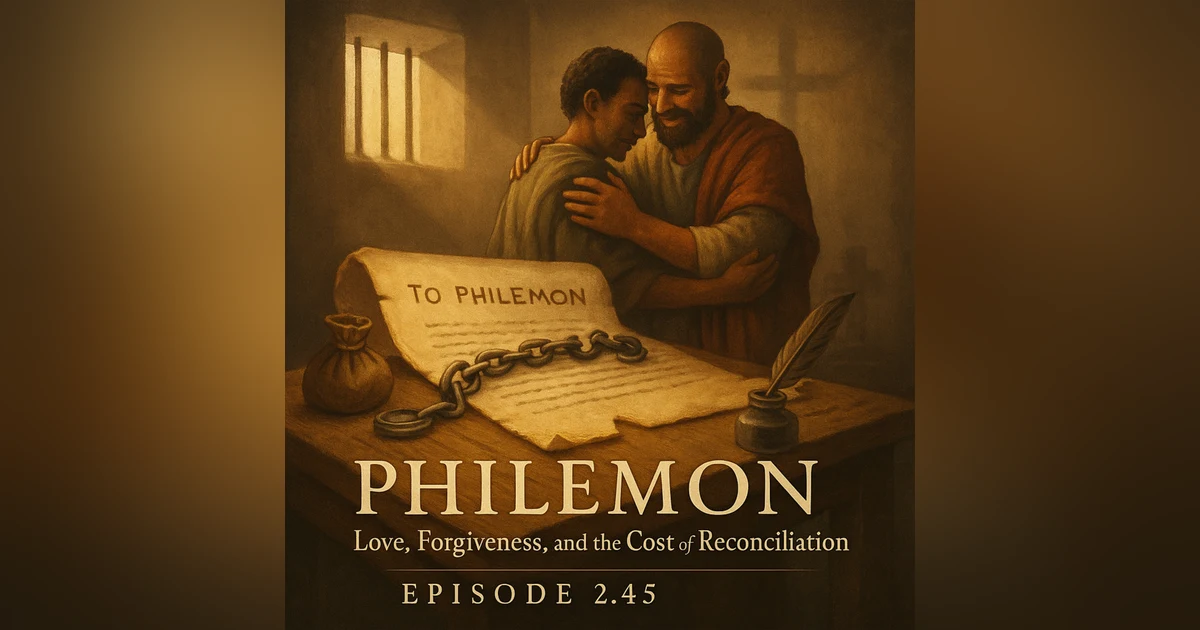
Philemon: Love, Forgiveness, and the Cost of Reconciliation


 RSS Feed
Episode 2.45
A runaway slave. A personal letter. A gospel plea.
This episode dives deep into Paul's shortest—and most personal—epistle, written not to a church, but to a single man: Philemon.
Through a story of slavery, repentance, and mediation, we explore the power of reconciliation in Christ. Who was Onesimus, and why did he flee? Why did Paul step in? And what does this teach us about Christian intercession, accountability, and mercy?
Covered in this episode:
– Background on Philemon, Onesimus, and slavery in the Roman world
– Paul's prison setting and role as advocate
– Wordplay, theology, and irony in “useful” and “useless”
– A gospel-shaped appeal that mirrors Christ's own intercession
– Practical lessons for handling conflict, forgiveness, and restoration today
Whether read as ancient correspondence or gospel drama, Philemon calls Christians to radical grace—and reminds us that love often comes at a cost.
Find our videocast here: https://youtu.be/63Zn3ARxHPw
Merch here: https://take-2-podcast.printify.me/
Music from #Uppbeat (free for Creators!):
https://uppbeat.io/t/reakt-music/deep-stone
License code: 2QZOZ2YHZ5UTE7C8
Find more Take 2 Theology content at http://www.take2theology.com
0:00 And does that do with your shirt? No, no, I should do one of my shirt. I I'm wearing this shirt now because the, the way the Steelers live their life is they, they, they often get out to like 5 and one six and two. What are they right now? Right now they're three and one, three and one waiting the AFC baby ahead of the gravens, ahead of the Browns, ahead of the Bengals killing it. But this is what they do a lot. And then they they in the year going like one and five. Mike Tomlin's great at like, making the playoffs and not doing any better. I have like a little voodoo doll of Aaron Rodgers and I'm just waiting to like poke his, his Achilles. It's great. Yeah he doesn't move around great but man he has like a cup like 3 great throws a game. He takes about 3 terrible sacks.
0:41 It just like his throws though are so pretty when they work, but if he doesn't throw it within 2 seconds, it's he's got to get out fast 'cause he's not taking that hit, he's just trying to get rid of it. He doesn't. He can tell he's. Yeah, I mean, I mean, he's no Tom Brady, so you gotta you gotta, you know, give him a specific. Well, this is this is, this is the banter I came up with. Words have meanings. Do you notice that one a difference in like a letter or a word makes a difference in the interpretation. This is so there's a difference between race karts and race.
1:26 Trying to think. I'm trying to think how I messed this up. My wife gave me specific instructions and I misinterpreted what she said. OK, what did she have to do? She abandoned me. Abandoned me. She didn't abandoned me, she had something to do and I was. Abandoned him. I had the kids. I was in a hurry. I had the kids. Oh, she was gone some Saturday, maybe some like women's thing. I don't. Know yeah, those ladies, those ladies, they got to reel that in you know what I'm saying? This grounded coffee stuff all the time. Who Who is actually who's? Leaving all that, Yeah, Jill and her 80s win suit. That's all that I just in my mind imagine now she just always dresses like it's the 80s. It's great.
2:09 I had to take the boys to the grocery store to grab something timing whatever. And I had Jordan and Joshua and Leanne said, oh, just put them in the there's like a race car, shopping carts that they love. That. I did not know that's what she meant. I thought they have like little kids shopping carts. I thought she meant, oh, just both. Give them carts. Have them race carts because they'll keep up with you if they'll be engaged. Does it disaster? We're in the grocery store. They're like running into people. They're like. Running into things 'cause they're. Race I was like boys keep up and I was like clan I had them race carts did not work out. She's like no, don't have the race carts. You put them in the race carts. So it's a difference between race carts and. Race carts, Yeah, yeah, yeah.
2:50 It's different, but it's so. Close, right. Race carts, which would could be a a verb and a noun, or race carts, which would be like an adjective and a noun. Yeah. So what's race doing? It was crazy. So you're basically, you're basically blaming it, It sounds like Adam and Eve here. You're you're blaming your wife for. Stories. A bad, a bad choice, yeah. And I was like, why didn't I think that'd be OK? But I was like, I just saw. I was like, and they and they were like, well, they're like, yeah, let's race carts. And then disaster, you know, people, people were laughing like passerby. They were having a great time. And except for the one like, they actually hit like one lady's cart not having as much. In the car as long as they didn't hit someone in the ankle. I have there was a a friend of mine growing up and his mom. Like I think people think that the the the cart itself sticks out further, but it's actually that little. Thing at the bottom.
3:46 And she was trying to like, kind of just run into me and like, hit me right into my Achilles tendon. Speaking of Aaron Rodgers. And it was very painful, like about about took me to the floor. I was like, I was very angry at her too. You know, it's like, what are you doing? But I felt bad afterwards. So yeah, you got to watch it out at grocery stores, man. So crazy. I think this connects well with our topic today because we're talking about an epistle of Paul's. Maybe some some say Philemon. Maybe some say Philemon. Philemon. I've never heard Philemon. I have heard Philemon. I think I brought this up most egregious like some words can be said both ways, one name cannot.
4:30 I've I've heard said another way and I'm like, how could you say it this way? Was King Nebuchadnezzar unironically like, on purpose, like in a sermon, like over and over Nebuchadnezzar? I was like, no, this is not right, You should not. Say Nebuchadnezzar. It's definitely Nebuchadnezzar. No, no, no, no, no, no. Yeah. Yeah, yeah, But I have heard I I grew up church, everyone said by Lehman. But when I I went to school, there was some person I was like, oh, let's let's look at Philemon. Philemon. And I didn't know if that was, you know, I, it was I've. Never heard that. Probably closer to how they pronounced it back in the yeah. Maybe, maybe he was flexing, I don't know. Maybe he was like, well. This is the, you know, it's like, it's like the people who won't say Jesus, they're like Yeshua, Yeshua, Yeshua. Yeah, OK, alright.
5:20 And I don't know, like when it comes to you prime more of this than I do, but like when you take Greek or you're looking at Greek, you know, you can be like, oh, I'm this is a rasm. This is how you're supposed to pronounce it. Slash. This is like how we're going to pronounce. This may probably maybe not how it is, but it makes more sense or you know, you know, and some people take a hard stance, you know what I'm saying? Like this is how it was pronounced, but this is how we say. That like if you take Greek in the seminary, yeah, the vowels that all of the professors learned are not actually like that system was was developed without necessarily relating it to like modern day Greek. So you'll mispronounce modern day Greek words. I've heard this. Yeah, Yeah.
6:01 It's just like a no, Yeah. So. Fun stuff. That's why I that's why I had to stop after a semester. I was like, I can't do this. It's not in the line of modern day Greek. You know, always, yeah, I love it. But Philemon, Philemon not. Not a lot of words. Yeah, few of the words. Sweet of the message maybe? Oh sure. And sweet. I love it. I'm excited to get into it. We're kind of in this series of sorts on the Apostle Paul. Yeah, I'm, I'm ready. I was listening to Paul this morning. Boom. Yeah. Second Corinthians. We should hit Second Corinthians. This is a weird book. It ends very he's very harsh. He like it, almost like he like a lot of people.
6:42 I'm ghosting, but it's like, what are you? We're like, you're all over the place. Yeah. We should, we should do that 'cause that is, it is you read it and it's, it is weird, but this is what we're here for to, you know, go through some of these books. That's good. Well, let's go ahead and let's take it to the next level from the hearts of the low country in South Carolina. It's the Take Two podcast where we take theology to the next level. Philemon short epistle. Really what what I like about Philemon. It's like we just talked an intro about Second Corinthians. It's a little bit harder to read it in one sitting.
7:24 Not possible. You can do it, but Philemon is easier to do. You could. You could do Philemon in one sitting. You can do first John in one sitting, second John, second and third John. Definitely in one setting, Jude. Get the contact. You didn't get the big picture and really Philemon is a single issue to a single individual very personal, very intimates. You know, some would say it's it's kind of the Paul kind of shows his most personal intimate side of himself in this letter and you were we were flipping there. This was we were not recording, but you were like, man, I think they should go after Colossians and it really should. Right, yeah, 'cause this was written, I guess Onessimus is the slave, right?
8:10 And Philemon is the person to whom the letter is written. And Philemon is at the Church of Colossi, right? And so Colossi and Philemon went together from and so go eat Peaches and cream, right? The relations Ephesians, Philippians, Colossians. Is that how you remembered it? No, I did this weird thing where it's like, I would just memorize it, you know? But it's great though. It's like when I took anatomy in physical therapy school, you just had over and over just all the monomic mnemonic devices, like over and over and over. I remember the brachial plexus and you're trying to defend some I might remember. Randy Travis drinks cold beer and he's like, add these things.
8:51 You have like all these sayings that you're just writing out sayings and then trying to piece it back together. Too. Yeah, yeah. Like I know all the sayings, but I have no idea how they relate them to it. Yeah, yeah, yeah. Go, go eat Peaches and cream is that's a good one. Yeah. It made me not as good as go everywhere I preach Christ, but you know. Nice. Yeah, yeah, yeah. Peaches and green, though. One of the. Pages of cream, yeah. You know, go to. Yeah. Now, were all of those prison epistles I, I, I, I, Yeah. Which which ones? Galatians. Ephesians. Philippians. Colossians. Well, definitely Philippians, Colossians, Ephesians. Yeah. Galatians, maybe not Galatians. It was pretty early. Yeah, yeah, yeah. Other ones, definitely. Some background on Philemon.
9:34 If we were in Colossians 4 chapter or verse 9, we see Onessimus, we see him mentioned as a resident of Colossae. So, you know, we can assume, you know, Philemon was there as well. We think of the Lichus Valley in Asia Minor. You've got some of these different books. We were just talking about Philemon 7 and 17 in this book. It speaks highly of Philemon. So you know, we can see that Paul had this strong bond with Philemon. And like you mentioned, Onessa, another one of those ones that I think can the words can trip people up. Onessimus, not Onessimus. 111 is must. Yeah, yeah. Fight Lehman slave and as we all know, slavery in the New Testament is was just like Civil War slavery.
10:19 Yeah, yeah, it's exactly the same. And here we we have Paul condoning slavery, right? And it's it he's like, you should, you should do slavery. This is what Paul is saying. So, so this is this is such a good conversation because it's like, like we were saying up the intro like words mean things. But when people hear slavery, maybe they think of something different. Especially if you're in the United States, you probably you hear slavery, your mind goes to one and only one things. It's so prominent in our history where I think, you know, you'll lose this idea of what slavery might mean in the ancient Near East or a cross for, for really like most of history. And it is confusing because, you know, indentured servanthood's one thing and when you would take over people's, you probably would take slaves as well. And so there's like the spectrum where you see different. Things, yeah.
11:05 And the Roman Empire, when we were covering Rome, there was like more slaves than than citizens. It's like, so it was almost like it was the slave class. So not, not to justify it or say that's the the best way to do things, but it was different than, you know, slavery in America. Yeah, if I had a debt I couldn't pay off, I would just come work for you. And, you know, you could see menial, you know, people did menial task might have been slates, but also teachers, accountants, managers, lawyers, this kind of thing often were indentured servants. And and usually it was a voluntary thing, like, oh, I need to pay back your debt.
11:46 Like this is how I'm going to do it. I'm going to be. And in doing so, you could also pay off a debt and you could have shelter and you could have you could be taken care of at the same time, making it a little bit easier. Based on what I was looking up, it was not uncommon for Christians to sometimes sell themselves into slavery to raise money for the poor and the sick. Slaves could own property. They could actually own other slaves. So it's just a different mindset that I think you can read these on the page. It's just hard to under, it's hard to put yourself in that situation. Just a whole different vocabulary and that kind of thing. And these slaves often times would were given some sort of prominence in a household. It's not like it's like, hey, you're going to take care of the kids or something like that, You know what I mean? Yeah, yeah, yeah, they were.
12:33 They were you could get you could purchase freedom Onessimus so so set some back on Onessimus. Not a believer ran into Paul. Paul, as we will read, will mention this led him to Christ. Yeah, I was just looking up 'cause I taught on Colossians once and I was trying to remind myself, but Colossians is a place that is a town known for their cold water. That was really refreshing. And then nearby was Hierapolis that had warm mineral waters. That was very refreshing. And then Laodicea was like in between. And so by the time they didn't have their own water source, so they could get water from colossi or Hierapolis, but by the time it got to them, it wasn't cold or hot. It was just lukewarm.
13:20 And it was like, Nah, it's not all that big, so. Spew that. Out of your mouth, that's where that's good. The reference in Revelation comes from. Like, you're neither cold nor hot. I just want to spit you out. So Colossi is that town. With cold water, I love that it's good, good context. Also, some big picture, just like Paul doesn't a lot of letters, but what we see here, he references a lot of people in this letter, Afia Archipeus Epaphras that you might read about and Colossians 2 a little bit, but it's a good reminder. So this is a letter to Philemon, but he like includes all these other people too. So it's a good message of the church collective, like we're holding each other accountable. We need, we need that kind of encouragement. It's not like a total individual pursuit. Yeah.
14:06 Yeah, that's good. So kind of this whole epistle centered on a problem of one person, Oneessimus the slave, having run away and escaped his slavery. And we don't really know. We don't. Have everything that that makes it hard. Yeah, yeah. Was he some indentured servant to basically or was he like captured? You know, lots of times when the Roman Empire went to war, you capture the military men and you put them in bondage because yes, that you don't want what you them to rise up and, you know, try to fight you again. So. And there's a lot of speculation, like, OK, was Onessimus A fugitive who ran a what?
14:51 What is interesting? Onesimus's name means useful. It means helpful. Paul, in this little read, it says that he's being useless. It's probably this pun kind of play on words that you might miss if you don't know that, like, why is Paul saying you're useless? It's probably just appealing to his name a little bit. So like you said, we don't know a lot about Onesimus. He may have wronged by Lehman. Maybe he owes money. Maybe he stole money. We don't know. Or maybe, you know, he was managing a household and made a poor business decision and kind of felt guilty, went away. The law did allow slaves to flee. If you need to have like mediation, like you can run away until you get someone to mediate. If, if he felt like he was wronged or he felt like his life was in danger, like maybe he made a poor decision. He's like, oh, my master's not going to be happy with this.
15:33 He could flee until it could get arbitrated and have like a hearing of sorts. But it seems like he he ends up in Rome, right? And that where Paul comes across them. I I think that's the thinking most likely, Yeah, yeah, yeah, yeah, yeah. But did not necessarily have to be a fugitive according to Roman law. Paul, he might have been the advocate. Maybe Onessimus could have been happenstance. It could have been Onessimus was like, I'm trying to get really far away from Colossae. It could be because some people say you go to Rome, it's a big city, get lost in the crowd. Maybe some people say maybe you don't want to go to like the center of commerce if you're trying to like stay off the grid. So it's hard to, you know, read stuff, but you know. What? I guess if you look like you're a slave who was on an important errand and like, hey, you're just caring about your that that's.
16:22 Right. Yeah, that's true. That's true. So, you know, we get some clues. We don't know everything totally. You mentioned this as well. Paul was writing from prison, usually thought that he's writing the same time he's writing Colossians and Ephesians, many similarities and we read on EMS from Colossians. So we'll find that and there too. So a lot of options. I don't think we necessarily have to go through this, but some people think you're doing from Caesarea or Ephesus or Roman. Caesarea Maritime, right I. I think so and A and a lot of your thinking here depends on what date you think it is. If you think it's written like at the same time as Colossians, that's going to push you one way versus another way. So some of the pros and cons, Caesarea people, it's unlikely scholars have put this forth, but it would be, you know, he would not be anticipating a speedy release like in Rome and Caesarea.
17:12 He would have to appeal to Caesar. So if he's like really trying to escalate things seems kind of unlikely 'cause he probably, I don't know well. I've always seen Ephesians and Colossians as like sister epistles. Yeah, me. So if he's in Ephesus, why would he write a letter to the Ephesians? If he oh, right, that's the. So this is all. Yeah, that's a very good point. Yeah, anyway, it's it is interesting and I I love you read at critical scholars. They're like Paul couldn't have written Ephesians and Colossians because they're just like so similar. And you're like, you're like, well. They, they just make whatever argument they want to to try to discredit it because they also say, well, you couldn't have written such as us because they're so dissimilar. It's like, have you ever looked at like take writings from anyone and they're going to be some that are very similar and some that are that are dissimilar, you know, depends on like what you're trying to accomplish, even even your mood at the time.
18:10 It's just so. It is crazy. Bonkers because a. Lot of times they will. I'm not saying this is not what I've read for this in particular, but they'll be like, it's so similar then or they'll say it's too like they'll argue like both sides of it and it's like just pick a lane or something, you know, it's like, what are we doing? Be consistent and the they are consistent trying to tear down the. Bible. Yeah, just trying to grab on anything they can. Onessimus, how did he run into Paul? Well, you know, some people would say he sought out Paul. He knew he if he was in prison, he would kind of need to seek him out, right. It's not like Paul would happen upon him. He would have to, if that's what you think. So that that is likely especially you think of Apapras who's mentioned here. We have record that Epaphras had been to see Paul or or in Rome. So most likely on purpose, probably not an accident. Paul defended an SMS brought him to Christ and Paul saw an SMS as being someone who was repentance and kind of is communicating this deep connection to Philemon. He wants reconciliation.
19:08 But and we'll we'll read this. It's very short, 25 verses. You can kind of see that he wants his reconciliation, but he doesn't want to. Like he's not like, I'm an apostle, do what I say. Like he's not laying down the wall. He's like, really appealing. Like, he wants to win him over and like, hey, yeah. Yeah, it's like this is what's so great about this book is that you see this pastoral heart that's like, hey, letter the law. You probably have a couple options here, but this is what I feel like you should do base, you know. Yeah, that's really good. So he didn't strong arm arm him anyway so we can get into the contents. Yeah. What I like about it is it's like it's so theologically deep. There you go. Yeah. Yeah, we get a lot of major doctrines. That's right. Yeah, it is a unique letter.
19:50 Doesn't like you're saying. It's not focusing on doctrine or teaching, but shows Paul in this advocate role, this friend role. No, what he does not appeal to his Apostolic authority. And when you think of Paul, he's doing that left and right like all of his other letters, like I'm an apostle. You know. You know, it's, it's great. We, we talk about this all the time. He does not do that here. He asks him essentially for a favor as a friend. And that's that's why we would classify this as Paul's most personal letter. So I don't know if you want to take it from the top, sure. Greeting verses one through 3. One through 3 Paul, a prisoner of Christ Jesus, and Timothy our brother. To Philemon, our beloved brother and fellow worker, and to Apiphia our sister, and to Arca Pipus our fellow soldier, and to the church in your house. Grace to you and peace from God our Father and the Lord Jesus Christ.
20:44 We mentioned it, it's his personal letter, but it's not, it's not justified. Wait a minute, It's to a group of people. But that's so. I know they probably are like what the heck? My my name doesn't make the make the big title at the front. You know. Anyway, so, so that's the greeting, classic greeting. We'll start to get into often like Paul does Thanksgiving. It seems like, you know, he's got a got a way that he likes to classic Paul. So let's go ahead and read verses 4 through 7. I think here we go, Zach Pope, I thank my God always making mention of you in my prayers, because I hear of your love and of the faith which you have toward the Lord Jesus and toward all the Saints. And I pray that the fellowship of your faith may become effective through the knowledge of every good thing which is in you for Christ's sake.
21:37 For I have come to have much joy and comfort in your love, because the hearts of the Saints have been refreshed through you, brother. I love it. So when he's in this, you know, mode of Thanksgiving, he's really, you know, appealing to these positive attributes of Philemon. Like, he knows what he's doing. He's like. He's winning. He's winning friends and influencing people. Yeah. Exactly. He's like, wow man. Your love Philemon, it's been great. You share your faith. You have blessed other people. Don't don't forget about that. As we, you know, keep keep going on set, setting the stage and sharing these truths because, you know, it probably is true that he has loved and blessed people. It's like it's, I think it's easy for us to be good in one area, but then you can have like a blind spot in this other area.
22:20 And maybe Paul's like trying to like just bring that to light. And so, hey, we're already, you know, 1/4 of the way through the book. We're getting there. So this is what this is really where we're getting to the meat of it. Verses 8 through 21. Maybe we can read verses 8 through 10 and see what talk about that for a little. Bit OK, says therefore, though I have enough confidence in Christ to order you to do what is proper, yet for Love's sake I rather appeal to you, since I am such a person as Paul the aged and now also a prisoner of Christ Jesus. I appeal to you, my child Onesimus, whom I have begotten in my imprisonment.
23:04 Great, so we kind of see Paul he he he, he, he doesn't just say like, can't he, he I mean he literally says like, hey, I could command you. I mean, basically he's like, I'm not going to, but I, I. Could. But just just so you know, I prefer to appeal to you for Love's sake. He's an old man. And then he says, Hey, I'm an SMS father, which, you know, brought, brought, brought him to Christ, essentially really trying to get an, I mean, finally just to apply, apply this scripture Scripture. I'm an I'm an old man. I'm not, I'm not Paul the Apostle. I'm Paul the old fragile man. That's, you know, caring for an SMS. It reminds me of a passage in another book called Lord of the Rings.
23:46 But he. Should have guessed. Yeah, tell me more. Oh, Gandalf is about to go into Theta and and he's like, you know, I'm an old man. Don't don't rob me of my staff. And yeah, so. There you go. Maybe, maybe, yeah, maybe token was pulling from by Lehman here. So we see Paul as an advocate. We're we'll go ahead and read 11 through 13. This is where you kind of see some of this word play. Anessimus is name meaning useful. Yeah. So this is Anessimus, who formerly was useless to you, but now is useful both to you and to me. I have sent him back to you in person, That is sending my very heart, whom I wish to keep with me, so that on your behalf he might minister to me in my imprisonment for the gospel. Great, we see.
24:33 So this is, you know, he's useless. We can read into that. Like, what's that mean? Like what happened? Something bad happens, but now transformed changed useful that Onessimus being very useful need to keep him around. He's a changed person. He's repented. He actually had cared for Paul and so Paul essentially it is really appealing that look for some good goodness. So you can kind of speculate like what happened that violin be like so upset. Maybe maybe it was something significant. We don't really know. I'll read verse 14 here. This kind of set aside here. I just want.
25:15 To warn my listeners this this will be from the ESV, so just. Yes, everyone's like falling along in the NFP of Changes first board team, but I preferred to do nothing without your consents in order that your goodness may not be by compulsion, but of your own. Of course, this kind of gets to the heart of what we were saying earlier. It's like the second time he's kind of hitting this and saying, hey, this is your call. Yeah, your call definitely have a a preference here, but it's you. That's right. It's your, it's yours to make. It's good 'cause like other places like Second Corinthians, for example, Paul is at the end like coming down, he he will really put his foot down, but not not as much here. So he's kind of appealing to Philemon.
25:57 You know, you are kind of the the in charge in this situation. And one since then, if you want to read verses 15 through 16 kind of appeals to God maybe as ultimate ruler. For perhaps he was for this reason separated from you for a while, that you would have him back forever, no longer as a slave, but more than a slave, a beloved brother, especially to me. But how much more to you, both in the flesh and in the Lord? Yeah, essentially because God has changed him. It it. I like how he ends with in the Lord, a very good thing has happened. Look at the big picture from from God's perspective. Take this and and this key phrase like beloved brother, this is this is your brother.
26:43 You know that that that should change your perspective. And then we can we can finish out 17 through 20 when he kind of ends with a twofold petition. And then, you know, like a good, you know, pastoral person, like, I have confidence in you, you'll do the right thing. Yeah, yeah, yeah, I know you don't do the right thing. If then you regard me a partner, accept him as you would me. But if he has wronged you in any way or owes you anything, charge that to my account. I, Paul, am writing this with my own hand. I will repay it. Not to mention to you that you owe me. Owe to me even your own self as well. Yes, brother.
27:26 Let me benefit from you and the Lord. Refresh my heart in Christ, having confidence in your obedience, I write to you, since I know that you will do even more than what I say. Love it. So verses 17 through 20, he's got this petition. He he's asking file limit, file limit to forgive. Not only that he's like, I'll I'll pay his debt like credited. I mean, put on my account. I got it on what Paul didn't say He didn't say Onessimus didn't deserve discipline or something like that. He he doesn't, he doesn't say that. He's not like, you know, saying nothing bad happened. He's just saying like, hey, for forgive in this situation, he didn't say, you know, just waive the wrongdoing by the side. He was going to pay for it and that kind of thing. But asked that his heart would be refreshed by Philemon showing kindness.
28:15 And it's interesting. Paul's like, show me kindness by forgiving Philemon. That's interesting. Yeah. Verse 7 So this is also something that it when you read the whole thing, maybe you can connect if you go back see if I can find this. You gotta say this is a chiasm. I, I, I should you, you, you, you would expect nothing less. He appeals to Philemon's character in verse 7, uses kind of the same verbiage in words at the end. So he kind of starts like, hey, blame, I know you're this kind of person. Then at the end, like, hey, remember, this is what we're talking about. Kind of closes this that you should be forgiving Paul. What he wasn't, he did not, he did not like way down this command.
28:59 Like, hey, everyone's got to forgive everyone in all circumstance. Like it's not like this blanket statement across the board what he's not doing. Maybe we'll get in some conversation. He did not obliterate all social institutions. Impossible to know if Paul was saying, you know, you can run with this passage in a lot of ways. I'm saying what Paul was saying and Paul wasn't saying and you know, he it wasn't this like social upheaval. And I think people that's what people will point to this and be like, why? Why didn't Paul like, say, let's get rid of slavery, you know? Well, yeah, well, Paul is talking to one person he's not talking to. Yeah. Yeah, Caesar, you know, and even if Caesar said get rid of your slaves, it's not like it's going to happen. Like that's a it's a cultural thing that took time. Whole exactly right where I think we see this a lot in Scripture.
29:49 It's we're called to act a certain way within our context and we we might not maybe things aren't right, but we our response can be right even if things aren't, you know, perfect all the time. And then you're in verse 21 that, you know, Paul really believed that Philemon would follow his counsel. Philemon love Paul, love the church. We don't know the outcome. That's the interesting thing. We don't know. I mean, we can, you know, if if you look up tradition has it that Philemon released Oneessimus and that's Oneessimus became a Bishop of Ephesus. Wow. That was martyred in 8095 in Rome, kind of the successor to Timothy. OK, that's tradition. We don't. I mean, that's what I don't know. You know what we have there.
30:30 I mean, I trust tradition to let me know that Matthew was written before Mark, so I should trust this too. Right. The the the thing that's hard about it is oneessimus I think was a common name at the time. So it's hard to know if it was like this Onessimus if it wasn't, but it's like it's like the geography. Maybe you could make that connection, but still common name anyway. And and you would think, you know what, what people point to is that Onessimus Andor Philemon might have been like, I'm gonna RIP up this if it like, if Onessimus been like, I'm not gonna do this. He wouldn't like, let's preserve this as God's word or, you know, like. I mean, God put that in the fire. Yeah, I never got this and then Alvaread verses 22 to 25, he writes at the same time, prepare a guest room for me, for I'm hoping that through your prayers I will be graciously given to you.
31:16 The path for us. My fellow prisoner in Christ Jesus sends greetings to you. And so to Mark, Aristarchus, Dimas and Luke, my fellow workers, the grace of the Lord Jesus Christ be with your spirit. Paul is expecting to be released from prison quick, quickly give some final, final greetings. So short books book. What do we what do we do with this? Do we learn anything? There's a lot of lovey dovey stuff in here, not a lot of doctrine. Like what can we, you know, what can we take away from a book like this? Well, I think one, it teaches you how to appeal to people like some you might say he's manipulating, but you know, he's just saying, hey, say hey, put it on my account and actually just remember you owe me.
31:59 You owe me in this. But you know, I think it's good and you see someone who and we see this with John Mark too, that someone who may yeah, yeah, maybe down out that someone else can find A use for him and and then repair that relationship. So just because you know, it's not working out with you and someone or the person doesn't mean that that person can't kind of get discipled up with someone else. Does that make sense? Yeah, Yeah, that makes a lot of sense. Yeah. I, I like this. It's good to have a book like this in here because it's sometimes it is necessary to lay down the law. But there's something about just like over policing everyone where, you know, depending on what the situation is, where it that that's not like fostering.
32:46 You're not coaching up or building up in a way that people can, you know, grow where it's like more legalistic or I have to do this. It's like this encouragement based in truth, and you're not shying away and saying I do whatever you want. You're not saying that you're like, hey, sure, really think, really think you should consider this compact. Yeah, go ahead. Another point that you can get from this is that you could be walking tall and proud. Yeah. And the next thing you know, you get this for Dimas, having loved this present world has deserted me and gone to Thessalonica. It's like, man, Dimas, what happened, bro? Bro. I know it's like, man, that's a that's a bad, bad beat. Yeah, things can change.
33:28 That's right. Don't get, don't get over overly cocky on that kind of thing. Compassion. I like we see Paul's compassionate side, a lot of kindness, a lot of charity. Paul called Philemon to deal with Onessimus in the same way that Paul dealt with Philemon. You kind of see this, it's good. He's kind of interceding on the behalf of Philemon. And then it's great reconciliation, like very different social cultural classes where even if so, indentured servanthood, very different than chattel slavery, very different. But just like with anything else, like even in America, you might have a abusive boss. Sure, right.
34:09 And it's like it's not it's OK to have a boss that's not bad. The abuse part is not good. You and probably in these days maybe it looked a little different than 21st century where there's more protections and that kind of thing, you know? Yeah, like if you were to think like, you know, some physical therapy bosses, they just. They're the. Worst. I mean, just just on you all the time about getting your time in and seeing enough patients and stuff. Right. It's brutal. Yeah. Yeah, exactly where it's like, it's a good, good way to to look at some of that, some of that stuff. It's not exactly how we would do it. Totally different culture. But we have problems today, you know, It's, it's, it's not, you know? Anyway, at the heart of this reconciliation, fostering unity, fostering love, there was repentance, like there was a change.
34:55 It wasn't just like, hey, everything's good, you know? Yeah, it it seems clear that there was a change in an SMS and that Paul was like, hey, let's recognize this change. He's come to the Lord and you have the opportunity to use this to my advantage, your advantage. Everyone's like it's a win, win, win. Yeah, yeah, there's something to like, and I don't know, we don't know the situation, but there's something to like, I can just imagine like a, you know, you're a wealthy, like well respected person in the community. There's I mean, probably had implications for people knew Philemon and some people probably like, hey, you need to like wait on the hand whatever happened, Like you need to teach this guy a lesson. It, it probably had, you know, ripple effects after that, but Philemon, one of these, it's great. You know, at some point you get to these letters, you're like, oh, it's one of those like little letters in the back, back of the Bible.
35:46 Like no one knows what these things are, you know, So it's good to explore and read them and that kind of thing. That's. Good, that's. Good. When Paul, like everyone knows Romans, Philemon gets a lot less less play, you know, average Christian. I think a lot of people be able to nail down an SMS, but a lot of people probably like, huh, like, you know what I mean? Like what's going on, you know? Probably lesser lesser known. Probably, yeah. Probably lesser known, so read Philemon. That was, you know, edifying to me. Anything else you want to hit on this letter? No, I, I think that's good. It's it's a quick one to read and ponder and and learn from Paul's example. I love it. Well, thanks for hanging in there with us. Maybe we'll hit some Prism epistles next time, but that's our take.
36:28 Thanks for listening to Take Two. Find us wherever you find podcasts and on YouTube for those who want to watch our video cast.

