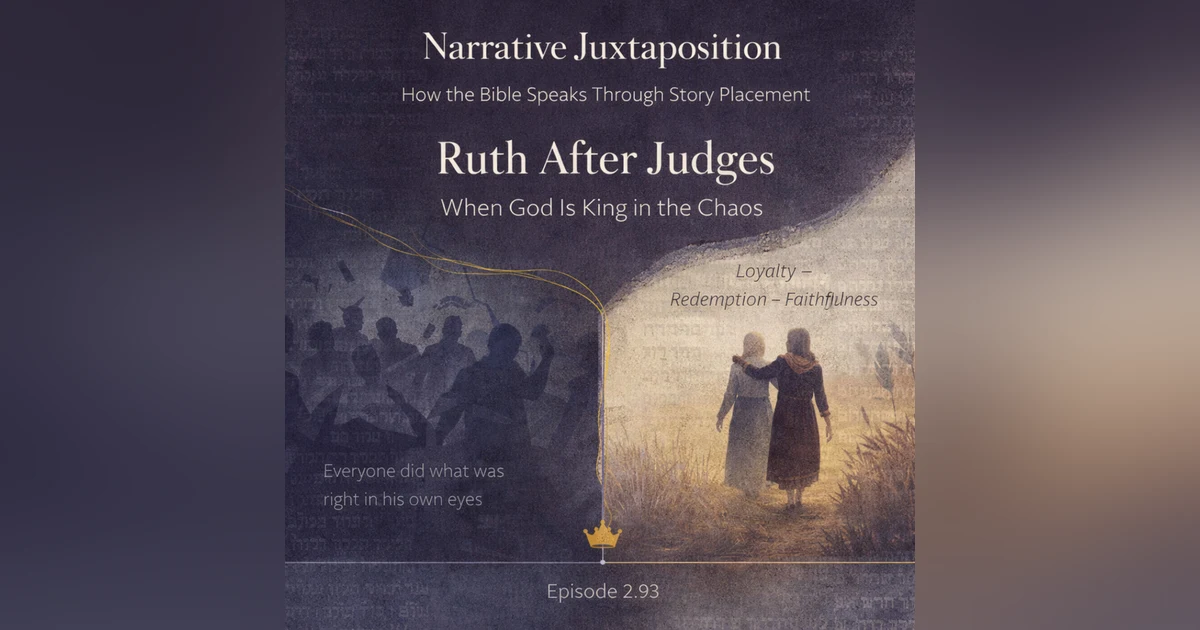
Ruth After Judges: When God Is King in the Chaos


 RSS Feed
Episode 2.93
Narrative Juxtaposition: How the Bible Speaks Through Story Placement | Part 4
In this episode, Michael and Zach explore why the book of Ruth is placed immediately after Judges and what that placement reveals. Judges ends in moral collapse—“everyone did what was right in his own eyes”—yet Ruth quietly insists that God is still King, even when His people are not living like it.
Rather than working through judges or national deliverance, God moves through ordinary faithfulness—through Naomi’s lament, Ruth’s loyal love, and Boaz’s righteous strength. In a world shaped by chaos and self-rule, Ruth shows what life looks like under God’s kingship: protection instead of exploitation, redemption instead of violence, and covenant faithfulness at the margins.
The story ultimately points forward. What begins in Bethlehem during famine ends with a genealogy leading to David—and beyond him, to Christ. The message is clear: even in the darkest seasons, God is still ruling, and He often does it quietly, through faithful people and redeeming love.
Find our videocast here: https://youtu.be/rw4goMqh1zc
Merch here: https://take-2-podcast.printify.me/
Music from #Uppbeat (free for Creators!):
https://uppbeat.io/t/reakt-music/deep-stone
License code: 2QZOZ2YHZ5UTE7C8
Find more Take 2 Theology content at http://www.take2theology.com
0:00 Narrative juxtaposition. Aw, I love that. Word. Say it five times. Fast juxtaposition, juxtaposition, juxtaposition. Now I think we define the word at least the first. Yeah, we should do dedicate. That's smart. But maybe you haven't been listening and you're tuning in. So juxtaposition really means we're taking 2 seemingly unrelated things and putting them right together. Sometimes, you know, in literary sense, authors were well juxtaposed to ideas and find some commonality or contrast them or whatever. And I, I love this. I'm loving this series. We talked about Matthew, this Jewish gospel and the Gentile intrusions. We talked Mark in sandwiches. Looked at Mark.
0:40 He breaks up these stories. Why does he break him up with this other story? We talked to Jonah, this prophet that stands really in a strange place when you compare them to people like Ezekiel and Obadiah and Micah and you're like a different tone, different kind of story. Today we're in the fourth episode of this series. It's titled My God is king in the days when there was no king. We're talking to Ruth judges and this this quiet theme of the kingship of God. That's really not not so quiet. And I think we've alluded to this a lot through Joshua. Like as we went through that, we talked, we kind of alluded to judges a lot. So I'm excited to see how these books, put right next to each other, really emphasize the kingship of God. That's nice.
1:32 So with that in mind. Yeah, let's do it. Let's take it to the next level. Let's fire up that twanga music. From the hearts of the Low Country in South Carolina. It's the Take Two podcast where we take theology to the next level. Here's the claim all. Right. The book of Ruth is intentionally placed after judges to show that even when Israel collapses morally, collapses politically, God continues to rule and reign as king. I'm not working how you may expect through judges, through warriors, but do something totally different altogether.
2:16 Quiet faithfulness, loyal love and redemption. And I think, I think it's applicable to today. You just expect like all these like ways you would want to be done. But sometimes that flies in the face of how God chooses to operate. Now, when I think of Ruth, I just think of this passage that always gets quoted at weddings. Yeah, it's that great passage. But I mean, that's probably why, because there's going to be so many weddings in first and Second Samuel that they needed to know this passage that. Yeah, exactly right. Yeah, I feel like Ruth, same thing. I'm not saying this is bad, but it's it's like Ruth and Esther and these things are a lot of times like relegated to like women Bible studies or you know what I'm saying?
2:59 Like instead of like incorporated into the body of Christ, it's kind of like. Oh, that's for women. Yeah. And like there's a probably disproportionately a number of studies that's like we're going through Esther or you know, these things and it you know, not saying that's like. A type of men's Bible study that does Ruth, Esther. Maybe we look at what's the woman in Jericho? Rahab. Rahab, you know we should do something. That would like in the midst of all this, like gender and sexuality issues, like really flying in the face, but in a positive way, like you might actually land some people who were like way on different spectrum, you know what I mean? And they're like, whoa, that's like the full circle. That's $1,000,000. That's not half baked, Michael. That is that is good. Well, we're going to walk through this as we're looking at the notes.
3:41 I have a lot of notes. We might not. We don't have to make it all the way through. Some of this might be overkill, but I really like these themes. So we're gonna start at the beginning of Ruth. And so Michael is gonna read for us, Ruth. One versus 1 and 2. I'll read it at What you have printed here is 1 and two. Yeah, yeah, yeah. That way we get the ESV 'cause I know it's near and dear. Alright, that's right. In the days when the judges ruled, there was a famine in the land, and a man of Bethlehem and Judah went to sojourn in the country of Moab. The name of the man was Elimelech. Great, Let's stop right there because before we get even into the story, we come across this name. We've emphasized names of a lot of this podcast.
4:23 It's easy to run past them. And I never really knew this growing up, but once I saw it, I can't Unsee it. This Elimelech that you read, his name means my God is king. And then we and the the part I never knew that the part that I feel like is always emphasized is the end of the book where we talk about Obed and David and ends talking about a king. But it begins that way too. And it talks about my God is king. And so as you get into this book of Ruth, we we have this tension because the book right before in Judges doesn't talk about God being kingly. It actually is much more tragic. If you study judges, you probably know where where we're going with this.
5:06 But Judges many, many times we've and we've talked even when doing Josh, we talked about this recently. What's the refrain that we hear over and over? And they did what was right in their own eyes. It it. Exactly. And it even in in Judges 2125, let's see how many, how many chapters are in Judges? Is it 21? Even better, the very last verse of Judges says in those days there was no king in Israel and then everyone did right in their own eyes. So those things kind of go together and then Ruth picks up talking about alumna like kind of like subtly, this idea of my God is king. So Judges ends in a bad way, moral chaos, political fragmentation, spiritual collapse.
5:47 And Ruth boldly begins with this opening name of my God is King. And so a question maybe you as the reader should be thinking about internalizing do God's people actually believe that God is king? Coming from Judges, it's probably a hard thing to understand. There is no king. And even this, the wealth the the people who mean well don't get the job done. I'm trying to make a connection here. Oh yeah, 'cause we, we talked about there's this character. I think it was more of a title that when Abraham pawned hit Sarah off as was a oh sister. His name was Abimelech.
6:30 Abimelech. Yes, but it had a similar meeting. Something like something is king or. I think you're right. Did you just look it up or? See, I'm trying to find it but I couldn't find it and I was like not being able to pay attention to you to talk as much. I think there is something there, yeah, that would make make sense. Yeah. So. Same kind of probably similar root word. Yeah, Yeah. We'll have to. Maybe we'll we'll try to find that as we keep moving on and talking about the book of Judges. So, you know, to better understand Ruth and this positive way it ends that we all talk about, we need to really embraced and and understand this darkness throughout Judges where we get this cycle over and over. One of the key passages that really encapsulates this cycle can be found in Judges Chapter 2 verses 11 through 19 kind of kind of shows this.
7:18 This cycle you. Want to read that? Yeah, go for it. Says Then the sons of Israel did evil in the sight of the Lord, and served the Baal's, and they forsook Yahweh, the God of their fathers, who had brought them out of the land of Egypt, and followed other gods from among the gods of the people who were around them, and bowed themselves down to them. Thus they provoked Yahweh to anger. So they forsook Yahweh and served by all and the Asteroth, the anger of Yahweh burned against Israel. And He gave them into the hands of plunderers who plundered them. He sold them in the hands of their enemies around them, so that he could no longer stand before their enemies.
8:01 Wherever they went, the hand of Yahweh was against them for evil. As Yahweh had spoken, and as Yahweh had sworn to them, so they were severely distressed. Then Yahweh raised up judges who delivered them from the hands of those who plundered them. Yet they did not listen to their judges, for they played the harlot after other gods and bowed themselves down to them. They turned aside quickly from the way in which their fathers had walked, and obeying the commandments of Yahweh, they did not do as their fathers. When Yahweh raised up judges for them. Yahweh was the Judge and delivered them from the hand of their enemies. All the days of the judge for Yahweh was moved to pity by their groaning because of those who oppressed and afflicted them.
8:44 But it came about when the Judge died that they would turn back and act more corruptly than their fathers and following other gods to serve them and bow down to them. They did not abandon their practices or their stubborn ways. Man. So we see Israel sins, God allows oppression, Israel cries out, God raises a judge, but then Israel later on falls again and it's classically described as this downward spiral. Not only that, you kind of progress through judges and you kind of see that's that spiral really going more and more and more. It gets more fragmented, Faith is weaker, the leaders fail and you kind of get to the final chapters of Judges and you see things like religious idolatry being rampant and Judges 17 and 18, you read Judges 19, this horrific sexual violent of this lady who's all cut up and this kind of stuff. And you're like, wow, insane.
9:37 And, and the book basically ends with civil war among the tribes, Very, very dark where Israel's not living under God's rule, but truly everyone's doing what's right in their own eyes. And so that raises no small question, you know, what happens to God's promises when God's people refuse God's rule? And then Ruth comes in and I, I think, attempts to answer this question. And so El Amalek, his name means my God is king. Abimelech, my father is king my. Father is king OK? El is the God, yeah, yeah. So that the emelec must mean is king, yeah.
10:22 We learned something new Molech just be throwing out some some knowledge. Michael read the opening verses of Ruth Elimelech. He'll leave this town of Bethlehem. Maybe you've heard of this before and travels to a place of Moab. If you, if you've read, if you're familiar with Scripture, you know both of these places, probably Bethlehem going back to me. Moab descendants of Lot. Moab descendant of lot. That's gonna be important. I want to circle back around to that at at the end of this Bethlehem, this town we talk about a lot at Christmas, a little town of Bethlehem. It literally means House of bread. Sounds good. What a name. I want to go there. You should have a restaurant in Bethlehem, and it's, like, known for its breads. Yeah. That'd be good. There's like, yeah, there's got to be some of the Bethlehem bakery or something.
11:05 That's awesome. Something like that should definitely exist. We read Ruth and we see Bethlehem, this House of bread. But what's interesting, this juxtaposition, there's a famine, not a lot of bread going on, driving them away. And there's Moab, not just a random place, but like you said, distance from lots historically at odds with Israel. They're not, not a lot of times, you know, aligned. I don't know if you can pull up for us Deuteronomy chapter 23 and 3:00 and 4:00 because it speaks specifically about Moabites by name and kind of shows us maybe what the average Jew of the day might might think about with these Moabites. So Ammon and Moab were both grandsons of Lot, and if you read that story about those, how those grandsons came about, not the prettiest picture.
11:59 Yeah, all right. But so we'll just leave it that probably familiar. If not, you can look it up. There you go. Yeah. It says that no Ammonite or Moabite shall enter the assembly of Yahweh. None of their descendants, even to the 10th generation, shall ever enter the assembly of Yahweh, because they did not meet you with food and water on the way when you came out of Egypt, and because they hired against you Balaam, the son of Beor from Pathor of Mesopotamia, to curse you. Yeah. So you kind of see they've got the special status. If a Jew is really familiar with the Torah, you know, time of Moses, we're in. We know we got Joshua judges. It's not, it's not like yesterday, but you know, it's in the, it's embedded in the in the RE culture.
12:43 Recent, maybe 100 years ago. Yes, so it's like things it's like, you know, we know American history, you know, pretty well actually probably a lot of people don't. But I I would like to see their culture was more, you know, embraced and can remember things a little better. So Alumlek, this guy, he leaves Bethlehem, the promised land and and seeks survival among Israel's enemies. You know, Scripture doesn't condemn this necessarily. But, you know, if you're reading, you're like, this is kind of strange. Like, why are we going away from the promised land? This guy whose name my God is king. And so something to think about at least. And so we're not very far into Ruth. We're in verses 3 through 5.
13:23 Alumlek dies, doesn't last long in this narrative, and his sons married these Moabite women. I always want to say Oprah when I say Orpa. It's just like that, you know? Do you know that Oprah was supposed to be named Oprah and it was misspelled on her birth? Wow, I did not know. This Yeah, that's how Oprah got named Oprah 'cause it was supposed to be Oprah ORPA. That is amazing. That's yeah, easy mistake to make. I make it almost all the time. So I can't blame blame her parents. There's the sons that marry the Cobite women die as well. So Naomi has three widows, no heirs. And so the line of Olmelek, it's not not looking pretty. The family line's clap clap is there before so. Elimelek and Naomi were married, had two sons, Elimelech. The two sons die, so all that's left is Naomi, the original matriarch and her two daughter in laws, Ruth and Orpa. That's that's good.
14:23 That's good. And, and they don't. And there's not a lot of heirs running around. No. Well, yeah, 'cause back in this time inheritance did not flow through females. So you would basically you'd be inheritor less you'd have to get well in in for Jews. They'd find a kinsman Redeemer, which we know about in in Ruth. I don't know if we're. No, that's good. That's not something I, I, I, I think, I think that's great. And so like Alema, like my goddess King goes away from Bethlehem, this House of bread, because there's no bread, there's famine. And then on top of that, the family line is like dying outs MO about women. It just, it just seems really bleak. Bleak. That's the right word. Very fast.
15:07 Even when Naomi returns to Bethlehem, she has one of these famous laments, very honestly says, don't call me Naomi, call me Mara, for the Almighty has dealt very bitterly with me. What a name. Like, you have to be feeling damage if you want people like every time they say your name, just think of that. And Naomi meant pleasant. So it's like a big contrast. I've worked with Amara. It was spelled slightly different and they you are. I wonder if it's the same route. I'll be a cassette. It's just Hebrew. Like what's the? What's the? Are you a bitter person? You know, and so it's interesting here and you know, it's one of these areas if you talk about laments and this kind of thing, she speaks about suffering, but about scripture.
15:47 We talk about that a lot with, with things like the Psalms or Lamentations, not abandoning hope totally, but you know, recognizes some dire situation. So, so it seems right now in Ruth that God is silent, but like Ruth and other places in Scripture, you know, and, and we probably have to have this distortion where we just like expect like miraculous things happen in every page of Scripture. It's, it's funny, people expect that in every day of their life. It doesn't even happen in every page of Scripture. That's right. That's right. Yeah, 'cause there's, you know, hundreds, thousands a year, sometimes between miraculous interventions in the Bible. And and we talked about with Ezra, Nehemiah, not a lot going on, you know, famously. And Esther, like, you know, name of God is not mentioned. And Ruth, God doesn't speak directly. There's no prophets, there's no angels, there's no miracles. But it's almost like that highlights God working seemingly in the background.
16:44 That's right. That's right. And it is. It is really cool you read through Ruth. There's some really good stuff for men to learn there. Yeah, there you go. Well, that's exactly right. Let's see, Ruth Two, we meet Boaz, and, you know, we kind of get this idea of, you know, what some people would call coincidence. It's actually divine Providence, you know, that God, again, this theme that we're going to see is ordinary faithfulness, like maybe your hope was in Samson and these judges really God is working in this different way. And so, yeah. Yeah, just add on to that because, you know, if you've read the rest of the story, David is going to come for this.
17:26 And when David was picked out, he was kind of ordinary, too. Yeah, it's like the story, it like keeps on, it keeps on going that that's really, really good. And so in Ruth, she's now kind of the center of the story, this Moabite woman, and she has like probably one of the most, you know, beautiful confessions of faith in all of Scripture. I've got it here, but Romans 116 or something. This is paraphrase in my notes. If you want to read the real thing or the paraphrase version, it's good. Yeah, you want me to read it? Read it, go for it. And you said Romans. You did. But it's Ruth. You'll be like And they gave themselves over to yeah. It brought, yeah, but Ruth said do not urge me to leave you or turn back from following you. For where you go I will go, and where you lodge I will lodge. Your people shall be my people and your God, my God. Where you die I will die, and there I will be buried. Thus may Yahweh do to me, and worse, if anything but death parts me and you.
18:25 Man strong language where she's living, leaving her homeland, her future, her security and like we see in these other places where we're highlighting this like foreigner, she shows this covenant loyalty that so often people of Israel, the covenant, you know, members often lack. And so we get to this concept of has said, we see this kind of phraseology used in Scripture a lot, talking about steadfast covenant, love. Also the name of Shout we should shout out, the Brinson's ministry has said Olathea. Has said Olathea they're doing some work in Uganda. Yeah, that's cool. Yeah. So yeah. Man, they should. Yeah, be great, Be great. If they were going to Moab, you know, plugging, plugging, that's great.
19:10 That's good. And you know, you could we're not going to do it today, but you could pick up on this theme of has said several places throughout Ruth Boaz pointing it out a few times. So so you back up again, judges are showing like this covenant violation where people like the people of digital transgress over and over and over and over again. This Moabite woman, Ruth, she she shows covenant faithfulness when things are looking pretty bad. Like she probably has, you know, quote UN quote every reason to like, just like, give up. Yeah, there's no explicit condemnation of Elimelech. Yeah, Yeah. You see him dying and, you know, maybe he should be commended. It's hard to.
19:52 Know it is. It's hard. It is hard to read. Yeah, you know, because you would think, OK, your family's starving and there's nothing around. At least he showed some gumption. Yeah, but you know, it's hard to know. It's. Kind of the same thing with Abraham. There's famine in the land. He goes to Egypt and it's like being proactive. But it, I think in Abraham's case, it's painted more obviously that this was not a great thing here. Maybe a little bit different, but yeah. But then you see this like it is a huge contrast between this Jew who's named my my God is my King versus this Moabite woman and the great confession she makes. You know, it's, it's a pretty big, it's, I would say it's a juxtaposition there. You go nice.
20:35 Well, we're we're going to turn and talk about Boaz. His name means strength, strong name we should bring, people should bring about Boaz. Do you know any Boazes? I don't know any Boazes and at last we didn't have any sons, so it's not even like we got down any of the the male biblical names. And this guy whose name means strength is a very different strength than you see in judges. We see a lot of violence in judges a lot, a lot of, you know, a lot of times in a good way, like courage and a lot of times not in a good way, right? But when we read about Boaz, we see him and his strength protecting Ruth, providing for her. When he has the opportunity to exercise this redemption that you mentioned, he does it the right way with integrity, following the legal rules.
21:21 His strength is not not, you know, not right domination, but it's a protection, loyalty, covenant, faithfulness. I so those things, I don't know if that's on purpose. Juxtapose that in that way, but this guy's name mean strength, and his strength looks a little bit different than what we see over and over and just even among like, you know, the good guys and judges, a lot of it is, you know, kind of crazy. Yeah. And he's it's a tender strength. A tender strength, yeah, that's right. That's. Exactly right. It's really great. Yeah, that's good. Now let's go and talk about the and we alluded to this Obed to David, God's quiet answer to chaos. Again, we're going like, what do these names mean? Obed, I don't know these things all the time, but Obed means servants. And we know that Obed leads to Jesse, so. Related to the term eber, probably. Hey, it could.
22:09 It could. I think that makes a lot of sense. Here's a just a very quick aside. Let's do it. There was a choir director when I grew up whose last name was Sheets and they were going to name their son Obed. OK. Yeah, I guess that's. Funny and then like they're like they make his middle name of so obed of sheets. I don't know if that ever happened, but he he said it like it was a for real thing. I I should I should find out if that ever? That's great. You know, if like guys were solely in charge of naming and there's like no like white spouse to like bounce them out, that's great. I love it. So good, but we we we mentioned how this ends that God's answer to this chaos and judges is not right away political revolution right away, but it's this quiet family line lead to some political success with with David and Solomon and this thing, but it comes through famine, redemption, this kind of thing preparing the next king.
23:03 Well, the a king of Israel that they will one day receive. We mentioned Bethlehem's connection. If we want to take that all the way through to test, I don't. I think that's that's most people when they nail that, they nail for one thing. Right Christmas time, we. Don't have to spend a lot of time on that. But one thing that I thought was interesting, if we go all the way down to NUM point #9 here, I think some of this is some undertones we mentioned a little bit. But it might be good to draw out a little more really if if you want to read Judges 1922 through 26. Because this is gets down to one of one of these dark stories and judges probably one of the darker stories in all of scripture. Judges 19 What was it?
23:47 19 verses 22 through 26. And if you get shocked by this narrative, it's, I think that's the point. It's meant to kind of make you uncomfortable. While they were celebrating, behold the men of the city, certain worthless fellows surrounded the house, pounding the door, and they spoke to the owner of the house, the old man saying, Bring out the man who came into your house, that we may have relations with him. Then the man, the owner of the house, went out to them and said to them, No, my fellows, please just do not act so wickedly. Since this man has come into my house, do not commit this act of folly. Here is my virgin daughter and his concubine. Please let me bring them out, that you may ravish them and do to them whatever you wish, but do not commit such an act of folly against this man. But the men would not listen to him, so the man seized his concubine and brought her out to them, and they raped her and abused her all night until morning, then let her go at the approach of dawn.
24:41 As the day began to dawn, the woman came and fell down at the doorway of the man's house, where her Master was until full daylight. Is that good? That's good. Not good, but enough. Pretty, pretty crazy. This is like kind of that we're getting towards an edge the. Darkest. One of the darkest stories in all judges. You're like, this is crazy. And we'll talk about I just want to forget this. I think I have this in my notes later. But this story in in a way we're going to kind of talk at the end, maybe a connection between a lot and Moab. It's kind of reminiscent of this lot story, right? So I think that's like in there too. But but you read here, you know, bad, bad stuff's happening. It really leads to this national collapse leads to the Civil War. You read this and compare it with Ruth. This is this and judges happen right around the region of Bethlehem.
25:32 There's vulnerable vulnerable women. This moral climate is pretty, pretty terrible. And in Judges 19, a woman's abuse and discarded. And Ruth, there's this protection, honor, and redemption of this vulnerable foreign woman of, of Moab. Very crazy. And then kind of moving all the way down. We'll try to make this connection to point #10 because I think it's interesting lots daughters to Ruth that this redemption in Genesis 19 after Sodom's destroyed, lots daughters believe their family line will disappear. Take matters into your own hands, like you kind of mentioned at that outset. And the older daughter gives birth to a sudden a Moab.
26:15 You know, Genesis will, you know, have this aside that he's the father of the Moabites to this day to ruin their origins or not. Not great shame, fear, human manipulation, some bad some bad stuff. We read that passage in Deuteronomy that said no Ammonite or Moabite may enter the assembly of Yahweh. Clearly they're outsiders, but I I like how it's like scripture intentionally picks Ruth being a Moabite highlights that doesn't run away from that and has that here, has that, you know, mentioned in the in the genealogies all all the way there. And Matthew, it's mentioned explicitly with Boaz and Ruth and Jesse and all of this kind of thing. So good.
26:59 A lot, a lot of through lines just to think about that, you know, if you're not in a woman's Bible study, you might not, you might not, might not make your way all the way through through Ruth. Yeah, there was one line that it that we skipped over that already thought that was good. It it said that Judges asks who will rule us and Ruth answers God. Ari is. He's. He's in control even though. Like this, yeah, it seems like it's things aren't going great and God's ruling and. And that's one of those things you can apply today. I think every culture probably struggles with it a lot because it is confusing and there are political powers and you're just like, man, wouldn't it be great if like Christians just like dominated the world, like, you know, like took over. And if that happens, great.
27:45 Like, great. But things can look really bleak on the outside and God is still still raining. And it's like, even with all the political chaos and all this stuff, it's like you read stories and it's like the church in China's growing, the Iranian church, you know, It's like you read the things, you're like, that's kind of crazy, you know what I mean? It's crazy. Yeah. Yeah. So you, you wonder you we don't. We just don't know all God's accomplishing through some of the things that seem odd to us. It is it seems like there's such a such a battle. Things look bad. I don't know, I think good. So anyway, it's it's one of those things I enjoy reading about these, you know, juxtapositions. But you know that that's good. Ruth doesn't take that long to read, right. You could get to Ruth and that's, that's fairly short, 4 chapters.
28:30 I see. Yeah. Yeah. Final take. Yeah. What's what's on your mind, Michael? I really don't have anything on my mind. I'm getting ready. For chess tournament, yeah. Big chess tourney, yeah. Can you see your players as they performers? Like a close off remembers like Windows and you can see everyone. Do walk around. I am. I am an arbiter. OK. Yeah, Yeah. So. I'm one of the guys that walked around, but I can't answer a question that has it that involves a game of my own students. Oh, I see. That's something. So when my. Parents has a question, I have to get one of the other arbiters over to answer it so that there's just no question of because it's not a good optic. I've seen some things I'm like. I know you can't. Say anything. And I've even thought if this was someone else's player, I might say something to them.
29:14 But you know, generally we're not supposed to interfere at all unless they raise their hand and ask. And so, yeah. Yeah, it's one of those things that's yeah, it's and this is all day events. Yeah, we will leave at 7:30. Takes about an hour and a half to get there. So we'll get there around 9:00, get set up. It's just the whole convention floor. It will be twice as big since because we cancelled the day. Nice and so it'll be about twice as big and so yeah and so we'll have lower school and middle school together tomorrow yeah wow tomorrow as of the day we're. Here. Big day for Emerson. Yeah. You know, come back ready for some soccer he'll be you know, ready to ready to run around. He'll be.
29:57 Good. He went from 5th grade last year to the top of lower school to 6th grade, bottom of the middle school. But there's this, there's a well, I guess he's a 3rd grader now at Pinewood who's pretty tough yeah. I expect him to win the lower school division tomorrow 'cause he's won it before. He's I mean he when I play them, we bet we traded games like I would win 1 he. Would win. It is amazing how some people just like take it all in computer mind can just, you know, figure it out, make it happen. Cool, Yeah. When you played chess, did you have a favorite opening?
30:38 I don't know I I am so bad now where I did not know a lot of times I did not know like names of things necessarily but just like. Had tendencies and. Played certain ways, yeah, I would. And then as I got older, like I stopped playing after middle school, really. And it was, you know, really the that was part of it. I just did not. I see you still have a chess.com account, do you still play on there every now and then or no? I. Yeah, this is my, my, my life with chess is like every 2 1/2 years I'm like, I'm gonna get back into chess and play a little bit and I'll play for three months and I'm like, oh, I'm kind of picking up. Then I'll get then I'll just forget about it for another year and a half, you know what I mean? So that's kind of my level play a little bit. And it's like everyone get my kids involved and I'll play and like, I'll play against them.
31:20 Like I made them an account, me an account. And they'll have them like play against each other on it sometimes or these kind of things. And they get excited and they get bored. And I'm like, you know, so I want, you know, I want them to play chess more. They want to play against me. They can. Oh yeah. I don't play odds chess where I'm like down a piece or so. Oh, there you go. Yeah. Yeah, because my kids. Are like at the point like Jaden and Jackson, like know how to play chess and they'll play, but right, not a lot of strap. They're just like moving pieces, you know what I mean? I know this is a legal move. I know. Exactly, and they'll be like, oh, and they'll like be like no rhyme or reason this, you know, a little rhyme or reason, like they know how to protect a little bit, but definitely thinking a couple steps ahead. It's not what we're doing. We're just, you know, we're like, you know, always surprised, but you know, it's good. I, they, they like playing, which is fun. I should, you know, it's just there's so many things to like, teach your kids.
32:09 You know, it's like I'm really trying to focus on like soccer one day, then basketball, then chess. It's hard to, you know, keep attention. And it's like not, you know, walk that fine line between like they don't need to be doing this for five hours straight or whatever. You know, like if they do something else, it's fine if it's not what they want to do. But yeah, chess, they can start 5th grade's the first year at at Northwood. Northwood they could play earlier by Skisa rules, but it would be tough to because there's lower school kids show a lot of interest in chess, which is good as I feel bad. Like I I couldn't handle, you know, 20 from each grade or 10 from each grade. You'd have to have someone else there.
32:50 It was kind of more full time or something full. Time chess teacher. That would be cool, wouldn't it? Like that's like what you did at Northwood. There's like a chess class that'd. Be pretty cool. Yeah, you just show up and do chess class. It's like what you do. Yeah. That's like pretty amazing. Yeah. I don't have another update, you know, I'm just been working on my editorial skills for the Northwich shout out. Trying to try and do make make it sound better. Good. Yeah. You're talking about JV soccer and the. The the thing, this is what's frustrating to me. The frustrating thing is we played a game on Tuesday and then weather was weird on Thursday and so practice was cancelled. So we have a game on Friday, Next practice is today.
33:32 Weather is weird, it's camp. So we have three games in a row with no practices. It's like. Because you can't correct anything. Yeah, it's like we can talk about it, and each game we like talk about things, so we go hoping. No, I paid attention a little more in the first half. Oh, that's good. Yeah. And this is. Thank you for what it's. Worth. It's good. Bring it on. Offensive lineman. For football. 'S observation on soccer, but my only thought was that once the ball got played out to your forwards, the Mids did not try to take up ground in order to help keep it on the other side of the. Field our whole team like this is what we're working on. Our whole. I'm trying to get our whole team to like press up like even our defense like stays like really far back. And it's like, let's like make the field a little smaller, make it a little harder for them to.
34:20 And we can, like you're saying, like support our offense because it's like. One or two guys trying to keep the ball away from 4:00 and it would immediately go back into the all side of the field instead of getting into the other side of the field. And like they need support from their mids, they've got to run up and help. And our mids. Our mids are good players. We do need better conditioning. Like we can't move. Like we were getting really tired of it. Our mids are like good. They're really good at soccer. And last, the positive thing in the last game was like the coach gave me the roster, which is cool because I like seeing their roster and they only only had five ninth graders ever and that so it was like a lot closer. To our age more closely matched in age than than than the previous game that I saw.
35:06 Because like our game, our game that you saw on Friday, we were ten 6th graders and four 7th graders, I think. And then they were, they had a couple 6th graders out there, 7th graders and 9th graders. They were kind of split even 6th and 7th, even 9th. I don't think they had 8th graders, 9th graders. And they had a couple 9th graders that were just like they were more our sized by a couple were like pretty fast 9th graders that were they had a couple guys that were fast. I would love Lieber said that this team is he said he thinks they're all 7th and 8th grade at Heathwood for JB. I'm like that would be really good. Even though we're most 6th and 7th, we have 1/8 grader that would be like great to have like no high schoolers on the field just to see and the killer last game. It would have been more even than that's two. We were missing our starting two center backs, our starting left back, our starting keeper, who all happened to be our 7th and 8th graders too.
36:05 Randomly. We do have a. Were they sick? They were sick, 11's on concussion protocol and then the other ones are sick. OK, well, and the goalie apparently isn't, was injured too. And then tomorrow we're missing the guy who played goalie for us. He's got a fever, he's out tomorrow, so I'm hoping there's other goalie can play. What? Does he need more cowbell he's got? A fever? Yeah. So I'm hoping our other goalie who missed last game is able to come or roll down our two, our first two goalies. Or the third string. So that's tough so. I'm hoping 'cause that would that's a game changer. Like if we get so Emerson might have to suit up. He plays some goalie in his history.
36:46 So it might be Emerson. He might be used I'm. Hoping Emerson, yeah, yeah, he, he's not hit his growth spurt yet. And goalie, you need a little, you need a little bit of size, like, Oh yeah. So we'll we'll see what happens. But that's a good Yeah. It's like if we can, part of it is we're missing our whole defense that really initiates because really I think if our defense pushes up, I'm hoping that would push up our midfield. Like everyone just kind of steps up a. Little bit make Karis look like a. Hey, let's do it. Let's do. It play goalie for you. That was good. She played great goalie in that shootout game. That was cool, that. Was good that one that she saved. That was awesome. It's cool to make. It's cool to save a shot against the other keeper, too. You know you want to do that, right? Yeah, that's pretty cool.
37:30 That's a good one. But that was good Northwood soccer. We'll see. We'll see how it goes. Anything else you got? On your mind? No, I'm good. All right. Well, that's our take. Thanks for listening to Take 2. Find us wherever you find podcasts and on YouTube for those who want to watch our video cast.

