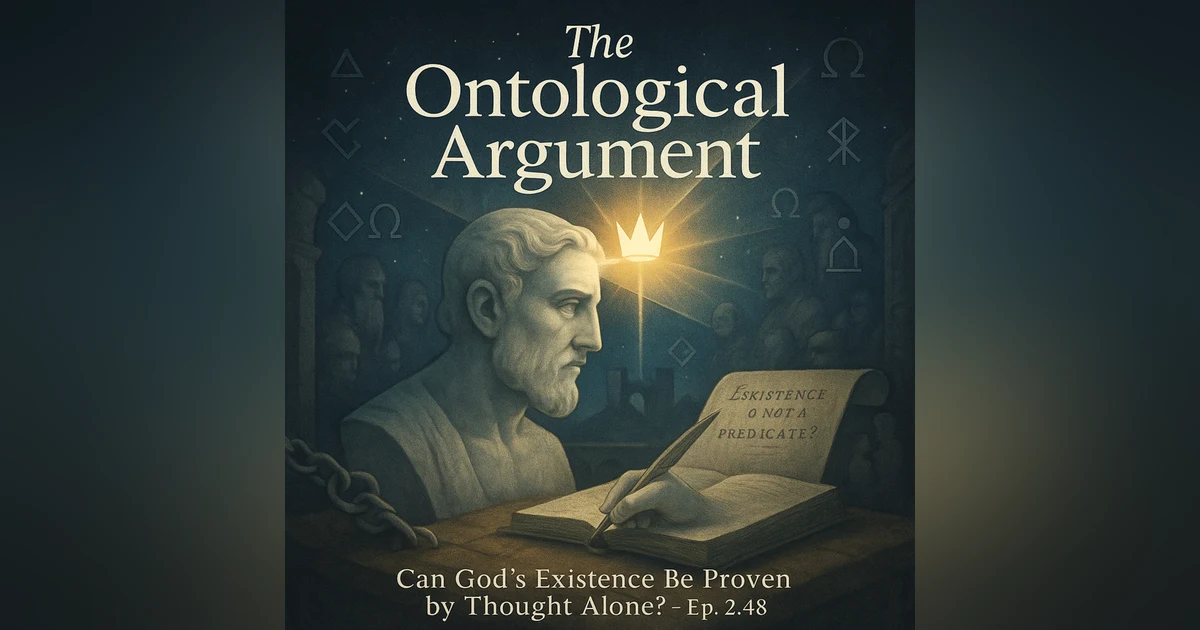
The Ontological Argument: Can God’s Existence Be Proven by Thought Alone?


 RSS Feed
Episode 2.48
Is the very idea of God enough to prove that God exists?
In this episode, Zach and Michael unpack one of the most famous—and most misunderstood—arguments in philosophy: the Ontological Argument. From Anselm’s “that than which nothing greater can be conceived,” to Descartes, Leibniz, Kant, and Alvin Plantinga’s modern modal version, they trace how the debate evolved over nearly a thousand years.
Covered in this episode:
– Why some concepts logically entail others (valley–mountain, shadow–light)
– Anselm’s original argument and the “greatest conceivable being”
– Kant’s critique that “existence is not a predicate”
– Plantinga’s modal argument: if God is possible, God is actual
– Atheist counterarguments and why they must deny God’s possibility itself
– Modern developments from Pruss & Rasmussen
The Ontological Argument remains as bold as ever—an exercise in pure reason that asks whether logic itself points to God.
Find our videocast here: https://youtu.be/IXCAEns1uKw
Merch here: https://take-2-podcast.printify.me/
Music from #Uppbeat (free for Creators!):
https://uppbeat.io/t/reakt-music/deep-stone
License code: 2QZOZ2YHZ5UTE7C8
Find more Take 2 Theology content at http://www.take2theology.com
0:00 So tragic story came in one day and my wife, well, actually I think I was out and she's like, hey, the the toilet's leaking. I was like, oh, we'll turn the water off, I'll check it out. And it was a connection to the bidet. Oh, that is tragic. So I had to trash that one. So it was like two or three weeks and then I finally was like I I need to buy a different bidet. So I have it just got delivered. I just haven't had a chance to install it so. What a good day that'll be. Get the bidet back up and running honestly. Have you? Have you gone through more than one bidet? Yeah, yeah, yeah, yeah. Not not a lot, I think just two, maybe 3, I don't know.
0:40 Yeah, I'm probably buying them on the cheaper end of things, so. Yeah, You wanna go ICE if you you need to like lease like a $400.00 a month bidet. Those are like the, it's like a car, like a nice car. You're just like, that's when you know, you got a good one. I'm just kidding. That you, you can get a $400.00 bidet if that's, if that's your thing. Yeah, like you can get a toilet that's like it's all built in. It's like warming and stuff. That's the first bidet I ever tried was like its own thing in a foreign country. And I was like, I don't know, like 12 years old or something. And me and my little brother, my little brother was 8. And we were like, just like, we were like, what is this thing? Like, we didn't know? And it would like squirt water like across the room. And is this a water fountain?
1:22 We were like losing our mind, 'cause it was like the toilet's here and then there's this whole other toilet that's not a toilet and it just blew, blew our minds. And we were like obviously immature and young boys and just like my mom was like we, we had, we were like told like you're not allowed to miss the room anymore 'cause it's going too crazy. So. It was, you know, it was fun. Yeah. Got to get that. Got to get that home. But hey, we I know we should get sponsored. By we should get sponsored by somebody 'cause I I bet we're the only Christian podcast that was talked about bidets twice now. At least that's. Great. When we've learned we were growing in our podcasting. I won't figure out the specifics, but our transition to a very serious topic.
2:08 Yeah, we didn't really match up our banter with the topic the the last time, so yeah. So we're learning, we're learning, we're learning. You know, it's great. You know, bidets, man, I don't know when, when did, but when, when did bidets start to be a thing? I know in American culture not a huge thing like I know other. Places. Not a huge thing, but I think they're growing. If I had to guess, I'd say maybe 3 to 5% of homes have them. That may be high. I don't know man. Normalize bidets. I watched this guy. He's called poor, poor man's pumper, poor pumper society. But but basically he's from Texas and he pumps septic tanks. Oh, OK, yeah.
2:52 And he's like, if you want me to see less of me coming out to pump your septic tank, get a bidet. You're going to use less toilet paper. The fewer solids that go in your septic tank, the slower it accumulates 'cause you just have the the wastewater going out into your drain field. And he's like I use a bidet. Dude, you'd be stupid not to, you know it's. Just like stupid not to. You heard it. From Zach. You don't have the day. Put that on the T-shirt. Be stupid not to. Our next T-shirt, you know, it's great. You know, it just, I, I said this last time, it's like you go, you just, you garden. You're not going to just wipe, get paper towels and wipe your hands off.
3:35 You're going to wash those hands. I'm going to wash. It you know so. Wash. Clean. Wash clean. Yeah, we should. Transition something you know about something better than the ontological argument. Yeah, ontological. When I think of ontological argument, I don't know what come. I don't know what comes to most people's minds. Probably nothing. Probably like what is that word? Why are, you know, there's probably people who will not listen to this because of the title? We need to, we need to sneak it in. A Trojan Horse title. Yeah, yeah. So win the free car title or something? Like that, it'll be like, what's something like everybody wants to hear more of and then we just like hit them with the. Greg Kochel biography right?
4:18 More Greg Kochel quotes. You might be overlapping too much with the ontological argument crowd. We might be. More Tom Brady stuff. Snap. I'm gonna tell you something. I didn't get to see it Sunday 'cause we were preparing for Home group, which you weren't at, but I was kind of keeping tracks. And apparently Drake May had an awesome pretty. Honestly, they played this. He doesn't have a son, so he hasn't kissed a son in the mouth yet, so. That's that's in his faces on my birthday. Great birthday present. Steelers beat the Patriots. Do you? Did you watch this game? I don't this year. This year, just 21st September 20. First ohh, just ohh Yeah yeah yeah, we got. A We got a huge fan over here. Yeah, yeah.
4:59 No, no, no. I'm scanning, 'cause it was Raiders and then we won and then we lost and it was, you know. Why you lost to the Steelers? No. 'Cause you guys turned the ball over 5. Times. Yeah, yeah, yeah. That was against the Steelers. You guys fumble it and we beat the. Dolphins. We lost. The Raiders beat the Dolphins, and it was. You should have beat us because we got the ball. Oh, 'cause this is where I got mad. I just turned it off because we were like on the goal line and this guy's running with the ball like this and y'all punch it straight out, dude. I didn't I I had mentally blocked out that it was the Steelers. It's great even we just played the Vikings and beat the Vikings, same thing like they're just fumble. I Steelers defense is not been a little point. It's coming on strong the last couple weeks, but it just turned.
5:42 It's turns out it's hard to win a full game when you turn the ball over 55. Times 5. Turnovers and it was a close game. Like, you know, that's that was the and Drake may look a Steelers have no pass rush, but it was like Drake may look good. I mean, when he has just like any quarterback, he had some he was like making good throws. It was just like, yeah, he he actually looks pretty good from what I've seen. I don't follow them too much, but it's like he's like not making a ton of mistakes. Like their turnovers too. Weren't him just getting interceptions every a lot of fumbles? It's like 3 or 4 fumbles. Do we play all again? We do don't. Don't we, maybe, I don't know, we're both AFC, so I don't know how the but. You're not AFC North, right? AFC North. No, we're, we're just.
6:24 Dolphins and. Classic Patriots. You guys play nobody. And bills, right? Yeah, yeah, bills are actually good so that that's good, but but for like my whole life did not be good besides for a couple years in the 90s, but. All right, well, we gotta move on to logical argument, so probably the most esoteric and we're going to do our best. I was telling Zach before we started, like he's like my test person. So if I can get Zach to understand it, I think I can get most people to understand it 'cause you'll ask me the questions like if if something doesn't make sense, you'll stop me and you'll say that doesn't make sense. I love it. I will also for our listeners.
7:04 Michael also did say earlier I only got 9 pages of notes for this one so. It's based out. It's based. Out. Yeah, yeah, that's great. I'm just kidding. I'm not kidding, but yeah. Well, let's take this to the next level. From the hearts of the Low Country in South Carolina. It's the Take Two podcast where we take theology to the next level. All right, Zach, so we have done a series of apologetic arguments, cosmological argument, theological moral argument. They seem to get some engagement you. Know what we should do next?
7:44 The wife's arguments. The the wives argument is that a. No, but there's it should there should be like an apologetic argument that's like because I said so or like, I don't know. I don't know. I didn't say that that was that the wives argument because I was that I'm. Just kidding. I'm trying to think of like something like fun that was like less academic, you know, Like, you know what people can relate to. We could do like a whole podcast on that anyway. Very. Good. All right, so ontological argument actually has a long history, but I wanna before we started the argument proper, I want you to think of a valley. OK. And try to imagine a valley without a mountain. Yeah.
8:25 And maybe you're like, well, I can think of a flat land and like a trench, but that's not a valley, It's a trench. Or maybe like a Cliff. But like so that's that's really not a valley either. So if it's a true valley, it kind of entails the idea that there is a mountain. You can't have one like it logically entails. It goes. Together, it's like there ain't no Mountain High enough. Right. Ain't no valley low enough. That's what comes to my mind, yeah. There's some other of these things that kind of entail each other. Like you can't really have a shadow without there being light because the shadow. Like you can just have total darkness. That's not shadow. Yeah. You can't have a hole unless there's like some material that that's been dug in.
9:07 OK. Yeah. If I said there's a child, then that logically entails that there was a parent. Yeah. If I say there's inside, that logically entails that there is an an outside. Yeah. And So what we're saying is when we think of a greatest possible being or a maximally great being, the idea of that entails its existence, It logically entails it. And so some people, this one some people don't like I'll. Yeah. I will only I. Think on its face. I think when you explain it, everyone's gonna love it. But. Yes, yeah, yeah. But I think you read something like that. You're like, well, what if I just think of I, I don't know, you know, does that mean it has to exist? Right.
9:49 And we we will deal with that because there's like the maximally great Island rebuttal. I've I've heard. No, this is not draw my manning because I have listened to some responses and one person said, you know, the maximally great pizza, you know, yeah, different things. The maximally great pizza then doesn't exist. So we, yeah, let's, we will address those rebuttals. But the idea is that if there really is, if it's possible that there is a maximally great being, then it really entails that being's existence. And so that is the ontological ontology just means existence, like what's really real.
10:30 And so this is like an existence argument. That's what that word means. So don't get, don't, don't get then. You think of like the Trinity, you think of the ontological Trinity versus the economic Trinity and that that helps you think, you know, it's not like. Maybe for some people, OK. Yeah. Yeah, Yeah. So ontologically, like what? How do they relate to themselves in their purest existence versus the economical? How do they relate to themselves in the economy of salvation 'cause they had different roles there? Yeah, OK, so St. Anselm was the first one to really put this out.
11:11 Renee de Cart had a version. It didn't. It wasn't as famous. Leibniz took Renee de Carts and refined it, and that one became well known. Kant kind of pushes back against that. Spinoza, Heartsburn, Godell and Malcolm all have their versions. Plantica is going to take Godell's version and kind of give it to what is today. So out of all that, what you should remember is there's kind of the big three, OK and Selm. He's like the he's like the first person that gets a lot of credit, foundational. And selm live Nets and then plantinga. Plantinga, I don't hear. I don't know Plantinga as much. Yeah, he's from I would have said this for sure, but now that I had said on the podcast, a doubtful, but I'm pretty sure he's at Notre Dame.
11:58 But I think he's a Catholic philosopher, but he's like a philosopher of religion. Yeah, he's pretty famous 20th century philosopher. William Lane Craig did a lot of studying underneath him. OK, so I figure we could hit the big three versions and see how it's the the the arguments kind of morphed over time. And Selm in his Proslogion 2 and 3 on his chapter 2 in existence reality said that God is that which nothing greater can be conceived. And then you're like, well, I could think of something greater. Well, as soon as you do, that is God. Yeah, I gotcha.
12:39 I gotcha. God exists in the understanding and the mind. A being that exists in reality is greater than one that merely exists in the mind. So if God exists only in the mind, we could conceive of something even greater. A God that is has real existence, but that but that is impossible since nothing is greater than God can be conceived. Therefore, God exists in reality. Yeah. I mean, it's like, it's like it to me. Like I get these and I've heard these things, but it does not compute with me very well where it's like I get these propositions, I can like replicate them for a test. Did you have to replicate this for a test? Yeah, like with Western, we I took a class in college that was like themes in Western thought.
13:31 And it just like you've read major things and they, you know, I went to Chris college. They always try to like combat stuff with this. And so you learn about all these arguments, but not in a deep level. Like you learn like little tag lines and maybe you match or you you write something like this. And so that's basically. So as so Amsalm was basically saying, if we, if we agree to the premise that God is that which nothing greater than can be conceived, then he must exist because a God in the mind is less than a God that's really real. That's really the kind of the, the pivotal point. And so he writes on it again, chapter 3, unnecessary existence, God is the greatest conceivable being.
14:13 Necessary existence is greater than contingent existence. If God existed contingently, we conceive of something greater, unnecessary God. But nothing but nothing greater than God can be saved. Therefore, God is necessary. I will say this, this just came to my mind. I need to share with you this article 'cause it's gonna, you're gonna get triggered. We're basically talking about, I don't want to derail this, but how we can trace like the downfall of like everything in Christianity to Aquinas? It was great. It was like it too too depend on natural law and got away from scripture it too much Aristotle on Plato and not enough not God. But I knew that you triggered.
14:53 You. I'm already. Triggered. I should have said this to you, 'cause it's great anyway, sorry, 'cause it's like, yeah, I anyway, yeah, I, I get these arguments there and there's not a good coral. Coral. There's no analogy like this is the hard thing because like you're, I guess we'll address it like with the maximally great pizza, like is it bad? Because it's like not the greatest thing. Like being so it only works like with one thing. It's like a one of one thing. So it's it's hard 'cause there's not a lot of analogies to go with it. Yeah, and and this one. Like could you say that? Could you be like the absolute worst thing is that like is there something like that or not real? It's like so you know. The worst thing in philosophy is non existence if you don't exist. That's the worst thing.
15:40 And so if you, if you never were conceived of, if you never, so in, in in Thomistic Thomas Aquinas philosophy, there's different acts of existence. So a horse has the first act of existence. It really exists in reality. It also has the second act of existence. It exists in our minds. We know what a horse is in our mind. A Unicorn exists only in the second act of existence. We know what it is in our mind, but it doesn't actually exist in reality. So I guess the worst thing would be something that doesn't exist in the. First or second one? Yeah, yeah. Gotcha. OK. I don't know. And that that's worse than being an active agent that does bad things because you had no existence like that, you know?
16:27 Yeah, so there is an argument, A defense against the problem of evil that goes along argues along the lines that existence is better than non existence. So why did God create stuff? Well, that he knew was going to be evil because existence itself is good and God loves the thing that exists. So there's a way that God loves Satan even though we would typically say that he doesn't love Satan, but he loves Satan because of the existence that he has, you know, the the functions that he does. Yeah, So, yeah, so this is we're going to instead of getting bogged download, we're just going to go on to Leibniz refinement of the carts.
17:13 So Leibniz argued this guy's also who came up with calculus along the same time as oh the the the apple falling. Newton. Newton. OK, that's what I thought but I don't know enough. About yeah, OK, so pretty smart guys. He says the ontological argument succeeds only at the concept of the supremely perfect being is coherent, so that he has given a way for you to potentially derail this argument. If the concept of a supremely perfect being is possible, then such a being exists necessarily. OK, the concept of supremely perfect being is possible and the liveness goes on to defend it in his in his writings. And so then he's going to conclude that a supremely perfect being exists necessarily. So kind of takes what Descartes had written earlier, tightens it up because Descartes didn't have the idea of coherence in his. So, but this does give you an Ave. like if you're an atheist, you could say, well, and some people have argued this, like they've argued that omnipotence is incoherent. So maybe you've heard, you know, if, if can God create a rock that he can't live and that so that's trying to show the incoherence of omnipotence.
18:35 There's an answer to that. We're not that's not this podcast, but there have been. Can God give away his power? Yeah, yeah, yeah, yeah. If he can, then he's not omnipotent. If he can't, then he's not omnipotent. So those types of things have been shown. I don't think those ultimately go through, but they've been raised up to try to show the incoherence of of omnipotence. All right, so Kant came on the scene. And if you know your philosophers, you know, as someone who's been trained Thomistically, like I appreciate what Kant did, but I don't agree with everything he did because he's trying to answer some questions that he he accepts some premises that he should never accept. And so he, you know, does this thing of trying to take the idealist and the, I can't think of the word for them, but Locke and, and, and putting them back together, the imperialist. So Kon's critique, he's going to say that existence is not a predicate.
19:41 And so the real thing here is that we can say we're trying to think of something that's really, really good. You know, this kombucha that we're drinking, we could, we could describe a lot of its essence, its nature, but exists. You know, I was talking about, you know, the 1st and 2nd existence. So. What we're saying is like you can think of all the attributes of a Unicorn and that's what we mean to predicate. So has four horses. We're predicating of it that it has four, four horses, 4/4 legs, it has a horn, it has a fur, has a mane, it has a tail, it has muscles like this.
20:21 All those things that we can predicate about the Unicorn, he's saying existence is not one of those things. You can't. It's like it's a category error. It's what Khan is going to argue, and so therefore he's going to say that these other arguments that Anselm and Leibniz put through don't really work because they're they're trying to predicate of this maximally great being exist. It doesn't. Necessarily have to exist. It could be something you'd think of, but not an existing thing. Yeah, I gotcha. OK, I see. Yeah. So I think it kind of hits at that maybe intuition that some people have that just because you dream of something, it doesn't necessarily make it exist.
21:04 Like it's not something you can predicate. So this is, you know how we would, Thomas would reply, We distinguish between essence, what something is, and existence that it is. And we would agree with Kant that existence isn't necessarily a predicate, but it's an act. So we would, we would say that existence is being, it's like participating in reality, but you can have different types of existence. You can have necessary and contingent existence, and that is where Godell and then there and then planting is going to go.
21:45 So they're going to take this out of existence and nonexistence into necessary and contingent and is. This going back to what we're talking about at the top just to just to make some connection to where mountain valley like right the shadow and light like you need these things well. All of these kind of are on though, so the archaeological argument is going to argue along those lines no matter if you're at the top with Anselm or at the bottom of plantica. So basic. So they're saying like, oh, he's basically arguing because a shadow exists now light has to exist, Correct? Yeah. All right, so planting gut puts it into modal, and that means modes of existence. So and so he's going to say a maximally great being is defined as an omniscient, omnipotent, morally perfect and existing necessarily in every possible world. OK, so that's what he's going to define up top and then he's going to make this very modest claim. It's possible that a maximally great being exist. So for the atheist, someone or or or not, you could be a theist, I guess.
23:00 Well, you couldn't be a theist for the atheist. In order to stop this argument from going through, you have to deny this premise right here. Because if you just like the camera. Everything else must follow. Right. Once you allow premise 2, it's possible that a maximally great being exists. Everything else follows moldly. 3 If it is possible, then a maximally great being exists in some possible worlds. So what we're saying is of all the worlds you could dream up, doesn't necessarily mean that there's this world ensemble out there, but of all the possible worlds that we could think of. If there, if a maximally great being is possible, then that being is going to be in some of these possible worlds.
23:43 If it's not in any of those possible worlds, then it's not possible. So if it is possible, it's going to be in some of those possible worlds. Now we're going to say, if a maximally great being exists in some possible world, then it exists in all possible worlds, since necessary existence cannot be confined. So since we've already said that a maximally great being exists necessarily, if it exists in some possible worlds, that it has to exist in all possible worlds, and we're living in a possible world, we're living in the actual world. So if it exists in all possible worlds, then it exists in the actual world. Therefore, a maximally great being does actually exist. This one, to me, makes more sense. Yeah.
24:27 Like it's easier to follow. Yeah. I think it is refined 'cause it's, yeah, I think it tried to. It captures what the older folks were trying to say, but in in in a way that's more defensible and more logically sound. Yeah, I mean, maybe we're in the matrix. Maybe we're in the matrix. Yeah. So it avoids cons critique. So we we stopped talking about existence and non existence. We just talked about, you know, possible and we, we moved it all to modal logic and, and you can predicate necessity, you can predicate contingency because you can say you're a contingent being that's a, you're predicating of that. So it avoids Kant's, you know what he came up with. So and so basically the atheist just going to say this, this maximal great being can't exist or it's like not not possible. Like, yeah, you'd either have to take out the first or second premise.
25:29 You'd either have to say that how he is defined A maximally great being is wrong and it's not. You would have to say you'd have to show that maximally great being is not a necessary being. I think that'd be difficult to do because you could always show that a necessary being is better than a contingent being, so that one would be difficult to do. And then you'd have to show that the second premise is false, that it's not possible for their being met. And so some people are like, there's not a single maximally, some people argued this way, there's not a single maximally greatest being. It's like gradations and you can just keep getting better, keep getting better. And there's not a single one up there.
26:09 They try to get around it that way, but I don't know that that that that works as that goes. Through yeah, let's, I'm curious, yeah, objecting. Right, so there is this idea of of, you know, the, you know, the the greatest possible island, the greatest possible pizza. The problem with the this is these are by their very nature contingent. OK. Yeah, not necessary. It is logically inconsistent to try to conceive of a necessary pizza, a pizza that exists in every possible world. Yeah. Things that are made out of matter are, by definition, contingent. Yeah. So I mean, what, what could you go to that's not matter, That's not maximally.
26:55 Could you do a? Could you do this with like just? I don't know. So if you get matter out of it, then we're talking about some abstract object. And so then are we talking about a concrete abstract object or a non concrete abstract object? So a concrete abstract object would be something like God who can stand in causal relationships. A non concrete would be something like a Platonic form, like the form of the number 3, the form of triangleness, the form of Tubinus, you know, the coordinate Plato, everything that we have down here, there's some form.
27:36 Now we can debate whether those exist or not, but that's the that would be the realm that we are automatically being pushed into because we're looking for something that's not contingent. Gotcha. So that's why these island ones don't go. Through they don't make sense, Yeah. They kind of miss the idea of contingency versus necessary. And it's hard to think of what a nationally great island is because what you want on an island, what I want on an island are are different because they're contingent, right? Whereas in a God, when you start like getting things down to and this is that, you know, we would talk about God being simple in his being versus US who are not simple. We we're composed of parts.
28:20 We have all these things. So when you simplify the oneness of God, existence itself and all those things, then it's easier to talk. It's easier to, it's not just that it's easy that makes it possible, but you can see how there could be a maximally great. And so planting that can define here is what a maximally great being is and puts those things out there. I don't even know that you could define what a maximally great pizza is. Definitely not pineapple on. Pizza. Right. Is that? And and then, and then some people would be like, definitely. Pineapple so but but same thing like I feel like you talked to 100 different people while they might agree on an all loving God, I don't know what that means.
29:05 I mean, do you know what I mean? Like some people would be like all loving means accepting of everybody no matter what and condoning everyone's actions. No, maybe not all of you. So all of you, it's just powerful and knowing. So love is not part of. Omniscient, omnipotent, morally perfect. So, yeah, so you could, you could debate. So this is a a question of epistemology versus ontology. Like how do we know what morally perfect is? What is moral perfection? Can we know that versus does it exist? So you could have people who have a lesser understanding of moral perfection that would maybe let murderers go free versus someone who's like, no, we value human life so much that we're not going to let murderers go free.
29:52 So that would be like a, but that wouldn't. I don't know that that would because you could basically you could argue we don't necessarily know what moral perfection is. We disagree. We. Don't know. Yeah, yeah, 'cause. I I don't know that that would embe against this argument 'cause they're just saying that there is some being who is morally perfect even if we don't. We don't know what it. Is what that is, yeah. So that is the ontological argument. You're probably left a little underwhelmed. Yeah, I, I think I, I did like that. Like I think it makes sense that if it has to be there, it will be there. I just, I don't, I don't love it though. It's not, it's not as satisfying. When I first was introduced to it, I didn't love it. I I couldn't say that if I'm talking to someone on the street.
30:41 Let me tell you. Yeah, yeah, I'm not starting without the ontological argument. Great comfort on the side, yeah. I think it is a very. It's like if you enjoy mathematical proofs, yeah, like, hey, I can prove to you that sqrt 2 is an irrational number and you're like, oh, wow, that is a cool proof. Like, if you can enjoy proofs for the proof's sake, then I think this is probably an argument that you're going to like. If you didn't like geometry in school and you didn't like using siding aside and all that stuff, this is probably not the the argument. That's great. I I love the like witnessing, choose your own adventure witnessing be like, hey, you want to talk about sqrt 2 or do you want to talk about, you know, like and like, all right, you chose ontological argument.
31:27 Here we go. You chose the moral argument. Here we go. It's. Just like you know that actually we we need to patent that to choose your own adventure witnessing. That's great. You say something in that. That's like a decision tree, a flow chart we follow. It's good. All right, so we're only we're not, we got time. So there has been recently recently developed a new argument that's like a brother argument to the ontological argument. Tell me more. The modal argument from beginnings by Pruss and Rasmussen and this one's even I like this because it's even the beginning premises. It's like the nose of the camel is even less offensive than than plant cows. And so it says for any positive state, a state of affairs S that can begin to exist.
32:20 It is possible there is an external cause of S. So what it's saying is so if let me break that down to for you. If it's going, it's worded funny, but a contingent. If something begins to exist, it has to be contingent. OK, so another way of saying this is, if I were to rephrase this one, is if a contingent state of affairs can begin to exist, then it's possible that there is an external cause of this. And. You'd be like, yeah, that that seems that checks up. Second premise, it is possible that the state of affairs contingent, let me it is possible that the state of affairs contingent concrete beings exist begins to obtain contingent concrete beings exist begins to obtain.
33:14 So it's just saying that it's possible that contingent concrete beings begin to exist that that that comes about. If one and two, then it is possible that a necessary concrete being exists. That makes sense, yeah. If it is possible that a necessary concrete being exists, then it exists. Therefore a necessary concrete being exists. So, so basically if I order word this, you know, in layman's term, it's basically saying that if a contingent state of affairs can come into being, and that contingent state of affairs can be a contingent concrete being, then it's possible that a necessary concrete being exists.
34:04 And if it's only possible, again, that a necessary concrete being exists by modal logic, then it has to exist in every possible world and therefore it exists. Boom. What can you walk through what? What's the definition of a being? Anything that exists. Any anything a being is a thing. OK, gotcha. OK, so so so it's it could be like a force of sorts. Like it's like it's, it's not necessarily personal at all. Yes. By definition, it doesn't have to be you. Gotcha. Yeah. Yeah. A well, a yeah, All forces that we know have their heart in matter.
34:46 So the force of gravity is matter tracking is force of electromagnetism is like charges, you know, electrons and stuff like that. So I don't know, I'm trying to think of the physics of that. You could have a world where I'm trying to think through if you had a world that just had pure vacuum energy. Sorry, you would still have the particle pair of production out of that vacuum energy layer, so I don't know how you could have a force exist without having some matter exist along with it. That's all I'm saying. OK, so going back, so a being is just anything?
35:29 Sure, something. That exists. So like like so like like you're saying like gravity is a being or electromagnetic? Charge gravity is a being. Gravity is a an effect we see that happens when 2 being between two beings. OK, so like 2 planets or two beings, Right. OK, gotcha. That that's confusing that that helps me out to where a being is really vague and doesn't mean much. Yeah, yeah, yeah, yeah, yeah. Yeah, it's something that that that's concrete. So what we're saying is not abstract like something something not platonic.
36:10 Gotcha. Yeah, that makes sense. Yep. So again, it follows the same modal structure as the ontological argument goes from possible to necessary to actual. This time it doesn't start with a concept of God, but with possible beginnings and it converges on a necessary concrete being that's there. And so the the beauty of this is the premises are very, very modest to begin with. It's like hard to deny those, but then it then it ends in, you know that so. Boom. So yeah. So people to disagree or try to disprove this, What? What do you say? That external causes aren't not necess? Not necessary.
36:54 Causes don't always cause contingent things. Is that like what you have to say? To to get around this most recent one. This is so recent I've only heard it I I've not heard an atheist response to this so I don't know. How it is, maybe drop in the comments. Maybe we'll maybe we'll hear the 1st. 1 So I don't if I were to try to it's I'm trying to put my mind, put myself in the. Atheist. I'm just thinking of good titles for this video. It's like atheists have no answer. It'll get. It'll get. Not just to get just to. Get engagement Engagement. Yeah. Well, yeah, just so we can, we can, we can learn what the pushback would be. All right.
37:34 Yeah, that would definitely I'm. Not saying in a bad way, but you know, yeah, yeah. Anyway, atheists don't have an answer that Michael knows of. That's great. That'll be good. I hope we get some, you know, back and forth on this. That'll be good. Yeah, I, I guess, well, places where you could so, so the first premise is for any positive state of affairs S that can begin to obtain, it's possible there is an external cause of this. So I guess you could argue that everything is just a brute fact that's not caused that there's no causal relationships. Like the first principle of causality doesn't isn't, doesn't hold. But that's I think there are people that that would argue that way, but it's a very fringe thing.
38:23 So if you ever, if you just said everything is a brute fact, it's all determined. But even then, you see, you still see things coming into existence that you would, I think naturally say that there are causes, even if they're determined causes. It's possible that the state affairs contingent concrete beings exist begins to obtain. I mean, I think we see contingent concrete beings exist. So it'd be, you'd have to deny that, that there are contingent concrete beings that have obtained. So I think it's a, it's a very, very modest argument. So we'll see where it goes.
39:03 Maybe it'll it'll stand next to the ontological argument in the future. I love it. Just keep adding them, you know? Yeah, that's great. Awesome. Well, any. So have we. Is there any argument stone left unturned? I'm sure there is stuff we haven't touched, but you know I. Think we touched on the problem of evil when we talked about the moral argument, but we didn't give like a full. Yeah, we should do that one sometime that. 'D be good. What's the what? I can't think of the word. Theodicy. Theodicy. Yeah, Yeah. Thank you. I like that word, yeah. I'm getting old. I can't think of all the words we haven't, We haven't really explored some of the theodicies like the the soul making theodicy. We should do that that'd.
39:45 Be good, Yeah. So maybe, maybe we can do that sometime. Love it. Well, man, add it to the playlist of arguments. We got like a we got a bunch of episodes lined up. That is good. Yeah. Hopefully we'll get some good engagement here. So thanks for hanging with us. Through this argument, that's our take. Thanks for listening to Take Two. Find us wherever you find podcasts and on YouTube for those who want to watch our video cast.

