The Purpose of the Church


 RSS Feed
Episode 2.8
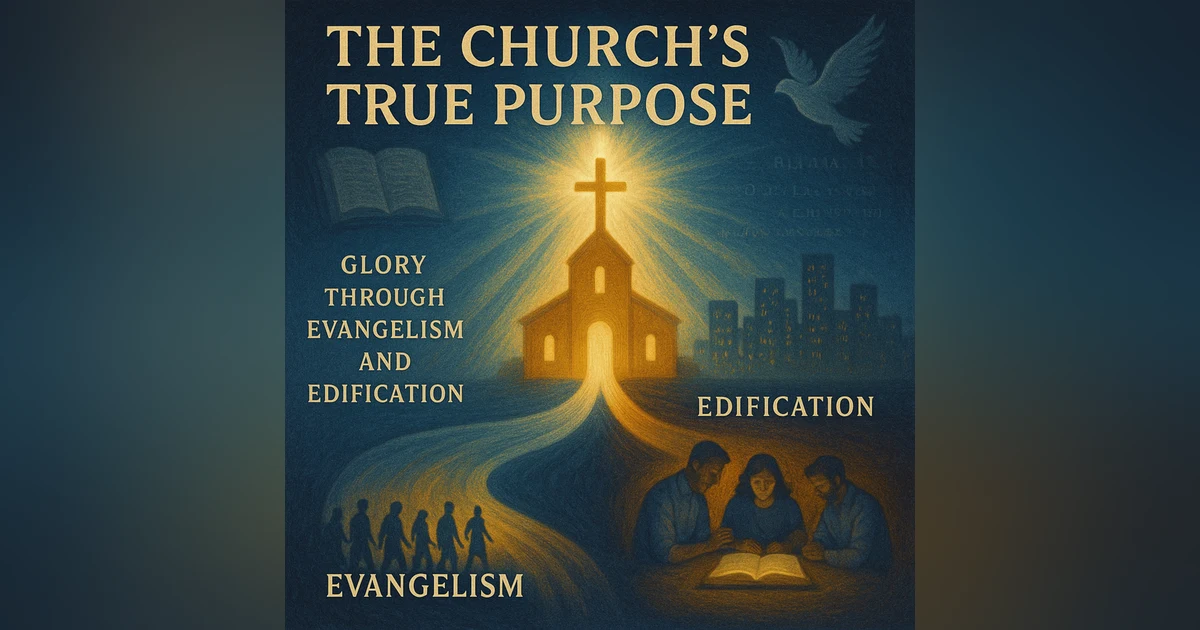
Why does the church exist? In this episode, we begin a short series on biblical church ministry by laying the foundation: the church exists to glorify God. Drawing from passages like Romans 15 and 1 Corinthians 6, we explore how the church’s ultimate purpose isn’t growth, tradition, or activity—but glory.
That glory takes shape through the Great Commission—evangelism (reaching the lost) and edification (growing the found). We unpack the dual calling to make and mature disciples, examine warning signs of mission drift, and challenge churches to evaluate every ministry through this simple but powerful lens: Does this glorify God?
Find our videocast here: https://youtu.be/BJ_WW_fRmHo
Merch here: https://take-2-podcast.printify.me/
Music from #Uppbeat (free for Creators!):
https://uppbeat.io/t/reakt-music/deep-stone
License code: 2QZOZ2YHZ5UTE7C8
Find more Take 2 Theology content at http://www.take2theology.com
0:00 Looking looking nice Michael got some new threads. Yeah, thanks. It looks like, Oh yeah, you got some too. That's very nice. Nice here, I love it. You went with the give. Hate a chance? Shirt just, you know. Coming in hot. Yeah, so we have two different give hate a chance options. You can have the one that just says give hate a chance with the verse reference on the back. Jonathan White is like, it may be a little too pokey. James Dunham, who's already has already bought his. He's like, no, no, that's it's conversation. Starter. I think he actually said not pokey. No, no, I'm just kidding. But so this is a little bit more gentle because it still says good, hate a chance. But then on the back gives a little bit of context to what we're talking about because on the back it says abhor what is evil.
0:45 And then the Romans 12/9 I. I just went with the simple pun take two on the front, on the back it says tanking it. So it's a tank top. So you know there you go. So you know merch is rolling out. I think Michael was really planning on every 3rd Sunday of the month is take two to just wear it when he's doing worship and we all got our take. 2 That's right, everyone shows up. We should do that. Just have one. Maybe, maybe, maybe it's a Wednesday night. I don't know if it's Sunday morning, might be a little too obvious, but where? We all wear our Take Two merch together here. I don't need to buy another take two shirt. I probably will not wear the the tank top even on on Wednesday. But there you go.
1:26 I'm glad they're, you know, getting out there. Yeah, it. I mean some people have experienced longer shipping than other poor clay. Thrower. He's still waiting. No, no, he did get it, but he was wanting to get it prior to our next gaming session. And it finally did roll in. But he ordered his probably a week or so before, maybe two weeks, I don't know, Week and a half before I got, he got his and I got mine, you know? Pretty close, very close. To when he got his I. Ordered mine like the day before Mother's Day or something, maybe a day or two and got mine today. So yeah, like a week and 1/2 or something for me. So in Clay's face. Yeah. See if the Nephilim help you with that.
2:06 Yeah, there we go. Yeah, he did get the introverted but willing to talk about Nephilim. That's. Good. And and I'm gonna we, I've already thrown this out there. People looked at the store, a lot more shirts have popped up. So keep keep stuff coming because we can put whatever we want. You know what I mean? Yeah. There's no cost of putting an idea out there. So if you're like, hey, if this shirt were there, I'd buy it. Let us know because we'll put it in there. We'll make. It make it. Happen. We do have one non South Carolina buy so far. Wow Cordell. So you know Jill's cousin? Taking over the mid. South as well, I think he got a cokel and chiasms, so yeah, that's classic. That's that's pretty that's pretty funny.
2:48 Yeah, that's good. I I'll try we have to think of think of more of these that that's like a great one that's like specific to the pie. That's like so good Cokel and chiasm. That's great. Well, the good thing about there's a variety of colors out there, but the good thing about this color is it should work well with a green screen, unlike the shirt that I wore last time 'cause I've started to produce some of those. In fact, one of them hit today. Wow. Later today. But it did hit today. Sorry, a lot of stuff going on, but yeah, I was looking at that and I was like, Oh yeah, there's just like we're the little Plaid, like the little hats. You could just kind of see some. I can only. Imagine our YouTube comments. I can't watch this unwatchable. This shirts got a slight bit of If you have not been following our podcast, Michael manages the green screen attire very well. So it's not I I have had to change my shirt once or once or twice, but but here we are talking about the church. Yeah.
3:48 Maybe you, maybe the church. It's such a ubiquitous term. Everyone talks about the church, but a actual robust understanding I think is a little bit harder to come by. Yeah, and we're really be talking about like we're gonna be talking about the church Universal, or someone would call it the Universal Church I. Thought you were gonna say Catholic Church. Yeah, you could call it the Catholic Little Sea Church, or as the Irish Hillbillies call it, the Church Catholic. Oh, that's right. Yeah. Yeah. Nice. Yeah. But yeah, obviously whatever applies to the universal church has to trickle down to be enacted by local churches. So yeah. Absolutely.
4:28 Well, I'm excited for it. Let's go ahead and take it to the next level from the hearts of the low country in South Carolina. It's the Take Two podcast where we take theology to the next level. All right, so thought we'd start at the, you know, at the very beginning. And if you go to our church, some of this might seem familiar, but you know, this was, you know, I've always talked about, you know, Jack may say, you know, it's Sunday school with teeth or something like that. Yeah, yeah, yeah. And I really borrowed this material out of a paper I wrote for a graduate level seminary degree.
5:15 So, you know, you can some of the things that at least at our church that may seem like, oh, this is like normal everyday stuff. You know, that's this is stuff that some people still, you know, it, it is graduate level talking. So we're going to be talking about what is the purpose of the Church I. I think that's good 'cause I think if you asked 100 people on the street, you might get like 50 different answers and they might be like similar. But I think a good subset of those would be kind of missing the mark. Like maybe tangential, but like not the purpose. Of the church and broadly speaking and, and I, I do appreciate what we say and I think I've made this comment before, but the, the biggest part of the purpose of our church is to glorify God. Full stop.
6:03 Yeah. We we are to glorify God and then we see that Romans 15, five through 6 says so that with one accord, that's all of us together. You may with one voice glorify the God and Father of our Lord Jesus Christ. And then you know, we see lots of verses. Let your good work so shine before men that they may see them and glorify your Father in heaven. That's the sermon of the mount. There's different places like First Corinthians 620 talks about glorifying God. There's a number of verses that would give credence to this stated purpose of the church. So you could be doing a bunch of things, but if you're not doing that, you're really miss, you're missing the mark no matter what you're doing, even if it's a hundred really good things.
6:51 Right, right. Yeah, yeah. And you know, this kind of echoes that Westminster Shorter Catechism. And did you grow up with this? I not really because you're a Baptist and this silly Presbyterians are just they're, they're a little bit too close to Catholicism for my taste is kind of how it was presented kind of. But but this was the one that was like you could say, yeah, yeah, like we didn't get to question 46. We like question 1 was like where we started. And stopped, yeah, we grew up with. There was one family who did it and then he took over youth for a little bit. So then they kind of understood into youth a little bit. But we were kind of older than that. So we never formally went through him, but this was the one that was there. You know man's, you know, what is the purpose of man or why? Why does man exist?
7:31 You probably know the question better. But man's chief end is to glorify God, enjoy him forever. And so if the Church is made-up of, of men, you know, mankind, then you can see how that would naturally, you know, correspond to that. Yeah, because and when you look at the landscape of church today, sometimes this everyone would say that like we're going to glorify God, but sometimes the focus is skewed a little bit to where it's about growth. How do we, you know, fit into the culture? How do we impact our community? Like really good questions and not unimportant, but you just, you want to set your sights on what's important. I think some of those things happen organically, but you can't start with those tangential things. No.
8:11 And I yeah. And I think that they may be indicators, like if you got 5 people in the church and everyone is like saying bad things about you and your community, it should give you a pause. Like, are we really glorifying church, glorifying God? But it's possible you can imagine that there might be societies or cultures where Christianity is so hated that 5 is all you can get and you're doing your best to, you know, shine forth Jesus's light and, and you're still getting hate. So the end goal is to, you know, glorify God and, and not be measuring yourself on numbers. Easy to do. Yeah, it's, you know, you go in the workplace, I'm sure your job is like mine. Monday morning I just get a page of analytics. Like I just click through sheets and sheets and sheets of numbers.
8:58 And that's going to dictate how I spend my day, who I talk to, which, you know, referral sources I reach out to, which employees I prioritize. It's all based on a lot of numbers. And you can get in a lot of trouble if like that's you're just looking at a spreadsheet of numbers. Yeah, and we're not saying that numbers aren't wrong. Yeah, but the. Sounds like what a math guy would say. It would be the yeah, but it's not the end. Yeah, that's. Right, right. And I, I like, I like this note on here that, you know, when you think of glorifying God, maybe you're thinking of like, all right, I guess that means I'm just reading my Bible and singing all day. And it's, it's much broader than that, that, you know, if you're, you know, eating, drinking, whatever you do it, it comes down to how you live and everything. And so think about maybe that in the context of church as well, where it's not just, you know, hey, we're going to have like the special music and that's glorifying God. No, I think that's great.
9:48 And it also that might lend your thoughts on what heaven's going to be like because, you know, when I was younger, I even heard people say, well, we're just going to be singing and praising God forever and glorifying him and, and the kind of those two are tied together and, and I think we will be glorifying God forever, but I don't think it is just just that, you know, singing. Like that. And when you when it's posed that way, you can't be like, oh man, because then you sound bad. So you're like, you kind of like go with it a little bit. But you're right. Oh, yeah, That's exactly what I want to do. Yeah. Yeah. All right. So glorifying God, you might compare to a compass, you know, if you wanted an object lesson that if we are not, you know, all the things that your church may be doing. If it's not pointing like at that true north of hey, we all of this we measure by whether it's glorifying God or not, then then you might be off course.
10:47 I I like that a lot because again, you can have programs everywhere. Your calendar can be full, but maybe you're missing some, you know, important components to, you know, really that underlying idea of glorifying God. So I guess as we get into this, a good question to ask would be what what glorifies God? Because there are certain things we can probably say no, no, no, no, your turn should. That's like a non starter, right? Yeah, and there are. You know, I'll say something a little risque. You know, sex inside the bounds of marriage glorifies God, you know what I'm saying? That's God. Designed that right. So there's lots of different things that glorify God, but all of them don't fall in the purview of the church, right?
11:27 You know, we wouldn't put that underneath something that a church should be doing you. Know what I'm saying? I, I, I think that's kind of, you know, kind of a funny example, but it's like when you start drilling this down, you just get it's easy to get up course. So if we are drilling down, what's the mission of the church This is, I don't know if this is in the notes, but we've recently came out of a Sunday school about missions that Nathan White at her church LED. And it was really good 'cause he pointed out a distinction Kevin Deyoung makes in one of his books where you've got the mission of God, the Missio Day. And that's not the mission of the church because God does a lot of things at the, you know, does everything and your church is called to do certain things. And when you conflate these or mix these up, you can really run into some problems and you get you get your focus wrong. And so I like that we're drilling down on what what is the mission of the church, if you could say it simply or just get to the root of it, what does that look like? Yeah.
12:26 And I, I think probably, if you've been in the church long enough, you probably aren't really thinking about verses like this, but you know, the Great Commission comes to mind. Some people will say, no, that's not the Great Commission, it's the everyday Commission, but it is a Great Commission. So let's read through that and then maybe we can talk about that. This is, you know, some of Jesus's last words in, in his earthly ministry. He says, all authority has been given to me in heaven and on earth. Go therefore, and make disciples of all nations, baptizing them in the name of the Father, the Son, and the Holy Spirit, teaching them to observe all that I commanded you. And lo, I'm with you always, even to the end of the age. Man, that.
13:11 Word, people have probably heard a lot. You try to boil, you can boil that down. If you boil it down to discipleship, that's a big part of what your church should be doing. And that's a broad concept to What's that mean? Discipleship. Right making disciples and you know that I think it's you know is from the beginning to that very first time where you're talking to people and you're you're like hey, come, come give Christ, give give God, give the Bible a chance all the way through, you know helping someone, you know sanctify themselves and overcome sin and you know live, you know out there gifting it encompasses. All of that. I love that. So like, you know, your Sunday school teacher teaching 2nd and 3rd graders like you are doing this, not just the person standing on the street quarter evangelizing because you I think you can read that and just think, oh, it's just evangelism and it's really, you know, you want to get farther.
14:04 It's not go there for and make decisions for Christ. It's like, how are we living? What's your fruit show? And so it's all across that spectrum. And when you put it that way, it makes it easier for us all to play a part and know that this is what I should be about. Even if other things happen. This is like the main thing. Yep, Yep. And so often times you'll hear people talk about that disciple making process and they break it down into two big chunks. And if you were to come to our church, you would hear us say something like this. We exist to glorify God by bringing sinners to Christ and thanks to Christ's likeness. Among all nations. Among all nations, that's right. But so really you have, and so this is, you know, you have evangelism, edification, There's lots of ways that this has been cashed out, but it is this kind of twofold process, first bringing them to Christ and then once they are in Christ, helping them to become more like Christ.
15:04 Yeah. And so if you were looking at your church, I think, I think it's good as my church about these things. Is there an emphasis on things like evangelism? Is there emphasis on things like teaching? Are we making disciples all across that spectrum? Or is our emphasis like, hey, we're doing a food drive for the neighborhood, good thing to do, but that's not the number one thing or it's like, hey, we're here to stop human trafficking, great thing to do. We probably should support that in some capacity. But that's not what the church's mission is foremost. And I think if you do disciple, probably people in the church will be involved in those things and changing those. Yeah. I think that you can maybe do some of those things if you have at the outset that you are doing those things to help walk the gospel forward, right?
15:50 Absolutely. Yeah, yeah, it it. So if we're like, I like painting things in extremes because it makes it kind of silly or obvious. So on one hand, if you have all the social services, like you're adopting every kid in the community, you're giving food for everyone, you're fostering everyone, you're stopping everything, but no one's coming to Christ. No one's learning about Christ. Bad job. You're, I mean, you're not doing church on the other side of it. If you are, you know, faithfully teaching. Frozen. Chosen. Yeah. Yeah, yeah. Then it's like, OK, there's nothing. There's no growth, there's no fruits. But you're not being a light in the community at all. Like no one would go, oh, we, we know those people.
16:32 They're loving people. You know, if I had a problem, I would go to those people. You know, if you're at the other end of that, then probably that's not good. Either probably not good and you would think that through discipleship that that like you were saying, it would be a bridge to bring the gospel. And yeah, you are proclaiming God's word and at the same time you are helping the community. You're doing these things and those things aren't mutually exclusive. And really the one should exponentially like fuel the other probably. Right. Yeah, I wholeheartedly agree. I won't make one other comment like these words were initially given to the 11 apostles at the time, and it was broadly their mission to bring this about. Now, clearly you look at Ephesians, Paul talks about, you know, Christ being the cornerstone of the church, the prophets and the apostles being the foundation, and then we're building upon it.
17:29 So if it was their mission, then it is our mission as a church universal to be also about this. That doesn't mean that, you know, God has gifted us differently. So it doesn't mean that just because, you know, this Great Commission was given out to the church writ large via the apostles, doesn't mean that you, Zach, has to be someone who's baptizing people, but you should be somehow involved in the evangelism of people you know, whether. That's. Great however that works out in your individual life. You should somehow be involved in the edification of of people once you know. And obviously your gifting may mean that you are very heavy on, you know, teaching believers and, you know, you're not as heavy into evangelism or vice versa, you know, as your personality and God has gifted you individually.
18:23 And the you don't have to make this too crazy. It's like I've got four children, probably good that I evangelize them. You know what I mean? It's like, and, and also should be doing more evangelizing, but there are opportunities very close to home where you're developing and, and helping people grow. And I like, you know, if you look at the overarching trajectory of the New Testament, you know, we start with the apostles, we look at Acts, it's bookended by some of these kind of things. And we look at Revelation and it's like, man, every tribe, language and nation, just it's, it's something that's going to going to grow. And so I think when churches get in trouble, it's, it's when things, you know, focus on personalities or what, whatever it may be, it's like, man, it's, it's so on one hand simple, but it is challenging when you're trying to, you know, make your church grow and these kind of things, I think you can take your, your eyes off of what's truly important.
19:13 Yeah, especially if you're just trying to grow numbers, grow numbers, grow numbers, you can get a lot of people in, but are you making disciples, which is what we're really called to do. One last talk about, you know, thought on gifting. Really we've we, we have two podcasts, Part 1 and 2 on spiritual gifts. That's right. Some of our most listened to podcasts. So if you haven't heard those, go back, go back and find them. Summer 2024. But we we talk about gifts there. But really you can see if I in any organization in your organization, my organization, we got different folks doing different things have different talents to bring because the mission is big. And so in a mission that that is this big, you know, you really need all hands on deck and use a naval term.
20:00 And so whether you have the gift of exhortation or serving or mercy or helps or administration or teaching or evangelism. Whatever your gift is, it's one piece of that pie that help, you know, bring about this big, you know, mission of the church so that we can ultimately glorify God. Yeah, you think of it. Maybe this will come out in other podcasts, but even thinking about the church, how does the Bible describe the church? What analogies are used? It's like, you know, maybe where there's like, you know, vine and branches, maybe there's like temple, like you're saying cornerstone building on it. Two of the analogies are bodies, whether one is including the head or maybe Christ is the head. You know, it's like Paul used that analogy twice that that you're right. Everyone's got to be kind of firing on full cylinders if we're going to be more successful in what we're called called to do.
20:49 So I like that overarching theme. Stay on mission, glorify God, don't don't drift the wrong way. So what what would you say? How would you caution a church? Church is like auditing themselves. What what are good signs of or some signs that maybe there is some drift going on? Yeah, maybe and we're going to talk more about this in the future, but if you have some activities that they, the activity is the end, right, OK. Yeah, This year, even if it's like the Christmas pageant or the Easter, you know, whatever. And like that becomes so high of a focus that your focus is on that.
21:32 Yeah, yeah, right. You know, and instead of you know what we plan to do through that. That's right. And if you know, if someone would say maybe this year we're not gonna do fill in the blank and people have that reaction, then, then probably that has become the end, you know your. Purpose. That's what you're glorifying rather than rather than, I think. I think that's good. You can easily confuse busyness with faithfulness. It's just like everyone needs a group or you know, you look on things and groups are good, but you can just literally just be like, OK, we're just like maxing out the calendar and focus on the programs. But but like you said, these programs are kind of what we're aiming to build, not we're not aiming to glorify God. Yeah, it reminds me of the letter to the Ephesian church and opening part of Revelation where Jesus says, you know, you're doing all these good things. You are doing good things, but you left, you lost your first love.
22:24 Yeah. And so you, our first love has to be this idea of man. Everything we do, we live and die by. Does this glorify God? Does this meet our mandate? One thing that we talk about, you know, we're both elders, so we're both in on some of the decisions on activities and stuff. But, you know, we've had this paradigm of a plate and you can only fit so much on a plate. You you can maybe, yeah, maybe you can do it. So, people. Are good at stacking that. Yeah, yeah. And does that plate, you know, is it balanced so that it is trying to do all the things that a church can do? And if you see one, you know, a certain type of activity in your church just growing, growing, growing where it is dominating what your church is doing, that's another another indication that maybe you kind of missed the mark here.
23:11 I'm going off scriptural, but I was just thinking about, and I don't know if we can, we can audit this and say this is a terrible thing to add in here. Just bear with me. One, one passage I really like is Luke 4. It's when Jesus is rejected at Nazareth. He like reads the scroll and says what he's going to do because everyone says, well, Jesus is bringing all this social change and he did upend a lot of social categories and these kind of things. But I think this is a text people might point to sometimes He reads, you know, 'cause when you think of the Old Testament, it's like make the blind see, you know, set the captives free. John the badges is in prison. Are you Jesus? Because I heard you're going to set the captives free. He's probably thinking that a little bit like, what are we? This is what's going to happen.
23:52 What he actually says in Luke 4 when he's, you know, reading Isaiah, he's quoting he, he's reading the scroll. It says the spirit of the Lord is upon me because he has anointed me. And this is so interesting, the verbiage. He says to proclaim good news to the poor. He has sent me to proclaim a liberty to the captives and even the languages. He's gonna do these things. But a lot of it is giving that gospel message and focusing. And it's like we even see that in the Messiah, Jesus Christ. I think that's instructive for us, that man. If we're not proclaiming that good news and, you know, building people towards maturity, we're probably just mixing up what is truly important. And even his examples, when everyone gets mad at him, he's talking about the widow who gave everything she was, you know, poor.
24:36 Then he talks about naman and he probably wasn't poor, he was poor spiritually, but it's probably not lacking for a lot of resources. So you try to like think through, think through some of this. And I think that helps kind of recalibrate our mindset. Yeah. And it, you know, if you are straying from the actual gospel, then I think that would be a problem too. And, and like you said in that, in that, you know, proclaiming liberty like our gospel should be, we can deliver you from, you know, the law of sin and death, not us, but we're pointing you to the person who can. And so if your church is focused on legalism or, you know, or libertinism where you just, oh, anything goes, then then those would be, you know, if you're straying from the gospel itself, then you're, I would say you're not glorifying God as well.
25:22 I. Absolutely. And I think that one of the encouragements is this is that on one level, it's like simple, A church is a heart hard place. It it it's hard to run successfully in quotes. There's a lot of, you know, people and sinners and and stuff. But on the other hand, it the blueprint's kind of simple, which is I like that. You know, I think a lot of times we complicate it more than it needs to be. But if you're running, I like this podcast, we're going to kind of dissect some of the essentials. Just think of that. That kind of helps you stay grounded to being faithful to Scripture. I think that's great. All right. So obviously you should be aligned to to scripture. We should evaluate, you know, the the people that we have leaders that we have programs that we have in a church. Are they existing to glorify God through some of these ways? So anything that you have to recap or any final thoughts that you have.
26:20 Well, I think, I think I, I can't remember what it's called. I should look it up. It's probably called the Mission of God and the mission of the church or something like that. Kevin Deyoung has a book it's not audible to. It's just so good where it just talks about this exact thing, what the church's mission is and don't confuse it with the mission of God 'cause that's a lot broader where we're just called to be faithful and make disciples. He also has other part he talks about like what you were just saying about, you know, this liberty, like just trying to social gospel kind of thing too. But he gives all the these contrasting viewpoints that really just helps us focus 'cause I think you, you, you go to the, you know, bookstore. No one goes to bookstores anymore. But you look at like the church section.
27:01 It's like not on your mission. It's about all these great things you can do, you know? Anyway, all. Right. So just to recap #1 Buck stops at glorifying God. Obviously it would be nice just to say, hey, what are you doing? I'm glorifying God. We're, we're glorifying God. Well, there has to be some, you know. Practical. That's right, vehicle. For that and we're suggesting that that's primarily found in the Great Commission Bringing sinners to Christ, Saints of Christ likeness. There's one guy that's talks about catching fish and then. I'm really making it, like, practical. That's good, yeah. And then so next, next episode on this subject, we'll be looking at, you know, some of the more practical ways for priorities that a church might have in trying to meet this goal of evangelizing and edification to the end of glorifying God. Great.
28:01 I love it. Fantastic. So we've got maybe three more episodes in the Series, A four episode series, I think it's. A four episode series. So, yeah, yeah. Great. Well, that's our take. Thanks for listening to Take Two. Find us wherever you find podcasts and on YouTube for those who want to watch our video cast.

