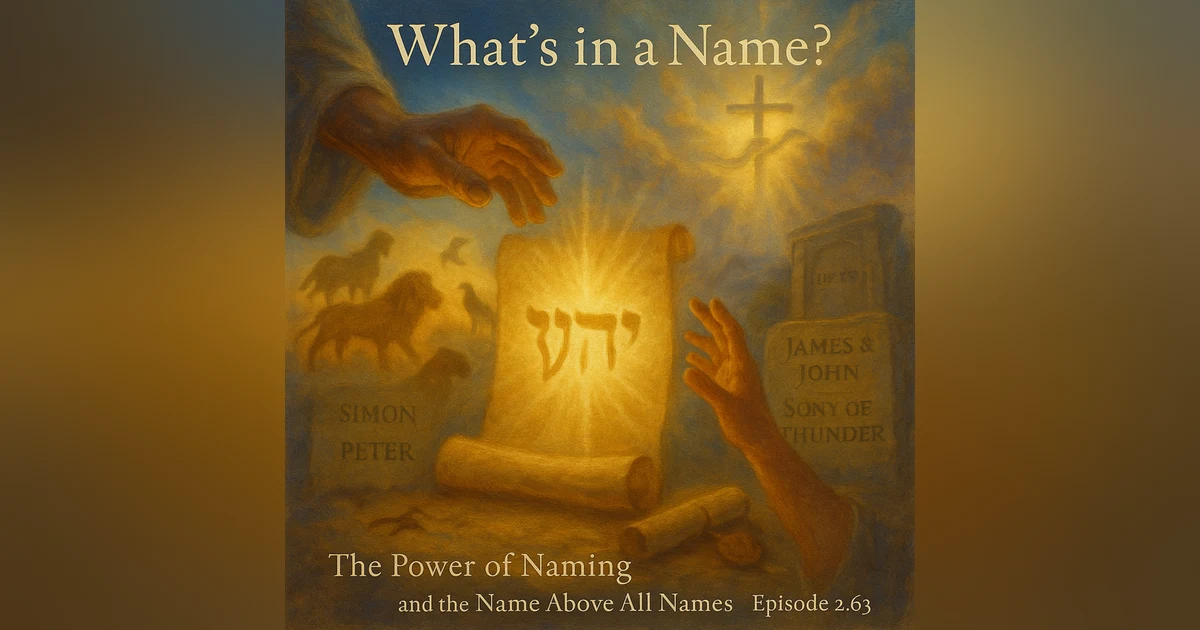
What’s in a Name? The Power of Naming and the Name Above All Names


 RSS Feed
Episode 2.63
This episode explores the biblical theme of naming—from Adam in Genesis to Jesus in Revelation—and shows how naming reveals authority, identity, mission, and destiny. Michael and Zach trace how Scripture uses naming to communicate dominion (Adam naming the animals), responsibility (parents naming their children), divine revelation (God naming Himself in Exodus 3), and testimony (Hagar calling God El Roi). The episode highlights how Jesus wields unmatched authority over the spiritual realm, silencing demons who attempt to name Him, and how He renames His followers—Peter the Rock, the Sons of Thunder—to define their calling.
The hosts show how naming attempts in the ancient world were often tied to power, control, or manipulation, yet Jesus resists every attempt to be defined by others. From Philippians 2’s “name above every name” to Revelation’s mysterious “name no one knows but Himself,” the Bible presents Christ as both revealed and inexhaustible.
The episode concludes by connecting naming to adoption: God places His own name on His children, granting belonging, identity, and security. The God who cannot be claimed or controlled chooses to claim us—writing His name on His people and inviting them into His family forever.
Find our videocast here: https://youtu.be/fYC6ZokR3iw
Merch here: https://take-2-podcast.printify.me/
Music from #Uppbeat (free for Creators!):
https://uppbeat.io/t/reakt-music/deep-stone
License code: 2QZOZ2YHZ5UTE7C8
Find more Take 2 Theology content at http://www.take2theology.com
0:00 Boom, I noticed you reached for a certain drink in the fridge there, Mike. Yes, thank you, Greg and Verna, right. Yeah, you're good. You're. Good I I told I I don't get drinks here often. That's right, yeah. Occasionally I do. I was like I told Zach, I need to like spot y'all, A5 or A10. He said no, no, no. My parents have it covered. Do not worry about it. So I was like, all right, well, I appreciate that. Now it's documented, yeah. So Diet Coke. Diet Coke? Yeah. What is this? I. Oh man. I. Jill too, or just you? Wow. Yeah. Jill, too.
0:41 So I was I was I never if you could have told me six months ago, Michael, you wouldn't start enjoying. Yeah, I enjoy diet Cokes. What? I really like diet Doctor Pepper. Yeah, yeah, yeah, it's. And I would have been like, if you told me that three months ago, I'd have been like, not a chance. Wow, just three months ago. Yeah, but I'm over the last six months we've, you know, tried to drop, you know, yeah, not that we were doing a lot of sugary drinks anyways, but you know, we started getting, we'd have bubblies on hand, you know, the slightly flavored, but just basically soda water. And I don't know what it was 'cause I wouldn't even normally pick one of these up, but maybe we went out to eat. Maybe it was a Sunday dinner and they didn't have like water or tea or something.
1:27 I was like, I guess I just got to get something that's diet, and I got a diet and I was like, wow, this doesn't taste bad at all. Man, no. Going back now. Now he's addicted. No, I'm just kidding. I'm sure you're not an addict, but it's, you know, that's what all Diet Coke people, that's where they start, you know, started somewhere. Yeah. I mean, I haven't had Diet Coke in a long time. In my mind, it's just like, I don't know. But you know, I guess I should try it. Don't knock it till I try it again. Yeah, maybe should try it again. Diet, Doctor Pepper. It. It's so good to me. I don't, man. Yeah, it's crazy to me. And my kids are like, Dad, you've always told us that that's not healthy for you. I'm like, hey, starting to drink them when you're almost in your 50s is. Probably. It's like, how much cumulative damage can you do you?
2:08 Know it's only a probably if you start yeah, when you're like 15 and it's like you're just like that's great. It's like, yeah, my grandfather started smoking was like a teenager. That's like that's like what it is in our our age. It's like all started those sugary drinks when I was just a teenager, man Diet Coke. Wow, never thought and now you are. Yeah, yeah. In fact, I've got, but I was getting a sorry, my work has like a little mark that you can go and it's like self-serve. You can just buy scan and I was getting like, have you ever seen like the it's like the really hard crackers, slice of cheese and meat. It's like so speedy, like a little low carb, high protein lunch. So they have those there.
2:50 I sometimes get those. Sometimes they get like a little burrito, but I almost always get a diet doctor pepper there. I was like, I'm spending money here. So we did a Sam's order and I got like this huge case of of diet Doctor Pepper and it came in and my kids are just like what? Like where? What is going on here? That's great. Totally out of left field. And hey, has Chloe tried the the Diet Coke and she you know. I don't know that she is into it, but Karis, yeah, she's she's come over to the dark. Side. Nice. That's what we call it, the dark side. Hey, as long as it's Coke man, just stay with these Pepsi Pepsi things. What is Doctor Pepper? Is Coke or Pepsi? It's its own thing.
3:30 So you can. So Doctor Pepper is independent. Yeah, I see it, but. They don't have bottling. So you will see you can get a bottle of Doctor Pepper, two different bottles and one of them will look like the Coke bottle because in that region it was bottled by the Coke company there. And then another region, they have a deal with Pepsi and they bottle it. So you can find Doctor Piper in a Coke, you know, cause Coke has a style, a look of their plastic shape for the bottles that's different than Pepsi. So you can get them separate. So yeah, it's, it's, it's its own thing. A. What goes into naming and that kind of thing? Yeah, branding.
4:11 Branding. Yeah, and and name? What? What's in a name? What's in a name? I feel like we've talked a lot about names, but for good reason. A lot of names in the Bible. We know adoption, you get a new name. We're coming to Christmas. And maybe I, I think every Christmas, people you know, you think you read about Jesus, what his name means, maybe Emmanuel. How do you spell Emmanuel? That's the other thing. Yeah, I I think I prefer with the EE. Yeah, yeah, yeah. When I see a church and it's like I, it's like Emmanuel. I'm like, oh man. What are we doing? There's a Catholic Church in Goose Creek that's an an Emmanuel, right? I think I. Yeah, with an I, yeah, that's. Why 'cause they're Catholic. I'm just kidding.
4:52 I'm just kidding that they were. That just make. I'm making things up, but want to talk about a name, Maybe even. Maybe you thought about this. Maybe you haven't. There's some circles where it seems like people perseverate on this. Yeah, some. People separate. That's a big word. I must. Find that for us. Really just constantly think about this, like can't take their mind off of this Jesus or should it be Joshua or Yeshua? Like, you know what, what should we say? Why? Why do we say Jesus? Why don't we say Joshua? Some people do say Yeshua over and over again. They're like this is. The only way or the I think the Greek is yesus. Yesus or yesus exactly if you're going. So we're going to talk about that. And you know, I thought this is Christmas and Jasons. Jesus.
5:37 Or Jesus, there you go, a lot of names. Hope you are ready. But let's go ahead, take it to the next level. Let's fire up that twangy music. From the hearts of the Low Country in South Carolina. It's the Take Two podcast where we take theology to the next level. Jesus and Joshua, why this is a debate. Is So what I hear you saying? Yeah. Is that I need to start getting a lot more deference to my nephew, whose name Joshua that. That's that's right, that's right, 'cause the name Jesus is really the same name as as Joshua.
6:18 If you're like looking back at origin and this kind of thing in Hebrew, Jesus name is Yeshua or there's a longer from also Yahoshua, the same name that you see Joshua son of Nun in the Old Testament. But when the Old Testament was translated into Greek, what we know as a Septuagint, the translators took the Hebrew Yehey ashiwa. And just like you just said, the Greek version yesus, yesus, yesus. So in the New Testament written in Greek, Jesus is called yesus, yesus. I keep like blending these together. So we have the Hebrew Yeshua, Yahshua, Greek Yesus, English Joshua and Jesus. We have like 2 English equivalents for the same Hebrew and Greek name.
7:08 Maybe people have not thought about this before. Yeah, I was just listening to a different podcast. Oh yeah, there are, there are similar ones out there. This is the Bear Grease podcast, and they're doing deer hunting stories. And there's this pastor who said that he was, I don't remember the exact context, but he's like, yeah, Jesus was talking to me. A lot of people call him Jesus. He's goes to my church. It's funny, Yeah. Yeah, it's like a congregate in his. Church, right, Right. Yeah. But yeah. So it it would feel weird to me to name a child Jesus. Yeah, yeah, that it would. It would feel strange. Yeah, but Jesus, I, I mean. It's like.
7:49 Yeah, it's not. Yeah, it's like. It's pardon me, Jesus. Yeah, it's like, it's like fine. It's like fine to hear it all the time. Joshua. That's fine. Joshua. Fine. Yeah. So wait, why, why do we have two different names? We can look, we can like trace the the divergent, like why doesn't our English New Testament call Jesus Joshua? And spoiler alert, if you, if you're the King James Version, there are places where it says Jesus, but it means Joshua, that the other translations change Joshua. We'll look at those a little bit later and we'll see. We'll, we'll kind. Of yeah, let's look at those. Yeah, we'll, we'll look at those. So here's the historical reason. The Old Testament name came straight into English as Joshua comes through Hebrew to English. The New Testament name Jesus came through Greek and Latin. So we kind of see see that progression that I'll let you read it because I just like butcher it every time. I guess Latin is probably really close to that. Jesus to then Jesus.
8:46 And and so essentially entered the English language through different pathways. This is like the big picture overview English there. There's really 2 forms of the same name. And by the time we get our English Bibles, Jesus was already kind of the established Christian name for Christ and translations didn't want to confuse people. Like, wouldn't that be super confusing if, like, we were like direct translation, it was all Joshua, like, whoa. Yeah, that would be crazy. Do you even think of praying the name of Joshua? It's. Weird. Yeah, You're like, what is going? Oh. That is. Crazy or or the vice versa. After the death of Moses, the Lord said to Jesus, son of nine, that would be weird to, you know, go the other way, Jesus. Took the Battle of Jericho.
9:29 Jericho Yeah, you'd be. Like this doesn't make sense. So translators, you know, stick with Joshua for Old Testament, Jesus for New Testament, even though both in the Greek, same Greek word, Hebrew to Greek. I'm contextualizing all this, so I'm like, you know, Joshua loves me this. I know. Yeah, you're like whole. Yeah. It was just even if you know, that's it just. It just is like hard. It's like so ingrained and so here we. Go. I'll stop. I'll stop Rabbit trailing this. Hebrews for a Do you want to look this up in the KJV? Oh yeah, sure. So this is this is where we get it. And so if you go way old English translations like 1611 KJV before the KDV, we have the Witcliffe Bible, the Geneva Bible, literally every Bible that was that old.
10:11 We're going to look at Hebrews 4 eights and we'll read what what you have in the KGB and then maybe compare it with the CSP. I can compare it with the ESP. So go for it for if. Jesus had given them rest, then would he not afterward have spoken of another day? And if you read the context around it and we're talking about, you know, promised land, this kind of thing in the ESB, it says if Joshua had given them rest, but that that's why the King James says Jesus because they're, you know, trying to or, you know, says Jesus says Joshua. They're trying to make that translation. I'm guessing your CSB also says. My NASB. Sorry, that's what I mean. Sorry NASB, I just think you're the CSB guy too, you know?
10:52 Yeah, I was for a while. And then I had to get back to NSB because I'd done so much memorization in ASB. It was. It's difficult to get back, but yeah, let me look at. But I'm sure I'm sure it's the same as the ESP but just to check in. For if Joshua had given them rest. But but the author of Hebrews maybe is maybe, you know, you're trying to see this connection deliberately. I don't know. But I think there's a lot we can learn from this type, shadow type, you know what I mean? Where Joshua has a lesser rest, kind of points to the greater rest we have in Jesus. So Old Testament, New Testament in the Greek, same exact word, same spelling, same pronunciation. We just translated a little bit differently because of what's baked into our culture.
11:35 Here's a question. Why did the Septuagint use Yesus? I always won those together for Yeshua. Why did it go this way? It wasn't really random, but this might be maybe a primer on what a transliteration is. Yeah, it's not a translation. It's a transliteration. Right. So basically you're just, well, if you had some word over in names often don't have translations. Especially a name. Yeah. You're right. So if you had the same name, like Michael, and there's a Spanish version of it that's just been transliterated into it. So it's like Miguel, it's like you.
12:16 Try to make it sounds. Make it sounds. Similar, you maybe take some of the letters and like if it is like the same kind of system, it's pretty close. Yeah, if you're in Russia, it's Mikhail, it's Michel, some places so. So you're going for the sounds? Yeah, yeah, yeah, you're. Going for not necessarily the meaning, where if it was like, you know, any other word, maybe not a name, maybe you would do a whole different word that's totally different because you're trying to capture the meaning of it. But a but a name like you're saying is different. So what they could have done was they could have found a word that means salvation in Greek and then given that name to him, since Joshua in Hebrew, from what I understand, means salvation.
12:56 Yeah, yeah, it it. Yeah, exactly. And so maybe a different way too. You think of the word Hallelujah. It's a transliteration of the Hebrew, basically. Hallelujah. It's praise Yahweh. If we translated it, you might say praise the Lord, but you could say Hallelujah is like the word, the transliteration word. We think of Messiah versus Christ. Messiah is a transliteration of the Hebrew word for Messiah. I can never say these words, Meshach, Meshach when we say Christ, that that's a translation, that's an anointed one. It's the same word as Messiah. It's it's not trying to keep the sound the same. It's getting at the essence, the meaning, the anointed. One, but I think from as it's written it would be Mashiac, right? Mashiac I think, I think so.
13:38 I always get mixed up. And so that that's kind of what happens with Jesus and Joshua. But it's across Hebrew, Greek, Latin, English. It's been transliterated so many times. You get Jesus into the direct transliteration, straight from Hebrew to Greek to English. You throw in these other, other language, another one, baptize the Greek baptizo. Baptizo means to immerse, dip, wash. But most English Bibles say baptized because they're trying to capture the sound. They don't say to immerse. Wouldn't that be nice if they just say just just so you know, they don't translate it, they transliterate it. So we see this in other places too. It's not just only with names or these certain things. Does this matter?
14:19 Why does it matter? I don't know if it matters. Like everything, I don't think it's like you should base your whole theology on this because some people really are like we got. The wrong name prayers. If you're not praying in the name of Joshua, he doesn't hear hear your prayers. Man, but that, that's the difference. The English name Jesus, in essence is a transliteration of a transliteration versus just a transliteration. I don't know. Important to know is that the Septuagint? It came into being about 200 years before Christ. So people were reading about Joshua, but literally the name Jesus when they read this A2 agent before Christ was born. Now that is pretty cool to think about.
14:59 You know that Jesus is like what they were reading and so they they might just think Joshua if they had understanding of the Hebrew. At all. So they would have really connected Joshua in the Old Testament more than what we do to the Joshua in the New Testament. And I think that's informative. Like they they would have naturally seen that more because like, I think unless you're told that you probably don't pick up on that. Jesus, Joshua. It's like close, but it's like not the same. Interesting. You and I just start a movement at CBC. Yeah, let's do it. And I'll be like Joshua, no other name is given to us under heaven by which you must be saved. And people will be like, what are you talking about? Oh sorry, I was just translating directly from the Greek so you guys want the English version, Sorry.
15:42 Jesus, OK. So as you, what we've been talking about is why did Bible translations do this? Well, it's clarity the English speaking world knows that Jesus as the name of Christ continuity 2000 years of tradition has uses Jesus and the meaning is preserved. You know, Matthew 121 explains the theology. He shall save his people from his sins or salvation deliverance these things. So switching the name in the English Bibles would as we've like hinted that cause a lot of confusion even if it is linguistically plausible and maybe food for thoughts. I took this from an article I came across online, you know, would you buy? It'd be interesting to make a Bible that substituted Jesus with Joshua. And like we were saying, like, imagine all these things at the name of Joshua.
16:25 Every knee should bow every tongue confess that Joshua Christ is Lord. It would just be mind blowing, but it's good to think about the name that he'll save the people from our sins that Yahweh saves or whatever the Lord is our salvation. These different things for Joshua and Jesus because that that's what we see in the New Testament. We see that in the picture of Joshua and we see this connection, but I think matters a lot to think about that. Joshua leads Israel to the promised land. Jesus leads us into God's final resting Kingdom. Joshua succeeds Moses because the law can't save. Jesus doesn't what the law can ever do. Joshua defeats Israel's enemies. Jesus defeats sin, death, and Satan. Joshua gives Israel an earthly inheritance.
17:07 Jesus gives us our eternal inheritance and then Hebrews 3 and 4. That's the one where the KJV mistranslates Joshua's the shadow. I don't see people giving the KJV any flak for this. I've never heard this before. Like I never was like I never picked up on that. And I grew up in the KJV and I, I never, you know, picked up the oh, that that talking about Joshua, not Jesus. Why is it saying? Jesus, you know what I mean? Yeah, that, that is interesting. So anyway, big picture Jesus, Joshua, I thought it'd be fun. We're Christmas time. You got something to add? Here I was just thinking with all these things, it would be nice if there was a program where you could say make these flips. I want all of the plural U's to be y'all. Yeah, just do this, yeah.
17:48 Porky, but I'd prefer y'all I want in to be upper room like let me let's make that correct. Let's make Jesus Joshua. Let's let's. We should we should do this make like a version of the Bible, just like couple we base it off of 1. You know, we get permission from the Lockman Foundation or crossway and do an ASB or they'll they'll they'll probably give it to us. They'll probably take two listeners and we and we could just be OK, let's use this and change. I mean, that's essential. Yeah, yeah, you're right. Probably never going to have it because that's essentially what do you ever read the LSB? The legacy standard Bible. I'm aware of it, but I've. Never really read it, but they got permission from the lockman. Foundation. This is Macarthurs. Macarthurs and they basically kept everything the same as NSB 95 but they just changed out Yahweh for Lord and they change that like slave for bondservant or something like that and they basically everything else is the same for the most part you know? Yeah, this slave for bondservant thing it it's not a, it's not a, it's not a simple thing because, because you make choices, because there are places where it happens real close to each other and they do one slave and they do 1 servant or one bond servant.
18:59 And it's like it's the same word underneath there. And so, yeah, it's because slave, I think there was this big push to make it be slave, but then slave in that time was not what we have in our context. Bond Servant's a good word because it's like a weird word to like you like you. It like stands out where it draws your attention, where I kind of like that better than just servant because it's like it's a little. Bit more elevated above a servant, but it doesn't come with all the the baggage that that slaves has with it. You know the. So, but I guess if you're McCarthy, you get the permission to like make that to like bar that text like, you know, and, and make your subtle changes and it's fine.
19:40 Other names. I thought that would be fun. Mary and Joseph, you know, let's let's go through some of this. Mary the Hebrew. Really. It's pretty close to Miriam. Yeah, I was aware of that one. You know, meanings, beloved, exalted one. Also, I don't think it. Possibly bitter, rebellious, probably not, but mostly beloved. And then we got Joseph Yosef. That sounds like. A Polish name to me, Joseph. I know, yeah, means to add or to increase. God will add Yahweh, may Yahweh increase. Kind of echoes this Genesis story of Joseph expanding the covenant family. Anyway, little teasers threw in a couple of names for fun, but big picture Jesus and Joshua, they say it's the same name.
20:25 It's just just the funnel of how the history I love like we did that series on translations or that, you know, whatever. It's just interesting to know like that's there is a rhyme or reason, but it's not necessarily a good one. Super clean. Yeah. Yeah, exactly. It's like, OK, we got here for this reason that Jesus and Joshua really shared the same name. They the Greek uses the same form for both English. We keep them separate for clarity, not because their names are actually different. The meaning of the name Yahweh saves heart of the Gospel. Joshua foreshadows Jesus and even you know, Jesus family name preaches a little bit of theology with Mary and Joseph and so. So what, what you know, there's this joke that goes on where people make fun of Christians, like they'll knock on door and like, hey, do you know Jesus Christ? She's your personal Lord and Savior, but we need to change that.
21:20 Joshua, do you know? Joshua, do you know? Joshua yeah, that is like so wild to even think about. And there it's, it's yeah, it's the same like AI guess maybe this maybe come it comes up if you're taking Greek or something and you're like reading a Septuagint and you're like reading, I don't know, we just know so much, but. If you would have asked me before, you know, looking at these notes and stuff and you said, I always said, Oh yeah, I think they are like derivatives. But I would have thought that Jesus name had slightly changed a little bit. And that's what gave us the rise of Joshua here and Jesus here. But it's really just once translated from the Hebrew, transliterated from the Hebrew, and once transliterated from the Greek or Latin, which was then translated into Hebrew, it's.
22:03 Just like a more. Yeah, exactly. And it's it's where I came across too. It's like, you know, no Jew would ever be called James. It they it's Jacob. I mean, not Jacob, but you know, Hebrew, the transliteration. And there is another another name like that too. Maybe it was Jude where it wouldn't be Jude. Judas. Maybe it's Judas and we just say it because it's just cleaner to separate him. But it should be Jude, you know Judas. On that long episode of all the people on how they died, it was like, I was like getting confused between Judas and Jude. And I was like, Oh yeah, it's the same name because. The same name. Yeah, yeah, yeah. I think I'm trying to think if there's any other thing, but they're like, you know, anyway you know names. So hey, Judas, don't, don't, don't be so sad. That's great.
22:49 So maybe we'll have a few other Christmas episodes. We'll just say this one gave you a couple minutes back. We went a few minutes long on the impossible 1:00. We we try to even it out. You know what? I'm saying yeah, yeah. And so I will just say I'm sorry to keep advertising this, but but, but I will. But this one actually does come out. On. On December the 9th if I'm gotten that right. So Northwoods. This is Northwood Baptist if you're local, and you can buy your tickets online if you look up house for the holidays. House for the holidays you're playing on? Friday the 12th, yes, OK. And that's an evening. And then Saturday the 13th, that's a matinee like I think. I think and no, Sunday we're done.
23:30 No Sunday this year. I'm not sure why that. Seems like an easy 1 to get to. Maybe it was hard. It's just a stress with church. And it was. It was stressful. For the people in it. Yeah, it was stressful for us because we had to get out and like I had to leave early and stuff. So yeah. Yeah, I get that. OK, cool. Well, awesome. Great. Maybe some more Christmas episodes down the Pike. We'll see. No promises. Maybe interviews, we said. There we go. Yeah. Yeah, we need to talk about more about, you know, Joshua coming in the form of men. Boom, I love it. That's our take. Thanks for listening to Take 2. Find us wherever you find podcasts and on YouTube for those who want to watch our video cast.

