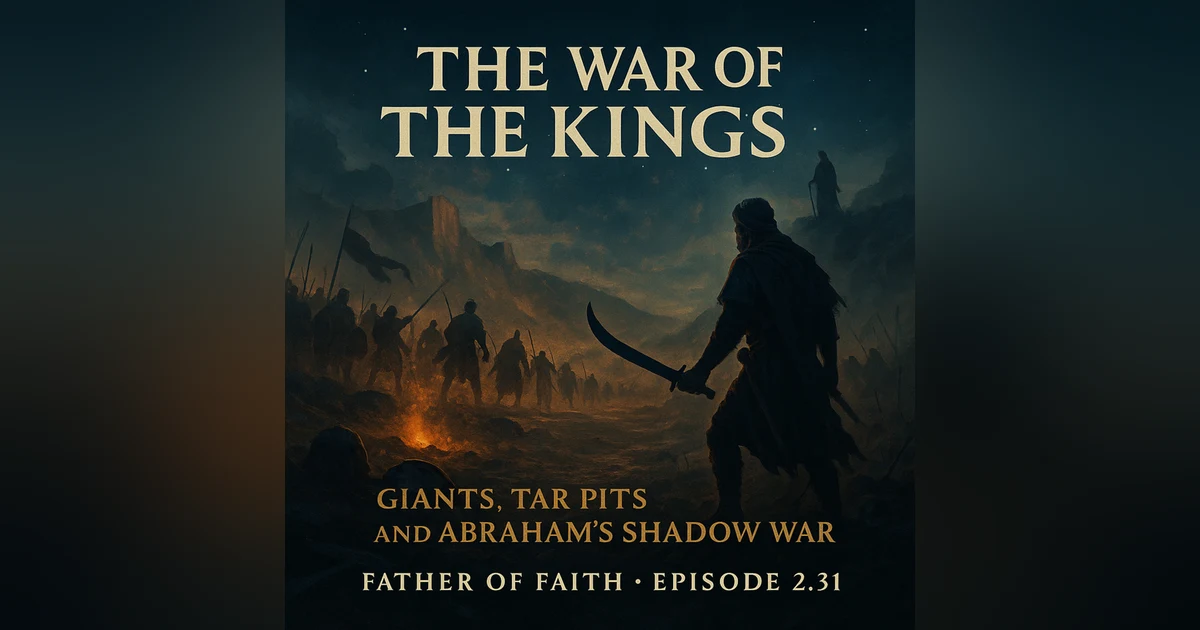
Abraham | The War of the Kings: Giants, Tar Pits, and Abraham’s Shadow War


 RSS Feed
Episode 2.31
Father of Faith: The Life and Legacy of Abraham – Episode 3
Abraham steps into a war zone. Genesis 14 brings ancient geopolitics, shadow wars, and unlikely heroism into sharp focus. In this episode, Zach and Michael unpack one of the Bible’s most overlooked but epic battle scenes: a four-king coalition sweeps through giant-infested Canaan before looting Sodom and taking Lot captive. Abraham launches a daring rescue, defeats seasoned kings, and meets the mysterious Melchizedek. What’s going on behind the scenes of this battle? Who were the Rephaim, Emim, and Zuzim—and why were they targeted first? This is no ordinary war. This is a war for legacy, loyalty, and the land of promise.
Find our videocast here: https://youtu.be/S5SOSutcC44
Merch here: https://take-2-podcast.printify.me/
Music from #Uppbeat (free for Creators!):
https://uppbeat.io/t/reakt-music/deep-stone
License code: 2QZOZ2YHZ5UTE7C8
Find more Take 2 Theology content at http://www.take2theology.com
0:00 All right, Zach, Yeah. Got a little quiz for you. Oh. Man. So I was reading this that we're going to talk about. Oh, nervous. And there is a name of a place in here. Oh boy. That is in some fiction writing. But it just occurred to me like how often are biblical names? And I'm not talking about like your kind of ones who have reached in the comic coming out. Like you can find lots of Davids and Matthews and Johns and stuff. But like some of the more obscure places and names. And it's it's a subjective call. I want to obscure or not. But maybe I was thinking maybe how many you can name that have made it into like books?
0:42 Popular. Culture, Bible names of people or places. Yeah, man. Great. So you got to think of people a little bit off the beaten path maybe. I mean, maybe they're common stores, but names that are or places that are not. Totally. One of my favorite places in the Bible is Middle Earth. Read about that a lot. Let's see. So one of the names of Aragorn, his Elva name is a lesser. And there's a place in the Bible. It's not spelled exactly the same, but it looks like it's pronounced exactly the same a lesser. OK, there you go. Let me think if I can think of, I'm trying. So can we think of Lord of the Rings specifically? There's some.
1:24 I don't know anymore in Lord. Of the rings. OK, give me. Will that give it away if you give me a story? Maybe Moby Dick. Oh, locked. OK. I don't know a lot about it. Oh, let's see. I don't know. OK all. Right. So the the narrator, it's kind of first person, well, not first or second person. Like I did this, I did this. I guess that is first person. His name is Ishmael. Ishmael. The captain is Captain Ahab. OK, yeah. So we're picking, you know, maybe not everyone's favorite characters here. Yeah. Sure. Jeroboam is the name of a ship in Moby Dick. Rachel is a whaling ship in Moby Dick. Peleg is the name of a Quaker owner in Moby Dick. So so Herman Melville went all out in these biblical references.
2:14 The one we're going to get today. There's like one of the kings is from Shinar and that is a a place in the will of time. So if you've read through the Will of Time series. Love the will of time. Love it. Yeah, yeah, yeah. All 1314 books. So good. Yeah, so good. What's what, when where did what era or what is it different like universe, world? This takes place will of time. Yeah, yeah, yeah, yeah, yeah. Yeah, OK. That's all I need to know. Yeah. There is like the Steinbeck novel East of Eden. OK, I recognize this. Yeah. Megiddo is in the Omega Code. Oh, OK Omega Code 2. Just some others.
2:58 Nineveh is title setting for plays and novels. Many. I guess there's more. Babel was a 2006. Film, yeah. Nebuchadnezzar, the name of Morpheus's ship in the Matrix. Oh yeah, Matrix got a lot of those. Parallels. Yeah, yeah. Interstellar. Interstellar in the book of Eli, both mention a Methuselah. OK, I think Yeah, well, yeah. So they're they're they're Babylon. Armageddon, Lilith. OK, yeah, I'm, I'm good. Did. Did. It dropped out but came back. OK, All right.
3:40 Do we trust it to keep going? I think it'll be fine. All right, one of our many technological issues that's. Great. You know, maybe, maybe do you think when we started saying like Middle Earth, it like it tuned out? Maybe when I said, you know, a Polygon or or Armageddon, it was like, whoa. That's great. You know, pulling from, that's a deep cut to pull from these kings. Yeah, yeah, yeah. You know, that's not what you're, you know, great. Yeah, So, yeah. So I think we're excited for this episode. I'm. Excited because I think this gives a lot of context. You know, it's something me growing up like familiar with this account, but not really.
4:20 You kind of are like in my mind, I'm like, what's a tar pit? I don't it's like you don't have, it's not like, you see, I mean, I know what asphalt is. It's just, it's like some of this stuff is like, not as a kid, it's just a little bit different, you know? Yeah, it does it different. All right, so we're going to talk about these kings and take it to the next level. From the hearts of the Low Country in South Carolina. It's the Take Two podcast where we take theology to the next level. Genesis 14. What an epic story. Yeah. So last time we kind of talked about 12. That's right.
5:02 Skipping 13 for the most part. That's right. That's a little bit interesting Lot in Abraham divide the land, but nothing major. Lot just gets mad. It's just like there's not a whole, I guess it's, it's the redeeming quality of Lot's. Like he like latched onto Abram, like, like, like every time, you know? He's in Hebrews as a person of faith, and it's like. Yeah, that's, that is something, yeah. Because he does not get a lot of love in chapter 13. He just looks very. I mean, I'm sure I don't know how the conversation goes, but it always, you know, gets picked like, well, Abram was like so kind and saying hey, pick and he's like, I want the best today. And no matter what, even maybe it maybe it wasn't that harsh. Maybe it was like, you know, some more back and forth.
5:44 But yeah, yeah, you know. And then he gets kind of some forbidden love later on and it's like. Yeah, not, not, not great. So we're I don't think we're going to do a three-part series on, on that part of last line like we're just going. We need to really dive into the motivations that's going on here. Yeah, no, we'll probably just kind of skip that. I think I've shared this before, but we were doing this Bible study plan and I had to go unravel for work. And so the very first night that I'm not there, Jill is with like Chloe and Lydia and they're probably, you know, 5th and 2nd grade and Paris's, you know, kindergarten or something.
6:26 And it's, and it's this story about what it's. Great. They're like, So what happened? Yeah, like. Oh, that's gross. Well, we we are on chapter 14 where you know, a flat gives me PTSD from Ezra Nehemiah and reading these names, you know. Joel, he read through these names. He did a pretty good job. So we got these 4 kings from the East. 4 kings from the East, yeah. One of them is kind of southern, maybe like around Babylon. OK, I thought you're about to like make a pun on someone's name. Like it like sounded southern but I got. You literally, yeah. But yeah, literally I think he's more like present day like southern Iraq, that kind of area.
7:08 But some a lot of them seem to be coming over from like northern Iraq and and over like so that Mesopotamia general area maybe slightly east and of of Haran and. And you made this point last time in passing about these, you know, different city states where it's not like, you know, 15 cities that are all connected politically and they're all, it's like every city state probably had, you know, full autonomy and sovereignty and would look to trade with other nations, have their own king. And it's like more maybe centralized in one spot. And so, you know, that that's a little different than like, it's not like Russia and the US and China, you know, are getting together for a war.
7:51 But still we got these, you know, different kings. And I do have a map of this as well, a kind of their journey. And so what's going to happen with these kings is they are going to come around and almost kind of follow Abraham's path. That was helpful, pastors, that map that showed everything. Yeah. So they're going to come around like if this is, let's say this is the, maybe I should just point it, but I don't know where it's going to be. So I don't know where my. Heart's going to be. But you can see on this map I'm showing that they're going to come down and really go on the western side of the Jordan River, and they're going to fight several little nation states along that way until they even get into like the Negev, like South, almost into Saudi Arabia.
8:40 They got some people. They take care there. And then they start working their way back up the eastern side of the Jordan River. And that's where they come into the five cities that will be destroyed. I think Genesis 19, Sodom, Gomorrah, Tyre, Zoar and one other, they go by the Tyre, Tyre and Zoar, they have different names, but it's those cities. And then they're going to kind of go keep going North East of Galilee and start heading up kind of where present day were not present day, but where the Samaritans would be kind of headed towards Damascus.
9:23 Well, while they're on their way there, that's where Abraham is going to assail them and kind of win Lot back. Oh, that's good. Big. Overview Overview. Yeah, that's, that's super helpful. So if we're starting like this, well, do you want you want to read their names, Michael, just so people can appreciate it. Yeah, yeah, yeah. Let's let's give this a, a go. MMM. Raphael King of Shinar. Love it. This is the this is the thing that the the Shinar. Yeah, yeah, yeah, yeah. Ariat, King of Alessar, which is the name that I told you about Aragon. That's right, yeah. And I've seen this as cheh and keh, but I think it's keh. I think it's AK sound.
10:07 I think it is AK sound. Kedor Lamer. Kedor Lamer. Sounds good. Name of Elam and title King of Goem. And Goem here is just the word for nation. So we don't really have a lot of information about where he's coming from. And we talked about kind of the campaign path down the eastern side of the Jordan, down in the Negev. And, and this and this is where where if your name is Claythor, your ears start to perk up a little bit because you start in, in my, I never can memorize all of them. But it's like, if you hear those Eames, those anakims, those raphi Eames, that's a good sign that you might be in a Nephilim territory.
10:49 Exactly. And you listen to the first three of the places. So as they're going down the eastern side of the Jordan, they get the Raphaim in Astaroth Carnium. So these are people who probably serve Asharath, that female guy that that connection is crazy. The the Ashdraff Poles, the Zuzim in Ham, possibly the Zam Zoom men of Deuteronomy 220 they were. If it is those people. Giant people. Yeah. So maybe that's like a shortening or a different way to say reference them. I mean it would make makes makes sense.
11:31 And the Raphae, the Raphaeim are giants, purportedly. That's right, 'cause I I think Raphaeim. I can't remember which Raphaeim or what the maybe next iterationist is kind of tied. That's kind of tied to Goliath in a way. Like with like there's some connection there like. He's a descendant of them. Yeah, like exactly. Imim probably where M&M came from. Probably. EMIM in Shava Kiriathiaim and these people are also mentioned in Deuteronomy 210 through 10210 through 11. And they were also noted for their size and strength.
12:15 And then they're going to continue going down to the Horites, which are cave dwellers. So now we're getting more S into present day Israel. Then they're going to sweep further South into El Paran on the edge of the wilderness, turn back N striking the Amalekites in at in mash fat or Kadish and the Amorites in Hazza zone Tamar, Hazza zone Tamar. So Amalekites and the Amorites, so two different people as they are coming down now they're going to go turn back up the West side of Jordan and they're going to there's going to be a battle in the valley of Sidham.
12:58 So this is where these five kind of city states are near the Dead Sea with their tar pits, and that's the bitumen deposits. And I, I will say this real quick, like these, a lot of these people, you said, you referenced them in Deuteronomy. It's just interesting that they kind of like hang on for years and years and years. And this is, these are the people that it's like, oh, why the Israelites were so scared? Because they did have this strength. And they're like, I don't know about about these guys, even though they were with God and they could like, you know, knock out these countries left or these these nations, I mean left and right, but these people were the ones. That made the 10 spies. And that's why they did not that's why they, you know, failed their test, essentially had to wander and then the pass. It had to go through them eventually, but same same people.
13:49 It's like it's good to. Connect those. But Moses, you know, got this on his mind. Yeah, that is yeah, 'cause Moses will be writing this. Yes, yeah, right. After they had failed. Yeah, that is. That's a good point. So now we're going to get to the Valley of Sidham. And so we have these kings, the five kings. So the four kings from the Far East are going to face the five kings of the valley. There's Bera of Sodom, Bersha of Gomorrah, Synab of Admah, Shamember of Zeboim, and King of Bella or Zor. And we're not, we're not given that King's name. So there we see Sodom, Gomorrah, Zor, either Admah or Zeboim would be Tyre 'cause we know Tyre is one of those, those five cities.
14:39 I'm not sure which one is those. The five kings are routed. Some of the people as they're fleeing fall into tar pits and you know, others escape. And in that tumult, Sodom, Gomorrah is looted and Lot and those cities goods are taken with those kings. Now that that that's great. I would love to it just like I want to know exactly like how like how big these tar pits were where they were. I've like always like looked up pictures of like tar pits and stuff. You. I would just think that these kings in the Jordan Valley would like use geography to their advantage, you know, versus like, but maybe they were just smaller and, you know, couldn't keep up or, or whatever. But it it just like, it seems like a massive battle, like 4 kings versus 5.
15:27 And it's like a lot going on. Yeah, and you wonder how what their losses were along the way if that played into Abraham being able to defeat them. I don't. Know that that that's true. Maybe it was about a lot of geography. I mean it's like a lot of mileage is covered. So then from here they kind of make make this retreat N marching up the eastern side of the Jordan past the Sea of Galilee toward Damascus. OK, so we're we're going around. Someone escapes and alerts Abraham that Lot had been taken. So Abraham is going to rally his troops. 318 trained men. Yeah.
16:08 Yeah. Are they soldiers or are they shepherd soldiers? We're not given, but we're just told they're trained and he's going to ally himself with the Amorites, Honor, Eshkol and Mammary. Mammary. I know there's NOK there. Yeah, I always recognize Noko. Mammary I It's interesting too, aligning himself with the Amorites. Just, you know, just to think about. Right. Yeah. So we really can't get on to David for. It's like I'm just Abraham. Helping with the Philistines while pretending to help with the Philistines while he's actually slaughtering them. Because that is interesting if he's got, I mean, I guess he's got all these other. He's got a good kind of, you know, group of group of people with him. If he's got 318, presumably, maybe they do too. Maybe they're larger and right's probably have been there longer than he has.
16:58 So maybe he just has the maybe people just like Abram because, you know, he's a good guy, you know, and God's blessing him. Yeah, yeah. And probably these people were like, if we don't stop this. Yeah, what? What's going to stop them from coming, getting us the next time? Yeah. All right. So tactical smartness, man. So we don't know who who the genius is. Is it Abraham or someone he's with? But they split up their forces and they surround these folks and they kind of ambush them at night. Man, near near Dan, which is like you're getting pretty far up north there in Dan, Dan's territory and things go well, ambush success. Yeah, yeah, yeah.
17:39 So Lot is restored to his home, Abraham and and they get a whole bunch of stuff. Get all the stuff. Yeah, they get a lot of stuff. That's right. And so Abraham is returning home and you wonder because this is not necessarily on his path there. Did you have a audio blip? No it. Didn't OK. This is not on his path, but he makes it down to Salem. Yeah, interesting. Jerusalem. So what do we know about Salem? It sounds a lot, I mean peace, and it sounds a lot like J Roof Salem. Yeah. So this is, you know, Salem is kind of where present day Jerusalem is. He's going to meet Melchizedek. We've done an episode on Melchizedek.
18:21 So you can go back and find that the question is that we're trying to answer, is he a Christophany or is he just a person kind of a type of crime? But Abraham is going to give how I understand Scripture all of his share, which is 110th of the total. So it you could one verse you read, you think he gave 110th of it and it's like, I'm going to tithe off of this 'cause I don't want anyone to think I was made rich, but I'm like, you're keeping 90%. But if you keep reading the full context, I think his share was 110th and so. He gave. All of his 110th to Melchizedek. I think that's the correct reading. OK.
19:03 And, and the trick is Melchizedek, he is this priest the God knows high also he's king of of Salem. So king of peace and king of righteousness is what Melchizedek means versus he's a king of peace. Yeah. Yeah, yeah, All right. And so Joel came down on the side of not a Christophany. We recorded that and we're like, I think we were like maybe Christophany. Have you where, where you, where do you stand today? What percentage on one to 100 Christophany? I think it's very plausible. And what so did we, we had two separate episodes on. We had one on, on, on Michael and one on Melchizedek.
19:43 Yeah, I feel like I was much stronger on the Melchizedek versus Michael. Plausible. Maybe not sold Melchizedek, I'm not sold, but I think I lean in that direction of a Christophany. I probably. Lean that way too. And just to clarify on Michael the Archangel, not to be confused with the Jehovah Witness doctrine. We are not bringing Christ down to Michael, but maybe suggesting that Michael was the Archangel like the the proper name of the not pardon me, the Angel of the Lord. Like Michael may have been the name of the Angel of the Lord and so. Was another name for God the Son. That was what we were. Talking about yeah, it, it is. So it's just interesting thinking about if you know, Melchizedek, King of Salem, and then I don't know, I don't know, you don't get all, you just don't get a whole lot of other. So it's like he's there.
20:31 Then he's not like Jebusites are like there. I don't know. It's like, you know, a Malachite. You like come across all these names a lot, but it's like he's there that he's not there. Yeah, and we get we get told about him. He shows up with Abraham 2000 BC and then 1000 BC Dave is going to reference him. And then around 60 AD, the writer of Hebrews is going to reference him. That's what you're on this. Yeah. And that that's it. Over thousands of years, not a whole lot. It's very significant, but not not a lot. Pastor Dole did mention this Temple 0, which is, you know, some concrete, you know, proof of some something was happening there with the altar and that kind of thing. But yeah, so, so fascinating.
21:20 That's all that happened, right? It's so it's so interesting. Yeah. Abraham Day, you got all these people just writing all about it. Great. I love doing that. That episode with Clay was really, really good. All. Right. And so that's really where the story ends. He's going to go back. But I thought we could maybe do a deep dive on these kings and on the peoples. So I have a table in our notes from these kings. So MMM Farfel and Raphel M Raphel, king of Shinar would have been from southern Mesopotamia and maybe Hammurabi Link, but it's less supported. So we're trying to figure out where these kings came from. Ariat, king of Elisar, the names means servant of the moon God and so we think he's probably you know from this area maybe an Amorite vassal.
22:22 So Kedor Lamer, King of Elam, Elamite royal type name and matches the Elamite usage. And then we have title King of Goem, possibly some type of Hittite or Gooshian leader. Goem just means nations that we mentioned before. Just could be maybe a someone they gathered in as part of the coalition to round up their numbers. Very interesting. Got some. I I like this little and it's just such a different context, like having all these maybe a little vassal kings to these suzerain kings and how there's probably a lot of these nascent states, city states that just like served the other one kinda and have played up paid a lot of tribute, big ones, the little ones. But that's so interesting.
23:13 So based on this chart back in the day, it's like, oh, Hammer, Robbie, people thought that was more connected. And then as more maybe archaeological evidence or whatever has come to light, they're like, OK, maybe we just said Hammurabi because that's like the only person it just, you know it, you know, that kind of thing. Yeah, yeah, yeah. Cool and it and it says these people are like Amorite and Hittites, but they must have been of that lineage but moved east. But they're coming back. I I don't understand why they would fight against you know, so I'm not a near ancient near Eastern expert and and you're not either or are you you.
23:54 Don't know me. You don't know that. Don't make judgments. No, but definitely, definitely not. But what and what I'm also not is a expert on nepheline. Yeah, yeah. But Raphaim and their neighbors, that, that is fascinating. Yeah, this, I thought this was very fascinating. So we kind of alluded to this at the beginning, but this Mesopotamian coalition, they March into Canaan in Genesis 14. And do they have a beef to pick with Sodom, Gomorrah? Yes, because those kings had stopped paying tribute. We're told that explicitly, kind of. But they. Don't go right there. And the people they go after are at least the three people. And if you read some of the more current supposed Nephilim encounters, they happen in caves and the fourth people are cave dwellers. So the fourth people, the Horites are not necessarily known to be.
24:48 They're not stated to be like large like giants like the other three, but they're told to be cave dwellers. So you might have these like, you know, people who have, you know, good cave tactics and stuff and fighting. Yeah, yeah, yeah, very, very interesting. And it's like all these things, I think it's hard to lean on one of these arguments super hard. But there's like 18 argument. It's it's just like you stack them up and you're like, OK, maybe not any of these one things I love 100%, but it's like, man, you put them all together and it's kind of, it's very compelling. Yeah and when I was doing this research and like I, you know, I'll do some research, I'll find something on the website, I'll throw it in and I'll talk to ChatGPT about it and and Chet GPT used.
25:28 I almost said he I don't want to say he don't personify him. Use this word bread crumbs, bread crumbs. And it's like. Yeah, that's right. That's a good sign for it. It's like, yeah, if we follow the bread crumbs, it seems like Moses is saying something that his audience would have been familiar with at the time that we go, OK, are you trying to say something? Is there something going on behind the scenes, which I think maybe there is? I, I, I think you're probably right. So let's, let's talk through these again. We've talked about a little bit, but the Raphaim repeatedly LinkedIn the Old Testament with that height, with that strength. We've referenced Genesis 2 several times. It says to the about the Raphaim. They were great, numerous and tall like that Anachem, which is another, you know, giant group too that maybe wasn't mentioned in this group but mentioned in numbers and then. And you said just say, just just to clarify, you said Genesis 2. Oh, sorry, sorry.
26:21 Drug two. Yeah, yeah, yeah. And then and then from the from the Bible character drafts, you know that, Cordell. I love it. Yeah. Had that bed that was over 13 feet in Deuteronomy 3. So presumably he just didn't want a place to spread out. But he was really, really tall. Yeah, and he was reportedly the last of the Raphaim. Yeah, raphaeum, however it's pronounced. However, it is while, while you're going through some of this, I'm going to look up, I'm going to, I'm going to try to find the connection between Goliath and the Raphaeum. And then lastly, the Raphaeum, they had a stronghold in Ashtaroth Karn name which Karnaeim which is in Bashan, which you know if you've read through the Psalms and you know you have OG king of Bashan. This was called the giant country. And so it seems like this coalition is like, you know what, these people stop paying tribute, but we should take out these dangerous people too, or at least reduce them in numbers. So that's the Raphaim.
27:22 The second place that they hit is the Zuzim in Ham, often considered to be connected to the Zam Zum meme in Deuteronomy 220, who were also called a people great and numerous and tall like the Anachem, likely lived in the Amorite territory just east of the Jordan River, and their name may carry an anomano pH. There you go. Flavor as buzzers or murmurs, possibly referring to war chants or intimidating battle tactics. So if you had these giants going, you know, something like that, then you might call them the Zazim. Here's the connection.
28:02 So we talked about Raphaim. Connected with them are the Anakim Anakim in Joshua 11, it says that Joshua wiped out the Anakim for most of the land except for Gaza, Gath and Ashdod. So Gath Goliath is from Gath and describes him as a giant and describes him as a descendant of the Rapha, which people connect with the Rapha aim. It's like maybe not just a short full of the end. Exactly. And so presumably the Anakim who survived Joshua's conquest fled to places like Gath and over generations, they're only just continued and produced, you know, some giants here. So that that's that's the connection again, that's like that is like a breadcrumb you following that. But you know, with all these things, it you know, makes makes sense.
28:52 All right, so we talked about the Raphaim, the Zuzim. The next place that this coalition of four kings hits is the Emem in Chavez Kiriathaim his names. Again, Deuteronomy lists all these, so Moses is clearly making a tie here. Deuteronomy 210 through 11 records that the Moabites called them the Amin, meaning terrors. Same description given. They're great, they're numerous and tall like the Anakim. Their territory was the South, you know, which is what we see in what would later become Moabite lands. Finally, I'll take this one.
29:32 Really hard to pronounce the Horites in the Hill Country. Seer name means like you were saying, cave dwellers, not necessarily described as giants, but masters of this rugged terrain with that tactical stuff. They, you know, maybe did mining or stone work. They had, you know, mountain warfare probably under wraps. That's like their home territory. They knew how to how to battle there. So that those are the four peoples defeated in that Eastern sweep. And I asked Chad if there was any evidence to indicate that these kings, the coalition of four kings, had giant blood in them. And there's really no link. But you maybe think maybe these are rivals. I don't, I don't know. You're trying to think like, hey, we're going to go after the meanest, baddest folks for what reason?
30:18 To just take out the threat. You know, if there's a ladybug and a wasp, I'm killing the wasp, you know? So maybe that's why maybe that's what's what's going on. I'm not not sure. Yeah, that's man, it's so interesting. And it is also interesting in how all of this maybe relates to Abraham in a way this, you know, person proclaiming Yahweh and battles and all, all of this, all of this kind of thing. But you, we have this good question here. Is there a theme? We've kind of been talking about that a little bit. I mean, you it, you can't not, you can't be like, oh, just three of these are really tall groups. No big deal. I think if you read it and you, you see the connection there, then you go, OK, clearly Moses is saying something there. He's he is laying something down. Four of the the peoples are LinkedIn scriptures. Three of the four are linked to giant clans. And then the third one is known as these cave dwellers, cave fighters.
31:19 And so, you know, I'm guessing they're trying to take some some potential dangerous enemies out and, you know, so suggestions neutralizing the most formidable, formidable warrior people's first securing travel routes. So maybe these people were exercising taxes and these people wanted goods to move over them. And so this would have been along the kings, the way the kings or the what is that called the? Yeah, the whatever highway or Mustina Del Mar or one of these things, I don't know. And then maybe possibly targeting clans with it, which they had long standing feuds, but clearly they were targeting these these people with giants in them. And you have to imagine, you know, if you're got these city states there, there's probably always skirmishes going on. It's probably like, oh, your uncle died. I don't know.
32:13 There's like all this bad blood that probably goes way back. And your grandfather said, if you ever see these people, and then it's probably always occupying more land or taking more resources. It's probably an ongoing kind of thing. And then you do probably want to be the top dog. I can't. I'm just asserting my my dominance so people know, like that's what's up. Yeah. And that was the conclusion that this is probably less like our modern day wars where we're just more like an ancient gang turf war where we're like, we're going to be the top dogs. We're going to own this via Del Mar the the, the road of the Kings, we're going to be the number one.
32:54 So we're going to take these folks down, make them pay tribute to us. So. And and if I were to ask, maybe the average evangelical on the street, like, hey, let's write down like top five favorite things about Abraham. I, I mean, maybe this comes maybe does it is a prominent thing like this is a story, but people probably wouldn't be able to tell you more than Abraham the PDC. Maybe they skipped straight to my kids. And Oh yeah, he had. To rescue lot, Yeah, yeah, yeah. That's probably what he. So, yeah, why does this, why do we have all this detail of these things, like, why don't, why does it just say that Lot was captured and Abraham, you know, rescued him? Yeah, yeah, that's very good. All right, so I'm skipping done #4 in our notes. Why does this matter for Abraham's story? Kind of the question you were just asking. By the time the Mesopotamian army reached Sodom and Gomorrah, they'd already steam rolled through most of the intimidating forces in the Levant.
33:45 So that makes Abraham's victory against that same coalition even more remarkable. You know that he's got his 318 plus whatever allies he has. That's yeah, pretty, pretty amazing. After all that's going on, he's still gonna take take on on these people who just, you know, laid the smack down to these these giant clans. And so you think of location, Transjordan Highlands, Bashan kind of area. We read over and over again, great sized Anachem Nephilim linkage book of Enoch. Also if you say that three times clay also does appear makes maybe this connection a little bit more explicit between fallen angels, giant clans and the pre flood corruption.
34:31 Post flood Raphaim is often seen that that's like the remnants from from all this from Genesis 6. Yep. All right. And then the five cities before destruction, because, you know, in chapter 19, if I've got my, if I'm remembering, I think that's right where Sodom and Gomorrah are destroyed. If it's not 19, it's it's right around there. These cities were known as being fertile. Oh yeah. Wealthy trade hubs along the Dead Sea route known for moral corruption. Yeah, yeah. And isn't that? Just so amazing that like to this say names associated with moral corruption. You know, it's like it just like it's one of those things. And I don't know if that's like Americanism or if it's like, no, when the 1200s, if you said sodomy like that, I mean like in whatever language you were in that carried the same wait, I don't know.
35:26 And then this is a question. I lift up tarpits today. Yes, natural asphalt still occurs in the region historically mined for use in waterproofing and construction. So there you go. There you go. There you go. I wish I had more experience with some of this, like geography, because it's hard to envision. You go to the Dead Sea area today and boy, is it just like desolate, like it's just man, that it just. They haven't even. They haven't really. Like there's no houses that live around there. Or they, they, they do have like resort like they have like Dead Sea, like resorts for like fancy people, but. It's like. It's like, yeah, it's like desert. And then they like Rhodizer. It's like they're on for like the spa and the salt and all this stuff and like some industry there for that. Was there salt that you could pick up? Oh my.
36:13 Oh my goodness. You go in the water and you just go in the bottom. Yeah. And it's just like handfuls. I've got some of my house that I just like kept like brought. You like grind it up and salt? Your I, I never looked. I mean, it's, it's like it all like turned into like salt crystals based on like the weather and stuff here, but it's like everywhere. It's one of those things that you're not thinking. It is really hard to go under the water because it's so buoyant. It like forces you up and you don't want to go under the water because you're even ice close to it instantly burns. Like everything burns. It's like not super comfortable if you have any kind of cut. It is just crazy. And the water is like very warm. I mean, maybe because I went in the middle of summer when it's like a bajillion degrees, but it was like it just so interesting.
36:55 And you can see just like probably other, you know, places like this, but it's like it's receded so much. There's like, but you can just see like where it was probably 10 years ago, 20 years ago, which is like. Why is it receding? People aren't using that water. Or maybe they're pulling water out of the Galilee. Or I don't know what. It looks insane, like you can just see where it had been maybe 100 years ago or something. Anyway. Estimates that Abraham's force would have been 500 to 800 people. Perhaps an underdog type victory with the element of surprise against them at night. Yeah.
37:38 So all right, takeaways Abraham and Genesis 12 verses 14 kind of talked about this last Tuesday. But he goes from a self preserving and fearful in Egypt to bold and decisive and rescuing Lot. I'm just glad he learned his lesson from Egypt never to be repeated. Again, never to be repeated again. He'll never struggle with this issue again. Wink, wink. Oh my goodness. Yeah, that that's interesting. You know, maybe you one, you know, it's just, I mean, it's a much larger scale, but you know, there there's ups and downs, failures, victories and that kind of thing. And I like this note that Abraham refusal of spoil shows Abraham's allegiance to God over political and economic gain. Because there's probably a lot of both of those things at stake with with all these different things. All right, some questions to consider. Why does God sometimes allow his people to be caught up in other nations conflicts?
38:34 It happens like believing the Palestinians. Yeah, that is caught. Up in in between the the Muslims and the the Jews man. Why does Abraham's growth between What does Abraham's growth between chapters 12 and 14 say about sanctification? What does his future fall say about sanctification? How should believers truly balance alliances with unbelievers for just causes? So that's a good question. Maybe you should roll over into a politics episode in the future. And then was the meeting with Melchizedek a mere historical encounter or divine foreshadowing of Christ?
39:16 So. Man, a lot of good things to think about. That's Abraham. Abraham episode #3. Three. Yeah, yeah. Any anything else about this account before we leave our listeners? And there is a there is a fourth Abraham episode down the Pike. Oh yeah, yeah, nothing more than I have. Me either, thanks for talking about Raphaim, Aikim, all this fun stuff. We will catch y'all next time. That's our take. Thanks for listening to Take Two. Find us wherever you find podcast and on YouTube for those who want to watch our video cast.

