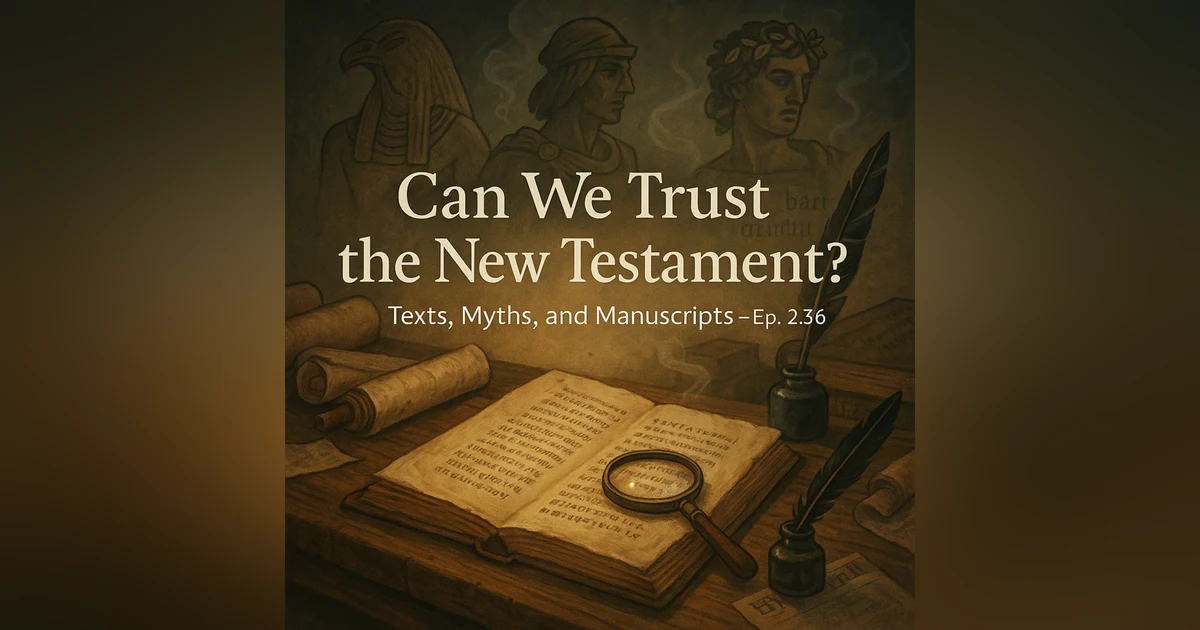
Can We Trust the New Testament?


 RSS Feed
Episode 2.36
Texts, Myths, and Manuscripts
Is the New Testament historically trustworthy—or just a rewritten patchwork of pagan myths? In this episode of Take 2 Theology, Zach and Michael respond to online critics who claim the Bible is unreliable and Jesus is just a recycled myth.
Covered in this episode:
– What do textual variants actually show?
– How do the Dead Sea Scrolls impact our confidence in Scripture?
– How was the New Testament canon formed—and does it hold up under scrutiny?
– Are the popular “copycat messiah” claims (Horus, Mithras, Dionysus, etc.) grounded in truth or internet fiction?
Drawing from respected scholars like Bart Ehrman, N.T. Wright, and Ronald Nash, this episode unpacks the facts and clears the fog—so you can know what the Bible really is and why it still stands.
Lutheran Satire Video--Horace Ruins Christmas: https://youtu.be/s0-EgjUhRqA?si=dNr0t7vhazj-Afkm
David Wood is the gentleman whose first name Michael could not remember.
Find our videocast here: https://youtu.be/rPZV4u8C1zc
Merch here: https://take-2-podcast.printify.me/
Music from #Uppbeat (free for Creators!):
https://uppbeat.io/t/reakt-music/deep-stone
License code: 2QZOZ2YHZ5UTE7C8
Find more Take 2 Theology content at http://www.take2theology.com
0:00 Well, I was thinking, Michael, if this podcast thing doesn't work out for us, I mean, we committed to it a little bit. I was thinking like, what's a good backup plan? How can we, I'm gonna see if I can find here we go my notes for this. What what's a good backup plan that we could do? And I thought is this? For fun or for industry? For fun. I don't know what the audience is, but maybe there is. This is a. It's a little bit of a weird idea. No, I would expect nothing less. Yeah, you're like, what else is this? That's what we've been doing. For the last couple weeks, this is the this is the guy who's like, hey, let's take one claw off a lobster, throw it back, sell that claw to eat, and then let it grow another claw. I stand by.
0:41 I stand by that idea. I was thinking you guys go out to eat on Sundays a lot. We do. I think we should. We should review restaurants put with a theological bent. OK, so I I'll give an example. We can workshop this like like I, I got this idea from a podcast that I will listen to. Sometimes this guy or he writes columns or he'll do stuff where he will talk about sports players, but he will do it like with different categories. And I was like, maybe we could talk, for example, a couple weeks ago went to Moe's. So and I know you're familiar with most. I thought we could we could Moe welcome. Yeah. So so some categories if we talk about the hospitality, this exactly what I'm talking about. The the fellowship factor is is what I was, you know, you look at a restaurant is is it X242?
1:30 Is it like this communal, like we love each other, you know, or is it like the diaspora? Is it like First Peter where the 12 tribes are scattered? It's tough out there. Like this is what the people want and welcome to Moses. Great. It is great and their tables they will easily slide together, yes. So if you have a large party, which we have had like I've been there once, the Mots and the Petters and I think maybe Trey and Kelly Hawks family. They're not easy to accommodate all those kids and families. Yeah. But but Moe's did. But Moe's does. That's right. So it's so and I was thinking you're thinking, you know, maybe each of us think of a restaurant and we could like have pre thought biblical puns ready and the other person can chime in too. But I think we're on the same wavelength here.
2:14 Other categories. I was thinking, I was thinking of Paul and you know, is this is this restaurant orderly or is it chaotic like you know, and not saying one's not. Gonna be talking about like meat sacrifice to idols with Paul. Now there's this restaurant. Where do they get their? Where do they get their proteins from? We could go in a, in a, in a lot of directions. I, I had a category about hospitality. Thinking of it is the hospitality of Abraham, you know, like right there or is it not there? Moe's fits that bill. Speaking of, can I? Can I help you? Yeah, please do. I have. Noticed maybe the past six months, everyone at a restaurant says welcome in versus versus welcome or welcome to Moe's or welcome to Texas Roadhouse or it's like welcome in. And that's just like a new, it's a new phraseology for me, but man.
2:58 Yeah, I'll, I'll, I'll pay attention to that. That might be like a little sub, a subsection portion size. Is this a loaves and fishes situation that can feed everyone or is this like the mana in the wilderness where you're trying to hoard it off for yourself 'cause you're a little bit worried? Moe's man. It's it's there's enough for everyone. That's. With all those chips, they just. Like and then the chips. Yeah, that's exactly right. It's like. Chips in the salsa bar I I have gone to slow Moe's long enough to remember when they had really good names and they also had all of these look alikes. Do you remember that Where you? I remember the name like names I think. So the names of the salsa, like they had one that was Kaiser salsa. Something. And I'm going to forget them now, but they had, they had some cool names for the sauces, but then they also had pictures of like people like a guy who won the Michael Jackson look alike contest or stuff like that.
3:54 So they had all these, it looked like, and they would say something good about Moe's and they would actually tribute to the right. But it looked like, you know, Michael Jackson was endorsing Moe's. So I, I don't, I don't know if they got sued for that, but yeah. That's great. Another category it could be if you're a sit down rush or not, you know, was your cup overflowing? How were the what was the refill? What was the drink situation? Moe's again has the machine that has like 800 different options. Yeah. Did they prepare a table for you in the presence of your? Enemies. That's right. That's fine. Yeah, I love it, The Salm test. But animals refills my truck, my cup. My cup truly did overflow. It was great. Here's one I I came across. I thought this was pretty funny.
4:35 The sermon length test. Fortunately, Moe's comes quicker than a seeker sensitive sermon. In 10 minutes, you're getting your stuff. It's not a Puritan John MacArthur servant where you're waiting for an hour. You know there aren't. Yeah, there are some of those, yeah. And then there's another category. I was thinking, you know, is this place tide worthy? You know, are you gonna, are you gonna tip 10% or more? You know, is this, you know, do you feel like they, they, you know, it's one of the places that, that. So anyway, we don't use these categories. We can come up with different ones, but I think there there's a little bit here we can like rate restaurants, you know? Yeah. Is it, you know, maybe. Is it so bad you're looking forward to the second coming better? There you go. The more puns the better. And then and then like our final verdict to wrap it up, I'll be like 1 to MO's. Give it 4 out of five solos.
5:19 Like, you know, give it that. Yeah, pretty good, Yeah. Yeah, 4:00 to 5:00. And I was like, you go, you guys go at least, you know, every Sunday we go out of, I think between the two of us, we can like figure out some, you know, and I was like, podcast isn't working out. We can cut these aside and just be like, here's our Moe's review, you know, see if we get some. Stragglers Yeah, I left a review for some restaurant and I guess my and because we thought it was so good. Oh yeah. And Chloe was like, we're I'm going to leave one too. And she saw mine show up and then she clicked on and she read all my and then I don't guess my family knew, but I'm like, I guess I'm pretty. I mean, I'm sure there's more up there like, but I'm higher.
6:01 Than your oh because you rate a lot of stuff I. Rate stuff and people find it good and they're laughing at some of the things I said. They're like, there's all these pictures of our family at places and I thought you were more And I'm like, well, I if someone wants to find out pictures of our family, I think. They can figure it out. They can figure it out, Yeah. So what was the good place you went to? I'm gonna forget that. Man, that's what the listeners want, the hotspot. You're keeping it all to yourself, so. So keep the traffic down so you can have them. I'm old, Zach. I'm old. Though that's fine, I'll. I can look it up and then maybe get back to you. It's great. So anyway, Moe's, great experience, great, very welcoming, large portion sizes, the salsa bar, great drinks, whatever you want. You know, how can you go?
6:44 How can you go? Rum. Yeah, I don't think I don't. I don't love paying like 20 bucks for a burrito but everywhere you're going to pay money and you get a cheaper 20. Bucks but it seems like prices were maybe creeping up a little bit pre COVID, but it's like post COVID it's like the price exploded. It's yeah, you go. So you're like, I that was OK, very expensive. Yeah, yeah. I, I, Phoebe found a nickel on the street. She was like, I want to buy some candy. I was like, I remember. I don't know if, like, I remember at our local grocer, there would just be a box of individual jog ranchers, like 2 for a nickel and you could just give them a nickel and get like, maybe it was 3 for a nickel. I don't know. It was like incredibly cheap. And I sound like I, I know I sound like the, you know, the like I remember we used to build a movie and get popcorn for, you know, $0.50 type of thing. But yeah, so those days are gone. Those days are gone that I mean, we have to factor that into some of these categories.
7:37 You know, some of these places we gotta we'll come up with some. So if if you're listening, you have a good category like I'd like to, we could even I would like to get it to where it's like a well oiled machine. We like 3 to 4 go twos. Maybe we sprinkle on like some bonus ones based on it, but it's like give some consistency and we're not here just to say every restaurant's great, every restaurant's not great. We're we'll speak the truth. In the North. But we'll speak the truth. We love you. We're pointing these things out so you can get. Better. Yeah, that's. Good, that's so. Anyway, that, that was my idea. I'm I'm hoping maybe like a once a month thing we can, you know, roll this out, you know, so there you go. All right, what? So what are We'll preview a little bit. Oh, responding yeah to comments. I'm excited for these.
8:18 These are so good. Yeah, we had one and it got a lot of traction. And I think there's more to come back to on that one. Agreed. But you know, we'll let the moral argument settle for a little bit. Yeah, we. The only thing we didn't want to say is like Michael said, I think we want to come back to it. So we're not like skipping it with this. We just want to do IT service and we had this kind of already planned, you know, we you know what I mean. 'Cause if you listen to that one, our response, one, we're like, we're going to respond to two different ones and the other one took too long. And so we're like, OK, we'll just cut it off here. But well, and there have been a lot of I think 5960 comments, which is pretty I it's not Mr. Beast, you know, so that's amazing. More than one comment is great and 50s and.
9:01 You know, I was gonna say there's just one guy. I just don't know if I understand. I don't know if I'm on the same page as this. Reform Form D. He's yeah, he's little SUS. No, I honestly overall great dialogue and reform and specifically I know that's is it OK to connect names that bad? He used to have his name and then he changed it. So maybe, maybe he wants to say, Incognito, we know who you are. We know who you are, and I would. Appreciate you. Really appreciate you very smart and like not like. Well, he's in the medical field. So not yeah of. Course. But not only smart but good dialogue where I honestly reading through it was like he is assuming the best in this person. He's being very charitable and being patient even when it was it maybe patience wasn't it.
9:47 I was like, it was great dialogue honestly all around. Yeah, I thought so. And I've seen some comment sections go really bad, throwing out ad homonyms and stuff like that. And even for the people who disagree with us, we appreciate the dialogue being at a high level where you're dealing with, you know, facts and stuff. Even when you disagree sharply, you can do it in a way that is polite. So we appreciate that. I'm also thinking about getting on there and just being like naming in a Boo Boo, like like taking it down a notch because it was so smart and so good, but it was great. So this this is Part 2 of that original 1 taking on a comment. Let's go ahead and take it to the next level from the hearts of the low country in South Carolina.
10:33 It's the Take Two podcast where we take theology to the next level. All right, so we have a comment from. A great name. Great name, yeah. Is it it it with the comment was from? Is this 13 shadow? Wolf 13. Shadow. Wolf, I love the name. I love like YouTube names and handles. Shadow Wolf is a cool name. Whenever I'm going to make names, I like never know what to make. I just made like a Kobe 1. Like I was like Kobe forever or something, you know? And you do show up here. Kobe. Kobe forever. Oh yeah, and that was taken to Kobe Forever 824. What's 824 are? You serious? OK, OK, OK. I was about to get riled up, but but but this, this is great. I love, love the interaction here.
11:16 What? What's the first comment? Oh yeah, so shadow Wolf 13 Shadow Wolf says the fact that modern people still believe in ancient mythology is truly disappointing to witness. The people that wrote the Bible have absolutely no idea what they were talking about. And I appreciate this comment because I think a lot a lot of people are OK Bible written a long time ago. Why is it different than everything else from that time frame? We kind of like dismiss that ever progressivism like we're better today than we were 50 years ago. That's like common thinking I I believe, right? I think it can go in cycles because most, you know, you know, the Bible was written across, started being written around 1500 BC, completed around 100 AD. And so there's actually a lot of stuff written along during that time.
12:06 That's right. You have Plato writing for Socrates and himself Aristotle writing. Plato, Aristotle, like people go back to them frequently. Homer, the Iliad, you know, so there are some great works that people would look back and go, oh, these were some smart people. So you wouldn't want to fall in the trap that just cause it's a long time ago that you know these are. Cause 'cause I I but I like that you explain that because I think a lot of people just like default think that. Yeah. And, and they, they just think naturally, oh, you know, 100 years ago we have better medical procedures or, you know, people don't get like we have antibiotics. And if you go back 200 years ago, people were dying from like, you know, scarlet fever or, I don't know, It's like you're like, of course we're better, you know what I mean?
12:47 And I feel like there are definitely different measures where we are better, but by some measures we're not as good. I think we probably always trade stuff off. Like I heard one person going off on probably how dumb the founding fathers were. And I'm like these people, like, spoke multiple languages. Like, yeah, could translate like, they had a very rigorous, like, classical scholastic training. And so, you know, could quote like long passages of books and stuff. So they were very learned. I I was just reading this guy John Gill. He's like a Reformed Baptist pastor from like the 1600 Puritans.
13:28 And like, I was reading like I was getting a quote for a Sunday school I'm looking at. And like he like learned, he like learned Greek and Hebrew when he was like 9 or he learned Latin when he was 9 and Greek and Hebrew and he was like 12. And it was like, this was like he, he was like maybe an outlier, but not really. Like a lot of people did this. Was it? Was it John Quincy Adams that could like write in two different languages with both his hands at the same time? What what surprised me, it's like they knew all this stuff and we have more access information, but we don't know things and you have to. We can find it maybe, but we can't. We definitely don't know this stuff. Cold, right? Yeah, I think that is the case. So there was some back and forth. You asked some questions like, hey, could you explain that a little bit more? What do you mean by mythology?
14:12 I think I chimed in a little bit and asked, you know, basically recommended looking more closely at this, this idea that Jesus is based off mythologies. There's a little bit of back and forth. And again, it was all, you know, even though we disagreed, I thought it was all good. So I thought maybe we could talk about the Bible itself and maybe why it is likely more trustworthy than what you might think. And so have we. Have we already? We've done a textual criticism one, but I think this is good and I don't know if we took this exact example or approach. I think this is great to re talk about. Yeah. So just a New Testament in itself, there are around 138, a 136,000 words in there, and we have 6000 original Greek manuscripts. And that's for every book.
15:05 Some books have more than others and there's 27 different books there. And then on top of that, we have like 14,000 other manuscripts in different languages like Coptic, Syriac, some Latin stuff. So there's a lot of even outside the original language that scholars can use to like, well, what did they think that meant in that language to help them get back at? The results on top of it, I think we talked about a little bit of this claim, but you read like even the, not the, not the founding fathers of the church fathers, church fathers. And you can like maybe not put together the whole thing, but you can, you can extrapolate large passages based on, based on there's, that's not a, that's not a manuscript, but like just from the right.
15:49 And you can be like, oh, they're quoting this passage. Right now, yeah, Yeah. So, yeah, there are large sections of the New Testament quoted in their works. OK. But when you the The thing is, we have so many manuscripts in there and this is from here on out, it's all original Greek is what I'm talking about. There are around 400,000 variants that. Sounds bad. Why are there so many bearings? This is bad. It's what it seems. Like it does seem bad, but you can start like knocking away those 380 thousand of those approximately. These are broad strokes are spelling changes or word order like. Jesus Christ versus Christ Jesus. Right. Or in some sometimes you would put a an article in front of someone's name. So James or the James or you just would spell someone's name slightly.
16:35 Yeah, 'cause where they're spelling standards like we have today. No. So it's like you like with like big words you might like, it's acceptable to, I mean, whatever. Yeah, right. So when we're counting those, almost all of them go immediately away to like, you don't even need like as long as you could read. Yeah, you wouldn't figure that out. Then that leaves around 20,000 variants and 19,000 of those are what we would call dead on arrival. You don't need any training because like lots of times we'll see there's actually names for this, like where a scribe will write a line twice or he'll skip a line, or this is a singular reading. There's no other manuscript that has these 5. Paragraphs there point outlier like you could you could have added a letter and totally changed the word and it's like, oh, that you didn't mean sharks, he meant he was happy or something. And you're like, OK, we can get rid of that. So that gets us down to 1000 variants where you need training to figure out which one is the case. And of those 1000 variants, roughly 950 of them are very easy to solve.
17:42 All of the textual critics who have training, they basically agree on 950 of these. And so it gets down to around 50 variants where it's tough to solve. And different people will have different opinions on it. They'll say, I think it's this because of these things. And they'll write, you know, this academic paper putting forth why they think that variant should be read this way. And someone will say, no, I disagree. And I think the original text said X. And there's around 50 of these. And so and so you say 50. It's not that many committed to 400,000, but this is the Bible you're talking about. You know, what if one of the words was, you know, work save you or they don't say this seems like a pretty big, you know, could be have big implications.
18:27 Right. Well, none of those fifty are in places where that's the kind of thing that's on the line. And so one of them that I like to use because it's is one that gets a lot of play back and forth. Mark 141. We don't know for sure whether the word is originally compassion or anger, so you could read it. It's translated in in ESP as compassion, mood with compassion. Jesus reached out with his hand and touched him and said to him, I am willing be cleansed. Well, there are some manuscripts that have mood with anger that doesn't really make sense to us. But actually the more difficult reading, sometimes people like to adopt because they would say, well, you would never change compassion to anger, but you might change anger to.
19:13 Compassion. Let me like make it a little bit softer. And so depending on which one of those words is true, it might help color the story. But it both of the stories have Jesus performing the miracle and healing someone. Yeah, it doesn't change the end result. And, and honestly, I, I like that you bring up that example 'cause that's probably like the quote UN quote worst one where there there's a difference between compassion and anger. It does change some things, but it doesn't change right very much. A lot of the other ones as we look at are a lot more subtle, even if they are significant. Like they actually change the meaning, but not really. Like it is a different. Word, I think we have, I don't know, several of them here.
19:55 We don't have to go through necessary all of them. Another one, Romans 51, we have peace versus let us have peace. Therefore, having been justified by faith, we have peace with God through our Lord Jesus Christ is how NASB some will argue, because in some manuscripts it says let us have peace with God through our Lord Jesus Christ. And, and that's where like a lot of these 50, that's what they are. It's like a different way to read. But essentially it's it's the, it's the same. First Timothy 316, God was manifested in the flesh versus who was manifested in the flesh. So originally in the NSP it says by common confession, great is the mystery of godliness he who was revealed or manifested in the flesh.
20:37 And so is it he or is it God? So the thought is probably maybe someone went back and made it be God manifested where it was really just a pronoun. But those are the types of things that we're talking about. Any more of these that stick out? Well, the number maybe it's not 666. Dude. Could be 616. I remember when I worked at McDonald's back in high school, every now and then we'd have some to order or come up to 666. They'd be like I've got. To take an apple. Pie. Add an apple pie to it. But maybe they should be on the lookout for 6/16. You know, maybe that was it. So those are the level of variance now, just because basically what what this is arguing is we can get back to the originals of what these people wrote with certainty better than any other historic document.
21:31 If you're going to throw out the if you're going to say we don't know what they wrote for the New Testament, then you have to basically throw out all of your books from antiquity and just. Like. We just don't really know. You have to be agnostic about all that. But just because we know what they wrote doesn't necessarily mean they wrote truth. And so there are other tests like if you were to look at, I don't even know if we have this in, in our notes, but like if you were to look at Luke and what he wrote in Acts and all the details that he got right and like he got stuff right that historians for a long time thought was wrong. And This is why it's yeah, yeah, yeah. And then they find stuff that's like, Oh no, I think it was the name Pro Council for the leaders in Philippine. And they're like, this is not a thing we do. I think there's something similar with like they're like, oh, actually Jericho, there's no history of the of this place here.
22:25 And then it's like in the 90s archaeology like, oh, actually this makes a lot of sense. And there's like 10's and like there's a like more than one of these kind of examples. And Luke wrote the book of Acts and Luke. And so, you know, if Luke's trustworthy in Acts, trustworthy in, you know, Luke and there's it's easy for us maybe in this mindset today to go, oh, he could have looked it up. Like you can't look in that. You're not look in those kind of details. It's easier to falsify something. And the fact that you, I mean, you'd be like, oh, who's going to like, you could technically like I'm going to write about this thing in Africa, like who's going to Fact Check me on that? And then 20 years later, people could Fact Check you on that. But it seems like they're turning right, you know what I mean?
23:08 Yeah, yeah. So Luke has been found to be very like the, you know, everything. He he checks out John's gospel. He doesn't have a lot of travel stuff in there, but he has like a lot of stuff that's local to Judea. And you know, even the stuff like all the descriptors of we went up here, we went down here, that's not North and South, that's normally elevation. So all of it reads like history. So most New Testament historians, and I'm, I'm talking about, you know, things that we would consider conservative and non conservative, they treat the New Testament as reliable history. The there's a, a large swath that reject the miracles, right, 'cause that doesn't fit their worldview.
23:49 But then they have to give a reason why they would reject the miracles that they find in there. But they find it to be historically reliable, even even those who would put themselves in not believing, you know, the the Christianity part of the books. I, I will say this too, there's no other book that's been like torn apart or about. It's not like people going through Homer's Odyssey and like looking for every concert, Like if you put that same attention on any other book that that's what's impressive about it is that's been studied for so many years by people of all different walks of life. And it's like if you're trying to poke holes it, it's just like up for it's up for grabs. You know what I mean? Yeah. And there have been one of the comments on the other video we did was it basically seemed, I'm going to summarize, I'm not going to quote it, but basically The thing is for your audience, they already believe.
24:42 And so what's the purpose of apologetics? Because if you're not already in the audience, you're not going to believe it. And if you're already in the audience, then then you will believe it. This was in the, this was in the comment of the most recent 1. And I will say that, well, there are Christians who have doubts, right? There are people who, you know, maybe don't know all these facts and they, you know, they hear something, they have doubts. So it's good to, you know, give them some rational reasons for their belief and for their faith. But there are also been a number of atheists who have sought out to poke holes in the Bible like you're talking and then were converted. Lee Strobel famously was one of those.
25:24 Jay Warner Wallace was one. There is a Muslim up in Michigan and I can't think of his name right now, who basically set out, he's a lawyer and set out to prove the Bible wrong and was converted to that process. Nabil Qureshi, he's passed on, but he and Chris Wood something would Matt Wood, Michael Wood, I can't remember the first name, but they were roommates in college and he was missed. I'll just call him Mr. Wood was a Christian, Nabil was a Muslim and they had conversations, conversations and he slowly is converted through these arguments. So I'm not saying that everyone who hears an apologetic argument is going to be converted, but I think that they are strong enough that they are worthy to be considered. What I would like and I again 13 Shadow Wolf, thank you for this. I'm going to read this comment that they said because I think this would help us out if we drill like what I I liked about the other comments section that we will maybe get to in the future.
26:25 They drilled down on some more specifics, which was helpful. He says. I used to work in a library archive. I got to look at some of the Dead Sea Scrolls and non canonical gospel manuscripts. I've spoken directly with curators, linguists, and historical experts. The modern Bible is extremely different than the original text, and the fact that there isn't an actual method of determining which gospels are Canon other than tradition is a strong indication that modern Christian beliefs are just another retelling of ancient mythology. I would like to know like which non canonical? Like where are the discrepancies and maybe later we could talk about. Have we talked about the Canon? Is tradition the driving factor? Are there other maybe more objective elements or you know, like that might be interesting to talk about, but I would like him to say like, hey, this is the this is what part of the Dead Sea Scrolls undercuts everything else like that would be helpful. You know what?
27:15 I. Mean well, the Dead Sea Scrolls are not even New Testament related. For the most part, they are. It's like I yeah. They are Old Testament they. It's like. From 250 BC to around 100 AD, the manuscripts found there and what they do. I just gave you a We spent a long time basically giving you the textual criticism argument for why the New Testament is sound. If I were to be asked to do the same thing for the Old Testament, I would go to the Dead Sea Scrolls cause what we had before that were the Masoretic Text which dated to be around 900 AD. And so we had almost 1000 year gap that was and there are like hardly no differences.
28:00 I've even heard. Between. Isaiah scrolling specifically is like literally word for word the same, which is insane because to your point, it's like the Dead Sea Scrolls have actually like confirmed a lot. So I would that's so all that say I would like him to say like this is the specifics, because that's like hard to in my mind, it confirms rather than tears apart, but so be I'd like to know that. Yeah. And and just to kind of speak to I, I, so the, the things that we reject, we, we, we reject the Apocrypha as scripture. We don't reject it as historical. Books. Right. It's a historical book. We reject it as Scripture because for several reasons, the Jews treated it differently.
28:42 No one, none of the apostles or Jesus referred to it or quoted from it. And there's some things in there that contradict the what the apostles and Jesus taught. So for those reasons, we like, hey, good history. Maybe it's worth, you know, reading just to understand, but we don't put it in the category of Scripture. And then there are some gospels like the Gospel of Thomas that came out way later. We're talking about the end of the one hundreds, beginning of the two hundreds, and the style is completely like if if you read. The Gospel, Thomas. It's not. It's not Matthew. Right, right. It's not Matthew. I, I, I'm gonna, I wanna pull some gospel. I'm 99% sure. Like Jesus was like a lot of this.
29:25 He's a kid and he like, does like he plays tricks on people with his miracles. Like it's kind of funny. It's like a dentist. The menace, kind of. There's some chicken or something that he raises from the dead in in the in there. There's a lot and read Michael Kruger's book. I don't remember the name of it. It's something like how we got to the Canon, but he goes through basically by the end of the one hundreds people had known. These are the writings of Paul. These are the writings of Peter. These are the writings of John. And so there was a community agreement. Were there some outliers? Sure. Like we they debated Hebrews, they debated James. But you could, you could toss Hebrews and James out, and you'd lose some of the color and some of the details, but you're not losing the core of the message of the New Testament.
30:15 I love it. So 13 Shadow Wolf. I hope I hope that was helpful. I I would I would have loved. I think that would give good content too, to like look at what because because maybe he was thinking of, you know, one of these Gnostic gospels or something like that. He's saying this is different and we would probably agree that these are different. You know, it doesn't undercut because we would separate from them, you know? And then the other thing I do want to to he mentioned like copying myths. Oh, yeah, he did. Yeah, yeah, yeah. And so Reformed Lutheran satire. Nice. I think it's just Lutheran has this great video that does it kind of through satire.
30:56 So it's going to be a little pokey funny, but if maybe we can link it. But he kind of goes through all these different myths and kind of shows how they don't fit. This was the Internet craze. There's a guy I worked with who grew up as a Mormon, rejected Mormonism and kind of in that rejected all faith. Like I got fooled once. I'm not going to get fooled again. And he made this passing comment to me one, one time. And he was like, well, you know how all the, the, the 12 disciples like that was Osiris and stuff like that. And I was like, Don, you're a smart guy. Go look into this and you will find it does not like that Zeitgeist movie that came out and everything that quoted it afterwards. That is not sound.
31:44 And to his credit, he did and he came back. He's like, you know what, you are totally right. I just accepted what what I heard. But you can read this stuff. The like we said, there's a difference between the real agnostics. You read Luke's introduction. It's not like Once Upon a Time fairy tale. That's right. And the introduction to John, you know, in the beginning, as much as we saw, we held, we saw these things. I'm telling you this so you can believe. Yeah, yeah. It's rooted in history. Now that that that's great, what other things do we want to hit on this? Yeah. So maybe we could just go through some of these on, you know, the copycat Messiah. Let's do it.
32:28 So the claim is that Jesus is a remix of Older Dying Rising? Yeah. These things are like baked into every civilization had these kind of things. Mithras, Dionysus, Osiris, Horus, Addis, Krishna, Isis. There was an Internet video called the Zeitgeist I already alluded to, and one of the things that Zeitgeist says Horace was born on December 25th of the virgin Isis, Mary crucified, buried for three days and thus resurrected. Yeah. Oh, wow. All those things. Other gods were cited, All all allegedly with virgin births, December 25th, birthdays, miracles, death and resurrection. Dan Brown's Da Vinci Code quotes it saying nothing in Christianity is original. The problem are that the facts of what we just covered are often false.
33:19 Yeah, that's a big part of his argument. Facts are important. Cyrus Osiris never resurrected bodily. Egyptian religion had no concept of resurrection. Horace was not born of a virgin, in fact he never dies. Jesus's birthday, December 25th is not even biblical like that was chosen later. So we did a whole episode on 25th how it might like there's the small small small chance of of some stuff that could be Mithras emerged from a rock. He wasn't virgin born no death, no resurrection, no disciples. Addis no evidence of a bodily resurrection. Dionysus no virgin birth Krishna mother had seven previous children. So you're saying not a virgin birth either?
34:01 Not a virgin, just checking. And then the ones that are the closest to. So they're like, if you look into Mithras, there's a lot that does parallel Jesus. The problem is those details come out after Jesus. Which would give, yeah, give Creedism. They're the ones that are copycats. Right, so Mithras is mentioned before Jesus but not in any detail and the and the sources that give detail to Mithras and have these parallels to Jesus come out after him. So Mithras appears in Rome only late 1st century AD Bull sacrifice element wasn't it didn't come around until 2nd century. Resurrection of Adonis, 2nd to 4th century, the birth of Zorastra 9th century.
34:47 So all these things. Even somewhere before, like the addition to all these things, it just keeps growing, but it's adding afterwards I. See, so my friend and mentor Greg Kochel, he has an article on this that we'll link called Jesus Just a Recycled Redeemer, where he goes through all of these facts and in more detail. So we're going by pretty fast. Here's the problem. Let's say that all these claims are true. Let's say that Osiris did have all those things. You still have to judge Jesus based on the facts that support the claims for him. So just because you could say Osiris had all these similarities doesn't mean you can say well then Jesus must be false. You have to 1st prove that the claims of Jesus are false based on their own merits before you throw it out and and say, oh, we know where we these came from.
35:44 They came because they're a copy of this and. And there's a lot of evidence. I I mean, if you, even if you don't believe resurrection, that kind of thing, that historically Jesus existed as a real man at a real time in a real place, like there are records pointing to that. Yeah, that we would use for anyone else. I went to find it and someone took the YouTube down. But there is Bart Ehrman, who wrote all these books about the Bible. And Bart Ehrman's not a believer, but someone said something in one of his conferences. Like, you know, why do people even believe that Jesus ever existed? And he, like, he takes him to task. Oh, yeah. And like says if if anyone of antiquity existed? Yeah, he was the guy.
36:28 Like we can't say anyone else did like you. You. There's no evidence as much as there is for. Jesus. Yeah, there's this book written in late 1800s called The Titan. And. It's about this boat that is supposedly unsinkable and it hits an iceberg and sinks right? And you're like, that sounds like something. You could not in 1915 say, I don't believe the Titanic was true because all that was just based on this book that was written 20-30 years earlier. Like, yeah, it's an amazing coincidence, but you'd have to judge the Titanic on its own merits, You know, are the eyewitnesses believable?
37:12 Do we have evidence, all those things? And so that's what I'm saying, even if there are these similarities, you can't just reject them out of hand. You got to judge Jesus based on his evidence and come to some type of conclusion. No, I like that to to the going back to point Jesus, real man, real place in time. When you contrast that with some of these Pagan gods, it, it seems like things came with the seasons, like there is this cultic rituals maybe and and it's like, Hey, it's the springtime, whatever versus this one time historical. Well, you know, study events and Jesus is very unique. It wasn't like one of these Pagan gods that you're trying to satisfy. You know, it's like 1 one time vicarious sacrifice for sin in a very special unique way.
38:00 Yeah. And if you are interested in digging into it, look into Jay Warner Wallace's person of interest because he details how the life of Jesus and the impact he had on his followers and those who come to know him and his teaching. How it changed all of history in almost every sector, healthcare, education, arts, you know, writing, reading, all the, you know, all these impacts that, you know, happen because of who Jesus is. And those didn't happen with those other myth so. Yeah, very, very different. And I like that even people like true historians will go to task for that, you know?
38:41 No other person has as many songs written about him and good or bad, that talk about who Jesus was and through history. Pretty incredible. It's crazy, man. Well, anything else you got? No, obviously one of the comments we have is, yeah, give us the specifics. So if you've got specifics. Specifics are great. That helps us because then we. Just go back and forth saying like we think the Bible's true and they'll be like, I heard it's not. And you're like, well, I heard, I know, I know it's true, and it's not helpful. Yeah. So if there is some inconsistency or contradiction that you are aware of, give it to us and we'll that would be awesome. We, you know, we dive into it and kind of show how it's, you know, can be ironed out. I love it.
39:22 And to that end, maybe next month, one of these days, we're going to dive back into that that threat and get back on the more arguments. So that is great. I like these. These are good. Thanks for, you know, just and you should just do some someone should just do a silly comment. Just throw throw it off a little bit, you know, but it take us to make us get down a rabbit hole or something. But anyway, I think I think that is good for this episode. That's our take. Thanks for listening to Take 2. Find us wherever you find podcasts and on YouTube for those who want to watch our video cast.

