Children of God — A Biblical Theology of Adoption 3 | The Cost of Our Adoption


 RSS Feed
Episode 2.58
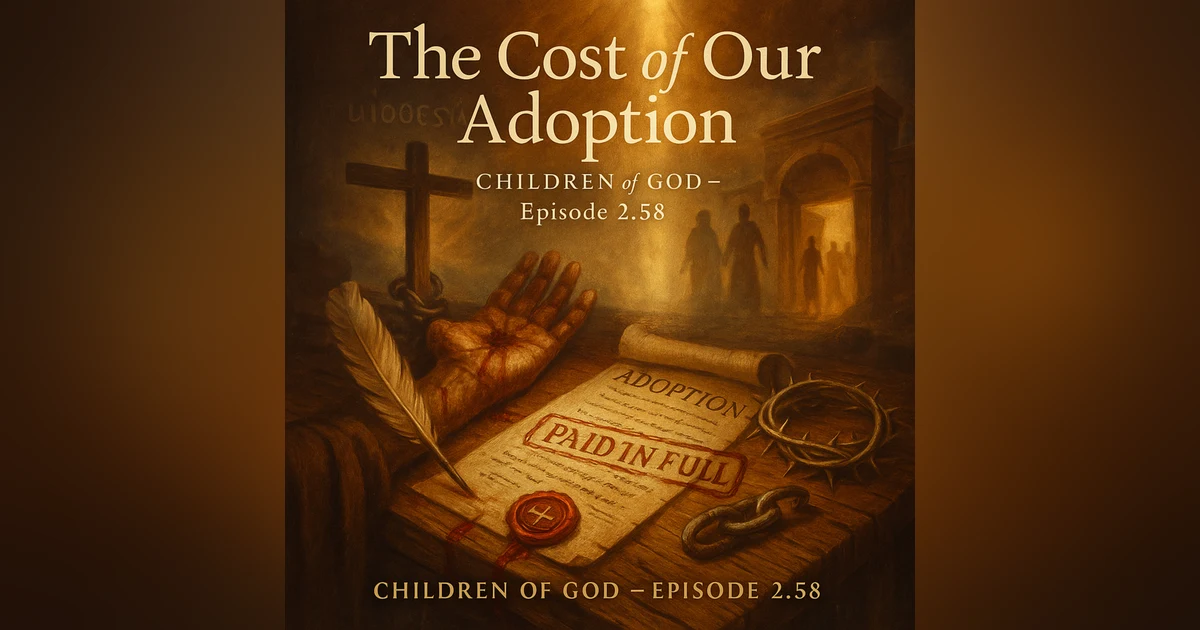
Adoption is not sentimental — it’s sacrificial.
In this week’s episode, Zach and Michael turn from the Father’s loving plan to the Son’s redeeming work, showing that our adoption came at a staggering cost: the blood of Christ.
Drawing from Galatians 4:1–7, they trace the journey from slavery to sonship. Humanity once stood as heirs-in-waiting, bound under the law. But “in the fullness of time,” God sent His Son — born of woman, born under the law — to redeem us so that we might receive adoption as sons. The Son bore the curse we deserved (Gal. 3:13), freeing us to share in His own inheritance.
Paul’s phrase “adoption as sons” carries Roman legal weight: all believers — male and female — share in the same full rights before the Father because they are united to Christ, the true Son.
Our adoption was not cheap. It required the cross.
Romans 5 reminds us: “While we were still sinners, Christ died for us.” God didn’t adopt the neutral — He adopted the hostile. Every believer’s redemption is a declaration of victory in a cosmic war.
Applications:
– Adoption is Warfare — every redeemed life is proof that Christ has conquered.
– Adoption is Costly — our family status required the Son’s death.
– Adoption Invites Worship — Jesus was forsaken so we could be welcomed.
– Adoption Shapes Gratitude — understanding the cost leads to humility and joy.
Big Idea:
Spiritual adoption is possible only because the Son paid the full price of redemption, securing our right to call His Father our Father.
Find our videocast here: https://youtu.be/cWkzqx5GK6U
Merch here: https://take-2-podcast.printify.me/
Music from #Uppbeat (free for Creators!):
https://uppbeat.io/t/reakt-music/deep-stone
License code: 2QZOZ2YHZ5UTE7C8
Find more Take 2 Theology content at http://www.take2theology.com
0:00 What What's your take on in your family Hallmark movies? Where do they stand? If it's a good one, there's been a couple that I've liked, but generally I cannot stand them. They're. Tough, tough. I can't if it's like going on and on and on like and I'm in the room, I might like the last 10 minutes, like OK, what's going on and try to sort it out. But generally I am not a fan. And I know that's so stereotypical, but it's like there's no, there's no, there's nothing there. It's. Just it's the same form, you'll have rinse and. Repeat. Yeah, Yeah. And you know, recently Hallmark has gone to same sex couples. Has it really? Yeah, so Candace. Cameron.
0:44 Cameron started her own network. Because of that. But I think largely because of that. So they kind of do their own Hallmark. Hallmark like movies that don't have any of that in there. Man, that's, that almost surprises me a little bit 'cause I would feel like their target demo as a rule, but maybe everyone kind of likes Hallmark. Like, it's like, not likes it. Yeah, yeah. Most people I talk to like, don't love it, but it's something to have on during the holiday or like, I don't know, you know? I don't know my my wife and daughters and my grandmother or their grandmother, my mother-in-law. They they seem to like it. Yeah, man, like. Oh, this is a good one. I'm like, Oh my goodness. And you're like, let me guess, like there's a pumpkin patch and there's a big I, I don't. Know a lady comes in from the city and she's getting back to her roots and there's a guy there that's a lawyer that she likes but he never has time for her so she like goes to pick apples in the orchard and she meets the apple orchard owner whose wife died three years ago from cancer and he's raising a little girl like.
1:43 Yeah, it's like it's, it's it's there's too much of this. What's going on? I'd say this. I mentioned Hallmark and my Sunday school. I don't know if you were sitting in and like, yeah, you were in that. For just a second today because I we had Michaela Thrower on the slide today. Her first time her like hanging out back. There, Yeah, yeah. And but I was like, I'm not sure anyone has double checked these slides to make sure like, 'cause I did a little bit Wednesday and it was a good thing I went and checked during your little bit of interesting in school because there was a song that he was singing wasn't even in there. Yeah, Yeah, it's good. Yeah. I just we were able to use the computer in the other building to get proclaimed and then it syncs with the other.
2:23 Computers did. Have you ever seen the show Practical Jokers? Impractical. Jokers. Oh, is this what the three guys or four guys where they like tell them scripts to do? Yeah, they have this thing where they'll like make PowerPoint presentations for the other group they have to present. They've not seen them. They've not seen them. It's it's hilarious. I was like, you guys should do that for worship some time. Be like Tim, just wing it. Here's what I'm talking like. Oh, that's good. Yeah, don't, don't, don't do that. That that was totally, totally a joke. But in my Sunday school made this I I it's like a subtle thing I've been saying, but when we think of adoption, you know, I it would be a shame to walk away from the series and think of adoption. It's like a nice warm fuzzy thing that would like be missing the significance.
3:04 So I was like, you know, a little less Hallmark, a little more like I told people this was this was the phrase or the question, how would you describe adoption in one word or short phrase? I think most people would think of compassion, kindness, love, beauty, these things, these these things are true. I think these things are right about adoption. I would say those though. What would you say? Well, the the mental image, I don't know if it's great, but the when you said that the mental image is I have a of amoeba. Like encapsulating something. And then just bringing it in, making it a part of itself. See that that that's a good image. What I'm trying to what I was trying to incorporate a hit this hard today was a little less harm Hallmark Y with those like little left like soft music, nice lighting and this is maybe a different direction than most people would think. But word I used was adoption is warfare like more confrontational, more gritty.
3:57 I said less Hallmark and more Saving Private Ryan. So also classic movie. Not everyone's cup of tea. But anyway. So I was thinking I was thinking movies Hallmark movie Saving Private Ryan. Do you do you have like a favorite movie? You might get me in trouble a little bit. That's what I'm going for. You know, different genres. I I love the first Matrix. Now that's not a clean movie. No, there's some stuff. To. Be concerned about there, but just the overall theme. I remember watching that in college and like going wow. You're probably it's like the perfect age for it too. I was. I was like, I'm like 10 years younger than you. It was like the movie that was like I wasn't allowed to watch, but people my class had seen it, but it was rated. But it was like, it was like it was really popular, obviously. Yeah, we went and watched it and I had really no idea about it. And like I left and it was like, it's, it like gave me an adrenaline high that I I couldn't like I was driving a little bit crazy in my college room. It's like, what's up with you?
4:56 I was like, I don't know. You're like, and that's not if you know me, that's not normally I love for right October. I mean, it is just like if I had to have something on, like if I'm like folding clothes or like I'm grading papers or something and I want something on, it's like hunt for October. Is there Kung Fu Panda? Kunk Hilarious. Great. I like, I like Ace Ventura when nature calls. Not the first one, but when nature calls is pretty good, man. Good. Stuff. Yeah, usual suspects. Yeah, a lot of language in that.
5:41 A lot of language. And I don't know if we've talked about this before, but I'm not personally sorry listeners, as offended by the F bomb as I am. I was. Going to ask you. He uses like a lot off air. Like I said, the mics are on. I don't like, No, I'm kidding, I don't. Use it. I don't use it, but if it's in especially like save a private right, Saving Private Ryan, like you know, we're told to only say what gives grace to those who are hearing and if you're being bombed, the F bomb is probably gives grace to those who are. Hearing you know, it would be, would it be harder to watch it? They were like, golly Gee, my knee it, it smarts. Yeah, yeah, yeah. Those, you know, fiddlestick bombs keep falling on us, you know?
6:25 Yeah. So hey, and us, they've been around a lot of scripture, you know, where's my, we're, we're quoting scriptures, we're sniping people. It's like, you know, it's basically a Sunday school lesson. Yeah, so I there's, I could go on. I actually the other day made a fairly long list of movies that I want to watch with my daughters, like some classics from the before they were born and stuff. Harry and the Hendersons is on there. Nice, I. Could pull it up, but it's it's a lot. Of well, Speaking of that, I felt like, man, my kids need to watch. Remember the Titans? Yeah, yeah, yeah. Classic sat down. Jay Jayden liked it. You tried to quiz him on it did not. Seem like it, you know, left side and he was. Like he was like, yeah.
7:10 And and really this is maybe we can, I can get some counseling here. He really started zoning out during the part when Sunshine kisses Gary in the locker room. And he was like, mom, and I don't think we should be watching this. This is like not. And he, his conscience was really pricked. And I was like, you're gonna sit here and watch it no matter what. No, I'm just kidding. But but he was like, really like, I don't think this is right. And I was like, well, it's not like they're gore, but I was like, hey, you know this, you know, we'll, we'll talk about this later. But that I think really colored a lot of the movie for him 'cause we've, we've talked about this kind of stuff and, and he's very, in a good way, very sensitive. Where if it was Jackson, just like he's like, oh, this is so funny or you know, like, even if it's not over, is that like even if he doesn't understand the full thing, like he's just like not a sensitive I. Think there's things like that, that that movie came out before, like that was mainstream and accepted. So that's a funny prank in the locker. Room it's like, yeah, it's not glorifying that. It's like like yeah, yeah, right. It's like funny prank slash.
8:11 Almost like he wouldn't be, Yeah. Yeah, yeah, yeah. So. And I I think he's not in the movie and he's not and. He's not. Yeah. Yeah, it's. Like he's just messing. Around. Yeah, he's just messing around. Yeah, exactly right. So a lot of great. A lot of great. Coach there did. Did Jay never get over that or no? Yeah, yeah, I, I, I think so. But I think that's not gonna make it. Not his favorite, not his favorite movie. One thing, one bone watching it again, what bone I have to pick with the movie, man. It's like in a pivotal part, it's where Coach Yost to sit. The assistant coach, the white coach, the white coach. Yeah, that, that probably. Makes it easier. Talking about yeah, he's like, he makes his quote. It's like very inspirational thing.
8:52 He's like, guys, we're going to blitz them all night. He's like tonight they're gonna remember. He's like they remember the night he he said like they're gonna remember the night that they played the Titans or something. And I was like, oh, I felt like he was gonna say they're gonna remember the Titans, but it's like, it's not even the movie name. It's like so pivotal. And it's like, yeah, they remember the night. They don't. It's like this whole different thing. I was like, I feel like it should be the same. Yeah, yeah. It was rubbing meal. It was a really good good speech, but in. My mind, I say that's more like a if you had a Jonathan White here, he might say if you say the name of the movie in the movie, that's like two tries. Two on the nose. Yeah, maybe that's what it was, but I was like, I just feel like it was at the opportune moment. Also, I need to Fact Check this. I'm pretty sure like Coach Boone Denzel in the movie was like he said some like crazy number of people died at Gettysburg.
9:37 That didn't happen. Like I, I think he was like. A lot of people died at Gettysburg. Like 10 million. He maybe not. That high, but he. Said I'm exaggerating, I'm I need to Fact Check this. He said something like crazy bro. I was like, did we was there even this many people? I was like how would this? But I was like, how would it make him past the cutting floor? Should I like I'll say like certain politicians during Covad, like how many people are dying from cover? Like that's like 3/4 of the population of America and that that's not the case. I. I will say I could be wrong. I could, it just might have been in my mind, but it was great. You know, classic movie. You love that movie. So trying to do that with the with the fam, but yeah. So anyway. Yeah. So you're going to look that up.
10:17 I'll, I'll look it up in the in the in the break and see if I can get a number on this. Yeah, do do the comparison. There was something else that was going to slip in, but I can't, I can't remember that that we were talking, just got carried away with all that we're talking about so. Here we go and remember the Titans. So maybe it wasn't that bad, but Coach Boone said that over 50,000 men died at Gettysburg. In reality the number of deaths was around 9800 according to Google AI. So it was like not that off. It was off by a factor of. 5. Yeah, So, yeah, exactly. Which is, you know, I mean, numbers were a lot smaller than I thought, but I, I just remember I was like, this seems like a lot of people compared just, I felt like countries were small, like things were smaller, you know. But you know, we lost the most American soldiers in Civil War. Yeah, we did use a lot of.
11:08 Civil War, because we're fighting, we're fighting both sides and we were doing that, you know, line, let's line up and fire at each other. Warfare type stuff. Maneuver warfare. I know this too. Do you know the bloodiest battle in American history up to that point? I wonder if there was one more. It was big in Tennessee, where I where I was from. Oh, we run. I was battle Shiloh. Shiloh. This was big. We were always like for school. We were like always go. We would always go to these places. Like we would drive here for like a field trip. So 25,000 died at the battle. Shiloh. There you go. Well, some Civil War history, maybe. You weren't, you know. Maybe is history your your thing? I've really liked history. I much preferred English and history to math and science and then I end up going into a science field but it was not not my thing.
11:53 What was Leanne Math and Science or no was her preference. That's that's why you're not a a fantasy guy. That it's the math and science people who are typically the the fantasy nerds. Yeah, there was in college, a lot like science. Yeah, I hung out with some science people, but not, not my go to. Yeah, not my go to group, but great adoption. Adoption Chapter. Three, which we'll try to. We didn't go 20 minutes about soccer this time, only going 13 minutes. So this is good. So let's do it. Let's go ahead and take it to the next level. From the hearts of the Low Country in South Carolina. It's the Take Two podcast where we take theology to the next level.
12:39 All right, week #3 this is a 5 week series, so kind of in and out kind of short, but I like that that the the whole thrust of the beginning was maybe reframing adoption from if you were thinking warm and fuzzy and sweet and gentle too warfare. And here here here's some things I'll. Think about that for our listeners, because we probably don't think about adoption as warfare. Like you snipe in, you can crossfire, you put them in the, you know that's. Right. That's right. You know, the battle of a Marine is that you hit them with ammunition but also machine gun fire up front so that they can't go far and they can't come towards you. Like they get caught in that.
13:22 Yeah. Yeah. OK, that's smart. Is that what kind of adoption is? Very similar. Well, I'll put it this way. Let's talk. We'll talk about them one at a time. Horizontal adoption, the adoption we experience in our culture. Jade and Jackson have been adopted into my family. Horizontal adoption, I think, flies in the face of what our culture prioritizes. I think of our culture, maybe not just American culture, but culture at large. Thinks of autonomy. I want to do what I want. Thinks of convenience. I want to do what I want and I want it when I want it. Uber Eats, Amazon Prime, all these things primarily about self-interest, and I highlighted it through this article I read in Forbes a few months. Ago I would say kids in general fly in the face of all those things, but then adopting someone else's kid. Even more even even more so.
14:12 And so I I brought up this concept. Have you heard of of DINKS? Do you know what a DINK is? This acronym? Well, maybe different connotations in the Navy. If you were dink on something, you were delinquent. So you didn't, you were like behind on something like hey, you're dink here. Or if you did something wrong, they would dink you like ohh, you did this wrong, you did this wrong. But. Ohh, that's interesting. Yeah, let's hear. Let's hear the context you got for. It it's on the rise. It's a fray. It's an acronym point in the 80s, I think I do you know this? Yeah. I've heard it before about. Remember, it's on the rise, Millennials, and even more so in Gen. Z. Here's an article from Forbes from last year. Rise of Dinks stands for. Dual income, no kids. Yes I did. Yeah yeah, yeah cuz cuz my dink has AQ in it, not AK.
14:55 Oh, got that. Yeah, yeah, yeah. And. And so these kind of Dinks, Pew Research Center has this stat that from 2018 to 2023, in that short period, the number of Dinks have increased by over 10%. And a lot of that, a lot of you think Dinks, it's very intentional and purposeful. It's not like, oh, we just happened this way. It's like, hey, we're setting out on this lifestyle. You can imagine reasons why child care is expensive. The stat I read was it's 3 to 400 K per child from zero to 17. I have a college roommate, first DINK in this way. I think his wife probably doesn't want to be a DINK, but he's like, I don't ever want to have kids. I think he had maybe a little bit of a rough. Childhood things kind of just like. I don't want kids. I don't want, you know.
15:39 Child children cost a lot of time. You got to take Johnny to appointments and soccer practice and do homework and whatever might limit your ability to participate in things like work and make money. Another reason people said were I just don't, I look at the world, it's a terrible world. Don't want to bring kids into this world. I see there's war. I look at the news. Whatever closely associated with that is like a subset. Like some people are like, I'm trying to save the environment. So less kids mean less strain on the environment. Like that's like they're thinking, so some people would say, hey, I'm trying to be unselfish. So, you know, I don't think. And then the most transparent group, which was a large subset was like, I want to travel the world. Like I, I just want to see the world. I want to go on cruises, I want to eat. Yes. And so there's a lot of reasons why a couple might not have a child pursuing this gratifying lifestyle. Not not a good reason.
16:28 And so that that was kind of my illustration where horizontal adoption stands out in a world that sees children sometimes as an obstacle to personal fulfillment. It kind of pushes back and says that life is precious, building a family matters. Love is costly, but but it's worth it. And I'm willing to give it myself for the sake of the vulnerable, for the sake of others, even if it cost me something. That's horizontal adoption. Vertical adoption stakes are even higher. I think it's a little bit easier to see that really it's nothing less than, you know, a battle cry against the powers of darkness where children of wrath were enslaved to sin in some capacity were under Satan's dominion. And, and so when you think about South horizontal adoption, I, I like putting these little phrases in there too. I was, I just remember how I said it. I was like, it's not sentimental. It's countercultural combat because it's so countercultural. Vertical adoption is along the the same lines. Like it's so pervasive in Scripture that when God adopts you, he's snatching a soul from the powers of sin and death, right?
17:29 So these are things we don't probably think about these in these terms, horizontal adoption, vertical adoption, whatever you're talking about. What I hear you saying is that the incarnation is like getting a beach head on Omaha Beach. Yeah, it's like, exactly. Like we are making a foothold and we're going to, you know, get victory. Beautiful. It's an invasion into enemy territory and the watching world, when they see you participate in either of these, maybe you're evangelizing, you're pushing for vertical adoption. Whether you're participating in foster care, horizontal adoption, the world sees that and sees where your priorities are at, like what matters to you? Things that are costing you time, energy, resources, but you're participating in these things. Just want to keep that on our mind because it might be like slightly different way to look at things than we we do sometimes. The The application is Saving Private Ryan has now become a Christmas movie for everyone to you know. No, it's so good.
18:23 No, it's good. And I'm going to talk about this next week. Next week is a really cool day. It's like the perfect confluence of events, but it is a day a lot of churches across the world celebrate, as they call it, pure Religion Sunday. And you know, really a lot of the application is that. Why did it get that day, do you know? That day, well, November is adoption month. Right, but is there a reason? Why it's Why? Why is November not like but like January 22nd is second to human life because Roe V Wade and you know, January, is there something like that with November? You know, it's AI need to look at the history. It's a combination of two different days. One's called Orphan Sunday. It used to be called that. I think that's like falling out of favor to call something like Orphan Sunday.
19:04 And it's like there was a movie called like Possum. Have you heard this? It's like about this church that adopted all these kids. What's it called it like the city was called like Possums. It was like some hillbilly city in like Arkansas or somewhere. I think it's there is. Possum's grape in in Arkansas. It is, but it's a it's a really good movie. And then? There was from bald mom. There is another day called like Stand Sunday and they like combine them and I think they just pick November because it is like adoption like like a lot of the that stuff happens in November. So I think maybe it was just most on that. I don't really know. But you know, the big driving forces, they, they say, OK, we look to Christ as our example. Christ moved like you're saying, towards discomfort, like not away from it. We see struggle.
19:48 We're like, I don't want to go there. He he got moved into that. So anyway, the text we looked at today is one of your favorite books. Oh man, it is a great book. So maybe you can give some insight here to where I I I missed but. You did miss a lot, but I didn't want to point it out during. I was in here for for most of this. I was like, yeah. He's really. He's really whipping at somebody dropping the ball. Looking at Galatians 4/4 through 7 if you want to read 4 through 7. Sure, but when the fullness of time had come, God sent forth his Son, born of a woman, born under the law, to redeem those who are under the law, so that we might receive adoption as sons.
20:29 And because you are sons, God has sent the Spirit of his Son into our hearts, crying, ABBA Father, so you're no longer a slave, but a son, and if a son, then an heir through God. Great. I did this long thing. We don't necessarily have to do this where I went like the build up from Galatians 3 into Galatians 4. And and I like it because the end of Galatians 3 has some bearing. All of this has some bearing. It's kind of pushing towards what you just read. He's like building this argument. I would say maybe Galatians 3/28/29 is kind of like his first conclusionary statement and then kind of four, four through 7. He's kind of also reinforcing kind of concluding what he's been building so we don't have to go go through all of it really.
21:15 I, I wanted us to hit 313. Christ redeemed us from the curse of the law by becoming a curse for us. For it's written cursed as everyone who is hanged on a tree that the really thrust of this lesson is that our adoption cost something at a very high price. It cost us or cost God the life of, of Christ that there was this high cost association. It's not just like it's free for us, but it wasn't wasn't free. Christ became a curse. There's nothing we contribute to our salvation. I think if you slide back, not that our viewers see this, but at the end of Galatians 3, he's talking about these classes. I don't know if I'm still in any Thunder, but true and Greek, you know, there's we're we're in Christ. Those distinctions become different, not that they are lost, but there's no distinction, slave or free. Those distinctions go away.
22:07 Male, female, those distinctions go away and we're all heirs. And that plays into some of the wording, like if I wasn't in class or hadn't talked to you about, I wouldn't know future, but I think that's good. Oh, yeah, yeah, yeah. And I, I love that. I think this word, I think the words are so interesting. Talks about heirs and then Galatians 4 one through 7. He uses a lot of this word child slave, sons slave and then back to an air at the end, kind of like, you know, he's mirroring everything really well. There is this. I didn't mention it. I should have. I just totally forgot because I need to do more research on it. I was like, I think this is true based on what I can see, and I think it's true based on that Roman like the 12 tables laws, whatever they have when it comes to adoption and slavery, we're actually very closely connected in the Roman culture from what I could read, where when it came to not a grown adult being adopted, but a child being adopted, say I you were wanting to adopt Jordan, what I would have to do is I would sell Jordan into slavery.
23:08 So that's like connected. And then I would redeem him from slavery. And I if in Roman law, if you sold someone into slavery 3 times like I would, there you go. I would have an alarm on my phone every time I would there's three times. There's like a three times law. I could sell someone to slavery 3 times. And then by doing that, I could not buy them again. I'd like totally released my I even if I wanted to. Rights are gone. So you could sell a child in the slavery, you could buy that part that child back, sell them in the slavery, buy that child back, sell that same child in the slavery, no more buying. Them back too and so in an adoption that would kind of go through just to symbolize like it's I'm told I I have no connection. To this, they would like do this transaction on paper three times just to say, hey, you're no longer. Yeah, exactly.
24:01 And then the adoptive father could purchase this as not a slave, but at not but you could redeem this as a son. And so don't know if that's exactly what Paul was thinking, but that would be in the context like readers would think child and slave, like these things would not be totally. Dissociated. Yeah, that's, that's really interesting. Because I and you, you go through Galatians so much. I, I find Galatians like 3 and 4 can be a little bit challenging. It's like, are we talking about the law? Are we, are we talking about like bondage to sin? Is the law good, bad? Are we just immature? I get confused a little bit going through it at times, you know, but anyway, some of this stuff. And so I didn't want to weave in another like metaphor on top of some of these like different images and this kind of thing. But I thought that was part, I didn't didn't really share it today, but I was like, oh, that's so interesting that all of that is connected.
24:49 And I think you talked about this today. I think we may have talked about it in the very first one on adoption, but it's specifically adoption that's. So good. Yeah, that's on. Purpose. That's on purpose. It's a deliberate move. By Paul. It's not just because they were like, sexist. They're sexist. It has real meaning to it. Yeah, and like you were saying, going back to Galatians 3, there's neither junior or slave nor free male nor female. If you were adopted to a first born male heir, which that that the first born male son is the one who adopted things. Daughters did not adopt things. Typically there were exceptions. Sorry, you're right, inherit and even you know, I think like, you know, you give away your daughter at wedding. Like some of this is like hold over from some of this kind of thinking, right, Where daughters were not the ones who inherited usually was a son, not just a son, but a first born male heir.
25:37 And so when Paul is is saying this, it's really legal shorthand more than gender exclusivity, where he's actually elevating not only women, but everyone to that status. You could be the poorest woman in Galatia, be on the same point as the wealthiest man. You could be a slave on the same as a freeborn says you could be a non Roman Jew, be on the same level as a Roman gentile. And all that's captured in that word, which I'm all most of our translations do well in ESP 95 ESPCSP KDVESPNESP 20 does the and daughters. It's all in italics, which I can at least get that they're saying this is not the text, but we're trying to be more inclusive like, 'cause Paul is talking about everyone, but he's not the NLT totally smooths it out and says children.
26:25 And you're like, oh, I wish you didn't. I see, I see what you're trying to do, but you're making an interpretive choice that you just miss that same thing. I think the other place you see it sometimes is like, you know, if someone died, if someone fell asleep versus died, like, oh man, sleeping's such a good picture because you're going to wake up. It's like, but you know, so some of these things like get why you do it because it is it can be confusing. But that sons because in Galatians 4-5 through seven, he says sons 1234 at least son or sons four times. It's like he it's not like he like accidentally said this. He could have used Technon, He could have used child. He does that elsewhere. So I think that's a really good point. But yeah, Galatians 4, I don't know if I've got a whole lot I want to add here, got some pictures of, you know, Joshy crying, which is, which is great, but good.
27:16 So my, my main point, I want to drive home adoption is warfare. Our adoption was costly. So it was planned, it was costly. Next week we'll look at the Spirit and these different benefits, these privileges we have, the fruit adoptions, the what? The fruits. The fruits, Yeah, yeah, the fruits. That's right. That's right with the S. Get that plural. Really, really strong. Anything else you want to add about adoption and the cost of our adoptions? One of those things that's like, you know, I, I like Paul's line of argumentation. He says God sent forth his son to redeem this under the law. Why? Well, so that we might receive adoption. So again, it's kind of like this goal it's moving towards. And didn't you, and in this verse, in her heart's crying out ABBA Father, didn't you say ABBA father was found in legal documents? I need to do more surrounding adoption. I I need to look more.
28:06 I know for sure that ABBA, it was like used in it was commonly used in legal documents. I'll talk about this next week, but ABBA father, I think can be a highly misunderstood phrase where it's it's intimate. This is right. This is this is a teaser for next week. Intimacy is good. I would say it's probably a mistake to say it's like Dad, dad. Yeah, it's not Daddy. It's not. It might be daddy, it might be like beloved father. So maybe daddy in like a reverent way. The way one author put it was it's less a child giggling in his daddy's face and more a child screaming out to his father to save me from this dog that's attacking me.
28:49 It's primal. It's Jesus in Gethsemane saying ABBA father. It's not like dad, dad. So it's similar, but I think we miss a shade of it. So it is intimate, but it's more you see what I'm saying? So I think it's because I've always almost erred on the side of it's like goo, goo not, you know, it's like. Almost that. Yeah, yeah, yeah. Yeah, yeah. And so I think, I think the trick is some of that's like underneath some of the etymology, but maybe it's more significant than that. So in anyway, something that I think maybe helps us because the other thing we see when we see things like we see the same kind of language in Romans crying out this, this word crying. This is like the word that the blind like Bartimaeus was like crying out to Jesus. So it so it is like this like Primal Scream and not like I'm happy things are good.
29:33 It's like a desperation. So maybe we don't pick up sometimes or I never picked up on that as much. So anyway. Son of David. Yeah, they're they're yeah, yeah, exactly. Yeah, where they were like, hey, stop, stop talking these things. So it's like it communicates more than maybe what I've. But even though I don't think those people were totally off base, you know, it's just like a different, different shade. So that's that's next week. We will talk about that. So what I hear you saying is go regulations again. Go regulations. Yeah, just knock it out, you know, and you'll really get get the picture there. But that's all I got two more weeks on adoption, 2 more weeks knockout. This, this is great. So I love it. That's our take.
30:14 Thanks for listening to take two. Find us wherever you find podcasts and on YouTube for those who want to watch our video cast.

