Cults | Is Christian Science Christian? Mind, Matter, and the Meaning of Salvation



 RSS Feed
 Episode 2.88
[Note: We accidentally reference Jehovah's Witness at the beginning, but this episode covers Christian Science.]
In this episode, Michael and Zach examine Christian Science using the same framework applied in previous discussions on Mormonism and Jehovah’s Witnesses. The question is not about sincerity, charitable work, or moral intent. The question is theological: Does Christian Science fall within historic, creedal Christianity—or does it depart from it at a foundational level?
The discussion begins with the origins of the movement under Mary Baker Eddy in the late nineteenth century. Eddy’s book Science and Health with Key to the Scriptures functions alongside the Bible as the interpretive authority of the movement, providing the metaphysical framework through which Scripture is understood.
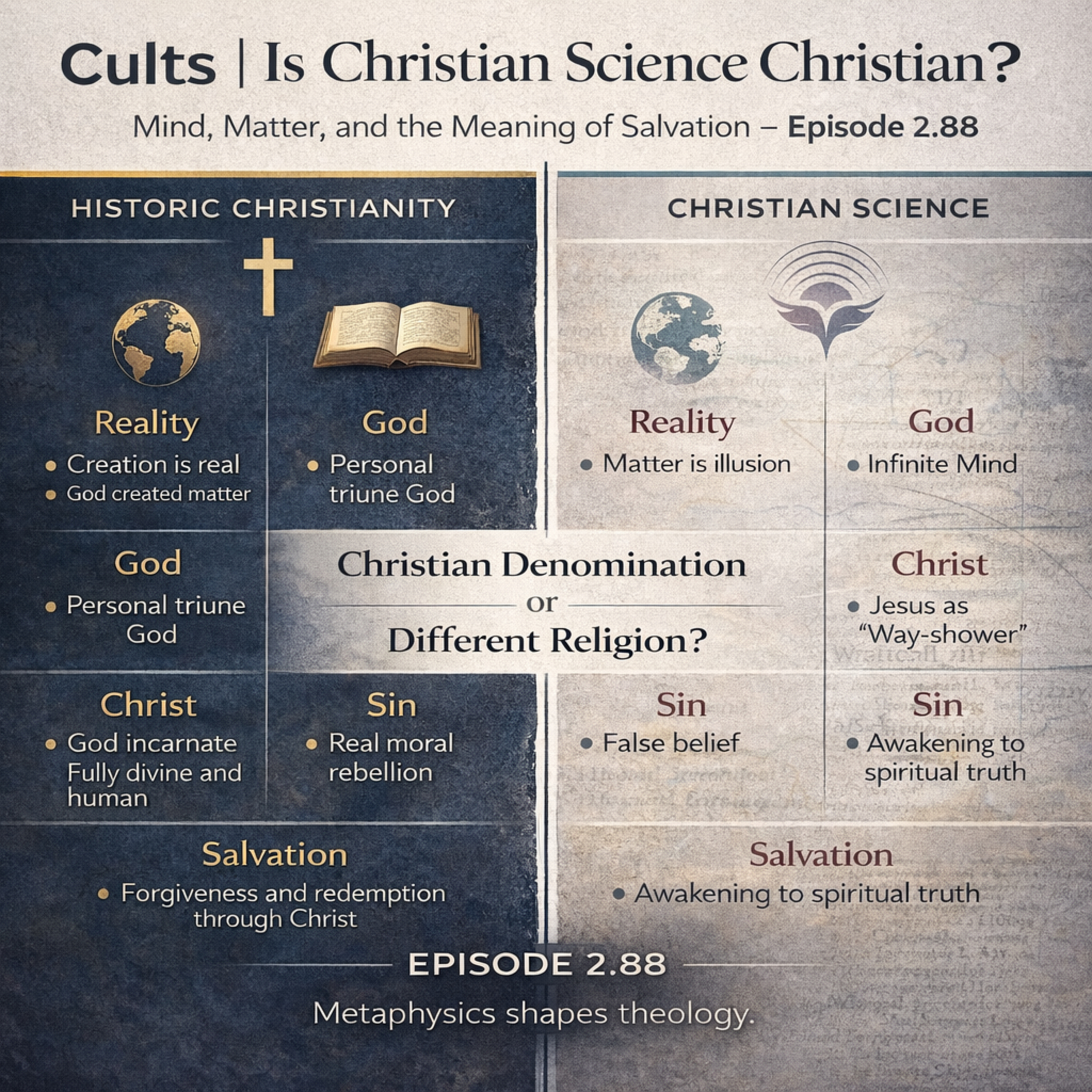
From there, the episode explores the system’s central philosophical claim: reality is purely spiritual. God is defined as infinite Mind, while matter, disease, evil, and even death are ultimately illusions of mistaken perception. This metaphysical idealism reshapes every major Christian doctrine.
We examine how Christian Science redefines key theological categories—including God, Christ, sin, atonement, creation, resurrection, and salvation. Jesus is treated not as God incarnate but as the supreme “Way-shower,” demonstrating humanity’s true spiritual nature. Sin is understood as a false belief rather than a moral rupture with God, and salvation becomes an awakening to spiritual truth rather than redemption from real guilt. The resurrection is likewise interpreted spiritually rather than bodily.
Along the way, we briefly compare Christian Science with non-dual philosophical traditions found in certain strands of Hinduism and Buddhism. While the systems are not identical, they share a common rejection of material reality that sharply contrasts with historic Christianity’s affirmation of real creation, the incarnation of Christ, and the bodily resurrection.
The episode concludes that Christian Science differs from Christianity not merely in practice but in metaphysics. By redefining the nature of reality itself, the movement departs from the doctrinal framework that has historically defined the Christian faith.
Find our videocast here: https://youtu.be/Zj3BZM6RjM0
Merch here: https://take-2-podcast.printify.me/
Music from #Uppbeat (free for Creators!):
https://uppbeat.io/t/reakt-music/deep-stone
License code: 2QZOZ2YHZ5UTE7C8
Find more Take 2 Theology content at http://www.take2theology.com
0:00 We're back at it, Zach. We're. Back, back in black. Back in black That's right, we're. Wearing black if you're watching the YouTube feed. Yeah, so second video, Yeah, well, really third 'cause we we keyed up, we kind of baptism. Oh yeah. It is kind of cult adjacent because it is something that can be, you know, if if, if it is viewed as salvific, you might, you know, you might put that into cultist behavior. But oh, I loved that on our last. One and we welcome the comment, especially this this individual LDS.
0:40 Yeah, LDS confidence in Christ, I believe. Yeah. OK, which is it's good to hear from people that we're talking about 'cause we, we do aim to use like good sources and, and so it's good to get that kind of back and forth to people in that world. Yeah, and so you may find yourself 'cause this, this video, although we're not talking about yet, is geared at Jehovah's Witnesses. You may not have any idea who we are, but because you're Jehovah's Witness, YouTube knows you might be interested in this video. So you may get served this. So I, I would just say, hey, if that is your case here, Sal, if if we get something factually wrong, then yeah, we would love to, to get to get some interaction. We did use the word cult.
1:27 And another commenter, Henry Keener, I guess I can say his name, his his handle, at least not guaranteed to be his name, but it sounds like a name, you know, kind of took issue with us using the word cult. And we're using this. And I, I said at least upfront because we might go on to we can decide, you know, do we want to talk about New age? We want to talk about, you know, Buddhism, Hinduism, Those wouldn't fit that tight cult thing, but they would be different viewpoints. And that's what I meant. By we're not trying to like for no reason be pejorative or anything, right? Yeah, that means. Right, 'cause we, you know, 'cause we both have graduate degrees in Christian theology and in, in our studies, the word, we're just familiar with the use of the word cult to, to mean a system of beliefs that is different from the mainline.
2:21 And so for, for us, we would say, you know, systems of beliefs that would call themselves Christian, but they have significant differences from what we might call creedal Christianity or classical Christianity or orthodox Christianity. And so we're and we recognize that the word cult is used in other ways and what we're using it in the academic sense, not in the the we're not using it as a slur. Yeah, yeah. Not trying to like just put down someone, but just factually and I think there was some good discussion on that YouTube feed that helped. I think at the end of the day it whether like terminology was agreed on it.
3:03 It showed there is a difference was kind of where like it was helpful the interaction right I. Think it's sort of like that confidence in Christ, he said. Yes, we do not claim to be credible Christians. And I'm like, that's all we're we're, that's what we're pointing out. We're pointing out that there is a difference and it's probably not fair to say. I have heard some people say Muslims believe in Christ. You wouldn't call them Christian. And I, I don't think that's fair to Mormons because I don't think Muslims are calling Christ their savior. I, I'm putting my faith in Christ for my salvation. Obviously when a, a Mormon says that and when we say that we mean slightly different things. That's what we're trying to point out.
3:44 But I do think it is a fairpoint that just because you believe Christ existed doesn't mean that you are falling under the the big umbrella of of classical Christianity. I I have to create, create, recap, check the YouTube comments. That's good today. What's on today's agenda? Today we're going to be talking about Jehovah's Witnesses, so another group that would call them self Christian, but they do have some vastly different ideas about who God is and who Jesus is. And so I thought that we could go through those. And I think it's important that we do discuss these. It's not like we're not trying to hurl rocks. That's right. We don't hate Jehovah's Witnesses or Mormons. We we love them.
4:27 And I was just reflecting on, you know, I was walking today and I was thinking about this series. And there's a lot of stuff in culture that we debate vigorously, sports. Yeah. Oh boy. We have. Yeah, trust me. Entertainment, you know, politics. Oh, yeah. And, and I don't, I don't see anyone, you know, telling what's that Guy Smith, The, the, you know what I'm talking. About I don't, I don't know Smith Smitty, I don't. Know the kind of controversial sports anchor? Oh, Stephen A. Stephen A Smith. Yeah, yeah, yeah. No one tells him like, hey, why are you? Why are you, you know, why are you calling this person out? Maybe they. Do and he's made a living off over the last like 20 years.
5:09 And so he's going to draw distinctions between teams and players that he finds relevant. And that's what we're trying to do. We're trying to draw distinctions between different belief systems. And it, if you think that this is all made-up, which you might be, you might think that religion's all made-up, then it doesn't make a difference, you know, and, and I could see, but it's not like we're trying to say Jehovah's Witnesses are not in our club. And, and, and we're saying there are real differences here. We're just trying to, to delete the, to this, not delete those differences to discuss those. That's the, the word I'm looking at. All right. So with that, I think we are ready to take it to the next level. Let's fire up that twangy music. From the hearts of the Low Country in South Carolina. It's the Take Two podcast, but we take theology to the next level.
6:05 So we kind of already talked about this framing the question. We're not talking about whether Jehovah's Witnesses are good or bad. As people, we're trying to say that we have differences in what we believe, and obviously we disagree with them 'cause if we didn't disagree with them, we would be Jehovah's Witnesses, right? And, and, and we're not, so we're looking historically, we're looking theologically, we're not looking like, are they a good? Are they like, like have dinner with them? Are they sincere? Do they really believe what they say? We what they believe. Right. And So what we're looking at is the words that we use just like we did with the LDS and Mormons. Are they using the words the same way? And, you know, and for Christianity, when we say a denomination of Christianity, whether I know Roman Catholics don't like to be called a, a denomination, but whether we're talking about Roman Catholics or, you know, you're Baptist or you, you know, there is a, a mere Christianity that we mostly share.
7:03 Now. We might have some episodes on Catholicism in the future to kind of draw some distinct, some distinguishing lines there. So if a group denies those core doctrines of Christianity and then we would say and those doctrines are like incompatible and they just don't match up, then we would just say, hey, separate religion. You may still we're not saying that you don't have some allegiance to the Christ figure, but it's not it's a. It's a different thing and like our last episode, probably get some of the same things that really revolved a lot around the Trinity along the the person and work of Christ. That's almost all, almost all the time. That's like where a lot of it and then the Holy Spirit, you know, with the Trinity like that, there's that's where a lot of the battlefield is fought right there.
7:51 Right. Because if we're arguing about Calvinism or Armenianism, we would say that those don't rise to the level that you're not a Christian. But when you start talking about the very nature of who God is, who Christ is or what's required for salvation, those are the big enough, you know, big enough, the foundational building blocks that we would say, all right, that's different enough that you're in a different system, You're in a different religion, even though you may say you are Christian, It's it's different. Yeah. You just heard that magical harp and thanks for Zach for stopping me because I sure would have just recorded that's I guess that's how tired I am.
8:35 We should of would have recorded Jehovah's Witness twice. You know, second time's the charm. Second time. It's a charm. So maybe maybe you're a member of the Christian Science I, I think. What are the numbers? I don't hear it very often. I don't either, so maybe this is a dying religion, I don't know what. If you had a guess how many are in the Christian Science community, what would you guess? In America or around the globe? Oh, both. I don't know. I don't. Know, OK, so America I would say at least in the millions, I'd say 3 million in America. OK, All right, let's see how. Let's see what what chat tells us it does. Christian Science does not publish official global membership stats, so figures or estimates. In the United States, common estimates range from 50,000 to 100,000 out of here.
9:32 Wow 50 to 100,000. This is saying worldwide 200,000 across 60 to 80 countries. It's declined from its early 20th century peak when it had several 100,000 members in the US alone. So there you go. So maybe you didn't even know Christian. I mean, I feel like maybe this is, it's like you don't want to give them the advertisement that, that, that it's still around. You know what I'm saying? Well, if you are a member of the Christian Church, what is it? The Church of Christian Science, the church Christian Science Church. If you're a member of that and you're getting served this video, then yeah, we'd like to hear from you. I, I don't, I don't see any, you know. Don't come across them.
10:13 So the church's central organization, according to CHAT, is the First Church of Christ, Comma Scientist, often called the Mother Church, so it's based in Boston. Oh, Boston. Go figure. Well, I mean, not everything out of Boston can be good, you know what I'm saying? There's got to be some duds, you know? What I'm excited to, you know, talk about. Christian Science, Christian Science, not Jehovah's Witness. All right. So for Christian Science, obviously it's all the same stuff that we talked about with Jehovah's Witness. It's, you know, looking at those core doctrines. And so if, you know, there's not as much published by the Christian Science. So I did go to their official website to pull some of this material.
10:59 What a name. Like for some reason, like like you pulled that name out of fit nothing, but it's like one of those names like sticks with you. It's the three name. Well, OK, so yeah, maybe, I don't know, maybe we we should maybe say that for Banner, but OK, great. All right. So founded Church of Christ Scientist 1879 authored Science and Health with Key to the Scriptures 1875 claimed this is all Mary Baker Eddie claimed spiritual discovery following recovery from an injury in 1866 ordained the Bible and science and health together, which was another book as the church's pastor. So the Bible and science and health together as the the pastor of the church that that so context. It emerged from 19th century American metaphysical mind cure movement influenced by Phineas Quimby. You know that great that great guy. Mental healing.
11:58 Yeah. Idealist philosophy, transcendentalism, positioned as a restoration of primitive Christianity and its lost element of healing. So not to, you know, some of a lot of the cults, the three out of three so far our, you know, the claim is, hey, we're, we're bringing Christianity back to what it should have been. It's kind of lost. That's right. Restoring. Yeah, we're. Restoring it, yeah. There we go. Well, let's talk about the way they structure authority and with Protestantism, what I like about it. I know. Where you're going? It is just, it's it's the word of God. Yeah. It's Scripture, yeah. It's great. You don't want to say the, you don't want to say the solo script.
12:42 Oh, there we go. Yeah, there we go. Now that means. You won't read any other books, you'll only read the Bible, right? As a Protestant close. No other book can give you insight. That's good clarification. Other books can, but the final authority you at the end of the day, if there's contradiction, you gotta lean, you gotta go with the Bible here. And I think this is a common theme. We've got multiple texts that are authority in this case 2 two different texts where if if you look at Christian Science teaching they they will say in science and health. The Bible has been my only authority. However, the Bible is read through science and health. It really helps provide the key to scripture almost like unlocks the scriptures get more insight and like you mentioned in 18 in the 1800s, or she ordained the Bible, science and health as the church's permanent pastor, which I love the nomenclature here how this these texts are ordained as the pastor. Yeah, yeah, yeah, yeah.
13:48 That is very odd. But yeah. So Science and Health is this book she she wrote and yeah, so that that is going to be. So when you have something that says, hey, here's how you really understand the Bible, which, yeah, a commentary kind of does that. Right, this is what this means, but it's insight but. If a commentary was like clearly saying stuff that wasn't there, you'd be like, at least this part is wrong. You know, right. Yeah, yeah, I, I think you're totally right. And then what I'm excited to get into is this the, the metaphysics side of it, because that's, that's your. Student of Aristotle, you're like man just. Tell me more. All right, so their core metaphysical claim is reality is purely spiritual. And I asked Chad. I was like, so this is kind of like there are some similarities between this and what, what, you know, like Buddhism and Hideaism. Yeah, not exactly.
14:34 The same, but you can see like that's almost like what when we first were getting into it, surprisingly, the numbers were so low because I would feel like, you know, there is this draw towards like Buddhism, Hinduism, New Agey stuff, you know, I feel like in the West, yeah. So there's central doctrine. God is infinite mind. Matter is not ultimately real. And I don't even know what that means to say matter is not ultimately real. Because what does real mean? If God, if, if, if it can have a real impact on me, then I think it's real. I, I don't know, evil, disease and death, just an illusion that sounds like it's straight out of Buddhism. Yeah. Yeah, 'cause when you're enlightened, you, you realize that all of this is, is not, not real. Humanity is an idea of the divine mind. Yeah.
15:24 Man, we're getting deep. This is a quote from Science and Health. All is infinite mind and it's infinite manifestation. Man, yeah. So it's hard. Like if you, you know, carry this out by implication, creation is not material, real. Everything we see, it's like you're saying, not real. And ultimately at least everything that's, you know, physical in this universe, it's it's just this false perception. We perceive it, but it's not there. This, you know, countertop, not there. It's like matrix before a matrix. Yeah, man, ahead of, ahead of her time. So this is radical philosophical idealism. At least the cart would have said hey I think therefore I am right. Yeah, that's right.
16:07 Yeah, We talked about that callback. All right, so all right, so let's just get into the doctrine of God. We already talked about God is mind, spirit, soul, principle, life, truth and love. That's a quote sounds. I mean it sounds a little new Agey, but but you might be able to fit that in. Yeah, yeah. Now here's where we're going to go. God is not personal in the Orthodox sense. Yeah, so we're starting to see some of this deviation already. And then also ahead of her time. God is often described as Father. Mother Godfather. Mother God. Yeah, it's, you know, I feel like that would not have resonated as much in the 1800s, but today, again, you know, would. Resonate more?
16:52 Yeah, yeah, yeah. Trinity. Eddie rejected the traditional Trinity. The theory of three persons in one God suggests polytheism. I guess it's a difficult concept, I agree. But we it is one what 3 who's? So no contradiction. One being three centers of personality. And, and and that was like a quote you said three persons and one God suggests. So she it's like in your face explicit. It's not like, oh, we're twisting the words like she's like, no, we're not trinitarian, essentially. Yeah, yeah, they explicitly say they're non trinitarian doctrine of Christ. Christian Science distinguishes between Jesus the man and Christ the divine idea or principle. Don't love that.
17:38 Also, it is confusing if Jesus is a man and and there's like the physical's not real. It this is going to start confusing me, you know? Right. It's like it could be self. It kind of starts collapsing in on itself, you know, That's good, good observation. So Jesus is the way shower. That's another quote from the book The highest human expression of divine sonship, not uniquely God Incarnate. OK. We're yeah, we're hitting, we're hitting a lot of landmines early on here. Christian Science rejects the deity of Christ as in the Nicene terms, the incarnation of God is becoming flesh or substitutionary atonement.
18:19 So here's a quote that kind of, you know, just, you know, these proof texts, but it says the material blood of Jesus was no more efficacious than when it was flowing in his veins. Man Yeah. Well, let's see how that jives with the doctrine of atonement and sin. I can already see where we're going this. So we mentioned a little before, but sin is not ontologically real because it's like this manifestation or a way you're thinking or a bad thought or something like that. Evil's an illusion. The belief in sin is punished so long as the belief lasts. Mind games. I do feel like we need to address the the first vault there. Sin is not ontologically real in a sense. There's one way that Christian philosophers would agree with that We would say that sin or evil doesn't have its own. It can't exist on its own.
19:16 It has to in here in an act or a thought or a failure to act. So we would say that you can't point to evil, but you can point to an act that is evil. But I don't think that's what she's saying here. She's saying that acts are not there's no, there's no act that has, you know, a status of being really sinful. It's all an illusion. Does that make sense to you That that that's kind of a lot of philosophers We'll. Say I I I think so. Yeah. All right, not for atonement, no penal substitution, which I want to ask her. She's not around. But like, what?
19:57 What do you do with your guilt? Because I think if you are human, you have guilt. Even if you don't try to live up to this standard. There's a standard that you try to live up to and you still fail. Right. Yeah, yeah, yeah. And so you would think that there has to be some penalty for that, which is where the word penal comes from. And there's no penal substitution. What are you doing with your guilt? Yeah, it's interesting. It's almost interesting that it's called Christian Science. You know what I mean? Like what? What are we doing? There's no satisfaction of divine justice kind of going alongside, no penal substitution. Like you don't have that. This isn't so. So is this atonement? This is her definition like she would even say or in health and science like at one meant is like a way they would teach it. Yeah, this is a summary of of, you know, their beliefs. So yeah, that doesn't really make sense to me. But I think the implication from there is if sin isn't real, then there's really no sacrificial.
20:53 Payment for you just need to be one with God, that unity with God that's more important than sin, which is and evil and death and disease that are all just like mind games. As long as you kind of tune up to God, I think you're you're good, which we would say this is directly conflicted with Romans 3. You know where Paul would tell us, you know that none seek him, all have abandoned him. Hebrews 9 Second Corinthians 521 You know all these things that talk about sin and the price that it and the penalty, and you know what Christ did for it. Yeah, I would love to read some of it, like the commentary along some of this where it's like cause 'cause it's, you know, at least in Romans 3, Paul is really belabor like making us point Jews, Gentiles and like saying all these things. But let's talk about creation.
21:42 We mentioned it that Christian Science rejects, rejects creation of matter by God. And then if you can imagine the goodness of material creation, because if you know physical doesn't exist, it's that's what I'm that's where my mind's going for sure. So big picture Genesis one, this big creation story is really spiritually true, not like physically something that happened. Yeah. And and to me, it's like people invent these categories and it's like it doesn't, it's meaningless. Like what if we just, we're calling this the wrong thing? This is not physical reality. This is spiritual reality. It's still a reality.
22:23 Yeah, we. Might. Yeah, yeah, yeah. It's just like a rose by any other name. It's still a rose. So you just, yeah, it doesn't make sense to me. Genesis Tune Onward treated as an allegory of mistaken material perception. So all of it is just people going through this false perception that's not really real. Man so if we're looking at historic Christianity, hopefully you're tracking with this real creation incarnation affirmed bodily resurrection a big deal that those are really non negotiables and and so in light of that Christian Science denies these at a metaphysical level. So we we see, to me more than anything else we've talked about in the colds, this is like the most stark, like we're not, we're not talking the same length.
23:07 Yeah, this is very, very different even from, you know, Jehovah's Witness and the Mormon we talked about. All right, doctrine of resurrection. Well, at least there's going to be resurrection, right? Well, resurrection is not bodily, is awakening to a spiritual truth. That's more and more like Buddhism, like Nirvana is, is waking up. And I don't know if she has any type of reincarnation here, but matter has no ultimate existence, therefore no future physical resurrection, no restored creation, so it's not like. Yeah, that's like the new heavens and new earth, man salvation. Let's get to the crux of what we talked about. You know, the atonement, penal substitution a little bit. Christian Science would teach that man is already spiritually perfect. Man is already saved.
23:51 In essence, like we said, there's no sin, so there's nothing, you know, blocking that chasm. It's really more of what you just mentioned, this awakening to spiritual reality that is salvation. The quote we have from Miss Eddie man as God's idea is already saved with an everlasting salvation. Compared to what you've heard many times here, historic Christianity, humanity is sinful. They're fallen in need of redemption, in need of forgiveness, needs to be born again. Salvation is something you don't possess, something that through the personal work of Jesus Christ very central.
24:31 And here it's like you already got it. You just need to like, realize it, or, you know, manifest it or whatever the terminology is. Here's where I think I really get cynical. Yeah. Oh yeah. So we have healing practice. I'm not cynical about healing. I mean, everyone wants healing, all right, but if it's all an illusion, then why would you need healing? Well, so since Christian Science healing, they reject matter as real, they deny disease is ultimately real. OK, so prayer is just kind of correcting your false beliefs about what's going on. So so. You're sick. It's just a false belief. I have a cold and it's like, hey, we're going to pray and you're no cold.
25:15 Right. You're just changing, you know, you're spiritually changing like the reality there, but there were practitioners in healing they were certified they may charge fees. I don't know why you need the illusion of money. It's. It's not real, but I it's going to cost you 100 bucks. And they offer prayer based healing. While members may seek medical care, traditional emphasis strongly preferred spiritual healing alone. So you're not you're not precluded from going and getting traditional medicine, but you should probably just do this spiritual. Thing. I'm guessing they would say, well, by going to that doctor, it treats your mind better that you're doing something.
25:56 So it you're you're you're you're tricking yourself into it and it and it has the same effect as just praying it if you really believe it would be my guess. Yeah, that's that. That might be that. That tracks at least. Let's talk about, you know, their ecclesiology, their their kind of church stuff. There's no word in clergy. You know, you might be certified practitioner, but here, here's we're not ordaining clergy. Services consist of reading solely from the Bible and then science and health. There's no sacraments, no baptism, no Lord's Supper, Eucharist, any of those things. Doing a lot of reading from the from the Bible and the key that unlocks the Bible. Yeah. So I guess really you don't have to have a pastor there.
26:37 Yeah. You just have to have a reader, yeah. You just have to have a reader, yeah. Man. All right. Points of contact with Christianity. Christianity's Christian Science does affirm the Bible has inspired Jesus's central crucifixion and resurrection language. I don't know what that means though, to affirm something you think is an illusion. Moral transformation and prayer. However, these terms are redefined metaphysically, not historically. So they're all just kind of looking through those from a spiritual lens. Well, let's just look at, you know, the theological places that are just no goes out of it. Christian Science rejects the Trinity, the incarnation as God becoming flesh, substitutionary atonement, material physical creation, a bodily resurrection.
27:24 It changes the definition of sin where sin is merely an illusion. And then salvation's also redefined to where, you know, really everything's good. Sin's not separating you. You just need to be awakened to the reality that that it's all good. Yeah. And so like we said, this is not just some minor doctrinal squabbles between Christians. These are big. They concern God, Christ, creation, sin, salvation, the future, you know, resurrection, how it all is going to end. So I think we could say by any safe standards of Christianity that this is outside the pale, outside the fence of what what is. Christianity is a metaphysical religious system, kind of like Buddhism or or Gnosticism.
28:19 They use some Christian terms, but it's built upon this philosophical idealism structured around Eddie's revelatory authority. Man, wow, Christian Science. I I, I don't think we need to say too much more. It's very different. What might be worth saying is you know where does it share some touch points with Hinduism? Buddhism. Yeah. All right, so here are some touch points. Ultimate reality for Christian Science. God is infinite mind only. Spiritual reality is real. Matter and evil are illusions for I guess. Do you know how to pronounce this?
29:01 I think it's, I've heard it pronounced and I would recognize it, but I'm going to, I'm going to mess it up here, so just bear with me. But it's Advaita, avaita, Avaita. Hinduism, their ultimate reality is Brahman. So absolute consciousness in material world is an illusion. So that's shared Buddhism, at least of the Mahayana strands. There's no creator God. Ultimate reality is non dual awareness or emptiness. That's the Enlightenment and material permanence is an illusion. So some of the contrast historic Christianity kind of repeated some of this real creation, real incarnation, real bodily resurrection.
29:44 So it's kind of hitting those beats again. Sin and suffering for Christian Science sin and suffer disease or mistaken beliefs for Hinduism Buddhism suffering arises from ignorance and obviously Christian Do you think those things are real we're going to fall in. The world. Yeah, salvation, freedom, liberation. For Christian Science, salvation is wakening spiritual truth. For Hinduism, liberation is realizing a realization of unity with ultimate reality. Buddhism is Nirvana. It's released from the illusion. So you see a lot of similarities there. Obviously. For us, salvation is found in a person, the God Man, who is the interceder between God and man, who is our great High Priest who died for us and now stands ever at the Father's right hand, interceding for us, clothes us in His righteousness, and took on our sin for us.
30:39 And that that's good. So we think of Christian Science uses like these other cults we're talking about. They use Christian vocabulary. But even you drill down to the philosophy and it's, it's like some of these, you know, Hinduism, Buddhism and, and the fact that it denies matter and treats evil essentially as an illusion, very much different than historical Christianity. It's like, I like this series that it's just like pretty simple. It's, you know, just like, here's one thing, here's the other. And, you know, we went down the line through a ton of different things. Very, very different. All right. Anything else to add on to Mary Baker, Eddie's Christian? Science. Nothing else. What are we looking at next? Let's see, I think next is I have it 7th Day Adventism film. I like it.
31:28 My friend went to a 7th day Advent PT school and while they don't like push their beliefs hard on you, like the school operates within that framework. So like, you know, coffee's not readily available. They're all these different things. So it's an interesting to to kind of talk about that. So cool. Well, that that's all I got. Last take. Last take, it's cold outside. You're wearing a sweater, but maybe you should have been wearing a tank top. I don't know, I just. Ripped these sleeves off right now man. The world wasn't ready for that tank top and neither was I Watching it back man, that's good. That's. All good. SO we, we were putting out some shorts, more shorts on YouTube. I, I was doing, you know, I did a lot back in the fall and then I think I started teaching and like my time went away and I was like trying.
32:22 I was like, I kept thinking I need to get back and edit some more shorts. I need to get back and edit some more shorts. And so then I did like at the beginning of the year, I did like a month worth of shorts. And it's kind of the slog because for this, when I produce it, I can, it's it's long format, so I can do the editing and then I can just set it alright, go render everything and I can walk away and do stuff where I can work on other stuff. For sure. It's just like a little bit of editing, a little bit of rendering, a little bit of editing, a little bit of rendering. But we found a online service that does it. And so I gave it one of our videos and I, I was just picking it on the like the popularity of the video. It was something fairly recent, like the purpose of the church.
33:03 And so it just like cuts little segments out there and like the first one, like 1.7 K or something like that, 1.6 K. And then we realized it's just because Zach was wearing a, a tank top. Definitely. The thing that got me was it's the tank top plus the goatee that's just really flowing in the wind there, man. It is a look, we'll say that it's it's a choice. Oh, man, it's great. So, you know, let there be a plug for the take. It's a Take 2 tank top. Yeah, yeah. You know, yeah. And if if for some reason, like you only watch our long format videos, go go watch a few shorts. If you ever like it's, you know it. It would. Help. There you go. Yeah, absolutely, man.
33:46 Next we need a short with the we had we didn't have Michael on a tank tank top. We do have a short where Michael in a cowboy hat. That's true. Yeah. I was telling my class so one of my students, yeah, got scarlet fever. Wow. Do you know what scarlet fever is? Dang, I when I think of scarlet fever, I think of a little house on the Prairie. Oh, yeah, yeah. I think of 'cause she went blind from it, right? I I. Think saddle now and. And that correct me if I'm wrong, I'm pretty sure that was the disease in the Velveteen Rabbit. It might maybe sell. Well what my student said was it is when you have strep throat and it moves from your your throat totally, yes. Yes. And if it a lot of people get it when they don't treat the strep throat, they're like, hey, I'm just going to get over it. I think it's a sore throat.
34:28 You're exactly right, because I've had strep throat several times. I was like, yeah, what's the big deal? And Chad kept telling me, hey, it could develop the scarlet fever. So where does it go when it happens? Does it go into a different spot in your body that's. A good question in. Your lymph node if. It just spreads or what what the deal is. This is a total aside. You're you don't have to do anything with this. I'm going to send you it's going to be a total waste of time. A video that I made in college that me and my roommates made. So it's definitely going on the the Take 2. It's great. It's like so corny, but we did like a little bit on scarlet fever in there. So you're going to like this. It's very, it's very timely. It's good.
35:09 But I don't know what what the deal is. Yeah. So getting back to my student there, there's a reason this is, but he was like, I, I, he was there last Wednesday and I could tell his he's, but there's been something going around. And then he's gone Thursday with a, with a parent note, Friday with a parent note back today, Monday when we're recording, he's like, I got scarlet fever, scarlet fever Couchmont. And he's like, I woke up Wednesday night, like at one, it felt like my skin was on fire. And they took him to the ER, they ran some tests and he's like, it's happened before where he doesn't know he has strep throat, like something about how his he doesn't realize he has it. And so then it is it developed into scarlet fever and he has had to take cold showers.
35:54 He was saying this is not fun and then it reminded me. I told him about our cold plunge. Yeah, we've recorded 2 videos. Were we trying to get under a minute under? Under 3 minutes, so it's a long time. Yeah, yeah, yeah, yeah. So I was told him I was like, you can go out there and watch him. Like you'll see me and see a big massive water displacement as I like basically toddler squad into this little pool. That's great. Yeah, man, the cold plunge. I, I wanna get a sauna so bad. Yeah, sauna's more expensive than cold plunges. Harder. Harder to justify. It's good, you should be able to like build something. Just heat up some rocks and put water on it that might. Do you can? It's cheaper. Yeah, the build. Do it, man. That's what I if I go to build stuff, build it in the garage.
36:37 I want to get a sauna really bad. You know, Leanne doesn't think it's a great use of money. So we're going back and forth. Hey, just use the HSA money on it, you know what I mean? It's good for your health. So. One day, maybe One day. Yeah, yeah. Yeah, well, anything else? I I think that's all I got. OK, that's all I got. Right, well, that's our take. Thanks for listening to Take Two. Find us wherever you find podcasts and on YouTube for those who want to watch our video cast.

