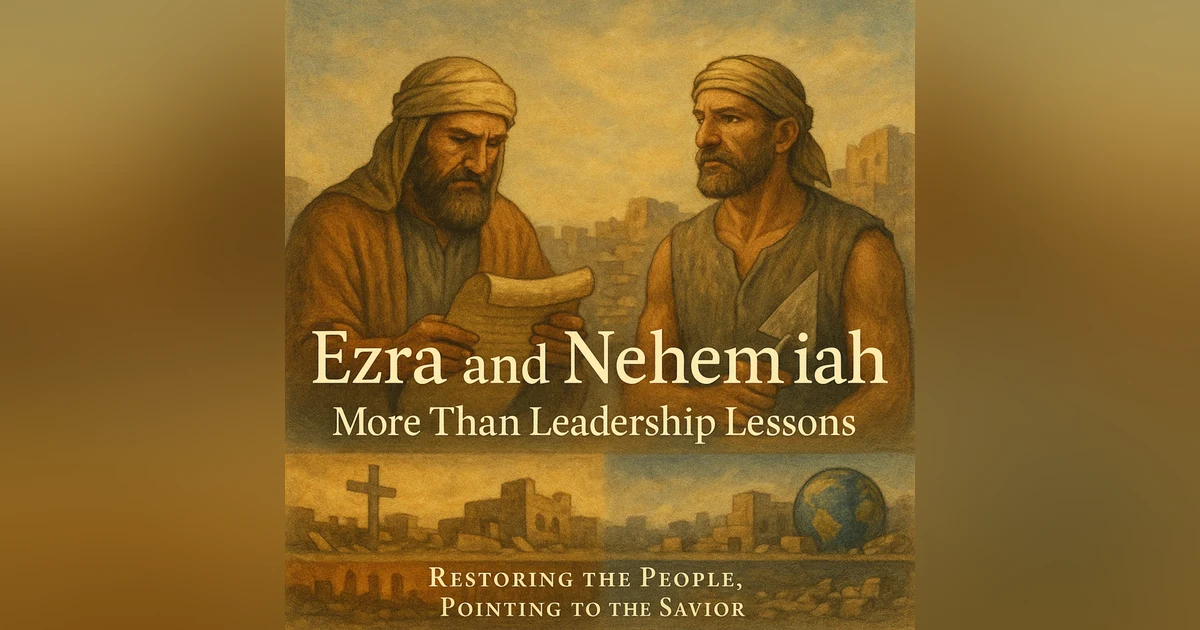
Ezra and Nehemiah – More Than Leadership Lessons


 RSS Feed
Episode 2.13
They’re not miracle workers, prophets, or kings—so why do Ezra and Nehemiah matter? In this kickoff episode of our new series, Michael and Zach explore why these often-overlooked books are anything but boring. Too often reduced to leadership manuals, the real story is far richer: faithful men giving everything to restore God’s people… and still falling short.
We unpack the structure, timeline, and purpose of Ezra–Nehemiah, showing how the three movements of the book mirror one another with deep theological intent. Each begins with hope, faces opposition, and ends with mixed results. Through it all, we see God’s sovereignty, human failure, and the aching need for a better Savior. These books don’t just teach leadership—they point forward to Christ.
Whether you're new to Ezra and Nehemiah or revisiting them with fresh eyes, this episode lays the groundwork for a deeper journey through two books that belong together and tell one story of longing, faith, and future hope.
Find our videocast here: https://youtu.be/6RObE1DjgjM
Merch here: https://take-2-podcast.printify.me/
Music from #Uppbeat (free for Creators!):
https://uppbeat.io/t/reakt-music/deep-stone
License code: 2QZOZ2YHZ5UTE7C8
Find more Take 2 Theology content at http://www.take2theology.com
0:00 Well, right. So my in laws were in town. Yeah, big. Weekend. Big weekend, Yeah. Lydia graduated. We were recording several, so this is going to come out several, you know, weeks after. Yeah, just graduate. But at the time of recording, Lydia has just graduated. And I don't know the contest because I wasn't there for the conversation. But apparently my in laws were, you know, my my mother-in-law likes to keep track of everyone. She's always asking like, who's this? Who's this? And I'll remind me their names because if they think she wants to be personable and, you know, be able to come up and, you know, talk to you about your family. And if there's new people, she's wanting to find them out. But one of them asked about you, Zach. And the the question was, oh, is he the one with the beard? Oh wow, I'll take that.
0:44 And So what? This is Jill's mother. Jill's mom. Yeah. Yeah. Which I you know, Jill's mom, I don't know why you asked that because she probably watches this routinely on YouTube because you could see the progression, right? And I was. Kidding. And then I don't remember who else it was. I have a feeling it was Clay or Jonathan White. I can't remember but they asked if you were going after that reformer 0. Jonathan White, because he told me the same thing at Goldie's graduation party. The beard, the I, I mean, I, and I don't know if you know the nomenclature. Technically, this is not a goatee. Do you know this? This is this. Part this is a goatee. Yeah, yeah, yeah. On the chin's a goatee. Technically, it's a circle beard. If it's beard, which I'm gonna say what I can get. OK, Yeah, Google this.
1:28 I need this because I can't throw a full beard. I thought below the lips was goat, but together was goatee. Oh, see, maybe we're looking at different sources. My understanding is circle beard, if you have like the mustache and the goatee and they're not connected, that's called a Van Dyke. Have you heard this? You should just just just just just look this up, look this up. And or if you know our associate pastor, assistant Pastor Danny, he does what we like to call the sideburns. And I say that because I've had a conversation. I don't. I think his wife has never seen the side of his face like he's at sideburns. At least they known each other, which is amazing. Now that you bring this up, yeah, I have to, I have to say this. Did you ever play Mike Tysons Punch Out? I I'm familiar, I never really played it. Yeah.
2:11 So one of the characters that you fight against, his name is Piston Honda. And he had these big sideburns and kind of looked a little bit like Elvis Presley. But whenever I see Danny, sometimes I'm like, oh, he looked just like Piston Hot. I'm going to look. It's amazing. Facial aid is great. I'm getting a lot of comments on my facial aid, which I'm loving. I'm just going to keep growing it out. Yeah, Jonathan's like a former beard, Matt Gilbert said. I had a ferocious beard and I was like, I like, I was like Matt Gilbert. Oh yeah, yeah. Yeah, hopefully he'll be on the podcast one day. And yeah, so I mean, people, it's very polarizing. People are like, oh, I love it. Mostly guys, girls, other way. Like like how does your wife, I mean, like they'll be like, does your wife like facial hair? But I think that's more of a maybe a facial hair thing versus like, I'm just growing it out.
2:58 But what? What's she got it? Says Goatee. A small, narrow vertical strip of hair centered below the lower lip. OK, hair on the chin so it has goat tea and then also goatee and circle beard. Circle beard is mustache connected to a rounded goatee forming a full circle around the mouth. Goatee is hair on the chin only, no mustache. Variants may include a connected mustache. So it's like. Yeah, yeah, yeah. It's kind of given some leeway for probably people miscalling it, but it seems like you you were on the money. So goatee is, you know, below the lips. Don't. Say goatee. Yeah, yeah. Circle beard. Sounds more manly because I have trouble growing the full the full beard.
3:43 But man, I've got I'm getting a little bit. I do have a little bit. I've got the salt and pepper goatee getting a little more, you know, so it's. Coming easy, how fast it starts coming in and like before you know it, it's like white and I don't feel that old, but I guess that's what people always say no matter what the. Class is like, that's when you know you're old, when you're like, I don't feel that old. Bingo, you. Made it. But yeah, my, I have talked about, you know, Jonathan White does this thing where he will completely shaved once a year. OK, Yeah, I don't know if he's done that recently, but there for a while. And I told you I was like, I should probably do that. Oh, yeah. And she's like, no, do not, do not do that. So anyway, maybe. If you've had the beard for a while, like a long time, yeah.
4:24 When was the last time? I got out of the Navy 2006 immediately started growing. A goatee went to because I had to go to college. So yeah, yeah, yeah. You know, out of the Navy, you know, in the Navy, obviously clean shaving. I've seen a lot of people in uniform with facial hair. Yeah, I don't. I've got to go check out the regs. Like, how are these people doing it? Because it doesn't seem like it's just a no shave permission slip. I I said permission slip because the actual word is chit, CHIT. But, you know, it's very close to another word. So no shave chit. OK, yeah, but five times fast. Say it.
5:04 Yeah, but so anyways, I've probably had a beard since 20/10/2009. Wow, rocket truck. See I really can only grow the goatee really well. Basically on the side does not come in well. People just associate me with a goatee like what? I will go queen shaving. People are like not freaked out, but they're like, you know, I'm like I I shave my face a lot of times, like once a week or twice a week or something. But it just like the way it grows in is like just a goatee. So I feel like people perpetually or circle beard think I've got the circle beard going on, but no one's a circle beard. So we had no. One says circle beard. Yeah, I'm trying to make it, you know, make it normalize circle beards.
5:45 That should be a new that should be new merch. Make circle beards great again. Nice, great. We also have some Stewart's orange and cream and get the stuff at, you know, Cracker Barrel and the Light. So, you know, classic. So this tastes like, like a orange cream. So I want to taste hints of vanilla and orange. Yeah, yeah, yeah. All right. Cheers. Cheers. Oh, yeah. Yeah. You. Got you Got a cheer from it's class file for sure. Oh yeah, that's very nice. It is good. That is very nice. You heard it here first. Now sponsored by Stewart. Blackstone and Stewart's get just get on on on the train. But I like when Jonathan Reformer, he was like, yeah, you know, I I got that.
6:34 I'm I'm going to stick to it because what? The reformer Tat. That's right. I'm just going to go. Yeah, we missed an opportunity because last time we recorded you were wearing. A tank top, Yeah. So that would have, you know, given us some access. I don't know if I've ever actually seen your Wow. Yeah, yeah. Should have should have showed showed everyone your tattoo. Man, next I'm wearing the tank. I don't know if I'll do it again. I I, it was a spur of the moment decision. Michael was wearing his merch. I was like, oh, I got I got the tank tops. So I put it on. But I normally I like work out in it or do something, but I've got the noticeable what, what do you call it? The farmer's tan? It's pretty bad and and the tank top, you see the farmer's tan coming through. So farmer's tan.
7:14 Coach's tan. Yeah, yeah. Anyone who's got sleeves out in the sunlight tan, Yeah. Yeah, well, today we're starting a new series. I I wonder what facial hair Ezra or do you might have? Yeah. Or did they drink orange? Orange cream soda, Yeah, I don't know, Maybe when we get. Can't wait to, you know, get get to the afterlife and, you know, ask them all about it. But I'm excited for this new series. Maybe, I don't know, for episodes, something like that. But hopefully as we do this podcast too, we're doing all different things, apologetics. We talk a lot obviously about scripture. Maybe we'll start covering, you know, over the course of time, different swaths of scripture. So basically.
7:56 Eventually we cover 66 different books. Wow, I was that bad. Did you just pull it out of thin air? So let's go ahead and take it to the next level from the hearts of the low country in South Carolina. It's the Take Two podcast where we take theology to the next level. Well, I'm excited, Michael, for this series when we went through Ezra and Nehemiah, an impact maybe like actually it was last summer a year ago and it was super edifying. Loved it a ton. And the way I started out the class was I just had everyone like, who's your favorite?
8:40 Let's start naming like the top 20 Bible character of everyone in here. And I bet neither one of no one named Ezra and Neiman. No, it's like Moses, Elijah, Jesus, Apostle Paul, John. Yeah, it's it's it's almost like everyone except for Ezra Nehemiah doesn't get a lot of play. Anyone, Samuel? Samuel. Yeah. Samuel. Like I mean like, I mean, I don't I can't remember the exact list, so maybe no one, but I'm just saying it was like everyone, a lot of patriarchs, Genesis, like all those guys are, are taken. So maybe not Samuel, I don't know. But it's it's one of those neglected areas. I don't know when the, you know, everyone's different, but when the last time you heard a good sermon series on Ezra or something like that, But it's something you know, maybe not typically that you hear a ton. Yeah, I'm trying to think we obviously we kind of hit Ezra sometimes when we're talking about history of of Israel. Yeah.
9:33 So maybe not a sermon series on Ezra did. Did you ever? Not since I've. Been. Yeah, I know you've. Been here like twice as long. So sometimes you get a sermon series on Nehemiah because it's like the 40 days build the wall, you know, that type of focus, leadership, rah, rah, rah type of stuff. Yeah. And and when you when you look at Ezra Nehemiah, no miracles. So that like rules out like the fun factor a little bit like, nothing super crazy happens. No one's getting a nail put to this either head. Yeah, exactly. Ezra's really just someone who loves the Torah, loves the Bible, loves the worship, no signs and wonders. He's just trying to be serious to God's word and encouraging other people to as well. Nehemiah, talk about building a wall, glorified construction worker.
10:17 Like that's like kind of, it's like it's not Moses or these things. Jesus talks a lot about Isaiah, talks, quotes Deuteronomy a lot, never talks about Ezra and Nehemiah. That might be part of the reason we don't talk about, you know, he talks about Dave, he talks about Solomon. And, you know, most people are probably familiar with the story in some capacity and know that it's like, it's good, it's in Scripture, but it's not Moses or Joshua or Elijah or the apostles. So it just kind of gets pushed to the side a little bit, not on purpose. I don't think people are like, I hate Ezra. It's just not as important. Do you think that, Well, there was a time when I was younger, maybe 10th, 11th grade, and someone went through the structure of the Bible with us. It was our pastorate time on Wednesday night. And I don't guess I had, I had known at before that time. You know, you get Genesis through Ezra, Nehemiah, Esther. Those are all history books.
11:17 And then they're separated by our poetic, poetic books. And then we start our prophets. But those prophets overlap the timing, the timing is, is the same. And, and I think probably everyone knows, you know, the story of creation, the story of the fall, the story of the flood, the story of Abraham, and maybe even up to the divided Kingdom and then the divided Kingdom. And the more hazy there's always good kings and bad kings and yeah, yeah, yeah. Yeah, you. Know and so I think it probably just gets lost in the the history and then an important role that these two played in kind of bringing helping be bring Israel back right before the New Testament. I, I think you're exactly right.
12:05 And so I, I think for that reason, it's important to be acclimated with it just because it's probably a blind spot for a lot of people. And then when you zoom out popping up the end. This might go together really well if we're doing a Kingdom of guide episode in the future and looking at some of this, how it just where it's placed in Scripture is is pretty amazing. Some of the facts I have about here. If you look up like on Amazon bookstores, like books on Ezra and Nehemiah, almost all of them about leaders are like be a good leader. Like you want to be like Nehemiah rally the troops. We were in a church planning meeting. Someone's like you need your Nehemiah. Do you remember this like they were like, you need a Nehemiah figure to spearhead this or it's not going to be successful. It's a very common thing. I'm not saying that's wrong.
12:46 I think Ezra Nehemiah portrayed as very good leaders, but the story is. Actually Ezra be like someone who dares to speak up to the king cause normally that's an Ester. Oh yeah, yeah. You know, but when Ezra is in front of the king, he's the one that's the cupbearer, right? And the king says, what's the matter that is. Nehemiah. I think Nehemiah is the cupbearer. You got to TuneIn. We don't know. We don't even know. Yeah, maybe that's This is why we need to do this study. This is. But this is the beautiful thing. Like let let me read sections of the end of Nehemiah because this is like frame like we all think when I before go into this, I thought like, Oh yeah, great leaders build the wall. Don't know a lot more about it.
13:27 But if you're looking at Nehemiah 13, last chapter in Nehemiah, this is basically how the book ends. In those days, he saw these different Jews and I confronted them and cursed them and beat some of them and pulled out their hair. And I may think an 0 saying that you don't don't give your daughters to marry these sons. And so the book basically ends on a major downer. This guy who, you know, brought people back or built the wall between Ezra name eyes rippable. It kind of ends in a bad spot. It's not like what you would look at this great leader and things flourished. It's like actually, this didn't turn out how I thought it would turn out. And I think that's a big part of the story.
14:08 They build a temple, they build a wall, worships restored, but there's not not a good king that kind of takes them into that next chapter. They're looking for the Messiah. Maybe they're kind of the original already, not yet kind of they're looking forward. They're not in our spot. But I think when you think about that and where it fits, it's like, wow, the author is trying to tell us something. It's help helps us think about our faith much more. And one thing I did want to hit is English Bible versus the Jewish Bible. It's laid out differently and I think it plays a role. Like I think we'd be more familiar with Ezron Nehemiah if we read like the Tanak if we were Jewish. It would just stand out more 'cause it's kind of lost, like you were saying in the shuffle.
14:52 So how's it different? Can you? So you you might know this better than I do, but the Tanakh T for Torah N is like the nevium nevi. I don't know what the I I took a. If you want to look this up, look up the Tanakh. And then the last one's like Kabithim I don't know but it's basically Torah, prophets, writings, histories, whatever. And Ezra Nehemiah a. Theater nuclear operations course, is that, is that what we're talking? About maybe on the next tab, I don't know. But what's interesting is the Old Testament in the Jewish Bible ends with Ezra Nehemiah on Chronicles.
15:33 And that's on purpose. That's like the trajectory of the Bible. Ezra Nehemiah kind of leaves you with a downer a little bit. You read first Chronicles and in the ways of Downers, these kings aren't great, but it's it's, it's, it's anticipating something much, much more. And I think there's good reason for the way our Bible's laid out too. Maybe we talked about that one time. I think it's like the year 1000 or 1100. We kind of get maybe maybe it was your boy Aquinas who did something because I don't know. I don't know. I can't remember when he was born, but it's like we don't different where the whole trajectory. We kind of get this like downer and as our name. I then a little bit on a upswing because there's a little bit of hope at the universe Chronicles as we're waiting. And then the New Testament beautifully comes in with this, you know, all these genealogies in the gospels. It kind of fits really cool with Chronicles, but that's just not how our English Bibles are laid out. But anyway, I don't know if you have information on the Tanakh, how it's.
16:23 I've found some, but I have. It's an acronym for the three sections of the Canon, the Torah, the first five books of Moses, the Naveem, the Prophets, and the Ketuvim, the writings. So the first library of the Jewish people contains many genres, narrative history, law, poetry. So yeah, so those 3. And I'm gonna advocate for this also what we find in this Hanoch, Ezra Nehemiah, that's one scroll. Meaning we probably should read those together. They're not 2 separate books like how we have them. And I think when we look at the overall content and structure of the book, we're gonna see, oh, the author have these theme, have have these themes and parallel movements that we're supposed to read these together.
17:07 That's important. If you don't, I don't get this now. I'll, I'll try to break it up so you can understand it. It's like reading the second Lord of the Rings book before you read the first. You can probably. Still understand the story, but you. Admit it's like you're not getting the full picture. So anyway, you alluded to like timeline context. That's when we normally hear about these people. We kind of talk through that because I think even I've gone over this a lot of times and it's still, it's not like 1776 like you know what I mean? Like some of these dates maybe are, but it's I think it is hard to get the flow when these profits lived and it it's kind of tricky. That's good. So you want to go over some of this timeline stuff? Let's do it. So if you are trying to understand like one major date, what do you think that major date would be? Well, you don't have the one I was put on here, 586. Oh, I, I do.
17:57 Are you, are you on my notes? Yeah, yeah, yeah. I if you. So what does? At 7:22 when the Northern Kingdom went to Syria, is that right? Yeah, yeah, yeah. So probably those two. So Northern, whatever that northern, I think it's around 7:22. I think you. Nailed it. Yeah, Northern Kingdom is spread, taken captive by Assyria and spread abroad, abroad and so-called loss. And then the second you know, kind of go hand in hand, the 586 which yeah you do have on here is when Jerusalem, those people are taken captive into Babylon. So huge, huge turning point for God's chosen people because from Egypt through that, that date, you know, they've kind of been a sovereign nation.
18:39 And now that now they're, they're not so much. Exactly right. So there's one day that you should know, and you've probably heard us, probably that date. You Fast forward about 50 years, you know, you know, some of this is a little all over the place. 530-8539 and 539. Babylon falls to Cyrus and the Persians and Persia had a little bit different structure than the Babylons did. Babylon took people into exile. Cyrus kind of allowed people to do what they want. He kind of wanted to keep all the gods kind of happy. He was like, oh, you know, great, go serve your God. Let's get some favor there. I want people to worship your own gods. This is what I'm going to start doing. So in 538 or around that time, we have the decree of Cyrus. So about 50 years after the fall of the temple and then 516, not that much farther down the road, we have the temple rebuilt.
19:25 I think what's really interesting as well, you just go a little bit in the future, you know, whatever that is, 25 years we have Esther. So Esther's like kind of in the thick of this too. Ezra comes on the scene about 20 years after Esther in 458 and Nehemiah comes on the scene 445 But the book of ever opens up with this decree of Cyrus about you know, I don't know, I'm not not great at math, but a a good amount before Ezra comes on the scene. So 'cause you might be thinking, Ezra, that's not where the book starts, you know. So anyway. And so through here we would have, you know, Daniel would have come over and Shadrach, Meshach and Abednego AKA Hananiah, Azariah, Michel, but they would have.
20:13 Where did you place them? Because they'd be a little before. Like what? They would be before them, right? So they would have, they would have been young, maybe 12 during the fall of Babylon. Yeah, yeah, yeah. So they're, they're probably born, you know, right at 600 BC ish. Yeah, I think that's probably. Nailing and then came over, you know, during the fall of Jerusalem and then. So Daniel is going to live a good long time. So he's probably going to live till, I don't know, 520 BC 5 somewhere in that range. So he's like seeing. Some of this. Through so some overlap. And what's tricky too, I don't have this on the time when we'll talk about this in subsequent episodes, but it's like Haggai Zechariah, contemporaries of this time. They're writing prophecies, they're talking, they're engaging with these people.
21:00 Ezekiel too some he's somewhere in. This Ezekiel and Jeremiah are contemporaries and if you don't understand the book of Jeremiah, guess what? You're not gonna understand Cyrus and this book. So there's a lot of overlap where it's like all these things kind of collide in Ezra and Nehemiah, which makes it very, it's just fascinating cause most of us, no, Daniel, we know, you know, but more so than Ezra, Nehemiah. So it's like, oh, it's, it's good to fill in the gaps here looking at authorship, just like everywhere else. There's like thoughts all over the place. I think Tradition Patch review Ezra as being the author of Ezra Nehemiah and maybe versus Saint Chronicles or Chronicles as it is in the Jewish you know Bible. Yeah, I'll just say I, I think I've said this before, but you know, you mentioned it and it's good to be repeating. Whenever I do my chronological read through the Bible and they put they just like chop up kings and chronicles. Kings and Chronicles.
21:58 I'm like, I wish you wouldn't do that. Just give me Chronicles, you know, with, you know, Ezra Nehemiah because it's supposed to be a recap, like a looking back. It's not. Yeah, It's on purposely looking back. That's smart. Yeah, that's good. Go ahead. I like that you read Ezra Nehemiah. Some isn't the first person, some isn't the third person. So it gets a little bit tricky. But Ezra usually is given over, as you know, he's the one who studies the law, all of this stuff. He writes it, you know, Ezra a lot isn't the first person. Ezra one through 6 happens a long time before Ezra's life, really 538 or 515, or at least before he really gets in the ministry. Ezra 7 through Nehemiah, 13. Those overlap more or less. Ezra and Nehemiah are are pretty close contemporaries of each other.
22:42 And 4:58 to 4:33 kind of range. And you look through this, you can kind of tell Ezra is clearly writing some of this. Sometimes he's writing in the first person, third person. So anyway, that I think a good take away is Ezra Nehemiah, one scroll. This story is a span of about 100 years. If it kind of gets you where it starts, where it finishes, maybe not quite, but it's it's not like all this happens in 20 years. You know, they kind of get out, get a feel for it. And really, what I want, what I want to set up in this episode, is broad strokes. There's three parallel movements that more or less mimic each other where you're like, OK, we're seeing the same kind of story here, here and here.
23:24 This was all in one scroll. It's probably trying to reinforce the same kinds of things. These three movements all have a Persian king that helps them go back. Each movement has a different leader, you know, as we will focus on the temple, Ezra on the law, Nehemiah on the wall, each movement has this great anticipation, this great hope. It's so exciting. They're coming home from exile. They can build this. You're gonna read Zechariah and Haggai and some of this, especially Zechariah talks about this temple. Speaking of Ezekiel, it's like all about this temple with like specific measurements. The measurements actually kind of don't make sense. You know, these are like these don't these don't fit. And then it ends talking about God being with his people. And you're kind of like, OK, what's going on? There's a lot of hope, much of excitement. If you're reading Jeremiah, you're like, oh, there's a new covenant coming.
24:11 We gotta it's like everyone's like pumped. They'd be familiar with this. But then each movement ends with a little bit of good, but a a lot of bad too. And you're like, that's kind of weird. You feel like this would be like the consummation in a way. Yeah, yeah. I remember like these people marrying some foreign wives and, you know, being very upset and then some of the bad stuff that's in there. Yeah, yeah, yeah, that's right. There's some room that some guys basically has that he's misusing in the temple. And it's like what? And it's crazy because like Ezra has just come temple, like worships re establish right after all these things happen. It's like they're being misused and Ezra Nehemiah, the only ones doing what's right.
24:51 They're like, you guys don't see this and they've got to, you know, weed their people back. But it's it's kind of disheartening because all the Old Testament is pointing to this, like new city, this great king and Ezra Nehemiah seem to be doing what's right, but it's not paying off. So Ezra one through 6 focuses on King Cyrus, focuses on durable building the temple. And again, some people are happy, but the people that remember the temple are like, this is not like Solomon's temple. Ezra 7 through 10, you have King Artaxyrxes and Ezra is the leader restoring worship and Torah to the temple. Again, mixed results. And then Nehemiah, it's a lot, you know, some people say it's like 1 big movement with a couple of sub movements where you have king art exertes again, they're contemporaries. Nehemiah, it's coming back a little bit after Ezra to build the wall.
25:38 And then we have this little sub movement where there's like the covenant's renewed, all the people are like contrite, there's tears, there's rejoicing. And then there is this major failure where the Temple's neglected, the walls design or Torah's ignored. And it kind of ends with him pulling people's hair out. That's a different kind of laying on hands than we're used to in the New Testament shirts. I made that joke and killed. And in fact, it was great. He's like physically lit. It's like, that's like so insane that. Is good. And so you kind of zoom back and you think, you know what, what's the point of this? What what are we to learn about these books? And there there's a lot. This is not exhaustive, but a few things that I tried to key on was, you know, God's sovereignty is throughout all of this where he's like turning King's hearts to like build a temple.
26:25 They're giving money. Hey, here's my bodyguards. I want to make sure you're safe. That's insane. It points to human failures. Even good humans who try hard, Nehemiah, Ezra, don't want to paint them as bad people. They overall are painted very positively. We see God and his faithfulness over and over, even when humanity isn't. And really, I think a big part of it is political and social reforms are good. Like you want things to be good, but they only can get you so far. You can have the city, the temple, the word of God center. And people don't do what they're supposed to do because their hearts aren't affected. What Jeremiah wrote about what they thought they were going to get had not come yet. And it just kind of just keeps you in that anticipation more, more and more as kind of that Hebrew Bible kind of comes to the end.
27:15 So I'm sure in the future, we'll talk about Jeremiah 30 when we'll talk about Ezekiel 26. Because they didn't just need a new city and a new wall, new temple, but they needed a new heart. And that's like what they didn't have. That's good. So just looking over your timeline. So if you look at the Bible, like Esther comes last after these two books, but on the timeline, you have some of the events of these books happening before Esther and then Esther happening. Because this is, I only ask because this has always been a confusing thing to me because there's this there's this line that talks about the Queen Mother kind of helping. And I've always wondered, is that Esther, or is Esther somehow having an influence because of her position to help get some of the stuff going?
28:03 Maybe we'll I'm blanking a little bit. Maybe we'll come across it because there is like a part where they are in whatever says whatever. Yeah. And and there is a lot of maybe we this be a separate spinoff where we can address it. Kings are This is where critics of the Bible will point to this section and be like King Artaxerxes What or ah, Jesus or whatever. And, and a lot of them a. Hazarous yeah. Are like, you know, are these titles or these specific people? Can you have like a hazardous was a title and there's like 3A hazardous, you know, And so the timeline is a little bit funky and we might want to deep dive on it because, you know, I've looked at it and it's like air, you know, there's different ways to reconcile it, but it's not for the faint of heart. And there is trickery where it's like, oh, is Arctic Zercy's here?
28:48 Or was this just a title that could have applied to like 5 different kings? You know what I mean? So it could be like more than one Caesar. Or. More than one czar. That that's the thing. So that might be something to look at. If you look at my notes, we're not going to go through my notes. If you scroll, I don't know how I have like maybe 60 pages because I did like a 15 week series on this that we're not going to do on the podcast. And a lot of it is text that I would just like copy in here and we can and I have summaries of the text. So I I'm trying to parse it down to what's like manageable because I'm, I love this series, but I know our listeners probably don't want 20 episodes on Ezra Nehemiah. I mean, let us know if you want us to go, you know, in the, the very deep deep dive. I mean, we've got the material here to do it. And what we'll we'll see what happens.
29:29 But my vision, this is like the intro episode. We can at least have one episode for each different movement. Nehemiah has a lot to chew off because that's like one movement. We might make that like one or two or maybe there's a wrap up, but probably 4 to 6 episodes. We can, we can do it justice without belaboring the point. Cause one other thing I did learn, if there's you wanna get, you wanna work on your pride, just read Ezra Nehemiah out loud because it's like a bajillion names and they're all hard to pronounce and you're just reading Jewish names and it's, it's great, you know, So everyone's like, don't call on me. You know, I think there's something like, well, so if you look at a color for long enough, you know, your eyes, that's a chemical biochemical process and your eyes get tired of that. And, you know, you look away and you see the opposite of that because those those cones and rods are are resting. And it seems like whenever I launch into a list of names. Like.
30:25 For the 1st 20 seconds, I'm good. I'm like, man, I'm killing these names. And then it's like you're, it's like the ability of your brain to like, like see that brain, that name and try to parse it and come up. It like gets tired and you're like, I can't read any more of these names. It just like goes. Goes over. It's literally like 6 paragraph straight of names. You're like, is this a joke? And it's actually Nehemiah will repeat the list of names in Ezra 'cause they're like when Zuruba will up to these people now, you know, it's like just recounting stuff. What Ezra, Nehemiah does a great job of is it'll go back and talk about Moses. It like recounts everything up into the day where the people have failed over and over and over again. One last thing I should know just 'cause it's going to get sources credit. I love the ESB study Bibles because it's easy. I like it a lot.
31:13 They help me a lot with like timelines. That's what I realized was like. They probably know what they're talking about when I when I have a trying to like figure it out and I have to like just probably get. NASB study Bibles better, but we'll, we'll, we'll, we'll defer to these. We'll let it slide because when you do look at the kings and stuff there is there, there are 10 different views of what could have happened. So some of that is like nailing down the dates are off by four or five years here and there. I really like this series. It's the new studies in Biblical Theology. It's like a series of like 40 books that the series editor is DA Carson. He had this big initiative for biblical theology. And they're like little books that are like, they're not superficial, but they're not like overly academic, like they're a little academic.
31:59 It's like a good sweet spot. For they're not superficial, but they are a little official. Beautiful. Yeah, I love it. And I use that a lot. And then I also, I, I like listening to a Bible project a lot with like Old Testament contexts 'cause I think they're good at setting. What did a Jew think in this time? Should then you listen to Did you say Bible? Podcast, Sorry, Bible Project is what I say 'cause I think they're, I think they excel at context. I think they missed the mark when they do some theology. So I would not say, hey, go to all your theology through them. But I think when they're like, oh, what was going on in this time frame? What, what kind of things would they be thinking?
32:39 They're they're better at that kind of thing. Yeah, I I have listened to more than one of their Bible book overviews, and they do a good job of even if I don't agree with how they land on everything, at least it gives me, oh, here's at least how someone else views this. That's right. Yeah. And maybe I'm not gonna make it as important as they do, but oh, here's another facet of it. 'Cause I think that's where they go wrong. They know so much about Jewish context and culture. They might sometimes make that the main thing. And they're like, oh, they would. And it's like, oh, you're kind of like deemphasizing and overemphasizing. But I think that that helps paint. Paint a picture for the so next week we'll kind of get into maybe the first half of Ezra that first movements and just take take it little by little. Yeah, I'm excited to read it and find out because both Ezra and Nehemiah were in service to some king, right? Is that that's true or am I crazy? To to some king.
33:30 Yeah, Yeah, yeah, yeah. OK. OK, yeah. And Ezra and Nehemiah, same king, observable, different king. So this is good all. Right. Good. Good. Yeah. I mean, I have read these books before. Oh yeah. Yeah, yeah, yeah, yeah. Yeah, but like you said, they're they're probably not the the books that people would just go to like, oh, I need to read this. It's again. Yeah, it's. Not that you know what I'm saying. Yeah. Exactly, and it's like, you know, probably don't want to spend more time here than you do in Romans, you know, but whole council of God, it's great and I think it is it has edifying. So that's what I got out. You got any parting words? No, I'm good. That's our take. Thanks for listening to Take Two. Find us wherever you find podcasts and on YouTube for those who want to watch our video cast.

