Ezra and Nehemiah Part 5: From Revival to Regression


 RSS Feed
Episode 2.21
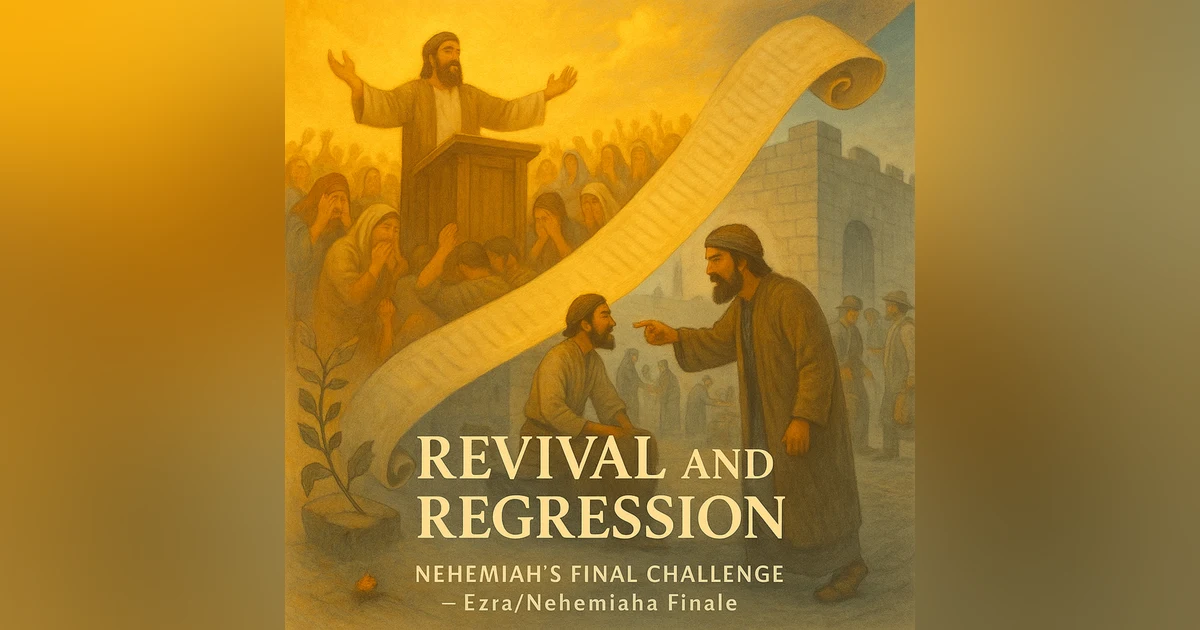
The Final Chapters of Ezra and Nehemiah
In the concluding episode of our Ezra-Nehemiah series, we walk through Nehemiah 8–13—an emotional and theological rollercoaster. From the public reading of the Law and national covenant renewal to the bittersweet failures that follow, this episode traces Israel’s spiritual high points... and its all-too-human shortcomings. We see the people hunger for God's Word, confess generational sin, and recommit to obedience. But by the final chapter, old sins resurface—neglect of worship, disregard for Sabbath, and compromise through intermarriage.
What do we learn? That revival is real—but it’s fragile. That leaders like Nehemiah can reform, but only God can transform. And that our ultimate hope isn’t in policy or perseverance, but in the unshakable faithfulness of the Lord.
Find our videocast here: https://youtu.be/LcY10bZtatU
Merch here: https://take-2-podcast.printify.me/
Music from #Uppbeat (free for Creators!):
https://uppbeat.io/t/reakt-music/deep-stone
License code: 2QZOZ2YHZ5UTE7C8
Find more Take 2 Theology content at http://www.take2theology.com
0:00 You ever heard the phrase Michael, you peaked in high school? Not, not you, not you. I'm not saying, but have you heard like people say, like, oh. This guy peaked out soon or something? Yeah, yeah, yeah. Well, my mom, they like their house is really damaged in, in flooding from a hurricane like last fall. And so they're getting some work on their house and people working on it are finally like they're getting work done like in their attic or they're raising their house now. And so they have to now they have to get like stuff out of their attic, out of the house. She was like, oh. It's all the important stuff is in the attic. Oh yeah, yeah. Yeah, I was like, thanks mom. She's like, hey, I got some some of your old trophies from like school from a long time ago. I was like, oh, I forgot about these. And yeah, you know, there's nothing better than going to a small school where you can, like, be good at stuff.
0:44 It's great. It's like, not the real life. But I, I, I found some trophies. I was like, Michael Mott might have been proud of middle school Zach. Yeah, yeah. So it. Might not be peaked in high school, might be peaked in middle school for me and and when I say I used peaked loosely loosely 'cause these trophies are not nothing really to brag. About you, as we'll see. So the first one is my is my best trophy, but the least it's the highest placing, but the the least challenging 1. So I got a a first place trophy at CBS. My school was called Central Baptist School chess tournament. Yeah, get that get the camera on there. I think about. Six people see a chess piece up here and it looks like a little king, yeah. And so this was, I think I won out about 6 people. So for first place, I think this tournament was actually at my house.
1:30 It was like classmates first place, not a whole lot of competition. Nice. Next next one I found this is 2nd place at Rosemark Chess tournament which I think was a school in in. Looks like the same person's buying the the trophy here. So this one was slightly better. It was at A at a different school. Several schools came, but it was like a bunch of small Christians, right? So it's not, it's not like really. Right. It's not first place, but the the crowd was much better. Yeah, the competition was steeper. And then this one is the best competition, but the lowest place. OK, alright, so. This was a This was a Memphis chess tournament. Oh, these? So the all three of these are chess. These are all chess, OK. For the junior high, I don't know what, but I got the the trophy looks impressive.
2:16 It's taller. Yeah. Yeah. Can you read what place I got here? 2nd honorable mention. I didn't even place but but why would you give a trophy for a second? Honorable mention. But there were a lot of people. It's like a packed out, you know? It's like he's a the the top five get trophy. OK so so this might be like. Yeah. So top three or fifth or something? Probably top three and then first honorable, second honorable because. That's what it is. This was like my best one because it was like Memphis, a lot of kids there and I got lucky and like beat a couple people I shouldn't have beat probably like, and I was like in 6th grade. So kids don't think things through all the way. And I, I played this kid who he like did a, he was like devastated. Like he was like really highly ranked. But he did like a dumb move that he like would never do. And I got his queen or something. And then it was like, oh, great.
3:06 And then I got. Blundered the queen, Did he, did he resign or did you checkmate him? Oh. I, I checkmate he, I think he was holding out that I would make a mistake because. Obviously, I mean, if you're in a tournament, I, the, the, the, the advice I've been told is never resigned. Never. Resigned and I so I and he was like, I was like a low seed. He was like a high seed. It was amazing. And then the next guy I played like just wiped the floor. Obliterated. You but it like helped me get to like this like it was it was really cool. And then so what's the 2003 that was those were the years. But I was like surprised I had a chess trophy. I was like, oh man, you know. What year did you graduate? I graduated in 2008 from from high school, so you know, and in my defense, I I think I might have talked about before I blame my parents.
3:55 I I like I was always the. Talking to you, breaking his parents. I started school. I was always the youngest in my class. Saying that you graduate, you're 17. It's like, man, I could have used the extra year for. Sports. There was it was actually Jill's second grade teacher. She got her doctorate, but I guess she's following up with some research that is about old guys who are held back. Like they'd be really young in their class and they just decide to hold them back and and the research generally shows that it's good for. Them everyone does it, whether it's sports or cognitive, I mean like you know, or social like I think in almost all of the different areas. On the social side.
4:36 You're like this. So that is the number one social cues. And yeah, I might have mentioned it on the podcast, so just sorry if I did. But if you look, they did this study of like US and Canadian men's national hockey teams and not just like who's in the Olympics, but like the U16 team and the U15 team. And if you were born January through March, you had like a 90% greater chance of being on the team because just when the birthdays fell. There's, it's funny, you said, because Jill's pregnant with Phoebe and it's an unexpected pregnancy and we're like, maybe it's a boy, maybe it's a boy. And this guy I worked with who coaches hockey, I was like, yeah, her due date is the 24th. He's like, do everything you can to delay that pregnancy to January 1st.
5:24 He's like, I'm telling you, like if your boy is going to play in any U, you know, 12U basketball, you know football, hockey, it's to their advantage if they're born in January and disadvantage if they're born in December. If you're. Born in December, it's like the worst like if you are like October through December, you're. Saying that to Jesus right now. I take it back for for hockey specifically, if you are divine, you are excluded from this. But it's like insane that percentages go down. Like if you're if it's like April through May, not great, but better than June through, you know, so it just goes down. It's so funny. It's very predictive. Very predictive. Maybe they should change their model. They should change your model because you miss people, right? Because they get weeded out when they're 11 years old instead of and maybe they would have been great, but the system starts when you're like 8. 1011 it needs to be 11 1/2 you. I know, man.
6:17 I don't. I don't. Know what you know. It's a problem because anyway, I, I shouldn't look up what the theory is. Malcolm Gladwell did like a study on this and he has like some solutions, but it was something like that where you have like rolling seasons and I don't know what it is like different, but it's, I don't know. That's that's why, man, I could have been. I could have really peeked in. High school, so my, my parents were, were trying to do the 'cause I was born in October, late October, but they were like, he is ready for school. Like it's OK if he's the youngest because he's doing math, he's spelling, he's asking questions all the time. He is ready. And the school's like, Nope. And, and we're, we're not taking them. You know, he can wait a year. So I had a year with my grandparents, 'cause you know, my mom and dad were working.
7:01 So I spent like every day I get up and they basically watch me. It was probably it's where I learned to to cope with boredom for sure because it was like it was crazy but probably did me good. Man, I love it also. Well, I won't get out there. I should. Michael, this trophy I have, it was like a cardboard cut out of me. It's like great. I was like, they should do more trophies like that. That's like hilarious. It's. Like a, it's like an actual, you know, you know, like the card, you know, like huge, but it's a it's like a trophy of of little 7 year old, 7 year old. That's great. It's great. Well, you know this connects to Nehemiah. Very well. Very well. Yeah, Chef. Tournaments, middle school birthdays, you know, we'll give another shout out to NLT. They do instead of saying the you know, we're I'm we're rating actually from the ESP.
7:45 But if you were in NLT, it would be like in November. Me and my did this instead of in a month of chill sale or. Whatever you know so. Anyway, I don't know if there's a way to make a transition. I just think we just say let's take it to the next level. From the hearts of the Low Country in South Carolina. It's the Take Two podcast, but we take theology to the next level. All right, Nehemiah 8 through 13 second-half. Of Nehemiah. Of Nehemiah. But last podcast in this series, right? Nailed it. I, I would love to do like 3 more, but I I think they're 5 or 6 or whatever we landed on is probably the really sweet spot. Look into the back stories of Sand Ballad and that other guy Tobiah or whatever his name was.
8:38 That's great. Well, if you want to kick us off, can you read verse 1 of chapter 8? It says and all the people gathered as one man into the square before the Watergate, and they told Ezra the scribe to bring the book of the Law of Moses that the Lord had commanded Israel. Anything stands out to you? Well, Ezra's back on the scene. He's back. He wrote a book and stuff and then we forgot about him and now he's back. So, so yeah, it's kind of so a lot of people will say this is kind of the beginning. Of the end of the end. Where it's kind of coming to a conclusion, like all of it. We've kind of heard these individual stories and this is kind of it's culminating. We're going to see almost three different series of the people hearing the Torah covenant renewal, like it's go, it's crescendoing to a very high point where the wall's built.
9:25 Ezra's reading the Torah. Things are really good before things tip and go really bad. And this is part of the good part where he's reading the Torah from early morning until midday. Try that at your church Sunday. I dare you, Pastor, go, go for it. See, see what happens. It even says the ears of all the people wore attentive not not just to Scripture, but to the book of the law, Leviticus. They're like, give me more. Yeah, yeah, yeah. That's those were some fanatical people because you know, Leviticus when you start talking about, you know, the different spots showing up in your house and you know how you deal with it, you're like, OK, all right, all right. Let's keep going. But they were pumped. He opened it, the book, everyone stood, they bowed their heads, they worshipped the Lord with their faces to the ground. And then we've got a list of people, Joshua's in this list and I don't know, 10 other people they, they broke out into, maybe it's the first small group, I don't know. They, they broke out and they helped people understand the law while the people remained in their places. They read from the book, from the law of God clearly and they gave the sense so that the people understood the reading going really, really well, spending a lot of time in Scripture, a lot of respect for God's Word. They're standing for God's Word, they're bowing, they're worshipping, they're all understanding. They have this hunger for God's word really, really good. We'll keep going.
10:44 If you look at the paragraph verse 9 through 12, we see that's the people actually maybe before they they started to mourn, they started to weep. They're probably broken over. We're not, we're not keeping the Torah and they're broken about. Actually, if you want to read verse 9. Says and Nehemiah, who is the governor, and Ezra the priest and scribe, and the Levites, who taught the people, said to all the people, this day is holy to the Lord your God, do not mourner weep for all the people wept as they heard the words of the law. And and actually there Nehemiah's gonna say go, go eat fat, drink sweet wine. Like this is like a good day, not a sad day.
11:26 But I mean, it's good that they're repenting and they're sorry, broken over their sin. But it's good that that some of these people may not have even heard the law to know that they were breaking it. Yeah, yeah, it's probably very eye opening to be like, wow. That's what we're supposed to be doing. No wonder things are going so bad. And then can you read verse 10? If if no one knows anything about Nehemiah, they probably know this verse. Verse 10 says Then he said to them, Go your way. Not this part of it, but you keep. Going eat the fat and drink sweet wine and send portions to anyone who has nothing ready. That that's in there for this day is holy to the Lord. And do not be grieved, for the joy of the Lord is your strength. Yeah, so this is the context of the joy of the Lord is your strength.
12:07 If you read different commentaries, they make a big deal about this word strength. In the Old Testament, this Hebrew word, which I don't know if the top of my head is almost never translated strength. Very rarely. It's usually translated fortress or refuge like we see in the Psalms, you know, God is our fortress. And so that that kind of gives not a totally different meaning, but the Lord's. And it's like, is it your joy and the Lord or the Lord's joy as your refuge and your fortress? It might have a different shade of meaning that might be. Most in our in our English translation. Exactly. And it's one of those verses, I think, that is so familiar to people that they cling to this and it's like we can't change the trend. It's like people don't want to mess with it as much even though it might not be the best.
12:51 The joy of the Lord is my fortress. The joy of the Lord is my fortress. You've got to work everything. It doesn't. I'm the. Same. Yeah. And so then the people have great rejoicing. This is great. And they're going to go on to celebrate the feast of booths. And there's something to it. Like we don't do it in our modern context, especially if you're, you know, we're not necessarily Baptist, but non denominational. Like if you go to the Anglican Church or the Catholic Church or whatever, they follow like the church count. There's like different beats. So we kind of do with Christmas and Easter. But you know, when that the Jews, they had the Feast of Booths, they're celebrating, they're kind of getting back to some of their roots. They're talking about from the days of Joshua, the son of nun.
13:31 They're reading about these things and saying, oh, we want to do this. We want to kind of participate with what the people of God have been doing for so long. They find out what they're missing and they want to remember all these great things. And that brings us to Nehemiah. We'll look at chapters 9 and 10, and really, 9 is just a long a long a long prayer. That's well, if you want to read it. Probably worth reading verses one through 3. OK says Now on the 24th day of this month, the people of Israel were assembled with fasting and in sackcloth and with earth on their heads. And the Israelites separated themselves from all foreigners and stood and confessed their sins and the iniquities of their fathers. And they stood up in their place and read from the book of the Law of the Lord their God for 1/4 of the day. For another quarter of it, they made confession and worship the Lord their God.
14:25 Yeah. And if if you're reading this like they are doing this like for days on end, like several hours worshipping, I was spending a lot of time. They're confessing their sins. If we look to the end of verse 5, it says stand up and bless the Lord your God from everlasting to everlasting. Blessed be your glorious name, which is exalted above all blessing and praise. This is really going in a good direction. There's fasting, there's sackcloth, there's prayer, a lot of confession. It's like man, the book would it were were to end like here. This is like really the Christian. It would say just keep pushing through. Things are great. We keep reading. We get to his prayer again. Nehemiah's gonna praise God's character.
15:05 He's gonna use God's covenantal name. He's gonna praise Yahweh and really recount all of his redemptive acts from Moses all the way up. It's almost like a Psalm. It's yeah, exactly. And it's like just reflecting on all this great greatness of our God who keeps his promises, who is faithful and righteous even when his people aren't. We aren't going to read all that stuff. I'm kind of glancing Israelites rebuild, but God was good to them. Let's see. Oh, and even we even get a shout out to the land of Ogg, King of Bashan. Isn't that interesting that that's I was like Clay would appreciate. That it's still there, Yeah.
15:45 So. And just a side note, Yeah, Oh, we got a text from Clay. You were on that same text. Yeah, yeah, yeah. Yeah. Oh yeah, during because we just started Abraham and we skipped over, you know, we kind of were sat in the context and we were talking about Noah and we skipped over the part that talked about the nepheline. Clay was furious. I think he walked out of that service. I'm just kidding. He like he like started messing with the sound. Ezra. Ezra doesn't even leave it out, you know? That's right. That's like, I saw that. I was like, that's interesting that that is like, man, we're going to keep keep that in there. Do you want to read verses 26 and 27? Yeah, it says. Nevertheless, they were disobedient and rebelled against you, and cast your law behind their back, and killed your prophets who had warned them in order to turn them back to you, and they committed great blasphemies. Therefore you gave them into the land, into the hand of their enemies, who made them suffer.
16:40 It's we see God's goodness and then it's like, I mean, it fits really nicely with Ezra, Nehemiah, it fits nicely with us today. It's like mankind, humanity just disobedient, rebellious. If you skip down to verse 31. Nevertheless, in your great mercies, you didn't make an end of them or forsake them for you are a gracious and merciful God and then appeals to God. You're great, you're mighty, you're awesome covenantal God steadfast to love. You know he's he's really crying out that you've been faithful. We've been wicked and they've renewed this covenant. So they're reading the Torah covenant renewal lot of praise to God in verse in chapter 10 we get a list of all the people who like sealed this covenant that they're like, hey, I promise I'm going to keep Torah. This is the start of something new. Now would these people go on to be Pharisees? These people are promised you can keep Torah. It's yeah, I don't know, you know, I don't. Yeah.
17:36 It's like all these names are there. It's like a huge list of names of presumably heads of households who are going to keep this. Then then we get the obligations of the covenant that they're agreeing to. It deals in all of these areas where they have failed kind of it goes through these different Levitical laws. So we're going to skip through a lot of that talks about tithing, first fruits, sacrificing, don't neglect the temple Sabbath. Intermarriage. Intermarriage. Yeah, it almost talks about a lot of the things that they had previously messed up, like, hey, we're going to get this right now. They. Talk about the year of Jubilee. Year, yeah, yeah, year of Jubilee. They they're really doing some deep cuts in in the tour saying, hey, we are going to be faithful to all of this.
18:20 We get to Chapter 11. It says now the leaders of the people lived in Jerusalem and the less of the rest of the people cast lots to bring out one out of tend to live in Jerusalem, the holy city. Well, 9 remained in other towns and the people blessed all men who live. So it was almost like it was kind of gonna be tough to live here. It's like a new city. They had to cast lots. For it, it's like on a mountaintop, so. It is a high, Yeah, yeah, yeah. I mean, I guess they probably have some agriculture there, but it's not like they're gonna have like these. It's not the fertile, fertile area, right? Right. Yeah, exactly half of it. Where the? Water and rainfalls. When I was reading too, they were like, man, if you're in the city, a new city, probably much more likely to get attacked. I don't know how much that matters where they were living.
19:03 Like they're not going to attack the rural areas probably as much. But it just wasn't. Whatever it was wasn't super attractive to live in the city at that time. And then buckle up. A lot of names, a lot of chiefs, a lot of valiant men, a lot of sons of Benjamin and priests and Levites and gatekeepers. We won't bore you there, but talks about all the villages. Just just a lot of specifics. Ezra saying, hey, all these people were here. Nehemiah 12. Kind of. Keeps the names rolling. Keeps them going and and these names like go back to Ezra. So kind of re repeating a lot of this. We could go on and on and then we get to verse 27 and we kind of get to this dedication of the wall.
19:46 Wall. It's great. They get all the instruments out there celebrating. Tubas were definitely there. I think that's in a different translation. Cymbals, harps, liars, and people purified themselves. It's great. They're dead. So Tor is red. They're sensitive to it. Covenant renewal, people making formal covenants. They're dedicating the wall. Even 2 great choirs come. He's got a choir walking from the east, from the West. They like, dramatically, like, walk together. They're singing, swaying in choir robes while they're walking up. Definitely the choir robes on and it's it's a really big deal, a huge scene. It even says that the joy of Jerusalem was heard far away. Verse 43 says that we see joy mentioned a lot here. We read in verse actually, this is actually a big turning point. This is probably the turning point where once we get to verse 44, we start seeing more negativity. Specifically after this paragraph, we see, you know, long ago in the days of David, in the days of David and Asaph, there were directors singings, there were songs. He's appealing back to David like this is a great time. He's kind of re establishing duties of the Levites like they were in the day of David.
20:56 So they're trying to kind of bring that Davidic kingship into here. I'm very excited for it. And then verse 13. Let's go ahead. Read verse one for me of chapter. 13 on that day and you have I guess this is your parenthetical statement or is this Yeah, they read from. The book It might be longer than a. Day Oh yeah yeah, on that day probably longer than a day maybe even months I appreciate that in there I've. Never made that connection. They read from the book of Moses and the hearing of the people, and in it was found written that Noamonite or Moabite should ever enter the Assembly of God. For they did not meet the people of Israel with bread and water, but hired Balaam against them to curse them, that our God turned the curse into a blessing.
21:42 So this is this is just interesting that I read. So they're reading back in the Torah and they're like, hey, no Ammonite, no Moabite that really traces its origin back to Abraham, and lots. And his two daughters. So that's like the. Origins great. A great family story. Yeah, go family devotions. Let's hit that one hard. And so it goes back to that. And their response is no, foreigners are out loud, which isn't necessarily the same thing, so. It's easy. You can't even look at it or touch it. Yeah, yeah, yeah, yeah. Exactly. And so and now read this. Read verse 4. OK, it says. Now before this, Elisha of the priest who was appointed over the chambers of the House of our God, who was related to Tobiah, prepared for Tobiah a large chamber where they had previously put the grain, offering the frankincense, the vessels, and the ties of the grain, the wine and the oil, which were there by commandment to the Levite singers and gatekeepers, and the contributions for the priests.
22:36 We've read this a lot, Do you remember what Tobiah was? Yeah, he was an Ammonite. It's like, so they're not letting any, they're excluding all foreigners, but they let one guy in, presumably, and it's specifically what they're not supposed to do from the Torah. This is not good. And not only that, it was allowed by this guy, Eliashib, the priest is the one who said, hey, this is cool. You can even like he was, hey, he was related to Tobiah and he said, hey, you can have a chamber like in the storehouses of the temple. This will be like totally fine. So so we see this covenant renewal and then immediately after we see the temple being defiled, like right away they're letting in the people they promised they wouldn't. Nehemiah read, read verse 6. This is Nehemiah's alibi.
23:18 While this was taking place, I was not in Jerusalem, but. Don't get me. He was up there with Artis Grixes. Yeah, so he's like, I wasn't here. I came back and I saw this and I was furious. We see like a major shift. Basically it's. This guy where he's like pulling his hair out. Yeah, we're about to get to that part. So the temple's kind of defiled. We're gonna see if we were to keep reading everything that people are like using wine presses. They on the Sabbath. They're like trading on Sabbath. Not only are they trading on the Sabbath, but the wall that Nehemiah built now was like the place to be on the Sabbath to to do business and the temples have filed the wall that was just dedicated is being used to intentionally break the Sabbath.
23:59 No one's keeping Tora worship. Everything they basically have done has been undone and it's still with Nehemiah. It's not like this has been 100 years later. It's like not not that far different. And we see this kind of thing happen at least two or three times in verse 14. He'll say, Remember Me, Oh my God, don't wipe out my good deeds that I've done. This is like not but he's like. Remember from yeah, in the beginning of the book he's like corporately confessing sin. And now he's like, OK, not me, not me, them. Them yeah and this is a good shift we see I don't know how much we're supposed to read into this, but in the beginning Nehemiah is I mean he's kind of emotional when he blurts up before the king, but he's taken 3 days to assess the situation. By the end of it he's like pulling being violent with people. We see kind of like this shift where where where things aren't going great he's like and so verse 15 does say I saw on Judah people treading winepress on the Sabbath, bringing heaps of grain on the donkeys this kind of stuff. If we keep going through, he's saying we're gonna close the gates because of all this stuff.
25:00 He says I will lay hands on you if you don't listen to me. Remember this. Oh, my God. Spare me. According to the greatness. He's like, come on. This is not not me. He makes physical threats. He's like, you better keep the Sabbath. I'm going to beat you. Like, come on. We've talked about this over. And people were killed when Moses first came out. Yeah. So you know. It's. Not that is kind of kind in comparison. We get to verse 23. You go ahead and read verses 23 through 25. It says in those days also I saw the Jews who had married women of Ashdod, Amon and Moab, and half of their children spoke the language of the language of Ashdod, and they could not speak the language of Judah, but only the language of each people.
25:42 And I confronted them and cursed them and beat some of them and pulled out their hair. So. So not only has intermarrying happened, but their kids don't even know Hebrew. It's like they don't even have the culture at all. They just sort of like we what we love the Feast of Booths. This is great. Like we're loving these traditions. And I don't know the timeline, how much different, but it's not that much. And it's like Sura Bull has been there, Ezra's been there, Nehemiah's been there. It's like all just falling apart. And then and. If you can't speak the language, you can't read the Torah. Makes a lot harder. You can't follow the law. And and basically I does this end in verse 30. He's like, that's like cleanse them from everything for and I established the duties of the priests and the Levites each and his work Have I provided for the wood offering at appointed times and for the first fruits.
26:30 I guess I skipped over this. He he chased Sam ballot away. He's like, I'm getting Sam ballot out of here. But that that's and it it's done. It's over. The book drops off where if I was writing the story, it's like if you stop at that covenant renewal, it's like so nice. And then it's like kind of flat. Or you might want to say, and they learn their lesson finally, you know, after 10 years, none of this happened anymore. I we fixed it, but it's kind of left it just. Left there and it's like, man, I never picked up on this, but it's like over and over and over again, you know, and you're you're still confronted like Jeremiah still wrote something in Jeremiah 31 that is true. And this immediately this happens after this Jeremiah prophesied the edict of Cyrus a little bit and you look at this and you're like, OK, this isn't it. So what where where does it not jive up? And you're like, oh, there's no new heart. There's no spirit of God at work here. And it's not like Nehemiah and Ezra were like the worst people in the.
27:25 World and you know, hopefully you would kind of looking back, you may assume that God is saying the new covenant what Jeremiah spoke in 3131. You're not going to find it here. I'll let you come back here. I'll let you rebuild here, but this is going to be empty because this is just a shadow of the thing that I'm actually going to bring. Man, it's it's so great and there's so there's more just thinking. I mean the people are just longing for something else and it's just I I it's such a great lesson. It's like I feel like everyone just been more Tom and Ezra and am I because it it speaks to where we're at not really good the new covenant, but it's like we're still longing for the consummation when Christ returned we're.
28:06 Like Fulfillment 3131. Yeah, that's right. That's right. It's like we have so much more than they had, but it's like, man, everything is just pointing to. The good thing is we never sin, right? Right, it is a great picture of even Nehemiah recounts from the time Moses up to him, everyone's rebelling and we can probably we can go back to the time of Ezra and pick up the story and say everyone's been rebelling since. And it's like, man, we don't learn our lesson, but we can, you know, look forward to what God will do. So I think Nehemiah was probably a good leader. I think Ezra was a good leader is a real good leader. But it's like, man, you might not you might hope that your you know, your endeavor goes better, better than theirs. But anyway, I like the series, it's Good Hope.
28:48 Hopefully it's a little bit of a fresh perspective 'cause you know, you just read through scripture. Sometimes it's hard to pick up on this 'cause you're probably not hearing a sermon series on this because. And if you are, it's probably not picking up these. Particulars. That's another point. Yes, yeah. So it might be good to read it back. You know, Ezra and me, my fresh eyes and go, OK, yeah, yeah, I see, I see that. And oh, I hear all those names that Michael and Zach skipped. That's great. Yeah. Work on that, you know, vocabulary. Get it, get it, get it going. That's great. I really enjoyed this series. Probably time to move on to something else, but any any other closing thoughts? No, I think this has been good. I'm glad that you brought it. So, yeah, great. But what? What? What is next? Do we know what's next? I think aren't we doing 2 on the Kingdom of God? And I think that fits so well with this because it's like they were trying to usher in the Kingdom of God. We can kind of pick up on that.
29:37 Theme and then our pastor just started Abraham alluded to that I. Like some of your ideas on Abraham like that are like a little bit. So we're I don't yeah, we're going to try to. We're not going to just let's do sermon recaps like with Romans, although I thought Romans was really good. But we're going to maybe look at some, you know, some things that Joel probably is not going to talk about with Abraham and maybe investigate some behind the scenes stuff, you know? I love it, I'm excited for it. Well, thanks for hanging in there for this series. That's our take. Thanks for listening to Take Two. Find us wherever you find podcasts and on YouTube for those who want to watch our video cast.

