Ezra/Nehemiah 2: Ezra Sent to Teach


 RSS Feed
Episode 2.17
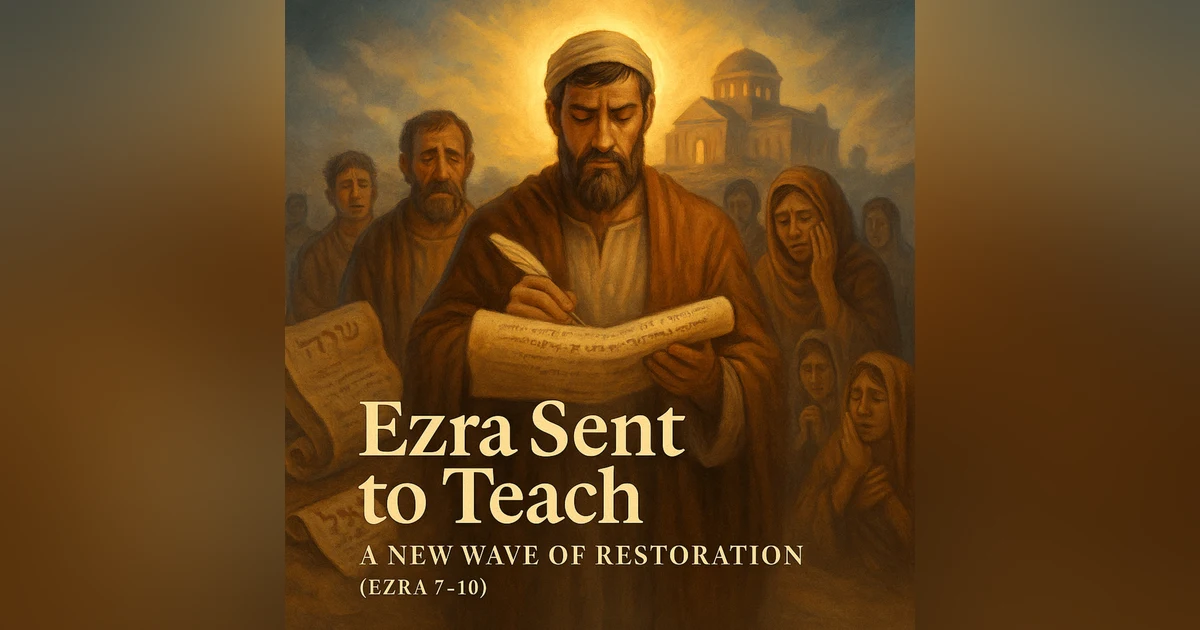
In this episode, we witness a fresh movement in Israel’s return from exile—led not by a builder like Zerubbabel, but by a teacher and priest named Ezra. Sent by King Artaxerxes, Ezra returns to Jerusalem decades after the temple’s completion, carrying royal authority and a heart devoted to God’s Word. His mission? To study, obey, and teach the Law of the Lord.
We explore Ezra’s arrival, his reliance on God’s hand of protection, and his grief when he discovers Israel’s spiritual compromise. The story turns from joyful return to heartbreaking repentance, as the people confess their sin of intermarriage with pagan nations. Through Ezra’s brokenness and bold leadership, we’re reminded that true revival begins with God’s Word and leads to real repentance. This is not just a history lesson—it’s a call to examine where we have set our hearts.
Find our videocast here: https://youtu.be/FfyaQL2JKXA
Merch here: https://take-2-podcast.printify.me/
Music from #Uppbeat (free for Creators!):
https://uppbeat.io/t/reakt-music/deep-stone
License code: 2QZOZ2YHZ5UTE7C8
Find more Take 2 Theology content at http://www.take2theology.com
0:00 Right, Zach, Yeah. Do you ever have unmet expectations? Man, from time to time, yeah. Yeah. And Tim would say that, you know, unmet expectations is kind of the, the Pebble that kind of can start the avalanche of some of these, you know, anger or fear or, you know, you know, my rights type of things. But today I was at work and this meeting was going very long and, and finally I hopped off of it 'cause I was like, I'm not, I'm not doing anything here. It's time for, I should have headed out, you know, 20 minutes ago. And then also on Facebook, I saw this person with a picture of this huge but very nice looking banded water snake on their back porch. I'm like, can anyone come, you know, remove this And I say, hey, if it's still there, I'll swing by and I happen to look. It is on my way home.
0:53 Wow. Perfect. It'd be stupid not to, yeah. Yeah, and it'd be stupid not to. And I thought, you know, this was when I said, yeah, I can do this after, after work was, you know, this before this meeting went long. And so then I show up, 'cause I'm, I'm thinking, I'm, you know, we're expecting to start around 5:00-ish. OK. Yeah, yeah. And so I get there and I Oh yeah, let me take you, take you to the back porch and I'm, I'm like looking for the snake and the guy's like, well, normally it's like right here and like there's this deck there that getting a political call on while we're talking. I do not want to answer that that call any.
1:33 Fun banter. Just put it on speaker team Lindsey Graham. No, I don't want to take that call, but I digress. And so Long story short, this snake is not around. The wife comes out and it's like, yeah, we haven't seen him. Like we saw him a couple that that picture on there is from a couple days ago. He's normal. And so then like I want to be polite. I don't want to be, but they're like talking like all this stuff, like, well, he comes out here, but I'm afraid of my dogs and you for afraid for my dogs and all this stuff. And like, I get drawn into this like 20 minute conversation when the snake is is not even here. So I finally was like, well, if you ever seen it, like the best bet is if you see him, just don't go back out here and like, you know, give me a call and if I can come come by, I'll swing around. So yeah.
2:22 That's why you were late. Yeah, that contributed. So I got into the truck and that's why I was like, this has taken longer than what I had accounted for and there's not even a snake here 'cause if there was a snake there, I could have just grabbed it and gone. Like work, you know, a couple things from that story. That's how you're gonna die. You're gonna go to someone's house. You said they have a snake, and they're gonna trap you in their basement and you're just gonna be dead. They're gonna. Yeah. If you go missing, I bet it's from a state relation relocation call. So. Well, that was the main thing. Other thing. Oh, yeah. Other thing was, yeah, I made a joke. You know, whenever Michael says to meet you at 5, I already pinched out that way. And I was like, we got some time.
3:02 It'll be 530. We got time. 5:30 Then he said 5:30 so I was like noon. It's like, you know, I made the joke. It's like Eastern Central time. There's like Zach Michael time. But you know what? It's consistent. You know, I know what to expect. Yeah. Yeah, I know the conversion. You know how many? It's like you do. And I feel like maybe this would be more useful if I baked more, but it's like an elementary learned, like how many quarts are in a pint? It's like, I know how many. How many? Quarts are in a pint. Pints in a quart? Well, you could do a half a quart. Oh yeah, but yeah, there's a half a quart in a pint. There you go. So you memorize all these things, but you got to do the conversion, right, Right. So I got the the Michael Zach time conversion. Well, we're on our third man episode on the books of Ezra Nehemiah or the book of Ezra Nehemiah. And we just talked about unmet expectations and our last episode kind of talked about maybe he's rubable having some unmet, unmet expectations and and perhaps Nehemiah or Ezra, I think we'll be talking about Ezra, right? He's he's met, yeah.
4:07 He'll have some unmet expectations as well. Yeah, you couldn't. You couldn't frame it better. Unmet expectations. Let's go ahead. Let's jump into it. Let's take it to the next level from the hearts of the Low Country in South Carolina. It's the Take Two podcast where we take theology to the next level. Episode 3 looking at closing out Esther we're going to jump through. Sorry, you're like what? I wasn't prepared. Ezra, Ezra, sorry Ezra. Chapter 7 through 10 we heard all about Zerubbabel. Now we're to the next guy.
4:48 We, we kind of mentioned 3 movements, 3 different characters with three different missions with three different kings, all without position, all with mixed results, very repetitive to prove a point. And so I'm glancing at the first few verses and they look like there's a lot of hard names. So, Michael, can you read verses one through 6 to kick us off? Of Chapter 7 Chapter 7 Now after these things, the reign of Artaxerxes, king of Persia, there went up Ezra son of Syria, son of Azaria, son of Ilkia, son of Shalom, son of Zadok.
5:29 I wonder if that's Zadok, the priest who dedicated the. Temple, I was going to make a note. Of it, son of Ahitab, son of Amaria, son of Azaria, son of Marioth, son of Zerahiah, son of Ozzy. So probably, I think that's probably the the word I heard that's probably not Ozza the one who. Yeah, Ozzy related to Fuzzy? Never. Mind, son of Buki, son of Abishua, son of Phineas, son of Eleazar, son of Aaron the chief priest. This Ezra went up from Babylon, and he was a scribe, skilled in the law of Moses, which the Lord God of Israel had given.
6:12 And the king granted him all he requested, because the hand of the Lord God was upon him. How much? Nice. That's perfect. That is perfect. We'll start. Who was the king? Well, we moved on. We kind of started the last time with Cyrus, moved into Darius, now we're on Arctic Xerxes. This is depending on what source you're looking at. This is 50 years later, maybe up to 80 years later after Zuribol and Jeshua rebuilt the temple. According to the ESP study Bible, Ester has happened. I think probably closer to here than closer to there. I'm just looking at my notes now, but maybe the same universe that that's according to the dates a little bit different, but I think people are making their best yes, if you so this.
6:57 Is that that actually makes sense to me because like I've said before, there's gonna be a, a part in here where it says and the queen was there when, when? No, no, that's Nehemiah, isn't? It so yeah. So maybe it's different. I will for the record, I will say ESP study Bible I think places this movement 60 to 80 years after durable. The Bible project places it 50 years. So there's like 30 years that it could go either. Way they're trying to figure out the timeline. Yeah, exactly. And so anyway, we know a lot of people are back in Jerusalem. There were waves of people coming back, that first wave. Do you remember how many people were were in it? There was a lot of people at at least 42,000, you know, maybe more of women and children.
7:40 I don't know how they counted all of this. And then we're introduced to the man of the hour, the man whose namesake is this book, Ezra. And it's, it's probably worthwhile to spend a little time on Ezra because those first 6 verses you read, really we're all pointing to Ezra like painstakingly like saying this, this guy is a good guy. Also Ezra probably wrote this scroll not not making any connections. Moses was the most humble of all the people. Just sliding that and there. But you what made this astute observation. I mentioned this last time that people talk about all this craftsmanship. If you look at this genealogy, it's also very symmetrical. You've got 7 priests before the temple destruction, 7 after, and then right in the middle Zadox.
8:24 And it that that's like on purpose. And it's all building up to establishing this credibility that it's. Yeah, exactly. It's like right there and it's on purpose. And I think this is the first scribe we're introduced in all of scripture. And so when you're, this is like where it starts to be a thing around this time. And so you look at the Pharisees and the scribe Sadducees, like when you think scribe, they're in their mind probably like, I wanna be like Ezra, like Ezra's like the standard. He is the scribe. He brings, you know, Zerubbel built the temple. Ezra's bringing Torah or bringing worship. He's bringing scripture back to the temple 'cause he doesn't build a wall, he doesn't build a temple. He's like just bringing. The worship. He's building the people. I love that. Yeah, exactly.
9:06 And so that's kind of where we get all of this stuff. You know, it looks, you know, you read about scribes and people point to Ezra because he actually carried authority. It wasn't like he was just a copyist. He, you know, he did write down the he was very familiar with the law, but he actually acted on it. A teacher and something that probably many really wanted to be. You see the priestly line? Yeah, we mentioned that and we see, you know, God was with him, blessed him, it granted him, like everything he asked. So setting the stage for some pretty, pretty big things. Do you want to read verses 7 through 10? Sure, some of the sons of Israel and some of the priests, the Levites, the singers, the gatekeepers, and the temple servants went up to Jerusalem in the seventh year of King Artaxerxes. He came to Jerusalem in the 5th month, which was in the seventh year of the king.
10:01 For on the first day of the first month he began to go up from Babylon. And on the first of the 5th month he came to Jerusalem, because the good hand of his God was upon him. For Ezra had set his heart to study the law of the Lord, and to practice it, and to teach his statutes and ordinances in Israel. So where we're getting an overview of, of what's going to happen kind of, and then we're going to get into details, kind of setting the stage. We'll get into specifics later. Also it, you know, we can note that it's like over and over. God was with it. God was with Ezra. We see this kind of thing all over the place. Ezra set his heart to study the law of the Lord. He loved the Torah, set his heart on it, memorize it, obeyed it, taught it. He he was so connected in a very important way. And then what we probably do want to know, how long would it take for Ezra to travel?
10:54 It's probably about four months. This is one of the areas I really like the NLTI think it's pretty accurate, but they, they never say like the actual Hebrew months. They're like in on November 4th, he did this and you're like, oh, OK, it's probably this time of year. And so this is probably like April to August. It's a it's four months. It's not like we read this and it's like, oh, they're there. It's probably so it's a long journey. It's not like you get there automatically and then once again. Does the NLT also tell you the month and date when Jesus was born? I don't. I don't. Know that that would solve so much. Yeah, we would know. We should have looked at that during our Christmas episodes. We missed the NLT. That's great.
11:34 I'm going to just do a just jumping around at a few verses of things to keep keep in mind as they make this travel back. They they give us a copy of the letter that came Artaxerxes gave to Ezra. And we learn in places like verse 13 that he makes a decree that any one of the people of Israel or their priests or Levites in his Kingdom who want to go to Jerusalem, they're free to go. You can carry the silver if you skip to 15 and the gold that the king and his counselors has offered. Bring all these resources for free will offering skipping down to verse 22, up to 100 talents of silver, 100 cores of wheat, 100 bags of wine, 100 bags of oil and salt without prescribing how much whatever is secured by the God of heaven and let it be done in full for the House of the God of heaven unless his wrath be against the realm of the king and his sons.
12:24 Verse 26, whoever won't obey the law of your God and the law of the king, let judgement be strictly executed on him, whether for death or for banishment or for confiscation of his goods or for imprisonment. I just kind of glanced at a few of these things, but king wants people to go, says here's a bunch of resources and again, don't stand in their way or bad things are going to happen, but just entering it's a different Persian king just saying the same kind of thing. And so you see again, kind of these expectations set, you could kind of go, man, this is going to be it. We're going in, Zerubbabel built the temple and now we're coming back. We got all this stuff. We're we're going in like gangbusters. Expectations are high. Even this is totally different. But even like today, if President Trump was like, hey, here's half of the US Treasury let's Jews work, you know, with Israel, it's like that's like, that'd be such a big deal, you know?
13:15 And it's like the world would like go crazy. So you can. Yeah. Like you're saying, it's like, man, if they're giving this much stuff as much salt as you want, that's. I don't know. Yeah, that's great. So we'll camp out or start back up in verse 27 through 28 if you want to read that, Michael. Blessed be the Lord, the God of our fathers, who has put such a thing as this in the King's heart to adorn the House of the Lord which is in Jerusalem, and has extended loving kindness to me before the king and his counsellors, and before the kings of mighty Princess. Thus I was strengthened according to the hand of the Lord my God upon me, and I gathered, leading men from Israel to go up with me. So we see a shift here, third person all in Ezra. Now it's first person.
14:06 Ezra's talking about himself and the first person praising God knows God is with him, gathered men to go and you can see things. Things look pretty good. You know, we got the king on board. Ezra seems like a great guy. Then we get to chapter 8. Verses one through 14 will not make you listen to that because again, it's name after name after name. One thing that is of no is wizardable 42,000 people went you read this list. It says I don't know if it numbers it, but if you do the math, it's like 6007 thousand. So it's still a lot of people, but it's, you know, the first wave was like the big wave. I don't know if that means people are jaded. I don't know what the deal is, you know, or maybe there's just less people to go that kind of thing. And then we get to like this weird section in verses 15 through 20.
14:55 At the end of verse 15, you know, they're on their way. And Ezra says, I found we didn't have any Levites with us. We forgot the Levites. And verse 17, he's like, we got to send, we need a Levites. We need to send ministers for the House of God. We need to like we can't come back and bring Torah to the Temple and Levites aren't with us. Yeah, that's confusing because he's a direct he would he consider himself a Levite 'cause I that may have not was there just one didn't weren't there three different sects of the of Aaron's descendants? So is he looking for a specific sect? I I don't know. Yeah, I'm trying. I don't think I I'll have to look back in my more extensive notes, but I don't have anything in the in our podcast notes where he's like looking around and he's like, uh oh, let's go, let's go find people and he rounds up people.
15:43 It's still not a ton, a ton, but he gets he gets at least some people to come with them because you got to have Levites if you are going to, but that might be worth to maybe we can look it up it. Says 220 of the temple servants whom David and the Princess had given for their service of the Levites, all of them designated by name. That's in verse 20. OK, Yeah, yeah. So they get a chunk compared to the 7000 people or whatever. And I think part of this too is this might not be in this part, but another part, there are some people who are like, they might be saying they're Levites, but it's like you can't prove. It's like they lost. They're saying they're part of this family, but they don't have that that record. So it's like, well, we can't really count you for sure in this. We probably want to pause in this paragraph, Michael, if you want to read verses 21 through 23. Then I proclaimed a fast there at the river Ahava, that we might humble ourselves before our God to seek Him from, seek from Him a safe journey for us, our little ones, and all our possessions.
16:44 For I was ashamed to request from the king, troops and horsemen to protect us from the enemy on the way, because we had said to the king, The hand of our God is favorably disposed to all those who seek Him, but His power and his anger are against those who forsake Him. So we fasted and sought our God concerning this matter, and he listened to our entreaty. Great. So we see some fasting, some prayer for protection, and the King's like, hey, I got bodyguards. He's like, no, no, no, I've been, I've been talking a big game about God. Maybe it's a weird look and I'm like, actually, give me those bodyguards. And. Maybe you pick this up I as you read through Ezra and Nehemiah. They're the same, but they're difference. Nehemiah, he's going to say, give me all the bodyguards you want. And that's probably the difference between a priest and like a governor.
17:31 Like like it's like a different. It's leadership with Nehemiah. Yeah, yeah, he's, he's, he's coming. But they've got kind of different things in their mind and do different things. But they're both, you know, good leaders. I wouldn't say 1's wrong. Right. That that's the point. There's different, and as you look through these different things, there's different judgments, different things. And it's not, yeah, like you're saying, not right or wrong. It's just a judgement call. Yeah, 'cause I could see, you know, me saying, yeah, give us the bodyguards because that's. You're doing four months right over, you know, a bunch of land. Yeah. But I could see. With all this gold and all this wheats man. Right Or, but maybe some missionary, he's like, no, we don't need bodyguards. We're we're going straight to you name the city and and God's going to have his hand on us and and then God protects them. And I think both of those are fine models. Absolutely and something that we'll probably talk about again and again, Ezra, Nehemiah, it's one of those places if you just want to like clip out all the different prayers that they pray.
18:26 There's a lot of like great prayers that are, you know, prayers are confession prayers for the people right here, fasted, prayed to God and it says in verse 23, God listened to us. I like that you kind of get the both sides of it. If we continue on in verse 24 through the end of the chapter, a lot of text, I'm just going to summarize. Ezra appointed 12 leaders to guard the treasures like once they like during their trip, even though they weren't taking bodyguards, they had people that are gonna watch over this very valuable things. They actually were ambushed, survived an ambush and made it safely, keeping all the gold and silver intact. Then they offered offerings to God. So again, things seem really, really good.
19:06 So you want to take a guess at least stay that way. It's too, too good. No, each movement's gonna have like this good king leader and then opposition, something else maybe we'll highlight as we go throughout. It's interesting, the opposition's all over the place in these stories. There's some from within, from without. It's kind of showing different, different sides of opposition. And so we're going to get to some, I think, what can be challenging things to deal with about intermarriage. So we've got verses one through 5 and maybe, well, some discussion and intermarriage so we can summarize. Or actually, if you just want to read the first 5 verses, it might be good.
19:47 Now when these things had been completed, the Princess approached me, saying, The people of Israel and the priests and the Levites have not separated themselves from the people of the lands according to their abominations. Those are the Canaanites, the Hittites, the Perizzites, the Jebusites, the Ammonites, the Moabites, the Egyptians, and the Amorites. For they have taken some of their daughters as wives for themselves and for their sons. So that the holy race has intermingled with the peoples of the lands. Indeed, the hands of the Princess and the rulers have been foremost in this unfaithfulness. When I heard about this matter, I tore my garment and my robe. I pulled some of the hair from my head and my beard, and I sat down appalled.
20:32 Then everyone who trembled at the words of the God of Israel on account of the unfaithfulness of the Exiles, gathered to me, and I sat appalled until the evening offering. But at the evening offering I rose from my humiliation, even with my garments and my robe torn, and I fell on my knees and stretched out my hands to the Lord my God. Great. We we hear the word appalled a lot in there. I know he's he's appalled. When was the last time you pulled out your beard 'cause you were so upset at something? You gotta be pretty. I don't think I ever have. He's pulling hair from his head, his beard. It's not a good situation. We see again, you know, Ezra, very familiar with the Torah.
21:13 He's bringing all these illusions he talks about. This reads straight out like all these people are of these Ites and Egyptians, but the Bible Project says no, these are just people who didn't leave the land and so, but maybe, maybe it's the same. Maybe those are one. And the same, I think the argument, I think it's unclear in our English translations. I think in the Hebrew there leaves more work, there's more if it's like, oh, this is an allusion to the Torah. We're repeating the same things that are not direct descendants. But I think it, I think it could go either way. It depends on how you're reading it. And it's like in the in like the same spot, you know what I mean? Like you just see. So I don't know if it's a literal thing or not because different people say different things.
21:54 I mean the people that like the Bible product they appeal to the underlying Hebrew is vague or something like that. Yeah, and it's not clear to me that all of those, every single one of those people were banished from the land anyways, so. Anyway, yeah, that's. Right. So maybe those people are hanging around. There might be some. Yeah, exactly. And so we have this situation where there's been marriages. The people have not separated themselves. They, I think Ezra does a good job of highlighting that they're living with their abominations. It's not necessarily just the marriages. You look back in the ancient Near East, you know, marriage wasn't always because you're in love with someone. You know, a lot of times it was like more for utility. And there's like, you know, treaties, economics.
22:36 Yeah, Yeah. There's a lot of things that maybe you're trying to embrace and these kind of things. And it's not like it's been totally smooth sailing for the Jews. Like, they're probably like, man, they got some resources. I mean, this might be expedient for me. It's been like, we've been like building the city for a long time. It's like not been great. Yeah, And I wonder if, you know, this is in Ezra's mind. He's like, This is why everything's not clicking. You know I found the sin. Probably, Yeah. Yeah, That's a good point. Is like, haven't you guys read the Torah? These are the same things that have happened in the past, and we're doing the same thing. We're not. Being faithful. No wonder. No wonder things haven't returned to the glory of. No wonder. Like we.
23:16 Yeah. And I made this note because I think it's hilarious talking about the word of Paul Taurus cloak his government. I when I was teaching impact, I said, imagine the scene. What if there's someone you really respected? What if Pastor Danny tore off his sideburns? You would know it would be a big deal. If I saw Danny take off his sideburns, I'd be like, what's going on it? Would. Be it would be a a a big a big thing mentions prayer. So, you know, I think critics of Scripture would point to text like this among others and say, man, bunch of racist, these Jews, you know what I mean? That's like, that's like the charge that it's like, man, you just can't, you know, marry someone else. I wonder if anyone used this text as a basis for prohibition against interracial marriage? That would be very interesting.
24:02 Because I'm not even. It's not clear to me that you know you. This is descriptive. I don't know that this is proscriptive or prescriptive. I, I think that's like nailing it too. That's what I I wrote down where it's it's not giving us a pattern to live by. Cause Paul would say some stuff that's different. That's what, yeah. Yeah, Yeah, yeah. Of course it's New Covenant versus Old Covenant. So it's it's hard to judge. Ezra's operating, yeah, off of the Torah, like pretty strictly. It's like you almost can't blame him necessarily. And it is more complicated where it is mixed up with practices where I can see people like truly racists using this to be like, well, you know, there's cultures, they, you know what I mean? And like ascribing some sin, which might be true, but it's like you're, it's like, you know, you're trying to conflate everything to prove your points.
24:50 Yeah. And then the the the Bible project also mentioned, hopefully I'm not stealing any. That's great. Malachi is prophesying during this time. That's what's going to say. I was going to, I was going to open it by talking about the Italian prophet Malachi. Malachi. But yeah, so people again, Malachi, no one knows when to date it. It's like 400, but it might be a little bit older than that, you know? And then and it kind of does fit with like if the Exiles had come back, maybe they weren't giving like they should have. Maybe they weren't the the they were divorced. And you see all of these, whatever they call it, the back and forth of Malachi where God's calling them out. Kind of makes sense that it would be during this time. But Malachi says God says I hate divorce.
25:33 And now, yeah. And so people look at that, I think, and maybe the Bible projects at this too. There's like might be the Malachi criticizing Ezra's actions, you know, a little bit, or may, I don't know, or you know anyway. Or maybe this happened and they thought divorce is nothing and so now they have they have a low view of marriage after that. You, you just don't know. We're not giving all those details. But I love that you brought Malachi into it because it's yet another like, it's like all this stuff is going on at the same time. And me growing up, I was not putting Malachi with Ezra. Like, you know, it's like good to think about these people. Too, Because Ezra's like here in the Old Testament and Malachi's way over here almost until we get to the New Testament. It's so far away. How? Could those be the same?
26:13 Yeah, it's, it's great. That was again, I love studying this, these two, this one scroll because it's like everything like kind of comes together and you see it. Let's look at Ezra's response. I'll read some of this. This is kind of his. He's appalled. And then he prays and he says, Oh my God, I am ashamed and blessed to look my face to you, my God. For our iniquities have risen higher than our heads and our guilt has mounted up to the heavens. From the days of our fathers to this day, we've been in great guilt. Something, I'll pause here, something you'll see is a lot of times he's recounting all of Israel's history over and over and over again to show you that this is not just, it's like this is a pattern in the people. Verse 7 continues. And for our iniquities, we, our kings and our priests, have been given to the hand of the kings of the lands, to the sword, to captivity, to plundering, and to utter shame, as it is today. But now for a brief moment favor has been shown by the Lord our God to leave us a remnants, and to give us a secure hold within His holy place, that our God may brighten our eyes and grant us a little reviving in our slavery.
27:16 For we are slaves, yet our God has not forsaken us in our slavery, but has extended us to a steadfast love before the kings of Persia, to grant us some reviving, to set up the House of our God, to repair its ruins, and to give us protection in Judea and Jerusalem. And again, another, another like great prayer, humility, confession, we don't really have. I mean, Ezra did not partake in this intermarriage, in this sin, but he's asking forgiveness like he's including himself. Like I'm part of the people. It's this intercessory prayer. Corporate intercession. It's great and then he praises God for his mercy and he goes on to say we've forsaken your commandments, their abominations and uncleanliness is everywhere. Evil deeds, great guilts.
27:58 Are we going to continue to break commandments, intermarry with people who practice these sins? Don't be angry with us. You're just, but give us your mercy, confessing guilts, owning up to we didn't do what you said, but please give us, give us a, a break here with your mercy God. And that leads us into Ezra chapter 10, where the people kind of come around and confess their sentence. Like we hit this hard point and then it's kind of we're we're kind of coming into this. I'm going to summarize some of this. We see men, women, children, they're gathered and the people are weeping bitterly. They, there's this guy Shecheniah in Impact. We were really hoping that Christopher and Emily would name their kid Shecheniah based on this, right? People don't, there's a lot of Bible names. People don't name their kid Shecheniah. They did not end up going with that. Obviously they went with Christopher or something. Like that, you know some family name. He basically said we've broken faith with God, we've married foreign women, but now there is hope. Therefore let's make a covenant with God and divorce these wives and children.
29:01 This sounds rough to push the children away too, according to the counsel of my Lord and those who tremble at the commandments of our God. Let it be done according to the law. Ezra listens to Jacob second night says you make some good points, let's do it. And so we see a lot of different things. I think the point of this is we see repentance and godly sorrow that they are broken over this. And then some of the leaders come together. Shekinah has this solution, which again, like you're saying, maybe the new covenant, maybe Paul's, he's he may be telling people in first Peter three and 1st Corinthians 7, like you don't have to divorce your spouse. You can you can win them over that kind of thing, but different time.
29:41 I think it's hard to grasp what culture was like and that kind of thing. And you made the good point. It's like, you know, old covenant versus new covenant. The new covenant is a better covenant. You know what? I mean. That's great. Anything else on that before we continue on in Chapter 10? No, I think that's good. So we're going to talk about even a mixed result out of this, right? Yep. Yeah, yeah, we're going to get there. If you want to read verse 6, verses 6 through 8. Sure. Then Ezra rose before the House of God and went into the Chamber of Jehoan Jeho Hanan, the son of Elishab. Elishab.
30:22 Although he went there, he did not eat bread nor drink water, for he was mourning over the unfaithfulness of the Exiles. They made a proclamation throughout Judah and Jerusalem to all the Exiles, that they should assemble at Jerusalem and that whoever would not come within three days, according to the council, the leaders and the elders, all his possessions should be forfeited and he himself excluded from the assembly of the Exiles. So we're we're about to implement some of this, some of the what they just said they're going to do. We're going to start doing this. He's like, everyone's got to come here or you know, you're going to be banned like this is that importance. There was heavy rain. Verse 10 says that Ezra stood up and told him you've broken faith. You've married foreign women, you've increased the guilt of Israel. Now you have to confess to the Lord, the God of your father, separate yourselves from the land, from the foreign wives. You keep jumping down and we see kind of the timing of it on the first day of the 10th month.
31:17 By the first day of the first month, they've kind of figured all of this out. And we get to the end of the chapter in verse 19. We see they pledged themselves to put away their lives and their guilt offering was a lamb of the flock for their guilt. It names names a lot of names and talks about at the end, all of these had married foreign women and some of the women had even borne children that they ended up putting away. So it's interesting that we got like everyone named here. Like, that's pretty incredible to like. Like men, I do anything to have my name in the Bible. Well, not here. Yeah, be careful. Here's. Here's, you know, your own faithful like Demas who has done me great harm or something like that.
31:58 And so we see the the leaders come together throughout this, what we're going to do, they implement it. And then it basically says they put away these women, even these women and children. And then it ends. And it just like a weird way to end the book. It doesn't like wrap it up with a bow. It's kind of like that. Seems weird. Yeah, and and the the Bible guys say that the Bible project guys say some of them end up not following through is that but I was. Like, yeah, there's some people I think, I don't know if they're mentioned by name too, but I think it, it says like I would need to read it again, but I, I think you're exactly right where some of these people didn't show up or whatever it is. Yeah, it's like it's a rainy season. They can't show up, let our leaders, you know, go. And so, yeah, So I think there's somewhat of a mixed response. So again, that there is like, you know, this expectation everyone's going to kind of really be on the up and up and then we don't really fall through with what we say we're going to do.
32:54 That's exactly right. And it didn't just like ends it just like if you're telling a story, you just don't leave it like that. You like have a moral of the story or a lesson or like this was bad. But this and that's kind of what we're going to see with Nehemiah as well. And again, it's for this is like a literary device that's like proving a point that it's amazing you know, not to pick up on this if you aren't familiar with the overall structure because when you see it, you're like, oh, it's like in your face. It's on purpose. Yeah, it does smack in the. Face, but it's like you just don't pay attention to this kind of stuff. I don't know that I've ever seen anyone teach or preach and have that as the point, because it's always rah rah. Rah, 'cause like I don't, I don't want my church point. I don't want whatever to end up like that. That's not what I want.
33:39 You know, it's like you're missing the point. You're getting like the storyline, right? These are good men we want. Jesus and the apostles and the prophets as the foundation of our church, not Nehemiah. Not Nehemiah, that's right, that's right, exactly. I love it. So that is episode #3 I need to condense. I'm working on condensing my notes for maybe two more splitting up Nehemiah into two sections and we'll continue on. So this will be good. So read Ezra name I if you haven't. It's great. It's fascinating and I just. Love the exilic prophets too. Yeah, yeah. Hey, actually just read the Old Testament. Actually just read the whole Bible. Just go just knock that out before next Black Castle will be good. Then you'll then you'll know everything. Then when we apply it to Jesus, it's like, great, you know, or I could bring the.
34:23 You'll be good. That's great. Well, thanks for hanging in there 'cause I think it's one of those things there's a lot going on and even you don't grasp it all. Just like it's just amazing to see all these things kind of connect. So anyway, that's our take. Thanks for listening to Take Two. Find us wherever you find podcasts and on YouTube for those who want to watch our video cast.

