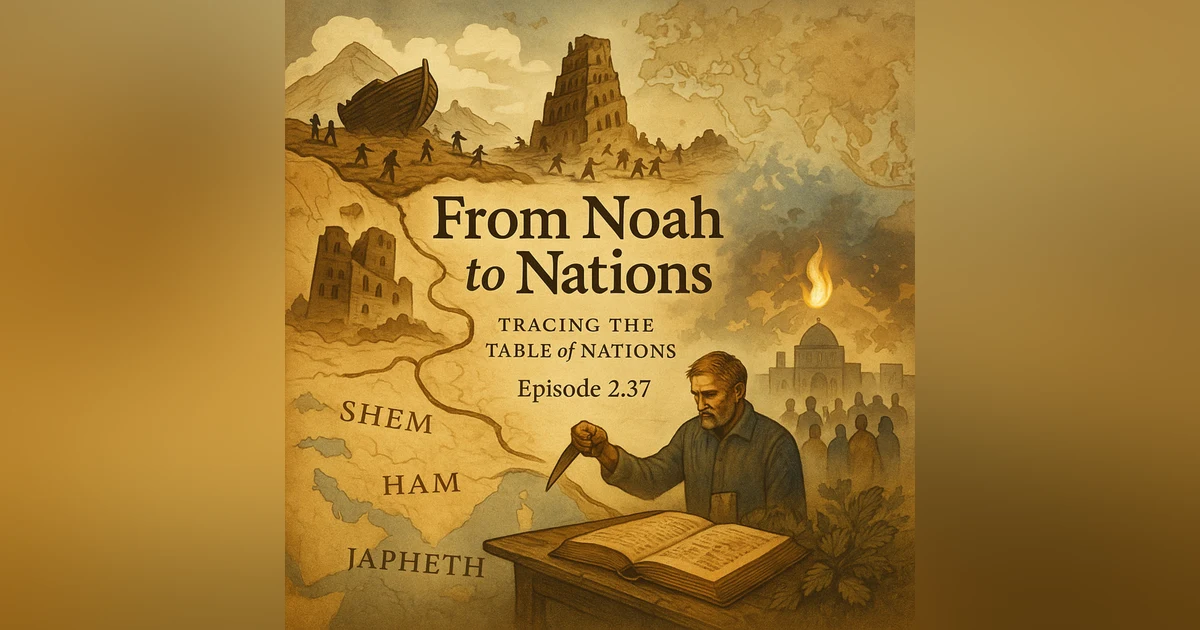
From Noah to Nations: Tracing the Table of Nations


 RSS Feed
Episode 2.37
If all humanity came from Noah’s family, where did the nations come from—and how does that story impact the Gospel? In this episode of Take 2 Theology, Zach and Michael trace the sons of Noah through Genesis 10 and 11 and connect them to biblical nations, Israel’s history, and the events of Pentecost.
Covered in this episode:
– What Genesis 10 and 11 reveal about the world after the flood
– How the descendants of Ham, Shem, and Japheth shape biblical history
– Clarifying the “curse of Ham” and its misuse
– How the divided nations of Babel are reunited at Pentecost
– Why it matters for understanding the global scope of the Gospel
With key texts from Genesis, Acts, Galatians, and Revelation, this episode weaves theology, history, and hope into one sweeping narrative.
Find our videocast here: https://youtu.be/rG3EjxsZqVs
Merch here: https://take-2-podcast.printify.me/
Music from #Uppbeat (free for Creators!):
https://uppbeat.io/t/reakt-music/deep-stone
License code: 2QZOZ2YHZ5UTE7C8
Find more Take 2 Theology content at http://www.take2theology.com
0:00 Babyface is here. I I I'm trying to decide whether I launch into this 'cause I was in a Dixieland band. And whoa. Oh. Oh, Dixie, Wait a minute. Dixieland Band. Is that what I said? Yeah, yeah. Yeah, you nailed it. Yeah, I thought I said Dixie band land. That'd be pretty. Funny. Maybe you did. Maybe I did. Yeah, and there's a song we played. Babyface, Babyface. There you go. I love my babyface. Baby, we just got, we just got cancelled 'cause you said Dixieland, YouTube's censoring us. We're shadow bands. Oh, I didn't. Even think about that. Yeah. Yeah. Well. No, I'm I'm just kidding, but. I'll just say most of the Dixieland bands are not Caucasian.
0:45 There there. You go, yeah, yeah, yeah. So in New Orleans and stuff, so you can go down there and they walk around clarinet and sousaphone and, you know, string bass and stuff. It's, it's all, it's all. It's really good. Saxophones, trumpets. Saxophone that, that's what. You want to talk about Dixieland music like hard hearted Hannah Babyface? I listen. To Maple Leaf Rag, I'm. I'm getting used to the clean shaven look. You liking it? I'm not really, I was kind of actually bummed. I was like just trying to trim, trim up the like on the sides and I over cut and then I was trying to even it out and then I over cut and then and my goat just kept getting narrower and narrower and it was looking pretty rough. Yeah, and you were doing this on your own or Liam? Was on on my own.
1:27 That was probably my mistake. But then I was like, Liam, does it look bad? She's like, not that bad. But then the more I looked at it, I was like, I'm just gonna shave it off. The thing that hurts my heart the most is I've had I've had multiple people be like, man, looks better that you shave it off. I'm. Like, oh. That's like so sad to. Me. You know, I think maybe, you know, if I were to say, yeah, yeah, yeah, probably somewhere in the middle. Yeah, yeah, yeah, yeah. Not, not the excessive. Just let it go. Yeah, when Duck Dynasty was all a rage, man, I was. And I still feel like at some point in time I should just let this thing go. November. Yeah, well. For the Christmas play. Yeah, but it doesn't really get that long if you already have this.
2:10 Yeah, just a month of growth like this is probably, you know, I shave it down to like a 1 1/2. This is probably a week and a half old. So it's not going to get like, it's not going to get Duck Dynasty proportions in a month. Hey, don't don't cut yourself short, you know, just just go with it. I am going to SO. What I hear you saying is I should shave clean. Yes, at the start of November. Yes, I'm going to keep myself queen shaving till November and then I don't know, I'm not going to shave for a long time, so then that. Will be like babyface. I probably have, like, you know, some people who've I've had this beard since, Yeah. A long time 20. 12/20/11 I don't know, you know, some people have like weird like wrinkles and stuff that like they don't. Even know what you'll look like. Yeah, that's great.
2:51 It'll be like a whole like shade lighter has not like seen the sun, you know? Like it'll be red because it's like the first part of sun will make it like the lobster or something. Yeah, yeah, there you go. So, you know, I'm getting used to it. I I kind of like it, but I did like, I just like the commitment of growing it out, you know what I mean? It's like you really put some effort into it. Yeah, and I don't think that you were gonna keep it till a wedding. That's in a couple days, right? Yeah, yeah, that's what I was. That was the plan at least that long. And it just felt like I accomplished something and I don't. I just like think it looked better, but it was like, man, I just like I loved, I loved it, man. It's. Great. What did Leanne think? She she was actually encouraging me to keep it. Yeah, that's, you know that is, you know, just listen to your wife on I.
3:33 Know, yeah, that's why should I keep it going, you know? So maybe she just knows it keeps me like unattractive to the rest of the world, you know what I mean? Yeah, honey, keep it, keep it. You know, and also you shouldn't like don't change your clothes it's been 3 days whatever. It looks great. Yeah, yeah. So I don't know We'll we'll see we'll we'll have to but when, when it gets closer to we'll have to really think about it. What's going to be tricky is we record too much in advance right. But if we talk about like no shave November, we'll be like in December, like, hey, we're not going to shave, you know, so. Yeah, it'll be January when it airs. Yeah, that's gonna be good. I don't know, but yeah, what what goes right along with clean shaven Yeah is talking about people groups in the Bible. Oh. That's good.
4:13 That's good. It's different, you know. Some some people groups Let's roll the beard. Well, yeah, some people don't that that's. Right, you know, so, you know, all over the place and we can go back, you know, where, where did, where did all the people come from? You know, we can, we can kind of trace some of that. This is the cotton eye, Joe. You know where they come from, where they go, where. They there we go. Yeah, that's exactly right. So not a Abraham episode. It's slightly private. If Abraham says 12, we're not going that far backwards from a numerical standpoint. Yeah, we're we're what we'll be. We'll be in like 10 and 11:10 and 11:00. So we're right before 12. So anyway, table of nations and people groups, let's take it to the next level from the hearts of the Low Country in South Carolina.
5:05 It's the Take Two podcast where we take theology to the next level. You, you hear this phrase a lot, like, you know, and all goes back to Adam. Yeah. And that is true. But it really goes back to Noah. But Noah, yeah, exactly where, you know, I feel like Noah doesn't get any love. Like we're all related to Adam, right? And we are. But it's like people don't don't bring up Noah as much, you know? Yeah. And yeah, I guess it is all Noah or Noah's wife. Oh, yeah, yeah, yeah. Well, actually, OK. Yeah, yeah, yeah. You do have to be this in a Noah, but you do get some like so the son's wives, those are three different families. Potentially, Yeah, yeah, yeah, yeah. That's.
5:46 True. That's true, you know. That's a good point. Yeah, but you have some gene, some genes coming in from those other families. But yeah, and and unless you have some Nephilim. Unless and what? Yeah. And then? Graph I am Jeans. You gotta be careful we can't see it too many times where Clay will show up. We don't want Clay might be like enjoying dinner with his family. We don't want to like, pull him over. Here. Unnecessarily, but what I like about this episode, it's one of those maybe like big picture, connect the dots like we're it's not about Abraham really at all, but it kind of, you know, big picture and we'll talk about, you know, where did Abraham descend from kind of look at some of that, maybe understand Bible history, even understand some of the conflicts we see in the Bible. Some of these like are baked into some of these familial lines.
6:32 And even more global than that. You see God's plan for redemption starting, right. I mean, we get that glimpse up in Genesis 12, but but really get some of the disorder that gets like revisited in the New Testament, which is pretty, pretty cool. You want to read Acts 17 verses 26 and 27 because it kind of talks about, you know, oh, mankind. And He made from one man every nation of mankind, to live on all the face of the earth, having determined allotted periods and the boundaries of their dwelling place, that they should see God, and perhaps feel their way toward Him and find Him.
7:15 Nice think you're talking about Adam. Probably Adam. Yeah, I was like, I was like, I feel like we had to say that because we just made this big thing about Noah. But you know, I don't want to. I don't want to like read the wrong I. Mean it got it all got started off with Adam. And that's right. Yeah, that's right. We're not saying Adam, you know, wasn't involved, but. And there were people between Adam and Noah. That's true that this would apply to that. That would apply to exactly right? Well, let's let's set the stage. Genesis 6 is the flood. We get past the flood. Noah's there, three children, wives, this kind of thing. We get. We get. Explicitly told we can eat meat now. A big deal. That's a big deal. Yeah. Seasons. But I think they're eating meat before then. I do. But but but now it's like go for it.
7:55 Eat meat, just not with the blood. Stay stay away for that from that from that blood. So if we were looking Genesis 12 is Abraham. Genesis 10 is referred to as a table of nations got a lot of genealogies. Genesis 11 is the Tower of Babel. And I think this can be confusing to people because it's it's not in chronological order. You read it and and you're like, why are we learning about people all being together after we read about everyone's descendants before? And that can be confusing. And I think it's another good example. So is it like, hey, here are the nations, here's how we got them? Exactly, exactly the reason. It's like, you know, in our Western mind, that's not how we would probably map things out.
8:37 That's a good reminder in the Bible. A lot of times it's thematically or theologically or there there's there's usually a reason if it's not like in every door or you're like, what's the reason? I think, I think you're exactly right that it's exactly as simple as that. That kind of talks about God's command to fill the earth out. He's making, you know, everyone's going. And then it talks about, you know, humanity's rebellion, that they really wanted to be in one place and God's gonna, you know, send them all over the world. So Michael's getting his Bible out. You're ready to read. I know you. You just hate reading these ESV passages. You got to get it. I wanted to be able to kind of glance at the whole thing, but yeah, I'm happy to read from NASB as. Well please do if you want to read Genesis 9 verse one going back to Noah.
9:22 And God bless Noah and his sons, and said to them, be fruitful and multiply and fill the earth. And if we're going to Fast forward to Genesis 1032, you want to read that one as well. These are the families of the sons of Noah, according to their genealogies by their nations, and out of these the nations were separated on the earth after the flood. So you, you kind of see these kind of go together, be fruitful, multiply, fill the earth. But then Genesis 11, we kind of get this, this negative story of how God's kind of making this happen a little bit more. They said, Come, let us bind for ourselves, build for ourselves a city and a tower whose top will reach into the heaven, and let us make for ourselves a name, otherwise we will be scattered abroad over the face of the whole earth.
10:09 Come, let us go down. And they're confused their language, so that they will not understand one another's speech. So the Lord scattered them abroad from there over the face of the whole earth, and they stopped building the city. Therefore its name was called Babel or Babel, because they're the Lord confused the language of the whole earth. And from there the Lord scattered them abroad over the face of the whole earth. All right, probably very familiar, most of our listeners with with this accounts. So so that's kind of what happens. And we get these different lines from Noah, We get Ham. I love I love the name too. I love, you know, with to translate stuff. We got Ham, we got Shim and then we got Japheth and you kind of trace where these people settled in and people groups and that kind of thing.
10:53 At least, you know, broad strokes. I think it's interesting to kind of trace some of that down. So if we're looking at Ham's line, you know, a lot of this is you maybe could label it southern and western, I don't know. But you'll look at things like Cush, which would be like Ethiopia, that kind of thing. Egypt's Canaan put that would be Libya or North Africa. And then we think of Canaan, you think of all the Hittites, Amorites, Jabucites, Sidon, the Canaanites, the this is generally where hams line descend. So. We're talking maybe like Iraq over down to the eastern side, eastern and northern side of Africa. Yeah, I I would say to so and and when you read the Bible about Cush a lot, I I think they that's almost really associated with people with very, very dark skin. I think there's like a verse in Jeremiah that's like, can a leopard change his spots or a cushite the color of his skin? And it's kind of like really a play on on like just how dark skin is.
11:54 So I I think that's exactly right. And so we read about some of these people. So we think Ham was really dark skinned or we think maybe his wife was really. Dark skinned maybe that see, I would love to like see and I, I, I don't know, those are good things to think about where maybe maybe so, you know, at least that genetic makeup was in there somehow. So is it? Is it reasonable to say if you have today darker skin like, you know, darker melanin, you're on that side you you probably have some in your background? Some $1,000,000 idea instead of 23andMe ham Yeah, 3 and me ham Shim and JPEG. You're 23% ham.
12:36 There's something. There, you know, Yeah, yeah, yeah. Yeah, this is like Ken Ham's probably on that. He's probably like he's probably got that down. But we see a lot of these people groups in the Bible through, you know, Egypt enslaving Israel, Philistines opposing Israel, Canaanites driving, being driven out by Joshua. And then interesting you, we hear this curse of ham a lot. But a proper reading yes, makes it not Ham himself. It's like 1 of Ham's sons. Yeah, exactly right. And a lot of people would use like this. This is like, hey, This is why slavery is good. I'm going to use the Bible to justify this is the curse. We're just like fulfilling God.
13:16 So you're telling me people can misinterpret the Bible? Yeah. Yeah, and in a crazy bad way. It's like you can stand by this. And you know, I'm trying to think like, I think I don't think it went super far, but like there's notes in like the Schofield Study Bible that talk about this in a pejorative way, which you're like, that wasn't that long ago. Like people in mitres growing up with like Schofield Study Bible's the best. The ones they had I think had this edited out by then, but it was like in it was in like Schofield's original study Bible. It was like that was kind of like one of the first premier mainstream study Bibles. Yeah, I think that's good to address that and get on the table that that that is a misinterpretation of this.
13:58 That was a curse to his son and it was like local to him. And it doesn't say that's going to go to like all of his descendants everywhere. It says he said cursed be Kanan a servant of servant shall be to his brother. So he also said, blessed be the they got a Shem and let Canaan be his servant. May God enlarge Japheth and let him dwell in the tents of Shem and let Canaan be his servant. So, so there you go. And I think, you know, you get, you get some color on this too, even. With so so Canaan probably, you know, if we're just talking about people groups and skin tone, he would have the lighter skin of that because he went up into the Israel and he was the cantonized, the Hittites, which are not the dark, dark skin of Africa. So it doesn't even fit the.
14:46 That's so crazy that it gets like lumped as the curse of Ham. And then, yeah, it's like all these things kind of get changed. So anyway that that is Ham's line. Next Shim's line, which is where we get maybe some Eastern nations and then we get Semitic people groups. Elam, that's Persia, Asher, Assyria, Arfac said. The line maybe that led up to Abraham, Arum, Syrians, that kind of thing. And we see, you know, Messianic, Messianic promise flowing through this line of Shim. So Shim's line looking for the sins, you see them a lot. A Latin stripper, right? Yeah. So this would be like, if you're thinking visually, like the Persians maybe mean dark, dark skin or mean dark, dark hair, but maybe lighter olive skin.
15:32 Yeah, that's probably right. Like you, you think of like someone from Iran or maybe Kazakhstan or you know those, right. But, you know, you have, like, you start moving over and then you get into India, then you get some really, really dark pigmented folks and, like, wonder how those bridge the gap because, you know, most of Asia they are. They're lighter in tone, maybe darker, maybe darker than a European. Yeah. Yeah. You know, it's just fascinating how that all came about. And it is fascinating. Like maybe people that just yeah, had darker melanin just naturally did better a little farther S with the heat. And I mean, it's, I mean, you know what I mean? It's like those people maybe that stayed there and other people filtered away.
16:18 I don't, I don't know. It's it that is. And then there's been so many, you know, war, all these things that move people groups and these things, it's hard to hard to. So then we've got Japheth, you know, maybe you're thinking northern and coastal peoples. We got like the Gomer people, Magog, Medes. Greeks really come from the Javan line, Tuba, Meshech, Terasberry, common people groups we've all heard of millions of times. So we've read about the Greeks. You know, you go to the book of Daniel Medes of Persian and Esther and Daniel as well, Magog, Ezekiel, you know, that's like, you know, I love, you know, this guy, Doug Wilson.
16:58 I have heard of him. From Moscow, ID his church is really big. He's always getting interviewed by. Just interview. Yeah, he's like very into patriarchy and theonomy and these things. He's got a blog very famous not his blog is called It's like GOG and may blog. I don't it's like blog and yeah, it's like it's a play on word with this somehow I don't know what it. Is, but it's pretty funny, yeah. So anyway, we read about this these people groups like we mentioned in in Scripture and then as you, you know, go throughout, it's interesting just to think we've talked about this a little bit, but the Moabites, the Ammonites, those come from Lot Sun, so that Shim line, but they're like little you see the little offshoots of all these different people. So it's not like, Shim, all of your people are going to be blessed.
17:45 That's like not, that's not how it works. Like, Messiah comes through Shim's line, but there's a lot of people that come through Shim's line that don't do the right thing. Right. And so Europeans are probably from Japheth probably. Probably, yeah. I I think so, yeah. Yeah, OK. Very interesting. And then, you know, eat them from Esau's line, but also comes through shims. And, you know, then we see, you know, a lot of these other Philistines. Would have been from Japheth's line. Yeah, I did this say. Well, my understanding is Gilstein's were like from around like Crete or the the Greek islands or somewhere around there maybe Turkey. Yeah, and they kind of came on, came on over going really global, big picture. What's really cool is and, and Clay I think made this on one of his pockets, made this connection. Acts 2 you can connect to the table of nations and it's almost like verbatim the same regions.
18:41 And these are the 70 different areas, yeah. Yeah, exactly. It almost lines up like really perfectly, which is it's pretty incredible, where Pentecost is like the undoing of the table of nations, where they're separate, bringing the Gospels, going to everyone. No, that's good. Yeah, 'cause just recall that one. We. It seems as though perhaps these different geographical areas had some type of watcher assigned to them, maybe one good, one bad. Yeah, we get that from Daniel, where talks about, you know, the Prince of Persia delaying, you know, the messenger and Michael the Archangel having to go over there and and free him. And so we we're just kind of grasping at the bread crumbs there. But you know, if there was a splintering and then all that is reunited under 1, you know, the the Prince of Peace, the King of Israel, Jesus, and like we see in Acts 2, like, OK, now this is all his.
19:40 It's all his Yeah. It speaks to God's sovereignty, God's hand in history. You see, it's precise, it's purposeful. You see this big major bookend connections that the Gospels for every tribe, tongue and nation. It's not, you know, you could look at this and be like, you know, what the heck? It's like ham gets cursed. Curse of Ham, which we debunk not a thing. It's curse of Canaan. And it's not like these Canaanites didn't bring this judgment. On themselves we talked about with Abraham Anyway, it's like they were, you know, living, living in sin. But how God works all these things together. I see you flipping that Bible. What are you looking for? I'm looking for this place because we just saying is worthy and it quotes from Revelation 5. And this is one of my favorite lines. I get a little emotional reading it, thinking about it, singing it.
20:32 But this is Revelation 59 and it says and they sang a new song saying, 'cause this is after there's a scroll, just kind of back up a little bit just to put people in John there and like no one can open the scroll. Who's worthy to open the scroll? And they find one who looks like a lamb who's been slain, the lion of Judah. And he is able to take the scroll and open it. And when he does that, it says, and they sing a new song that says, worthy are you to take the book and break its seals, for you were slain and purchase for God with your blood men from every tribe and tongue and people and nations, and you have made them a Kingdom and priest to our God, and they will reign upon the earth.
21:16 And then there's places where it talks about all of the people like singing together like this, this choir of all the people together. So I just think it's a great picture of, you know, the diversity that we have in humanity, different cultures, different, you know, looks different, you know, abilities and, you know, traits and stuff. But God's redeeming some from all of those and we are going to be 1 bride for him in the future. Yeah, it's it's amazing. I love. And in Revelation 7, where it's kind of similar to what you read, it's like there's a multitude. No one could number like it, just like endless.
21:58 And I like that. So we look to the future and that that's the trajectory of where everything's going. We see like kind of where things started in the table of nations and the Tower of Babel and things get all dispersed. And then Acts 2 was kind of like that already. Not yet. So but we're not, we're not total revelation. That's a good trajectory. We, we want to, it's going to be imperfect, but it's like, man, that, that is really, really cool. Just all the unity and diversity. Because you look at the other side of it, Galatians 3, there's neither Jew nor Greek, there's neither slave nor free. There's no male and female for you all, all you are all one in Christ. Nothing brings you that merit. So you know, number one, I, I was in this, I was looking to talk one time I was really good and it was about culture.
22:43 And it was saying culture is really important. But you know, Christ that that's number one point. If your culture does not line up with Christ and every culture's got its things that don't line up with scripture. That's number one thing. Culture's important, but it's like a, a a secondary thing and it's kind of that's AI think tough to, you know, find the where, where it is. Culture may make sense and fit in, but this passage is great because nothing, nothing merits your salvation. But at the same time, Paul's got a lot to say about, you know, male and female. We wouldn't say it obliterates these differences. You know what I'm saying? You can read it too far. It's like, so if we're saying there is a difference between male and female, not and how it merits your salvation, but there is a difference, Paul's presumably saying June or Greek. There are good differences there too. We're not saying you have to obliterate those differences. Right, yeah, I I think it would be a mistake to say we become that that the the best solution is 1 emulsified culture across all the earth.
23:43 And it should be fill in the blank, this culture, because different cultures have strengths and weaknesses. And, you know, just like the gifts, you know, the gifts are handed out different strengths and weaknesses. You know, You know, when something goes wrong, I'm always trying to figure out how do we prevent this from happening again? That's good. Yeah, Right. Right. May not be good in the moment when someone's just dropped something. I'm like, OK, this is what happened. Wrong. Don't do this again. You know this fix. It. But you might need someone with the gift of mercy to come. On and say yeah. In the same way with different cultures, you. Know. And there could be there can be bad. Cultures and and there can be bad cultures or a lot, a lot of it is is bad. I think it's it's easy to maybe be blind to some things in your own culture and it's easy to it's just like with anything else, it's easy to see, you know, the other person's faults really easily. And even in this is not what this is necessarily about, but even the the neither slave nor free, you know, not talking about chattel slavery, but maybe an industry. There's in hierarchy might be the right word, wrong word, but an order.
24:42 There's like an ordering in society and that does reflect God too. Not saying everything's always just, but there are like gifting different roles. Some people are are kings and some people aren't and. Some people are employees, some people are employers. You could use the same same type of division for like a capitalistic society which is different than their society back then you. Know, I, I, I think that that's exactly right. So anyway, I, I think it's interesting as we're talking about Abraham to think about, you know, leading up to Abraham and all, you know, and it's even even interesting how Abraham's journey and geography and that kind of thing to consider Genesis 10, consider Genesis 11, maybe read Acts 2. It'd be Michael Heizer does have a talk where he brings this up and he does a good job of like mapping those things together. Like it says this here, it says this here, this is how they're the same.
25:35 And it's like perfect. And you can really see how Pentecost does just overlap that table of nations so, so well. So anyway, I like those big picture connecting the dots, you know, something, something to think about. No, that's good. Very good, Very good. And it's part of the it's probably, you know, we last Tuesday's episode was on Abraham and Isaac. Yeah, you probably have that if you if you're in the church scene. Yeah, you probably had that as a Sunday school lesson multiple times. That's right, yeah. You probably didn't have table on nations as a Sunday school lesson. Yeah, that's true that that's a good point. And it's one of those when you're doing your Bible reading, it's easy to kind of like. Why ISIS here just.
26:15 OK, I've got to. I'm skipping through this, but in the light it's like, and you might think that, but in the light of the connection facts, she's like, wow, all these details. That's pretty, pretty cool that they the right Moses didn't just leave it at Shem Ham Japheth, but he actually like broke down this kind of stuff even more. And I think it's a bigger maybe we can do a hopefully this would not be a boring podcast, but do a podcast on genealogies because I think, you know, most of the time when genealogies are in scripture, it's not just for nothing. A lot of times there's a feel logical emphasis on top of the historical. Emphasis if you read the names. It was an elaborate plan to get. I want you to repeat it as your name. I just you're always reading names. That's great.
26:59 But it it'd be interesting to take just genealogies and and see like, OK, what's the emphasis here? Like, why are we skipping these people but not these people? Like what's the author? Like, why are we even doing this? And usually there's a good reason. We should ask Jonathan White, but this would be a good test for him. And, and because when I was his youth group leader, we went through the genealogy of Christ. And if there was anything at all to say about someone, we had like a lesson or, you know, to. So we talked about Adam and we went through that and we just went from Adam all the way to Christ, the different ones. And of course you get a lot of ones in the middle that you don't have really anything to say about because all you have is their name, but they're all the ones that we'd had something to say about. We talked about, you know, David and Solomon and you know, Judah and all the ones in between.
27:45 Jesse. Yeah, that that is really good because those are the parts of Scripture which it is easy to be like we got, you know, we're just going to zoom through all these, but they're they're in there for a reason. I don't know how many more Abraham adjacent ones. I think I got one more. It's it's pretty adjacent, but we're going to we can connect it. OK. It's not adjacent. It's cattywampus. It's cute. It's diagonal too. That's. Right. Yeah. We need to keep getting words that farther and far the way, then maybe we'll totally wrap up. I'm trying to think of anything I can. I like having a nice series. I've got like a few ideas, but they're just quick hitters disconnected, you know? Sure, we can have some mini series.
28:26 So yeah, anyway, that's all I got on this one. You got anything you want to add? No, I think that's good. All right, that's our take. Thanks for listening to Take 2. Find us wherever you find podcasts and on YouTube for those who want to watch our video cast.

