I Think, Therefore I Am | Part 2


 RSS Feed
Episode 2.72
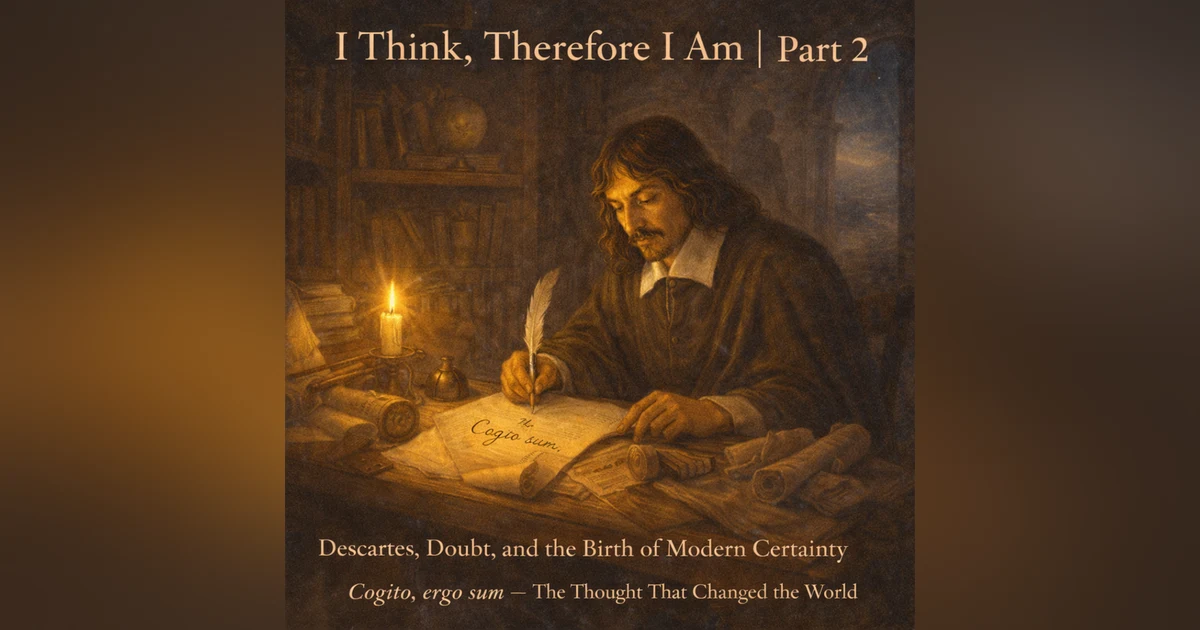
Descartes, Doubt, and the Birth of Modern Certainty
What can be known with absolute certainty?
In Part 2 of I Think; Therefore I Am, Michael and Zach walk through René Descartes’ most famous move—the cogito—and why it reshaped the entire history of philosophy. Faced with the collapse of Aristotelian certainty and the rise of radical doubt, Descartes wasn’t trying to be clever. He was trying to survive an intellectual crisis.
By doubting everything that could possibly be doubted—senses, mathematics, the external world, even his own body—Descartes discovers one truth that cannot be denied: the very act of doubt proves the existence of the doubter.
This episode explores:
-Why Descartes adopted methodological doubt in the first place
-What the cogito actually claims—and what it carefully avoids claiming
-Why “I think, therefore I am” is not a syllogism, but an immediate insight
-How the cogito becomes the foundation for clarity, certainty, and reason
-How this moment launches modern philosophy and reshapes the God-question
Far from being a throwaway slogan, the cogito marks a turning point: the shift from inherited authority to subject-centered certainty. Whether you admire Descartes or see his move as the beginning of philosophical trouble, understanding the cogito is essential for understanding the modern world—and the questions it still can’t escape.
Find our videocast here: https://youtu.be/9sCu1pq-2HE
Merch here: https://take-2-podcast.printify.me/
Music from #Uppbeat (free for Creators!):
https://uppbeat.io/t/reakt-music/deep-stone
License code: 2QZOZ2YHZ5UTE7C8
Find more Take 2 Theology content at http://www.take2theology.com
0:00 All right, well, if you want to know more about this podcast, yeah, just ask ChatGPT. Chat knows everything somehow, somehow. I wish you could get like should ask it like where, where, where did you pull? Did you listen to the episode? Did you pull it from somewhere? What's the you know, what were we doing? So I'd be curious, you know, for all of our listeners out there. And it seems like I don't, I don't know how this works. You know, especially when we first started out, like numbers didn't mean anything to me. But now I look at numbers and like I was surprised at how fast our YouTube numbers went up and our Spotify numbers are like meh.
0:41 And our YouTube numbers are kind of like. Plateaued I'm. Like what? Like. I know we were, yeah, yeah, that's true. We were getting subscribers and it's like it has like it was like going up crazy, like very routine and then it has definitely leveled off. Yeah, just kind of plateaued, but our Spotify. Spotify. It's like we're getting six a month or something. I don't, I don't know which is the slow growth, but everything I've read like not that we, you know, we're probably not going to be the next Wes Huff. You know, Hey Wes, we're coming from Hey Papyrus 52, maybe 1 episode. Yeah, we're on your corner. Watch out. But you know, everything I've heard is is podcasts that do eventually make it. They all start off with this slow growth.
1:22 And then there's like this, you know, whip that comes up. So I'll just say, you know, if you do joy, enjoy and listen, you know, interaction does help the algorithm and we do our best to give you some, you know, both. I I think our goal is not seminary. Yeah, yeah, yeah. But not, you know. Yeah, not. Nothing. Yeah, not nothing. But not it's great. I mean, 'cause sometimes when I think of a podcast, I do think you are very deep doctrinally, but just just, you know, I, I, I think everything chat said is very positive about you, but I'm inserting negative. You're just cold and unrelatable and, you know, just. So the Baxter, I don't know why she did, but Chloe was like just asked ChatGPT about our podcast and it came up with what I would consider.
2:13 So some surprisingly accurate descriptions of the podcast and of our personalities. And like some of I I wonder because it can pull we have some stuff on our web page. We should probably promote our web page, but it's in the Doobly Doo below. We do have a web page where you can kind of go back and see all of our podcasts and stuff and and see, see, see stuff like that. But so there's like some biographical stuff there. There's some biographical stuff on our church's website that it can pull. So I wonder is it just like OK, given Michael's back educational background and and the things he put that he. Likes Oh yeah. Does it extrapolate? He's going to be. Because I have it up right now, it says you're thoughtful and analytical, your backgrounds in engineering and philosophy, loves deep theology and apologetics.
3:02 It also does say Mormon relational. So we don't have, you know, so you, you're, you get it. It says Zach is engaging and personable as a physical therapist. I love this. And father, you know, he's very relational like that. That. Yeah. Like I'm not a father. Yeah, yeah. Exactly, it's so funny, light but serious where it matters. Pastoral and pastoral style communicator are dynamic together. I don't know where Pat where Chad got this, but conversational and humble must have been. Here in a lot humble group of podcasters out there. One of my favorite verses Moses ever wrote that he was like the most humble person. Balance of humor and depth. It's great.
3:42 In short, Michael is the analytical thinker who loves deep doctrine, which is like, I don't know what that means about me. Zach is the approachable real life communicator who keeps the conversation grounded and engaging. Together, they're thoughtful, friendly and earnest about helping listeners think deeply about their faith. So you know, there you go. Yeah, yeah, yeah. I I just curious how how it came up with that? Oh yeah, If it did take like engineer and father and run with it, you know what I mean? Like that, You know what I mean? Yeah. Yeah, you know, you know, yeah, these stereotypes were just going to pigeonhole men. So I'm curious, if you know you're a listener, you could go to Grok or ChatGPT or Gemini or. Claude Perplexity. One of these.
4:24 Yeah, and ask, you know, what do you know about the take to a theology podcast? See what it says. So I'd be interested to to know. We should have yeah, I guess it could look up pictures of it. I would. I would love it for it to like draw a picture of us just based on the audio, like just just see, you know what I mean? That would. Be crazy, that's. Great. I bet, I bet it would get some Patriots gear on there like I'm trying to think I've had to, you know, I've had to pick how it would, how it would do it. But yeah, yeah. Anyway, yeah, leave it to chat, you know? Yeah, and with as often you've you've mentioned, it probably have me like full fall in the mouth kissing Tom Brady or something like that. Oh, Oh my. Goodness gracious yet, Tom. Brady, I think I From all I can tell, Drake is a believer.
5:06 Is he? I haven't thought, but yeah, to see, is it like the way he posts game interviews or like what? He doesn't say stuff like that. So it like, I don't know if he may, you know. 'Cause that's the, that's how, that's the best way to tell someone's a true Christian is that they say, I think God first. Right, right. That's the only way you know, I don't take away from. That I think that's good. I I should not. I'm not minimizing. That much? Yeah, yeah, yeah. But I did some research and it seems like maybe he is. Oh yeah. Yeah, it's, it's and it's, it's always difficult to to. Pre meal oatmeal, that's the most important. Yeah, I 'cause I can't. Get with. Post Trib pre meal. So I was like, you know. Oh my goodness.
5:47 Yeah, crazy. Yeah. So that that's our podcast. So we are going to continue on into the. We should, we should ask. Yeah, we should ask chat. Who do you think came up with the Descartes series? I bet it would know. That'd be interesting to ask. Like, which podcast do you think Michael drove versus Zach? Like just by topic, you know it'd be. Interesting. Well, I find it, I think, well, no, we're just shooting the breeze here. I think you can come in on my notes better than I can yours. Like I it's difficult for me to to but. It is hard to get into sides, get into someone's head with notes like what are they thinking when they say this word?
6:28 It is tricky, yeah. Yeah, yeah, yeah. So on the your podcast, I think you do more of the talking than what I do on my podcast. Which I try to. But him I'm like, I don't know, he's got that song. I. I find the same thing with sometimes some of this stuff. It's like, I don't know, you know, like I, I, I don't want to. I don't want to just say words, just to say words, but you know what I mean? Yeah, yeah, yeah, yeah. So it's good. It's great. All right. Well, I think we're going to take it to the next level. Let's fire up that twanga music. From the hearts of the Low Country in South Carolina. It's the Take Two podcast where we take theology to the next level. All right, I think therefore I am maybe a quick reboot. Just a recap.
7:19 We talked about Aristotle and how he was a third of these huge philosophers had a big impact. His writings were lost refound around 900 in the Islamic world. Ish. And then that started floating into the European world around 1000 or so. By 1100, he's translated, he's in these universities. You could refer to him as the philosopher and people knew who you were talking about. And really he reigned supreme for 203 hundred years till we start getting some cracks. We talked about William of Occam and some, you know, having some philosophical differences.
8:03 And then we have this Copernican revolution. We kick out all of his bad science, physics, and we also kick out the metaphysics. So this time of like, how do we know what we believe? And we talked last time about these two schools of thought, the idealist and the empiricist. The empiricist would say we learn everything from physical interactions. Idealists would say what we really should do is find some true ideals like geometry axioms and build on those, like just logically build up.
8:49 So Descartes is one of those idealists. He's a mathematician as well. And so this this method really sits well with him. And so he because there's this turmoil over what we can believe, what we shouldn't believe, our senses being lied to, because we can see, we can show times where they're. Yeah, perception is weird. Yeah, yeah. And so that's what he starts doing. So there's this. He writes a book called Meditations that and if you're interested, it's not that difficult of a read. Not. I'm just kidding. Not. Really, is it, is it like a, is it like a like a big textbook or is it like a skinny 100 page book like something like this? About that size, but it's not too bad. Yeah.
9:38 About that size of a book. So we're talking maybe 128 pages now he's. You might have to. I mean read a couple, read, read a paragraph a time or two. Yeah, yeah. But if you can keep up with the day's discussion, you, you, you should generally be OK. And what he is seeking is what are those axioms that we can build up from? Like that, the absolutes that you can take to the bank. Right. And if you can get enough of those, you'll get right. Yeah, something that's indubitable. What a great word. Yeah, yeah, yeah. Can't doubt it. And so the goal isn't necessarily probability or plausibility, but absolute certainty. Same stuff to come by.
10:21 Couldn't, couldn't not doubt this. And he goes through all of you know, all of the, I won't, you know, all the things that he thinks that he could put in the place of this and he can find some way that he can doubt it. Yeah, 'cause almost everything in a way can fool you. I mean, or a lot of things can. I've been fooled just by like, you think you see something but you don't, or the glares like this. Or have you been to like a Science Museum? It's like, is this coil hot or cold? If they're like back-to-back to back or it's like you can't really tell. And then he's a little bit ahead of his time. These thinkers, because they actually propose something like the movie Matrix, like this could all be an illusion.
11:04 We could be nothing that we are experiencing physically could actually be real. Maybe there's this very powerful bad entity, we call it a demon, who is really tricking all of us. So that's what they're trying to get through. Like so he adopts what he calls a methodological doubt. He is going to doubt everything and not trust it if it can be doubted, even if the doubt is only possible and the doubt is epistemic, not practical or psychological. So he suscends belief in sensory knowledge. Like I don't trust anything that I can sense. 'Cause it could be an it could be dreaming for all you know. Like this?
11:46 Yep, he suspends belief in mathematical truths. Like maybe there's an evil demon who has tricked us into believing all the mathematical things that we believe. They're saying 2 + 2 is 5, and that's just what you, that's what you're building off of, yeah. He he suspends belief in the real physical world. Like maybe this rule doesn't exist. If you listen to William, like Craig make a reference to a Boseman brain, but basically this brain that is in some type of metaphysical or some type of VAT or something that thinks it's sensing stuff, but it's not really. So, you know, there's other people that he doubts the existence of his own body. So he's just doubting everything. And so he introduces these progressively stronger skeptical scenarios, sensory deception.
12:38 You know, sometimes our senses deceive us. The dream argument or the matrix argument, an evil demon. And the result is that everything that depends on perception, inference, prior assumptions is placed in doubt. That's a lot of things. It's a lot of things and that's why I like it. Atomist would be like this is not good. Because you need, you have to be ground. You can ground in certain things. Yeah, if you can't trust your senses, then how he can trust anything But and, and I think there's a case to be made here that while we can trust our senses, what he's going to get to you can trust even more than your senses. It's got a higher certainty of, of trust and that and, and generally, you know, probably not, you know, Doctor Thomas may not say I'm a Thomas, but or Doctor Bridges may not say I'm a Thomas, but I, I think I am.
13:30 But I still find this to be useful. OK. Yeah, yeah. So that's. The problem too, people get in there like lanes, you know what I mean? You can't like just just take the best, you know? Like all the Thomas say this is bad. So as a Thomas, I'm going to oscillate his bad like no I, I I find use in this, but nevertheless. So while doubting everything, Descartes notices something that's unavoidable. Doubting is a type of thinking man. Yeah. So even if you're doubting that you're thinking of doubting. Right. And so thinking requires A thinker. And so this realization is like, even if there is a demon who's deceiving him about everything else and he's doubting everything else, the deception itself presupposes that there is someone who there who's being deceived. And this was the problem with Daniel Dennett's you know, the consciousness is just an illusion bit because and for there to be an illusion, there has to be someone who's being deceived.
14:32 So you can't deny the someone somewhere because they're if our conscious, you know, you're taking away the someone who's supposedly being deceived that they exist. So, you know, this would cut right through that type of thinking. So therefore the very act of doubt confirms the existence of the doubter. So it's kind of a. Sure, I might be wrong if something's hot or cold, but I'm feeling something or I'm thinking something like like something's happening. I'm thinking something. Right. Whether it's right? Right, right. And so then you get this famous formulation we hear in English. I think therefore I am, you know, we all the time. We're going to. Say that you just have. No idea. No, Exactly.
15:13 Yeah. It's like, it's like you're in a class in high school. That's like the matching question. You're like, that's all. You don't need to go much deeper than that. Yeah, yeah. And then in the original what he wrote would be cogito ergo sum, which I think ergo is with that gets translated right into English. Cogito you can think of cognate so I am thinking and sum just means to exist so. It's. A fairly easy translation. Cogito ergo sum. There you go, like it. So important clarification. Descartes does not present this as a syllogism. It's not, you know, all thinking things exist. Minor premise. I am thinking, therefore I exist instead. This is like that axiom, like the axiomatic geometric premise. It's an immediate intuitive knowledge. The truth is grasped directly.
16:04 It's self-evident. It's known in the very act of thinking. Can I just say I don't think I exist? Yeah, yeah. So that would be self contradictory. Yeah, yeah, yeah, yeah 'cause you can't not exist. The Kajito cannot be doubted without a contradiction to, you know, like what you're saying. To doubt that I exist is itself an act of thinking. The ACT confirms the truth that's being doubted, so even deception cannot undermine it. If I'm deceived, great. I must still exist to be deceived. And so the certainty is not inferential. I'm not inferring it based on anything else. It's not a, you know, I don't need a more basic foundational thing.
16:50 It's not sensory because I'm not feeling my way. It's not depending on memory. Like you, you know, this is one of things, like, what if all your memories you, there's no way that you could really know. Yeah, that everything that's 5 minutes old and older existed. Right, right for. You could be being tricked into believing all that history. Now I'm doubting everything. But if you're doubting, you still expect. That's like the going back to what he was aiming for, foundational certainty, absolute that kind of like gets underneath all these other things. Right. And it's present wherever the act of thinking occurs. So even if we don't know if it's in this plane or another plane of existence, there's some place, some way that this thinker is existing. And so he exists there.
17:41 What the ion cogito means At this stage, Descartes does not even claim that he has a body, that he has hands or eyes or a brain, that he's a human being. It's just that there is a thinking thing just. Basic I mean. Foundational. I mean, yes. Res cogitans. And that thinking includes doubting, understanding, affirming, denying, willing, imagining and perceiving. So hopefully, like to me talking about this, I get excited, get a little chill bumps. It's like, wow. You got chills too, not just me. Like, you know, like. Now that makes sense. I think therefore I am foundational because you can run into, you can. I remember hearing that and you can mean something very different.
18:26 Yeah, yeah, yeah, yeah, yeah. The Cogito's certainty is moment by moment. I exist, is, is true as long as you know that you're thinking or doubting. So when you're sleeping, maybe you're dreaming. Yeah, I guess if you're dreaming and you're thinking, then you could say you're existing. Their strain is deliberate. He avoids smuggling and assumptions about persistence or substance, those will be argued later. So we're going to, So all we're really, we're just trying to get that very basic geometric axiom here. The cogito is clear, it's present, accessible to an intentive mind. It's distinct, it's separable from other ideas. So this becomes a criterion of truth. Whatever is perceived clearly and distinctly is true. The cogito is a paradigm, paradigm case of being able to be clearly and distinctly perceived as true. Now there have been philosophers that come after and have tried to pick on this definition of truth. So if you read through meditations, you'll hear this definition like the test is clearly and distinctly true. And so some people have said, well, we don't think we agree with, you know, the cart when he said this wasn't clear or that this is clear, those types of things. So that is a definition that you're going to have to decide for yourself whether you think the cart has handled it well. However, the reliability of the criterion still requires justification.
19:56 Justification comes later in the proof of God's existence. So we are leading up to a proof. That. God exists based on the fact that I think, therefore I am. It's great 'cause I, I think I mentioned this in the last episode of this that I, I've seen, I've read stuff going both ways where people are like the carts the worst because it was like the beginning of introducing not God things, but he's coming from a God perspective, you know, 'cause you know, it's saying, oh, why, why don't we just, I think what's the people looking at? Like, why don't we just start with scripture? Like, you know what I mean? Like, you know what I'm saying? It's like, that's like the mindset behind it versus the philosophy. But these same people also can be critical of Thomas, like, like, you know what I'm saying? They're like, why are we doing that? Like, why are we metaphysics, like philosophy, like what are we doing?
20:44 You know what I mean? We have. God's word. Why are we judging God? We were you. Oh man, to put God in the judgement box, right? That kind. Of thing. So that's kind of something we talked about earlier, like why can't you just like these things are true about philosophy, metaphysics, like we can say these are good. Like you don't, you know what I mean? Like. Yeah, right. And, and the part of the problem here was these are people who are are going to push and they're going to push the pendulum a little bit too far. But for hundreds of years, you believe things based on authority. This person in authority said it. There's no reason to question it. You believe it. And so there's a time where like, we don't want to believe that anymore. Like I want to verify this some way. So that's part of this Enlightenment theory, part of like the critical way of interpreting the Bible. We're not going to believe all of these people who told us that Matthew was first and then, you know, Peter copied Matthew and Luke to get Mark.
21:42 There you. Are you know that it all comes out of this push against we want to the evidence to speak for itself. And so this is this is part of that. Now just as we're kind of taking aside from the notes. I think it's curious that we've had two congregational meetings, 2 testimonies. Apologetics. And both of them said apologetics led me to Christ. That's pretty crazy, yeah. Yeah. I'm like, yeah, yeah, yeah, yeah. That's great. And I come from such a different place where I, I've always had an interest in apologetics, but I was never like, I'm always like rooting for the home team, so to speak. Like I've never, I've never been like, I don't think, like I have more reason to think God is not real than real.
22:27 You know what I mean? It's so fascinating to hear like people and it's like these arguments and they were listening and I won them over. You know what I mean? So that's pretty cool. Yeah. I, I, I did, you did. I guess he was saying more cult like apologize. Did you? I don't know if you followed up with like, which podcast do you listen to? I I should I meant to? Ask that I'm guessing Well, when he said cult, I'm thinking Jeff Durbin, I'm thinking James White, 'cause they deal with those. So maybe who? And so maybe he's a presuppositional, you know, apologist, you know, 'cause that's what they're they're gonna be. But don't you know by what standard? Don't put God in the judgement box. Who are you, old man, to judge? But, you know, the Bible tells us to judge.
23:07 So I'm just, I'm just being obedient to what God said. Man, you're like. Hey, if you don't, if you don't believe me for this, believe me for the miracles that I'm doing. And then who was who? Did Jacob say he wasn't too a lot? What was that one guy saying? I think. I can't remember. Did you say William on Craig? He mentioned Wayne, one Clay. He mentioned another guy too, not the side Rd. but I was like, oh, that's so interesting. Yeah, that both of them did mention like listening to hours and hours and hours of apologetics. That's cool. Yeah. So coming back to our notes, what the Kajito does not establish, it doesn't establish the existence of the external world. So just because he's a thinker doesn't mean there's an external world. It doesn't establish his other minds, the reliability assistance. It doesn't even establish the existence of God yet.
23:49 Yeah, build on that to get there. It doesn't establish the body mind relationship. It only establishes the fact that there is something that is thinking, Something that is thinking, yeah. It's it's, it's a foundational basic thought. And that's like at least right now it's, that's all it's doing. It is very foundational. It's underneath everything, but that's like all it's doing. Too. Yeah, yeah, yeah. That's, that's its only role right now. So Cochito shifts philosophy from metaphysics of being to epistemology of certainty, the external realism to subjective centered foundation. So, and this is part of the problem that Thomas had with it is like once you doubt all that other stuff, you cannot.
24:31 You've given it all away. There's no way to get back to it using the same logical principles that you did. All you know is that you exist and you have no real reason to think that even other people exist. So that you, you'd say you'd never get out of solipsism. Solipsism is the idea that you are a mind that exists and no other minds exist. And everything else you see is just like your own dream or some, you know, you're going to make me up type of thing. But I, I don't think it is quite as bad as that. So it inaugurates some modern philosophy. It inaugurates the real rationalism, the primacy of consciousness in epistemology.
25:16 There are later responses lot questions the nature of of self humanize A substantial self behind perceptions. Can't will refame that I think as a transcendental condition, not as a substance. So there are responses to this. So it's not like anything philosophy. Is not what I've done. That's right. That's right. Yeah. All right, so how do we get from a thinking thing to God? So that's what we're going to lead up to and we're going to end with this. And then Part 3, we'll look at some of the critical responses to the cogito air lasum, and then how how you might defend it against some of those. So if a thinking thing exists, this is secured by the cogito.
25:56 There's doubting, there's affirming, there's reasoning, presupposition by the thinker. The premise is epistemically minimal and does not assume bodies, sense perceptions, or the external world. Some of this is, you know, repetitive because it's self-contained, exhaustive ontological division. Anything that exists must either exist contingently or it must exist necessarily. Those are the like you're saying, only two categories. You got to fall into one of these buckets. Right by the the you know and Descartes doesn't, he assumes the laws of logic. I think there are other axioms that you could bring into this. So you could have the cogito ergo sum as one of your axioms. And the laws of logic, the laws of logic are X is XX is not not X.
26:49 And there's the law of excluded middle so that there's only X and not X for well defined X. Those are the laws of logic. Just three laws. Of logic, there's the identity, there's the non contradiction and the law of excluded middle. So by the law of excluded middle, this thinking thing, this race cogence, it's either has to be necessary or not necessary. The the word we like to use for not necessary is contingent. And so you could imagine that, well, what what's the most likely scenario? Is the cart a necessary thinker or is he a contingent thinker?
27:35 So, you know, you assume the thinking thing exists contingently by the principle of sufficient reason, or at least a casual version of it. Whatever exists, contingents contingently has to have a cause of its existence, right? So if you have, you know, there's a phone, it can, it exists contingently, contingently. It could have not existed. There has to be a cause for how it came into existence. Well, the same thing. We can say Descartes is a res cogitans. He's a thinking thing, but he's contingent. So there has to be a cause for him to be thinking. Therefore, the thinking thing has a cause of its existence #4 the cause of the the. The thing must either itself exist contingently or exist necessarily, And if it is contingent, it likewise needs a cause.
28:30 And so then this generates this chain of. This thinking thing has a thing. It just goes on and on and on. You got it, you know, forever. Right. And so we reject the infinite regress. And so that means that somewhere at the end of this change, the chain, the series must terminate in a 'cause that is not contingent. And the other way we say something that is not contingent. We say that it is necessary. And so if we have a necessary being, it exists by the necessity of its own nature. It does not derive its existence from another. It is the ultimate explanatory ground of contingent beings. You could even make an argument that you can't have two necessary beings because because their their characteristics overlap. So you can't distinguish 2 necessary beings if you truly understand what it means to be necessary because then they have all the same I'll say the word properties. Thomas don't like the same the word property, but they have all the same characteristics.
29:32 The things I can say true of this necessary thing and the thing I can say true, this necessary thing are all the exact same. So you can't, you can't they're, they're identical. And so this necessary being causes or grounds the existence of the contingent beings, including the thinking thing which we begin with. So therefore we arrive at that necessary being as God. A being that exists necessarily is uncaused, is the ultimate ground of contingent existence. This fits the classical definition of God. Therefore God exists.
30:13 So there are some assumptions with this argument. It assumes a real distinction between contingent and necessary existence. It assumes this causal principle that something, if it exists contingently, it has to have a reason for a subsistence. It assumes the possibility of an infinite regress, the impossibility of an infinite regress of purely contingent causes. So we could use some other arguments to show why you can't have an infinite regress, but this we're just assuming that right now. It does not assume sensory realism. It does not assume empirical cosmology. It does not assume Aristotelian forms. It does not assume Platonic forms. It does not assume a thick account of natural causation. So really it's very which very stripped down. A thinking thing exists contingently. There has to be a cause for it to exist. That can't be an infinite regress of contingent things has to stop with a necessary thing.
31:15 When we think what it means to be a necessary thing, that thing looks and smells and acts like what we call God. OK, Yeah. Therefore God exists. Boom. Yeah. I. Love it. I know you just said a minute ago. So what are we teeing up for next? Next time. So next time on this, so we're going to look at some of the criticism. Of the. Argument and then try to maybe answer some of those. And like you know, is with any argument, there's strengths and weaknesses and things that you assume and, and so we'll look at that and, and can we get back to a real world from this? Yeah, 'cause this is foundational, but you're still kind of, what's that even mean?
31:56 Yeah. Yeah. Well, you know. Yeah. Yeah. OK, that's good. Awesome. There we go. There we go. Cart 101 Cogito. Yeah, hopefully you didn't get lost in that. It makes sense all along. The way I think it did, I think the first half made total sense and then I think we went quickly at the end with some, but I think it all makes sense. Like I think, you know, it all all checks out. Like, I'd be curious, maybe we can maybe some of this will be brought up in the criticisms like, you know, I would like to know more about contingent necessary. Are these like us? You know, what are your other OP anyway? But I think, but I think they all make sense. Yeah, yeah, yeah. Yeah. Sounds good. Yeah, Yeah, forward that through. All right, that's our take. Thanks for listening to Take Two. Find us wherever you find podcasts and on YouTube for those who want to watch our video cast.

