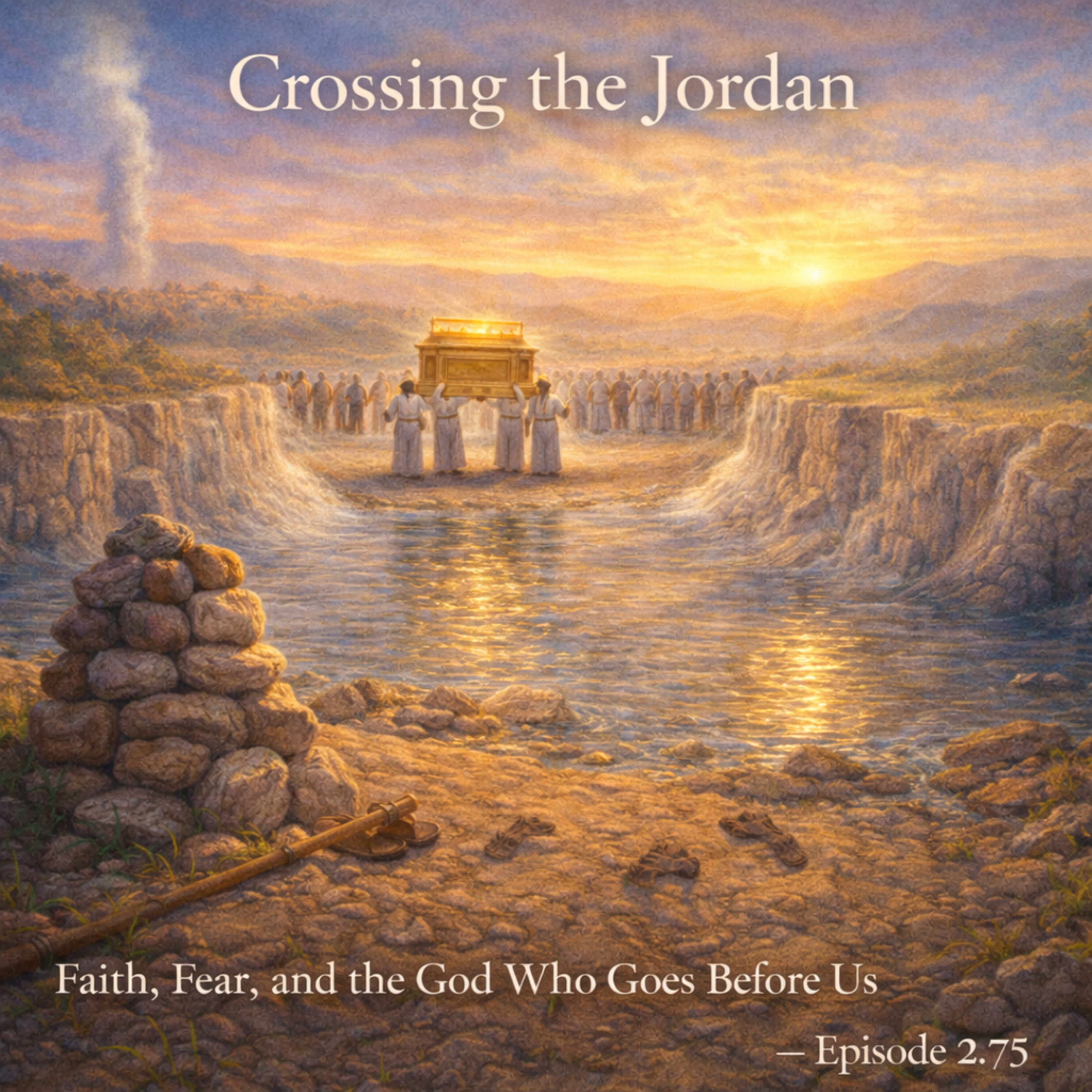
Joshua 3 | Crossing the Jordan: Faith, Fear, and the God Who Goes Before Us



 RSS Feed
 Episode 2.75
What does it really take for God’s people to step into His promises?
In this episode, Michael and Zach walk through Joshua 1:1–5:15, tracing Israel’s crossing of the Jordan and uncovering how the text teaches faith, obedience, and remembrance. Along the way, they slow down on two pivotal moments: Rahab’s unexpected confession of Yahweh and the miraculous crossing of the Jordan at flood stage.
Rather than reading Joshua as simple conquest history, this episode highlights the book’s theological depth. A carefully placed chiasm centers the story on Rahab’s confession—showing that faith, not ethnicity or status, marks those who belong to God. The Jordan crossing then echoes the Exodus, confirming that the same God who redeemed Israel from bondage now brings them into rest and inheritance.
The episode also explores why God commands Israel to pause and remember—setting up memorial stones not just to defeat enemies, but to guard against forgetfulness. Before a single battle is fought, God emphasizes covenant faithfulness, dependence on His presence, and obedience rooted in trust.
Joshua’s message is clear: victory comes not from strength or strategy, but from a people who believe God’s promises, remember His works, and follow where He leads—even when the waters are at their highest.
Find our videocast here: https://youtu.be/MEUpus3Cu5M
Merch here: https://take-2-podcast.printify.me/
Music from #Uppbeat (free for Creators!):
https://uppbeat.io/t/reakt-music/deep-stone
License code: 2QZOZ2YHZ5UTE7C8
Find more Take 2 Theology content at http://www.take2theology.com
0:00 Right, Zach, we are about to enter into our, what is this third from Joshua and it's kind of like third and a half because our New Year's was Joshua related. That's true. It started with a little Jordan reference. Yeah, it's good. Yeah, crossing Jordan and going to New York's. So we, we did pick out our New Year's word, you know. You know, we had serve then we had strengthen discipline. Man, I'm excited. Journey, journey. Yeah, yeah, yeah. Yeah, what? What's the phrase? It's not about the destination, it's about the journey. I don't know about but. That's exactly it. And there's also it shows up in this Brandon Sanderson books, the Starlight Archive, where this really wise king writes, you know, these these three things and one of them is journey over destination.
0:51 It's like, and it it's kind of goes along with what you're talking about, you know, with some of your stuff for Jay, like you want the end result to be this, but I don't want to make that the goal. I want to make the goal, the process thing. I've been. Thinking about that too, it's like people and I think these are great goals, like reading the Bible in a year, do these things great, but just learn to like love to read the Bible, even if they're happy and maybe you do more. It's like, that's like a different thing. And it's like, man, if you can like do that, That's I think a hard thing to appreciate, but it's like that. That is awesome. Yeah, I want to love the I want to love activity. I want to love, you know, those types of things. So that's that's kind of the the the spirit behind. I like that the journey, you know, just just soaking it all in.
1:36 And the other thing I was going to say maybe the, maybe the users pay attention, maybe they don't. But I, So what I do is I take our notes that we use and I have three things that I do three different threads with ChatGPT. So I'll, one of those threads is only producing the summaries. So I don't, I don't go in and write the summaries. I just say, I just actually, I don't even say anything. I just copy notes in there. Boom, it gives me a suggested title. Sometimes I tweak it if I don't like it and then some a summary and I, I use that, But then I take that summary and I put it into a different thread and it knows I want a prompt to create an image.
2:21 So all of our image. And then so I take that prompt and I throw it into a different thread and it knows I get a prompt, I make an image. That's great. And that middle step has just been, they're fine images. You can probably tell they're AI if you're if you're looking for that kind of thing, but they're like always the sepia color. Yes, I've never. Yes, yeah, yeah. And I'm like, OK, finally I'm like I said, I'm tired of the sepia. Like I don't want like neon or vivid, but give me something with a little bit more saturation. So I did that for the episode that came out last week, so the last Tuesdays, and I went back and I was like, you know what, I like that so much. Let's change all of the Joshua related ones.
3:02 That's actually smart to all the series. That's like kind of smart. So so if you notice that that's. I saw. That's cool. Yeah. So that's kind of the thought process behind. So I went back and I tweaked some of the, the, the YouTube and the, the Spotify little logos just so that it's like not so sepia all the time because I like sepia. Yeah, yeah, yeah. It's got its place. But it's like we, we got to, we got to have a little bit more variety, so. I love it. That's good. Very, very good. I like the word to journey, man OK, I'm trying to maybe this year I'll learn to love movies more. I've I've been I've been looking at some classic movies and trying to fill in some gaps or some I know these are great or not for the first time I watched You'll not believe it, Dead Poet Society.
3:47 What did you think? Honestly, it was like, I want to be a good teacher because it was like engage, you know, yeah, that kind of thing. I and it's like old, you know, I mean, not that. Does someone commit suicide there or is there? Yeah, that's something I remember. Yeah, yeah. Boy, that like his dad is like, don't be an actor, don't love the arts. You're going to be a doctor. Yeah. And he's like, OK, I'm going to shoot myself. Somehow they don't hear the. I don't, I don't know. I mean you can, but I thought it was a good movie overall. Yeah, yeah. And they're responding to that. Well, how? How far into the movie does that happen? Toward toward the end, yeah, yeah, he like goes 'cause he like acts in a play and he loves it and all the this stuff and anyway, but yeah. And did you feel like the same kind of pressure from your father to be a doctor? Yeah, and, and it was, it was a little overtime.
4:29 He's like, you're gonna, everyone's in this boarding school and they're, you know, all of them go to Ivy League, but, you know. I remember being inspired by it, but I was so young when I watched it again. I. Captain, My captain, I. Did I think I did put that on Lydia's list? So it's so let me let me make sure I can check to see if it's on Lydia's. List Yeah, I I really was struck by all the scenes with Robin Williams. And he's like teaching and he's doing like all these weird things like taking him outside and he's proving a point. Like he hasn't take their poetry book and he hasn't like read. It's on there. Hey, it's on the yeah, I like it. And and he just like RIP out this page. It's stupid. It's like making poetry a science about meter and it's like we don't care about. But he was a good. I bet he did not teach them chiasms.
5:11 We got a chiasm today. What a great what a great segue. But overall, you know any? Other movies. There's a, there's a couple I've watched that pretty good. I don't think they're, I don't think they're bad movies, a little bit violent, but other than that, nothing too, too crazy. Have you have you ever watched No Country for Old Men? I haven't. I I've never watched it before and I was like, everyone's like, this is a class movie. I watched it, it was pretty good. It's it's a little bit violent, a lot of shooting and killing and blood. I've never seen Pulp Fiction. Oh yes, yeah. Have you seen it? I I have seen like parts of it a long time about it. It's. Like it's like it's a classic cult classic. You should watch it. And I don't know, I, it seems like it's, I don't know. I don't know if it, if it's bad, if it's racy, if I don't know anything about it other than people reference it all the time.
6:02 They'll make some reference like you don't know where that comes from. And I, I don't like that. I don't like that feeling. But yeah, so I, I don't know. The hard thing, what I found is it is hard to find like a good, it's hard to find a good movie. Well, a game changer for us is especially with our kids. I mean with us too. We have bid Angel and that like opens up. You can like really tweak things if they're on certain platforms, like pretty like specifically as much or as little as you want something, but it's hard to find like a great movie and you're like, oh, it's really great, but it's got this or this and like, you know, you can like Fast forward it or what, but it's like hard. You might not know what it's coming, you know what I'm saying? So you, like, want to stay away from that, you know? Have we talked about this? We have.
6:44 We talked about Teen Wolf. I don't think so. It was not. It's also on the list like the old 80s one. I just remember Michael J Fox playing basketball turned into a wolf and like being a good time. And we watched that. And it's like, it probably wouldn't be an R today, but it like goes right up to the edge of, you know, sexual innuendo and stuff like that. And my kids. Yeah. I like this is this was what movies were and it was PG. They didn't even have APG 13 back then. So it was like either that's true GPG or R and PG13 like came out of a year or so after this movie came out, probably to catch these. Catch these things like I think is airplane PG probably. I know it's like, you know, yeah, it's like all these old ones.
7:24 It's hard to, you know, figure figure it on. It's like problem bit Angel is nice. The problem is not everything's on Bit Angel. And so it's like, yeah, then you can't, but you can like. So if you were watching Private Ryan, yeah, you the F bombs don't bother me. Personally, right? Yeah. But when they take the Lord's name in vain. Yes, that. So I could, you could take the you could like, Hey, specific bombs are fine. Yes, but I want the Lord's name in vain removed. Yeah, Yeah, yeah, yeah, yeah. Not that I used them. I think in a time of war, I would use them. Yeah, if, if, if we're being bombed, I will also throw. A bomb. I think we're an imperialistic country now. So maybe, I mean, maybe there's a chance, maybe you get in the dream, but it's are we, are we going to take over Greenland?
8:07 Is this is this happening? Take over Greenland. I think we're going to buy Greenland. What's what's? I don't pay attention to anything, but what's the what's what's the what's green going for these days? I don't know how much it is I, you know, I think Trump's modus aprendi MO is to make some egregious claim. Yeah. Yeah, yeah, yeah. To then give him leverage in making a deal. And that's what he does all the time. And so he's made some egregious acclaim and now he's wanting to buy. I think, you know, Marco Rubio, I think has said, yeah, we're, we're going to be on the table, too. I saw this hilarious clip of like, Marco Rubio and Trump in a meeting, and he's like passing a note that he's like not wanting Trump to read out loud, but it's like, hey, just this.
8:51 And like Trump just like takes it and starts reading it. Marco's like, no, no, that's like, you know, we don't want to say this out loud, but it's great. It's really funny. That's the inside out. Yeah, yeah, yeah. But anyway, we've talked a lot, Chi Asm's probably where we should have transitioned. We are in Joshua Chapter 3. Let's go ahead, take it to the next level. Let's fire up that twanga music. From the hearts of the Low Country in South Carolina. It's the Take Two podcast where we take theology to the next level. All right, Joshua, last week, just quick review. Are we back up two episodes?
9:33 We did an overview last episode, talked about four funerals a little bit. Strange ways. Prophecy, not history. Prophecy, not history. That's right. That's right. A little bit different, different take on it. Today we're going to look at some familiar stories. We are crossing into the land. Last time we kind of talked about right right into the, we talked about the Jordan River and crossing the Jordan or we did not. Yeah, we talked about really, we focused in on the four funerals like Joshua's. Oh, and. Today we're going to talk about actual, the actual crossing into the land. And and like you were mentioning Michael in my note, I've gotten bold letters, chiasm alert.
10:17 That's right. That's. Right, so so I love this this book I'm reading by Dale Davis that's like a very short commentary. He does a good job of pointing out structure and content in the literary devices as a the help interpret the book. And what he points out is if you look at chapter, well, let's say where you want to I, I, I feel like I'm trying to get get my bearings. Are we just jumping right into? Chapter 2, right? Ray Hat. Yeah, Ray Hat we're. In episode 3, but chapter 1 so we cover like really chapter one in the first episode and then we did book ends in episode 2 and so we're.
11:00 In and here we're at yes, that's right. Because what what confuses me, I think we made this point last time is like, you almost could go chapter one to three and skip over to do. You think 2 happen chronologically between? Like they sent spies in before they probably. Yeah, yeah, that that actually does make make a lot of sense chronologically. So let's give the overview of the chiasm. And if you know the listeners in a home, I forgot what a chiasm is, How would you describe a chiasm? Well, a chiasm. It's like it gets its name from the Greek letter X. And so really if you kind of cut the Greekler X in half, you'd have like this slant and then another slant. And basically as you are writing something, once you kind of shift thought, you indent and shift thought, indent, shift thought, indent.
11:52 And then when you shift thought back and it starts paralleling what you have above, then you start out didding. And so that the things that line up are the same topic. And so the beginning and the end, similar thoughts or topics, maybe from different viewpoints, but the same same message. And then the next indent level is the same and next. And then so you get to the center and that just like in a Tootsie Pop, it's the best, that's the best thing. It's the. It's the core, core idea. Well, if we're looking at Chapter 2, it's the rehab story. Many are very familiar with this. If you look at Chapter 1, it's really about Joshua commissioning these spies. Or if you look at verse 1 of chapter 2 and then if you look at the very end, 22 through 24, it's like the spies coming back to Joshua.
12:40 That's like, you know, the bread on the sandwich. It kind of bookends things. If you go in one level, there is this concern, you know, the spies, are they getting a caught whatever Rahab like protecting these spies. And then if you flip it towards the end of the chapter, we're actually protecting Rahab is kind of what's been said. Hey, we'll, we'll protect you. You protected us. And so if you're working your way in the pivotal part of this chapter would be the very middle, which actually it it makes a lot of sense. It's Rahab's confession of faith and that kind of according to this commentary I'm going through, it is being pointed out very significantly that hey, this is like this is the part of the story we want to highlight.
13:20 So maybe before we will read that that part soon, we'll kind of maybe go through this story a little bit. So Joshua too, we know the rehab story. Most people do the first paragraph. Joshua was sending these spies into Jericho. They found rehab's house. You know, King gets word that, hey, there's some spies here, Let's go look for these people. Rahab told them, told, told, you know, the King's people like, hey, these spies, they already left, Go chase them. But they're really hiding with with her. And then if you skip from that first paragraph that ends in verse 7, it ends. Let's read. So the men pursued after them on the way to the Jordan as far as the forwards. And the gate was shut as soon as the pursuers had gone out. So the people pursuing the spies left. Then verse 15, like 8 verses later picks up the story. Then she let them down by a rope through the window. So it's like the chronology of the story is like interrupted by this confession by rehab.
14:18 So it's like this gap in the middle. It does kind of seem like everything's kind of pointing towards this. Yeah. So go ahead 'cause you would almost think like, well, anyway, read, read these verses for us if you want to. 8 through 14. 8 through 14. Gets to the crux. Of it, yeah, there we go, it says. Now, therefore lay down. Oh, sorry. Now before they lay down, she came up to them on the roof and said to the men, I know that the Lord which is this is the word for Yahweh, has given you the land, and that the terror of you has fallen on us, and that all the inhabitants of the land have melted away before you. For we have heard how Yahweh dried up the water of the Red Sea before you when you came out of Egypt, and what you did to the 2 kings of the Amorites who were beyond the Jordan, to Shiha, Scion and Ogg, whom you utterly destroyed. When we heard it, our hearts melted, and no courage remained in any man any longer because of you. For Yahweh your God, He is God in heaven above and on the earth beneath.
15:27 There Now, therefore please swear to me by Yahweh, since I have dwelt kindly with you, that you will also deal kindly with my father's household, and give me a pledge of truth, and spare my father and my mother and my brothers and sisters, and with all who belong to them, and deliver our lives from death. So the men said to her, Our life is our life for yours, if you do not tell this business of ours. And it shall come about when the Lord Yahweh gives us the land, that we will deal kindly and faithfully with you. Great. Thanks, Michael. And then the third paragraph will continue with, you know, they were let down through a rope, through the window. Men go home safe.
16:07 Everything turns out OK. It's that middle point and if you were to break it down, there's a lot in Rahab's confession where she focuses on the mightiness of Yahweh. Like I've heard what you've done. You've dried up the that Yahweh dried up the water of the Red Sea and Egypt, the king of the Amorites has specifically mentioned shifts to not only that, but you know, he is the God of the heavens above and on earth beneath like this majestic God. And then really let from there, it kind of moves like, can this God have mercy on me? Like I've heard of this God. I'm, I'm here. Please let me know what I can do to be saved by this God in a way. And I like the structure of it because I, I often read narratives and stories and sometimes my mind like immediately drifts to not the main point. Like I read the rehab story and I'm like, is rehab lying? Like or like, you know, like, you know what I mean? And those are I don't think those are bad questions to consider, but it's like you're you're missing like the main point.
17:08 The main point's not even like despise like snucker. It's like man, that Yahweh is great and he's going to save this non Jew. Yeah, and like you said, I also wonder, you know, I was purposely saying Yahweh for all the times that Lord capitalized, but did she actually know the name Yahweh and use it? Like has that? How far the name of the Lord had spread and and the fear that went with it, which I think would be pretty cool if it is. Like. Hey, we know this Yahweh that met Moses at the Bush and he, you know, let them out and, and, you know, save them and all that, that. And when you tie that into, you know, what someone like clay thrower mate might believe and I, I kind of believe.
17:53 And you have these different watchers and you these different, you know, things and like God is taking back this land that was promised to him and, you know, and the friends of Israel's taken back. I I think it's a, a cool connection that now she they know these even people know the name Yahweh and he's coming, coming to take back what's his. And it it's crazy, you know, Rahab for this person at the very beginning of Joshua, I feel like, you know, gets it's a lot of significance elsewhere in Scripture. You see Rahab popping up a lot of places genealogies you see in James 2. It's like Rahab's directly compared with Abraham, Like these are the two people, right? That's it's like crazy. And we mentioned this last time, but that's one reason probably that the rave story is at the beginning. It's kind of setting the tone for this land right away. And Speaking of land, you know, you read this chapter, we didn't read it all, but you see this theme of of the land talked about verse one, verse 9 and verse 14 and verse 18, verse 24. The promised land is a huge motif and theme and it's kind of building towards this is so important. And and again, you know, rehab is really singled out and in a very pivotal way.
19:08 And it's like this woman, non non Jew, you know, her profession, all these things, you know, probably morally not the most stand up person in her past, you know. Yeah, she's always claimed to be have the oldest profession. And I mean, how is that the oldest profession? I don't know why? Why does why does prostitution have the name the oldest profession? I. Don't know. Yeah. What what I mean, yeah. Why can't it be, you know, any anything else? I. I don't know, probably farmer is the oldest profession. You got you got to eat. Yeah, But anyway, anything else on the on the rehab store kind of teeing it up for Israel about to cross the Jordan?
19:49 No, I, I think it's cool and I, I am always like, like I have all these questions. Like, yeah, we know it's going to work out because we've read it and how her part of the wall isn't going to fall down. That's amazing. That is amazing. But it's like God is honoring the pact that the that the spies made with with her. How did they know that How that was going to happen? I don't know but. Yeah, I know that that is that is pretty, pretty crazy. The rest of our time we're going to look at chapters 3 and four that that talks about Israel crossing the Jordan and God working in, in pretty incredible ways. So again, maybe something to talk about too. I don't know if you've heard this, Like there there, there's a lot of chatter about like, you know, how much how much is the Jordan flood?
20:34 Or like, is it is this a supernatural versus having heard this argument, like they made it. Well, some people say like either way, you know, you can have to read it to God. But some people be like this is a supernatural that God performed or it's like it was the right time in the year where the harvest happens and the moon was the right and you know what I mean, Like. I've always heard that it like there are natural ebb and flow of the river and this happened to be at kind of high tide for the river. Yeah, yeah, I've heard. During the right after the snow melt on you know what is that mount? What's that? Not Herman. Not Herman. Yeah, yeah, yeah, yeah. Which like if you're thinking of the Exodus story, harder to be like, well, this is the time. This is the time of the year where the sea like, you know, I don't know Red Sea, so. You're saying I heard that it was like higher and God parted it, but you're you're saying that it may have been lower and God.
21:24 Maybe. That that's something to argue. You you read a lot of a lot of different things. But anyway, neither he neither here nor there. You read this. And again, I've just never paid attention to stuff all the time because some of this is familiar. You read in your Bible reading and you're moving so fast. But it was pointed out that you look at 3 verse eight and three verse 13. There's like this very abrupt like stall in the story. So, so maybe what we can do here is let's read a little bit of this. I don't know if you want to read verses 7 through like through 13.
22:09 Sure. And we'll see if we can point out some of this, looking back on it, the suspense, maybe the author's building in this abrupt change. Yeah, it says now the Lord again, Yahweh, I can continue making those. I love that. That's great. All right, so now Yahweh has said to Joshua, this day I will begin to exalt you in the sight of all Israel, that they may know that just as I have been with Moses, I will be with you. You shall moreover command the priests who are carrying the ark of the covenant, saying, When you come to the edge of the waters of the Jordan, you shall stand still in the Jordan. Then Joshua said to the sons of Israel, come here and hear the words of Yahweh your God. Joshua said, By this you shall know that the living God is among you, and that He will assuredly dispose from before you the Canaanite, the Hittite, the Hibite, the Pezzerite, the Girgashite, the Amorite, and the Jebusite, before the ark of the covenant of the Lord of all the earth is crossing over ahead of you into the Jordan. But now then, take for yourselves 12 men from the tribes of Israel, one men for each tribe. It shall come about when the soles of the feet of the priests who carry the ark of Yahweh, the Lord of all the earth, rests in the waters of the Jordan.
23:20 The waters of the Jordan will be cut off and the waters which are flowing down from above will stand in one heap. Awesome. Thanks for reading that. And I think as, and I've been reading through Joshua a little bit more, it's like it's interesting to take into account some of the storytelling by the author where you can just like layout facts, but it's like you build some suspense and then you like have a parenthetical and then you finish the story. And it's like where where you make these different emphases. We'll talk about that a little bit later. I think plays into it. Looking ahead a little bit, we'll circle back to Chapter 3. But if you look at Chapter 4, it's really known for this memorial, these 12 Stones, big theme in the beginning of of Chapter 4.
24:02 And if you read in Chapter 3, there's a section that talks a lot about crossing over. In Chapter 4, there's a big section that talks a lot about crossing over. Spoiler alert, we're going to talk another, another chiasm potentially just with you see a section talking about crossing over, crossing over like 5 times, and then another section crossing over, crossing over, crossing over. And then in the middle you have a section that doesn't talk about crossing over but focuses on these 12 Stones, drawing a real emphasis to these. Something to keep in mind as we go throughout the story. And then at the end of verse 3, at the end of chapter 3 and verse 17, we we come across the priest standing in the water. They're still standing in the water until chapter 4, verse 10. The story doesn't advance as far as what's happening. The stones kind of intrude the story. And so it's like weird the threw that in there. Now.
24:57 It's not like a summary at the end. It's like in the middle of the story. Things to think about. Like why are we telling the story this way anyway? And then at the end of chapter 4, Joshua's got a speech that closes the account and really brings this emphasis. As you know, chapters 3 and 4 is a unit together. So that being said, we'll kind of walk through the account quickly here. Chapter 3, verse, 6 verses, Israel's just getting ready for the crossing. Joshua's preparing them, and we don't have time to read through it, but in these 6 verses, do you want to guess how many times the Ark of the Covenant has mentioned? Well, maybe not me. 6 verses and chapters 3 and 4 together. It's a lot. It's a lot. I can see their nose, so 17.
25:41 Nailed it. Nailed it. So you got to think like you look at these things. The word stones crossing over is mentioned a lot. Ark of the Covenant is also a central emphasis in these chapters. Why do you think that's there so much? Well, signifies God's presence. So I think he's, you know, reminding that one, it's God's presence, he's with them, and two, here has to be taken and treated, right. That's probably, yeah, kind of. Come on those themes. Yeah. I, I think totally reading the story, they're saying you know the arc's going to be 2000 cubits ahead of head of the group so you can see where it's going. Do you know how far 2000 cubits is?
26:22 2000, it's around 3000 feet, or what would that be? 1000 yards, So 10 football fields. Yeah, there you go. So that that's kind of a lot. I mean, I was trying to think through those like the arcs look really far ahead. It's not just like a football field ahead. It's a lot ahead. Yeah, Yeah. That's a big, a big separation there. 10 football fields. That's crazy. That's like almost like throw. It that far? If anyone could, you know, he would and and they're preparing for this. Their people are called to prepare themselves. Then we get to the next paragraph, verses 7 through 13. Joshua's kind of again lifted up like set apart a little bit, getting some credibility to him.
27:05 I'll read verses 14 through 17 comes immediately after this. Joshua's kind of exalted Yahweh emphasizes that Joshua obeys. You're always going to work through. It's kind of this theme throughout Joshua. It's like Yahweh does all these things, but he doesn't just, you know, happen right away. It happens through means. Joshua's obedience, Verse 14 through 17. I've got this as kind of an important center point. Here it goes. So when the people set up from their tents to Passover, the Jordan with the priest bearing the ark of the covenant before the people. And as soon as those bearing the ark had come as far as the Jordan, and the feet of the priest bearing the ark were dipped in the brink of the water parentheses, Now the Jordan overflows all of its bank throughout the time of harvest.
27:47 The waters coming down from above stood and rose in a heap very far away at Adam, the city that is beside Zarathan and is flowing down toward the sea of the Arabah. The salt sea were completely cut off, and the people passed over opposite Jericho. Now the priest bearing the ark of the covenant of the Lord stood firmly on the dry ground in the midst of the Jordan. And all Israel is passing over on dry ground until all the nation finish passing over. Did Jordan? So did the people eventually catch? Up. I I that's what it seems like. It's like they got a big lead and then everyone passed and then they closed it out. OK, All right. It is so interesting. Then why did I think it's such a big lead? Yeah, yeah. So they don't see the waters heap up. I don't know. Yeah, maybe don't get like caught in the craziness of it.
28:30 It is interesting. You look at what I just read, kind of the flow of the passage. There's like this introduction. It kind of builds up. And then again, it's just weird in the middle. We have like this parenthetical thing, like right in the middle of it where it's like, you know, the priest at their foot in the water and the water's froze in a heap. But in between, it's like just so you know that Jordan does overflow, drawing a lot of attention to this Jordan River. I don't know if you know a lot about the Jordan River. I'm not like an expert on rivers or the Jordan River. I mean it goes from Mount Hermon. Yeah, yeah, yeah. Down to the Sea of Galilee, Yeah. Then the Sea of Galilee down to the Dead Sea. Nailed it. That's that's and I know that it's not the cleanest river. Right.
29:17 Yeah, you talk. About like a dirty and some sometimes of the year it's like real thin and and not, not something. But the other times this year, I guess it's big enough to get baptized in or probably there's probably spots around that's kind of dugout and it's a little deeper and you can get baptized in and stuff. As I was reading about it, people will point out that especially you go back, you know, thousands of years, the banks have a lot of tangled Bush jungle growth. It's not you look at it today, it's easier to cross today and waters have receded a little bit, that kind of thing. Presumably, you know, closer to where they were crossing. There is, you know, we know there's this elevation drop from Mount Hermon all the way down to that, that sea. That's when you're farther N it's like 40 feet per mile elevation drops. So significant enough where you can get some with the overflowing and the flooding that kind of gives some of that. And with the flooding, it could be in some parts up to 1000 feet wide.
30:12 So it's not there everywhere, but it's it, you know, get some perfection. See pictures today. It's, you know, can be very, very small. This was the springtime harvest time, the hardest time to cross the river, really could be unpredictable and dangerous in Bible times. If you were, if you're thinking like livestock, elderly, that kind of thing, like maybe like, you're fit, people could cross. But if you're trying to get, like, thousands, thousands of people, that's not like nothing. Yeah. Mount Hermon, the snow is melting. It gives, it gives it make. It can be hard. And the obvious picture here we talked about a little bit is echoes of the Exodus really, you know, validating. You'll get these two stories out of bondage into the promised land. You see a lot of similarities here, highlighting Yahweh's greatness. So we hear this story, we talk talk about it a lot, but I think it's some of those facts, events, put a little bit of flesh on it where Chapter 3 is really the account, then chapter 4 is like, let's remember this and have this more. And I feel like the Old Testament, man, we're like, we're heaping up thousands of rocks all the time. Yeah.
31:13 It's like at some point, are you like walking around and you're like, there's no place to memorialize what just happened because it's already been memorialized, you know? So anyway, let's look at chapter 4 a little bit. Can you read verses 6:00 and 7:00? For us it says, Let this be a sign among you, so that when your children ask later saying, What do these stones mean to you, then you shall say to them, Because the waters of the Jordan were cut off before the Ark of the Covenant of Yahweh. When it crossed the Jordan, the waters of the Jordan were cut off. So these stones shall be a memorial to the sons of Israel forever. Yeah, it's a good, good reason people are going to ask you catching me Like what? What's this going on?
31:53 Joshua talks a lot about conquest, a lot about conquering enemies. But just as important, like there's things, things to do, but it's also like, don't forget what's been done. You know, it's like that other side of it. I think, you know, sometimes the greater enemy can be like, oh, I'm just not reflecting and remembering what God has done and not only remembering it, but, and children are going to ask, but you're like propagating, you're teaching it, you're passing it down. And also, I think a good side note is for, you know, all of us to remember is if God wants this like moment, same thing with the Exodus and Passover and these things. It's like so ingrained probably saying this stuff doesn't happen everyday. Like you don't need to be chasing like all the crazy signs, you know what I mean?
32:37 You're right at some level. Like it's like maybe most of the time God works very ordinarily. So you're saying we probably shouldn't try to cross the Cooper or the Ashley the same way? Let's do it, let's do it. So anyway, and, and people will also look back, you know, you can look at history and you know, 126719-O61927 they were all like earthquakes that caused the Jordan to flood in a miraculous way. You know, people, you know, there's a lot of ink spill on. Is this a natural? Flood or like reverse flow or something like that. Did you know the Mississippi, there was a earthquake in the 1800s that caused the Mississippi to flow backwards. That's pretty crazy. Yeah. So it had such a huge chasm that water flew backwards for a little bit till it filled it in and then it resumed its normal.
33:20 So. I'm going to this is I didn't know this, maybe this is common knowledge. I'm going to read Exodus 12/2 and three, and then I'm going to ask you to read Joshua 419. So Exodus 12, we're coming right right after the crossing of the Red Sea, the Lord said to Moses and Aaron in the land of Egypt. Let's see if it tells, I think it tells us in Chapter 11, but talks about a certain this month that we're in right now will be the beginning of months. It'll be the first month of the year for you. Go ahead and read Joshua 4/19. Now the people came up from the Jordan on the 10th of the first month and camped at Gilgal on the eastern edge of Jericho. So the 10th day of the first month is when they celebrate the Passover came out of Exodus.
34:06 10th day of the first month is when they crossed the Jordan. So it's like literally the same time in the calendar, just so happened it's like on the same day, you know, obviously. That just happened. Disobeying by not observing Passover. Maybe they did the night before. Maybe that's a good question. You know, I you know, it's, it's interesting. It's like all these connections are there 10th day of the first month. Anyway. You can't really miss miss these connections. Josh Joshua, 3 or 4, you know, by way of application. Maybe we can talk about this later too. Is there anything you're like, man, this is like a memorial? I was, I don't, I was thinking, you know, things that you like tangible physical reminders. I think those things are good. I'm not thinking of any like, but you know, like there's things, you know.
34:49 Yeah, I think I suffer a little bit from ADHD. Like I have these Army men at my work desk that was handed out a long time going to like fight the good fight type of thing. Yeah. And they just blend, you know, they just blend at the background. After a while, it's like you get used to. I'm guessing that's probably everyone. Yeah. But you know what? When my kids did, when it was like bringing a kid to work day, they're like, Dad, what are these Army? Oh yeah, Let me tell you about That's why. Children regret because they're asking. They're asking that's. What this says? Here, that's great so. Maybe that's good. I always wondered how long did these stones last? I assume they're not there today. Right, right. Yeah. How long did they last? Did they last through the Babylonian conquest and they came down.
35:31 Isn't that interesting? When did they come down? That's that's kind of stuff I want to know. I was like, and they lasted until, you know, Jehoshaphat, you know, do whatever, you know, and that's the day that he took down the memorial stones of Joshua. I'd like to see closure like that or something that would be. We don't have that. Man I know that that would be pretty cool. Well they have officially crossed the river. This is like a pivot point. If you look at different outlines of Joshua, some people say chapter 5 brand new section. I think that's what a lot of commentaries and reading say ESP study Bible does not at once chapter 5 into the taking kind of go either way. All that to say, is this a good top spot right here to cut this episode and pick up with the next one, or do we want to run through chapter 5? Yeah, we can.
36:15 We can probably, you know, cut here. We we could cut what's right here. Seeing how you know, I know what the next. Topic is that's great. This is good. The crossed in we'll begin next episode. We're taking, we're starting to take the door. We're preparing for that. Yeah, sounds good. So let's say together we never say it. Together We. Don't Hardly ever. That's our state. Thanks for listening to Take Two. Find us wherever you find podcasts and on YouTube for those who want to watch our video cast.

