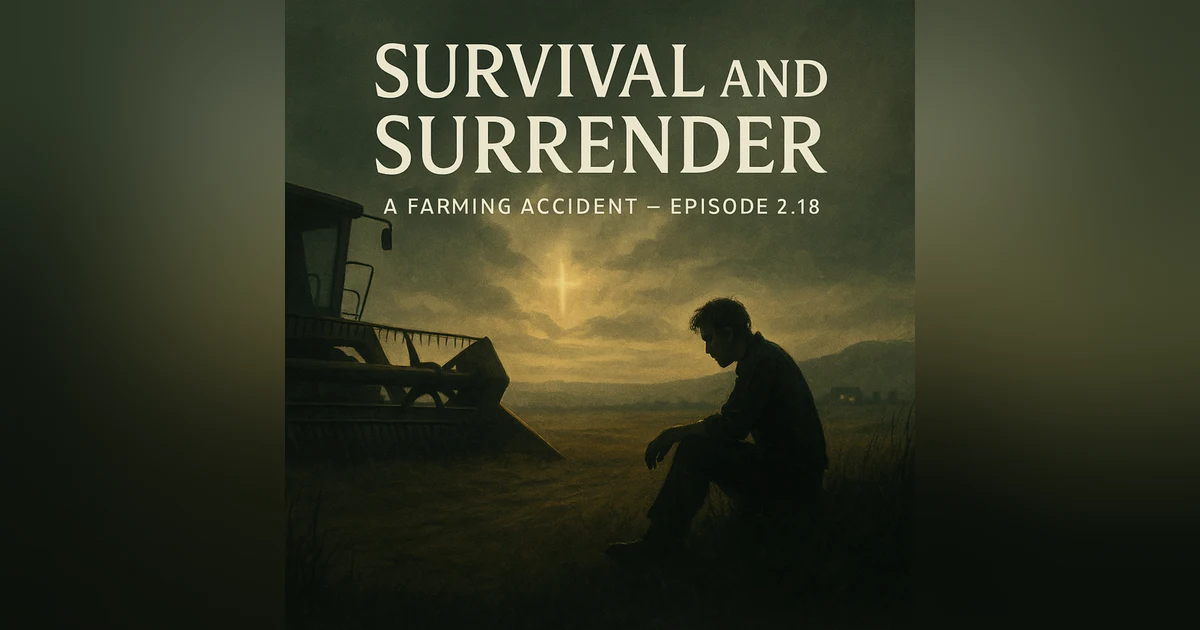
Survival and Surrender: A Farming Accident


 RSS Feed
Episode 2.18
In this powerful and personal episode, Michael sits down with a friend from his hometown who shares the story of a farming accident that changed his life forever. This isn’t just about machinery or missteps. It’s about clarity in crisis. This is a story of tragedy, survival, and deep reflection. Of how quickly the status quo can shatter—and what really matters when it does. Whether you're on a farm or far from it, this conversation invites you to consider what you'd see clearly in your own moment of crisis—and what you might need to change before that day comes.
Find our videocast here: https://youtu.be/wYvrTRFPHLY
Merch here: https://take-2-podcast.printify.me/
Music from #Uppbeat (free for Creators!):
https://uppbeat.io/t/reakt-music/deep-stone
License code: 2QZOZ2YHZ5UTE7C8
Find more Take 2 Theology content at http://www.take2theology.com
0:00 We are back. It's like a year later. Since the last time I was here. Since the last time you recorded when we were. Doing basketball teams. Yeah, we're, we're drafting basketball teams. This was on a Sunday afternoon I think. Yes. And then we had this great discussion which we got some feedback on about Calvinism. Did you? And Arminianism. Everyone decided that I was correct. I think they decided you're correct that it's not the most important. Thing. Well, that's that's what I meant. So that was Sunday. I think so. And then Saturday, I think it was just the like 6 days later.
0:40 Right. We got a horrible call that you'd been in a bad farming. Act was it? OK, now I see what you're saying now. So that it was only a week after we had. I think so. OK. All right. But I know that I looked, I watched that recently because after you asked me to do this again and I said, well look, I've got both legs, so I couldn't remember if I did or not. Yeah. So we got a prayer. I think it was just a text that went out on the WBC prayer chain. Probably you were already in router or there by the time it got that. Far. Oh, you think so? Was it in the morning 0? It was in the. Morning. Oh yeah, I know what time. Well, I don't know what time it happened, but I sent a text to my dad and my brother at 8:54 AM.
1:24 Yeah, I know that. So I think we found out around 10 or so, yeah. Yeah, I don't know if I would even have been at the hospital yet or not. I don't know. OK, It's hard to. Well as you may or may know this is Brian Coles needs no introduction, but I will introduce him. That's always funny when people say this man needs no introduction and they like spend 5 minutes introducing them. But we're going to be doing a two-part interview about the accident that happened a year ago. So like this. So we're recording this on what, June 10th? It happened on the 8th and it. Happened on the 8th so you're one year anniversary for the accident was just two. Days ago I think.
2:09 Yeah. So you may be a remember that one of the time honored traditions we have for our guests is that they have to say the magic words to get us out of the banter time and into the the official time. Do you remember what they are? Do we need to take it to the next level or? I think that's what we need to do. Let's do that. From the hearts of the Low Country in South Carolina. It's the Take Two podcast where we take theology to the next level. All right, so farmer extraordinaire. I'm not sure about that, especially in nowadays. We actually got the farm together some. Yes.
2:56 Back in the day. Back in high school days, I guess. Or college. It was college. It was in between my sophomore and junior years I believe, of college farmed, and I remember walking by a granary. I think it was the Lindsay Benz. OK. And there was this canonical pit. Yeah. And your dad said if that thing's running, don't ever get close to this pit. Oh. Right. It's dangerous. It's dangerous. So you've been farming for a number of. Years a long times 1990 eights when I got out of college, but I did it the whole time I was growing up too. And takes a math degree to farm, right? It does.
3:36 That's that's as soon as I got my math done, I came back home to the farm. Turns out I didn't know what I was wanting to do, but I ended up farming. I've been there ever since. And so this is like a normal day. Yes, it was. I was harvesting wheat and I was getting ready for the for the next day. We needed to clean the machine out because we were changing varieties of seed. We were actually growing wheat for seed production and that means it needs to be completely pure from the previous variety we had been harvesting. And this is something that you probably have done. I've done it at least every year once, probably more than once every year for the past 25 years or longer. And your mic is slipping down.
4:26 I don't know. I'll have to just. I can just tell you. Yeah, just give it a push. I don't know. There you go. And so do you remember anything specific going on that morning? Well, this is it's a job nobody likes to do. These machines are large and they don't clean out on their own very well. So you have to take quite a bit of time with air compressor and A and a wand and blow out stuff that doesn't come out on its own. It's very dusty. You get it all in your face and everything else and it takes a long time. It's just a real pain. Nobody likes to do it. And I was thinking water, but it's air.
5:07 No, it's it's air because if you used water the stuff would get all sticky and sprout and everything like that. So you have like a big error. Yeah, it was long, 3 or 4 feet long with air compressor with a line running down to the ground. The truck, I say down to the ground. A lot of the work is done on the ground, but but where I was actually hurt was up on top of the machine. So this is where I'm I'm assuming I was never farming during the harvesting season, I was pulling levees right? Disc and planting maybe? Did some planning. Did quite a bit of planning. I did some planning. Yes, yeah, lots of field work. Yeah, bunch of field work, but I never did any and we did some water work, pulled levees in the beans. I think the year I was working was the first year y'all used polypipe.
6:01 Oh really? Well, we still using it. That's a kind of a that's a hassle as well. Hot work. So we those are some so I never so, but I'm assuming this that this area is like the central place that seed goes in when you're combining. And then like if you see lots of times you see these pictures and these 10,000 acre fields in Iowa where they're combining corn and you know you have these combines and you have a truck running through it. I'm assuming this is the area that the seed initially goes to after its combine and then this auger is what would shoot it out to a truck behind it or or no well. There's a tank that holds about 3 or 400 bushels of grain and as you go through the field and pull the grain in, it separates the grain from the husks and puts it in this tank. And when you, what you're talking about seeing is if you get full, you swing the auger out and drop it on a truck or a grain card or something else like that. And that is where I was up in this tank, which is large. It's right behind the cab and it's the top of the machine, and that doesn't clean out all the seed just by running the auger. So I'm blowing the seed to get it to that spout where it can go out.
7:27 We were just dropping it on the ground. We're just cleaning out what was left behind and the way that it falls in there. It's a large tank and there's two horizontal augers that carry it to a certain place and then it goes up and out that spout. So is there like a main auger in the bottom but some horizontal? Augers that there's two horizontal augers in the bottom and they go to a vertical auger that they carry the grain to a vertical auger which sends it out to the truck. And all this whole area's sloped. It is sloped. Yes, it is sloped. Now the augers have cover over them, but there's a gap because that has to get the grain out.
8:12 So and, and nowadays this equipment is a lot larger than it was 25 years ago when I first started doing this. And I've often wondered if that gap that lets the grain fall into the auger would have been wide enough back in those days when I, in, when I first got out of college to fall into I, I don't know the answer to that, but I know that these larger machines, the, they can carry more grain and they, and they unload it quicker. So the gap is large enough for my foot to go in and, and yes, the sides are sloped. And also it had begun to sprinkle a little bit. And I can't tell you for certain what happened.
8:55 So you don't like remember minutes leading up to it or anything like that? Oh, I remember doing, I'm doing the work. I, I really don't have any memory gaps from and I never lost consciousness. So I, so I remember everything. It's just, I'm just doing what I always do and I, I just know that at some point I slipped and, and my foot falls into this gap. This is the gap between the horizontal auger and the ground. And, and the floor, well, the gap would be, there's a cover over the auger, but there's a gap to let the grain fall into it. And so I fall in there, my foot goes into where the the auger is running.
9:36 And by the way, this is not something you're supposed to be doing. There are safety features on the combine where if you're not in the seat, it can't be running or it won't only run for five seconds or something. So we actually have a person sit in the seat. There's a ladder on the back of the machine that you have to climb up to get up here. That ladder has to be folded up or it won't run. And all over the place, every year, farmers are doing this thing that I'm doing, breaking the rules, breaking the safety rules, having somebody sit in the seat and go in here and blow this, save some time to clean this out. Our farm will never be doing it this way again. And I honestly, I doubt that anyone in my county will do it again.
10:27 I've heard that comment from several people because yes, we've all done it. And it's, it's farmers do dangerous things. And, and it turns out sometimes we do foolish things. And, and that's what happened after all this time, 25 or 30 years of, of doing this. Now I slip in there possibly because of the rain. It wasn't a rain, but there was sprinkle. I don't know if I stepped on a wet spot and slipped like you said the the side is sloped, but I fell down and it my foot goes in there and this machine pulls me towards the vertical auger for a short time and then it turned loose.
11:13 And when it turned loose and I pulled my leg out, I saw a bone and it was disgusting and it was terrifying and my reaction was considerable time of screaming and banging on the window for my son to turn it off. I could see the knot of my ankle. You know, the not on the yes, I could see that exposed. So just like in a war movie when you see somebody get their leg blown off, I had about that same reaction. I am shocked and terrified and it's natural. I'm just screaming and it's I mean not on purpose. It's just happening, you know, and I immediately try to climb out of there.
12:06 Now this tank is, if I'm standing in the bottom of it, you could see my head, but it's still, it's a large tank and it's got a couple of steps in rails to climb out, which I did climb out, but I climbed out with a foot missing. And I remember going to put that foot down and realizing I couldn't use it. It's just I was pretty wound up so I didn't have any trouble getting out, but it was arms and one leg and desperation. So how many people were there with you at this? There was two. There was one in the in the cab. That was my son Samuel, my oldest. He's about 22 at the time.
12:53 And another young man, South African worker, that's only was about 20, and he was on the ground doing something, maybe some other cleaning. I'm, I'm not sure what he was doing, but he's probably cleaning out his grain cart because we have to clean every piece of equipment out. So I think that's what he was doing. So I did have someone with me. And so when I get out of the tank, there's a large flat place behind this hopper, which is where the engine is. It's a large engine. Yeah, I saw. It I saw you post a video yes recently on. Standing on top of it, I don't know how tall. Sorry.
13:40 I don't know how tall the machine is, but it's one of the larger machines that we use, and this is at the very top of it. But the engine is large and it's got to be covered, you know, to keep stuff out of it. So there's a large flat place and that's where I went to sit down on the sat down and I took my belt off because I've seen TV and I know what I have to do. Actually, I should mention, now that I'm out and I'm standing upright, I see muscles hanging out.
14:22 I see that bone and I see blood flow at a rate that changed my life. It, it shocked me and, and terrified me. And at that moment I realized that there was a significant chance that I would not survive. I'd never seen blood flow like that. I, I told one time I was speaking at the church and I, I referenced the verse in when God is telling Noah that people who murder other people will be put to death because of, you know, that's not I'm selling the wrong thing.
15:07 There's, it's when he's telling Noah not to eat blood. He's telling Noah not to eat blood because the life is in the blood. And my life was flowing out of me at an alarming rate. And so I knew from TV that I had to stop that. That was my only hope. Is the train going to bother us? No, the train's fine. I think we'll, we'll, we'll edit it out fine. So that I knew that the only thing that mattered at the moment was to stop the blood flow. I was wearing a belt and I tied it around my leg twice because the first time I did it, I ran the loop through the buckle like you would put it on, and I didn't feel like that was good enough. So I tied it in a knot and that was all I could do. So I'm sitting there thinking there's a pretty good chance that this is my final hour and I've done what I could do. So I that's when I turned to God. And it's interesting to me.
16:24 At least I didn't ask him for my life. I wanted to live. It was my daughter's birthday. I had a son about to leave to go on a vacation with some friends. I've got 10 kids and a wife at home. I wanted to live, but my all I said to God was that my life and my soul is in your hands and and that's all that I said. And then I sent the texts to my dad and my brother who farmed with with me and who knew where I was.
17:12 And the text at 8:54 on Saturday morning said ambulance, now I might die. And my dad got that text as he was trapped behind a train 20 or 30 minutes away. I'm not sure where my brother Michael was. He got there pretty quick, but it was up to them to call 911. And. So Sam or the the other guy hadn't called 911. Yet I think they had I, I don't know. I think that Samuel called them.
17:53 They called my dad and, and Michael, he was a little hysterical, but I don't know if he called them before he came and got me down or after. Probably after would be my guess. So. So that means they had probably called first, I thought, for the first time this week or last week. But why didn't I call 911? That's the first time. It's a year later. And I think, well, why didn't I do? And then pretty quickly I realized why. It's because I thought that I might be about to die. I didn't know how much consciousness I had left. And I called my wife and that's the only phone call I made. I sent the text.
18:43 And then I called my wife and apologized for being such a bad husband and told her I was hurt and that I didn't know what was going to happen, but that I loved her and for her not to come out there. And that was all the communication. I I didn't send any more texts or I didn't know how much longer I would be awake. My son Samuel showed up. He climbed up there and carried me down to the ground. It's 10 feet off the ground. So this is you're out of the hopper, I'm out of the hopper platform on top, tearing you from the platform to the ground.
19:24 Top of the engine platform so there's a couple of steps down to another level and then there's a ladder down to the ground and he first had to get the ladder down which we had had some was difficult to do but he was determined and and he carried me down from there without dropping me and and even this is I don't know how that happened. He's not any bigger than I am. He's younger and and, you know, strong but. He doesn't have 25 years of farming strength. No, no, not like that. And he, he carried me down to the ground and I never wasn't dropped. I didn't fall.
20:08 That's that's a miracle in itself. Now, when I got to the ground, he wanted Samuel, my son wanted to throw me in the truck and run me to the the hospital. And I knew that that would be a mistake, that I hadn't stopped the bleeding good enough. And if I pass out these boys, they did everything I told them to do. And they did a great job saving my life, but they didn't know what to do on their own. And they were wound up as well. They found me another strap to tie around my leg.
20:51 And I remember telling them because they were nervous about it, you know, and I said no, both of you pull as hard as you can pull, which they did. And essentially we basically stopped the bleeding. Or they did. Later, I had a police officer show up before the ambulance. He also had a tourniquet. I think when I when I arrived at the hospital, I had three different things tied around my thigh and the bleeding was basically stopped. So, you know, I made it and I never lost consciousness. And I, and I really feel like this could very likely be miraculous because my blood count at the hospital was 7.
21:34 I'm Speaking of hemoglobin when it's supposed to be 14. I used to say that me and I had lost half my blood. I looked up, I'm real. I'm real worried that I'm going to exaggerate things. So I started looking up and it's I may not have lost 50% of my blood, but my blood count was half of what it should was half of what it's supposed to be. So I didn't know if I would stay conscious, but I did the whole time until they put me out in the operating room. I was, I was awake and alert. I didn't get fuzzy or anything. So it took you to Searcy. Yes, that's another thing. I know. I feel like I need a helicopter and to be going to Little Rock or Memphis.
22:15 I'm very serious. That's got to happen. And no, there's a little rainstorm and the helicopters were grounded and I find that out. And it still, I don't know how long this was that I didn't know if I would live or not. But when I heard that news, I'm thinking it just doesn't seem to be my day. You know, I'm not going to get get out of this alive. That's that's what I'm thinking. All right, so you're at Searcy Hospital and I'm guessing you go straight to the ER? Oh yeah, and they are waiting on me. There is a room full of shocked looking people.
22:55 The looks on those people's faces when they see me come in. There is another thing that now I I feel pretty good about my chances now that I'm at the hospital. Made it to the hospital conscious I. Feel like I'm going to live now. It's. Like you've made it past the corner. But the look on those trauma of people's faces, right, is like, wow, I've never seen anything like this. You, you know, that's what it looked like to me. And that was full. If we're flying in the the flight attendants seem OK, you're fine. But if they seem like they're worried then you should be worried. And you're saying basically you experienced the flight attendants being looking worried. I would. Say they did or at least they looked like they hadn't seen this before and and that really surprised me.
23:41 But I talked to many nurses during my 8 days in the hospital and, and after, even then, they were like, man, I can't believe you made it. You know, that kind of stuff. They were, they were. I made an impression at the hospital, but with the folks that saw me, yeah. So I remember, I think we were there for a week and you were recovering what I think you know we. Were oh, you were still in town? Yeah, we were still in town for the week after we were trying to decide do we go visit them? Because, you know, that's it's awkward being in the hospital and like everyone come and visiting. You got like half your body showing and and that so we were like, I think I may have called you, I don't remember and just said something. I talked to a lot of people.
24:24 I probably would have told you. You could come. Yeah. You probably did tell us, but I was like. Now I was in the ICU for two days where you can only have two visitors at a time and and stuff like that. So there are some people that saw me in those two days though, and. So from there, I'm, you know, I know that you had some ups and downs with the wound healing. Even after I was out of the hospital. Right. Well, from while you were in the hospital and then maybe like a couple of months. Oh, well, I had several had five or six surgeries, or I'll call them surgeries.
25:06 The main surgery was amputation, but there was, they have to go back in and clean it. You know, it's a dirty accident. There's, there's pieces of wheat and stuff in in there and they're very determined to get all of that out because I was in danger of infection and I had some cultures grow infection, but I was never, it never got out of hand. They did a good job cleaning it out several times. I I don't know how many times while I was in the hospital that that that. Happened. Did they give you pain stuff for that or did well? I was out for that. It was it was that type of surgery I didn't have. Every time the surgeon dealt with my leg while I was in the hospital, I was I was put under the week or a few days after I got out was the first time that he unwrapped it without with me being awake.
26:07 So I but it's about the pain medicine. Yes, I was on a lot of drugs and I was the one of the nights in the ICUI had a dream that I think must have been fueled by this. I woke up thinking I was in a had been in a war and it was almost killed in an airplane. And I start trying to get up and and get out and everything. And my wife was allowed to be with me, which is against which is not normal. She was allowed to be with me because, but she was a nurse that worked at that hospital. So that's part of the reason. And, and she got in my face and told me, no, you, you know, you've been in an accident and, and all of that. And and I knew that stuff was true, but that but that dream seemed so real and I was so terrified that that I was trying to get out.
27:00 And then from the wound healing, tell me about so you today you're wearing a prosthetic and you know, and probably some of the listeners know, but my dad also had his leg amputated and he never, the prosthetic thing never really worked for him. He tried it a little bit, but I don't, I don't know that he was as motivated because I think you had to be pretty motivated to get it to work. Well, it's, there's a lot of things that happen. It, it's, it hurts it, it's hard to do and you get discouraged and all of those things.
27:42 My circumstance was since it's a traumatic injury and you're talking about surgeries on and and nerves ripped away and things like that. I I had a wound vac for 2 1/2 months. So that means the skin that I'm trying to put into this prosthetic is brand new, You know, it's just a few months old. So it's extremely tender and difficult. It was a, it feels like to me, it was a long process, but when I look back, I didn't get a prosthetic to try until the last week of November. And I could only wear it for a couple of hours every other day. And actually, I didn't even wear it every other day part of the time because it's, it hurt and, and, and I wanted it for Christmas, so for when the family was all in. So Christmas Eve was the beginning of the time that I wore it every day.
28:43 And I've worn it every day since. Not the same one but but. Yeah, that was the other thing because I, I dad would wear it some and then he would say it stopped fitting because I guess your leg is changing because of of the use. And so then you got to go get refitted for a different 1. And it just seemed like it was a long process for him. It can change during the day now. Mine they told me I would have to have another one this year but I seem to have leveled out on the shrinkage. At least I've been in the same, the same size for two or two or three months now, which is unusual. It's very unusual.
29:25 Normally you're having to make adjustments for it to work and probably that's what he's talking about and it what you might have to make an adjustment during the same day. For example, when I was going through that, you wear these socks to take up space and you can put on more or less or take them off and I would have more on at the beginning of the day and then take some off at the later on. So there's a lot of that that goes on. That's it could be a real hassle to someone and, and there are a lot of people that are real discouraged and, and all kinds of things like that. And not that I wasn't, I just, yes, it takes some motivation, it takes some endurance, some pain, and you just need to really want to do it.
30:21 Yeah, yeah. All right, So I think we will break off here and we'll call this a good stopping point. And then TuneIn next Thursday for the second-half of our interview with Brian, where we'll talk about maybe some of your reflections since this and maybe change your career. I don't know, you know, things that you're things that you're thinking about. So, All right, so you know how to to take us out of it too. Remember. Yeah. No, I don't. Oh, that's OK. That's our take. Thanks for listening to Take Two. Find us wherever you find podcasts and on YouTube for those who want to watch our video cast.

