Teleological Argument Part 1 | Design or Chance


 RSS Feed
Episode 2.22
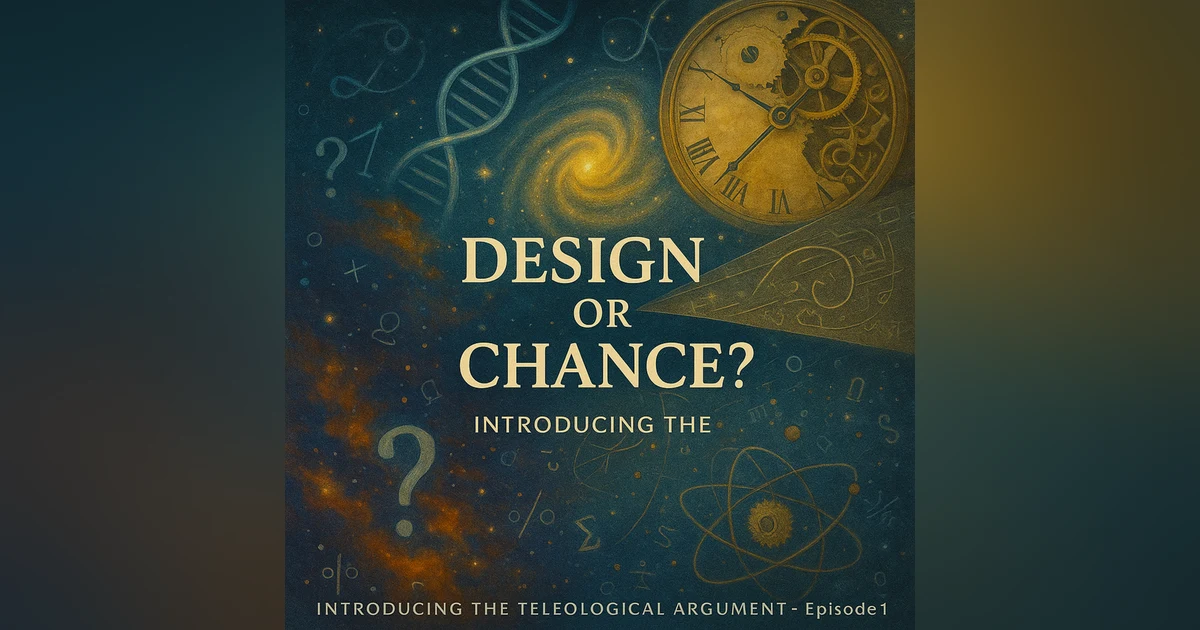
Introducing the Teleological Argument
Is the fine-tuning of the universe the result of necessity, randomness, or intelligent design?
In this first episode of our new series, we explore the teleological argument—the idea that purpose, order, and complexity in the universe point to a Designer. We trace the argument’s roots from Aquinas and Paley to modern thinkers like Dembski, Behe, Gonzalez, and Hugh Ross. Along the way, we define key concepts like specified complexity and irreducible complexity, and contrast them with evolutionary and naturalistic explanations.
Whether you're a skeptic or believer, philosopher or layperson, this episode lays the foundation for a robust, layered discussion of one of the most compelling arguments for the existence of God.
Find our videocast here: https://youtu.be/kG7l4EWu-LA
Merch here: https://take-2-podcast.printify.me/
Music from #Uppbeat (free for Creators!):
https://uppbeat.io/t/reakt-music/deep-stone
License code: 2QZOZ2YHZ5UTE7C8
Find more Take 2 Theology content at http://www.take2theology.com
0:00 So Zach, that's a nice shirt you have there. Oh, thank you. It's this the the seminary you're going to? Yep, that's right. Forge Theological Seminary. Yeah. Oh, the take Two podcasts I know. Yeah, so I wore this shirt on vacation. We were in the Branson, MO area. Nice. I go into the store and this guy looks at me. He's like, I'll try to mimic his voice as much. Like, dude, I love that shirt. I love that shirt. And it kind of threw me off because from the front, all you can read is give hate a chance. And so most of the time I think people look at it and go, I think they would go, what is that dude talking about? And then maybe catch the backside of my shirt and then go because in the back it says abhor what is evil Romans 12/9. So I didn't I did say, oh, thank you. I was like, this is actually a shirt from a podcast I listened to started there and then I showed him the back. I was like, you know, it's talking about, you know, hating what's evil, you know, and then therefore, you know, kind of by by the same thing, loving what's what's good. And I was like, yeah, and I'm actually one of the podcasters. So I did, I did kind of split that in afterwards and he and he was like, oh man, what's the name of the podcast? So I told him take theology and he's like, and is it still alive?
1:17 I'm like, yeah, we're still still recording. So perhaps we'll get another list we another story with this shirt different day. We're back in Arkansas. One of my classmates that graduated with Jill and I both graduated OK, their dog had a litter of dogs. We were on the the knife's edge, at least in everyone's mind except for Jill's, of bringing one of these puppies home with. Us Jill was a hard nail, she. Knew these were like half healer half we don't know, maybe rock a rot mix. But his wife I, I was wearing this shirt and she must have looked at it and she asked about our podcast afterwards and wanted the information and a link to it.
2:04 So maybe, maybe, maybe Megan's listening to us now. We'll see. Wow, I love. It we just need to get more edgy shirts. What else? What else can we say besides give hate a chance? Yeah, I know so. Like if there's something with Ezra Nehemiah, we can be like, we probably don't want to say don't intermarry or something that that's too, that's too much, That's not. Beard out. Pull your beard out. Hey, if you're not pulling your beard out, it's not that bad. Maybe that could be the back of it or something. Or I thought about, you know, we could do something like make something great again, you know, something, you know, whatever that middle, that, that next one is. So, yeah. So get your shirt. Get your shirt because it is a conversation starter. At least it's been for me. I'd I'd like to.
2:45 If you, if you're like, man, I don't know how to make small talk, we're doing it for ya. Grab this shirt because it'll do the talking for ya. Yeah, we got one on Nepheline, we got one on Giving Hate a chance, we got one on tanking it to the next. Level maybe, yeah, if you're looking for a car, if you're like, man, I, I wish I had this conversation started on a shirt. Give us a comment. Maybe we make it happen. We can, you know what it is. And let us just, you know, open that bridge to making all sorts of new friends. That's good, That's good. All right, so today we're going to be talking. We're gonna do I think it's a three-part series. We'll see how see how it goes, how fast we go. But we're gonna be talking about the teleological argument and I always have struggled with. This one, it's one of those hard ones to say, but I can't wait to just dive into it because what?
3:35 What other arguments have we covered already? We've got a good we've already. Covered the cosmological arguments and we covered the moral argument, and we talked about Aquinas's argument from existence and essence that there must be something whose essence is existence itself. OK. Yeah, yeah, yeah. Remember those? So we were covering the moral argument, which is really a we talked about the moral argument in particular, but we said really this is part of a family of transcendental arguments that say, here's something that transcends just the physical, like morality or beauty or knowledge or consciousness, or, you know, all those things.
4:19 Therefore there must be something that grounds it and we would we call that God. So I, I thought, you know what we were talking about that, that one, I was like, oh, normally these are kind of given in the order of cosmological, teleological, moral. It's like what we kind of skipped the teleological. So we should. Come back and get that. Got it. Don't leave it out and we won't. We're taking three episodes on it, so we're not leaving you out. I thought the options were either try to cram it all in one episode and leave the listeners like, whoa, that was a lot. Or, you know, and maybe the listeners, you know, I know some people, these aren't their favorite episodes, my wife being one of them, 'cause it's, you know, it does get a little heady, a little philosophical. I was like, you know, maybe if we just kind of take it a little slower, that's right, maybe.
5:05 People, it'll be their favorite one because they can. You can understand it more. I was thinking I don't know where this goes, but that there's another T-shirt. There should be like, what kind of argument you wanna hear moral till you get all the different ones, you know, And it's like, take two podcasts. You can figure it all out. I like it, yeah. All right, so let's take this to the next level. From the hearts of the Low Country in South Carolina. It's the Take Two podcast where we take theology to the next level. All right, so maybe you've heard about a design argument or the teleological argument, and maybe even that word doesn't make sense 'cause it kind of looks like telescope.
5:50 Yeah. Or telephone, television. Television. Telethon. Telethon. Telemetry. I'm just trying to think of all the. Yeah, all the telly's. So this word Tele means like the end so I can or distance. So a telescope helps you scope as the C, the end or C if long distance. Theological just means that we're talking about the end in the sense of the design, like the purpose. And so a lot of times we look at, you know, the things around us and it seems like they were designed because it seems like they have a purpose to them. And ology we, we, you hear a study of, but it can also just mean, you know, a logical discussion about. So we're this is a logical discussion about the end of things.
6:40 Love it. That's great. And I'm curious, it'll be good to see how how many other of these apologetic like arguments do we, I can mean like categories. Would you say there are that we haven't touched? Broad arguments, yeah. Yeah, well, William Lane Craig would give one from the witness, the inner witness of the Holy Spirit. And I don't know, I don't that's more of a testimony. Instead I would, I would think of a apologetic argument then. So the other broad category would be the ontological. Oh, ontological fine, yeah. Thomas Aquinas gives five ways, but those I think are kind of they overlap and and some of them kind of go back to cosmological, like there has to be a starting point type of thing.
7:30 He he talks about motion and stuff like that. So I could be leaving one out. William Lane Craig will give, you know, the adaptability of the universe to mathematics, but really we could map that back into the transcendental family of arguments. So the these types would be I think this and one more we would kind of cover the basis of the the general ones unless I'm, you know, someone comment if I'm leaving one out. Comment and I, I, I'm, I'm excited to get into this one because I think this one makes a lot of sense and it like it's, I think it's very relevant because, you know, everything just got thrown together or there was purpose in it or two views that people jump to one or the other. But it's good to press people on it because I think it is, you know, trendy to say like, you know, everything's just so random or, you know what I mean.
8:21 So I, I, I'm excited to jump into this. So I thought maybe we'd kind of give a, a history. The first person. I say the first person, the first notable person. I'm sure there's probably someone before him. William Paley, he gives this watchmaker analogy. He talks about like, if I'm walking through this Meadow and I stomp my foot on something thinking it's a rock, and I look down, instead of a rock, it's a watch. And I open it up and I look at it and I go, this watch did not just happened naturally. It's too intricately designed. It has a purpose. And so, you know, there must be a watchmaker. Yeah, there's like gear I could just like, well, I think anyone would say that, that it's just not, it's not grass or it's not whatever. That, that makes sense, yeah.
9:07 Yeah, and you might read someone like, well, no one gives William Paley's argument anymore because it's been shown to be false and all. All we mean by that is that it's not worded fancifully enough to ward off some of these attacks against it. And So what you'll see as we go through until we get to the third episode, it's probably the most philosophically, you know, well worded argument and it kind of bypasses, it's called the fine tuning argument that's made popular by William Lane Craig kind of bypasses some of the stuff. But to me, we're giving too much away if we just go with that one, because all the way from, you know, the atom up to the universe, there's all these evidences of design that I think that maybe any individual, one of those by itself, you might go maybe that's not conclusive.
10:00 But all of it taken together, I think is is is very conclusive. Yeah, I like this other example you have on here 'cause it's another one you hear a lot, the human eye. There's a lot going on in there and it's hard to just for that just to happen or it's, you know, you all these different things have to go where it's not like you add one thing and the eye works perfectly. It's It seems more complicated than that. Yeah, and even if you were to see, you know, a footprint on a beach, far less complicated than a human eye, far less complicated. But you would never go. This arose by natural. Just happens that this the wind blew this in the perfect place. Probably not as. Likely. Wow, this is 'cause there's a much better explanation for someone's step there. But Michael, I feel like the pushback for a lot of these things, I think we talked about others is like, but if he gave anything billions and billions of years, an infinite amount of time, it's gonna happen.
10:51 Yeah, we, we might should do an episode that just focuses on why evolution fails at some point in time. But you know that we don't have even even, you know, on an older few, there's not a whole lot of time between when the radiation goes down and the Cambrian explosion happens. And there's also no accounting for the information being there to begin with, cause evolution only works on information that's already there. Well, I'm glad Aquinas pops up again because we haven't talked about him enough. Yeah, so there are other historical thinkers who do mention some give some design things. Thomas Aquinas fifth way things without intelligence act towards goals like gravity pulling downward.
11:35 It seems like it was designed somehow. Isaac Newton also saw mathematical precision and cosmic order as evidence of a divine design. In fact, Isaac Newton writes as much or maybe more about theology and God. Not, not that we would agree with all of what you have to say, but he does write quite a bit about those subjects and those were his motivations for all of his mathematical and and physical discoveries. So moving on from historical to today, some of the big names, I haven't heard this guy's name in a while, but he was a big player in the design movement, intelligent design movement, William Demski. And I bring him up because he, whether he coined the phrase or just kind of made it popular, there's a there are a couple of ideas that the listener should be familiar with. Specified complexity is one of those. And it's like got two parts.
12:34 It's both specific and it's complex. So you can imagine, did you ever eat? Was it spaghetti OS the the soup that had all the different letters? In it, yeah, yeah. I thought all the spaghetti OS is just the OS. Maybe you got the other can with like all the letters, but there is one with the. Letters. Just the OS. Maybe there's one with letters. There was also some cereal that had letters. Oh, like alpha alphabets? Yeah. Alphabets I don't. Know or something? Yeah, yeah. Yeah. So you could imagine that if we poured a bowl of those and you look down and you just see that whatever arrangement that is there is going to be complex. Yep. Like it's not likely to happen again if I randomly pour a bulls. But if it's just a jumble of letters, it's not like you would say, yeah, it's complex, but who cares? Yeah.
13:22 Or you can imagine what if there was a serial that just had the letters AC H&Z in there, just those 4 letters, good letters and and you pour a bull there and you you happen. Can't believe. It oh, there's Zach. Oh, there's another Zach. There's another Zach. Well, those are the only four letters there, so it's not. That it'd be like more impressive. You do the alphabet and it's like you will die at 2:00 AM tomorrow. You get what? Right, right. So you have something that's really complex that's unlikely to happen on its own, and it's very specified that specified complexity. William Demsky, he demonstrated this. He was a, he was really a mathematician and a computer scientist and he looked at like information in the genome of animals and stuff and DNA and he was trying to show how DNA and all the all the information is a signature of intelligence.
14:20 I'm going to miss his name. Steven Meyer kind of talks about this a lot. Jumped off of this as well. This is an aside. I was curious if you should check this out. I'm not endorsing the Joe Rogan podcast, but Steven Meyer went on the Joe Rogan podcast. He really put forward this arguments and I was kind of they did not go over super. I mean, Joe Rogan's not like wasn't on the same wavelength, but I was like, I feel like I don't know enough about it, but I was like, I feel like he could do a better job explaining it, but it's hard when you're like he was he wasn't going to presentation. It was back and forth and. It was tough. Stephen Meyer, do better, I'll put. It on a quote, yeah, 'cause I actually like Stephen Meyer a lot. I think he was like trying to be just very personable and like, I'm not going to go on an all out attack and like bring everything that Joe says down.
15:08 But Joe's response to almost everything that Stephen brought up was but what if you're wrong? But. Yeah, yeah, yeah. It was like, how can he be? If blah blah blah blah blah, he. Kept talking about fine tuning, but I don't know, but yeah, yeah. You can what if for forever, like, well, if that's true, then this is false. But we don't have any evidence, Joe, that what you're saying is true. So everything we have points to what I'm saying being true. But you know, it was, it was kind of a frustrating interview to listen to, But that is specified complexity, all right. And so then this other idea that you should be familiar with is irreducible complexity. Irreducible complexity is a subset of specified complexity, so not all specified complexity is irreducible, but irreducible is a type of specified complexity. Michael Beehee kind of makes this popular, popularizes it in the ID movement, and kind of.
16:03 His flagship example is the bacterial flagellar motor Go you can go find videos of this and like there I believe there are like 30 more than 30. I think 37 is the the number, but that's the number I always use when I'm joking around my kids. So it could be wrong. Maybe it's 3435, but there are a number of different parts in this flagellar motor and if you take any one of them away it doesn't work. You can't. Yeah, you need all of. Them, yeah. And so the point of this is it's hard to imagine how that would have evolved because you can't. Just have. Yeah, that makes a lot. Of sense, yeah, they all have to be there together, arranged right and functioning.
16:45 And he he uses the idea of a mousetrap. Much simpler than a flagellar motor. Has five parts like the base, the spring, the the wire, the catch. And if any one of those are missing, the mousetrap doesn't work. And none of us would look at the mousetrap and go, oh, that just evolved. We know, Oh no, that was made. And if you look at the flagellar motor, it looks just like an outboard motor of a boat. So very. So that is irreducible complexity. And so you have some people will push back against this. You might say that, well, those parts in that motor had a different purpose and a different thing, and then they all got together and then the thing that was there was selected away when we don't have any evidence of that, like there's no proof of that. Yeah, when you get to specifics, I hear people are like, well, you know, that's why we've got body part, we've got organs that we don't know exactly what it does. And it's like, but it's like you're let's talk about the cilia or what or whatever you want to talk about. Then it's like harder to nail that stuff down. And then you also would, you know, wonder, you know, even if you don't get down to that micro, like what does half a wing do for you in flight?
18:05 What does an eye that doesn't really see, you know, So it's hard to imagine how these things could get selected for as it's transitioning, because in order for it, in order for it to get selected, it has to give you a biological advantage. And as you're transitioning from no wing to a wing, those those intermediate stages, unless you could show how they give you some advantage. Yeah, this. Yeah, these things don't actually help out May. Actually give you a disadvantage. Yeah, yeah, yeah. Yeah, that's good. Darwin, by his own emission, says if it could be demonstrated that any complex organ existed which could not possibly have been formed by numerous successive slight modification, then my theory would absolutely break down.
18:52 So some people would say, well, partial wings may have been given gliding. OK, we'll just take gliding getting up to gliding by itself, you know, it doesn't do anything, in my opinion, to assuade these. Yeah, I like that. Your rebuttal. These are, you know, it's a hypothesis. Everything is like theoretically it could do this, but it's like, does it do this? Yeah, yeah. OK, another big couple of names here, Guillermo Gonzalez, also with Jay Richards. Jay Richards have been known. He wrote a book about money, I believe he's got a couple different areas, but they wrote this idea about the privileged planet and it really has his two ideas that both the Earth is fine-tuned for life and also for scientific discovery or observation. So that because it, when you look at all that we can see and understand and know about, it's like this seems like it was designed.
19:53 Yeah, yeah, yeah. So not only was it designed for us to be able to live here, but it was designed so that we could could know what's around us. And the timing of that is pretty important too, because if we lived some million and billion years later, we we think our understanding of the universe is right. That the night is going to slowly get darker and darker as the universe expands because it's just the things get too far away. So you, you have maybe your Galaxy, but you don't have all the other galaxies and stuff. And eventually, so if we lived in a, in a epic that was much later than than now, then the you can't know as much about your universe as we can now because we can see all that we we can see.
20:38 But they give some examples. Transparent atmosphere allows for astronomy. Stable galactic location avoids cosmic radiation. Ideal eclipse conditions. So there's no reason that the sun should be 400 times larger than the moon and the moon be 400 times closer than the sun. So that they exactly cancel each other out. Because we didn't know, we wouldn't know that there's a corona that that upper atmosphere of the sun, because the sun itself is so bright. You can't see that until there is a total solar eclipse and you look up and you see the corona.
21:19 I got to see in Arkansas you're. A big Corona guy, you know what I mean? I know you like your Coronas, Yeah. But so those that is one of those evidence that it's there. Yeah, that that's good. And people might say, of course you can observe life because like, we're living or, you know, like. Yeah, and that's the anthropic principle. So we will address it directly either at the end of this episode or in the next episode. But yes, there are some people would say, yeah, of course, if you're living here, it must be the, you know, must be where you can live.
22:00 That's nothing big, but it gets deeper than that. Along with the privileged planet hypothesis, Hugh Ross wrote The Improbable Planet. I think I've talked about this a couple times on the on the podcast, but he will go through a number of these things about how Earth is arranged, how we have, you know, these supernova seating. So we get our heavy elements, you know, like all of this stuff. You know, again, I'm talking on an old Earth view, you, you could be a young earther. I think God just spoke metal atoms into existence in our Earth. I'm fine with that.
22:40 But if you're on an old Earth view, there's really no reason that the Earth should have as much metal and metallic heavy elements that it does. But it does. And it allows us to make, you know, all the stuff around us is not helium in in hydrogen. In fact, you know, the force to even have like a rocky planet and not be something like Neptune, a gaseous planet. We have to have these these heavy elements in in order for that to happen. Gas giants out there help shield us from comments and, you know, kick them out of our solar system. We had a very precise moon collision. So we have some pretty good evidence that the moon collided with the Earth, but it was like a slow velocity collision.
23:25 And we the Earth captures the moon and the moon is really pretty large in comparison to our size. So, so normally what happens is the those bodies would get pulled in or shot out. So either you take that large mass and you pull it into yourself and it becomes part of you as a planet or you, your gravity kicks it out. But the moon collision in our capture of it was very precise. Like they've, they've tried over and over again to show how it could happen. But because of its large mass, it stabilizes our axis, helps us have better, more predictable seasons, helps us not wobble and gives us our tidal waves, which that water going in and out for us.
24:14 You know, we drive by over the the bridges and we go, oh, low tide, high tide. But that is replenishing, nourishing nutrition, replenishing nutrients to those tidal animals. So all those things kind of go together. Wow, that that is good. I think 'cause it like going back to like Joe Rogan types. This is also the criticism for some of these things are, yeah, we haven't found another planet like Earth, but same thing, infinite, like where it's just a matter. It's like the universe is so big, there's got to be a bunch of Earths out there. You know what I mean? Yeah, Hugh Ross founded the the group Reasons to Believe Fuzz Rana is one of the members of Reasons to Believe.
24:58 And I haven't seen one of these articles lately. I don't know if like, I don't know, Fuzz is still around, but I don't know if he's like busy or maybe in poor health. I don't know because it's been maybe five years, but he used to regularly because you'll see these articles Earth like planet. Discovered. Earth like planet, Earth like planet and he'll go, no, this is not Earth like and I'll and I'll tell you why. And like by the own article, like here are the differences. Like, so there are a number of, you know, rocky planets out there about our size with water, but it's like those are three or four of the parameters that you would need to have. Life sustaining. That's right.
25:39 So when you do the math on it, it's actually the odds of Earth having there being a planet that have all these things gets close to very to 0, so. Yeah, that's. Even with all the billions and. Trillions of time, yeah, that's, I feel like that's just what everyone appeals to. Like, well, give it more time and there's more universes and it's like, whatever, we'll get to it someday. But yeah, OK, so, so right now I figured this episode we would kind of lay some groundwork for some terms that you would need to know. And then next episode we'll talk some of, we've already kind of talked a little bit about some of the evidences of design for life and earth and stuff.
26:20 And then the last episode we'll talk about William Lane Craig's fine tuning argument. So what I'm talking about now will really come to play more in William Lane Craig's fine tuning argument, but it's this idea that when we see something that has to be either necessary. OK. Either it's necessary or it's not necessary. Yeah, yeah. And we would say and that kind of. Gets up to the heart at some of this evolution stuff like how necessary or not is it right like. Does did gravity have to be the way it is? Like, and a lot of people, physicists will say no, we can imagine gravity being different than the way it is. It's not. But you know, for us, gravity is a calculation.
27:01 We have a constant, gravitational constant. Could there be a universe where the gravitational constant is different? Mathematically, there's no reason that we would know why so. So it could be necessary. If it's not necessary, then there are two options. Either it's just chance or it was designed. And so in philosophy, we can use the law of excluded middle to show that those are really the only three possibilities. So in law of excluded middle says you either have a property or you don't have a property. So you and it's not good for things that are like halfway. Like you could say, well, he's balding, he's not bald.
27:44 Well, that's not what we're talking about. But you can say either he is balding or he is. Not bald. Either he is bald or he is not bald. Either the surface is flat or is not flat. It can't, you know, can't be both. So you would say either it is necessary or not necessary. So that's the first law of excluded middle. It can't be a little bit necessary and a little bit. Not necessary, right? Right. That makes sense. And then if it's not necessary, either it is by chance or it's not by chance. And so another way we talk about not being by chance, we would say that's design. It was designed to be that way. And so you could split those categories up. Even further. Yeah, yeah, yeah. But that's still all going to be under the category of necessity, chance, or design.
28:28 OK, that makes sense. Because for whatever reason, I feel like people just don't like, I don't know, I think people want it both ways. They like there being something out there, but they also like chance. Do you know what I mean? Like they don't like to drill it down, especially not like a specific creator. It's like maybe like the universe is at work, but it's kind of chance and things just happened. Yeah, you'll see people. There was I was listening to, I think it was Greg Kokol. He had some guests on and they were talking about it was trip. I'm not gonna remember their names. The two gymnasts that he has, Trip and some Megan Allman, I think.
29:14 Are their names OK? And she was talking about how I think it was her talking about how every culture, every person has some God. OK. Something that they find meaning in. And you will, you will, you'll either be the ultimate God or something lesser. And I think that goes to your point because, you know, you talk about Joe Rogan earlier. He's like, well, what if aliens 'cause people try to, you know, they want purpose. They want mean they don't want this to be, you know, the blind, pitiless and different universe that Richard Dawkins talks about. They want something that they can find meaning in, but they don't want that thing to be perfect, morally perfect and and hold you accountable. They want all you know as you know they they want it both ways and and you can't have it both ways. Can't have it both ways.
30:03 OK, so that that's good. So you're going to get into some physics for us. Yeah, maybe some physics, maybe some, you know, just some more parameters to the things to think about about, you know, the Earth and our place in the Galaxy, our place in our solar system. And we'll talk about, you know, some things that would make you think that Earth is a privileged planet, you know, so. Yeah, love it. Nice episode one out of three. Yeah, that's that's there we go this. Is good. We kind of got it's funny. This is like at at Bob Jones old. They love talking about fine tuning, love talking about specified irreducible complexity. Don't like talking about here us. That's where that's where it's like we don't talk about supernova, supernova seating, all that.
30:46 So everything else is like they drill so hard, but then they're like they stop at the older stuff. Yeah, well, if it's if everything was created de Novo, like boom, you come into existence like it could be any arrangement that you want to and and that would still be a miracle, right? And I'm not saying you're not denying that. But if everything came about by the natural processes that God set up, but he you know, there was the the term fully something planet fully. I don't, but it's basically this idea that God set up the physical laws and The Big Bang in such a way that he knew as those physical because the matter we can look at the radio, the background rate turned away from my mic.
31:35 We can look at the background radiation of and it's not evenly spread like you would think that it'd be like peanut butter spread. But we find these places where it's a little bit hotter and places where it's a little bit colder. And those small differences are what led to there being a Galaxy here and not a Galaxy here or maybe a cluster of galaxies here and this huge void. Like there are these huge voids in space. Like you have Galaxy, Galaxy, Galaxy, trillions and billions of galaxies and then these like billions of light years were from what we can tell, there's nothing there. And so, you know, if you, if you have an overview and you think, well, God set this out on this thing.
32:23 He knew exactly how at the very beginning, all that had to be arranged in the laws that had to happen so that, you know, our physical universe would create, would produce a Earth. But it was still miraculous on my view so. I love it. I'm excited to jump into next two episodes. Yeah. All right, that's our take. Thanks for listening to Take Two. Find us wherever you find podcasts and on YouTube for those who want to watch our video cast.

