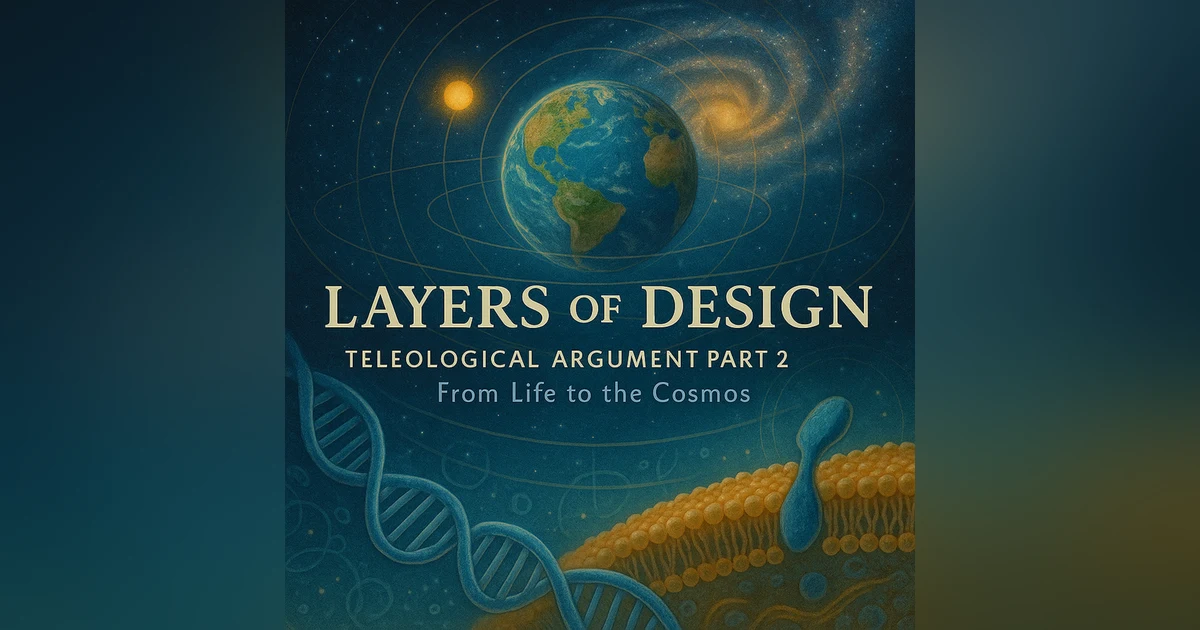
Teleological Argument Part 2 | Layers of Design


 RSS Feed
Episode 2.24
From Life to the Cosmos
Is the design we see in nature just an illusion—or does it point to something more?
In this second installment of our series on the teleological argument, we explore layers of apparent fine-tuning across biology, planetary systems, the solar system, and the universe itself. From the genetic code and molecular machines to the unique traits of Earth, the Sun, and even our galactic neighborhood, we ask: Does this all look accidental or intentional?
We break down key arguments from thinkers like Behe, Dembski, and Gonzalez, and engage with major counterarguments, including the anthropic principle, evolution, and the multiverse with clarity and rigor.
Topics include:
Irreducible complexity in biological systems
Earth’s “Goldilocks” conditions and solar fine-tuning
The privileged planet hypothesis
Responses to evolutionary and multiverse-based objections
Why the design inference remains a rational explanation
Whether you're new to this argument or want to sharpen your thinking, this episode dives deep into why life and discovery may be more than lucky accidents.
Slip Fault Earthquake (crazy!!): https://youtu.be/77ubC4bcgRM?si=vuD9oYqw-SwibFpD
Find our videocast here: https://youtu.be/W_bmn9LJEQE
Merch here: https://take-2-podcast.printify.me/
Music from #Uppbeat (free for Creators!):
https://uppbeat.io/t/reakt-music/deep-stone
License code: 2QZOZ2YHZ5UTE7C8
Find more Take 2 Theology content at http://www.take2theology.com
0:00 So Michael, yeah, this is coming way late, but I want to recap Father's Day a little bit now. This is not coming out till the end of July, but Father's Day wasn't Father's Day wasn't that long ago when we were recording. Yeah, 2 days ago I. Don't know if you did you get 2 days ago Yeah very recently. I don't know if you got any any gifts from the from the fam I. Did. Yeah, we got, my dad was in town got him just, you know, few different gifts. One of the gifts we got him was this was this koozie. He really likes my mom and dad, like love, they drink Diet Coke. They drink Diet Coke too much. Yeah, yeah, yeah. And, you know, we're trying to be trendy with the culture. So we got this koozie that says I identify as water so he can slide that on his Diet Coke and boom, he's healthy.
0:41 He's like, I'm on my 8th cup cup of water today, you know? We're good. That's very nice. So you. Know. And any gifts that you got, Zach? I got some stuff for the old Blackstone, You know, I was actually, I grilled, grilled a little bit today. Oh, you did what y'all what y'all have today? Did some, did some chicken bacon kind of bacon ranch kind of sandwiches and I, you know, put them. I just, I love putting bacon on the Blackstone, just, you know, so. So yeah. And bacon too. Last night I did bacon and sausage and pancakes and eggs. Man, so good. The pancakes like in the bacon grease and it just, it just made you can't. Well, Jill does not like the pancakes, the bacon grease. What so?
1:24 So I scrape all the the bacon grease off and then we put butter on it, 'cause she's, but she's very happy with the taste because she's like these. She's like, most of the time pancakes don't taste like anything like you get at the restaurant. Oh yeah, but they do. But they like she's like these taste just like Cracker Barrel pancakes, this particular mix and you know when you cook them in the butter on the griddle, so. Cracker, have you been at Cracker Barrel recently? I have not. Dude, I'll tell you what, it had it to me. It seemed better days. It used to be like the premiere, like my grandparents were like always stop at Cracker Barrel. Like you would always stop at Cracker Barrel on road trips. It's we the last time we went, we were on a road trip and we were like, it's not lunchtime, they're not going to be busy. We should be able to get in and out and we needed we needed that longer time.
2:10 This was in Tupelo, Ms. I've. Been there many times. And we got off on that, like the little Corinth Drive. We went to that Cracker Barrel that's kind of over there by, you know, just down the street. I could, I could just give you all the, I can see exactly what it is. We waited like 2 1/2 hours, 30 minutes before. Like we were seated. There's no one in the restaurant. The waitress doesn't even come over and like say, hey, anything for like 30 minutes. I was about to leave. Like she finally comes over and I say something like we're on a road trip. She's like, oh, we're so sorry. It will be fine. You know, we're going to really. And it drug out, drug out. And I was like, this was we dropped like 2 and I was like, I can't do it. Plus, you know, I think they're going a little bit woke. So, you know, they had they had some, you know, rainbow furniture out front in one of them and stuff the. Rocking chair was rainbow.
3:07 The checker set was rainbow. Absolutely. They had A and this was a couple years ago and they like changed the menu changed. They have changed their menu on there. Are some that they've even gotten rid of the all the old antique decor and stuff? Yeah. And I was like, for all this, I can just do Waffle House. I feel, I feel like they really went against their target demographic with that one. You know what it's like you, You have a demographic that loves you. I think do making all these changes is not going to make the other demographic love you. It's just going to make your demographic not love you anymore. And then and then you're just floundering. I feel like grandpa was going there, not for the mimosas. Like, like it's like crazy to make all those changes because yeah, I've, I've been there not a lot, but the last couple times I've been there just wasn't a good experience. It was like just not what wasn't what I remembered. The Cracker Burr store, on the other hand, seems to be firing all cylinders like they've done all the crazy stuff as always. So you know that that's still.
4:06 Maybe. I, I, yeah, I don't and I, I'm not, I'm not like a shop there, but it seems like they're always, maybe I don't know if there's cuz they're not busy, but everything's like really, well, not that I go in there a lot, but seems like they've got so much stuff that diversity and, you know, whatever it is, I feel like. Diversity. You don't mean like the woke diversity, just a bunch of different. Stuff a bunch of different stuff, whether it's like old timey stuff. I feel like they got the little the little like ball with like the weasel thing, you know what I'm saying? Like that's like a classic Cracker Barrel thing. When I was there, you always turned those toys on and you know, they just, you know, got us rocking the rocking chair, played some checkers. It's just, you know, classic, classic stuff. But man. So I picked, it wasn't really gifted to me. It was like you can go pick it out. So I took the money that my mother-in-law gave me and the mother the money that my wife and one of my daughter's has pledged to me.
5:00 Nice. I like the way you said that it's been pledged but. Yeah, because in in Arkansas is helping Tommy. Tommy. Trees. OK, Yeah, with chainsaw. OK, so I picked up a chainsaw from Oh, nice. Not the room, not that one, but they have like Craftsman. I used he, he had both. He had a steel and a Craftsman battery operated. And you know what, for the size trees that I'm taking down in our backyard, that that battery operated one is gonna be fine 'cause I'm not cutting a big tree down. Battery operated. Everything seems to be pretty awesome. Yeah, it's like so quiet to like you can like mow your I It's pretty amazing because you hear that and you're like, man, does it have power? These things.
5:44 I mean, I'm not saying they're like industrial whatever, but it they're pretty. They do pretty good. Yeah, it was it, it did fine. I mean it cut until it just stopped cutting cause the battery went down. So for for Father's Day I got him some battery so that he can have one. He can you know be charging 1 and I got the only one he had was 2 amp hours and that's kind of small. So I got him one that had a pack of A4 amp hour and a 2 amp hour. So he has a total of 8 amp hours of work that he could use, which is as he can cut down quite a bit with that now. So yeah. Dude, I love it. Father's Day for for the win. You know what's the next holiday, I guess is July 4th, the next thing that's coming up. Yeah, no Kings Days, July 4th, where we kicked King George out. No kings say get out of here.
6:31 Let's get out of here. But but by the time this airs, that should are you? Oh, that's right. Yeah. We're we're looking forward to Labor Day and. Labor Day will be will be what people can school do in the. Startup that is crazy. That is crazy. Oh my. Goodness, yeah. Pickleball with the church. Pickleball August 3rd or August 10th? Which? Which one is it? Oh, I also have another another banter that could be controversial, but we'll talk about it later. On another episode. Another. Episode. Is it about the 10th or third? Yeah, because I asked. Because I suggested pickleball. You did. Can you say, well, we were doing pickleball again? And in my defense, I think the third was thrown out by you initially.
7:14 I, I think I said maybe like that just that first Sunday in August, not knowing, not looking at a calendar. And then I looked at it as the third, our anniversary is the 4th. So it's like we're probably going to be, you know? Just do your have your anniversary at the pickle bar. It'd be great. It'll be great, yeah. Yeah. Be fun they would be your wife would love it because. It can be right next to the pickleball. That would be great. Your wife would see a lot of purpose and that decision. Yeah, Yeah, it would be. It would be. Meaningful, but you thought and designed it. It wasn't random chance. No, no, because it could be necessity or not necessity or I love it chance or not chance yet. So you're, I think you're alluding to the topic of our podcast. This is episode 2.
7:59 Episode 2. Of the theological argument or we're going to talk about, you know, the sun and the stars and the Earth and the moon. So with that, let's take it to the next level. From the hearts of the Low Country in South Carolina. It's the Take Two podcast where we take theology to the next level. OK, so today, yes, most circles, if you talk about the theological argument, especially like the philosophical apologetic ones, they're just going to go straight to the fine tuning argument, which I think is a great, very powerful argument. But it feels like they've abandoned some of the other stuff that's that's there.
8:45 And so this episode, we wanted to look at some of those other things that, you know, are there that we, I, I think it's harder to defend these in a debate. OK, yeah, that's probably why they get skipped over. A little bit, yeah. Yeah. Because, you know, you get into evolution and all this other stuff, but I'm not willing to give up that ground. Of course, I'm not debating someone either, but I think that these are some good, good things. So just a recap of what we talked about last time. We did talk about specified complexity. So it's specific and complex. So like if a magician shows you a card, that's not that big of a deal 'cause there's 52 in there. But if he shows you one that you signed that, you know, went through some crazy thing that was locked up that was complex and specific to you, that's a big deal. Talked about irreducible complexity. And then we talked about kind of the three options for the, the, the apparent design that we see there were the fine tune that we see it could be necessary.
9:44 If it's not necessary, it's not then it's not necessary. And then that falls into two categories of chance of design and it can't be just a little bit of design, but mostly chance. It's like. Yeah, you got to make your bed and lie in it, Yeah. It's got to be one of those. So we're going to talk about some of the layers of apparent design that we see in our universe, and we're going to start with our genetic code. OK, Someone famously said that you wouldn't. Microsoft would not code by chance, although some maybe some hackers would disagree with that. Shots fired. But you know the genetic code is a software code. Now you have a degree in.
10:25 What was your bachelor's degree in? It was more or less you don't want this answer. I'm going to give you a much longer answer. It was more I went to school, I wish I could have done kinesiology because I've been better. But my degree they did not have enough doctoral or PhDs to make it work for a kinesiology degree. So I was a pre physical therapy which basically meant I had to take all. I had to take more on the science department than the. Like. Exercise department which was stupid. So I have like stupid bio organic chemistry classes, micro like things that like it's good for foundational but for really PT you just need like 8 credits to physics, 8 credits to chemistry, 8 of biology. You just do like basics.
11:09 But then I had to take all these stupid classes and I did not take movement science classes as much. But anyway, here we are, yeah. Yeah. So you probably know DNA has those 4 bases, right? GTAG. GTA and CI believe and then RNA one of those gets swapped. Something, yeah. Yeah, and one of those goes away. We're trying to remember, but basically those are called codons because they code for amino acids. So if you put, you know, I think they're like groups of three like AAT or AT and you put those together, then you're coding for different amino acids. And that is how you build your, your proteins, building blocks and your enzymes.
11:54 So I've, I've said it like this before. Imagine that you had coded for your house this long string of construction materials. And what happened was you would get this delivered on site and then like, you would put like the first little bit of that long string. It would be miles long maybe. Yeah, yeah, yeah, yeah. And then you wrapped it and formed it so that all, you know, boom, your stairs are there. You know, your floor is there, your cabinets are there. And like all of all of these construction materials wrapped in them one way only to form your house. That's basically what's happening when you your DNA is coding for these very complex enzymes. It's not just, Yeah, I think on, on one level, you're like GATC. It's not that many, but it's like, no, it's like when you're stringing these together, it is very complex. Yeah, yeah, yeah.
12:49 And you, you it just the fact that anyone would think this would come by chance. Yeah, that's that's tough. And someone's also mentioned, you know, you have pieces in your cell. It's like your DNA is the record but you also have to have a record player. Maybe I should update that. A. C. DEI don't. And a CD player. Or maybe I should update that MP3MP3 player, but you have the thing that has the information on it. But that does no good. Unless you can read it and replicate it and understand what's there. And both of those mechanisms have to be there together. And so there's been some ideas about how my one of those might evolve by themselves, but it's like, how does that happen? Seeing it boggles the mind.
13:36 Yeah, it's like even the most, Again, I feel like these skeptics, it's like their only appeal is Infinity or you know what I mean? Like it's like, that's like the, I feel like I just hear that so much because I think they recognize that it isn't. That's all you could. That's all you can. Yeah, Yeah, we have. We already talked about some of these, like these very complex molecular machines that we see, like even when I was talking like there are these little things that look like they are basically forklifts of the cell that carry things into. It's kind of funny when you see like under the like how things move and stuff it is. It's like a very complex city just in your cell. We talked about the flagellum last time. You know, it's like a motor that helps the that bacterium get where it's going.
14:26 If you look at our ecosystems, you know there's a reason that you know we don't want all the bees killed. Yeah, man. You just watch the Bee Movie and you know, cool. Have you seen the big movie? I've never not seen the Bee Movie. That's Lydia's favorite. Movie. Is it really? Yeah. Yeah. Big Seinfeld fan. Yeah, well, I don't. Know if she's a big. Seinfeld fan? I'm kidding. Yeah, yeah. Yeah. But, you know, we look at our Earth, things seem to be balanced to where you have certain, you know, ecosystems, certain systems that, you know, provide certain nutrients or they do certain functions, certain organisms in an ecosystem. I talked about, you know, driving, taking an exit to my parents' house, Judsonia, probably like exit 52 on Hwy. 57 in, in Arkansas.
15:13 So you know exactly where I am and I see this dead armadillo, man, you know where I'm going with this. I knew before you got to this, yeah. And I see this vulture eating the dead armadillo, but it's eating it from its rear end. Like it's head. It's inside the body cavity from the rear end. I'm like that's, you know, that's a good thing because that you need that vulture is devouring this this animal. So that's all part of those finally balanced ecosystems. It's great. People are like always composting things, like it all like works, you know what I'm saying? Yeah, You know, so it is, it is pretty incredible how there's something to take care of something. And and it's like even these people that don't believe in a creator are like the circle of life or you know what I mean? Like they're like, this is great, you know? Yeah, and there we could go on.
15:58 We could make a whole. We could just look at the biodiversity of life. We could take a whole episode for that. I will mention there are like so many animals that look like other animals to scare predators away. Like you have the moths with the eyes on it and it's like that looks like a perfect eye. There are some Caterpillar that looks like a snake. Have you seen this? There's some flowers that look like like they like. It looks just like an animal. That's amazing, yeah. That information had to come from somewhere, so. Just random, man. Just just just appear. Yeah, there's yeah, I love it. Example after example after example.
16:39 Yeah, All right, so now we're gonna go from live to Earth itself. Earth has plate tectonics, and if you're Phoebe and you're afraid of volcanoes and lava, it's not a good thing. But if you need carbon silicate cycles so that those are renewed all around the globe so that life can happen, well, then you need plate tectonics because the lava coming up and the rock getting melted, all of that forms a cycle. And what drives our plate tectonics that we, from what we can tell are heavy radioactive elements in our crust and the heat from those and the heat from the core that is driving those.
17:24 So, you know, we have just the right amount of radioactive elements in our crust to help help drive some of some of those things going because those warm everything up. I love it. Yeah. Is man, have you, have you been in a earthquake before? I have not have you? No, not been in earthquake. There's been earthquake, but been to I I my favorite trip ever. When we went to, we went to Iceland, a lot of volcanoes, that kind of thing. And there were so many like islands that were like, so like this island popped up this year or whatever from, you know, from volcanic activity. It wasn't here and then all of a sudden it was here. And that's pretty amazing. And then we recently, too, went to the Volcano National Park in Hawaii. And, you know, yeah, they show you how all these things happen, you know? There's a recent video that hit and if I'm listening to this while I'm producing it and I remember, I'll put.
18:09 I'll try to finally put the link in the in the in the notes, but it shows the first slip fault earthquake caught on camera. You should you should look at it because there is like a building that's like built right on this side of the fault and you can see like the earth just moved like these two pieces of land just move past each other like 3 feet and it's like that is insane. First time that we know of it is caught on camera because it's not like a lot of rolling and stuff. It's just like. Yeah, it's, it's pretty. Yeah. It's like so cool. All the stuff that we just don't see here 'cause we're not around a lot of it like walking through like lava tunnels or it's like all these things are just like so crazy. I did make my wife when we were in Iceland, she was pregnant with Jordan and there was like an active volcano and we were hiking and she was like, I'm pregnant. But we we were able to hike like, pretty good. And it was like, they're like, you need to be everything. Everyone is like when you're pregnant, you can't do certain things and there's like fumes.
19:14 From lava you can do it's. Fine. We did it. We made it. It was, it was a little kind of little dicey in the moment. But afterwards, he's really glad we did it. That's good. Yeah, Yeah, yeah, yeah. All right, so plate tectonics, ozone layer, you know we have basically you were growing up during the time where ozone, there's a whole ozone. It's yeah. That's all cleared up. I mean, for good reason 'cause we stopped using some certain chemicals that would, you know, knock out the ozone and that's depleted. But the, you know, the ozone layer, how that forms it, the how our, our Earth is able to hold those different layers of atmosphere blocks the ultraviolet radiation, our axial tilt 23.5° stabilizes, gives us, you know, rhythms and temperature variations. You know, if that were more, if it was dead on, that's not a good thing 'cause you then you don't get seasons and then we need seasons.
20:08 If it's more than it's like much more chaotic, you know, 'cause I think Uranus is basically tilted where it almost like spins facing. Oh, that's interesting. So. It's like always. Yeah, yeah. The distance from the sun, we're in that Goldilocks zone where water can be liquid and solid and gas. We have abundance of water again on the old Earth view that water was not there with the protoplanet when it formed. So we believe, you know, scientists believe that some very water heavy comet smacked the Earth in its early days and delivered water. So if that's the case, then we have water, extraterrestrial water that you're drinking right there.
20:52 Dude, I knew. I knew Dasani. There's something to it. But we have an abundance of water more than what we should have had. We just formed naturally, so we so something brought us some some extra water or godspoken in existence. Either way, that's. Right. We do have a very strong magnetic field. Looks like it's going to flip here sometime in the next thousand 2000 years, sometime between one year and 1000 years. We don't know when it's going to. Happen. Have you heard of these people that are like gravity's not real? It's like more electromagnetism or, you know, or it's like more along those lines versus you're. Saying maybe you're talking about like star formation. Stars are held together together by electromagnetism rather than gravity.
21:37 That might be where they like draw some of that from. Like there's I'll, I'll have to show you this like popped up maybe like a year ago. Not a credible source, but there's like this actor Howard Terrence Howard who went on again, not endorsing Joe Rogan podcast, but he was like, I've unlocked this like new technology that they're trying to suppress and it's like gravity's not real. It's all based on, but it, I think it takes some of the theory and they apply it and they're like, this is the key to like everything. He was really passionate about it. Maybe I need to listen to that, But we do have a magnetic field Shields us from the solar wind. The solar wind is actually pretty strong.
22:18 You know, we have this probe that we sent out, Voyager 1, Voyeur 2, one of those it has crossed over and it's starting to get into that region where the it's the end of basically the sun's changing the environment and so he gets it, gets out into it. Actually, the can create a sound based on the particles that it's hitting because the Sun's particles basically clear a path around the galactic particles, you know, kind of Shields us from those. But then we have a magnetic field that Shields us from the sun's particles that it's sending. So if you've ever seen the Northern Lights or if you've been on the other hemisphere, the Southern lights, that is the the solar wind basically getting taken care of by our magnetic.
23:07 Story. Is it just like what's the like in the last year? Everyone's like, I saw the Northern Lights from Alabama, you know what I'm saying? Yeah. I don't know why. Why did that happen? Yeah. Why does everyone see the Northern Lights every day now? Like it just like, or they're like, hey, but when I you know, it just seems like everyone sees it all the time. Yeah. So our sun is on a 13 year, I believe it's 13 year cycle where it will go from hardly no activity to a lot of activity. And really this is, you know, you've, if you've ever seen a magnet and you see those magnetic wires. So those, the sun's spinning and for some reason it's around 13 years where it does a complete cycle of those wires going, going from pre calm to really messy back to pretty calm. And when those wires, the, I call them wires, but they're basically the magnetic lines, when they're messy, it's throwing a lot of stuff out in the solar wind. And so if it's putting a lot of solar wind out or if it has like a slow solar flare or something that is putting a lot of that stuff out, a lot of charged particles, then our Earth gets bombarded with it.
24:12 And then we see it in the lower latitudes and what you normally do. Gotcha. So it just happens all the time and just people just every time I see. OK, gotcha. So so it. Sounds like Oh it'll. Clear up and you won't, you know, 13 years from now, people will maybe see it again. Yeah, yeah, yeah. All right. And we have a pretty unique atmosphere. Oxygen does is not stable. Yeah. You don't. You don't want 99% oxygen. Is that what you're telling? Me. Well, I'm saying if, if we could see a a planet, we don't know of any mechanism that would allow oxygen to last a long time by itself without plants constantly producing it. So if all of our plants, if all the plants and animals went away tomorrow, yeah, our oxygen levels would slowly because it would oxidize and it would combine with other elements. Question for you, Yeah.
25:04 Are there more plants or more stars? More plants or more stars I'm. Going to look this up, I don't. It was just off the top of your head. No, no, someone was talking about this. I don't know if they were a real source or. I would say. This you. I would think there'd be a lot more stars, but maybe but but. Maybe not, because if you have single cell you have you could have trillions. It depends on what they're classifying this plant. Yeah, because the, because the moral of the story was way more trees on Earth than stars in the Milky Way, which I was like, and I'm looking at this now, it was trees versus stars in the Milky Way, which was crazy.
25:45 But I guess, and I don't know how good these studies, not to derail it, but the what the thing I'm looking at from NASA estimates there's 400 billion stars or less in our Galaxy, but over 3 trillion trees on Earth. But I guess maybe I don't know what definition of a tree is, you know, you know what I mean? Like, I don't know if like something small counts as a tree, you know what I'm saying? But anyway, yeah, I feel like there's a lot of stars, but there's way more trees. I saw someone, it may have been Neil deGrasse Tyson, Neil deGrasse Tyson, who was talking about, you know, the uniqueness of wood or grass. He's like, this doesn't happen out in the universe. Like, you know, we get all caught up about diamonds, but diamonds are actually fairly common. That's funny out in the universe because it's just carbon that's been compressed.
26:32 But you know, so you know, galactically speaking, you know, a 2 by 4 is more that's like more valuable than a diamond. There you go. When the Yeah, in the economy, we got the gold mine, so. So so all the guys out there don't get your, you know, your soon to be fiance a diamond. Get her just get her a piece of wood. And say hey, in the scheme of everything, you are so lucky. I love. It all right so we talked about the Earth we got some other things to talk about the moon kind of talked about about this a little bit last time large size relative the Earth stabilizes our axial tilt and by extension stabilizes our climate. The solar eclipse alignment enables advanced astronomical study because of the just right distance and size during SO.
27:19 To your point, I feel like we have solar eclipses like all the time. It's just something that happens like every couple of months. Everyone's like, ah, there's a so I'm like, I'll just catch the next one. There's so many. Everyone's talking about them. All the time, always just kicks the next I'll. Just catch the next one. I'll be fine. It seems like they're happening. It's and maybe just like social media something. I feel like it's like all the time. It's like, hey, just drive to Alabama. There's one happening this month but like it just seems like a thing but. Maybe you're confusing solar and lunar eclipses? Maybe I'm there's eclipses or a dime a dozen. I'm just saying they're having. Total solar eclipses are not. I'll just say that. I'm just, I'll just put that out there. When's the next total solar the eclipse for South Carolina you can do you can look on that one not worry about it. I'll just. Get to the next one, I'm sure people be talking about it.
28:01 I think you're just jealous you didn't go to the go to the one in Arkansas, so no. I'm just kidding. I'm just kidding. I just feel like it's the same thing with the Northern Lights. It's like, man, it's just like all these things happen all the time. I feel like when I was a kid I never heard about these things and now it's like we're like in the hot spot of there's an eclipse happening. Anyway, carry on. All right, So the Moon also provides tidal effects, regulates ocean movement, supports life cycles, especially those coastal life cycles, those tidal plane life cycles, and then it the Moon, we don't think of the Moon as a meteor shield because we think of Jupiter and won't get onto Jupiter. I'll just talk about them together. Jupiter is massive. So if you take away the Sun, which is like 99.99% of the mass of the solar system, if you take that out of the equation and just look at the plants, the planets and the dwarf planets and the asteroids, Jupiter is like 98% of the mass of that. So just completely massive.
29:01 Some people say it's like a failed star didn't didn't make into a star. But because of that it, you know, pulls in those asteroids or kicks them out. It helps keep that area clean for us because without that cosmic vacuum cleaner we would get bombarded more often so. Jupiter. I'm looking it up 1300 times the volume of Earth. Yeah, what about the mass though? The mass off. Look at the mass, it is 11 times the diameter of Earth. Let's see if I can find the mass of this bad boy. Stay tuned. While you're doing that, the other large mass in our solar system, the Sun is a yellow main sequence stars. Now it there are a lot of these out there, but ours is particularly heavy in metallic content. And from what I read, it is in the top five to 10% of stars for the ratio of heavy elements that it has because most stars are just pure hydrogen.
30:06 So that heavy metallic concentration allows for the formation of rocky planets like we have, allows for those planets to have metals in their core and in their crust. We have the, you know, the nickel iron core in the middle of our Earth is what we believe it is. And the rotation of that creates our magnetic field, which we are talked about protecting us from, you know, cosmic radiation. I'm sure you were ever our listeners who are dying for the mass of Jupiter. Earth's mass is 5.9 * 10 to the 24 kilograms. Jupiter's 1.89 * 10 to the 27.
30:49 Wow, so so 1000 more than 1000 times more massive than the Earth. So Saturn, the reason that I asked about volume, Saturn actually has a very large volume, but a very low density. Famously, it's less dense than water. So it they always like if we had a galactic ocean, it would float in the water. That's how how not dense it is. So, all right, kind of talked about that whole section there about the metallic con, our galactic address where we are in the Milky Way. We are between two spiral arms. We're not really in the middle of a spiral arm. We're between 2:00.
31:31 So if you look out on a a dark night and you see that light band strip across, that is one of the bands of the Milky Way that we can see. And that means we don't, we're not running into other stars. We don't have a lot of neighbors. We're pretty safe 'cause you really think about it. I was saying about this one time, I wouldn't want to be an astronaut. You're in a spaceship and your existence is dependent on that spaceship's ability to not run into radiation, provide food for you. You know, you're, you're just out there in space alone. And then it dawned on me.
32:13 Earth is just a gigantic spaceship. We're just floating through space and it's protecting us, you know, by design and, and it was what I by. Man, that is a good point. Yeah, that's kinda man. We have a pretty long ways from the galactic center and there's a dust cloud between US and the galactic centers 'cause we can't. We don't see clearly, especially with visible light, the galactic center. If that dust cloud was not there, I'm told we would be able to read a newspaper at night if oh 'cause it would be that bright. Step right. Wow. If we even have survived because that does cloud. Help we gotta get better analogies just like the record player, like newspaper.
32:57 And I'm gonna just derail us like why are we telling kids they should be astronauts when they grow up? The likelihood is way less than like an NBA player like we that just like, come on, you know, maybe we should be like anyway, yeah, there's I look like there's 46 astronauts right now in NASA. But there are. Yeah, But you there probably there's this key characteristic about NBA players that not everyone has, but I'm is there a key characteristic about that's a good. Point I don't know, I don't know if you can just like work hard and be an astronaut or there needs to be like some sort of like, you know, do they test well, just like or like, hey, I just work. Hard enough to be an NBA player. That's true. If you're 5 foot 5, it's just not in the cards for you most likely.
33:38 So that, that's a good point. Bugsy, Bugsy Bogues. Yeah, famously is like 5-3 or something. So I guess technically it can happen. Exception to the rule. I'm just saying 46 astronauts, everyone's telling their kid he'll be an astronaut. Just saying, maybe you should say like, you know, be in, I don't know, middle management something, something attainable anyway. Yeah. And then there's actually in our local group position. So where we are in like where our Galaxy is in the, you know, relation to to all the other galaxies, we're kind of on the edge there. Not so far out that we're like by ourself and we don't have some of the protections, but not so close that we're just in the the mix of things.
34:20 Because that's what everyone just thinks. I mean, it's like, you know, everyone's always talking about asteroids and, you know, we're going to see stuff and dinosaurs and all this stuff, you know, got extinct. So yeah, it's good. We're on a good run. All right. So I listed a bunch of these. Are these, you know, and I asked a question, are these defendable and there are measurements of these. I haven't, you know, tried to give you all the math. I'm just kind of talking to those, but you could put these into a, you know, mathematical equation and try to figure out, you know, the rare. All of these things together. Too, all of these things together and it is very rare, you know. So this we talked last time about Guillermo Gonzalez and Jay Richards and Hugh Ross and their works on showing how improbable our planet is.
35:07 And even with all the galaxies, all the stars that we have in there, all the star, all the planets that those stars have, you know, the chances of another life permitting planet being out there are very, very, very, very, very, very low. Man, so if it is so low, what do people say? You know, like what's the, what's the pushback, if you will? Yeah. So some people would put, you know, forth this anthropic principle. And we talked about a little bit of this last episode and then I might say, of course, it looks fine-tuned for life because if it wasn't fine-tuned for life, we wouldn't have life and we wouldn't be able to be here to, you know, observe it. And John Leslie famously put forward this firing squad example.
35:56 William Lane Craig repeats it often. You know, imagine that you're a convicted felon and and you and you weren't the president because you're about to get executed and you have 12 sharp shooters and they say ready, aim, fire. You hear the blast and you're still there. And, and it would be like you going, why am I still hearing someone saying, of course you're still here because you wouldn't be able to ask why unless you were still here. And like, no, no, no, no, of course I'm still here because that's why I can ask the question. But there needs to be a good explanation for how all twelve of these people missed.
36:38 Like, that doesn't just happen by chance, and it's not necessary. So something by design happened. And that's just 12 people missing. Far less. Yeah. Yeah. Far less, you know, random than than what I'm trying. You know what I'm? Trying to say I know what you're trying to say. I gotcha. All right, some people put forward evolution for our biological design. Problem with that is natural selection removes traits. It's hard to. Like usually if some someone's like hey, I got 3 arms, that's like not good. Like that's like, oh, something went wrong. Yeah, you know what I mean? It's like, oh, we just gained something new. This is awesome.
37:20 Right. Yeah. So you have, first of all, natural selection works on information that's there. So the life has to be there to begin with it. There is, yeah. So you have to have something that's there. And then if you have like a population, natural selection basically makes that population shift its characteristics, but that population is shifting its characteristics within what is already coded for in that genome. So if you talk about, you know, the birds on Galapagos Island and they had these shifts and their beak length and, and strength based on the flowers that were there, like all of those are coated within their, their genes.
38:00 And what we've seen is that's largely on the rain cycles because the rain cycles determine, you know, how Hardy the plants are. And so if you just go back, you see that those populations shift back. And yeah, back and forth. Yeah and and you know this cause of all the biology you took, but the like the poster child for the over adapted population are the cheetahs. Cheetahs. They don't have a lot of genetic diversity and so something has happened in the cheetahs life that has removed like maybe a disease went through and you had a small, you know, maybe 10,000 cheetahs survive that disease and all of them got selected because they were able to survive. But that survival, the fittest took away all that variation that was in their genome.
38:48 And so you have these cheetahs that are actually over adapted now and they don't have the genetic diversity because they can't write. So all I'm saying is survival of the fittest at at most it can push your population in different directions. Like you know, the peppered moth, it can push more of the individuals to be in dark or more of the individuals to be in white. But if it pushes too far, it doesn't create something new, IT just strips away variation out of the population. Yeah, that that's really good 'cause I feel like there's always some like one of those examples animals people point to. And it's not that it's not that like crazy or it's especially those, these ones that happen so fast, like those that it's like, oh, if it happens that fast, it can go very fast back. That's that's good 'cause no one, I hate that they like convolute this stuff 'cause no one's saying that that's not true.
39:45 You know what I mean? Like everyone's like micro evolution. Great. Like, yeah, you go to Bob Jones. They're like, we love micro evolution, this is good. And you're like, well, you know, it's like. But yeah, so. Micro evolution AKA adaptation. Exactly, Yeah. Another push back is the multiverse. We've alluded to this before. Especially now I feel like it's very, it's like more popular, right? Thanks a lot, Marvel. It's not testable, it's not fossifiable. There's no. That's the problem, you just throw it out. There, Yeah, the multiverse, yeah. Well the problem is it just kicks the can back because it in order for the multiverse to explain this, it has to be producing. Some level, yeah, Yeah. Yeah, all these different types of universes and there has to be some way that it can produce basically an infinite number in order to overcome the odds. And those infinite numbers need to have all the different variations in there.
40:38 See, this is the problem though, 'cause this is like what people like Neil deGrasse Tyson like, like people that are like, popular credentialed or like, well, if there was enough, you know, this many, at some point it's gonna happen, Yeah. In fact, in order for the multiverse to explain away what we're talking about here, it actually over explains it. Because if the multiverse is true and it's producing an infinite number of universes that have all the different parameters there, then we have had this conversation an infinite number of times on those different universes. Yeah, yeah, yeah, yeah, yeah. That's like that, doesn't this doesn't make sense. All right. And then the last one would be like God of the gaps.
41:20 Oh, you don't understand how this happens. So you're just saying there's a gap in our knowledge. You're just shoving God in there to explain to our account for that gap. Nowhere have we said we don't understand what we're talking about. We're saying we do understand what we're talking about. We do understand software code. We do understand DNA. We do understand, you know, all these different parameters. And we're saying that it points to some type of design. These things don't happen by chance. There's nothing that's, you know, physically or metaphysically necessary about these things. It could have been different. And so it it's it points to there being a designer science can deal without agent activity.
42:03 So all your forensic sciences, you know, it would be weird if you came into a room and someone was dead and you're like, I think someone did this. You're like, no, that's not science. There must be a natural explanation for this guy to have died. You're like, well, he's got a knife in his heart. That's not a natural explanation. Well, even though it looks like natural explanation, you're using murder of the gaps to explain this scene. They're like, no, that's we, we understand how these causes happen. You know, it's OK for us to, to point to an agent to, to do these, even if that agent is, you know, incorporeal God or. You.
42:43 Know being like that we would say God is. No, I like it because it's like everywhere. It's not like you're like, hey, let's look at this one area. It's like, hey, here's 25 areas or more, you know? In fact, I want to flip the script when people say science will eventually figure this out that science of the gaps because you're saying science doesn't know how this. Happens. I'm just shoving this the word science in my gap of knowledge and that explains it. Boom. All right. So hopefully that was interesting. I tried to take some of the math out of it. So just talking about those parameters, how well designed solar system, Earth life is and hopefully you can see it.
43:24 So next episodes we're going to peer into a little bit more mathy stuff where we're going to talk about the the fine tuning argument, which is one of the types of arguments in the T logical family of arguments. And it'll actually have the premise 1 premise 2 conclusion. And we'll talk about those and and we'll we'll say why it's so popular in apologetics today. I love it, can't wait. That's our take. Thanks for listening to Take 2. Find us wherever you find podcasts and on YouTube for those who want to watch our video cast.

