Teleological Argument Part 3 | The Fine-Tuning Argument


 RSS Feed
Episode 2.26
Is the universe the result of design—or just a lucky accident?
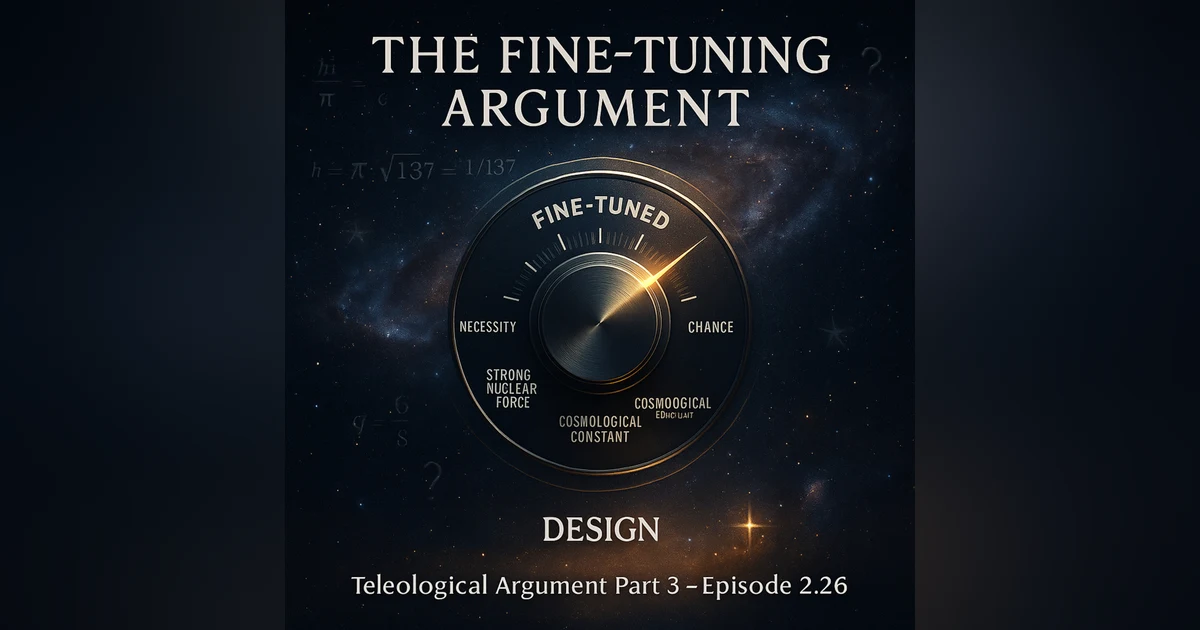
In this final installment of our three-part series, we break down the formal Fine-Tuning Argument as presented by William Lane Craig and others. We walk through the logic: the constants of physics must be the result of necessity, chance, or design—and only one of those explanations holds up.
We explore:
-Why physical necessity doesn’t explain arbitrary constants
-Why chance collapses under astronomical improbabilities
-Why design remains the most rational explanation for the universe’s precision
-We also respond to the biggest counterclaims:
--🧬 Evolution? Irrelevant at the cosmological level.
--🌌 Multiverse? Metaphysics, not science.
--🔮 Quantum randomness? Noise, not order.
This isn’t a “God of the gaps” argument. It’s a God of the data argument. If you're looking for a clear, philosophical, and evidence-based defense of intelligent design, this episode delivers.
Find our videocast here: https://youtu.be/Pxv-EczZ8vc
Merch here: https://take-2-podcast.printify.me/
Find more Take 2 Theology content at http://www.take2theology.com
Music from #Uppbeat (free for Creators!):
https://uppbeat.io/t/reakt-music/deep-stone
License code: 2QZOZ2YHZ5UTE7C8
0:00 School, man, they are just they're they're I I am a big advocate of school. I like school. If I could just be in school the rest of my life, it's way better than working A. Job you got to got to earn money. But you got to earn money. I thought about going back and getting my doctorate but I don't know. Dudes, hey, you know, it's not for everyone, Michael. It's not. It's not what it's cracked up to. Do should we start calling you doctor? Hale, that's what I want to get to. I need some more respect here. Everyone just called me Zach or heaven forbid, Mr. Mr. Hale or something like no. Unbelievable. Should I is there there should be a title that goes along with having a master's degree? There should be. Yeah, there should be. I'm trying to. Master probably has fallen out of favor. Not, not a good look right now.
0:46 Yeah. You know, I'm, I'm trying to, I, I just, you know, the way a lot of doctors shut their clinical doctorates. So it's just you get a lot of hours and you get it. But I, you know, I never did the masters. So I'm, I'm going back to get the masters. I went out. Of order, I have a bachelor's and a doctorate, correct, but not a but that's but yeah. That's how it works, Clint. That's how it works for. Yeah, yeah. But I mean, you put in, you probably put in the time of like someone who got a like a master's in mathematics and then a doctorate in mathematics. Yep. Basically what they found out was like physical therapy used to be a master's, and they were like, if you just add like 16 credits, it goes to it. It was like kind of close. And they thought that maybe, you know, we could get more autonomy. Yeah, turns out the AMA American Medical Association has a lot more lobbying power than the American Physical Therapy Association.
1:36 So we're not in any. We're not gonna touch what they got. But all that to say, school is like, honestly, school is crazy. Between the difference in schools, the difference in professors, what different schools wants arbitrary rules. I don't know if this is like a school thing or just where I went to undergrad but I got penalized for when when I I I have a hard time. I don't understand the SAT 'cause I only took the ACT but based on testing scores I was not allowed to take like some basic math or basic English but I did not. It's not like I clept or got credit for it, but I just got placed where like all my friends were in English 101.
2:21 I started in English. Like to a higher standard? Yeah, without the benefit of. Getting the credit and like the easy stuff. And I don't know if that's like just where I went to school rule or they place you in these higher things, but I think that's weird. Yeah, that is weird. I, I, I, I haven't encountered that cause most, most colleges will let you take the lower. Now what? I had something kind of the opposite spectrum because I had a bachelors of science and mathematics and we used to make fun of the Bachelors of education, Bachelors of Arts, Mathematics, 'cause that's what 'cause that was we're Bachelors of science, your bachelors of arts. We had to take, you know, some higher level math. They didn't have to take a few more math credits and of course, they had to go take their teacher, you know, their teaching, you know the methods.
3:07 There's a word pedagogical courses, but I took a advanced mathematics, OK, yeah, one and two and I took differential equations one or two. Sounds terrible. And differential equation comes after calculus. So basically you're looking at equations that are the equations of slopes and you're figuring out. So all that to say, when I that's the background, just so you understand a lot of math, a lot of in depth math when I was in the Navy, well, I'll say this, when I was doing my bachelor's, I started taking computer science classes because they're a part of our requirements, because computer science and math is really closely related.
3:56 And I was like, man, I'd change my major to be a computer science major if I hadn't already changed it twice and is in my like my senior year. So, but I was like, you know, maybe computer sciences where it's at. So I was in the Navy and then my first job out of the Navy, I went back to the College of Charleston because my plan was to just go out. I, I called them, I was like, I'd like to go get a degree in computer science. I'm like, well, you already have a degree in math, why don't you just go get a masters in computer science? I was like, OK. So yeah. So then I was like, well, you need to take these prereqs to do that. And so I ended up not getting my masters. This is a long story for a little payoff, but they made me take discrete mathematics.
4:40 Because you had. Because it was not on my transcript. I'm like, discrete mathematics is a lower level of advanced mathematics, one and two and the differential equation, they're like, you have to have this one to go into the master's program. And so it was a easy A, yeah. Yeah, yeah. But it was like, what are we doing here? I was. Like what are we doing? Like I could, can I test out of this? No, you have to take it. I was like, OK, I'll I'll go take it. If I had been the bachelor's arts, they did take. They did. That's so. Funny how it's different. Where my story goes wrong And it made me, it's so mad 'cause I could have taken this like easy English class and, and, and as you know, I don't love stories. I had to take like this Brit lit class and I'm like, this is like my, like I had to take for my basic English, I'm taking British literature. I'm like, I don't want to do any of this. And then for math.
5:27 Jane Austen. It also, yeah, we did like, yeah, exactly. Terrible stuff. And then for math, it got me to like my freshman year, I took a class, they called it transcendental functions, but it's basically trig. And then so that that was like my basic math, I had to take like 2 maths and I didn't realize this because I, This is why it's a sore spot with me because I was like, oh, all my friends are taking like. College Algebra. Yeah, exactly. And so it's like, oh, but they're taking college algebra and transcendental functions. I was like, oh, I just took transcendental functions. Skipped it. Great. My senior year, like I'm talking to my advisor's like, oh, you need your second math. So I'm taking calc one, which is fine. I took calc in high school, but I haven't done calc in three years and it was miserable. And I was with like a bunch of like freshmen math majors and it was like I was like doing the worst and I'm like a senior. It was like just a bad.
6:13 I hated all of it. You just called me up. I could have I could have helped you through some of those different those. And the worst part of it was like, I kind of remember this, but I don't 'cause it was like from high. And so it's like it was just miserable. And honestly, power rule chain rule. I, I, I tried to block it out of my, out of my, I didn't like go meet with my like, I, I like usually classes were fine And I was like, I'm no, I'm not doing good. So I was always like seeking my professor out in office hours, like really trying to be like, I'm trying here. And it worked out in the long run. But boy, did not like the math side of it. And even I did not, I'll tell you what, I did not like physics. I get why PT takes it. I think it's more important for the concepts more than the actual equations.
6:55 But I did not love physics 2 and all of that kind of stuff. I was like, why? I don't care about waves. I mean it's like it's it's I like the concepts but I don't like working out joules and energy and all. It's like no. But anyway. Kilo calories, calories. It was just but I had a anyway it was fine. I did not learn a lot and I was in a. My two options were I could do calc, base physics or is the other one trig based physics? Yeah, I mean it's just normal algebra based physics. Yeah, yeah. I think that was an algebra based physics. Which is better? For me, yeah, count based physics is where you're actually going to, you know, solve for some, you know, I want to say differential equations, derivatives where, you know, you find the slope because, you know, acceleration is the well, the slope of your position is your speed, the slope of your speed is your acceleration the and the slope of your acceleration is your impulse. And so all those are basically derivatives of each other. And so of calculus based physics you're doing the. Calculus behind that stuff.
8:00 I'll tell you what I me and them buddy idiots in this physics class full of and most of the people in our class were like pre Med, pre physical therapy. It was the kind of all this it was not math majors. It was more of like these pre professional degrees and me and my buddy, dumbest kids in the class aced physics, wanted physics wanted to mainly because our professor was an idiot. And no he wasn't. He's a really nice guy, really smart guy. But he would give us quizzes and his quizzes he used to like answer banks, which was not great. And we figured this out and I just like literally memorized. OK, 1.86 like I've memorized certain things to look out for and on the exam I was like I recognize this, I recognize this, recognize this finished it in like 8 minutes got like a 97.
8:42 It was amazing so. It was a multiple choice, yeah. And you knew that if it had this question in it, but this was the answer because you just studied your question. And there were some things that did not. Do you think you did it? On purpose. I don't know, I was like, that's a really poor way to learn because it's not like I can understand if it's like history class and that's how you learn because it's like memory. But it did not help me understand working out these problems. You know what? I mean I would give when I was teaching trig. I would give as a take home quiz. OK. Yeah, yeah. Basically the test. I would give them the test. But people don't know that. I mean, people don't. I wouldn't say it's a test. I would say, you know, this is a take home, use everything you can, but be sure you know how to do this. And some students would catch on like they're. Like.
9:24 And they didn't. They, one of them said to me at the end of the year, like I realized that your take home quizzes were your test and I didn't want to say anything like I didn't know it, like I didn't realize it and the and like, did you? Why didn't you? And I was like, well, I want you to learn how to do this math. And if you do, to put in the time to figure out how to do it on your own via a take home quiz. And then you can demonstrate it. You know, I know there's going to be some loss and, you know, there's some cramming effect, but yeah, yeah, yeah. Math is pretty cumulative. So it builds on itself. So you can't that can only last for so long. But yeah, yeah. That that was on purpose for me. I was like, great, I don't, I don't care. I want you to learn how to do this math. That's the goal here.
10:05 Dude physics was so miserable for me. I actually really enjoyed the lectures did not enjoy homework or tests and for however it was set up where I went to school it was it was like physics one and two were both 5 credits. So it was like a Monday through Friday 5 lab. Yeah. Isn't that crazy? It's. Normally 4 it's. Normally 4. 3 + a lab and one hour lab. And ours were not set up. I don't know, I guess Bob Jones things however they want to do, they make their own rules. And it was like just miserable because it was like 4 lectures and then a long lab is like all the it's just being shoved down my throat. But you know, it's good. I made it. I made it through. That's sorry, spent a long time on three. Yeah, this is a lot, a lot of higher education grievances.
10:45 Well, hopefully you have some higher education because we're going to be talking. This is our third and final nice, at least for current plan, we could always revisit the topic. That's right, of the teleological argument. Today we're going to be talking about the fine tuning argument. It's a type of argument that William Lane Craig gives, and I think if you've been following us through our other arguments, this will seem a little bit strange how it's structured, but hopefully you're prepared for with the groundwork we've done so far. So with that, let's take it to the next level. From the hearts of the Low Country in South Carolina.
11:26 It's the Take Two podcast where we take theology to the next level. All right, so just to recap what we have covered before we episode one, we really kind of just defined terms introduced you to like some of these key terms like specified complexity or reducible complexity. We talked about the you know, some options to explain away fine tuning or you know, does you know apparent design. We don't want to say design is design, but you know, necessity, chance or design. Talked about thinkers like Paley, Demske, Behe. Behe I like. That name, Behe? Yeah. Michael Behe, Episode 2. We looked at some of how these applied to like our local area, like our Earth, the life here, our, our Galaxy, our solar system, those types of things.
12:15 So now we're gonna talk about the cosmos at large, and we're gonna talk about the fine tuning of the cosmos itself. And this is unfortunately for use. We're gonna talk about some physics. Physics equations. But I I like physics, just, you know, not the, not the actual equations, but like the concepts, the concepts. We're gonna talk about the concepts. So William Lanecraig has made this argument famous. I don't know if if he came up with it or if he just fine-tuned it for his own nice for his own uses, but this is the standard form, the fine. So he just asserts the fine tuning because every scientists worth their salt will acknowledge that the universe is finely tuned for life, for the existence of matter.
13:05 That's a fact. He, he, you don't really even have to defend that. People will say we are in the Goldilocks zone. Like that's not something we just said. Like everyone says that. Yeah, yeah. So he's not going to necessarily argue for the fine tuning, he's just going to assert the fine tuning of the universe is due either to physical necessity, chance, or design. Which we kind of already looked that those are the options, yeah. So that's checks out. That's why I spent time talking about those last two. So hopefully that. Ohh yeah great that and now he's just going to assert it is not due to physical necessity or chance. One option. Yeah, OK. Therefore it is due to design. And so really the the meat of this argument is saying, you know, the premise too is where you have to do most of your defense to say it's not physical necessity. The, you know, all these constants, the initial conditions of the universe could have been different. So it's not physical necessity and it's not chance. Like the chances are wild, like, you know, the dumb and Dumber, you know, what is the chances of a guy like me getting together here?
14:13 One in 10100, More like one in a million. Oh, so you tell me there's a chance. It's much, much worse than that. Yeah. Yeah. Yeah, that's like one thing. If it was like one in 100, not likely, but not those kind of things happen. It's way worse than that. It's way worse than that. All right, so premise one, we've already really covered this. There is fine tuning and do the law of excluded middle. It either has to be necessary or not necessary. If it's not necessary, we can break that into two different components either by chance or not by chance and but not by chance means someone has tinkered with it, someone has designed it, someone has made it be that way. Has there's been agent causation in that? So premise 2, we're going to say it's not physical necessity. And So what we're saying is there's nothing that this is, I think, hard for people to wrap their minds around because they're like, well, the gravitational constant is. This but what?
15:19 We're saying is there could be a universe that could exist or the gravitational constant was a different. It could be like slightly off and we would. We could still survive and we could live. No, no, no, no, no. What we're going to show is that there's nothing that would make that constant have to be that physically, but if it was different, then everything was bad. Things are bad. So if it's just like a tiny bit difference. Tiny bit difference. Either life can't exist or in some cases matter. Doesn't even form. Like you can have all these particles, but they can't really. They can't form any, you know, concrete matter like bonds and like chemical bonds and stuff.
16:00 OK, gotcha. So it is necessary it's. That's why it's what we're saying is in order for there to be a life permitting universe, these have to be finely tuned like they are. But there's nothing that's forcing the gravitational constant to be 6.674 * 10 to the negative. It just. Happens to be that way. Well, I. Know, I know it is that way, and it happens to be precisely what it would have to be for life to be there, but there's nothing metaphysically that's making it there OK. It could have been different. Yeah, yeah, yeah.
16:41 It could have been different. Right, but if it were different then life wouldn't exist. That makes sense. I kind of I am confused because I would I guess we keep. I don't want to, I don't want to bog us down. No, the oysters are probably. On the same question, because I get this, when I taught this, this is where we got kind of bogged down. Yeah, 'cause on the surface I thought you're saying, oh, things don't necessarily have to be this way, but now it seems like they necessarily do have to be this way. But I would. But when we're thinking about our object pick, oh, I think there's a designer though. But those are like mutually exclusive, it seems like. Yeah, So what? What? Physically it could have been different, right what we're saying and but and if it were physically different, then it would no longer be a life permitting. There would be no.
17:26 OK, Yeah. What we're saying so in in this, practically it has to be this, but logically it could have been different is what we're saying. Gotcha. Logically, it's not necessary, right? But practically it is necessary and that's why there's a designer. Yeah. OK. Yeah, yeah, yeah. That makes sense. So there's no like gravity just has to be this logically, but if you want life, it has to. Be this way. So that's what we're saying there. And then the chance is just crazy. So we have some of these. So this applies to constants and initial conditions. So we just took a cross country trip.
18:09 Not really cross country, you know, from Charleston to Bald Knob and back. We had to constantly fill up our tank with gas. OK. Yep. Yeah. 'Cause you burn gas, we convert that usable energy into, you know, energy of motion, energy of heat, energy of sound. And in doing that, we're increasing the entropy, right? We're basically reducing the amount of usable energy that's available. So our universe began with extremely low entropy, IEA lot of usable energy.
18:49 And that is one of the things, one of the initial conditions that is not explained. Like, there's no reason that our we should start out at such a high energy level for The Big Bang. It could have started at a low energy level and immediately gone to 0 Kelvin everywhere and basically be a deadless, lifeless universe for forever, you know? But we started with very high amounts of usable energy. That's one of those initial conditions. Some of the constants that we observed, gravitational constant, we already talked about if there's slight changes in it, there's no star formation or stars wearing out way too fast. Cosmological constant. This basically is how fast controls how fast our universe is expanding.
19:35 And if it were, you know, too big, I don't know which way it goes. So we'll just say if it were, you know, just off, either everything flies apart too fast, galaxies never form, or everything rebounds on itself. And we can't. Yeah, strong nuclear force with it has to be finely tuned within ±5%. Without that there would be no atoms and no fusion. Electromagnetic force has to be finely tuned. Within one and 137 any slight variation we wouldn't have chemistry where we'd have unstable atoms. Proton neutron mass difference is 1.29 mega electron volts. Any change we would have no hydrogen and that would be no stars and therefore no chemistry.
20:20 So these are just a handful there. I think there's like 30 or 40. Of these more of those, yeah. So if. We look at chance, the values are not necessary, they're contingent. So the chance in the physical necessity kind of roll together. But we are talking about the cosmological argument. We talked about the entropy. So Rodger Penrose estimated that our chances of the current of the initial conditions of our universe just happened to be have as much energy as we did. Usable energy is 1 in 10 raised to the 10 raised to the 123.
21:02 Yeah, when you got two of the raisings in there, that's when you know it's, that's when you're doing the big numbers. That is a huge number. So basically you can think of 10 to the 123. Yeah, yeah, yeah, yeah that. Is one with 123 zeros behind it. OK, Whatever number that is, we're raising 10 to that number and that's how many zeros behind it you would have. And it's just, it's just crazy. So more than 123, you know that many numbers. Yeah, that's a lot of a lot of numbers. Cool. We talked about the electromagnetic force versus gravity finely tuned within 10 to the 36th. So if it were different by one in 10 to the 40 no stars form. And so these numbers are just, you know, if I said, hey, Zach, I got a good game for you.
21:55 I'm going to flip a coin and every time it lands on heads I get a dollar. And every. Time it lands on tails, you get a dollar and if it was a fair coin, you'd be like basically, the more we flip it, we're basically going to be even. Maybe I owe you $2, maybe you. But if I flip it like 10 times in a row and it's heads, heads, heads, heads, heads, you'd be like, something's going on here. I think something's fixed, but this would be like, you know, flipping this coin, you know, heads like 4000 times in a row, like something is something's off. Something's off here. This has been fixed. You wouldn't say that it was just. Random chance. Just random chance. Yeah, yeah, yeah, yeah. So Craig Wieland, Craig is quoted to say if the constants were different, we wouldn't be here. That's not an explanation.
22:42 It's just restating the mystery. And so there is a mystery to why we're we're here, and it all points to us having been designed. So the conclusion is there's nothing that physically requires those constants to be. There's nothing that logically requires those constants to be what they are. They could have been different, but if they were different then life wouldn't form. And the, the fine tuning of those is so, you know, they always say on a razor's edge, but you can't really, there's no words to explain mathematically how well, finely tuned they are. Yeah, that's good. It would be like helpful to like just have like a Word document with the .0000 just, you know what I mean? Like that's what I mean.
23:30 Like if you just had like even like pages lined up, it just shows you like how rare it is. Well, there you know there are only 10 to the 80 subatomic particles. In. The in the whole universe, so there you could not. If you lined up every subatomic particle in the universe, you would not have enough zeros to to do this because this is not ten to the 80, it's this is 10 to the 10 to the 123. There's not enough. You could you could string together A1 with one over every single subatomic particle in the universe, and it's and that's.
24:14 It's still not enough. Man, yeah. Yeah, it's mind boggling. That is mind. Boggling, you said something. I was going to say it now. Maybe it maybe it'll come to me. All right. So is this a good argument? I I think it is the form is valid, although it's a different form. The fine tuning is either due to these three things. It's not due to these two things. They're it almost. Seems like silly in a good way. Like I can track with this, you're just like narrowing it down, right? Yeah, it's not God of the Gaps, 'cause we're not, we're not, we're not saying we don't know. We're saying we do know all these things. We kind of talked a little bit last time about some alternate explanations. Some theologians will say you should never argue for God's existence or the existence of fine tuner based on science because it could change because.
25:07 We get new scientific journals. Yeah, yeah, yeah, yeah, yeah. But. These are fairly stable science. These are remarkably stable constants. Entropy force balances. So it's not like we're hinging this on some, you know, new science that could be here today and got them wrong. Obviously there are revolutions in science every now and then. We went from, you know, Aristotelian physics to, oh, who's the the Isaac Newtonian physics to Einsteinian physics. But all of those things, actually, each one of those revolutions taught us how finely tuned everything new. So I think if we have another revolution, it's it's going to be just more of a weave and understand this more. Wow, it's even more finely tuned. Yeah, that's, that's really good. Yeah.
25:56 So what? What are, in light of these staggering statistics, I guess the answer is evolution. Well, evolution. This is a holdover from my notes that probably GPT shouldn't be here. But yeah, so evolution doesn't explain any of our you know, if we're talking about all of what we've talked about, we've we said, you know, evolution can't explain the origin of the DNA, can't explain the information that's present in the code. It can't explain the conditions that are required for life. So you can't just say fine tuning O evolution because you know, it doesn't explain those multiverse is where things are probably going to get pushed in this.
26:37 We've already talked about that. That was the end of the last episode, right? Yep. Yeah, that's right. But the multiverse over explains it over proves the point here, because one, it would have to be finely tuned 2 in order for it to do what we're saying, we would need, you know, every possible permutation of universe to be created. And so then we would say, you know, based on that thought process, everything that could happen, it is going to happen an infinite number of times. So I know what I was going to say a while ago. Oh yeah. Go fuck me.
27:17 You know, have you ever you've watched Priceless, right where they spin that wheel? Yeah. In my mind I think of like this, you know, light years long of all these different wheels with like all these different. They all have to. And then you have to spin all of them and they all line up on, you know, some exact number that hits exactly what you what you want, you know, on all of them. It's like that is just. Crazy. But it would be, it would be like that if you have man, you know, probably, it's probably even under doing the math. Yeah, yeah, yeah. But if you think, you know, you just had these man, billions of those things, you got spin this one, spin this one, spin this one, spin this one. And they all line up to what you needed to be just incalculable quantum mechanics. Some people have said that, you know, the laws of quantum. Neil deGrasse Tyson, you know, and Mark Krauss have said that, well, gravity explains how all this came in because of the laws.
28:16 What? Well, you have to have an explanation of the law like the law does. This doesn't come up by itself, you know, that The Big Bang happened from the laws of gravity and the laws of gravity and the laws of, you know, quantum mechanics and stuff. Explain why things are finely tuned that way. Well, then that what they're really appealing to is physical necessity. It just had to be this way. But we have whole fields of scientists, physicists who look at what universes would look like if things were different. And that's how we have this science. And, you know, it could be different, but it's not, man. It could be different logically. Not physically and.
28:58 Still work. Yeah, I think that's a good distinction. That is good. I love how all of these like none of the physic like there's always like question mark or it's like, you know, relativity, quantum mechanics drink. They're just trying to, you know, can't explain or haven't figured out the everything lining up very perfectly. All right. So hopefully these three, the podcasts have been edifying. There's more out there if this interests you, you know, reasonably reasonable faith some of them out there. I don't know if William Demskey's still going, but he has some books. Michael B, he has some books you could read. Steven Meyer, Guillermo Gonzalez and Jay Richards put together some stuff.
29:44 So there's a, there's a lot of stuff on the, the, the T logical argument, the Jay Richards and Guillermo Gonzalez, they put out some videos. So 1 is about flight. You can find these and you can, they may be probably streamable by now, but I remember watching them on a, a DVD1's about the flight and how crazy that is. 1 is about Caterpillar turning to a butterfly and how, you know, the fact that that's coded for in its DNA and basically goes from one type of Organism to another type of Organism. And like, how could that ever be passed on? How could that ever be selected for? And then I think they have a new one out that I've heard Cocol talking about, but I don't remember what it is right now, but yeah, you.
30:34 Forgot something. I forgot something. People said they're can't. Believe it. Yeah, this is great. Learned a lot. Add it to the apologetic playlist. You know, with all our other ones, it's great. All right. Anything else? That's it man, stack up these arguments, go find someone and just challenge them, see what they got to say. I like it. Yeah. And most of the time, really questions are your way through this, you know, how did you come to that conclusion? Did you really think, does that make sense to you? And then help them see, you know, kind of some of the, the absurdity of what they're believing. Yeah, it's good. I like it. All right, that is our take. Thanks for listening to Take Two. Find us wherever you find podcasts and on YouTube for those who want to watch our video cast.

