The Moral Argument and More: Why God Is the Best Explanation


 RSS Feed
Episode 2.16
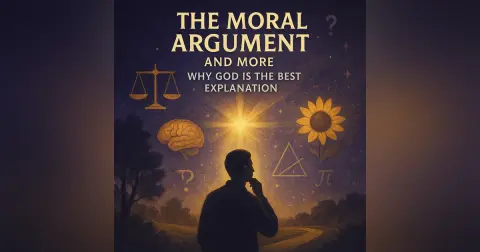
Can we explain morality, reason, consciousness, or beauty without God? In this episode, we walk through the Moral Argument for God's existence and expand into a broader set of transcendental arguments that point to a divine Creator.
We begin by showing that if God does not exist, objective moral values and duties lose their foundation—morality becomes subjective or evolutionary. Yet our shared moral experience strongly supports the idea that real right and wrong exist. We then build on this by exploring other features of human experience—reason, consciousness, beauty, and logic—that are best explained by the existence of a personal, intelligent, and moral God.
From Richard Dawkins' materialism to Plantinga’s Evolutionary Argument Against Naturalism, we weigh modern objections and show why the Christian worldview offers a more coherent and compelling foundation for the way we actually live and think.
Find our videocast here: https://youtu.be/jsaGA9j34cg
Merch here: https://take-2-podcast.printify.me/
Music from #Uppbeat (free for Creators!):
https://uppbeat.io/t/reakt-music/deep-stone
License code: 2QZOZ2YHZ5UTE7C8
Find more Take 2 Theology content at http://www.take2theology.com
0:00 So Zach, we've talked about half baked ideas before and we just, you know, recorded a podcast on the Old Testament sacrificial sacrificial systems and maybe probably not baked at all as this idea of, you know, re enacting, you know, an animal sacrifice, you know, just doesn't hit the sensibilities of where we are today in our modern culture. Yep, that's right. But, you know, have you ever seen, you know, the CPR dummies that you can do do stuff on or like when we went to Anderson, we were looking at the nursing lab and the doctor. Like they have patients there that, you know, you can like, take their blood pressure.
0:41 You can take start an IV and like they have all these vital signs. Yeah. What if we oh man Commission like? Honestly. Cow a fake cow, a fake ram. The Ark Encounters. Just dying for this. I'm being serious. Ken Ham, get on this. You owe us royalties. We set it for. We call dibs. That's a good idea. Yeah. So you have basically a cow that's not really a cow, but you could show like this is what would happen. Like, you know, they're gonna slit the neck and they're gonna let the the neck artery bleed out. You could have the fluid in there and then. This is one of your smartest. This is not happening. This is great. And then you could also in the same thing, it's like you have all the priestly garb and like people like this would be a great experiential thing, like you step into it.
1:25 I want to see the kidneys with the fat on the kidneys. Like what do you do with that? You're going to have to have some dung and you know, all of that could be built in there. And then you put it back in and take it to another church and you show them how to do it, you know? Dad, don't air this. We'll take some seed money. That's a good idea. That's like so that because it's like people do don't have any context and there's got to be a way to do something that's interesting. I I would love that. And if you once you could really build out Ken Hams, the one who could do this, you could really like be like, hey, well, here's the tap. We're going to unpack the whole Tabernacle, whatever. You know, it's like, man, there's something there that that's. A that's. I like that idea. Maybe it's maybe it's 3/4 baked. Fully baked out. Yeah. You know, sometimes I look at Michael and I say, what's he thinking? And other times I say, yeah, that that's a good idea. The other, the other side of it, he walked in and to his horror, he was freaking out about his shirts. So you should get on YouTube and look, it's not blending in with the green screen at all.
2:18 He's got a little blue in there. He's got a very tiny stripe of blue. And he was like, podcast is ruined. I can't, I don't, I can't cast in this. I didn't change. Yeah, normally I tried to wear like a a solid maroon color 'cause it's, you know, red is the opposite. Like you know your color wheel red is the opposite of green. That's. No, your wheel. Yeah. And, and, and so we have had colors similar to this that have had problem bleeding, bleeding in. So I'm hoping that I'm not just a floating head right now. He's taking shots at me. He's like, we got color like this sometimes. Is that, is that where it's? But it's great. He was like, Oh no, I'm wearing a tiny bit of blue. Well, 'cause Gray. I. Gray, Yeah, yeah, Gray color theory Gray is like a little bit of blue, a little bit of green, a little bit of red, and so when you start taking the green out of Gray, it goes away and so.
3:04 Yeah, hey, don't say you didn't learn anything on this podcast. That's great. And if you thought the color wheel was exciting, buckle down for some philosophy. And this is good. Honestly, you listen to the handful of philosophy podcasts that we have on here, you're going to like, you'll be well equipped 'cause I think, I think what we do well, what you do well, I'm kind of along for the ride. You give the basic and then you dive into it a little bit more. So you kind of get best of both words where you can get. And then if you're like, hey, I want to know a little bit more underneath without going like crazy, you know, it's a good, I think it's I think it's really, really. Helpful without going ham. Without helping. That's great. That's great. I love. It Yeah, yeah. So if anyone wants to market this idea just let me know on royalties or something you know.
3:51 Should have it pad patented or something. Yeah, get a patent on that bad boy that that is pretty, pretty amazing. Well, let's talk philosophy, the moral arguments, Yeah, for God's success. So we talked about. Cosmological. Cosmological. We've talked about, we haven't talked about teleological, have we? We skipped over that one, but we talked about cosmological and then we talked about Saint Quinus's essence and existence. OK. Yeah, yeah. Yeah. And then out of those we had a question from a user, not to be confused with Ken Ham, but has a username. What? What is the? Username This is great. I something like Ken Hammy or something like that. Ken Hammy I. Love that he's been listening to our podcast. We appreciate you and others who are faithful listeners. Maybe.
4:33 Maybe he knows Ken Ham, if you know Ken Ham. Potentially. Maybe it is Ken Ham. Maybe. That would be awesome. But, you know, I, I guess in some of what I was talking about in the probably more likely the Kelong cosmological argument was, you know, I am an old Earth creationist. So we had done some stuff on, you know, how could you interpret, Is there a way to faithfully interpret the Bible to be old Earth? And you may or may not agree with that interpretation, but I think it's at least in the ballpark. You know, there's a way to do that faithfully. And so today we're going to talk about the moral argument for God's existence. Yeah, it's. Great. Well, let's go ahead and take it to the next level from the hearts of the low country in South Carolina.
5:27 It's the Take Two podcast where we take theology to the next level. Wow, the moral argument for God's existence. I love we you got we got these handful. You can go different directions for different ways to think about, you know, God and his existence. Where where do we go? Let's talk morality. Yeah, and I think this is one of the strongest arguments, actually. It's hard to say. I think they're all really convincing for me, but I, but I think it's because I'm already, you know, lean that direction. So I, I, I think it's probably natural. I find them convincing. But I've heard a lot from atheists or former atheists who said this was this is really the thing that that got them.
6:13 And sometimes Greg Koko will even introduce this by saying, you know, one of the strongest complaints against God's existence is, is the existence of evil. They're. Leaning into morality, right? Kind of, right? Yeah, well they'll they'll say if evil's in the world then God can't exist. But the the rebuttal is the only way evil can exist. Objective evil is for there to be objective. Good. Yeah, I like that. If you're going to say that, you're kind of conceding that morality is a thing. Because really, to be an atheist, you got to be like, we're Stardust, like nothing really matters on on one hand. You could say on an older creationist, you could say we're still Stardust.
6:54 Too. OK, Yeah, yeah, very true. I mean, Stardust and the fact that that. Yeah, yeah. That whatever happens, we're just chemical. We're just, you know, everything's predetermined. Like you got to really commit or you don't commit. It's hard to be. I think a lot of people think they're halfway atheists. And it's like, wow, your worldview is not computing. Yeah, yeah, yeah, yeah. And so maybe we just start out with the the argument itself and then we'll talk about some of the premises. There are different ways to structure a syllogism and I'm not going to remember these. I should. Maybe I will modus tollens and modus Poland's something like that.
7:35 Maybe, maybe you can look that up. I think it's modus tollens and modus modus. But anyways, while he's doing that, I'll tell you what. This is the one that's less common, but the first one. First premise is if God does not exist, objective moral values and duties do not exist. And it's basically saying that in order for objective moral values and duties to exist, then there must be a God. Second premise of the argument is objective. Moral values and duties do exist, so therefore God must exist. So should you get those two types modus tolins and modus pon? What is the second the it's the ponens. Yeah, so there is modus ponens and modus tolins. You're right.
8:23 Yeah. Yeah, you're good. I nailed them. I nailed them. That's great. So and this is the. One, and those are valid forms of propositional logic, not syllogisms. Unless, unless those are the same things, I don't know, I'm just reading ChatGPT. Yeah, Yeah, that's a syllogism is just a way of structuring. It's a three line propositional logic. Yeah, yeah. OK, we'll take it up with chat 'cause it. Yeah, yeah, let's hear what Chat says. Chat says the whatever I typed in it says these are not part of syllogistic logic, but a deductive inference and propositional logic. Maybe there's like a minute difference between those, maybe there's not, neither here nor there. But anyway, I, I typed in Modis ponens and it was saying P to QQ Anyway, they, they, they're going, you know, yeah, yeah, yeah, yeah, yeah, yeah, yeah, yeah, yeah, yeah.
9:15 So. What we're saying is, yeah. So we'll just say #1 is not P, not Q, OK. OK. And. Then 2 is saying Q yeah. Yeah, exactly. And then? This says therefore P, yeah, yeah, yeah. So that is the modus tollens. So we're saying if God does not exist, that's the not P, then objective moral values and duties do not exist. That's the not Q. And then #2 is saying we're saying Q therefore it has to be P God exist. So you can look that up on, on, yeah. Look it up. Chat will give you a lot of yeah, yeah. So it is it is a sound.
9:59 Well, it it is a formerly sound in its its form. Yes. Yeah, right. And So what that means is if the first if two premises are true, then the conclusion follows through force of logic like you. So if you want to deny the conclusion God exists, you have to invalidate either premise one or premise 2. Film. I love it all right. So that's where the, you know, when you're talking with someone, that's where they're going to go. They're going to say, well, if you want to deny premise one, you're going to have to say that objective moral duties and values can exist outside of there being a God. Or if you're going to deny premise 2, you're going to say there are no objective moral duties.
10:42 Which I think a lot of people today like to say, you know what I mean? Maybe not when push comes to the shove, but it sounds really nice, just like throwing that out there. And that's how they get, they try to get around that syllogism. I mean, whether they're thinking syllogism or not, like, well, God does nothing exist because what's right, what's wrong? That's what you'd say it. Sounds nice until they express outrage over something that someone does. Until. You steal their wallets that. Is wrong. You should not do that. By what standard? Yeah. Love it. I love it. You love the. By what standard? How? By what? Precept 101 that's why I like precept because I'm not I can't keep up with all the classical yeah, it's like the precept. I can keep up with it. Hey, the by by standard, yeah, that's like the same. So this actually does fall into, and we'll talk about this at the end, the transcendental argument form, which is the presuppositional favorite.
11:33 That's the only argument that the that they will use. So support for premise 1, without a transcendent source like God, morals are either have to be subjective or they can be societal constructs so they can be outside the person. But it's like it's like the. Rules of monopoly you. All agree to it, yeah. We just agree to these rules, but there's nothing that really we just. Want to keep society together, whether it's right or wrong, it just helps us function There is no. Right or wrong because. There is no right or wrong. And I think, I think this to me this makes a lot of sense where yeah, if there, if there is no transcendent right or wrong person like, yeah, I kind of, I'm kind of right there with you drive. On the right side of the road, drive on the left side of the road.
12:14 Is there really a a difference? We're just, yeah, yeah, it's just. But by convention, we're all going to drive on the right side of the road, unless you're, you know, in England does this Australia. You lost the rule, lost the war, just changed the road, you know? Come on. Yeah. But yeah, that would be, that would be an example of like we don't think that there is some it's kind of right or wrong. It's just, it's just a societal construct, you know, that we're all agreeing to. Or it could be preference based. Like I just don't think it's right to do fill in the blank. But that's me. I'm talking about my feelings. I'm not talking about something that is outside I, I. Like that a lot when you look at people like Richard Dawkins or Michael Ruse or JL Mackey. I think this is interesting that these atheists, these philosophers, they'll concede that without God, morality is not objective, right?
13:07 Here's one of the famous quote from Richard Dawkins. The universe that we observe has precisely the properties we should expect if if there is at the bottom, no design, no purpose, no evil, no good, nothing but blind, pitiless indifference. So he's basically conceding that, at least on his view, there is no good or evil. Now, in a separate book, he writes this. The God of the Old Testament is arguably the most unpleasant character in all fiction. Jealous and proud about it. Petty, unjust, unforgiving control freak. A vindictive, bloodthirsty ethnic cleanser. A misogynistic, homophobic, racist, infanticidal, genocidal, philicidal, pestilential megalomide.
13:57 Maniacal. Sadomasochistic, capriciously malevolent bully. It's a mouthful there. Say that. 10 times fast. That's like, that's like Doctor Seuss gone rogue. Like something bad? Yeah. So he is going to say without God there's no good or evil but. But. Oh, it looks like this guy is really evil and that you shouldn't do these. Like, why would you have this complaint? Why? Why is genocide bad? Yeah. Yeah, what what if there is no God? It just happens. But to his first quote, it's like to me, these people that are so smart, it's like you, you really do have to just commit 100% and really believe that or you can't. But but yes, the average person on the street, they'll be like, Oh, there's no God.
14:41 Maybe they think that. I think a lot of people would believe in God, whether it's the God of the Bible, but they'll be like, everything's working out for good or something like that. You know what I mean? Like it's like it's not just totally random shit, but I I like how you put those against each other because even even the smartest of humanity can't grapple with this really. Some people like that guy can never remember his name. When I I tried to remember it. He's a physicist, but he'll he'll argue that well, objective. We have objective morals without God because we know what makes human flourishing good or human flourishing take off and and it's just like you wouldn't add sugar to your gas tank because that's.
15:27 Bad because it. Doesn't help your car flourish, right? So we know the things that help humanity flourish, but the question is, why is humanity flourishing a good thing? Why are we not doing things to make, you know, the German cockroach flourish? You know, we gas one of them and we and we get mad when someone else gasses the other one. There's a big difference there. So, you know, the So often times when people try to argue around the moral argument, they smuggle this concept of goodness back in. And it's really, if you're talking with someone, you just got to be like detective, ask some questions and then figure out where they're trying to smuggle morality back in, but you know, not to identify it.
16:08 Cut that. Morality, because a belief in God that gives you that grounding for moral values, what we've been talking about, what is good, what is bad, that that's grounded in this transcendent being, unchanging nature of God. And then on top of that, you got these moral duties. What we're supposed to do, we need to respond in a certain way, grounded in God's commands that just kind of stems and flows from his nature. So in our free flow talk and we kind of talked about some of these objections, but we'll just read them. Objection 1. Morality can be grounded in evolution or societal consensus. Evolution explains behavior. And so if, if morality is grounded in evolution and someone can say I'm a rapist because of my DNA, I'm a murderer because of my DNA, I, you know, whatever because of my DNA, then how, who are we to put them in a prison?
16:55 Like they're just living out what their genes told them to? Yeah. Behaving in the same way as scientists observing animals. And it's like, that's OK. We would say that's not OK for us, right? Yeah. And objective morals are non physical things, so it's hard to understand how that could be encoded in a physical strand of DNA. Yeah, yeah, yeah, that that that's fascinating. Objection 2. Morality can exist without God. Objective values, they just exist. Moral Platonism. And the answer to that, Sorry, I was getting a text abstract moral facts lack casual power.
17:38 Why would be more what would be obligated to something that's like these impersonal principles theism offers a personal law giver behind the laws. Like what would be the point? Yeah, these are just impersonal things. Doesn't matter we. All drive down the highway we see a a speed limit sign. Yeah. That sign itself has No, we don't we're not obligated to the sign. It has no causal power against us. We're we're you can there you there's it's not even possible to disobey a sign right That sign right. It just is standing in place of people who have said, OK, by our authority, we're going to make it this speed limit. So there has to be a law giver in order for that sign to have causal power.
18:24 So the same way like this, these plate Platonic abstract ideals, let's say there's an abstract ideal of goodness or something that would be just like a sign on the highway, though there's. Got to be something about signed. It yet to in order for theirs to actually have a duty to obey it. OK, that's good, 'cause I. Could put AI, could put a sign up. I could do too. Yeah, that's all let's do. And you wouldn't. Have a duty to obey because I don't have the standing in order to. I'm not a law giver. So you need a law giver in order to have that duty. All right, you want to pronounce this name. You would all. Right, so objection 3. Sometimes this name and you may have I I hear people pronounce it different. Euthyphro or Euthyphro heard it.
19:07 Both ways. Yeah, both ways. But. He was this guy in this, I believe it was Socrates in this dialogue by Socrates where he maybe Plato, either Socrates or Plato, but he's this guy who's having this dialogue. Well, let me just clarify. Plato wrote all of them. Socrates didn't write anything. But sometimes we attribute some of it to Socrates. Sometimes we attribute some of it to Plato. But he's this guy. He's and he says, why do the gods command what they do? Do they command it because it's good or is it good because they command it right? What makes it is, you know, which one is it? And you could see on like a Greek mythology where you have these gods who are not good. Oh yeah.
19:54 Yeah, yeah. But. They're commanding things like. What makes that good? They don't even necessarily agree. Is it? Do they command it because it's good? Yeah. Or does it? Or. Is it just arbitrary? And you can see how neither one, neither one of those is settling to us Like we went and wanted to say God the Father, he just, he commands it because it's good. Because then then they'd be like, well, there's something outside of God that makes it good. That doesn't seem right. Or is it just arbitrary? Capricious because he commanded it? It's good. Becomes good. He could have said anything and it would. And it's like it's forcing you to pick and choose between these two alternatives, right? So that's one objection to this idea. And what we do is we split the horns of the dilemma. We say this is a false dilemma.
20:43 There's another option. There's a third option, and the option is that the good is God's own nature. He command. He is the good. He commands according to his nature. He is the ground of good. Good. So there's no external outside of God, and it just kind of flows from him and. It's not capricious either. It's built on his very essence, his being. Yeah, that's great. So that that is premise #1 if God does not exist, objective moral values and duties don't exist. Let's move on to premise #2 objective moral values and duties do exist. Yeah. So what we're saying is we're premise 1 is just giving this relationship like they in order for them to exist, God has to exist.
21:27 Now we're going to actually pause it. And they do exist. And like we said before, anytime, you know, most people agree with this, most people agree that it is objectively wrong to be racist. It is objectively wrong to, you know, carry out genocide. It's objectively wrong to discriminate against people for for no reason, right For you know, And so then you would. OK, so we have objective morals and duties. We have an obligation to love each other, to treat each other well to, you know, not steal from each other, to not harm each other. Those are those are fairly straightforward concepts. Yeah. I. Think that's good? And here you say like, like you just mentioned, cultures recognize things are bad. You look at people like Martin Luther King, Junior Bonhoeffer. People are like, all these people are great because they're standing up for what's right.
22:18 There's all this moral outrage at, at genocide, racism, maybe pushing back against it. What about, hey, I know this tribe and they practice cannibalism. Like, doesn't mean it's, like, foolproof. Yeah. Or you could say, hey, the Holocaust did happen. People thought it was pretty good in the moment, I guess. You know, Yeah. Yeah. So we will talk about some of that, that the the the idea that there might be widespread disagreement disproves object objectivity. So those are all some things that happen. So some people will say, well, actually it's not morality is subjective. It's what we make of it. And sometimes college professors will say, you know, is it wrong to lie? And people go, yo, yeah, it's wrong to lie. Well, then was it wrong to lie about the people that who are hiding Jews from Hitler?
23:08 And and what what happens is this is just like a magic trick because and you just mind trick people into believing something. But the the fact is that is only a problem if. Yeah, if it's. Actually, objectively wrong, right? Yeah. Because you're appealing by appealing to that, Yeah, you're saying, OK, yeah, there is a right or wrong, Yeah. So what happens is sometimes you are putting dilemmas where you have to choose a greater good. What's greater, saving a life or not giving information? Saving lives is clearly greater. Would you? Steal to feed your family? Yeah, yeah. Yeah. So the reason that we feel the impact of those types of dilemmas is because there are objective moral duties and obligations that we're trying to weigh against each other like which one is more and and you always do the greater good in those situations now. That that's good.
24:00 So that that's objection #1 objection #2 well, evolution gives us the these moral instincts. They evolution explains how we come to believe in morality, but not whether those things are true. It's just that's how we got here. Right. Like even if it could do that, like we said before that it can't. But even if it could, it wouldn't explain the fact that they maybe we learn from our genetics. OK, that doesn't make it actually true. So it would only explain how we we come to learn it, but it wouldn't give us justification for its ontology. So that in philosophy we would say that's the difference between knowing and being or epistemology and ontology.
24:40 That, that, that's good because, yeah, I think you're right that people will, or you might hear, hear that that's like, oh, still it's kind of arbitrary. It just, we just evolved this way. Objection #3 Widespread moral disagreement disproves objectivity. Yeah. So lots of people disagree. Disagree on science. Yeah. And that didn't make, you know, there is still an objective truth there. So just because some people might disagree about what's good or bad doesn't mean that there isn't ultimately a good or bad. Just means maybe some things are less easy to know. Yeah. Yeah. And might even, I think we've said this for some of the other ones that might even kind of like prove the point because why is there so much disagreement?
25:22 Like you're trying to tease out some of this like it's such a big deal. If it was truly arbitrary, maybe it wouldn't be such such such a big point. And then and then. But to even cut against that objection even more, when you survey people, there actually is not a widespread disagreement. Yeah, yeah. We're like over minutiae kind of that that's true, yeah. Yeah. So almost all societies prohibit unjustified murder. Almost all societies have some condemnation of stealing and dishonesty. There may be some like, you know, I, you can think of some tribes where you know, it's part of their honor to go and steal something, but that's part of, you know, that that is built into their value system. You, we value courage and bravery and justice, protecting your family, honoring elders.
26:11 Like, so like there's one example. There is this group of people who once their parents started getting older, they would kill them. Oh yeah, yeah, yeah. And they're like, what is? Going on like this is like these people do not, are not immoral people. Well, the thing behind that was that they thought that you entered the afterlife with your. Capabilities. You had now, so before they. Become so before they become. Invalid and stuff. We want to honor you by killing you so you can enjoy the afterlife with all your attributes. So you're not like, you know, Yeah. So you hear something. 'S like wrong, maybe even underneath that most most things yeah, I I think that's good and most people, you know, there are people who are crazy, but most societies recognize the crazies like, oh, this is like other or out there. This is not norm.
27:01 Yep. OK, so that is the moral argument premise one. If God doesn't exist, objective moral values and duties do not exist. But we're gonna say objective moral values and duties do exist. And if those premises are true, which I think they are, then it shows that that God is, that God exists. And I mentioned this earlier, this is a form of a transcendental argument. And basically it's saying there is something that exists that transcends just this natural physical world, and it needs an explanation outside of just these molecules in motion.
27:41 Yeah, I like. That a lot too because I I like this because I think it's simple and like you're saying it kind of resonates on a level where it's not just like thinking about where did the world come from this earth, but it's like that you just experience this everyday you can see things that are right and see things that are wrong or things that rub you the wrong way or things that are beautiful and really good I think most people just feel that or experience that so here's. Some other arguments, so we could do that. We could do the same exact argument and replace moral obligations, more about moral values and obligations. Or sometimes where it is duties, you could replace that with reason and knowledge. Because if we don't, if God doesn't exist, there's no reason that we should trust our cognitive faculties to yield. Yeah, if it's just evolution.
28:33 Or whatever it could be any. We're just trying to survive. Not saying that you're right or wrong. Yeah, exactly. So, Alvin. Plantinga very famous philosopher, if you're in philosophy, especially philosophy and religion, you know who he is actually developed a full orbed. It's in the the the low notes. But we won't, we won't go a full orbed argument against evolution on naturalism 'cause he's saying that there's no way we could know evolution is true, or we should trust that we know evolution is true if naturalism is the case, because evolution does not on on the theory, it does not select for truth knowing truth.
29:17 Yeah, yeah, yeah it. Selects for. Being able to get your genes into the next generation, yeah. And that's. Oh yeah, you're right every time. True. It doesn't matter what true says, right or wrong, we're just going to keep propagating or whatever. So the most that we could. Know is what we believe right now helps serve getting our genes in the next generation. Yeah, there you go. And and it would be. Deterministic, you know, because we wouldn't have we wouldn't have knowledge you just trying to that. That's good. You can also apply this as an argument from consciousness, that consciousness cannot arise from a purely physical process. Our conscious experiences, intentionality and subjective awareness point to a personal immaterial source. And that's God and, you know, materialism. They, they struggle to account for first person. I feel like this whole concept of consciousness is like just a this is, this is like the question people are like grappling with like, oh, what, you know, what is truly conscious?
30:13 What is not? Yeah. And I. You know, I'd go back to Greg Hochul 'cause I listen to him a lot, surprisingly. Go back to him? Yeah, I haven't heard his. Name but. He's talked with people and basically has had questions where someone was like, you know, have you ever come into contact with something non physical? He's like, you do it all the time, all every time you're awake and you're thinking to yourself, you're you are yourself is non physical. And and like, you know, there's there's no law of nature that accounts for me raising my hand or for this mass to be lifted above and suspended above the mass of the earth. What has happened is an agent, me, Michael, has decided I'm going to pick it up and hold it up.
30:58 And there is a non physical self that's deciding to do that, who's interacting with the physical world in a way. Yeah. And this is like. An everyday thing phenomenon, yeah. And no matter what, you're used to it. We. Don't marvel it over. You know, people get all hung up over the resurrection because it breaks the laws of nature. This breaks the laws of nature. This. This should not be here. Yeah, yeah. But it is. Because I'm, you know, obviously there is a biochemical, you know, thing about my muscles tightening and the fibers. And so we can't explain it like this, but why is this cup hovering like this? Why did my hand grab it like this? There's no law of nature that can explain that. Yeah, it's great.
31:39 And if things. Were, you know, purely physical, then you would just expect like like we're talking about kind of before everything's just keep the genes going. Like there's no, we're not like, oh, let's do this or this. It's kind of like, hey, we're just doing the next right thing. All right, not to Daniel Dennett. I think he's passed away, but he was the philosopher that spent his career trying to say that consciousness was an illusion, that it didn't really exist, that we were being fooled. Who's being fooled? If consciousness is an illusion, who is the one who's being fooled into thinking it's an it's really there? It's a good question, all right.
32:20 Argument. From beauty, this one is a little bit more abstract, but if there is such a thing as beauty, objective beauty, if something, if we can go, this thing is beautiful, yeah. It is. Aesthetically pleasing. You ever seen like a crazy sunrise or sunset? We get a lot of good sunsets here in Low Country. Maybe. The Northern Lights. There you go. Yeah, I, I think those are overwhelming. Like when I was reading this, at first I was like, man, like Richard Hartnett pulls out one of these poems. I might be like spine. He'll be like, it's beautiful or, you know, like you see some of those things.
33:00 But I think like things like sunsets are more 100% all in things like the Mona Lisa might be more people are in different. There are taste and some people might find some things more beautiful than others, but it's scientifically proven like you can have people, you know, objectify the human face like this is a beautiful like rate this face on one to 10 on how beautiful handsome you think it is. And guess what? We there are certain G Yeah, yeah, yeah. Of symmetry. And proportion that we find beautiful and that aligns to, you know, mathematical laws that you know you're you're going to find that face more attractive. Yeah, no that.
33:46 That's interesting where there's probably overall norms and then there's just like, if anything else, outliers where I'm sure there's someone who's like, I hate sunsets or something, you know what I mean? Like, I don't know that person, but I'm sure there's someone out there who's like that, you know #4. Argument from logic there's a. Famous. Debate between I think it's Bonson now you're. Talking presuppers language I want to talk more about Bonson. You know the. The thing is presuppers, they use this argument and how they use it. They use it in a classical apologetic way because when they're just talking, they talk about epistemology like, oh, you know that God exists.
34:30 But when they actually, when you look at Bonson's actual debates, he reverts to arguing like a classical apologist man. But yeah. Yeah, yeah, this is great. But there is this. I think his name is Steiner. I should have looked this up. Yeah, yeah, yeah. Is it Steiner? He's debating this guy named Steiner Bonson. And Steiner Zach will Fact Check me while I'm telling the story. But man, I wish we had debates like this, even like between a Calvinist and an Armenian because they would have their normal, what you would expect in a debate. Like I talk a little bit, you talk a little bit. I rebut when you said, you rebut when I said, but then they go into a question answer and you have to answer, ask yes or no questions.
35:12 So you, I would ask you a series of yes or no questions. You would say yes, no, yes, no. And he basically gets Steiner to say, is it Steiner? So there. Is one I'm trying to think what this there is. Well, it might be that Chachi PT is saying there isn't a wide line of debate between Greg Bonson and Rudolf Steiner. But maybe there is a or a Robert Steiner. There is one he had with Gordon Stein. Maybe it's. Gordon Stein, I think that is it now. Gordon Stein what what? What we'll do for sure is I'll find it and I'll put it in the notes of Yeah, it's saying, he argued. That laws of logic, morality and science presuppose, Yes, this. Yeah, yeah, yeah, yeah. That's it.
35:53 And so during this back and forth question, they he it's a beautiful thing where just hate it the timing. Of it, it's like and Stein. Basically he gets them to admit that the laws of logic are outside, you know, they're not physical and and therefore they would presuppose something non physical as their origin. So it's great. This is great thinking. Of man, I want I want I'm gonna listen a little bit more to I'd like to understand Bahnson better because he's like the father of a lot of this, like theonomy, like reconstructionist too, like they all, you know, they're like, you know, it's just there's like these 5 or 6 guys that are side and I just don't when I read to about bonds and I'm like, man, I like a lot of what he's saying.
36:36 But then it's like some of it just doesn't compute or some of the conclude. I'm like, what are we doing here? But he's, he's the guy I need to, I need to, I mean, his son does a lot of he like takes a lot of print. He's like in a in the business world or something. And he, this is totally random, but he does a lot of like Bonson's like pre sub stuff and he tries to apply it kind of like theonomy like to your, I don't know, it's kind of interesting. But anyway, I need to go check out some more, more Bonson and Van Till and that kind of thing, 'cause I just don't get everything. A lot of their stuff sounds good, but I don't get everything. Yeah, and there is. Another debate that you can find between Bonson and Sproul where they're specifically debating and there's not video, but there's audio.
37:16 And the audio is not best, but if you, if you're patient and listen to it, you can hear, you can hear that debate as well. We'll we'll link both of those in there for funsies. All right, so. I think that's a good recap of the moral argument. Moral argument is in the family of transcendental arguments and really anything we named consciousness, we named beauty, The laws of logic reason more obligations. If those things exist, they have to have a grounding for their existence since they are non physical outside of the physical world and and so if you believe those exist, then you have to you've got to pick.
38:01 Your corner and people don't like the corner. People don't want to like face the music of of the atheists, but they don't want to come over to Christian. Sometimes it's like, well, logically you, you can't just stick in the middle. Yeah. There's a book written by man. I can't think of anyone's name tonight, but it's talk about stealing from God and it's this actual idea. Like, you know, these people who want to live in an atheist world but borrow stuff from the deistic. World. That's right. Yeah, Steal it. I love it. Add it to the philosophy collection. We're building a nice little. I like it too. And it's like it's it's robust. It's like not just these arguments. We've also talked about other things in philosophy. Maybe not, I can't remember, but I feel like we've got a good, good thing. So anyway, what?
38:44 What's our next philosophy podcast? You got anything? We should probably go back. And pick up the theological argument. Oh yeah, that's right. Yeah. That's good and. Then, you know, I want to touch on the ontological argument. It's probably the most misunderstood. That's great, but you know, you know, you get a lot of atheists saying like, well, I want a maximally great pizza, therefore, boom, it exists. You know, yeah, that's not how the there's, there's a key feature there that they're missing. Always confuse. Me, yeah, I love it. Existence, fun stuff. Well, thanks for hanging in there. That is our take. Thanks for listening to Take two. Find us wherever you find podcast and on YouTube for those who want to watch our video cast.

