Joshua 2 | The Bookends of Joshua: Four Funerals That Teach Us How to Read the Book



 RSS Feed
Episode 2.73
What if the key to reading the book of Joshua isn’t the battles—but the burials?
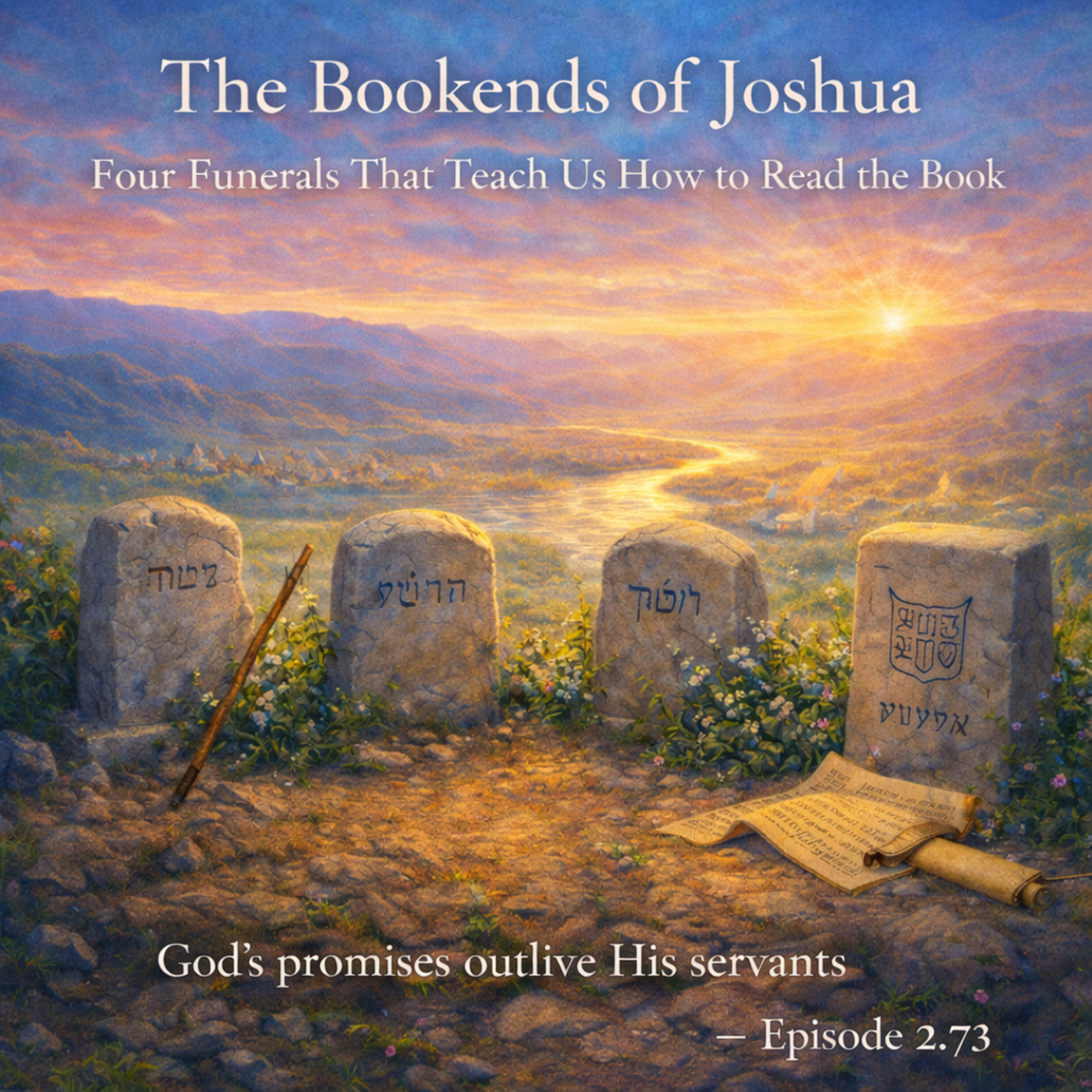
In this episode, Michael and Zach look at Joshua through an unexpected lens: four funerals that frame the book and quietly preach its theology. From the opening words after Moses’ death to the closing scene with Joshua, Joseph, and Eleazar laid to rest, these funerals function as bookends that teach us how to read Joshua rightly.
Rather than a man-centered story of conquest, Joshua presents a God-centered testimony of promise, presence, and perseverance. The land is a gift from Yahweh, courage flows from His nearness, and obedience is rooted in His Word—not personal greatness. Even the final burials are not anticlimactic; they are theological monuments, planted in the promised land as physical proof that God keeps His word.
This episode explores:
-Why Joshua opens and closes with death—and why that matters
-How Joshua is intentionally framed as a “new Moses,” without replacing Yahweh
-What the burial of Joseph’s bones reveals about long-term faith and God’s patience
-Why Israel’s unity is emphasized in moments of leadership transition
-How the book ends with both confidence in God’s faithfulness and longing for final victory
The book of Joshua isn’t just reporting history—it’s preaching through history. And when read this way, the funerals don’t close the story. They point forward, reminding us that God’s promises outlive His servants, and that the final rest is still ahead.
Find our videocast here: https://youtu.be/gGFI_HUs85E
Merch here: https://take-2-podcast.printify.me/
Music from #Uppbeat (free for Creators!):
https://uppbeat.io/t/reakt-music/deep-stone
License code: 2QZOZ2YHZ5UTE7C8
Find more Take 2 Theology content at http://www.take2theology.com
0:00 So Zach, I you may have heard about this epic DND night that. My goodness, what AI? Honestly, even if I was cut out for the DND lifestyle, I don't think I could hang with you guys. I don't think I could do it. I was not, I was like, Oh my goodness, it was a one shot. Which means it's like, you know, our normal thing where I'm DM ING it's several different sessions. Into one like a whole. Well, as I said, what we're doing is several different. It's called a campaign. So it's like you're, you're, you know, it's this epic journey and you're not trying to get it all done in one night. Like how could you? Yeah, how could you?
0:41 But this was trying to sandwich them. All, I mean, right. And it was already, we already did one like 1/3 of it before we left for Christmas. And we're like, we couldn't get done. And so we're like, well, we'll just pick it up and finish up another night. And so we kind of had the mindset of we're just gonna get through this and buckle up, man. But before I left for that, I had exercised that day. I was doing stuff around the house, stuff was going on. I go up to like take my shower. Right before I go I turn the water on and hold my hand out in like 3 minutes and the water is not. Getting cold? Oh man. And. I'm starting to get a little frustrated. I'm like, what is going on? Like what have like, did you know? Yeah, what could possibly be Like normally you get a little bit of temperature raise even if you're down. Yeah.
1:27 And I go down like, what's going on? And Jill's like, well, I just started a load of towels. Like would we put it on hot? She's like, yeah, but I always wash towels on hot. And so, so I just suffer through the cold shower. And it reminded me, literally, it reminded me that I was like trying to get through. So I head off to, 'cause I was, I investigated the, the washer and tried to like change the temp. What we realized was that that washer was just stuck open, draining the hot. Water just. Draining it. And so Jill calls me. She's like, I don't know, did you do something?
2:07 I was like, well, it was just like running, running when I was there. I tried to stop it and I did stop it. So I was like, well, unplug it. The water still kept going. I was like, well, turn those valves off. So Long story short, I got in that night. I got it to spin the towels dry or you know, and then I put those in the dryer. It's like I it was late night. I'll try to just let it rest. Look at it the next day, next day. The now the valves won't open. So we got a it's under extended warranty. That's. Good, good. Call. So you're still hot waterless. Oh, no, no, Oh no. This was the. Past this is the hot water was fine it was just getting drained by the washer going forever. So that's the washer that's that's not working toes washer.
2:50 So it was under extended warranty set it up when Sunday like we the first available appointment is Wednesday. I'm like OK yeah we can probably go that long without washing clothes but then the next available appointment was next Wednesday. Oh. Man. The 14th So I get a confirmation tonight and I happened to just send Adm to Lowe's like it doesn't make sense to me in this area. Why there's no? There'd be that few. Appointments. Yeah, it's weird. And she's like, we're, you know, we're sorry, I'll send this over to the and she's like, but did you get it set up on it? I did get it set up. I just got in there and she's like in your, from what you told me, it's the 7th. And I'm glad she said that number because I hadn't really paid attention 'cause it said Wednesday and it was the 14th is when they and I was like, no, we cannot do that.
3:36 So Lowe's, I'm not happy with you. It's kind of a. And they were like, we're just booked like they don't hire enough people. No, I had to like call in and finally it was a phone tree of phone trees like my third. Call so I. Finally got a person and they reset it up so now it's going to be Thursday with a different repair shop but. And and tying D&D into it. You probably like have a changed clothes three times because it went so long. Yeah, for the audience. What time did you wrap it up? Should we say this out loud? You don't have to be want to. Yeah. Well, we, we had said it at 5:30. It's when we started and we talked. We were, we have a group.
4:17 So we were talking 5:30. We all said the words 530. Sorry about this Jonathan. I made the event while I was in Arkansas, like I made. Central Time. And it captured the fact that I was in central time, so they all saw it at 6:30. So most of us, just like, I didn't even realize it was that there was a discrepancy till we got back here. And someone was like, all right, what time's everyone showing up? You know, 'cause you got to some people show up early to kind of get things set up and. You got to settle in. And John was like, I'm going to be there at 6:00. I was like, why is he going to be there 30 minutes late? And I was like, Oh well, I thought we're going to go at 5:30 and he's and Alex is like 530. And, and so I thought what we said and I went and looked at the and I thought, oh, it says 630. So I went and changed it real quick. But so anyways, so we probably didn't start. Yeah, yeah, yeah.
5:07 Because there's some other confusion till like 636. 40 wrapped up at like 8:00 or 9:00 reasonable time. 8:00 Yeah, yeah, yeah. Well, at 12, we're like we're, we're wrapping up. Yeah, yeah. And so you stopped right then. At 1:00, we're wrapping. Up. Uh oh. I start like and then the brakes when I'm not doing anything, I like start cleaning up, like getting trash, 'cause I like I want us to go out at 2:00, we're finishing up. Still going? Did you finish? We finished it. We did finish it. What time 330I think is when we left it was, it was crazy. I didn't get home till like four and then I and you would think you would just get into your bed and just, you would think immediately fall asleep and it's like you can't.
5:48 I was like, you know, so it was probably I didn't fall asleep till 4:30. What Saturday? I can't remember the last time I stayed up to 330. It's been a minute. New Year's. I stayed up past midnight, but that's to me. I'm, I'm, I'm, I'm a, I'm a early to bed kind of guy at this point in my life. But yeah, you know, D&D people need to know. It's not for the faint of heart. You gotta like, you gotta like, be ready. Yeah, you, you have to physically be kind of there just like you expect your character to be there, you know what I'm saying? It's it's it's you have to have that stamina, that constitution saving role here. You. Go people die in D&D, Characters die. Yeah. And in fact, we ended with the we, we just made-up some characters for this one shot. But my character basically died except for that I remembered in in the the big bad guy that we were fighting. It was close to dying.
6:35 And I was like, I was almost like, yeah, I'm dead. I can't really contribute more. But then I remembered that we didn't calculate one thing that my character would do to the big bad guy. And that was enough that the DM was like, yeah, that's close enough that that takes him out and we'll call it, we'll call him. Well, I say that because as we try to segue into Joshua, the way I love this book, the way that this guy Dale Route Davis frames Joshua is he wants us to look at the four funerals that Joshua talks about. One in chapter 1, three in chapter. I think 24th, the very end has like these bookends that Joshua that tell us something about how we should read the book. So let's talk funerals, let's talk Joshua. Let's take it to the next level.
7:21 Let's fire up that twanga music. From the hearts of the Low Country in South Carolina. It's the Take Two podcast where we take theology to the next level. Funerals. Yeah, there's a Psalm or Proverb that talks about better to be at a funeral. So I guess so. It's good that we're studying Joshua if it's four funerals. John, John Piper takes this very literally where he's like, yeah, I don't. I guess it's easier if you were pastoring like a large church. Yeah, such as Bethlehem. But he was like, I, I try to make it a practice to attend like one funeral a month, one wedding a month. I don't want to see both sides of the sadness and the happiness and just keep balanced.
8:09 Yeah, I hate funerals. I know I hate them. I know I hate them. This is like, either they're in heaven and there's nothing you can do, or they're in hell and there's nothing and there's nothing you can do. It's like man. Yeah. Well, if you're getting into Joshua, I think where my mind goes initially is be strong and of good courage. This is Joshua one that's like what sticks in my mind. Very important. But we're going to talk a little bit about the four funerals. One of the getting 3 at the end. Do you want to guess who some of these characters are that that die that's mentioned as die? So these are like, not figurative funerals, these are literal. And funerals might be. It's not like there's a service Moses. Moses is a chapter 1, then there's three at the end. Aiken.
8:54 These are these are good guesses, not Aiken. OK, Caleb. Oh, that's a good guess. Not Caleb. It is one. What is the title of the book? Oh, Joshua, Joshua. And then if you think Moses and Aaron, a lot of times it's like Joshua and Eleazar. It's kind of like the right hand kind of kind of man the the priestly arm of everything. And then the other one probably not expected is Joseph. They took his bones and buried them, right. So you have and you got to think like, OK, why is the author like throwing in Joseph here? Why are we starting off with Moses? Good things to think about. Obviously you can think about Moses and. 'Cause they took Jacob's bones immediately up and buried them. That must have. Just they just kept Joseph Bones. Yeah.
9:38 Exactly right. What do you call this things? It's like Austria, Austria. And you know how big these things ought to be, do you know? I don't think they had to be. That big They did not. There was. There's had to be because at least they, I think they shot for like the size of the femur 'cause that's like the longest build. So like if you think about how long a finger, that's like, you know, if you're thinking of 'cause they could fit multiple these in tombs and that's how families could be in tombs or whatever. I think you can correct me if this is wrong, but you would like be buried for a year or something or go back in like they would be a process. Right, right. I think they would, you know, put spices and wrap you and then basically like leave it sealed up for a year. And basically they're allowing all the soft tissue to decay away and then they come in and they collect the bones and put them in the ossuary. And then you might have so in one, you'd have more than one. One thing you know, you should talk about the femur being the longest bone.
10:29 Quick aside, that actually came up in an airplane. Did it ride one time? Because this lady like was leaning back in front of me and it was all those things like she was literally hitting it and I was, and she was like, and I, you know, I'm such a nice person in these situations. But I said something like, Ma'am, your chair is not going to go back any further because I have a 36 inch femur. I don't know. I was just guessing. It's around 3 feet. That's funny. That's probably not 3 feet, but. Yeah, that's something like you think I'm like pants, pants in seam, 36 inches, you know? Yeah, that's your femur. So maybe 18 inch, I don't know, but you know, a big femur was like it's not going back any further. So like. Nothing's going to happen here, that's always. I don't know if you have strong opinions on this cremation buried debate. You know, some people are like, man, I got to be buried no matter what.
11:15 And I was like, well, you know, even, you know, it's like, well, bones or it's things will happen. But going back to chapter 1, Moses passes off the scene. It's talked about, I don't know, maybe maybe turn to Joshua one, maybe you can read some of these as we go. But in a lot of ways, this chapter 1 is really framing Joshua as the new Moses, giving some credence. And Moses was such a great figure in Israel's history. It's like, how could someone even measure up? So I don't know if it's like the first 9 or 10 verses you want to read. I don't know, kind of like. Sure. You want me to just read and you can hold your hand up? Yeah. But yeah, I have my first. Section of people, Yeah, yeah. Is through 9. Let's do that, says now.
11:55 It came about after the death of Moses the servant of the Lord, that the Lord spoke to Joshua the son of Nun, Moses's servant, saying, Moses, my servant is dead. Now therefore arise cross this Jordan, you and all this people, to the land which I am giving to them, the sons of Israel. Every place on which the sole of your foot treads, I have given it to you, just as I spoke to Moses from the wilderness. And this Lebanon, even as far as the great river, the river Euphrates, all the land of the Hittites, and as far as the great sea toward the setting of the sun, will be your territory. No man will be able to stand before you all the days of your life, Just as I have been with Moses, I will be with you.
12:42 I will not fail you or forsake you. Be strong and courageous, for you shall give this people possession of the land which I swore to their fathers to give them. Only be strong and very courageous. Be careful to do according to all the law which my which Moses my servant commanded you. Do not turn from it to the right or to the left, so that you may have success wherever you go. This book of the Law shall not depart from your mouth, but you shall meditate on it day and night, so that you may be careful to do according to all that is written in it. For then you will make your way prosperous, and then you will have success. Have I not commanded you? Be strong and courageous.
13:26 Do not tremble or be dismayed, for the Lord your God is with you wherever you go. Nice. Probably a lot of familiar verses in there. A lot of repetition on like be strong and courageous, a lot of repetition. I don't know if you and there'll be more of this as the chapter progresses, but in chapter 1, Moses mentioned like 11 times, like there's a lot of talk of Moses, right? And so there's like this intentional passing of the guard, you know, a lot building up Joshua that, you know, when you say something just like Moses said it, there's, there's a lot of, a lot of that. And when you look in chapter 1, there's really it, it's interesting. There's not a lot of narrative. There's speeches are coming towards. So that was like speech #1 and then there's speech #2 speech #1 you know, is really God talking and speech #2 Joshua is kind of relaying some stuff. So you kind of see what's going on. And as you read chapter 1 there, there's really 2 emphases, talks a lot about this land.
14:23 That's a gift. God has given you this land. But then #2 is it's not, it's not, it's not just going to like up here, you got to go and take the land. There's a command, God is doing this, but there's a means you got to do this. And at the center of it, we, we alluded to this last time, man centered versus God centered. We see a lot pointing at God is at the center, Yahweh is at the center. And when you think of, you know, land promise, this is not like the first time anyone's reading about promised land in Scripture. What? There's land that's been promised. Right, this goes back like super far. Genesis 1518, Deuteronomy 17 also echo what you just read this lands pretty best the eastern borders, the Euphrates river.
15:10 Like look that up on a map. If you don't notice that's like it's not what you think of. What do you think of Israel, Right, that's an expanded. Border. Yeah, it's over into Iraq. Yeah, so it's like worth a look, 'cause you're like, that's actually that's a lot. And that's mentioned four or five different times in Scripture. Like that. Specifically, though, Moses was great. It'd be, you know, prior to most people's perspective. No one's going to measure up and fill his shoes. Yahweh's promise really spans much farther than just Moses, like goes back to like that whole time. Yahweh, he's the God of Abraham, Isaac, Jacob, Moses, Joshua. And what's interesting is Joshua, Moses is off the scene. It talks about, you know, Moses has passed.
15:51 There's not a lot of weeping and wailing and wanting. It's more like, go do it. There's action cross the Jordan. It's like just Yahweh promised this, it's gonna happen. It's not like let's cry about it. And what's it? Read verse 5 for us again. Says no man will be able to stand before you all the days of your life. Just as I've been with Moses, I will be with you. I will not fail you or forsake you. Great. If you compare that to Exodus 3, you see, you see maybe some echoes of it and this kind of goes you. Want to read Exodus? Three, yeah, Exodus 3 verse 12, not exact same, but it's kind of this time where Moses is maybe not wanting to speak about everything and God's kind of like, I'll be with you. It's kind of almost of the same verbiage. And he said, certainly I will be with you, and this shall be the sign to you.
16:42 That is I who have sent you. When you have brought the people out of Egypt, you shall worship God at this mountain. Emphasizing I will be with you is kind of the thing. Verse 679, we've got this theme of strong and courageous that we probably memorized as kids. Not because you know, Joshua is great. Joshua is even as good as Moses because Yahweh is with him. One more passage to read. Maybe if you want to flip to Hebrews 13, we'll look at 5:00 and 6:00 and we'll kind of see maybe some of this New Testament connection or application. It says be sure that your character is free from the love of money. Is that right? Yeah. Yeah, this is good. So interesting how this will because he quotes I think Joshua here.
17:22 Being content with what you have. For He himself has said, I will never desert you, nor will I ever forsake you, so that we can confidently say the Lord is my helper. I will not be afraid. What will man do to me? Isn't it so interesting? Some of this quote from Joshua is applied to the love of money. Isn't that like weird? Like it's not what you would expect, but it's how the author of Hebrews takes this phrase like be strong and courageous, God's with you, right? Don't load money like that's pretty crazy. You know what? I. Mean yeah, like. I never thought about that. These material possessions, you don't have to have them. Don't have to have them and and because God's with you. So kind of continuing on this train of thought, Yahweh is with Joshua, but his presence is integrally connected to the Torah, Yahweh's word. Those things are not separates.
18:13 He's with you, but you need to be careful to do all that the Torah, all that you've been instructed, which Moses commanded. It's not like Joshua. We read this like secret feeling. It's like no, no, no, it's none of that. It's like same thing in Psalm one. It's like, OK, there are clear instructions, you do this, good things will happen. And yes, God did talk to Joshua in a special way too, but it's not like he had all this Torah to meditate on day and night. Lack of this study really would result in a lack of obedience. And then what we probably won't read forsake of time is the second part of this chapter. How how many verses are in chapter 1 is like 18 or something maybe? Yeah, 18.
18:53 So half of this chapter is really Joshua's that this building of a Joshua. The second-half of the chapter, what's interesting is a lot of it is given to the unity of Israel. Presumably this would be important. A big leader passes off this scene. We see a lot of unification, especially in light. I think there's reference a little bit to numbers 32 and we all know what number 32 is about. We all know that like on top of it, Cliff notes, it's 'cause this is an illusion back and #32 talks about the 2 or 2 1/2 tribes Gad, Manasseh and Reuben that were like, hey Moses, we don't need to cross with Jordan. Can we take this land? And Moses response was like, you guys are the worst. You just don't want to fight.
19:35 You don't want to drive out these people. You can't do that. They're like, OK, what if we promise we'll go across and fight? We'll leave our families here before we come back and occupy the land. And Moses, like I will hold you to it because if you don't, you know what this looks like to me, He says. This is the same. Oh, I'm trying to think of the phrase he used if I can find it. In. It's he says, yeah, he says this yeah, Brutus simple men. He says this is just like Kadash Barnea Part 2, which is when the spies were like, we can't cross into the Jordan and they had to wonder in the wilderness for years. She's like, we're not doing this again. We're not going to wonder in the wilderness for 40 more years. But you're doing the same exact thing by not wanting to cross. Into the promised land and so this kind of like comes back to the front and Joshua one they kind of like rehash this out like you're going to cross and everyone agrees. It's like this is like it's interesting. Why so much Texas spin on that?
20:27 But it's because this was like hashed out before. It's a new leadership and everyone kind of gets on board these tribes that Yep, we're unified. We'll do this that that's really one of the the themes You look at Joshua and you see this phrase. All of Israel happens multiple times in chapters 3 and 4, seven and eight, Chapter 101623 and 24 where all of Israel together under Joshua's important, you'll get judges. It's really more factions with this person and this part of the it's not, it's not all of Israel together and that's a problem. Judges is a mess. Judges is a mess, to say the least. That's funeral number one. We'll skip to the back of the book, chapter 24 if you want to read verses 29 through 33, and we'll hit just short 4 verses, these final three funerals, so to speak.
21:17 It came about after these things that Joshua the son of Nun, the servant of the Lord, died, being 110 years old, and they buried him in the territory of his inheritance in Timnath Sarah, which is in the Hill Country of Ephraim on the north of Mount Gaash. Israel served the Lord all the days of Joshua and all the days of the elders who survived Joshua and had known all the deeds of the Lord which he had done for Israel. Now they buried the bones of Joseph, which the sons of Israel brought up from Egypt at Shechem, in the at the in the piece of ground where Jacob had bought from the sons of Hamor the father of Shechem, for 100 pieces of money. And they became the inheritance of Joseph's sons. And Eliezar the son of Aaron, died, and they buried him at Gibeah of Phineas his son, which was given him in the Hill Country of Ephraim.
22:18 Then, then it's over. That's Joshua. That's the end of Joshua. I'm not much of an author. If I was, I feel like that's kind of like a dry wet. It's like, you know it just like boom. People died, they got buried. Yeah, book's over. And you're like, that's weird. Most of the time, you know, you read genealogies or these things there. A lot of times there is this theological significance. You have to ask yourself, OK, we started with the death of Moses. We ended with the death of Joshua, Eleazar and Joseph. Is that like random or is there significance behind it? And I think we find several different emphases, like what? What is, what is the author trying to impress on us as we read this book #1 going back to this being God centered, Yahweh's promises are good and true.
23:06 And so that's why we talk about Moses. Great Prophet Joshua's going to be on the same plane as Moses. Joshua dies, Eleazar dies. The bones of Joseph are buried. These are one real physical people and real physical locations that these are like definite places probably trying to drive that home. More importantly, this is the land that was, you know, Joseph was looking forward to. You know, we probably learned all these things like, man, I'm in Egypt. Their gravestones, in a way, testify to Yahweh's faithfulness. And when you go all the way back to Joseph, you're really linking Genesis. When you're talking about Moses, you're linking really all the Pentateuch, Exodus, and onward, the book of Joshua's linking Joshua.
23:48 You're linking 500 to 600 years of Yahweh's faithfulness. People come and go, but this promise is being seen through these generations. Probably a big point we're trying to understand #2 we see the people's response is there. What's verse 31 talks about Israeli response. Oh yeah. And there's maybe a little bit we can read into the text. Here, yes, as Israel served the Lord all the days of Joshua and all the days of the elders who served Joshua and had known all the deeds of the Lord which he had done for Israel. I said this word, I shouldn't have said we should read into the text 'cause you shouldn't read in the text. But when you read that, there is like a positive and a negative kind of aspect subtly.
24:32 The negative it's implied that they served while Joshua and the kind of his close leadership were alive, but when that, you know, group of folks died. Seems past tense. Yeah, it fell off. And so if you're if you're maybe in Israel, maybe the time of the judges, you're reading this, you're saying, OK, Moses and Aaron Penteuch served Yahweh, Eleazar and Joshua linked together served Yahweh. There's like a new generation. How are the people all of how is Israel responding? And you look around and probably like man not responding well, which which leads probably to the third emphasis is that Yahweh's victory, a lot of victory has been accomplished in Joshua by the time we get to the end, but not not complete. Just like in Genesis, Joseph dies, a lot of good things have happened.
25:20 Israel has been like saved all the brothers kind of reunited. The nation doesn't starve from famine, but kind of ends and things aren't totally resolved. Deuteronomy, when Moses dies, you read very similar things like. So this kind of predicts you guys aren't going to do well, like things are going to go bad. I'm calling. This. Yeah, yeah, yeah. Is that Deuteronomy 31 where he's like, kind? Of calm him out and it's like not good. And then Joshua kind of the same thing. Is that a coincidence? It's kind of like these these are repeated. We should take something away from that in the same way we in a similar way to Israel, we look lot's been victorious and accomplished, but they're still like it's still incomplete where there is like, oh man, we we long and look forward to that day.
26:02 And I think the author is probably wrapping all this up in there through those different funerals. No, I, I think that's really good and it's, we talked about there was another book, I don't think it was Joshua, Joshua, but we kind of talked about the, it's just the emphasis of the already, but not yet. Ezra, Nehemiah. Kind of Ezra, Nehemiah. It's like we were like, you think, all right, we finally learned our lesson. Nope. And. It is crazy, all of the stories and they're all like similar, but they're different. It's like, it's like, I think about this a lot. Like I do not like reading fiction books and like an author like will say something and bring it back up at the end. And there's these through lines. I really love seeing that in scripture because I'm like, oh, any author could write it, but it is, it is pretty like masterful in scripture and see how it represents the human condition so well, how it is like totally relatable, but totally miraculous And and just you see these cycles, but they're different, but they're the same.
26:57 It's like pretty amazing. So anyway, good way. I think last episode, really big picture overview kind of narrowing down a little bit chapter 1 and in chapter 24 kind of narrowing that lens a little bit. Next episode would like to look more about preparing to to take though, like maybe a teaser question is like we read through chapter one. It looks like they're about to take the land. Like it's like, hey, get ready, prepare yourselves. It's gonna go. We read in chapter 3, we cross the Jordan chapter 2. It's kind of weird, like you can almost take chapter 2 out and one to three would make sense. Also another like literary thing, like why is that in there?
27:41 That's kind of weird, right? Like, but it's this famous Rahab story that really probably should be few chapters later with Jericho, but it's like not pigeon holed here. It's there on purpose and it happens probably, but it's like it stands out. And I think that's a good when you see something that stands out, you're like, why is it put here? What are we supposed to take away from other than that historical account? So anyway, anything else you want to add about people dying in Joshua? Well, not about people dying in Joshua, but I do wonder, did any other bones other than Joseph's get brought out a land of Goshen? Clearly not everyone's bones and it's just logistically impossible. But. Would anyone that be like, hey, just like Joseph man, don't let me stay here. I don't.
28:24 Know because it's it was it's crazy you read this and like Jacob's like adamant. Do you know these people are like, when I die, I cannot die here, You know, it's like a very big deal. And maybe some of that leans into this play thrower nepheline, like the cosmic geography and stuff too, you know what I mean? So there's a lot of stuff at play. I'm excited as we kind of continue in on this Joshua study. That's what I got. That's our take. Thanks for listening to Take Two. Find us wherever you find podcasts and on YouTube for those who want to watch our video cast.

