We Believe | How Can Jesus Be Fully God and Fully Man?


 RSS Feed
Season 3, Episode 25
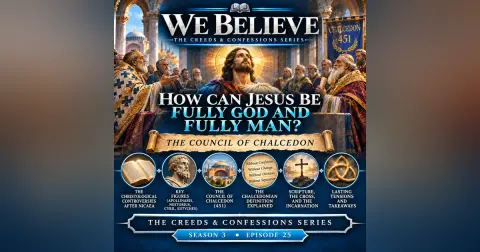
In this episode, Michael and Zach turn to the Council of Chalcedon and one of the hardest questions in Christian theology: how can Jesus Christ be fully God and fully man at the same time? They trace the controversies that followed Nicaea through Apollinaris, Nestorius, Cyril of Alexandria, Eutyches, Ephesus, and finally Chalcedon in 451. From there, they unpack the Chalcedonian Definition and its four famous boundaries: without confusion, without change, without division, and without separation. The discussion then tests those claims against Scripture, including Christ’s divine glory, genuine human limitations, suffering, resurrection, and the difficult question of what Christians mean when they say that God the Son died on the cross. Michael and Zach also examine why Chalcedon did not settle the controversy for everyone, distinguishing Eutychianism from Oriental Orthodox miaphysitism and asking how much disagreement can be terminological rather than theological. The episode closes by affirming Scripture as the final standard for evaluating every council and Christological formula.
Find our videocast here: https://youtu.be/hGM0UwI_vxs
Merch here: https://take-2-podcast.printify.me/
Music from #Uppbeat (free for Creators!):
https://uppbeat.io/t/reakt-music/deep-stone
License code: 2QZOZ2YHZ5UTE7C8
Find more Take 2 Theology content at http://www.take2theology.com
0:00 Comments. Yeah, I love the engagement. Yeah. They're good. I like my favorite comments are the ones, and this is this is being serious are the ones that are clear. I understand what they're saying and they either clearly say something in support or clearly say something that's against. You know where they stand. You know where you're saying and they're and they're making an argument. You know about something Comments that I don't like are ones like and even misspelled it. I this was on a short. It said bro. Let's see. Bro doesn't know liver mush.
0:40 Liver mush. I assume that it meant liver much but maybe it's liver mush bro, don't know. Liver mush MUSH. Yeah, it's liver mush. Oh, wow. Is there traditional Southern pork food product made from pig liver, head parts, cornmeal and spices bound together into a sliceable loaf by North Carolina law and must contain at least 30% pig liver? That sounds terrible. It does sound so maybe, Maybe. Here we go, liver mush. This came on my Google search. Liver mush versus scrapple. It's like. A battle. So this this I. I apologize this guy 'cause this comet makes more sense now than I when I thought it was a typo. While both descend from German settler traditions, Pennsylvania scrapple uses various pork scraps with a less or no required liver, whereas liver mush specifically requires a minimum of 30% pig liver and higher cornmeal proportion. Also, there's a lot of discussion between a liver mush versus liver pudding there.
1:41 There's a lot out there I don't know about and I'm I'm probably the less I know the. Better. It's funny, you know, we've we I don't necessarily love shorts, but they help drive engagement. That's right. So we do them. We use Opus clip, which is that we give, we give them a, we give it a long and it, it does the work. Doesn't do it perfectly, no, but it does makes it easy for us to put shorts out there. And sometimes it catches our banter and makes clips out of that. So we are bantering on food stuff. And so there's like clips of us talking about, you know, shorts anyways, but we had one short and opus clip. Will I'm not on TikTok a lot, but it publishes to YouTube, Facebook, Instagram, LinkedIn X and TikTok. So six different platforms it publishes are shorts to which which is nice.
2:39 So occasionally I'll log into TikTok and see what people are saying and I'll but you know. Do you see a different, do you see like different types of comments or is it like kind of all the same? I'm just like curious if like one platform's. The TikTok comments seem to be, I don't know, a little bit more like it from a younger generation maybe, Yeah. These young kids. Those kids, man. Maybe that's just my, my, my bias going in my, my preconceived notion, but one of the things that Opus clip clipped was me basically giving this definition of cult. It was probably like a fourth time to record it 'cause it was. It came from our Black Hebrew Israelite episode. And I said, I was saying, hey, I know that if you're a regular listener, you're tired of hearing me say this, Zach, you're tired of hearing me saying this. But we're, and I go through how we're using the word cult and we're not trying.
3:38 It's not supposed to be like, you know, dissing people, you know, that type of thing. And it and like saying we're using it in the academic sense. And the guy commented you know bro took 5 minutes to say something and then commit the no good Scotsman fallacy. And I was like, do you even know what the no good? Scotsman fallacy. Is and how is defining a term, how we're going to use it ever? Like you can use the term cult however you want to, but just defining your terms upfront that's how. Does that introduce a fallacy so. Can't please everybody, you know.
4:18 Cannot please everyone. Some people don't like the clothing we wear. There's some comment one time about Oh yeah. Yeah, that was a cheap shirt. It was one of our, yeah, that's right, our podcast shirts that we bought. Go get your merch still out there, still available. Cordell. I haven't forgot. I still have not put those shirts in. There, there comes I. I had an excuse in the summer cause Annie was so busy but that went. Really good. Right from Annie to now teaching, I just got to get back in the. Swing I would have loved to scour. I always feel like Cordell. He's always asking the right questions. He is. Like like I, I mean that also like he's always asking like really good questions. Yeah, he gave me some pushback on the yam Short and I, we went back and forth. People are really, and I'm, I'm just not convinced by this, but people like Cordell are really convinced that and we're saying his name, so we won't say his username right here 'cause so the people can't correlate the his first name in this real name.
5:19 Sorry, we outed you. Sorry. Man. But people are really convinced by this argument from where Moses says in the same way that God created the heavens and the earth in six days and on the 7th day he rested. You're going to keep this out they holy. And I'm like, if yam is already used, you know, in both of those ways, like it's familiar to use it both of those ways. I don't think that would be an issue for them. I just don't see why that would be. No, probably if that's all we had you say, Well, he's probably using the same, but I think there's a lot on the other side. I personally think that not only does Scripture allow it, but it points. To it. Yeah.
6:01 Crazy. Person. Crazy. You're basically that you're you're basically a, you know, open theist evolute. I just, you know, it's like it's great. Just call it all the old earth creationist names. It's fun. Yeah. So, yeah, not to, not to make this the old Earth creationist, but really at the end of the day, the only difference, the only big difference is death before the fall. Because for me, maybe those there's other stripes of old Earth's creationists that might be different. But for me, me and a young and a new Earth believe that there was an act of creation. And then there's a tiny rest between the days, right? There's evening in the morning and the morning was the first day and then there was an act of creation and then a break and then an act of creation and then a break and then an act of create.
6:51 There were six acts of creation and then there was God went in to rest man, I agree with all that. I just think that those the day the breaks in the days were longer and. Not that big of a difference, yeah. I mean theologically, because I, I know some people are like, well, sin brought in all death. And that's not what that Romans passage says. It says sin brought death to all men, because all men. Read the texts, exegete baby. Yeah, it is good. It's like, I feel like so many people have such an abrasion to quote UN quote science. Like this is what all these evolutionists play. So it's one side of it, the other side of it. And I would say I'm a young Earth creationist or a new Earth, whatever, not old Earth.
7:38 But it's like it does seem like all the quote UN quote, like smart theologians are older or the academic. But you know what I'm saying? Like people like the Wayne Grudems and that kind of thing, like the people that are like, oh, they got their degree from Harvard and from Moody. It's like they're like in the they're in both worlds and then and then other people might be like, well, that's why they're biased or whatever. But it seems like, you know, that's like that. That's my drum. Like a lot of people I like that are like very academic minded is where they drift. But you know. What do I know? Not that he's our standard, but Wheeling Craig speaks somewhat derisively of, you know, the Ken Hams and the and the young Earth creations 'cause he would see them as putting a stumbling block in front of people's path to believe 'cause it's like no one in the secular world would ever believe. And I know if you hold that position really tightly, you you say, well.
8:29 At some level. Yeah, God, you know, that is, you know, they, they're rejecting God in his, you know, But yeah, anyways, well. While we're on the topic of getting the Caledonian Creed, let's keep it going, yeah? So today we are talking about the Caledonian Creed in our series on the creeds. We've been all creeds so far, so we got to decide whether we want to hit the confessions later. Even if we did like, not that we have to like do a deep dive on all the confessions, but. Just the London Baptist. Just the London Baptist, which is great. It's the one time plagiarisms encourage because basically plagiarize the Westminster, so it's great. That's good, That's good. All right, well, with that, let's take it to the next level. Let's fire up that twangy music.
9:18 From the hearts of the Low Country in South Carolina. It's the Take Two podcast where we take theology to the next level. We believe how can Jesus be fully God and fully man? The Calcidonian formula. Yeah, so we have the Council of Chalcedon and it talked about the two natures of Christ. So central question, if Christ is fully God, fully man, how can he, how can two complete natures exist in one person? And so I want to ask, did the Council of Chalcedon explain incarnation or establish boundaries? So we want to get down to business with that. So here's the controversy that led to council, Don. We just talked about the Nicean Creed. Now I see it really was focused on one question in particular, and it had to do with whether Jesus had the same nature as the Father or not.
10:24 It's a good question because I feel like this is the one, like in Christology, one-on-one, there's like there'll be a matching section or something and there's like 18 different heresies you can fall into. Do you know what I mean? It's like when there's oh, heresy on this side, heresy on this side, heresy on this side. And it's like you can kind of understand how people would make these heresies. Hopefully you don't double down like once you're like aware of what's going on, but you'll. Be like, well, isn't he with the two wills? But I think I, I think I agree with him. I think he gives good reasons. But yeah. So where does William Lane Craig land? Well. William Lane Craig would call himself a Neo Apollinarian, so he tries to take the Apollinarian view here kind and tweak it so that it doesn't commit the same problem that that Apollinarius did. And then by doing that, he and and this kind of fits with a philosophical thing because if you have one mind, then out of that you have one will right, one set of emotions. You, you know, you have one self-awareness. And so that's where you would think Jesus, he's one person, 2 natures and a nature doesn't bring about a will. It does not.
11:45 They don't go together. Well, that's what that's what William Craig would say now. I know what? So he says Christ had one, one will. One will. And how so when it's like not my will but yours? He's saying God has multiple wills. That's weird to me that God isn't like one one. That God has multiple wills then. Right. Well, I think Jesus in his incarnation would be able to say I don't want to do this. Yeah. But. So it's still according to his human nature, but the will is. It's the one, it's the I think how he would say is it's the one will of the person who has two natures. So just like.
12:31 Just like you have. 2 natures. Not just like I have two natures. Though you do have two natures. But not in the same way. Yeah, but I think it, I actually think this is a good analogy. You are a slave to sin. You are, you know, all the things that Ephesians chapter 2 would say. Yeah, Yeah. And then you're saved. All the things that Romans 7 would say. You have these two wills. You have these two. Well, he says 2. Does he say 2 wills? You have these two. Natures. Battling. I see the law of sin and death. I see the law of the spirit. They're battling. And so you could say, man, I want to go tell off my wife because I'm mad at her, but not my will. Yours.
13:21 God can't do that. God can't say I really want to sin with everything in me, but I'm not going to. He can't sin by definition. Do you think not wanting to go the cross is a sin? No, I think accorded, I don't think that I I think, I think big picture God has one will. And so I think you have to have two wills to have the one will subordinate be subordinate in that way to the divine will. Two wills inside the person of Christ. Correct. So you're saying that the Father, the Son, and the Holy Spirit and their divine nature all have one will, correct. And so for Jesus to say in his prayer in the Garden of Gethsemane, not my will but yours, it has to be a will that arises from His human.
14:12 Nature, correct. Yeah, 'cause I, I think, I think you could say, and I'm not the philosophical expert, but I think some people would be like, each person of the Trinity has their own will, but they're like perfectly harmonized or something. And that would be like, I feel like they have one will. I mean, I don't know, but. I think I would say each person in the Trinity has their will, a center of conscious. Who gets their way when there's a disagreement but there's no? Disagreement the the only way. The only way there's a the only way there's an apparent disagreement is the only way You also see God expressing emotion in time. It's through the incarnation. So there there is this appearance of a disagreement and will, but ultimately Jesus. It's not Jesus's personal will to skip. He's like I, it would be easy for me to skip, but my will is actually your will.
15:09 I know I'm going to the cross. I'm not fighting this. This, that is my will. I think that's what he's saying. Yeah, yeah, I I see there's that that's interesting to me. I'm, I'm curious what, what counsel is it that they agree on the two wills? I, I'm curious, like as we go through this, like where does the councils get weird? And we're like, oh, we're definitely out. Or do you know what I'm saying? Like, you know what I mean? Like I know that's like a little bit farther down. Like are we like cool with that or not? But anyway, sorry to get to you real, but it's a good question because it's like this is like to me counseling definition is very helpful because there's errors all over the place. And the discussion that we're having, you can imagine like even let's say that we ultimately really disagreed.
15:52 Right, right. You could you could imagine people from history in notable positions having a similar collegial conversation and it just snowballing and snowballing until you have to have a council and you decide between Michael's version and Zach's version and you put that into a creed. That's, you know, that's how that stuff came about. But just to review, Nicaea ultimately answered the question that Jesus shared the same exact essence as the Father. And then we had three different theological approaches emerged, tried to help to decide about his humanity. We've already mentioned this name, Apollinarius of Laodicea.
16:36 His version was an incomplete humanity. He taught that the divine logos took the place of a rational human mind in Jesus. Now what William Lane Craig would say with neopollinarianism, he would say that the divine Logos is the human mind in Jesus. It did not replace it. It is the human mind in Jesus. Yeah, OK. Yeah, yeah, yeah. So that's how he's believes he's rescuing it. Yeah, I'm curious what the what's do you know what the response has been to? I mean, people probably always a little bit scared of like something new like that. But I'm curious. People are like, OK, it's good. Or like no, no, no, no, no. I think you find the people who hate everything, William Lane Craig says.
17:21 There's people that love everything William Lane Craig says. And there's people like me in the middle that tries to get the meat and throw out the bones. And of course, I place myself at the centre of excellence. Yeah. Of course we're like. Everyone's nailing the exact right optimum balance. Yeah, it's so. True so. True, more things about Apollinaria is Jesus possessed a human body, but not a complete human psychological nature. So this attempted to preserve Christ's unity with his deity is rejected because Christ must possess a complete human nature in order to be genuinely human. It's hard to say that that formulation would be human, hard to say that he was tempted in always like me and yelled out sin if he didn't have that.
18:07 Nestorius here we have dividing Christ. Nestorius became a Bishop of constant noble in 428 objected to calling Mary. Pronounce this word for me. They. I always say all the things wrong. I know, I know, I. Don't know I've, we've said this before, but it's, you know, the God bearer, the Theoticus, or yeah, I'm probably pronouncing that wrong. Preferring language that more explicitly distinguish Christ's humanity from his deity, His opponents accused him of dividing Christ's nature into two different personal subjects the precise interpretation of a story as his own teaching remains historically debated. So just like anyone from history, you might say, well that didn't really capture what he was saying, distinguished his actual arguments from the heresy later associated with his name.
18:57 And some people made this claim about oh, meant to say his name. And now it slipped my mind. The guy who thought that Jesus was a good example and we were all born perfect but we could fall into sin. Oh, like this is like Armenian Jacobus. What's that? Jacobus. Whatever. Armenian. Oh, no, no. No, the the guy Pelagian. Some would say that the so-called heresy of Pelagianism is not what Plagius actually believed and we defined it differently. I'm like, OK, well I can't really talk about what Pelagius actually believed, but this set of beliefs has this name on it regardless of that's what he believed or not.
19:39 No, yeah, that's exactly, exactly right. And some, I mean, I think if you're like reading the Bible, you could be like, oh, this is like the easy way. You just kind of divide, divide them out 'cause really it where everything landed is also confusing because it's just words. I mean, it's just like you just memorize words. Do you know what I? Mean it does seem that way. And it's good 'cause it keeps you inbound, but it's like 01 person to it's very it's it's like, how do I? Understand this? Yeah, Cyril of Alexandria the unity of Christ and says that Jesus is 1 divine person, the eternal Son who truly became human defended calling Mary Theocatos because the child she bore was God. The Son Incarnate did not mean that Mary originated the divine nature or existed before God.
20:25 So this this term Theocotos was originally wasn't to exalt Mary. It wasn't it. Was to exactly Christ in Mary's belly, but now it was. Actually to preserve the deity of Christ, yes. Yeah. That's such a good point. Like where it was. That's very true. Cyril's emphasis was on Christ's unity, and it would profoundly influence subsequent debates. All right, so we have the Council of Ephesus and 4:31 condemned. Nestorius affirmed the unity of Christ. What we just read above. The Council's proceedings were contentious. Imagine that involving rival Episcopal factions. Cyril and John of Antioch reached a partial reconciliation through the formula of reunion in 431.
21:12 Yet disagreement still remained about how to describe the Incarnate Christ. So here's a question. If Jesus has a complete divine nature and a complete human nature, what makes him one person rather than two persons? It's such a good question because I think if I were like coming up with this, I might go that way. There's 2 natures, 2 persons and one bada Bing bada. Boom. I'm a heretic. What? Yeah. You're yeah, you're condemned, Zach. Got this great idea, yeah. All right, Uticus, the failed Council and Chalcedon. So here we have the opposite danger of losing Christ. Humanity, the.
21:56 The pendulum just swings. Yes, so Uticus, he's again going to say one nature. He is a constant, constant Nopololian. Say that. I can't even say that. Constant Nopolian. There we go Arkhamindra What are what are these who who who would come up with these words who strongly oppose anything resembling the story ISM He's accused of teaching that Christ humanity was absorbed into or fundamentally altered by his deity. The extreme position associated his name effectively compromised in Christ continuing complete humanity. So.
22:42 And you can understand this, if I'm like, I'm a human man and I can run 10 miles an hour, but I'm also divine, I can run 1000 miles an hour. My I'm just going to run 1000 mile. It's like my divinity is going to take over and it's going to over shadow my mere mortal. So you can see where someone would go with that. There's a song that gets this right that this guy should listen to Totally God Totally Man by I think sovereign. Grace. Sovereign Grace. Yeah. Yeah, that's right. But it talks about how he had to learn to write his name, how to type you. I was going to, I was going to tell dude, I don't. Chris Hawk was leading worship like a few weeks ago. Does he, does he know there's like a whole album about the Valley of Vision?
23:25 Like he was like there was a song about, like he was singing. I got a song from, you know, it came from this. I was like, they have a whole album that's all about the valley. Of. Vision, like all their songs. Anyway, Sovereign Grace got a lot of good stuff. Yeah, they do. So basically you can see noble intent. Yeah, trying to figure it out. But doesn't match with scripture cause scripture say he taught, he is tired, he cried, he wept, he was hungry, he had to bathe. You know all the things that we had to do. He had to resist sin. So how can we confirm that if we, you know, it would we would lose his human nature. So we have a second Council of Ephesus 449. The first one it was for 31.
24:12 So we have, what is this, 18 years? Later. So convened under Emperor Theodosius. Theodosius, I think we're mispronounced his name the first time, but this is the second. Presided over in Alexandria. Rehabilitated Uticus. Sorry, it's like my mind is not reading all these words. Like I have so many correct pronunciations in a single night and then it's like you use those up. It's like. You're done. You're done. And dispose of Flavian of Constantinople. All right, so Pope Leo's the first theological letter, commonly known as the Tome of Leo, was not given a hearing. There's accusations of intimidation, procedural misconduct, violence surrounding the procedure. Leo subsequently labeled it the Robber Council. Not a great name, yeah.
25:09 Dun Dun Dun boy and Chalcedon would overturn its principal decisions. All right, so now we have 2. So that was the second Council of Ephesus did did not agree with its outcome. So now we have the Council of Chalcedon 451, now convened under Emperor Marcian with the support of man. All these names Pulcheria Bulgaria sought for resolve the continuing Christological controversies. Consider the teaching of Cyril Leos Tome and the decisions of earlier councils. Posthumously rehabilitated Flavian, who had died after Ephesus 2 and depose Discourius. Man, if there's any historian here, just forgive us for these things.
26:03 Combination involved procedural and disciplinary charge and should not simply be reduced to declaration that he taught Eudaikatism. All right, so let's get to the brass tacks. What did Chalcedon actually teach? It's a lot of history there. We should probably just have a history buff on sometime. Yeah, break it down for us 'cause that's just or just you just. He just sits there for pronunciation. Yeah, it would just point to that person, pronounce this guy's name, tell us a little bit about him. All right. All right, So what did Chalcedon teach here? We're getting a little more comfortable ground, focused on central assertions. There's one and the same Son.
26:45 Jesus Christ is one person, not two persons sharing a body or working in cooperation. The eternal Son of God is the same person who was born, suffered, died, and rose again. The incarnation does not create an additional person. And that and that that is so good. And when you read Scripture, plaintiffs reading it treats Christ as a person. It's not. There's never like, yeah. And so it's like, this is so wise 'cause I think you can like, in your mind, from a pure philosophical standpoint, be like, this makes sense. This makes, this makes sense. And then you compare it to the text. You're like, oh, that some of these don't make sense. And then theologically, what was accomplished on the cross, you're like, oh, these don't make sense. You can kind of like figure you start putting some pieces together.
27:34 But I think that's a good take away. You read about Christ being hungry or performing miracles. It's like, same person. Yeah, yeah. Second main thing, perfect in deity and perfect in humanity. Jesus is completely God. Jesus is completely man, possessing A rational human soul and a human body. He is consubstantial with the Father according to his deity. He is consubstantial with humanity according to his humanity. He is like us in all respects, except He's without sin it. Was so, so good. And it's like, you know, you hear this word like Gnosticism all the time. It's like the good. This is like good. Everything perfect, both sides great. Love it. So we have a what and a who. So there's important instinctions. The what?
28:18 By the nature, Christ is the vine and he is human. But by The Who? The person. Christ is the eternal Son, one person, one who to what's makes sense? Makes sense, I like it. Four essential boundaries. So here are the things that we we kind of alluded to like these are the things doesn't really necessarily tell you how all these work together, but here are the boundaries that you can't go across without confusion. The divine and human natures are not blended together. The incarnation does not create a third nature. So it's not like there's this new. Hybrid alien God name, like a, like a, yeah, a demigod kind of thing.
29:04 And you're like, why is that important? Well, it's not good if he wasn't human and it's not good if he wasn't God. It's like that on both sides. That's right, right? He needs both. Without change. The divine nature does not transform into humanity. The human nature does not become divine by changing its essential properties. The eternal Son assumes humanity without ceasing to be God, without division. Christ has not 2 persons acting in agreement. He's one person. His divine and human realities belong to the same personal subject. This is an aside. So you, we, you might say, you would say the Trinity is 3 persons acting in agreement because they're separate persons versus like Christ because it's one person, only one will is needed and two will. OK, OK.
29:57 I'm just trying to understand OK? Without separation, the two natures are united in one person of Christ. The union is not temporary or merely or cooperative in its relationship, so we call this the hypostatic union. Hypostasis refers here to a concrete personal subsistence of Christ. Christ, divine and human nature subsist in one person. Each nature retains its proper characteristics. The personal unity does not abolish the distinction between the natures. We talked about this before, like we have all those things and you could go, OK, I believe all those things, but it still doesn't make sense.
30:43 And we're going to say, yeah, it's it's Christ is a unique. That's right. There's not another one. Yeah, that's right. That's. Right, So what? Kyle Sedan does not explain. It doesn't explain the metaphysical mechanisms by which the two natures are united. It doesn't explain precisely how Christ, divine and human nature relate. It doesn't explain every question that you can ask concerning the operation of Christ, divine and human wills. That controversy would be addressed more explicitly in Constantinople 3, so this is probably where I would potentially disagree. So we've read through it. This Chalcedon actually explain how the Incarnation works or primarily eliminate explanations that contradict essential teachings. Clearly it's it's a second one.
31:33 So it's not necessarily trying to say what it is, but saying it's not these things. So if you come up with a theory that goes out of these borders, it's it's a bad theory. All right, testing John one, one through 14 very familiar opening passage of John. You can pause this and read it, but we see from there God, you know, He is the Word of God. The Word becomes flesh. Flesh dwelt some, you know, dwells among us as we see all of those things that are true and that makes you know it's right in line with what we would see in the Castilian formula. Colossians 29.
32:16 We see the fullness of DD dwelling bodily in Christ Hebrews one one through 12. We talked about this last episode. The sun possesses the divine glory participates in creation. Yet Hebrews also describes his entry into the human condition talks about how he was a great high priest. He suffered just like us. He resisted sin to the point of shedding blood. So all of those things that would make him human. So is Christ really is Jesus really human while he grew in wisdom. We see that mark that's in Luke 252, Mark 1332. We talked about this last episode. He doesn't know the hour, so.
33:02 Yeah. You ask questions about that, and I ask questions too about when. When Christ performs miracles. Yeah. How does that work? I know it's tricky. Is He just doing it from His divine nature, or is the Father granting those miracles to the human nature somehow? Yeah. Where is that? I don't know where the line happens. I always air. I always like the Calstonian formula because I feel like you can just, even though the Scripture treats Christ as one person, he'll be like, well, this was according to human nature. This was according to by nature. Gives you like not an easy out, but easy explanation. But that is confusing, yeah. Hebrews 214 through 18 and 4:15. Christ truly shares flesh and blood. He experiences suffering and temptation, yet He remains without sin.
33:48 So Jesus is one person. Jesus weeps and then he turns around and he raises Lazarus. Philippians 2, five through 11. He exists in the form of God, takes on the form of servant. First Corinthians 28 the Lord of glory was crucified, and so we see both of those there. So did God die on the cross? Man, the age-old, age-old question. Yeah, and you could probably spend a lot of time, you know, can God definitionally, definitionally die and all these different things, right? Yeah, and this is one of those things that William Lane Craig recently addressed.
34:28 He was like, the Father and the Son were not ontologically separated, but they were relationally separated on the cross and their divine natures. I was like, I don't even think that's true. Yeah, I think in his divine nature, there's absolutely no separation between the father and son. But in the human nature, there was between. Right, Right. Yeah, yeah, yeah, yeah. And that makes more sense. Yeah. All right. Anything else here we have a section that talks about, you know, in in all of these, there's a a statement of what we believe. And that doesn't necessarily immediately settle it. Like there's people who still don't, don't hold on to it. Those people would eventually kind of settle out into other sects and stuff.
35:20 So we're not going to spend, yeah, a bunch of time going through those people who finally disagreed. So final assessment why Calcedon still matters. And I think even today when we have questions, we can look back and go, is that outside of Calcedonian formula? If it is, that should raise some red flags for you if you got some way you thinking about who Christ was. Yeah, I think this is one of those that's like super helpful. Even if you don't understand it perfectly, it does. It does help you think through the theology of like, man, it is so important that Christ was divine and a human. It's like, oh, it all. It all does help you. Yeah. Yeah, yeah. All right. So we see these themes repeated in the Westminster Second London Baptist Confession Chapter 8.2, 8.7. Our standard remains scripture, so we only believe those in light of how they would accurately reflect Christianity. So next time we're looking at the Athanasian Creed. Maybe you can read that between now and they'll. Be our next episode just reading the Creed. We'll just read the Creed and go. Any questions?
36:34 All right, that's our thing. That's so funny. Or anything else on the Caledonian formula? No, I like it. It's good. Yeah. Hope people are reading through these two as we go. Very, very helpful. Very, very foundational, even just thinking through terminology. Good stuff all. Right, that is our take. Thanks for listening to Take Two. Find us wherever you find podcasts and on YouTube for those who want to watch our video cast.

