Cults | Four Christian-Adjacent Movements: Where the Doctrinal Fault Lines Are


Episode 2.90
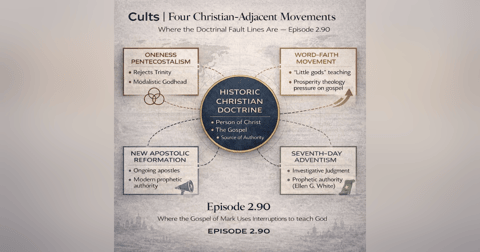
In this episode, Michael and Zach examine several modern Christian-adjacent movements and ask a clarifying question: Where do the real doctrinal fault lines lie? Rather than treating every movement as equally problematic, the discussion evaluates four key theological pressure points that historically define Christianity—the Trinity, the person of Christ, the gospel, and authority and revelation.
Using those categories, the episode surveys four movements often associated with Christianity: Oneness Pentecostalism, Word-Faith teaching, the New Apostolic Reformation, and Seventh-day Adventism. Each movement is examined according to how it relates to the core doctrines that have historically defined the Christian faith.
Oneness Pentecostalism raises fundamental questions about the Trinity by reviving a modalistic understanding of God. Some streams of Word-Faith theology introduce significant pressure on the doctrine of God and the gospel through “little gods” language and prosperity-centered interpretations of faith. The New Apostolic Reformation generally maintains orthodox Trinitarian theology but introduces concerns around ongoing apostolic authority and modern prophetic revelation. Seventh-day Adventism affirms many historic doctrines but raises questions surrounding prophetic authority and the role of the Investigative Judgment in shaping assurance.
Throughout the conversation, the goal is not to dismiss entire communities or question personal sincerity, but to evaluate theology using the same historical standards the church has long applied. By examining where doctrinal shifts occur—whether in the nature of God, the identity of Christ, the structure of the gospel, or the source of authority—listeners gain a framework for understanding why some differences are secondary while others alter the foundation itself.
The episode closes with a reminder: the presence of biblical language does not guarantee biblical theology. The real question is whether the central doctrines of Christianity remain intact.
Find our videocast here: https://youtu.be/oMjPjeiwrxs
Merch here: https://take-2-podcast.printify.me/
Music from #Uppbeat (free for Creators!):
https://uppbeat.io/t/reakt-music/deep-stone
License code: 2QZOZ2YHZ5UTE7C8
Find more Take 2 Theology content at http://www.take2theology.com


