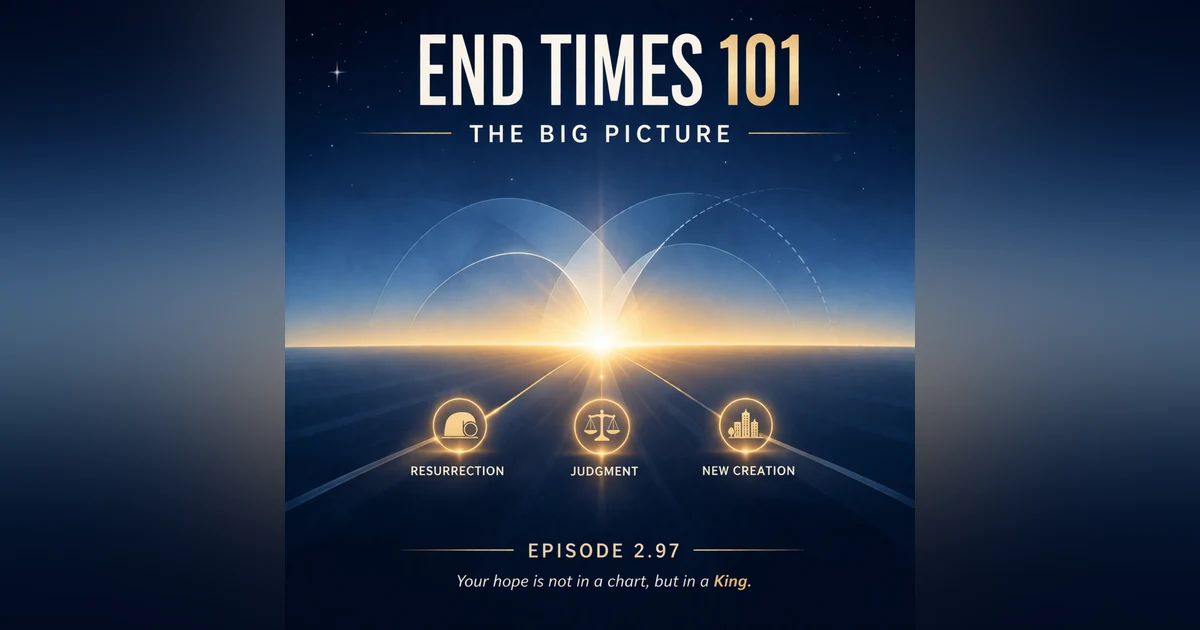
End Times 101: The Big Picture


 RSS Feed
Episode 2.97
In this episode, Michael and Zach kick off a new series on the end times by simplifying a topic that often feels confusing, intimidating, or overly debated. Rather than building complex timelines, they focus on what Scripture clearly teaches, why faithful Christians disagree, and how to approach eschatology without fear.
The conversation begins by grounding listeners in what all Christians affirm: Jesus will return, the dead will be raised, judgment will come, and God will make all things new. From there, the episode explains why differences exist—especially how we interpret symbolic and apocalyptic passages like Revelation, Daniel, and Matthew 24, and how the “already/not yet” tension shapes our understanding.
Finally, the episode offers a clear, simple overview of the three main views—premillennialism, amillennialism, and postmillennialism—along with a pastoral reminder that unity in Christ matters more than agreement on timelines. The takeaway is straightforward: your hope is not in a chart, but in a King who is coming back.
Find our videocast here: https://youtu.be/0C1vVMirdSI
Merch here: https://take-2-podcast.printify.me/
Music from #Uppbeat (free for Creators!):
https://uppbeat.io/t/reakt-music/deep-stone
License code: 2QZOZ2YHZ5UTE7C8
Find more Take 2 Theology content at http://www.take2theology.com
0:00 End Times. End Times. Man, people even either love talking about end times or hate talking about the end. Times. There's a fancy word for the study of end times eschatology, man. You and your big words. There you go. That's what we're looking. At put that in the title or no? Oh. Let's do it. That's great. That's great eschatology. Well, our goal with this series to the best is to make eschatology, make end times simple, as simple as you can. Because to me, there are these two camps. You'll love it. You focus on all these details and it's like hyper, like hyper crazy charts and graphs. And I've been there. And the other side of it is you're just like rolling your eyes. It's like everything, there's always a secret code to everything.
0:46 I don't even care. I'm a, you know, pan millennial. It'll all pan out in the end. And I've been there too. I probably would be more there than hyper focus because it's like you study all this stuff. You can't wrap your mind around everything. And everyone's got like a specific thing like this is China and this is Russian helicopters. And I know the code to all this stuff. And you're like, I don't know, but it is important. It is important it's in scripture. It's in scripture, so we can't, you can't, you don't want to be apathetic towards it, but you don't want to make it more complicated than it is. And I think you want to get, it's good to know a framework and then there are details you want to fill in.
1:28 And so in this series, we want to know what we want to look at what scripture says and also what Scripture doesn't say. Maybe talk about why disagreement exists because there are different views. That's what makes it confusing and different views within the views. Yeah, Yeah, yeah, yeah, yeah, yeah, that is true. Which you would, you would know, know well, when everyone likes to just to levy all of the insults at dispensational dispensationalist, you know, you're like, well, that's not me. Yeah, yeah. Also, a lot of it leads to fear or confusion, intimidating. So let's go ahead. And today we're going to do an overview. Nice. But let's go ahead and take it to the next level. Let's fire up that twangy music. From the hearts of the Low Country in South Carolina. It's the Take Two podcast where we take theology to the next level.
2:23 Michael, I don't know if you've ever read, you probably never have, but can you just imagine? Be empathetic. Tim Hayes Left Behind series. Hey, Tim Hay Yeah, dude, that when did that come out? It started coming out in, I was saying 96. That's a good guess. I bet it did 'cause I was of the age where I was reading like the little kids version that correct came out three or four years afterwards or something. They had like all the smaller books. But yeah. Funny enough, Chloe's name is there, she's one of the main characters. She's Chloe and but I didn't know. I was not familiar with the name Chloe, so mentally I was pronouncing it Cholo the. Whole time cholo, I should start calling Chloe. Cholo So we were talking about the books in News Group one time and I said something about Chalo and they looked at me like, you mean Chloe? And I was like, oh, is that how you pronounce that name? So it's just ironic that today.
3:13 That's that is actually. So I think this is the end of the episode. We're just going to say, read the Left Behind series. That's it. You'll know end times. Why even have this podcast? Some people might say that we today we'll try to give you a good over because I think a lot of people have read the Bible and thought I don't know what's happening here. I'm getting confused in Revelation. I'm confused in the you know, all that discord discourse. On the other hand, some Christians very confident, maybe overly confident, others avoid the topic completely left behind, dude, compelling writing that can give you some that'll keep you up at night. Some anxiety there and others just you just don't hear it at all.
3:55 And I think today a lot of the temptation is you don't take a strong stance. So it's almost like under talked about because it's not the end all be all, but we want to find the balance. The goal of this series is not to make you an expert, but it's to help ground you, honestly make you hopeful, like see the overarching trajectory of scripture to understand what the Bible says about the end time. So we don't want you to be obsessed and we don't want you to be burnt out. We want to we want to get a good scriptural view. So let's talk about what do What do Christians agree on? Or what should we agree on? What are some good things that bind us together?
4:35 I see you flipping running through Isaiah. Oh, yeah, yeah. Well, we were talking about sorry by the time I found this passage, which is probably should know exactly where it is as an elder, but I was like, I know it's somewhere in Isaiah, but I know which chapter. So it's kind of goes along with what you were saying. Obviously not what you just introduced, so I apologize for backtracking this, but even passages like Isaiah 2 where it starts talking about all of these, you know, things that are going to happen, Oh, I flipped too far. That was Ecclesiastes. And I was like, this is not what I was like. This looks a little bit different. But like Isaiah 2, where it says now, it'll come about in the last days. The mountain of the House of the Lord will be established as the chief of mountains and will be raised above the hills and all the nations will stream upon it. And he just goes on to talk about all of these things. And I read this and I go, which time frame is this? Is this purportedly the millennial, millennial reign? Is this like symbolic Speaking of eternity? Is this kind of like when Christ comes back and it's like. An element be.
5:41 Cause whatever I could probably. Make it work, yeah. But then I have to tweak what I understand each one of those things to mean if I put it in a different time frame. I think that tension is exactly the challenge and as we go through these different systems in a spoiler alert, I would classify myself as historic pre mil. A lot of me kind of wants to be aw mil, but some passages particularly in Isaiah and Psalms, in the Psalms. Point. It's like, it makes me feel like, oh, that that's talking about something that I can't ignore. Yeah. And it's hard. Like, where do where do you put this kind of stuff? Well, let's get back to what all Christians. Agree.
6:22 Yeah, what we should all believe on. And so we'll talk about some some texts that you might hear in these discussions if you want to read First Thessalonians 416 and 17 all. Right, I'll just apologize up front. This is from the USB. For the Lord himself will descend from heaven with a cry of command, with the voice of an Archangel and the sound of the trumpet of God, And the dead in Christ will rise first. Then we who are alive, who are left, will be caught up together with them in the clouds to meet the Lord in the air. And so we will always be with the Lord. Oh, good. Talks about a lot of good things. I'm going to read a passage, summarize another one. We'll talk about what these things express. John 528 to 29 says don't marvel at this, for an hour is coming when all who are in tombs will hear his voice and come out. Those who have done good to the resurrection of life, and those who have done evil to the resurrection of judgement. And then Revelation, the book everyone loves to talk about. Towards the end of the book, chapters 21 and 22, they present this final glorious picture of God's redemption. There's judgement, and after that God creates a new heaven and a new earth where he dwells fully with his people in the New Jerusalem.
7:33 There's no more death. There's no mourning, crying, pain. Nothing is broken. Everything is made new and the city shines with God's glory and doesn't even need the sun because his presence is light. Flowing from his throne is the river of the Water of Life with the Tree of Life restoring and healing the nation's, reversing the curse from Eden. The book closes with this call to remain faithful and an invitation for all to come and receive this life freely and promise that Jesus is coming back and it talks about in Revelation coming back soon. So you look at these passages and we know Jesus will return and not just return but physically and personally. Resurrection will happen of the dead, there will be judgment, evil will be defeated. All things will be made new.
8:18 I would say these are non negotiables. When you start departing here, you get into some wacky, wacky things. Yeah, I think those, those, those are good like a locus of what we should be leaving. Obviously I would put something about his return fulfilling the covenants in there, but not employment. Yeah, that's. Right. Yeah, that's great. I love it. So if we have agreement on that, why are there different views? And one, one of this is a one of these reasons is, is a hermeneutical principle is that, you know, we have different type of biblical, different types of biblical literature and understanding the meaning, you read things different ways and that can cause confusion. You look at a passage in Isaiah and people will read that differently because, oh, it's prophecy. Is this poetry?
9:05 Is it not? Is this narrative like that's going to go into the calculus? What? If you were writing a book that was apocalyptic, but there was literally 144,000 of something, and you wanted to communicate to your reader that there were literally 144,000 of something in this genre of apocalyptic, is there a way to do that? Is there a way to do that? I don't know that there's a way to do that. And especially it gets confusing when it's like 12 tribes and like and and 12 apostles and 144 like if you wanted. To literally say 1000 years, yeah. How?
9:48 You how would you say that? So that I think that is a tough like when we start diving into some of those details 'cause it's got to. Mean something, it can't mean nothing at the same time it. Seems weird to me. Sorry to cut you off. It seems weird to me that we would have some people would take a genre to say there's. It seems like it would invalidate the hermeneutic principle if there's no way to literally communicate that. I'm not saying all of those numbers are literal, I'm just saying that if you could, even then we probably have a problem, yeah. No, that that that's a good thing to talk about. And as we get to these systems, you know, I think that's a difference maker between something like a pre millennial system will often appeal to revelation 20 and say we talked about Millennium.
10:34 It's gotta mean something. We talked to a lot of all mill people. They'll be like, OK, we'll talk about Revelation 20, but let's let's that's like 10th or 12th or 15th text down there. We want to start here. And where Primo will be like, well, this has to mean something. You can't throw it away. And so it's like, where do you prioritize these texts? And so you look at apocalyptic is known for being highly symbolic. It's something unfortunately, we're not reading a lot of apocalyptic literature because the the imagery is vivid. It's sometimes strange with these symbols, beast horns, numbers, it's dramatic. There's this cosmic conflict and you know it it for us, it is challenging, but we see this revelation.
11:16 We see some of this in Daniel on Are you going to say something? I was just going. To say, well, 'cause you have Daniel under prophetic visions, but there's overlap in these genres, these end time genres, because some of the things you might say about revelation, you would also say about Daniel because there's there's the 10 headed beast and the the goat. And, and I think that one with the goat and the the bear, the and the leopard, like that's clearly a the Four Nations that are gonna come between Daniel and the time of Christ. So that one's the ones that the easy have already. Happened. Yeah, the. Ones that are easy that to understand are the ones that have already happened. We can look back, but if you could. Look back on it. It would be very challenging. Like even the moment you wouldn't be like, oh, I know that Greece or it's gonna be this law or it's hard. You couldn't know all the details anyway. Yeah.
12:02 And I know that John has told some stuff and then he's like, don't write that down. And I think something that maybe Daniel had something similar. I'd have to go back and double check that. But it seems like there was something that Daniel couldn't understand or he didn't write down or something. No, I, I don't, I don't have it up here, but there is a lot of these visions are explicitly said to be confusing or it's confusing some people and it's like that. That should keep us, keep us humble. And even Matthew 24, a lot of prophecy in there where, you know, it's just hard to make sense of everything, but Jesus is teaching about the future. But even there there's imagery, there's a layered fulfillment like you were mentioning, like is this fulfilled now or later or both? It's hard to understand.
12:44 I I. Think the keyword here is humble, because we read those things that are clear and explicit about the end times. And I think those things we can stand firm on. But the other things I think we got to hold humbly. If you're going to hold anything at all, if you're a pan pan mill, you're not really holding anything. But if you do follow on one of these, sorry about that. If you do follow on one of these belief systems, it should be held. With. A A a measure of humility because we it's it's hard to know exactly. Yeah, it would. Be hard to be like, this is like your specialty because it'd be hard. It'd be hard to like, that's like what you're known for 'cause you would almost feel like you have to have strong convictions, like really strong. So let's walk through just just slowly, some of the symbolic languages problems.
13:32 Revelation 13 talks about a beast with horns. You got to ask yourself, is this a literal beast with horns or a symbolic picture of political power and evil or? I mean there, there's probably some other options there too. It could. Be. A a Comanche helicopter that's. Right, that's right. Or it could be a. Tank, you know, 'cause you know, that's what I grew up with. All that saying, well, you know, John had no words to describe this advanced military equipment, so he puts it in the language of beasts. Where we talked about the 1000 years, is this exactly 1000 calendar years or is it a number that represents completeness or a very long time? You know, you read, if you look at Psalm 5010, you like this passage, you like Psalm 5010.
14:22 And I would ask you, in Psalm 50, is this reference to 1000 literal or is it symbolic? Or you mean it's exactly 1000? It's probably something that you could use for a mathematical equation if you were trying to predict the end times. All right. Psalm 50, 10 it says, is this right? For every beast of the force is mine the cattle on 1000 hills. Yes, we talk. About the cattle on 1000 Hills, is it like oh, it's exactly 1000 hills or is it trying to express something else symbolically, you know, you know, so it's like in Psalms so we always see that, you know, that's poetry different than apocalyptic, but you know what I mean are we talking what or are we not We probably can for sure say it's not like 5 the.
15:04 Passage where it says 1000 years is like a day and a day it's like 1000 years. That's another one where Harold Camping trying to use that to nail down Christ's return because it was all the mathematical equation. Because your answer to something like that might, if someone says definitely exactly 1000, you probably could get an idea of where they stand. Ecetology standpoint, cosmic signs, Matthew 24, the sun darkened, the stars were falling. Are those literal astronomy astronomy events or is that imagery you read some Josephus, It seems like they're saying the sky is falling. It's not literally falling. Or is that a partial fulfillment where this will be, it'll be greater fulfilled and the stars will fall. Or, you know, thinking about these kind of things, Isaiah 13 says, behold, the day of the Lord comes cruel with wrath and fierce anger to make the land a desolation and destroy its sinners from it.
16:02 For the stars of the heavens and their constellations will not give their light. The sun will be dark at its rising. The moon will not shed its light. This is talking about the fall of Babylon, something historically. So it kind of uses that that language too. What's it look like? You know, Anyway, yeah. I I wouldn't want our listener. So I assume that you believe that there was some type of darkening of the sun during Christ's crucifixion. Says that, you know, I think at the six hour the, the, the, the sun darkened or something like that. Yeah. Yeah. We don't know what caused that. Yeah, don't. Know what caused it? That that is, I think that highlights the hermeneutical issue is because sometimes we would look at a passage, I think go, OK, that's a literal astronomical event of something.
16:49 It technically could be. And then like I mentioned Josephus when the temple was destroyed, there are reports of stars falling that and you could imagine in like warfare today with, you know, you could you could imagine stars are falling. Maybe not, but it could you know, it might be really happening. It might be imagery. Yeah, Revelation talks about, I think, the things flying around with the tail that could sting. We have drones these days. Drones. This drone warfare is scary, man. It is crazy. So when you read a passage, you just ask yourself, what kind of literature is this? Does scripture use this elsewhere? Is this meant to be seen as a idea or a picture or measured specifically as a timeline or maybe both? I think the, you know, you look at a system like aw mil or post mil, it's often criticized as just being spiritualized. Like what you're getting at.
17:44 It means nothing. Like it just means like it's very vague versus usually on the pre mil side, there's more literalness and it's like, man, are you over literally having over literal interpretation or are you just giving meaning to something? So that that is the tension because some places you some things you would be like, OK, vine in the branches. We don't mean a literal vine in branch. So it's like, you know, it's a language, it's, you know, right? Yeah, you you should be trying to figure out what the author meant and how the, you know, people he wrote to that were like close to him in his day and age. What they might understand that that's not the end all be all because there are passages in the Old Testament where they understood it one way. And then Christ comes along and he's like, yeah.
18:25 And here's a second meaning. Here's a second layer of this that you're missing. So there it is, a difficult problem when we have prophecy that we're trying to understand all and to go. Back to you emphasize this point of humility, I think it's important to say that a lot of these views all have been endorsed by great faithful Christians. They're not disagreeing because they don't take the Bible seriously. And no one's saying I don't play the Bible. They're disagreeing because they're trying to take different parts of the Bible seriously at the same time. And there is, you know, tension. So if we were to look back at the old, you alluded to this as well, Old Testament expectations versus their fulfillments. Many Old Testament prophecies blend, have this near fulfillment, this far fulfillment. It's like looking at a mountain range. They call it like flattening where you only see like this two-dimensional picture, but you get closer and you're like, oh, that mountain's like 40 miles ahead or whatever it is. And you're like, we're not there yet. There's a.
19:19 Yeah, exactly. And we look at something like Isaiah 9 that is fulfilled in Christ. But there's part of Isaiah and I, we sit, you know, we sing about this or read this, You know, it's like we're not totally having fulfilled all of this yet. Yeah. It wasn't clear that there was going to be this distinct period between what we call the first coming of the Messiah, the second coming of the Messiah, the suffering Messiah versus the ruling Messiah. Like even after his death, resurrection, right at his, his ascent, the apostles, like, all right, restored to the Kingdom now. And they're like, yeah, you don't need to know when the time is for that. Yeah. And so this concept of the already not yet that we've talked about a lot on this podcast is huge for clarity. Crisis come already.
20:02 The Kingdom is already here, but not fully. Consummated Luke 17 highlights this. The Pharisees asked when, when the Kingdom of God, when will the Kingdom of God come and he said the Kingdom of God is not coming in ways that can be observed, nor will they say look here it is or therefore behold, the Kingdom of God is in the midst of you. That's crazy Revelation 11 says then the 7th Angel blew his trumpet and there were loud voices in heaven saying the Kingdom of the world has become the Kingdom of our Lord and of his Christ and he shall reign forever. So there's a future element at the same time. We've developed this in the past, but every end Times view is basically trying to answer how already is the Kingdom and how not yet is it.
20:42 Right. Where does that valley live for future stuff? How close is the stuff that's already here? How far off is the stuff that's that hasn't happened yet and in. One passage we'll talk about a lot, because it is the passage that a lot hinges on is this Revelation 20 passage. Do you just want to read verses one through 6? Because this is like a lot of the battleground is fought over this passage. It says, Then I saw an Angel coming down from heaven, holding in his hand the key to the bottomless pit and a great chain. And he sees the dragon, the ancient serpent, who is the devil and Satan, and bound him for 1000 years, and threw him into the pit, and shut it, and sealed it over him, so that he might not deceive the nation's any longer until the thousand years were ended.
21:30 After that he must be released for a little while. Then I saw Thrones and seated on them, or those to whom the authority to judge was committed. Also, I saw the souls of those who had been beheaded for the testimony, testimony of Jesus and for the Word of God, and those who had not worshipped the beast or its image and had not received its mark on their foreheads or their hands. They came to life and reigned with Christ for 1000 years. The rest of the dead did not come to life until the thousand years were ended. This is the first resurrection. Blessed and holy is the one who shares in the first resurrection over such. The second death has no power, but they will be priest of God and of Christ, and they will reign with him for 1000 years. Thank you.
22:16 Michael only place that explicitly mentions 1000 years and so a lot rides on this. I can compare four or five text, so most disagreements, this is simplifying it, but boil down to a paragraph or two, a handful of verses, you know, where it's like how much weight do you get this? And So what what we want to do with most of the rest of this episode is just give a simple overview of some of the main views that you'll hear about in eschatology. So the first is pre millennialism. You want to give us a word breakdown? This is probably hard for our listeners to grasp pre pre. Before millennial is like a prefix for 1000. So it's where Jesus comes back and establishes a rule on earth.
23:03 Before the millennial reign, before the 1000 years. That's. Great, all these you can. I like their names well enough where you can kind of as long as you know that Christ comes in reference premillennial. That's got a lot of times premillennialists get a hard time for having a negative outlook. Like things are getting worse and worse and worse until Christ comes. That's like typically the the the shtick there where things are getting worse. What gets a little confusing. We'll talk about them later. There's subtypes of premillennial. One version is called dispensational. One side that's called historic. And I don't know if that's like a jab, like people call it that as a jab. Look, wait, what is the historic view or whatever within dispensationalism? There's a bunch of views within historic pre mill. There's disagreement on things, but those are like the two big subcategories.
23:51 The trickiest one probably is awe millennialism, because what what? What's awe typically? Means not, so it's not an atheist is or an atheist would be someone who doesn't believe in God. So it's like cancelling it out. So an amillennialist or an amillennialism is a belief that there is no there is no they get mad at. You when you say there's no, there's no millennial and they're like, no, no, no. They're saying we're in the Millennium now. Christ will return after the Millennium at the judgment. But right now Christ is reigning. Don't you know Michael? Christ is in control. And he's no he. You can just tell the nations are not being deceived right there you.
24:33 Go. That's that's a big part of what you read in Revelation 20. And then the other side of it. And then Amil can kind of go both ways. I think typically a lot do also have a negative outlook like things are getting worse, worse when Christ returns. But there is I I see it in writings that they would people describe themselves as an optimistic mill, which really aligns closer what I've heard that term. Yeah, yeah, yeah. Closer to post millennialism where Christ returns after the millennial reign and really we're gonna usher in the Millennium cause the and that and this is compelling. The gospel spreads globally. The world's being transformed by the gospel.
25:13 Christ returns. So this is the one positive outlook. If I have any, you know, the the few post millennial friends that I have online, it's like when a new version of like Oreos comes out, they'll be like post millennials. Maybe things are getting better. Have you heard of this? Or it's like every time they're like that post mill man, that's it right there. Yeah. So looking at those 3 views, they're all they all agree Christ is coming. Back he. Is going to win. He's going to reign. The question is kind of with the timing and and how he goes about doing it. Oh, that. That's good. And so brief recap, brief recap, pre mill Christ comes back, millennial reign, then judgement all mill we're at we're in millennial reign now and Christ will come back and the judgement post mill gospel victory ushers and a golden age millenniums happening in the, you know, coming up happening then Jesus will come after that. And so I think, you know, easy enough to get a lay of the land here.
26:12 I'd like to it gets very tribal, but yeah, go ahead. Yeah. I just wanted to give one distinguisher because so those are the three big camps. That's right. If you grew up in my culture those probably weren't even set a lot because it was just assumed everyone was pre mill and so the things you were talking about were pre Trib, mid Trib, or post. Trib and. So those are subsets of a pre meal view. That's. Very, very true. And a lot of a lot of times, not always, I think, you know, historic pre meals gonna be post Trib dispensational pre mil will be pre Trib and then mid Trib.
26:55 I don't I don't, I'm not I'm not the expert on which people are mid tribbers or not. I think that's a little lesser, but right. I guess you could put those with other ones, but just I think, yeah, generally just the the pre mil the the because if you're on mil then you have to be Yeah, yeah. Yeah, yeah, yeah, exactly right. Again, want to highlight faithful Christians? Disagree. And it's interesting. I like highlighting different voices who are in different camps that can get tribal. But I think it's good to know like, oh, really great Christians are on one side and the premillennial dispensational realm. John MacArthur's like a heavy hitter. Charles Ryrie, David Jeremiah, everyone knows him. Tim Lahey with the left behind stuff. Greg. Kokul, Greg.
27:36 Kokul, Yeah. Any other dispensational ones you want to shout out, feel free to. You have Schofield, big one, majorly known for like a big one of the first study Bibles. We moved on historical. You said that he's not historical. I have him under historical, but Schofield was dispensational. Darby and Schofield were. I was having the wrong spot, OK. I was like, because I was like, because he wrote that the Schofield Study Bible, that was because that was. Big I even when I grew up, like people talked about the Schofield study Bible, you know, it's like that was a really revolutionary. I think George Eldon Ladd is historical pre mill a guy. I like some of his commentaries. Greg Plomberg, John Piper, Wayne Grudem, Charles Spurgeon are all kind of in that historical pre mill.
28:20 We would also claim Irenaeus, Justin Martyr, Papius Tertilian as historic. That's where it gets the historical framework. So you get to claim all those folks, Yeah. I have not read there there. I read a couple quotes that were interesting that we might share later on the all mill side of things. They would claim people like Augustine, John Calvin, Martin Luther, RC Sprole, even though I've heard him float between a couple different camps. Vodi Baucom. We got if you're into like some of these theology books you have Vos is like known this Dutch theologian, I think Bavink Berkoff, Michael Horton out of Westminster. You know, a lot of, you know, Presbyterians are going to be on this all mill side, really one of the more dominant views coming around the Reformation time, I would say.
29:07 And then post millennial, we got people like Jonathan Edwards. You got a lot of people coming to the new World saw like, oh, we're ushering in the golden age, the gospels going forth. We're not being persecuted. We're building up schools and hospitals and yeah, exactly. So you have like Jonathan Edwards, Charles Hodge, John Owen, BB Warfield, Kenneth Gentry, a modern day. We have Doug Wilson and people like Greg Johnson who would be people on this post mill side of things I did. Add three additional names underneath the dis piece. Yeah, let's. Bring up here we got. Saint Paul, Jesus and Saint John so I I figured if y'all can claim Irenaeus and just you get my that's great. I love it. Like the big pictures. At some point you have to come to terms with you're probably disagreeing with someone who knows the Bible better than you, someone on that list that's not in your camp. You're probably like, man, John MacArthur don't really, he's really the gold standard with expositing scripture. You think of, you know, Jonathan Edward, do you think these people, you're like, man, there's people on RC Sprole. It's like, man, do I really want to go against Vodhi Bakkum and these people.
30:09 So just know that I didn't bring this book, but there I was reading some quotes by Justin Martyr or about Justin Martyr and it was showing disagreement at his time where someone was saying Justin Martyr has these outlandish or fabulous views about this, you know, historic. It was referencing historic pre meal kind of stuff. So there's, you know, disagreement goes back a really long time ago. So they're gonna, you know, these people disagreements. We should be able to, you know, have a little more humility. Well, if. We can't agree. Why does it even? Matter. Yeah. So let's talk about why does this matter Some applications hope no matter your view, Jesus wins. You read Revelation.
30:54 It is a call to perseverance because in the end, Christ conquers and reigns. If you think. Of how Paul ends Romans 8. He's like, all these bad things can happen. It can't separate you from the love of Christ. And like, you read through Revelation and I don't know exactly what's going on, but it seems like there's a lot of bad things, it doesn't seem. Like a walk in the park, right? And so but through that, and we know that ultimately, you know, Jesus loves us and we we have that whatever Revelation 20 and 21 mean, we know that ultimately in the eternity it's going to work out for our good. So it should give us some hope we got. Some hope, and then it should call us to faithfulness.
31:35 Matthew 24 All of that discord says, therefore we want to live as people who are ready says, therefore stay awake. For you don't know on what day your award is coming. But know this, that if the master of the house had known in what part of the night the thief was coming, he would have stayed awake and would not have let his house be broken into. Therefore you also must be ready, for the Son of Man is coming at an hour you don't expect. Second Peter, Peter writes in chapter 3, Since all these things are thus to be dissolved, what sort of people should you you to live lives of holiness and godliness, waiting for and hastening the coming of the day of God, because of which the heavens will be set on fire and dissolved and the heavenly bodies will melt as they burn. The emphasis on staying awake to live with holiness and godliness and and the last thing is, is unity. We shouldn't be totally divided over it. I think it's OK to have some playful banter and I think it's fine to have conviction about what you say. That's good.
32:27 But don't you know like you were saying, live and die by by this different? From our series on the Colts. Yes, yes, that's good. That's good. Different levels, that's right, because. Yeah, we put doctrines on different levels and we're saying, you know, the things that we all agree on Jesus coming back, Jesus being the Son of God, Jesus establishing his rule and reign and and being victorious, whatever that means, whether it's there's some literal physical time that precedes an eternal the eschaton or not. We know that those so those would be we'd put in the Class A totally. But timing, you know what, what we just don't know. So it's not like we're going to we shouldn't be getting all up in arms, you know, over for disagreements on that kind of stuff.
33:12 Well. That's the first episode, hopefully a simple guide to eschatology, simple guide to the end times, giving you at least a lay of the land like who believes what what the overall structure is? And then what are the non negotiables that all these use? There's some disagreement. There's major agreement on these select things. So we'd. Hope that a reader or listener would come away with knowing pre mill, awe mill, post mill and then those non negotiables that we kind of talked about I. Love it, be hopeful, be faithful, live in unity. Final take. Let's go, man. What's what's been going on with you, Michael? Oh. I'm very busy, probably too busy wrapping up the end of the school year. Yeah.
33:54 So once that's done, I can kind of go back to normal stuff. Got DND coming up this Saturday. Yeah, Saturday. Yeah, yeah, yeah. I hope it goes to four in the morning. Hope you guys are like cleaning up before celebrating everyone. Likes to reference that one night, but that was an unusual. That was an exception and I was not DM ING that night. I don't want to throw. Yeah, throw. Them under the bus I don't want. To throw anyone under the bus, yeah. But yeah, that was we were trying to, we were just trying to get through this one, this one supposedly one shot, but man, you're not getting through that and. Making it happen. Speaking of D&D clay throw, I love the love the goatee this guy's growing.
34:36 Oh yeah. Yeah, just letting. It go. I asked Sharon about it. Yeah, yeah. She was. Like, no, she's like, no, no, man, that's good, though. That's good. I think. I think Clay was telling me this. If I'm, you know, lying on your name, let me know. But I think he was saying he's got a now a rhythm, a pattern to his beard growth where it'll be like no shave November. You grow it out to the end of the year, then maybe you shave. There's like different rhythms where he like, trims it up, let's it go so he knows. On Valentine's, I'm shaving it off. That's like, yeah, maybe something like. That yeah, I need to get, we need to get like a guide to create throwers because he's got his like bulking cycle, his cutting, all these got the rhythms to life. You know which we were talking.
35:16 It's very important to be bulking during the holiday season because you don't want to like be cutting during Thanksgiving and Christmas. You're like what? So that's. Good, that is good, he's thinking. It through, yeah. Speaking of D&D, I've only been sharing these regularly with, well, with D&D and my my math class because we're kind of in this weird phase. We're waiting on a test. They kind of have all the stuff, but we kind of went through the unit fast. So I'm like giving them a couple days to kind of absorb. So they've been working through a study guide and I've been helping them. But anyways, I've been, you know, for the four days now, I think I've been producing my own connections puzzles and I've been sharing them with the guys. They didn't like some of them. So what I have done now is, you know, you would think with, you know, I get, I get people like to think I use chat for everything, but I wasn't using chat for this.
36:02 But now I've started, I write them on my own. Yeah. But then I let chat be my editor. Like it's great. Do you think that's probably? The best use of chat, yeah. Yeah. And like and it will push back on some things and like it was pushing back on one. Do you ever play connections? No. You know what connection is and how it works. No, no. No, no, I'm guessing. Yeah, yeah, yeah. Oh, OK. So it's a New York Times game, like, OK, across, you know, but you have 16 different words or phrases, and there are four groups of four connections. So you try to find like, these four things all connect some way. And you like, select them and you hit enter and it'll say, yeah, they connect. And here's the connection Category 4. At a time.
36:43 And if you nail 4, you know you don't have to enter like all four connections. Oh, that's kind of you guess. Your first four and hit enter and there's it goes from yellow, green, blue, purple. So yellow's easiest category typically supposedly down to purple being the toughest category question. Will it tell you if you're one off or you don't know it will? Tell you if you're one off, well that's good, but if you're more than one off, it will just say you're. Wrong. OK Oh, that seems fun. Yeah, I bet you can. And like the trick is like you have some words that like could go either way, like they try to trip not maybe that'll treasure up yet, but you can maybe you read that into it and it's. So weird. I've been producing these for four days and it's like every day there are words that are somewhat related and most of the time it's not even intentional.
37:23 Oh, that's so crazy. So do. People make their own and the New York Times just picks one or they have someone that does it. No, New York. Times says their own and I looked into There's not even a way to submit. Oh, that's a bummer. Yeah. Like, you can submit a crossword puzzle to the New York Times. Yeah, but you can't. There's just a single editor for connections, from what I can tell. So I don't know if he. I don't even know if he or she. Yeah. Why'd you submit? It was a he at first I. Said he or she? Yeah, he. Started with he. Then why isn't it she or he? I'm just kidding. I'm just kidding. I could have just said he we're we haven't seen in the world for hundreds of years. That was the neither unknown man it's close to. Getting cancelled, Michael I Yeah. Just be. Just be careful. Great.
38:05 Well, how about? For you. Wow. It's just been just busy just coaching away. That's I'm trying to think of anything else that's going on. Just coaching, you know, trying to play some, play some soccer. It's been fun. I'm getting a lot more exercise in getting my steps in. That's fun. Got a new I I just, I deviated from the Apple Watch. I'm no longer an Apple Watch guy. Wow. What do you got there? Got. Got what? What Garmin? Garmin. The main driver was I just hate charging my watch so frequently and like with this one today is. Tough. So tough. Can't, can't. Well then it's like it's hard to track my sleep or it doesn't. I don't track all the things, you know my watch. Gets charged in like 30 minutes.
38:47 Just take it off during dinner. But. I'm not saying anything. Then hey. I'm just saying and then put it back on. This is like we're good for like 12 days. I don't have to. I just like, I just like not having to worry about it because it's so, you know, so made the switch, had it for half a week. So far so good. I don't I I'm like a sucker for these things where I don't know how accurate they are, but it's got like a maybe I've watched this. I never paid attention, but it's got like a they call it a body battery. It tells you like how like where your energy levels are and that stuff. And I'm trying to see if it's like validated, like is this valid or not, right? Or does it just start high and by the time you get to 10:00 at night, it's low? Like you know what I mean? Like I'm like is this a? I'm trying to see if there's any recent chat. Yeah, oh man, chat, make some assumptions. There's this video that got this guy was like, hey, can you tie me running a mile?
39:33 And he's like, sure, let me know when you start. And he's like hey, I'm starting and then he's and it's like 2 seconds like. OK. I'm done. And he's like, all right, good job. That was around 10 minutes and 30 seconds. He's like, I no, it was like closer to 2 seconds. He's like, all right, yeah, I see you're Josh and me. But it's closer to 10 minutes and 30 seconds. Like, that's pretty funny. That's funny, man. Yeah. So I'm trying to get used to the new, the new. I'm just I'm a sucker for the battery, battery life stuff. It's not as. Intuitive as Apple Watch, but I don't really. I just like the I just like not charging. That was like the main driver. Apple Watch should make something. You don't have to charge as much, you know. Just. Some feedback, some feedback for you, Apple, but that's that's about it.
40:16 All right, all right, Well, wrap it up. That's our day. Thanks. For listening to Take Two, find us wherever you find podcasts and on YouTube for those who want to watch our video cast.

