Cults | Eastern Orthodoxy: Theology, Authority, and Practice



 RSS Feed
Episode 2.100
In this episode of Cults, Michael and Zach examine Eastern Orthodoxy working through its core theological framework ending with a comparison and contrast with Roman Catholicism.
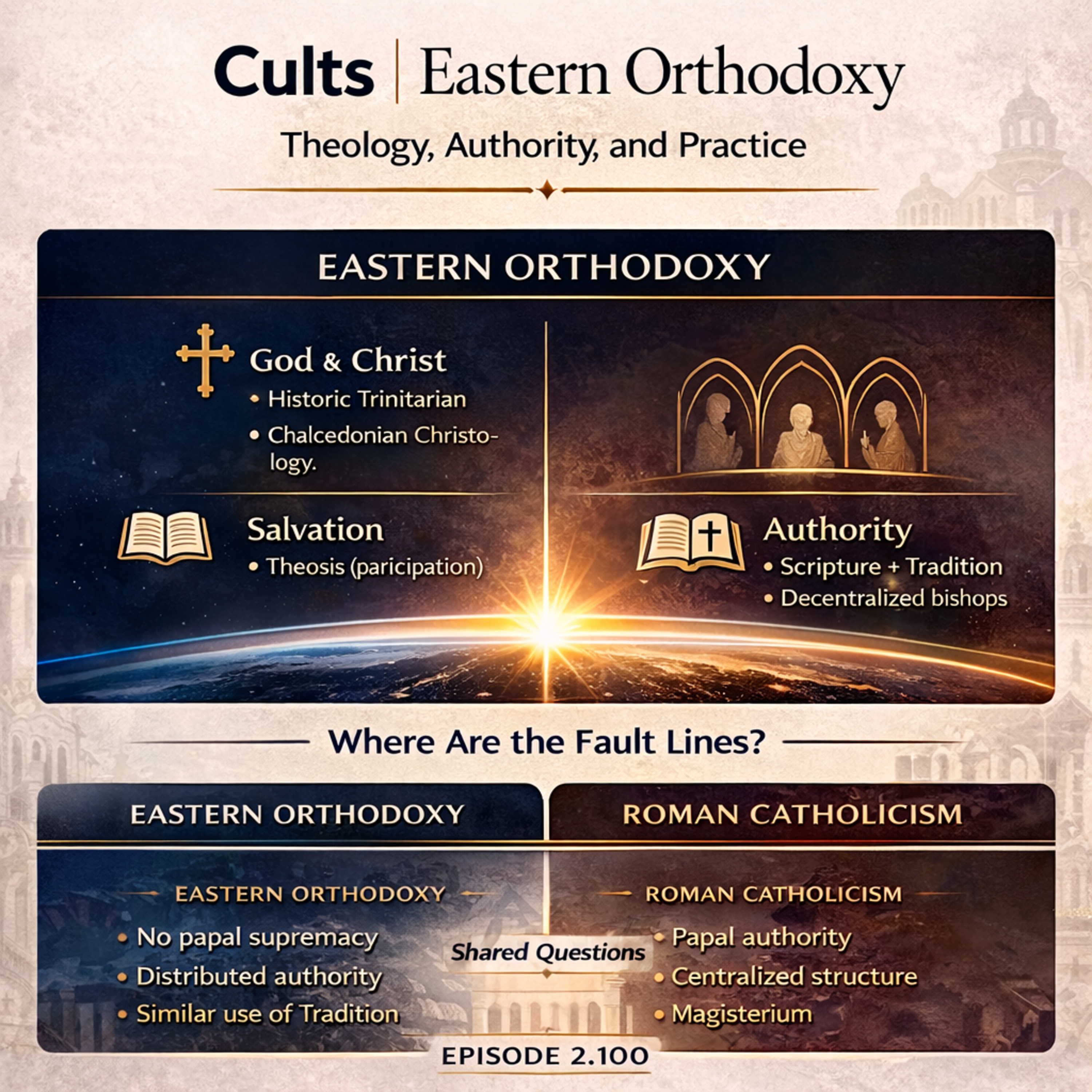
The discussion moves through key categories including theology proper, Christology, soteriology, and authority. Eastern Orthodoxy stands firmly within historic Christianity in its doctrine of the Trinity and the person of Christ, while approaching salvation through a more transformational lens—often described as theosis, or participation in the divine life.
From there, the episode explores how Orthodoxy understands authority through Scripture and Tradition, along with its use of icons and the practice of prayer to the saints. Each area is evaluated in light of biblical categories, particularly regarding the role of Scripture, the clarity of justification, and the pattern of prayer found in the New Testament.
The episode concludes with a focused comparison between Eastern Orthodoxy and Roman Catholicism. While Orthodoxy rejects papal supremacy and maintains a decentralized structure, both traditions share similar concerns regarding authority and the articulation of the gospel. The central issue is not historical rootedness, but whether Scripture functions as the final authority and whether the gospel remains clearly defined.
Find our videocast here: https://youtu.be/pkIbvuLpMmU
Merch here: https://take-2-podcast.printify.me/
Music from #Uppbeat (free for Creators!):
https://uppbeat.io/t/reakt-music/deep-stone
License code: 2QZOZ2YHZ5UTE7C8
Find more Take 2 Theology content at http://www.take2theology.com
0:00 We're back at it. Yeah, we said. We're the last one, might be the last one. But we are a glutton for punishment 'cause those comments come after us. The comments someone commented like do Eastern Orthodox next so I was like hey makes sense we just did the Catholic Church so. I, I think it's time to, you know, I think you do hear of, you know, people gravitating towards Eastern Orthodoxy a little bit. You know, I always see these articles that like men in particular, and it's like that high church. Bells and smells. Yeah, Yeah, There you go. Exactly. Yeah, I can't think of the Eastern Orthodox without thinking of that video. The enviro probably around 2010 of these old guys carrying the statue, I assume of Mary. Do you know what I'm talking about? I don't know.
0:42 I thought I did, but now I don't. What did you think of the dunking of a child though? I don't. Know what it was, but babies were like going under and no one was concerned except for me. No, I'm thinking they this they were carrying this large statue, which we're going to talk about iconography a little bit. And this guy is like going to move it all. He is. He's like, oh, now he's like 89. OK, yeah. And he is starting to be smooth with how he moves it off his shoulder and stuff. But that thing comes and then it just boom and that statue hits the ground and like shatters. And all the people are like all the all the people in the comments were like talking about Dagon and and Oh yeah, yeah, should be worshipping an idol and so. Yeah, You know, I don't know if they're, I don't know how closely related they're to the Catholic Church. I shouldn't say this pejorative, but it's like, I feel like we can always find another relic somewhere. The Catholic Church's like and we just found Jesus's this. In the Middle Ages, probably not so much. It's yeah.
1:48 What was the what was the quote that if you had like all of the wood of Jesus cross? It build the ark you. Can build the ark, yeah, that's great. Good business model probably to, you know, sell these things, maybe not, you know. And all the bones of different things. Yeah, yeah. All right, well, we should give our normal caveats. We are talking cults in the academic sense, not in a pejorative or in the psychological sense where you're mind controlling. So, and we're not necessarily saying we haven't declared whether we think Eastern Orthodox falls under the umbrella of cult or not, but in order to do that, you we were saying like clearly Mormons, Jehovah's Witnesses, cults, like they have heretical doctrines, but they still call themselves Christians and that's the definition of cult that we're using.
2:39 So, and as always, if we get something wrong, let us know. We want to we're. Not above. Yeah, that's right. We'll, we'll, we're not above correction and we'll, we'll Duke it out in the comments. The main thing that we're here to talk about are highlighting differences. We will try to maybe argue for the Protestant way a little bit, but even if we end up disagreeing, which we probably will on some things, it's the differences that we are highlighting. Good to go. Good to go all. Right, and with that, we will take it to the next level. Let's fire up that twang of music. From the hearts of the Low Country in South Carolina.
3:22 It's the Take Two podcast where we take theology to the next level, Eastern Orthodoxy. And for this one, we're going to kind of follow the same format that we've done for the last few where we're going to talk about theology, proper Christology, soteriology, and then bibliology slash authority. And then finally, we'll wrap up with anything that's kind of odd or just doesn't fall underneath those categories nicely. So just some background for some of our listeners who may or may not be as familiar with Eastern Orthodoxy. I don't think we see a lot of it in. It's not everyday, yeah. There was an acquaintance at Northwood, I won't say any names, whose son went to college with some Eastern Orthodox at CSU and CSU.
4:14 The hot pen, The Eastern. Orthodox, yeah, it's just like man. So Eastern Orthodoxity and Roman Catholicism, 'cause they do share a lot, basically the same church history for the 1st 1000 years it's. A good run. Yeah, yeah, same ecumenical councils, the first seven it's. More than a lot of Protestants would agree on. Same creedal foundation. The split occurs at the East West schism. 1054 big year. There you go. And the key differences from Catholicism, Rome centralized authority in the Pope where Eastern Orthodoxy decentralized. And then there's this communion of bishops called the patriarchs, and there's no like single head of the church. So structurally, Rome has centralized authority and Eastern Orthodoxy has distributed authority. Both of them still reject Sola Scriptura which we will talk about in Part 4.
5:14 Yeah, it is interesting. Like the East West divide, a Latin verse Greek. And I don't, I wish I knew the history better over this split. But I know there was like, I feel like people just kept like excommunicating each other like, you know what I mean? All those times like you're activated, you're excommunicated and you know. What a wild time. You can't excommunicate me 'cause I quit, man. Yeah. Exactly. But that's good because, you know, you think about it. How is it the same as Catholicism? How is it different? That's great. Let's get into Doctrine. Doctrine. So theology proper. Basically, the theology of God, and here fully trinitarian, would affirm the Nicene Creed and Nicene Orthodoxy.
5:57 So, so similar to Catholics in that regard, where it's like, man, we're pretty rock solid for for the most part. There is this difference. It is the. I'm gonna let you say it. Oh, close. Filioque. I get the accent wrong, Filioque. I just know, you know. Big difference when you add and the Son, the spirit proceeds spyrates proceeds not just from the Father, but also the son. That is Roman Catholicism, that's Protestantism I think would say the the same thing. And the East was not having it. They're saying spirits proceeds Spyrates from the Father alone, not from the Son. And I was thinking through different because we just read off air.
6:43 Well I'll read it John 1526. I have it right here. It says when the helper comes, AKA the Spirit AKA the Paraclete whom I will. So this is Jesus speaking, whom I will send to you from the Father. That is the Spirit of truth who proceeds from the Father. He will testify about me. So we at least know he proceeds from the Father. But there are also places, and maybe we should look this up where the Spirit of Christ is this the the Holy Spirit is basically given the name of the Spirit of Christ, like the Spirit of Christ is with you type of thing. And I think it's clear that it's the the Holy Spirit that's being talked about.
7:31 I don't know. I don't know what doctrinal anything doctrinal with of gravitas rest on this like I it'd be hard for me to press that either one of these like oh, if you don't believe that he proceeds from both, then you're heretical. Maybe I'm. Missing something? It's like confusing and I know when John not too far from where you read Jesus is like, if I go away, it's to your advantage because I'm going to send the helper to you. And it's like a lot of this. I, I know the the tricky part is the Nicene Creed did not originally say and the sun when it was written, it was further to try to, you know, clean up some loose ends, Trinitarian combat, Arianism, all, all of these things that was added and it was out of the here and there and then officially adopted.
8:16 And really that was kind of in the undertones leading up to this great schism that that was was a really, really big deal. I wish. I wish I knew the history more old. But the good news is this is the only thing where they would differ from Catholicism and most of Protestism. Protestant. Yeah, Protestant. Words are hard. They are US who protested out of the Catholic Church. That's right. This is not the, this is not what the the hill we're going to die on. This is this is this is small potatoes. All right, next section of doctrine Christology talking about Jesus himself, both Catholicism and Eastern Orthodox. And I can't say it productism fully affirm God. I can hear it, but I can't say it fully that Jesus is fully God, fully manned.
9:11 And they affirm the Caledonian definition. So we're good, all good there. Yeah. Soteriology, this is where. So soteriology and authority is where we're gonna start to see some breaks between Protestants and Eastern Orthodox. So shared with Rome. They would not say that you have justification by faith alone, so they would not affirm that. I wonder what they if they've weighed in on the Council of Trent that athematizes, anathematizes anyone who would say that. Similar to Rome, they would say salvation is a process. They have a Sacramento system. Very high view of sacraments, that's right. Grace is mediated through the Church, so some of the Orthodox distinctives less legal, more transformational. So there's an infamous emphasis on theosis. This is participating in the divine life. So it's like our walk with God.
10:08 That walk helps us. It's very similar to, you know, the where we would say we have imputed right righteousness. Then the Catholics would say, what's the word that they use? Infused. Infused righteousness, it's very similar to to that. Less focus on guilt and legal standing, more focus on the healing and restoration. Like a East West thing. I mean, it's, it's like, I feel like it's a little bit harder to relate to just from this Western tradition. And so much is like is based on guilt and penal substitution. And it's just like it makes sense in the court of law. And it's just so ingrained, I think our Western side. But but I know you're turning there that this passage, this, this is a perplexing passage the way it's worded. Like if you've ever, you know, come across it, it is said kind of strangely.
10:55 Yeah, so I'll just read this is second Peter one. I'll read the intro and then there are key passage happens in 4, but I think it's good to have the context. Simon Peter, a bondservant and apostle Jesus Christ of those who have received the faith of the same kind as ours by the righteousness of our God and Savior Jesus Christ. Grace and peace be multiplied to you in the knowledge of God and of Jesus our Lord, seeing that His divine power has granted to us everything pertaining to life and godliness through the true knowledge of Him who called us by His own glory and excellence. Here's our key verse. For by these things He has granted to us His precious and magnificent promises, so that by them you may become partakers of the divine nature, having escaped the corruption that is in the world by lust.
11:44 Yeah, that, that divine nature I think can catch people off off guard. And if you are reading really like any study Bible, they'll do a good job of being like divine nature, you know, not saying like ontologically being like God. You know, it's more, you know, it's like, you know, these kind of distinctions, not deity. Well, Paul would say in Rome that God works everything to for your good for those who are called, you know, we get that golden chain and then he'll say I he doesn't he doesn't say and that good is. But if you read the flow of a thought, I think he is basically saying and that good is your transformation into the image of Christ.
12:25 So I. Think we're getting at that's a, that's A and I think you see that framework like over and over. So it makes sense versus the second Peter and it talks about, you know, what happens through embracing the promises and and these kind of things. If you read second Peter, you don't get this idea that you're gonna become, you know, a a deity of some sort, but that you're it's transformation by the spirit. Yeah, exactly. So I think that that is really important. How I can take like one verse and like not look at the rest of Scripture and it's like man so much whenever. We're highlighting one verse and not reading in the context of the rest of the scripture to help us understand it. That's probably problematic. Red flag. Yeah. So Rome has a more defined system.
13:07 You've talked about the Council of Trent stored up merit in the different categories of grace Orthodoxy has. It's less systematized, it's a more mystical. I think that's the that's like a draw to it. Like I think people they leave Protestantism for like Roman Catholicism. It's like more mystical and if you really want to keep and then you know, this is different, but but there's a lot of. Important chants, too. It seems like they do. Yeah, yeah. These kind of things where, you know, I think that's like for some people, there's like this draw to it. So our concern here would be highlighted Galatians 216 A man is not justified by works, but through faith.
13:47 If justification is not clearly distinguished from sanctification, the gospel becomes unclear because it's. It's like this distinction between am I working to be saved, or am I working because I am saved? Yes, big. A couple different words, but a huge different meaning. Yeah, yeah. And so when when we walk and talk and teach people that you work to be saved, then you fall into Galatians chapter one. What is it, verse 8 or 9, where you are adding to the salvation method? And we said this over and over again, Paul said, if me or even an Angel come down here, we give you any other gospel, that person is a cursed.
14:35 Strong language. Very strong language. Romans, he would say, you know, it's if it's of grace, it's not of works. And if it's works, it's not of grace. So, you know, so we kind of hit that drum over and over again. But it's huge. Obviously, it's what Martin Luther, what got him, you know, all fired up, almost literally, yeah. Speaking of what could get you fired up, you know, authority like what what are you? What are you going to live and die on? Parallels, you know, tells us about that we told because both reject this so scriptura that the Protestants are going to be rallying around.
15:16 We've said this before when we had one, but when we say sola scriptura, that doesn't mean that we don't think that there are teachers that can help us understand or that there are good books or that we might even look at, well, how did Erinaeus understand this? Or how did Ply carp understand this or what a just the martyr think? We take all that into consideration, but the buck stops at Scripture. That's the highest authority. So if Scripture is clear on something, and if even Agustin himself says something that's counter to scripture, we're going to take scripture, right? So that's what we mean by sola scriptura. Both Catholics and Eastern Orthodox, they affirm Scripture plus tradition.
15:59 Some of the differences. For the Catholics, they had the Magisterium or the teaching office and the Pope as a final authority. For Eastern Orthodox, no single central authority figure. We talked about that upfront authority can be found in tradition, in the Council and in church consistent consensus. So practically you're trying to look at the differences. Rome's got all this centralized interpretation. It kind of rises and falls with the Pope in Rome or Orthodoxy. It's a little bit more more dispersed, distributed. But both of them would reject scripture as the final 40, which seems such an odd place to be.
16:41 It does. It does seem strange, very strange. I'm curious what what are some other practices about Eastern Orthodoxy? Very nice segue into I iconography man. Statues. So an Orthodoxy. Orthodoxy. They have a strong emphasis on icons theologically defended via the Incarnation. They see it affirmed at the Second Council of Nicaea, and their practices include bowing, kissing and lighting candles. I love. It you know, you think you think of the Reformation, you look at a a good Reformed Church and you ain't seeing no pictures of no one Like we're we're not seeing Jesus up there because we're we're especially in that time.
17:28 It's like we're having such a separation and we'll even send people in to break up the icons at the Catholic Church. And there were these like reports of people destroying icons because we don't want images of Christ. You know, we're, we're really fighting against that. And you can tell a big difference between, I mean, obviously, like you go to a Catholic Church and it's like everything is like so constructed. And then, you know, your classic Reformed Church, you can have beautiful construction, but it's gonna look very different. And then you even see like, you know, a church like ours, Charleston Bible Church, very plain, like you sometimes see, like a reaction against why are we spending so much money on these vaulted ceilings? And, you know, different traditions where, you know, a Catholic would say, we've got to make this. We're entering the presence of God. You know what I mean?
18:15 It should feel. Different it it should feel different you should. You should. Feel like that there can be some goodness there. I think we can be extremes in both, yeah. Totally. I think extremes in how you interpret second commandment as well. Do you have do y'all? Do y'all have nativities at your house? We do have nativities do. You put baby Jesus out in. The we, we we keep those separate now we we, we, we do overall, I'm not a big. Your heart strings are kind of tied into that a little bit, I can tell. When you talk, yeah, yeah. I don't like love it, but I'm not like anti against it. If I had my way, I would probably. Just put sharpie over his face. Refrain from having like pictures of Jesus all through like a worship service.
18:58 But I'm not like, you know, it's not like the worst thing. I'm like, oh, a picture of Jesus. What am I? But if I, but I do notice this majorly, if I, if I'm treating a 90 year old lady who is a Catholic, when I walk into her house, pictures of Jesus everywhere. Like it's like I know in my first and second someone's house, if they're Catholic and, and they're a practicing Catholic, it is like totally evident compared to a Protestant. You know it. Just, you know, seeing, seeing the old. Man praying over his bread. There you go see that you see you might, you might especially in like the older generation, you might walk in and see like 18 like random Bibles out or you know, like a big emphasis on having Bibles more so. Or maybe you have like a, you know, little Bible verse here and there.
19:39 But man, someone who who is probably Catholic everywhere. But you can see the 'cause I do have an appreciation for like a church that is really constructed like that is really cool. But you can see just how traditions like shape, you know, these these I. Guess I would say I see the second commandment as applicable to the divine nature. Oh yeah. And so when you have a picture of Christ, we're not trying to depict his divine nature. We're depicting his human nature, which is fine. Because we can depict the human nature, we can't depict the Anything that we try to use to depict the divine nature will always be, by definition, less than and a distortion of and falls fully flat of anything that we could use to try to capture the divine nature.
20:25 If you're, if you're in these like, you know, social media groups, it's great. Someone will like post a picture of like I, I wish I knew Star Wars better, like Obi Wan or something. And someone will be like second commandment violate. Is it like is this second commandment violate? Is it, you know what I mean? Like they're like trying to like troll a little bit and do these things. It's great. There's a woman in Brazil, I believe, who had a picture of Elrond, who is the elf in Lord of the Rings. Not a picture, a little statue. And she thought it was like Saint Joseph or something. And she was praying to it for years, and some missionary came in and they took a picture of it and it was Elrond. Oh, no, because really the reform, the, the argument, I think I might have mentioned the argument. They would think, you know, I think it's different than what you're saying because you're, you know, talking about the natures. They would say if you see a picture of Jesus and it and it really looks like Jesus, you should just feel compelled to bow down at the second person of eternity.
21:15 And if it doesn't, then it's idolatry and you're making Christ in your own image that that's like what they would say kind of thing. Like those are the two options. If it's like actually really good and accurate and you should worship it. And if it's not, you should be like, you can't, you can't have that because it's idolatry. It's so strange to me. It's a pitcher, so I'm not worshipping a pitcher. When Jesus was alive, walking on the earth, it wasn't as though the only proper response was to fall down and just stay down the whole time like you saw people. You wouldn't bow down and saw Jesus. No, I'm just, I'm not saying. That I wouldn't bow down, but I'm just saying that. Into social media. Clip. I'm just saying you maybe bow down initially and then he'd say, all right, we got work to do, get up. Yeah, yeah, yeah, yeah, yeah, yeah. So yeah, that, that seems like an odd take to me. It seems like someone is justifying their bad reaction. They're justifying a, a, a bad take to me. To me.
22:13 All right, should we? Should we move on? I can talk about for 20 more minutes. I'm just kidding. Yeah, let's move it on. That's great. So iconography, there is a problem that you are in my mind, yeah, yeah. That you are bowing, bowing down and kissing stuff because the. Because it's not. It's not the thing. It's it's not. So I, like I said, I don't have a problem, you know, looking at the shout Shroud of Turin and looking at a face reconstructed from that and thinking that's probably what Jesus looked like, but I'm not going to worship the shroud or that image that someone made because I'm worshiping Christ alone. I like it.
22:53 All right, prayer to the Saints. We talked about this last time, both traditions pray to the Saints, ask for intercession. We talked about God, Jesus being the only mediator between God and man. And that is clearly in a sociological sense, but I think it also talks about intercession, speaks to the intercession. And we see places like Romans 8 where we see the Spirit interceding on our behalf, the son in Hebrews 10 interceding on our behalf. So we don't really, we don't need intercessors. We talked last Thursday about all the Old Testament. Not a lot of positive instruction. 0 positive. A lot of negative about trying to speak with the dead Sacramento system.
23:43 Both have viewed baptismal as having regenerational power. Yeah, that'd be cool. Yeah, but that true. And then the Eucharist sustains. So for each an Orthodox, you're baptized, that cleanses the Eucharist, sustains, and then this theosis, this walk helps you to grow in in in God's likeness. And we might talk about this last time, but going back to traditions, you walk into a Catholic Church, the Mass is like right there in the middle. You walk into a good Protestant church, the pulpit's in the middle and the, and the Eucharist is to the side. And it's like very intentional, but it's important, but it's not kind of what's the what is guiding your church kind of all. Right. And we kind of hit this, you know, in general, Orthodoxy tends to be less philosophically defined 'cause there's more of the, the Mystic experience of God that's emphasized versus, you know, Catholics tend to be more liturgical than Protestants.
24:40 You know, we're just teaching. What does the Bible say? We always nail it and there's something to it where, you know, I think in Protestantism, you know, with all these things you can probably run into like I'm going to systematize every last word and you'll you know, and that's a problem, but it but it's like it's good to know what the text. Says it is good the hope that there are certain people not listening to this, but the precepts way of like. Oh yeah. Every time this word occurs in this pat, like they'll go through a whole book and they'll like they have like this crazy marking and to me that's I I'm like, I feel like I'm more focused on getting all my marks right than just what does this the text say?
25:20 I'm not saying that that can't be helpful, and it can help you find patterns, but man it it's almost like the shots. Fired. You hate the precepts, people. No, I'm just kidding. I like to, you know, rile, rile people up. No, that's good. So what are some more differences between Roman Catholicism? And summary, no, no Pope and no, you know, again, that has this patriarchy of the the bishops. I think that's good. Anything else we want to say about ether and Orthodox Eastern?
26:05 Orthodox, I'm trying to think there was maybe one or two more things I was thinking yeah, yeah. You know, you see the given pull. I think not this is important, but I think, you know, in Protestant circles, you see such a push back. It's like where you get these churches that do like the Lord's Supper once a quarter. It's like not important, you know, we're. Going to do ours two times in less than a week. Man, living live in large, yeah, you know, it's great. So yeah, that, that's right. Yeah. We had that. There was like, hey, and we were switching around Communion. I was like, man, let's do communion every week, you know? But it's good, good stuff. I don't know if there's anything else I want to add about Eastern Orthodoxy.
26:47 I think it's good that we covered it. It's like one of those that's like a little bit less familiar even just with it's like, you know, it's not something you see a lot in Charleston, SC. Except for CSU, you know it's. A hotbed. You heard it. Here, at first they're. Taking. Over CSU. I did have an employee whose husband was a priest in Eastern Orthodoxy at a church in Mount Pleasant and I. Had a neighbor. OK, Yeah, they were. Big in the Eastern Orthodoxy, and they lived in our neighborhood. They seemed like a great family. Yeah, yeah, yeah. We'd see them walk and they had two or three kids. They'd play. They'd play with our kids at the park. And then he went into the priesthood. Yeah.
27:31 It's very same thing with Roman Catholicism to some extent. It's so with the liturgy, I do like the rhythms to the year where they really go into the church calendar. I think there's benefit to like some of that kind of stuff. The problem is then you get into like these like myths and stories. And so you know, it's kind of like you in a lot that and really man, the garb that they wear the get up for some of these ceremonies is like is I don't understand it all. I know it all, but it's like to someone who's not familiar with it, like she would post stuff, it would be like, this looks insane, like, you know, very official and wearing all the things for different. It's like, oh, it's Lent. So we're wearing this thing and it was like all all these things, you know, got to see it. It's it's it's it's fascinating. But yeah, that that's all I got.
28:13 All right, we're ready for our final take. Oh yeah, final take. Well, what as of recording, we are about to get to the full moon. Oh, is that right? Yeah, yeah. And you know why that's important? Why is that important? It's the. First full moon after the spring equinox. Wow. Yeah, it is. That's true. That's true. And that that means the Sunday that happens after the first full moon after the spring equinox is Easter. Boom. This Sunday. Yeah, boom, here we are. Easter. I'm sure that's exactly how they they track Passover too. Yeah, there you go. There, there you go. Nailed it. No, I think Passover and Easter are close to coinciding this this year.
28:55 I just wish you. I wish you would just make Easter happen whenever Passover. Happens. Yeah, to make it. Make it. Yeah, that has to be great. I don't know. I think there's a little bit more variability, sorry. Also, there's a lot of pollen out there. Everywhere, man, it's. Insane. Can't win it. It, you know, the, the hot and cold, it just tricks the plants into releasing more and more pollen. It go, we go cold and then it gets sworn back up and the plants go, well, we better put some more pollen out there and it just keeps on happening. Just planted a garden this weekend. So nice. Expecting big things, so I'll let you know how it goes. We'll do garden check. Not a great gardener, but I'm excited for it. Do you have raised garden beds or? Yeah. OK, it's great.
29:36 I have just enough space to grow about like 20 green beans at a time, so it's good that we each have like 5 and then, you know, someone doesn't get any, so it's good. Yeah, like. If we could grow cucumbers, watermelons, it'd be great, but I don't think I think it may be too hot for us to grow. I think melons are more of a cooler climate. Man. Thing, I don't know. Yeah, maybe I'm wrong. Drop in the comments, let us know, you know, give us some gardening tips. I'm trying to do better on my word associations because you know when people say stuff, sometimes I just make these associations and I'm trying I try to hold those in check. I remember one time we were in a meeting, this is probably 20/10/2011 at work and we're talking about this computer and this guy was talking about we had some error in this computer system.
30:25 And he was like, we're, we're really trying to figure out what it is. It's like there's a phantom in there and we can't figure it out which and, and in my mind starts immediately singing the, the course of the operos and I'm like, OK, and I start thinking about that and then I go, OK, you got it Michael, you're in a meeting. You got to focus, refocus, because they're going to ask you a question here in a second, and you're gonna think about the Phantom of the Opera. So I'm like, OK, I'm doing, folks. And and then he says, I'm just concerned if we don't get some new drives, we're gonna be past the point of no return, which is another song. He's just like opera. And I was like, I was like, Ward, if you want me to focus. You can't be. You gotta stop dropping these references to the Phantom of the Opera song. So he's like, what are you talking about? And there was a couple other people like, oh, we caught it too.
31:08 I was like too, it wasn't just me, but what's the? Great, next podcast I make I'm gonna pick a random soundtrack and say like a lyric. Yeah, yeah, yeah. Pause. Well, you kept saying Anne Sun in this podcast about the, the, the Philly Oakway and I kept thinking of caveman. Did you Caveman's probably before your time. Yeah, way before my time. Yeah, yeah, according to you, probably billions of years ago or whatever. I'm. Just kidding. Yeah. Well, there's a cartoon that was out and I watched it for a couple years and it was just caveman. And that was like the. And then once that series is over, they launched a new series the second season or whatever it was Caveman. And then his little son went and he was like Anne's son. He would come along.
31:49 And so every time you said Anne's son, that's all I could think of. But I was like, I'm not going to. We just. Want to keep it together? Proud of you. That's great. That's what we do on this podcast. Restrain. Restrain ourselves. Restrain restrain the the I don't know, is that ADHD? Thoughts. I don't know, the only thing I remember about caveman is so easy a caveman can do it at the GEICO commercials or whatever it was. Those are pretty good. This guy looked like just maybe a round ball of care with an arm, arms and legs coming out and he had a club. Oh, nice. I think I've seen this guy. Yeah. Yeah, yeah, I've seen this guy and it's like his face is literally like just eyes poking out of hair, if I recall it right. Yeah. That, you know, they don't do it like they used to back in the day.
32:30 You know, thinking about some of these like shows and stuff, man, it's not what it once was. Is this a? Is this a wrap for? I I mean I think. So we can never say never, but. Yeah, someone will say. And why not now? Do fill in the blank. So yeah. I love it. Anything else? I think that's it. That's our take. Thanks for listening to Take Two. Find us wherever you find podcasts and on YouTube for those who want to watch our video cast.

