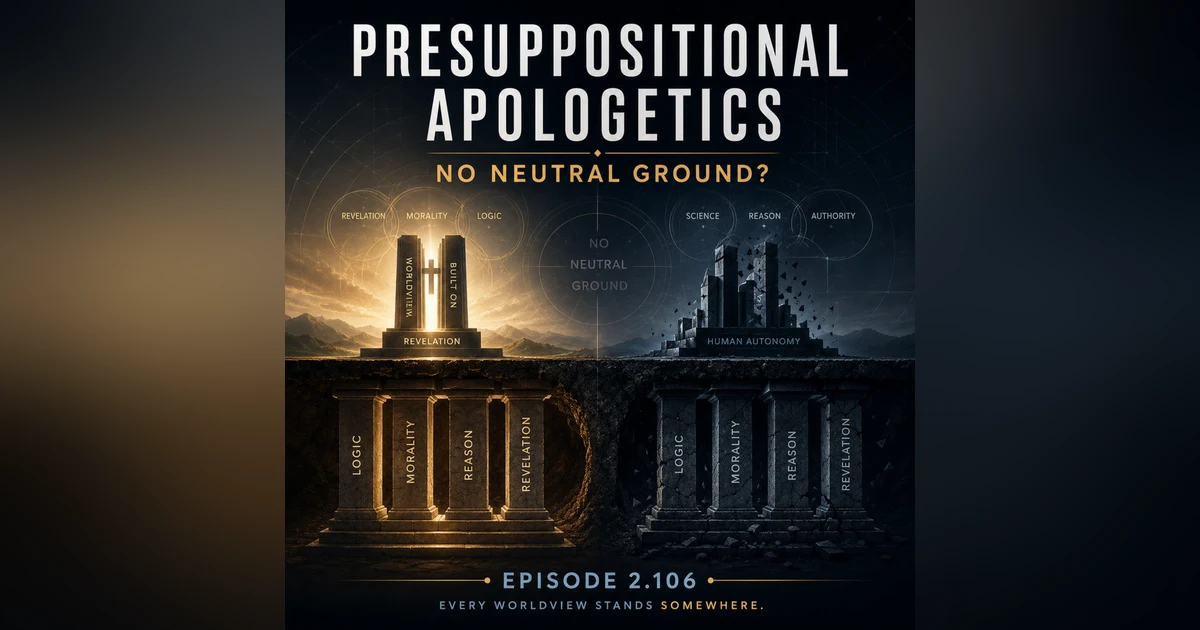
Presuppositional Apologetics | No Neutral Ground?


 RSS Feed
Episode 2.106
In this episode, Michael and Zach begin a new two-part series on presuppositional apologetics by examining one of its central claims: that there is no such thing as a neutral thinker. Drawing from passages like Romans 1, Proverbs 1, and Colossians 2, the conversation explores how presuppositional apologists argue that every worldview rests on foundational assumptions about truth, authority, morality, and reason.
The discussion walks through the major ideas behind presuppositionalism, including worldview analysis, “borrowed capital,” the suppression of truth, and the claim that Christianity alone provides the necessary foundation for logic, science, and morality. Michael and Zach also compare presuppositionalism with evidential and classical apologetics, highlighting where these approaches differ in method and emphasis.
At the same time, the episode critically evaluates several presuppositional claims and asks whether the movement sometimes overstates its case regarding neutrality, reason, and the role of evidence. Rather than functioning as an endorsement of presuppositional apologetics, this episode serves as an introduction and examination of the system—looking carefully at both its insights and its potential weaknesses.
Find our videocast here: https://youtu.be/LcqUnyPCdMY
Merch here: https://take-2-podcast.printify.me/
Music from #Uppbeat (free for Creators!):
https://uppbeat.io/t/reakt-music/deep-stone
License code: 2QZOZ2YHZ5UTE7C8
Find more Take 2 Theology content at http://www.take2theology.com
0:00 All right. Michael, I'm gonna need you to be. Objected here, you caught the sigh on that, but keep going you. Caught the sigh this is gonna this is this is taking a lot out of Michael because we are talking presup apologetics, the bane of everything Michael stands for I'm I'm excited for this episode cause I've always been fascinated by presup apologetics mainly because a lot of those who endorse it I I like when I think of people presup, you think of people and I don't necessarily love James white but I think he's a smart guy the more it's like the more I listen to him I kind of get aggravated you know what I'm saying like it's like he knows a lie but.
0:44 I don't ever listen to his podcast ever anymore. But what what I did listen to you don't come away with like, OK, I I am caught up on the hope of this. Or this? Is what I'm gonna go do. Like, yeah. Same thing, I don't listen. To it. Anymore and I feel like I don't know if it's like monologues are hard. I don't know what I don't know what it is, but it's like I'm just like, that was a slog. If there's like a specific thing other people I'm gonna put I should have looked this up. It's whatever the sigh. Do you know this guy? His name? Sigh. Young. He was the pitcher. Is that who you're talking about? Yeah, exactly. Vodi Bochum would say he's a precept Sighten, Brig and Kate, I'm probably saying he's a Canadian. I apologize.
1:31 Who does the precept mess? A lot, A lot People like Jeff Durbin. I'm kind of fascinated by it and I and we'll get into it more, but I think there's an appeal to. It. But Van Till Botsen, that's right. Some of these people, they have some famous debates. I did see a clip, maybe because I've been looking at this for a long time. Saw a clip of John MacArthur. Have you seen this? This talked about? He said Van Till lectured his first week of seminary and he was like, it was the worst week of my life. He's like, I couldn't follow anything. He's like, I just wanted to like preach Scripture and more text. And I got like lost in all of this stuff. But really, and I think all these people that really endorse it, really smart people and I like a lot of their system, but we'll get into it. We got the best person.
2:12 They'll talk through it. The the apologist extraordinaire. Cause I think there's the, and you probably, but there's a lot of things, maybe not a lot. There's some things that precept really does well, but maybe the the whole system is flawed. Yeah, I'm not, I'm not necessarily agreeing with the the statement that yeah, well. Let's let's, let's get into it. And this doesn't pique your interest. I don't know what will. So let's go ahead and take it to the next level. Let's fire up that twangy music. From the hearts of the Low Country in South Carolina. It's the Take Two podcast where we take theology to the next level and what what I.
2:57 Want to do here? I'm going to go over some notes Michael and I both prepared by reading a book by a pre supper, you know, and I and I think he did a good job of articulating his view. Like, I think that kind of makes sense. If by that you mean I understand what he. Believes yes yeah, this would be a great podcast. I can't wait. So I I put some of these notes together. I'll look over it and or I'll go through it as I go through it. Feel free jump in and be like man 'cause I'm I'm. What I'm going to try to do here is represent what a pre supper would say, not necessarily say man. 'Cause I'm not necessarily a pre supper. No, I like a lot about I like a lot of pre supper, but I, I, I'm like 80% there and I can't get the whole way.
3:37 I I would love it if it could be a tool in your tool belt, but I think it can't be. I think it's got to be all or nothing is what it seems like. I don't even. I don't even know what a tool a new tool belt even means for a pre supper if if I understand their their system correctly. Yeah, yeah, yeah 'cause you don't need any tools except for their for. You know, well, I mean his his thing was only believe that's the name of his and he uses the we're already getting fired. Are we talking to chiefs and a flag? Are we talking priests up? I can't tell. Yeah, it's the same. He uses this narrative that we've talked about before in the juxtaposition. That's right. Yeah. Yeah, I saw the mark.
4:18 Yeah, yeah. So this guy is like coming. He's like, hey, my 12 year old daughter is sick. Jesus gets interrupted by this. I think she's a gentile, right? Yeah, Cyrophoenician or something. Yeah, Cyrophoenician and she's had a issue of blood for 12 years. So you're pointing out those similarities and he's like who who touched me and the disciples was like we're in a crowd of Jesus. Everyone's touching. You said no power went out and and sorry to to to derail us, but but, but I got to I just got to tell the story. And so, you know, he finishes up with her and then someone during that time comes to Gyrus Jarius and basically says your daughter has died.
5:01 And Jesus says to him in a time of emotional distress and a time of, you know, hey, just believe, have faith in me. And of course you should take that as how that is what Jesus meant there was. This is how you give the gospel. You just go around people and say only believe. And if they don't, you just wash your hands of them. Don't interact with them at all. Just say you know, you know, Shake the dust off your sandals. There you. Go Yeah, well, let let's get into it where where they would base foundational thought for a pre supper, which you might agree with this. There's no such thing as a neutral thinker. There's only competing world views when you get to the bottom of it, they're all rooted in their own ultimate authority claims.
5:51 And so we, we live in this world, you know, we live in the science age. It tells us to be objective, to follow the evidence, leave faith out of it. Whether it's a podcast, a classroom, a conversation with a skeptic, the assumption a lot of times is the same that that if we find some common ground, some neutral ground, we can all stand. We can look at the facts, come to our conclusions, we can remove bias and what a pre supper would say. What what if neutrality actually is a myth? And they'll say this a lot. What if no one comes to the table without bringing not only assumptions, but deeply rooted assumptions about reality, truth and authority? And I think what this guy Paul Taylor said in his book was evidence isn't the problem.
6:31 I think he used the analogy like you read a mystery novel. Everyone's got the same evidence, but there's like shape shift in you know what I mean? And so he's like evidence. What what's that even mean Anyway? You're you know, and I think this is that that's an idea that pre suppers are going to look to where you just got to get at, at the root of it all. You need to get underneath all of this if you're going to engage with. Someone, and he specifically gives the example of Ken Ham answers in Genesis. And he says that Ken Ham said that I used to give evidence for creation and then evolutionists, they didn't just buy it, they would come back and they would bring their own evidence. And then I would bring our evidence and then they would bring their own evidence.
7:12 And finally I stopped doing that. And I just wanted to point out that your presuppositions will color how you view the evidence. I think that gives away so much because it's almost as if you're saying my system coheres, your system coheres. There's no real difference for you to tell which one is actually right. It all hinges on your presuppositions. Now I know what someone else's that is. That's how they argue and and in the book. Sometimes he leaves it. Flat like that I think. What he would come in at that time and say is he would talk about the precondition of knowledge and he would say our presuppositions make sense of the world.
7:56 They give you a knowledge, a foundation for knowledge and logic. But when you do that, you are giving evidence for your view. So you're saying they're undercutting? They are doing the very thing that they say they can't do. They're giving an argument that a classical apologize. Yeah, yeah, yeah. I'll give the transcendental argument all the time. There's many forms of it. The moral argument, the pure transcendental argument, the argument from the applicability of mathematics. Like you, I could go down the list. Argument for. Consciousness, life, all those things, they transcend the physical world. And so I'd stand right next to a priest supper and say, yes, an atheist materialist view of the world cannot make sense of those things.
8:41 And so I know you're you're talking about this big idea of no neutral ground just to come full circle back to no neutral ground as a good Calvinist sovereign grace. Yeah, there's no neutral ground. But I don't know who's been elected and who's not. And these are means, you know, just giving the gospel to someone. They are. They're using the same mind that they would use to evaluate the the bad news and the good news of the gospel that they'd use to evaluate the cosmological argument, right? So you can't get around that. Sorry, no, no, no, no, no. It's 'cause I like this interaction, 'cause this, this is good, 'cause really my experience come from from this book only believe I did listen to the Bodson Stein debate and the Bonson sprawl debate to kind of get the intramural side of it too, which I thought was really, really helpful as well. Bonson Stein debate, beautiful.
9:37 I listen to that and I go, this is great, especially the part that gets a lot of play where, and I wish debates did this today because they don't anymore, where you have this. Oh, cross examine is strange. So good, Yeah. Where you get to ask yes or no questions? Straight to them. Yeah, yeah, straight to them. I think that's so good because you have this interaction between Bahnson and the Stein where one of, I think, I can't remember which one goes first, but basically Bahnson gets Stein to admit that he believes in the laws of logic. And he says, and it's like Stein doesn't even really listen to it 'cause then he turns right around and he's like, do you believe in anything that's immaterial? And he's like, yes, the laws of logic, like what you just so.
10:19 But I would argue Bahnson is not arguing like a preceptor. He's arguing as a classical apologist. Like, he may be limited in his scope of what he's arguing for, but he is arguing like a classical apologist there. No, I I think that's good. If we were to define precept apologetics, we might define it as a system that argues that Christianity is not merely one possible explanation of reality. It is the necessary foundation that makes knowledge, logic, science and morality possible at all. And, and someone like Van Till really kind of the godfather of all this would say you really can't reason to God.
11:00 And unless you're reasoning from God, and you'll hear this a lot in their arguments that they're, they're borrowing from God's worldview. You, you cannot make your argument without a Christian worldview. In his book, Paul Taylor would say, it's like someone saying, telling you words aren't important and words don't matter and you can't communicate with words because they're using words to communicate their argument. He's saying that's what an unbeliever sounds like. They're borrowing from a Christian worldview that that doesn't really make sense in their worldview, but that's how they have to make their point. Yeah, so crossing streams a little bit because what I understand a pure precept could say, he would say you believe in words because you're using words. I'm not even going to tell you that words exist because you're using them.
11:48 And so to make the analogy come back, you'd have to tell the atheist you believe in God, you do believe in God. And I think from Scripture there's a sense when we could all say everyone deep, deep down has suppressed the truth of God. That's what Romans one would tell us. And so we'd say that there is this self deception and they traded the Creator for creation. They didn't give thanks to him, and God gives them over. Yeah, yeah, yeah, yeah, yeah. And. So and so. I don't know if you've ever talked to an atheist and argued, but it I've never found it helpful to say you actually do believe in God. Yeah, yeah, yeah, yeah, yeah, yeah. But but Romans one says that the invisible qualities of God are plainly seen by his creation.
12:46 So. You're trying to point those out more. Yeah. And this is good because in the SPRO, the Bonds and Sprole debate, it's funny 'cause they both were appealing to Romans 1, you know what I mean? And Sprole's like, yeah, he's like one of his concerns were, man, you're really minimizing natural evaluation. One of you know, we, we're giving two books. You're minimizing this book, is what Sprole was saying. This vantel you cannot reason to God. Paul didn't, I guess, didn't think that because he's saying you could plainly see the invisible attributes. I don't think David thought that either. The heavens are telling of the glory of God and they're expanse is declaring the work of his hands. David is saying you can look at the stars and you can reason to the fact that there is a God.
13:31 Well, let's zoom out real quick. Apologetic approaches, and you're the expert here. Let's talk evidential apologetics. If you had to, you know, give a 2 sentence a paragraph definition, how would you describe evidential apologetics? Yeah. Can I start slightly different? I would say there's broadly 2 huge classes and then there's a third stepchild that we don't ever talk about. So the two the biggest class is classical apologetics. Generally, classical apologetics is described as a 2 step method. Yeah, and that would be a critique. A precept would say that in a bad way. Like I just go straight to the source. Why are we 2 stepping?
14:13 Yeah, Yeah, yeah, yeah. Anyway. So I just wanted to. Whatever yeah, you can't like you should like Norm Geisler has like all these things like you can't, you know anyways, yeah yeah, yeah, he he addresses all those things, but it's classically 2 stepper. Some have even said three steps. No, with the advent of extreme modernism, AKA post modernism where people don't believe in the truth, sometimes you have to argue that truth exists. Then you argue that God exists. Then you argue that that the New Testament in the Bible is trustworthy in Jesus. You know the the revelation about Jesus is true. And so and so largely you are. You are first getting them into a view of theism that and then you're saying and Christian theism is the right the right one.
14:59 And you might say, like, William Lane Craig or someone would fall into this bucket. Yeah, like. Yes, yeah, William Lane Craig, Greg Kochl, Norm Geisler, RC Sproule. Yeah, the list goes. RC Sproule's the good one to have in your back talk, but that's like really good 'cause he's like real, you know what I mean? Paul Yeah, yeah, yeah. And so then I would say under that broad umbrella, a classical apologetic apologist might use evidentiary, historical, legal, so he might put a whole bunch of different things in his tool belt so that he can meet the person where they are, where your hang up is. That's what I want to address. And I, as a classical apologist, I see my job largely as stripping away the facade and making you really realize, OK, I don't have a good like we talk about like emotional reasons for not believing in God, volitional reasons or intellectual reasons.
15:57 And I'm trying to strip away all your intellectual reasons so you can tell, hey, this is just an emotional reason. Like you're mad because he won't let you sin, or because your grandmother died, or this is just you're being rebellious and helping you come face to face with who you are. That's good. So, so then that's a big camp. So I would, I would say that evidential apologetics would be a underneath the broad umbrella of classical apologetics. But basically you are looking at, you know, there's archaeological evidential some, some try to argue only the what would pass in a court. I don't know why you would do that. So we call that legal apologize.
16:39 And then there's precept and then there's like fideism where you don't do any apologetics. You just like. It's a matter of faith only type of thing. Precept's not far from that and and it's something you know, and the little bit I've read, I do appreciate your like calling this person repentance or you'll be like, Hey, you're sinful and this is, you know, you can do that in a bad way and a good way. And it probably depends on on the person. I think a preceptor would this is what I always hear from preceptors. I don't know if it's in the notes, but they're like when you talk about neutral gun, you're trying to meet someone where there is, there'll be like, why are you putting God on trial? Or you know what I mean? They use that kind of language like God should stand above you, not you know what I mean? Like they'll say stuff like that. Yeah. So you want me to address that, right? Let's do it this.
17:20 Is the time. You're just laving some steak out front. Of the line well, if you're bringing up like a meeting where there is, I think to draw out the difference like a Prince up would be like, I don't want to meet them where they are necessarily. I want to judge them on behalf of God. They they wouldn't say it that way, but they'll say like they're talking, you know what I mean? Like they would say that's bad. Yeah, when Paul talked with Christians about their issues, he went right to New Testament scriptures. He just said he just told them like it was. He was accepted as an impossible When Paul talked to Jews, he reasoned from the Old Testament scriptures. He did that in the synagogues. When Paul talked to Greeks, he would reference Old Testament scriptures, but he also brought in their own poets. And if you look at what he has to say on Mars Hill, he addresses the three big questions that the pre Socratic and Socratic philosophers from Greek philosophy ask.
18:10 What does it mean to exist? What does it mean to be alive? What does it mean to change but be the same? And he says we have our existence, our life and we we, you know, change or something like all that is found in Christ. So he is bringing this Greek philosophy to these Greek people and saying, hey, it's all in Christ. He's meeting them where they are. Some scoff, some like. We want to hear more, Some believe and. That's all you can. Yeah, that that's good. It's funny because I feel like that's like, like it's funny 'cause everyone's like Romans one, everyone's like Acts 17 or like everyone like claims these, you know what I mean? Isn't that like, funny? It's all based on your presuppositions. Full circle.
18:53 Talking about this myth of neutrality, A presupper would say that really every argument assumes the laws of logic. You know, like there's non contradiction. The reliability of human senses, the uniformity of nature, objective moral standards. The key question on what basis do these things exist? If if it's really just random, if it's really just matter plus chance. Like how can you even have logic or objective standards? You pretend you do, but your whole basis doesn't account for that and that, and that's really if you read these argument, I mean, listen to these debates. They're a lot of times just gonna hit this over and over, which I I think it is a good argument. But at some level it's like you hear evidence presented. We're just like, hey, you can't argue with me, 'cause it's you're using a lot.
19:38 You know what I'm saying? Allow you to argue with. Me like it's, you know. So I I think this is you you brought up the van till argument like if someone tells me that he doesn't believe in words, I'm not gonna so so when you use some big philosophical. Words. So epistemology, the study of what you know, right? Or if I say epistemological, it has to do with what you know. If I say ontological, that means this is good actually exists. Right, Yeah, 'cause this is this is this was Sprole made it? Did you listen to Sprole of Boston debate? OK. I mean, he talked to a class. OK. Yeah, Yeah, yes. At a masters level on there and so we listen to that whole that whole Sprole Bondsen debate. So when precepts are writing books and they're talking to themselves, they make an epistle epistemological claim. They claim the atheist knows God exists. The atheist uses logic and therefore he knows God exists. If you look and and listen to Banson's debate with Stein, he makes an ontological claim.
20:43 He says that because of this, then God exists. And classical apologists do that all the time. We say because the laws of logic, they don't they're they're non physical. Well, like we would say consciousness is non physical, morality is non physical. They have to be grounded in something. The only thing that makes sense for them to be grounded in is something that transcends, transcends the universe. Cause the universe is physical. So God must exist. And that's how Bahnson argues with Stein. I would say, yeah. But then when he's arguing with Sproul, he shifts to an epistemological argument. He says, you know, and so that's crazy.
21:24 I would never, I would never say to an atheist you know, God exists because you just use a logical argument. I would. Say. Because you use a logical argument. Let's think about what logic is. Therefore God exists. Can you not see that? Yeah, I know that I in the limited clubs. I don't know what I did not look at these recently for this, but you look at Jeff Durbin like St. witnessing or something. He'll always, you know, say maybe not always. I haven't listened to these a long time, but like your start up, you know, you think you're just like Stardust, like how you know, and he'll just like kind of really, really get get after that. Let's talk about world views clashing, getting to the root of what a pre supper would put forth. What's a world view really kind of trying to drill down?
22:07 What's the grid you see life through? What's your ultimate authority? What do you trust to interpret reality and a pre supper would they're they're very out in open. Hey, I've got an ultimate authority. You have an ultimate authority. Everyone has one. They want to expose this point and they'll belabor it. Like what are you appealing to? What are you appealing to? Let's get to that and let's just talk that and you know, you might say Christianity, God's revelation, Scripture is the ultimate authority. Secularism might look at human reason, autonomy as ultimate authority, atheism, naturalism, matter, time, chance, ultimate authority, Islam. You might look at the Quran or Allah as ultimate authority and there's no higher Court of Appeal above this ultimate authority.
22:51 You can't A presuppositionalist would say you can't step outside of all world views and judge them neutrally. You're always inside of 1 and that's going to color everything else. And so they or want to want to get to the root like, Hey, what are you appealing to and just like drill you on that kind of over and over and over and over again. So one of the verses you have here, let's do it. One that's listed that Paul Frank uses in his book. Only believe Proverbs 3 five and six. Trust in the Lord with all your heart. Do not lean on your own understanding in all your ways. Acknowledge Him and He will make your path straight. First, I would say this is written to someone who provisionally already believes. OK, Yeah. It's someone within the Jewish faith. It is Solomon talking to his son. My son, do not forget this.
23:39 These teachings don't depart from what you know. So already I feel like we're pulling a verse out of context because how they would use this is you don't get to judge God. And they'll also use, they'll use the the verse from I think it's Deuteronomy that says do not put the Lord to. God to the test. Yeah, yeah. Yeah, yeah, yeah, right. And, and this is where they're rejecting. I think it may be even, it may be Cora. It's one place where the Israelites are rejecting Moses's leadership. And it says do not put your God to the test. And they're going to use this to say you should never look at the heavens to see if they declare the glory of the Lord.
24:19 You should never look at creation to see if it reveals the you know, hidden things of who who God is. But I think this verse, if you use it to how they do it cuts both ways because at this at this level, I can't even give the atheist the gospel. I can't say here's what Christ did for you. Here's you are a Sinner because you're asking that atheist to judge the things that you just told them about Christ and make a decision about it. You, you, they are putting the gospel in the dock. They're being a judgement of whether they're going to accept it or not. Right, Right. Yeah, Yeah, I see what you're saying. Yeah, cause at the end of the day, the only thing that Zach has to make a decision is Zach's.
25:03 Mind. Oh yeah. My yeah, yeah, yeah. The only thing I have to make a decision is my mind, right? And I, I have to, you know, obviously I have the authority to help me make a decision. If I if I find this to be a trustworthy authority, then I can believe what it says, but I have to initially find it to be a trustworthy authority. No, I yeah, that that makes sense. Well, let's keep going down. Really getting again to kind of the core of presuppositionalism. They would say. We talked about it a little bit. People don't reject God because of lack of evidence. They reject him because they want to suppress the truth, relying on this Romans 1 framework for for a presupp proponents. They're not gonna say let me prove God exists. They are going to say, hey, let me show you how you are. You're borrowing from my worldview. You already depend on him.
25:54 They're not looking at introducing this new information, like look at this new planet or look at this archaeological dig. They're just trying to show you you're inconsistent. Your worldview doesn't work. We're saying we're kind of saying the same thing over and over and over and over again. Here's some illustration using logic, science, morality. You're, you're using these things, but you're denying their foundation. You're using borrowed capital, you're quote UN quote standing on God's lap. You're depending on God's world to argue against him or, you know, you're sawing off the branch on the proverbial tree. You're destroying the very foundation that makes reasoning even possible. And something that came up in these debates over maybe was Bonson Sprole. He was basically like, I don't, I don't want a probability of something.
26:37 I want to know for certain. And if I'm looking at God's Word, I know it's certain versus the preponderance of the evidence, or that's something that I will hear them say. Two, you know, you hear these things, The confidence factor. Yeah, Paul Frank in his book only believes, says that the cosmological God only or he actually he used the ID God. The ID God is only a probable God and is therefore no God at all, and it is idolatry. Yeah, he does say this. Yeah, yeah. I mean, it's just a wild, wild accusation. OK, let let's go back to some things you said. Yeah, go for it. I I think especially so. Just to be clear, I don't think there is any. Let me know if you are out there. I don't think there is any Armenian who is a pre supper. I I think, I think, and that's, and that's one reason I've said it has been like drawn to it is I think like you come into this like God, sovereignty, world.
27:32 Those are people that embrace that. And so it's like, you know, it's like different. Yeah, so, so me not being an Armenian, I, I agree with every, I agree with not everything, but a lot of what we're saying. I, you know, you were reading that people don't reject God because of lack of evidence, they're rejecting because of suppression. Truth, yes and Amen 2. And three. Right. But in Romans, one could also say people don't reject the gospel because of lack of evidence. They, you know, reject the gospel because they reject the truth. Yeah, so. But we're still called to give the gospel. Yeah. You know, Mark, the opening of Mark, Jesus tells apparel about a sower of seed who goes out and throws seed out, and he goes to bed and he wakes up and he doesn't know why. It grew.
28:20 Some of it grew, some of it didn't. And you know, he the, the Lord caused the increase. Paul in his letter to the First Corinthians would say, you know, you shouldn't be saying you're of Apollos and you're of Paul and I'm of Christ because while some planted some water, God ultimately brought about the increase. Jesus, after he gets done talking to the woman of Samaria, she goes into the town. The cyclists come up. They're like, are you hungry? And like, I've already eaten like. Where do you get food? And like my food is doing the will of the Lord and he says raise up your eyes and look at the harvest coming out of Samaria. You did not plant it, You did not water it, but somewhat you are going to harvest it.
29:06 OK. All of these things talk about a process that I think most of us, if you're believer, there were times when you weren't a believer and you could tell God was dealing with you through various things in your life to open up your eyes to the truth of the gospel. Apologetics is one of those mechanisms. Just like someone being a good father could be one of those mechanisms. A Sunday school teacher can be one of those mechanisms. Romans 10 is going to say, you know, how are they going to believe if you don't tell them? Like there are means to the sovereign decisions classical apologetics can and has. By have they saved anyone? No, apologetics hasn't saved anyone.
29:48 Jesus Christ has. Evangelism hasn't saved anyone, Jesus Christ has. You know what I'm saying? Like ultimately, it's the Spirit. Yep. Totally. And so, yeah. All right. No. I, I, I think this is good. A pre supper would at the end of the day. And one, one thing, maybe this other reason I like presuppositionalism or I have, I don't say I don't endorse a wholesale, but one thing that draws me to it is, you know, you don't have to be an expert on everything. You can just you can you, you can just say like you're inconsistent, but you know what I mean? It's like simple in that sense. You know what I mean? It is very. Simple it is. Yeah, it's like easier I Paul. Frank's book Only believe, Only believe, Only believe 'cause there's no more work.
30:30 What's tough, what's tough for me is, and I think it's good to know all the basic arguments, whether you're, you know, a hardcore apologist or not, you should be equipped with these kind of things. And I'm like, fine with those. I probably say syllogism wrong, but I get the the gist of it enough. What gets me is like, you're talking to someone and they're like, you say, Hey, you talk about this one issue and then they're like, well, what about this? It's like sometimes the target's always moving because we don't believe, you know what I'm saying. And I'm like, I just don't have time to research every little thing. And we keep moving and it's like I feel exasperated at some point. Do you know what I'm saying? Absolutely. I mean, there's a guy I worked with, good guy, was a nominal Christian as a younger guy, rejected his faith and I sat down with him probably for four or five lunches and we would talk for an hour and a half and I would just kept his name was Jake Jacob.
31:21 I'd be like Jacob. I'm happy to answer this. Yeah. But do you see how we're shifting subjects here? Like, we were talking about this. We didn't just like see this through, you know, So sometimes that's just, you know, kind of art of the conversation because we would go all over and like, you want to answer. All the stuff. But it's like it can be exhausting. And at the end of the day, did I save him? No. Did apologetics save him? No, He knows the gospel. He's rejecting it because he's suppressing the truth and unrighteousness. Do I think that I, you know, sinned against God or use unbiblical methods? Because I said.
32:04 That's where I think you're taking it, not you taking it, but like a precepticism might be taking it too far when they're like this is sinful. Are you doing because some people are I I think part of it is if you really embrace precept totally, then you, you kind of do have to think otherwise are sinful. You know what I'm saying? Like it's hard. That's why I I can't endorse at wholesale because I I'm like, I don't. I feel like to me, my job is to politely slap people on the face and say, look, the heavens are declaring the glory of the Lord here, look here, look here, look here. You cannot miss the fact that God is shouting, I'm here. And this book, unlike any other book, is trustworthy, and it has bad news in it, and it has good news in it, and you don't want the bad news. You don't, that's for sure.
32:53 Great. Last thing I'll say from our notes, kind of wrapping it up for their confidence, they'll say Christianity is the only world view that accounts for truth when it comes to humility. Unbelief is not intellectual superiority, it's more moral and spiritual. Depression is suppression of what you see. And then it's not about data dumping. You're you're just trying to expose their worldview. And so you're going to ask a lot of these questions. By what standard? How do you account for logic? Why do you trust your reasoning? What makes something morally wrong and really press into these? But anyway, I think this is a good good episode on Pres, but I think it highlights what a presuppositionalist is all about, or what they would say maybe.
33:38 What are some concerns? And I think I did a good job. Like the viewers do not know where I fall. No, yeah, this was like a total mystery. Like everyone's like, oh, I wonder what what's going to happen. But. I'll just say again, I think you said something like you could have precept. I don't think you could have precept the thought process in your toolbox, but but you could have the these questions that you just. Asked that's what That's what I mean, that's. What I think you want? To do, yeah, a lot of transcendental. The transcendental argument, yeah, it's one of we covered that. We covered the transcendental argument. Yeah, we covered the Kalam cosmological argument, we covered fine tuning. So yes, you can have the transcendental argumentation in your tool belt and there's nothing wrong with asking someone how do you account for logic? Why trust your reasoning if evolution is true? It didn't gear you up to believe and no truth. It geared you up to get your genes to the next generation. Yeah, what's, what's the point?
34:37 And I think it was in the Bondsenstein debate, Stein was like, here's 8 arguments that I have, I can show that are they're flawed or like they're inconsistent or something like that. And he and he went through like 7 arguments, but none of them were the transcendental argument. But he went through a bunch of other arguments, cosmological, teleological, all these. And Bonson was like, man, you just like missed the only one that I care about. He's like, and Bonson was like, Oh yeah, I think all those other ones are flawed. That's what he says. He's like, Oh, yeah, there's like, he, he like gave that, you know? It's been a minute, I need to go re listen to it, but I think one of the ones that Stein brings up is some form of the cosmological argument. And he asked, OK, who created God? And it's like you don't understand the premises if you're asking that one time Greg was talking with Michael Shermer in a debate and Michael Shermer said, ask Greg like, OK, you believe God, who created God?
35:36 And he said, Michael, that is an intellectually dishonest question. You don't believe God was had a creator because you don't believe in God. You know, as a good theist, I don't believe had a God. God had a creator. So why are you? Asking this question. Just turn it right back around on him. So it baffles me why one would let that through. You know Chuck Bonson did there, but whatever. Yeah, Bonson, man. Well, there you go. Do we transition to our final take? I think so. Let's talk. Fine, it'll take. Last time we did a much better job of outlining what we were. Going to talk about this time. I'll just say I feel like I told Jill this yesterday. I felt like I just got hit by a Mack truck. Oh, with everything that's been going on. Yeah, yeah, Yeah.
36:27 I have we ever talked about this? Maybe. I don't know. I don't think we did. Maybe we did. I'm losing my mind as well. So but so today is Tuesday, Tuesday, Sunday. I taught Sunday school. Yeah. And I hear you're skipping my Sunday school next week. Is that true? Who told you this? Who told you? This Danny. Yeah, yeah, yeah. He wants me to moderate. A. A call conversation. Loud. Yeah, Yeah, yeah, yeah. It'd. Be good, we'll just. Maybe no talk priests up, it'll be fine. It'll be tough priests up and then I preached and then DM Ed our kind of our final session of the first. You know the like if you were writing a book, this would be the end of the book.
37:13 Or if you're writing a trilogy, this might be the end of the short little trilogy. Now we may there are some threads like any good Oh. Yeah. Storytelling. Some threads that. Unfinished business. That could some unfinished business that they could but so I was like. How long was the D&D session, I must ask? We got done at 10:30 and we started at a little after one like 1:30, so about maybe 9 hours. I wow, that's very long, I know. We did break like we take breaks, no? Straight through. You guys aren't? Hardcore. Only hardcore people would. Go snow eating. We did like Danny and I did like a member, potential member interview kind of thing. And it went kind of long.
37:59 Like it got done like a little after 1 and I was like, oh wow, the D&D Group's. Here, Yeah, yeah, we, we went to eat at Waffle House. And it came back. So yeah, we were getting set up as y'all were. Leaving. Oh gotcha. I was like, wow, so man, that is a day goodness. Yeah, Monday. I took a little bit of time off of work that morning, but I had fallen. I had to take Julia to choir practice early. I was like, I'll just take her, come back and I just go right back to sleep. I did. I was like, I'm not even going to drink coffee. Oh, yeah, I'm just going to take her in. And I just laid there and I couldn't fall back asleep. And I was like, I'm not tired, but I am tired, you know. Oh. Yeah, I've been there, man.
38:41 Yeah, that's big. So, yeah. Anything else? I know you're still going through Sunday school. I guess the perfect storm's not hitting for a while, but still going Sunday school going strong. D&D happens once a month, so you got. Once a month. Yeah, yeah, yeah. No. Some people were saying I should have led singing Sunday, but that would have just been oh. You could have done it it'd. Been crazy. I mean I could have I think I could have but who wants to listen to me that much Like if you're in my Sunday school, if you are AD and D player in my Sunday school class, you would have heard me Sunday school. That's crazy. Singing, preaching, and then you. Should have greeted at the doors and done announcements. Just maybe run back to the algorithm real quick, change a few things, you know, there you go, just just do it. All sweet, good.
39:25 Anything else you can think of? I know, I mean this is like relatively short compared to the one we just oh, sorry, I know I feel bad. Sweet cream milk. All right. Well, that's our take. Thanks for listening to Take 2. Find us wherever you find podcasts and on YouTube for those who want to watch our video cast.

