Cults | The Amish: Simplicity, Separation, and the Gospel Question



 RSS Feed
Episode 2.102
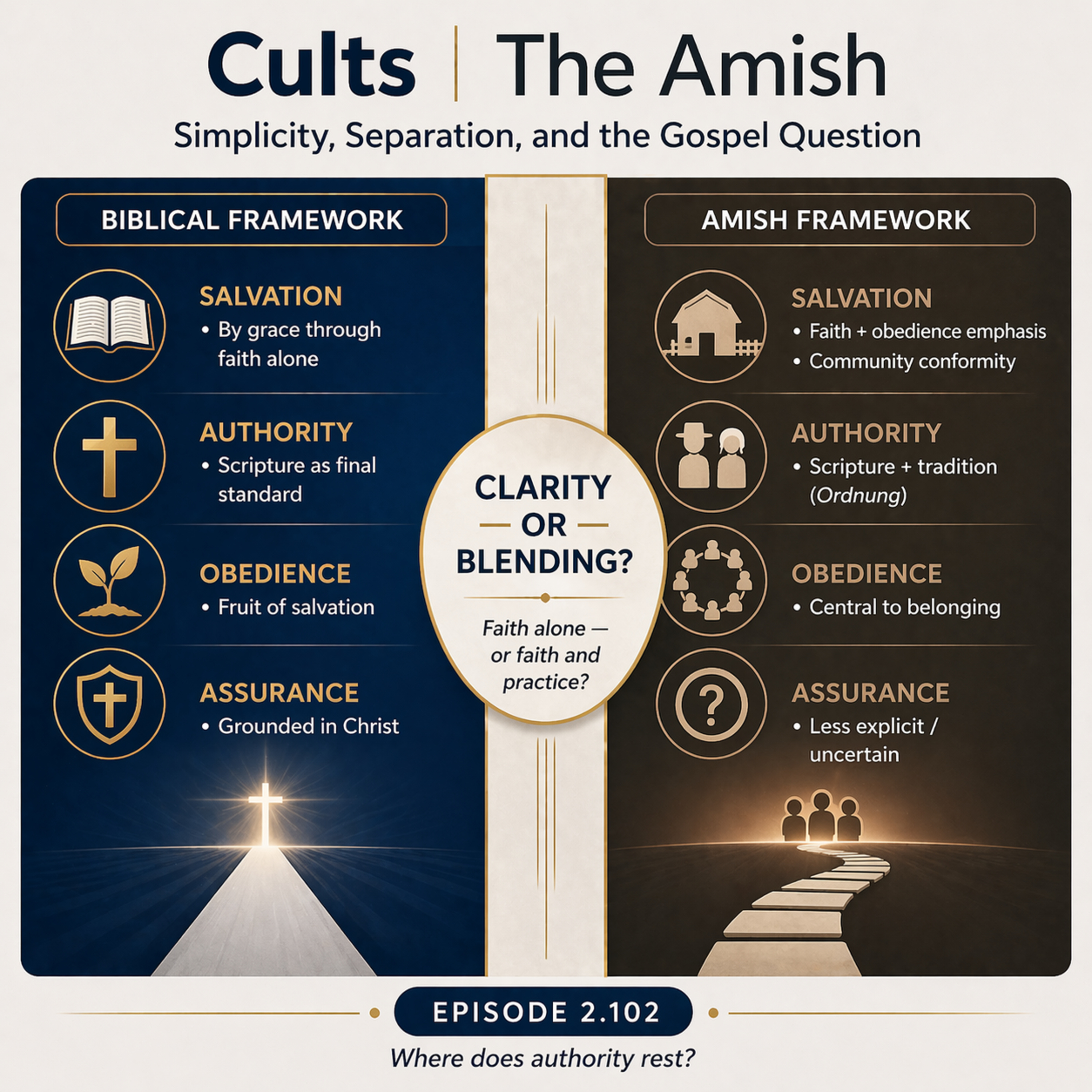
In this episode of Cults, Michael and Zach examine the Amish—a unique Anabaptist tradition known for simplicity, separation from modern culture, and strong community life. Rather than asking whether the Amish are a different religion, the episode focuses on a more precise question: how their theology and practice align with the biblical gospel and the authority of Scripture.
The discussion walks through Amish beliefs across key areas including theology proper, Christology, and especially soteriology, where concerns begin to emerge. While the Amish affirm historic Christian doctrines about God and Christ, their understanding of salvation often emphasizes obedience, community membership, and conformity to the Ordnung, with less clarity around justification by faith alone and assurance of salvation.
From there, the episode explores authority and practice—highlighting how Scripture, tradition, and community expectations function together, often elevating extra-biblical rules to binding status. Topics such as technology restrictions, shunning, and pacifism are examined not just culturally, but theologically. The episode concludes with a brief comparison to Mennonites and a balanced assessment of both strengths and concerns.
The takeaway is straightforward: the Amish preserve important elements of historic Christianity, but where authority shifts toward tradition and salvation becomes tied to performance, the clarity of the gospel and the sufficiency of Scripture are put at risk.
Find our videocast here: https://youtu.be/09clBAimUfk
Merch here: https://take-2-podcast.printify.me/
Music from #Uppbeat (free for Creators!):
https://uppbeat.io/t/reakt-music/deep-stone
License code: 2QZOZ2YHZ5UTE7C8
Find more Take 2 Theology content at http://www.take2theology.com
0:00 You ever have something like you just try to get rid of it and you can't? Oh. Man, Yeah, yeah, 'cause right now what we're doing is what you're saying. So I was watching a reel of this guy that I watch who left the Amish. Wow. When he was 17 and it just dawned on me we didn't cover the Amish. Wow and. So we are. And so we are, we are right now covering the Amish. Yeah, you were. You were singing the song a little earlier. Amish Paradise. Weird Al. You know that guy, he's been asked about that song. He said we loved it. He said we listened to that and he's like, we, we loved that song. But probably not gonna get as many comments on this episode. That's many YouTube accounts in the Amish world maybe? Yeah, but maybe some former Amish. There you go.
0:53 That would. Be good. That would be good if if you're former Amish and you're listening to this 'cause it got served up to you. We would love especially 'cause when we get into the sources, as you might imagine, there are not like a lot of online sources for Amish doctrine. Makes sense. So that was a question I had when I was researching this, Like how do we know what we know? And so there were some people like sit down and interviewed and and such. And so we do have some of that, but I feel like we need to once again, maybe for the last time. Yeah, maybe. Give our disclaimer about cults and just say that we're using cults in the academic sense, OK, not the pejorative sense or not the cultural sense that, you know, both of us have advanced degrees in areas of theology and in our studies we did have a study on the cults.
1:50 Did you have a class on the? Cults. I did. Yeah, I did. Undergraduate. In Martin School. Walter Martin. Probably have to look it was. It was like this huge book, no? No, mine, it was I, I wish I could go back to my to my colt's class. It was great. It was in my undergrad and we just, it went great. It, it was a little wild in a, in a, in a fun way. I yours was probably better than. Mine. OK, All right. Well, so Colt in the sense is really a sect of a religion that has big differences. And so we'll we'll look into the Amish, not necessarily saying that it does even fit into that, but there are some concerns with the doctrine that we're going to get to.
2:33 So with that, let's take it to the next level. Let's fire up that twangy music. From the hearts of the Low Country in South Carolina. It's the Take Two podcast where we take theology to the next level. The Amish are a radical and a Baptist offshoot. I just heard a a little thing on my computer, so I'm just making sure. Should we should we start that over? Let's start over. Just to be safe. Just to be safe. I mean, should we start over the I? I think everything's fine here. I don't know what the dung dami.
3:19 All right, everything looks fine. All right. Sweet. All right, so the Amish are a radical and a Baptist offshoot, and we do have some concerns about their authority structure and salvation and really some of their separation rules which you might think are good, like we probably could use some of their. Separation, finding that balance. And if you don't know a lot about the Amish, that's probably like the one thing you might know about the Amish. Yeah, horse and buggy, you know, not using cars, not using electricity, but they can if it's someone else's. So they can, you know they can. Also also, I feel like the yeah, the clothing really stands out.
4:02 Maybe the facial hair, Like when you know it, you it's like you might know it when you see it. Yeah, and maybe my facial hair is headed in that direction. You gotta be careful. Yeah, I think buttons, you can't use the buttons because those are considered English there. Yeah, but all right, so the real question is, are they a different religion? Do they? Do they have issues in these key doctrines which we've covered in the other ones? But before we get to that, maybe you don't know much about the Amish other than they have good furniture. They can build a barn today. That's right. They can make good pies from understand. So other than those kind of external things, what, what should we know about the Amish? Well, they come out of, like we already said, the Anabaptist movement from the 16th century Reformation. We see everyone's kind of separating from the Roman Catholic Church, there's these divisions, and we find the Anabaptist kind of finding their ground. Don't agree with a lot of what Anabaptist movement was about, but man did they nail rejecting infant baptism. They did.
5:06 They rejected infant baptism, emphasized believers, baptism, and holy living or separate living, and they were persecuted by both Catholics and. Protestants, they had no friends. It wasn't like they were going to like Martin Luther for, you know, help. It was like, no, he was like, no, this is not good. So then there was this main line that either was or became the Mennonites, and the Amish split off from the Mennonites in 1600s. And we will have a comparison between the Amish and the Midnights at the very end of this episode. They're similar but but the Amish is kind of like the more extreme version. So where did their name came from? Jacob. Jacob Aman. I wonder if it's like, you know, they speak like a German.
5:46 Dialect. Yeah, You see that Jacob with AK, Yeah, you just like want to say it? Yeah, yeah, yeah. He was a Swiss and a Baptist leader, emphasized strict church discipline, advocated strong separation from the world. Obviously required practices like shunning, excommunication and avoidance. I I know most of what I know about shunning from the office cause Dwight Schrute does a really good shunning. Shun, unshun, shun. Yeah, yeah, yeah. Yeah. Oh, and his followers from his name took on the Amish. Yeah, yeah, yeah. OK, nice. Yeah. All right. And if if you're located in America, you probably know this. Most of our listeners aren't, although we do have some in, you know, the UK and and abroad.
6:29 That's right. But recent estimates put them at 350,000 up to 400,000 worldwide. Up the most of those are in the United States. You're looking at the notes, but Lancaster County, Pennsylvania. Pennsylvania Amish Country. Apparently there's some in Ohio and Indiana. Those are the three primary and then there's some pockets in Wisconsin, Michigan and Kentucky. And see this note here fast. One of the fastest growing religious groups in America. And you gotta you gotta think what are the growing religious groups?
7:12 You know what's not shrinking with birth rates anyway, So that that probably, you know, I'm sure they're. I'm sure they're Mormons and Islam are the fastest 3 growing. I I bet, I bet. All right, so some of the general characteristics we talked about this known for their plain clothing, their plain dress, separation from modern culture, limited use of technology, horse and buggy transportation, strong community structure, and emphasis on humility and obedience. They don't speak English regularly to outsiders. They would, but they would speak a dialect of German called Pennsylvania Dutch. I think Joel speaks a little bit of this our.
7:53 Pastor, let's let's ask. Milk, milk and. That's what it is. Oh, I. Love it their church structure, they don't have centralized authority. So kind of a full swing away from our our what we just did on the Catholics in Eastern Orthodox, they do have local bishops that oversee a district. Decisions are communal, not individual. Man, and so that comes into play with like the shunning all the stuff. It is very like a community feel at this based on everything that that they do. So if you're gonna like defect it, that's a pretty big deal 'cause you're, it's not like you've got a few friends. It's like, man, you get cut off. It is, yeah. So this guy that that I was watching, he left when he was 17 and basically his family wanted nothing to do with him for a number of years. Then finally they're like, you can come back and visit, but that like he comes back and he visits like in the evening so that other people in the community don't see him. And he even tries to like like he's was wearing a button up shirt that we no one would think anything about, but that was like too worldly for them.
8:58 And so his mom asked him if he could wear something different. So he like he has his shirt that he'll wear when he goes back and visits so. Wow man. All right, So what do we know about their beliefs? I'll let you just tell us about this confession of faith. The. Tortricht. I can't say it. Yeah, it's some German name Dortreich Dortricht. OK. 1632 so right in line with like 1689, you got like Westminster. It's like all the confessions were being, you know, written. And that confession of faith is shared with the Mennonites, then they just their live practice is some of how we know there's ethnographic research. So Donald Kraybill wrote the Riddle of the Amish culture. So some of this is pulled from that interviews, internal teaching traditions and sources.
9:48 We'll have a full sources section at the end. Not that we got to go through all of them, but just kind of mentioned some if you were interested in reading more. All right, The Ordnung Ordnung, it's not a published rule book. It is an oral community specific list of rules. It's enforced by the local Bishop, and the Ordnung would control everything about your life if you're an. Amish, and so you're saying kind of varies from community to community, so each community has their own ordinance? Correct. Yeah, yeah. And so it would govern what that community could use as far as technology or their limits. Like you can't own this, but you could use this type of thing their dress what behavior is acceptable social boundaries and the we would say is not scripture, obviously, but it functions like it's a binding authority gotcha. So it's.
10:44 A it's a pretty big deal. It might be like a Protestant point, like a Presbyterian saying, hey, I love Westminster Confession of faith really important. It's not Scripture but as I don't know if it's the same as this but in as much as it agrees with Scripture and in Scripture but it's like it's an important document. I would say it's even more for the Amish, for the Amish. A person there in the community may not be able to distinguish between the authorities of Scripture and, and the org nug, like the org Nug is just in fact, I have a note somewhere. We'll we'll probably see it and, and get to it. But it would be similar to the fence laws that the Jews had under, you know, the, the Second Temple Talmud, I think it is.
11:29 So basically we know that, you know, it's, this is keeping us in line type of thing. It's not exactly like that, but it would have the same force. And you would do it if you were in good state. Like it's like you would just, if you're a good Pharisee or whatever, you're gonna like, do these things, yeah. All right, so let's look at the four doctrinal areas that we have looked at for each one of the past, several of of these. So theology Proctor, that's good, affirm historic Christian orthodoxy regarding God. So no issues here. They affirm Father, Son, Holy Spirit, classical doctrines of God.
12:11 Dude, good job Amish, we're one for one. One for one Christology, their view of Jesus again, fully orthodox, full deity of Christ, full humanity of Christ, death and resurrection. So no meaningful break. 2 for two. They're nailing it. Where could they go wrong? All right, well, here's where we might start having concerns. Their view of what it means to be saved. Like if you were to ask them, what do I need to be saved? A careful learned Amish might be able to give you an answer close to what we would give. But someone that's just in the ordinary day-to-day practice would say that, you know, you would need to basically be a rule follower. So there's a huge emphasis on obedience and submission. Salvation is tied to faithfulness to within that community.
12:58 And then there's a lack of assurance. So you could, you know, be good, be good, be good, be. Good, but you make that. It almost. Reminds me, it's different, but like, man, fundamentalism, like we like, it's like the gospel's there, but in practice, maybe it's not there and maybe some people are really depending on these works. I mean, it's different, but, you know, you can see I can relate to the strong emphasis on assurances, not huge rule. Yeah. All right, so their functional model salvation is often functions as faith, which we would agree with, but then we they would add on obedience, church membership and conformity to the local ordnung that we already discussed.
13:40 And of course, we would see this as being in tension with key biblical doctrines like we'd find in Ephesians 289 by grace you've been saved through faith and that not of yourselves as a gift to God, not a result of works. And the one may boast Galatians 216 you're not justified by works of the law. Romans where Paul would say it's either by grace or works, it can't be both. So those would be some of the key issues that we've raised with other folks where works become tied into their view of what it means to be justified. So there's no clear distinction for them, just like others between, you know, justification being declared righteous and sanctification where you're growing in your practical righteousness or holiness.
14:23 Man, so kind of looking at that topic of assurance it it might be hard for someone who is Amish to be like, man, I know it without a shadow of a doubt, 100% I'm saved. Yeah, Yeah, they would. They would they would have difficulty saying that because you wouldn't know that until unless you died in good standing and and living a good life. Yeah, cool. All right. Authority, bibliology or Sola scriptur. Where do they fall on this? They affirm the Bible as authoritative. So if you ask someone, they could probably give you the the right answer. But in practical function, you do have scripture, you have church tradition, you have your community interpretation.
15:03 And then there's this key thing, the ordnook again, keep showing up. And here's my note about the offense laws in the Second Temple. Just like the Jews created those extra rules to prevent God breaking God's law, they started becoming treated as binding. And so Jesus would even say, you know, you've elevated your laws to be equal to the God. God's laws. Mark 7-8 says you leave the commandment of God and hold to the tradition of men. So it's not that they don't have authority, it's just that some of the authority is placed in Scripture. But maybe on a practical level it's more in the ordinate. And that that's good.
15:44 And going back to this fundamentalist comparison, it's like church, I grew up. I don't want to paint in a battle like preach the gospel. Great. But there were maybe certain families there super on that fundamentalist side, which might be like, hey, women shouldn't wear pants and it and they would not say that superseded scripture, but that was kind of like, at least for them in their circle, like the community expectation that they would be like, Oh yeah, that aligned with. Scripture. Amen. Praise be to God for cool hots no matter what cool hots at all times. But but you can see like how this can get flipped practically at least, you know, like, that's not like too outlandish, you know? Yeah, yeah, yeah, absolutely. The The church that my family went to when we were in Michigan, same thing.
16:27 Very legalistic, very from the Who's the guy that wrote all those books? Oh yeah. You know who I'm talking. About I I I think I do in my mind. You had those conferences of youth, youth conferences. Yeah, I know what you mean. You you probably know that's what happens when you, oh, you can't remember names. It'll come to me in a little bit. But yes, very in that that line of legalism about what you could wear and stuff like that. All right, so those are the four big doctrines. So really you could be Amish as an individual and be saved, have faith in Christ. The only concern that we would have is if on a practical level in some of those communities, that faith is deemphasized and works and really works according to the org NUG are emphasized above and you know, above and beyond, you know, faith in Christ for his sacrifice in the cross. I as we transition to the next area, I love how they refer to outsiders as English.
17:32 You know, yes, really, really go in there 'cause they're ban if you, if you are English and you have English technologies, we're we're, we're banning those English technologies. That's right. Yeah. So like, like you said, they refer to outsiders as English. And you could see that some of these restrictions might be good. You know, yeah, we probably could use some moderation, but we would say this is an issue of wisdom, not of sin. Yeah. Yeah, and you look at all the stats I've read, everyone's like, well, you know, the Amish, your way healthier, way less incidence of like all these diseases, autism, all the things you know, so, you know, ADHD, there's no doubt I. Mean, but they're all also working all the day, you know, all to. Building barns, Yeah, barn raisings and all these. Things they don't have, you know, the chronic diseases of sitting in an office, you know, for 8 hours a day. But these state of purpose of these separations, they prevent pride.
18:27 They help preserve the community, they avoid worldliness and they maintain separation. So and of course we would see some of these, those goals, as good Romans 12/2 says, do not be conformed to this world. So, but you can, you know, take that too far. Totally. And and essentially we've been talking about you fall into legalism. Maybe there's a couple different levels that we can talk about here. Yeah, So I think like legalism, light, at the very least, you could see how this is elevating human rules to divine status. And so if you break one of these rules, it's considered sin. And that that's that's a problem. You know, Paul, even when talking about like eating meat, you know, sacrificed to idols is like, it's not really that bad. But if you think it's bad, it's bad, right? So you shouldn't go against your conscience, but you also shouldn't raise those rules up to be equal to God. But then the second type of legalism which is more serious in nature, which probably exists like we said in other areas, is where you know you are trying to follow these made-up rules in order to get justifica justification. And so that is that that is no bueno. No bueno.
19:46 Basically wrote all of Galatians to address that is. That the Spanish version you have that memorized the Spanish version, that's Galatians. But yeah, so and, and, and we should say, just like with everything else, it's like maybe this one community is a little bit more in this direction, a little bit less. This is, you know, broad strokes. Yeah, it is broad strokes because it they don't have a centralized authority. So it's hard to know unless you were to live with a particular community and figure out what what they were doing. And so I want to say, you know, what does Orthodoxy say about those? Well, salvation justification comes from faith alone, apart from works, law keeping and rule keeping. We would say that if you had a life trajectory that indicated that, you know, you weren't living according to God's plan, we would say maybe you're not a true believer. But again, we're judging this off of your whole life, not off of following an individual rule.
20:40 And those rules that we're talking about are, you know, the rules you would find in Scripture are not, you know, your, are you using a cell phone or not? Yeah, that is a very good distinction. And Speaking of distinctions, let's get into the fun stuff. I feel like the other thing people know about Amish is Rumspringa is like, you go crazy, at least in all the sitcoms, it's like you just go so crazy. Total rebellion. It's this like, you can do anything you want for a period of time. What? What's What's it really? Well, I think you might find some of that because I have seen like a documentary on PBS this like 10 years ago, I think, where they followed some Amish, you know, young adults, late, you know, or older kids. And it was something like that.
21:22 But that doesn't mean that they're all like that. They do want the youth to experience the outside world. And then this is the time where they decide like, hey, are you going to make this faith your own or not? Yeah, there's something to that. Like I don't agree with this practice, but I like that in some way they're asking that person, Hey, you got to make a decision now, join the church or not. Like you're not like in the snowman's like wishy washy. I feel like, you know, in America it's the opposite problem. It's like extended adolescence and there's no decision making. And he just kind of drifts. Don't think Rome Springer's probably the way to go, but at least they're making like there's like they're putting some accountability on on the kid. Yeah, and if you don't choose, you are not formally shunned at that point.
22:04 I did not know this OK. I think it practically, you might be shunned in practice, like, well, you're not formally shunned, but you can't be a part of us 'cause you're not a part of us type of thing. Speaking of shunning Maidung, I guess that's how you pronounce that Medung. That sounds Asian instead of German. I don't know, but it's a German word and it's basically their word for shunning. And we talked about, you know, the restrictions from their normal interactions is socially avoided. They're going to base this on 1st Corinthians 511 that says don't even eat with such a one, which, you know, if you are informal shunning, this would apply. But maybe they are over shunning. You know, they've got to shun shunning down too far. Yeah.
22:53 And also, you know that I agree with exactly how they carry it out. There's something to this, too, where if you exercise church discipline, it's good to make it mean something, You know? I think the thing in America too is you just never address anything and you'll let everything drift and no one cares and you just carry on. No, Yep. All right. We're just kind of going over some of the unique characteristics of Amish, not necessarily things that would be, you know, rise to the level of heretical. One of those other unique characteristics is their stance on pacifism. Boom, no military service. I'm against all violence. There you go. Based on Matthew 539, do not resist the the one who is evil.
23:37 However, if you're rightly dividing all the scripture, you might go, well, Romans 13 talks about the government bearing sword and it's authorized from God to do so. There's got to be someone, some person who actually stands in that office. So it doesn't seems like that wouldn't that would be fine. You know, it's not just like evil people that God puts in public office to do those things. Genesis 9, you know, we see Noah coming out of the ark and we see capital punishment explicitly allowed. Proverbs 2411 says rescue those being LED away to death. And Proverbs 327 says do not withhold good from those to whom it is due when it is in your power to act. And I think most people would say that saving someones life would be a good.
24:25 Probably, I think so. I I think you're right about that. One, unless it's the guy that, you know, Mr. Incredible saves, you know, OK, you don't get you don't get those references. Back over my head, yeah. Yeah, yeah, everyone else. Is loving it. Yeah, yeah, yeah. All right, so, and and last note here, the Mosaic law does all. We're not underneath the Mosaic law proper. It does have a category for self-defense that is allowed. So all right, Amish, Mennonite comparison, just quickly go through these again. They both come from the Anabaptist tradition. They historically share the same trinological theology, Orthodox Christology, believers, baptism, all the things that we talked about, pacifism, separation, key differences is really in degree.
25:17 The Amish are going to practice a more strict and more consistent version of shunning, whereas the Mennonites, they practice discipline, but it's not, it's less formal. Yeah, they're more chill. They're more chill, yeah. Yeah. Yeah. As far as separation, again, and it's matters of degree. You can see Mennonite communities, but they're not as separate as the Amish and it's not as structured as the Amish for authority and community. The Amish we talked about, the Ordnung is, you know, it's a binding like this is, this is going to be part of who our community is.
25:58 Whereas the midnights are going to have a wider spectrum, you know, where they may allow some significant individual freedom in their community. And I wonder if Mennonite's like if like you run across 1 midnight and you're like, oh, you're Amish. They they're like, dude, not that strict. Like way way more. Yeah, I'm sure that they they get that a little bit I'm. Sure, just everyone automatically maybe goes to the Amish calling. Again, for salvation insurance for the Amish, just, I know this is a little bit repetitive, but you know, salvation is closely tied to community membership and conformity. The Mennonite is often more individual expressed, more consciously driven.
26:40 So maybe that little bit more of a sweet spot where we would recognize him, the good that the Amish are doing, but not to the extreme that the Amish do it. Sources. If you're looking for more on this, the Dortrik. Dortrik, I'm sure I mispronounced that confession of faith from 1632. There's also a Mennonite Confession of Faith from 1995, and then some historical and academic sources. Introduction in Mennonite history, the Riddle of the Amish culture. We already referenced that, so I'm sure if you were interested you could find others. So really kind of the the bottom line, the Amish, they don't deny the Trinity or the personhood of Christ. They have a good view of God.
27:27 So it's really how much is works working its way into salvation. Now that that's a good way to put it, very separatist. And on that authority structure, you know, what do they base their salvation on? I like it. And maybe this rounds out our series, maybe it doesn't. Yeah, I think, well, I think we have one more in the series. To round out the series. Basically to round out the series where we're going to look at the book of Jude. Nice. I like it. It's good. Yeah. Sweets we transitioning to the. Final take. The final take, Yeah, You were in enemy territory. Oh. I wasn't in enemy territory tonight. Yeah, eating at Steel City. How, How dare you set your How dare you, a Patriots fan, set your foot in that fine eating establishment?
28:13 Oh man, like I was. I told Zach before we started recording that it's really it is good food. Yeah, I like, I like Steel City. Yeah, it's really good. It's like good enough to make the playoffs regularly but not necessarily win a playoff game. Yeah, yeah, you know, that's the story I'm on. I do like still city pizza though, but and it's right there, convenient next to Northwood. You know it is. You got you guys. We had like a pay my vote or like how did we? Oh, yeah, This was so we were going to eat out. This is actually our Sunday meal. Translated to Tuesday evening. Yeah, yeah. Because we're going to eat out for Easter and then we did in that evening and then we're going to do it last night and didn't work out.
28:53 And then it's like if we don't do it soon, it's not. Really makes. Sense because we're trying to do Top Golf sometime this week as well. Sweet for spring break type stuff. Yeah, that's really fun. I was like. Trying to get us to go to heavies or pose, but it just did not work with us recording. And we wanted to, you know, be faithful to what we said about recording tonight, too, so. That's good. You can if you need to. I mean. Not that it makes difference now because you're but you were saying that one thing about like Karis and Chloe that like rubbed you the wrong way. Do you remember? Can you say that you're like going on and on? No, I'm just kidding. Karis and Chloe happened to be in the house listening so.
29:34 So we got to be careful, be on our PS and QS. You know that's. Right, what'd you get? Lasagna is what you said I got. Lasagna I had, so I had to go buy Sam's Club where I sent you a picture of this sauna wonderful that you're wanting, and I got a slice of pizza there, so it's like I didn't want another slice of. Pizza. Oh, I see. Yeah. I didn't necessarily want wings either, so I got some lasagna, which is kind of. Yeah, I've never had their lasagna there. I don't go there. Pretty good. Yeah, it's pretty. Good. Pretty cheesy, so yeah. That's good. I get the they have like a like a Steel City kind of pizza, like I don't know what it's called, but it's kind of like a. They're. They yeah, something like that. Like that? Yeah, whatever. And that's what you get when you that's.
30:15 Really good, you know, getting the but yeah, haven't been there in a while. We've got a gift card there. So like we got to go. We almost went there today. Oh wow. But it would have been at like way earlier, you guys, but we decided that didn't work out. Yeah, yeah, yeah. They have a Hawaiian pizza with a hot honey. Well, their menu changed. I didn't look at their pizzas because I didn't want pizza. So it is possible that it's not on their new menu because I didn't look at it. But previously they had that and it was pretty good. I've. Yeah. So you're obviously a pro pineapple on the pizza guy because you know, that's like a thing. Oh yeah, I, I, I, I like, I need to on the pizza. I need to. People get all banana shape out of it, you know, I like pineapple on the pizza. And I will say this, our last D&D session we ordered Marco's Pizza.
31:01 Oh. Yeah, I like theirs. And there what is we got some. We got some with pineapple. We also got some with anchovies. Oh, that's, that's my, it was my first time and I was, I've never had it before. I'm fine with this because like I eat sardines and that's fine. And I ate one slice with it on anchovies and I was like, you know what? I am not fine with anchovies. On pizzas. I am against it I. Don't even know, I've never had it but it just doesn't sound great. I just feel like something really salty, I don't know. You know, yeah, it was. Yeah. It's just. Who's who? Who wanted it? Adam Well, Richard and and James both were like, yeah, I'm down with anchovies, so. And I ate one slice too, yeah. So I should knock it till I tried?
31:41 I've never tried it. Just, you know, someone was like, this is the last piece because we only got half of 1 of the pizza. Oh yeah. That makes sense, yeah. This is the last one with anchovies. I was like, eat it, take it, don't, don't worry about me so. Man covered our bases. Amish, Mennonites and pizza. Yeah, and one other thing about D&D is we figured this out. This is, I was thinking this is going to air after this 'cause we're actually pretty ahead in recording. So, so we got like a week and 1/2 in advance, maybe more. So I was concerned that I was preaching this Sunday 'cause I'd forgotten. And then I was like, it was like, no, it's next Sunday. I was like, OK, that's good. But then I realized, so I'll be teaching Sunday school. Yeah.
32:25 That'll be stressful. Preaching, which I've done that before, done both of us, and then our D&D is that afternoon. Wow, it's gonna. Be a full day. Dude big. I should just lead lead singing that day and just have, well, why? Not you only. Do the Michael Mott show, Yeah. Do announcements while you're at. It'll be great. Maybe you could do like a riff on the piano too. Like run over there and like be like 10. Watch this you know. It's all me. It's all me. Yeah, yeah, yeah, that's yeah. There you go. But you're gonna. Be preaching here pretty soon, right? Hey, I'm I'm not anti against it. I just, I, I don't think I can do it in the flow of I need to like prepare more of it. I can't do it in the flow of like the Sermon on the Mount or like, you know, like look ahead you. Want to do your own? I would have to like know, I would have to like know where to be.
33:07 You know what I mean? I can't like wait like 2 weeks out. I would like. To prepare, I do want to ask Joel tomorrow if I pick up on somewhere on the mount, like where are you going to be at? What, what section am I going to have 'cause I was thinking I might, you know, there was a part of me that's like, I just basically executed the book of Jude. Oh yeah. And I was like, I could just preach Jude as well. So I don't know. So it'll either be Sermon on the Mount or Jude. Yeah, I was going to bring it up tomorrow at our meeting 'cause I felt either at our last meeting or the meeting before felt your piercing eyes staring. I was like not looking at, it's like you're staring into my soul. So. But it would be good.
33:51 Oh, great. Yeah. Well, I guess maybe one of these. We'll get a recap on Michael Day. Where you? Where you and 'cause you'll be coming out of the D&D the day before. So no, no, it's the D&D that night. Oh, after on Sunday. After Oh, that's good. So you'll be like, I mean, tired. But there's a lot, like, since I'm in the DM, there's a lot of prep that goes into it. So I'm like, I'll be prepping for my lesson, wow, prepping for my sermon, prepping for the D&D session. And this is the session where we fight the big bad ego guy BBEG that basically caps off. So it's a pretty big session. That's a big deal. I don't know if the group would like this, but hear me out. There's a lot about D&D you might want to take. My advice. You should do a session based on false teachers and Jude not parenting well and then you can like prepare for all of your Sunday school.
34:40 The message Andy, Andy, all at once. Jonathan did mention like, you know, I hope there's bleed over. I was like, you talk about the session into the preaching. He's like, it doesn't matter either way. He's like, you know, maybe one of us do something wrong and boom, we have leprosy, you know? Yeah, that actually be pretty funny if like you just started preaching and it was, I don't know how the ending session goes, but you just were going off that script. You're like, Oh, no. Wrong, Wrong scripts. So you're walking into the dungeon. I need everyone to make a perception check that. 'D be pretty good, Pretty good. Well, I think we did it. We covered. It all I think so. Until next time, that's our take. Thanks for listening to Take Two. Find us wherever you find podcasts and on YouTube for those who want to watch our video cast.

