End Times 101: How Should We Read Revelation?


 RSS Feed
Episode 2.107
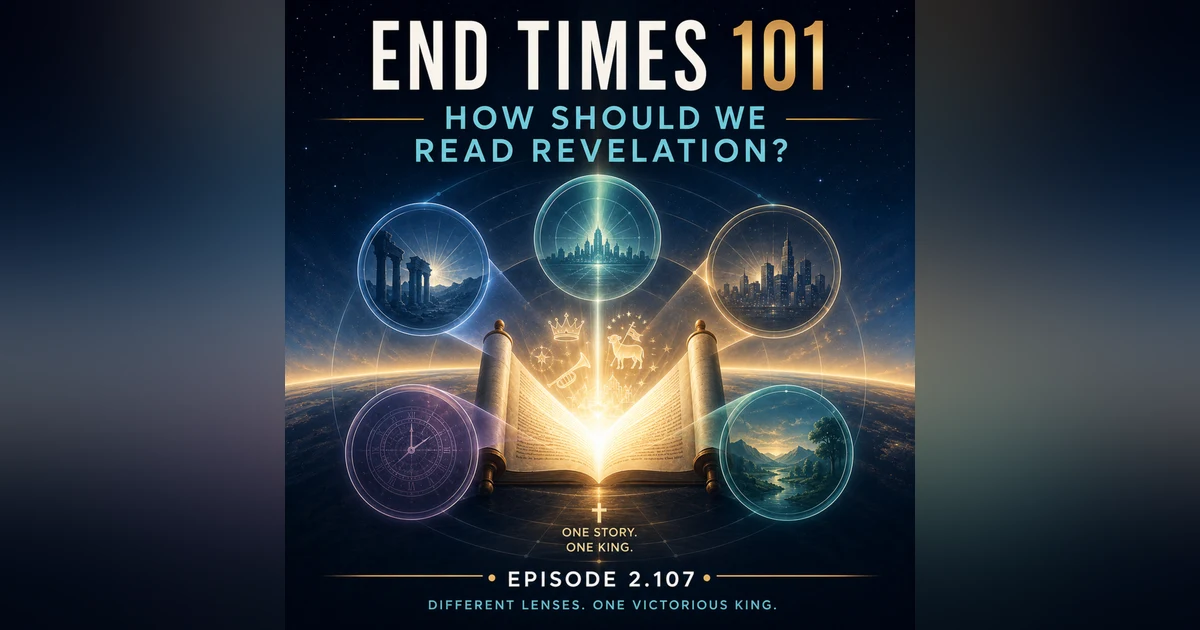
In this episode, Michael and Zach close out their End Times 101 series by tackling one of the biggest questions surrounding the book of Revelation: how are Christians actually supposed to read it? Rather than jumping immediately into timelines, raptures, or the millennium, the discussion focuses first on the interpretive frameworks that shape how believers understand Revelation in the first place.
The episode explores Revelation as apocalyptic literature, prophecy, and a letter written to real churches facing real persecution. From there, Michael and Zach walk through the five major interpretive approaches to Revelation—Preterist, Futurist, Historicist, Idealist, and Eclectic—explaining the strengths, weaknesses, and theological assumptions behind each view. Along the way, they discuss how symbolism, historical context, genre, and chronology affect interpretation and why faithful Christians often arrive at different conclusions.
The conversation also connects these interpretive methods to broader end-times systems such as dispensational premillennialism, historic premillennialism, amillennialism, and postmillennialism. Throughout the episode, the emphasis remains pastoral rather than speculative: Revelation was not written to produce fear or obsession, but to anchor believers in the victory and sovereignty of Christ. Whatever view one ultimately holds, the central message remains the same—Jesus wins, evil loses, and God will make all things new.
Find our videocast here: https://youtu.be/bJVVzgSSj00
Merch here: https://take-2-podcast.printify.me/
Music from #Uppbeat (free for Creators!):
https://uppbeat.io/t/reakt-music/deep-stone
License code: 2QZOZ2YHZ5UTE7C8
Find more Take 2 Theology content at http://www.take2theology.com
0:00 Well, we covered a bunch of different end times views. That's right, some of them are right. Some of them are wrong. Some of them are wrong, but by very, by the very nature, you know, they can't. They're kind of mutually exclusive, I guess. Historic pre mill and dispute pre mill. Yeah, they have overlap. Yeah, yeah, yeah, yeah. A lot of overlap. And then at least especially my version. Yeah, especially your version of the post Trib. Yeah, yeah. The the if we had a true, yeah, first or second wave dispensational of that conversation would have been different. And we, I don't know, I thought should we've done a episode just for that, but I don't, I don't know what we gained. I think we've talked about it enough where people would understand and I hope I know what some of the stuff is hard to break down, but I hope it was like as Simply put, I know we we dove into some text, but yeah, that's right. And so we thought we would do our next episode. You're probably like, what's the other view there? There's when I almost been an episode on something called it's like new creation alienism and but it's basically a spin off of pre meal.
1:07 That's kind of like the like it's almost like what you thought with post meal initially. It's it's kind of like that, like it like ushers in the Millennium. You have to do with that kind of all like, like we're restoring community. It's like, but it's it's still a literal. Mill and a pre meal put together like the the lead up to and then he comes in and he reigns. Yeah, yeah. And it was like kind of too similar. It wasn't that different. It was hard to make a whole episode on it. And it's poorly defined. And I, I think some people are like carving that out now as like a distinction. It's not not super defined. It's not going to make like I've got the ESB study Bible in front of me. It's not going to make the ESB study Bible. They. Just call it biblical eschatology.
1:48 That that is the best passive aggressive way to like assert your, your, you just put biblical in front in front of it and you're like, you win, you win the argument. That's good. Well, today, instead of going over a different view, we thought we would look at how to read Revelation because there's a lot of different ways to process it. And, and a lot of that, as we have discussed, plays into your end times view, what you think is going to happen. And there there's starkly different ways you, you can reach. So I thought, we thought maybe that would be a good idea. I like to talk about, hey, people like to talk about revelations, which is the first mistake. Yeah, you're saying revelations. I I guess you could say I've had many revelations. Right, right.
2:28 But. You've only read one Book of Revelation. Right. So we're just trying to help you out. If you're in a conversation, that's a telltale sign. If someone says that, start targeting that person because maybe they don't have all their ducks in a row because, you know, they're saying Revelations. But you know, many of us have read Revelation and and had these impulses. So I take it literally, symbolically, historically, something else or some of it one way, some of it another. Is it just a future timeline to the code? Is it just a drama between good and evil? Is it mostly all in the past? These things happened in the 1st century. Because before you decide what Revelation means, you have to decide, you know, what's it talking about?
3:10 How are you going to read it? That's very important. Who? Hermeneutical Principle. Very is very it really is. It's very important because well, yeah, I guess, yeah, you could I think maybe some readings wood forest you in a particular view, but probably all views could could stand some some certain types of readings. Yeah. Yeah, yeah, I I think you're right. We'll we'll get into, but let's go ahead and take it to the next level. Let's fire up that twanga music. From the hearts of the Low Country in South Carolina. It's the Take Two podcast where we take theology to the next level.
3:54 Well, Michael, what, what kind of book is Revelation? How would you describe it? Because I, I that's where a lot of the conversation centers around and, and it, it's challenging to unpack. You know what? What genre is this book? Yeah, I think well the the go to answer is apocalyptic and but I think there is some circularity here that you could have cause clearly there are, you know some of those pop apocalyptic. Elements. In it but if you know I've asked this question before how would you literally say that there's 12 or something or 40 or something or without because those numbers that can have like kind of stand in the place of something it's hard to communicate literal numbers if you can't take anything literally at all so yeah you're. Trying to communicate something and it is hard and I think you're right.
4:53 When in doubt, if you just say apocalyptic, you can like free your hands up. You can not. Not that people want to make it whatever you want to make it, but you can kind of like detach any strong meaning. Kind of it might be overstating that a little bit, but but it definitely fits that because it does use classic apocalyptic signs like vivid symbolic symbolic imagery to reveal spiritual realities. It was common at that time in Jewish literature that that's part of the problem. Today we're like, wait, a people don't read AB We don't have a ton of apocalyptic genre that would be weird to us. That's like not not the go to an American culture. I know we're reading through list, but like there are also similar creation stories at the time Genesis were written, but I think it would be a mistake to go, oh, look at these other near Eastern, ancient near Eastern creation myths.
5:45 Genesis is exactly like that. We have to interpret it that way because, you know, I think we we would all agree scripture is unique. So we read it for try to what it is not that we can't gain the insight by reading, but you don't want to just go oh. Because of these extra biblical sources, I like that I'm I'm putting together in the process of putting together a series on how not to read your Bible. And that's one of the things you can. I love historical cultural backgrounds, but you don't want to make it the foreground and interpret the text through that. You want to make it an aid and it's like helpful, but it it might not just because, you know, certain books are in this way, we can't that doesn't mean everything in this book gets because it's altogether different to the word of God. So that's good. So I think we're going to get into not only is apocalyptic, but it's prophecy as well.
6:31 And when you when you think of prophecy or you think of prophets, you know, I think we always just automatically jump up telling the future, which is a big part of it, but not always you read prophets. It's not always about what's happened in the future. Some of this stuff, you know, is speaking just those words of God. We're. Pretty sure that it was you know there are some views that would make it past him us, but it was still future tense to John that's. Pretty that that's true. That's very true. Also, it's a letter. It it says that should be written, you know, read aloud this letter, you know, blessed is the person. So it is rooted in a real historical context. So isn't isn't it isn't just about predicting the future, but it's revealing a spiritual reality to people in that day and age.
7:15 You know, these things must happen soon, these kind of things. So those are really, I think like what people are going to point to apocalyptic. It's prophecy, it's a letter. So that being said, there's a lot of, it's not one-size-fits-all, a little bit of of different genres kind of colliding. It takes some skill to to read and sort out. And and we should, I'll be the first to say I'm strong in my end times position. I'm strong in my reading revelation. It's OK. I could be wrong. I'm not like I've nailed everything because it is. And maybe you're right in this area and not right in this area. That's, you know, fine. So maybe we can start and and we can like work together and go over just a basic structure, just kind of hit some of the high points just to give people a flavor.
7:55 Or if you haven't read through it, you know, get these things in order and then kind of discuss how do you read these different things? Very good. So chapter one starts out this vision, vision of Christ, really famous vision like reminds people of Daniel and these things like, Oh man, this is this is pretty great. Did your church grow up singing talk about John? John, the Revelation. Oh no, but I like this. OK, Yeah, yeah, yeah. Maybe we can. I won't remember. So I always say maybe we can put that somewhere. I won't remember what I'm producing. I grew up with that song. Oh, I like it. Yeah. Yeah. You know, talk about this first vision, this chapter. That's, that's great. Chapter one kind of kicks us off.
8:35 You know, John's in the spirit on the Lord's day, these things. Then chapters 2 and three, we get these different letters to the churches and you know, this is this is like the safe area of revelation that the teach preach, do because it's like these are historical, whether it's before it gets into the craziness, you know, quote UN quote. And there are even some different interpretations of the churches because I've heard some people like, were all these literal churches? Were they just symbolic? Were they symbolic of different ages of the church? Church will go through all of that can be in there. So, yeah, yeah. So that it's not like a total slam dunk there. There's still some. Variety. It's still a safe that you can teach through that without having to pull out all the charts and stuff. In chapters 4 and five, we kind of get transported, transported to this throne room.
9:22 We see, you know, these visions of these great, you know, passages you sing in songs come from Chapter 5, then big section chapter 6 through 16. Both of the book. Here a lot, you're in the middle of it. You got seals, you got trumpets, you got bowls, you got all these different cycles of judgment that are happening. You know, the question is, are these just progressive and it's just like chronological, Are they like repeats, recapitulations. Chapter 17 through 19 we see the fall of Babylon, the return of Christ's you know, doesn't take if you if you haven't paying attention. Chapter 20 mentions the Millennium. So that's good. Then chapters 21 and 22, the new creation. So where you place these sections? Do they have in the past?
10:07 Are they present? Are they future that will largely influence your interpretation. What's this mean? A lot of it's where you place it in in history, very. Good. So what, what are the different tensions, a lot of tensions that that impact these different views, you know, literal verse, symbolic past, first future. Is it 1 fulfillment or is it repeated patterns of fulfillments? Keep these things in mind and we'll kind of jump into the five most common views view #1 the preterist view. And maybe we want to, you know, talk about partial verse full. Yeah, I'm just going to say that because from what I understand, the first people to use the word preterist when they explain their position, we would call them partial preterist.
10:54 And then other people came on the scene and they would be what we call a full preterist. And now I heard one preterist say we should not have to have the the adjective. We shouldn't be called partial preterism and preterism. It should be hyper preterism and preterism. But regardless, anytime you talk to someone who uses the word preterism, you need to establish, you know, are we talking about hyper partial? You know, how are you using the terms? Because different people can mean different things. So, but there are some people who would believe that basically everything in 2425 of Matthew and Revelation were fulfilled in that lead up to the sacking of Jerusalem in 7080. I think there's certainly elements in Matthew 2425. When you see, you know, when you see Jerusalem surrounded, you know, get out because we know Christians did get out. And then you know, who was the guy that was there first? Was it some guy was there?
11:56 He goes back because the the Caesar dies, he becomes Caesar and he sends his son and then it's his son that one of them, his name is Titus, but I don't remember which one is which. That's the father of the Son. But anyways, yeah, so different ways of saying preterism. So, you know the the basic idea is that some or all of Revelation, or maybe even most of it was already fulfilled in that 1st century time period. That that's good and I do have my ESV study Bible, which if this gives you any idea, I, I believe the theological editor of this was Ji Packer and then the general editor I think was Wayne Grudem. So it's, they try to have it like not nominational got a Baptist influence, Anglican these kind of things in in their preview or introduction to revelation, talking about preterism, partial preterism, they would say, you know, chapters one through 3, including these letters to the seven churches that lines up with 1st century churches. Chapters 4 through 11, they would categorize its seals, Trump as witnesses, really match with Jerusalem's fall in AD 70. A lot of partial predators would say chapters 12 through 19, the woman in the dragon beast bowls, harlot Armageddon, would actually correspond to the 4th and 4th century in Rome's fall. And then Chapter 20, the Millennium, you know, a lot of them would say, you know, this could refer to the Catholic Church, Reformation age, these kind of things like, couldn't it?
13:21 Would you know things going on now? But they would say, hey, the end of chapter 20, pass that a little bit second coming that that is future event. Very good. We might have a slightly different layout in the notes than a few. The key emesis, like Revelation 11 must soon take place. Two through three. Those are real churches. Revelation 6 through 11 might be Judgment tied to Rome and Jerusalem. 13 the beast. Some some might consider that Nero and then 17 through 18 Babylon's falling could be Rome falling or Jerusalem falling. Yeah, and if you someone like RC Sprole, a lot of, you know, all millennials, all millennialists will, will take this view and they they're, they'll be like, hey, you know, you look at number 666 like that's clearly mapping onto Nero like that. That's kind of how they're interpreting. And that's what they would say.
14:11 So they would say you add up the numbers and it's the name of this and it's like, and they would say the seven, whatever is the seven or the six King Caesars or whatever. And so they're kind of mapping this on to Rome, putting a lot of this in in the past strengths of this view takes the original audience very seriously. It grounds revelation in real history. The challenges is it's it's still hard to explain some of this cosmic language. It's like, does that? Would you say what happened in, you know, to Rome? Would you align it with that kind of language? Maybe you would, maybe you wouldn't you know, it's like hard to nail that down. And then Revelation 20 to 22 is is all clearly well, you know, clearly very future. So like where do you draw that line and map things on the past versus things that could happen?
15:01 I'm. Just thinking about passages like where it seems like there's some meteor falling into the ocean. Yeah, yeah, yeah, yeah. That's right. That seems like that hasn't happened yet. Yes, and and exactly right and. Turn to Wormwood and bitter and you can't drink it. And what what RC Sproll would focus a lot on in his at least in his book The last Days According to Jesus, and he's got a series on this. He maps it. He'll be like Josephus use some of the same cosmic imagery for the destruction of Jerusalem. He would say the stars were falling. And so, you know, you got, you know, whether that's what it is or not, but that that's what they're hinging. And I was like, Oh, you look at these other sources, they would say this cosmic stuff. I think us reading it, it does seem like there's got to be something more to that. So that that's the prejury and I guess we should also qualify it this way, like just like with everything else in Scripture or in theology, I should say, not every view is nice and neat like.
15:56 So I'm sure there's a preterist out there saying, hey, I disagree with four things you saw. There's a little bit of discrepancy between the notes we put together in the ESP study Bible. It's like largely the same, but maybe differs a little bit on specifics. Yeah, not, not that we had everything out, but the language of stars falling I think is different than the, you know, Revelation 88 through 9, says the second trumpet involved, well, great mountain burning with fire being cast in the sea. That's a little bit more vivid than just start falling. That's why I thought, well, maybe meteors hitting the Earth at some point. Something something like that would trigger someone to write it that way. I think that's good to think on the next view, it's kind of the opposite.
16:40 We're going to talk about the futurist view, probably largely what has been most common in evangelicalism in in America. You know, left behind version would fit into this and it would view Revelation 4 through 22. So not the letters, the letters they would say past, but four through 22. This is still future it it talks about, you know, in Revelation 4-5, this future vision 6 through 18, a tribulation 13 the Antichrist 19 the second coming, 20, the Millennium, these kind of things. And you kind of see this one big story, you know, you're progressing through essentially where there's not this recapitulation.
17:21 And if you can imagine, you know, this is a lot of premillennialists would fall into this, people like John MacArthur, Charles Riley, Tim Lahaye. I think if you're dispensational and you're pre Trib, you almost have to take this view. I'm not sure but but that's what those are the kinds of people you will see take this view by and what you're not going to see mill or post mill, really think about it in these terms. Yeah. I was just thinking about those statements because the recapitulation does that necessarily how does that relate to future versus past could could you not see? Just the future being talked about 3 or 4 different times essentially or. Five to me, and I need to do a deep study of revelation since I've learned about the recapitulation view. But in hearing you talking about it and thinking about what I've studied before it, I would almost personally come to the conclusion that perhaps the seals and then the trumpets and then the bowls were three different visions of the great Tribulation, which is still future. So I think it's. 3 recapitulations of a future thing versus.
18:33 Three different PO VS of and then you were talking about the the the the churches that were there and how they that they would still be, you know, passed. I would I specifically obviously, you know, 11 pinpoint of information from an evangelical dispensationalist view. So, but I remember being told these are literal historical churches, that they also stand for different ages of the church as you move through and you can kind of see how they might map on to general church ages like here is. Like America's in, we're later to see or we're something or whatever.
19:15 Yeah, that type, that type of. Thing but then you know the same it was you know any church could find themselves in any of these depending on their own situation. But you know that these are kind of the general types of churches that are out there and what Christ might say to you if you were in in that type of. Church yeah, and I I grew up in a similar church and our pastor preached something very similar, saying like this is the church from zero to 182, hundred to 400. We would map on that almost, you know, goes nicely with this next view, historicism, the historic view, which kind of is a church history timeline, where again, there's different strokes for different folks where some would say, hey, chapter one through 3, like they are for centuries churches, but some people met more on to that.
20:02 Some would say, like in this historicist view, chapters 4 through 19, the seals, the trumpets, trumpets, the beasts, bowls, harlot, Armageddon. They would actually do what you're saying too, like say, hey, this is the medieval church, this is the reformers, this is where we're at. This is modern leading up to the Millennium. And people like John Calvin and Martin Luther would say this. So yeah, yeah. Good, good people they met because so much was going on in their day. They were doing the same problem that many of us do today. You know, you read the newspaper and interpret your Bible that way. It's like, man, of course, Roman Catholic Church, the Antichrist, you know what I mean? Like you're. And so you not not throwing shade, but that's like kind of where a lot of them in the strengths is you see God really working in history and you're connecting Revelation to real life events.
20:50 It's not like my my whole complaint with all mills is that sometimes it just seems like nebulous, like nothing. It's like you can't grab on to what something means. This might. Be on the other end of that space. And and and yeah, exactly on the other end, maybe you're over realizing it, but the interesting thing is it's done also by all mills, right? Just all mills from years ago that because that that's exactly the challenge is it's highly subjective. You know, as we go more and more years, there's more and more parts of church history you don't know, like where to put. It's hard to map things. So, so as you can imagine, this view much less common today, the idealist, you know, this view is very trendy today. This is the view a lot of people like. And basically this is saying revelation describes recurring spiritual realities, this recapitulation thing. It's not one timeline and you would see cycles versus straight chronological.
21:42 It's the same themes. I like the way you put it. They put it in our notes, repeat it from different angles. You put it like different PO VS or you're saying it from here, from here, from here. People that teach this, a lot of people teach this. William Hendrickson is probably very famous from like the 30s or 40s today. People like Michael Horton, Michael Kruger, he teaches his class. He he puts a spin on it that I I really like. Michael Horton, is that white Horson? White Horson. Yeah, yeah, yeah, yeah, yeah, exactly. He's honestly Michael Horton's great. He's I think he's Westminster Theological Seminary. I like so much of what he writes. Just wish, you know, needs to be more one more Baptist that he would nail it. But he's so, so good. But the idealist view is strengths are, you know, this applies to every generation as well.
22:25 Things, these battles we go through there, there is every. Generation be looking for a fiery mountain. Too. So that's the challenge. It's less concrete because you are making everything mean whatever. It's hard to connect specific events like I just had my revelation or I mean that's probably over spiritualizing it. But you know, if you're thinking about it, revelation is always happening. It's the story of Christ versus evil in every different age. The way Michael Kruger puts it, he's Presbyterian. He's the president of Reformed Theological Seminary. He would say, hey, those are those are the four major views. Those are the 4 views you're going to find in, you know, ESC study by one of these things. Actually, Wayne Gruden just have 1/5 as well. He, Kruger calls it the eclectic view, where he's like, I'll just pick and choose what I like and this is the right view and I like it's a mixed view.
23:12 Different parts of Revelation are best read in different ways. Where you do read some of it historically, you do read some of it as recurring and also maybe historically, and then you read some of it as obviously future. And honestly, most of you would probably say they're here. They might just be heavy one way or the other. So if this is the fifth view that is there an eclectic UV on top of that that falls from all five of these views And so just pulling from the 4th that just meta take it. Meta totally, because even the way Wayne Grudem has in here, he has one, he says some introversible to mixed view that combines this or saying that, hey, some of these are past fulfillments and a future fulfillment, you know, so I think this is probably what most people are going to hang on.
23:58 People that have made this pop popular are people like Michael Kruger D and Carson, Greg Beal. Some people have really looked at this positively because it is a balanced view. It does take genre seriously, I think. I think the challenge is you still have to like know where to put things. It's it's not like, you know, it doesn't make everything perfect. You have to choose, Oh, this is future. This is when the Millennium happens. Then no, it's not. You still have to make these decisions. But if you're thinking through what you're reading and you can map it on one of these views, it does help you understand at least you know where people are coming from, how you're interpreting the book and that kind of thing. That's very. Good.
24:38 How do these connect to end times view? So this this is not one-size-fits-all, but I think by and large, if you are dispensational pre mill, you're going to take a futurist approach. If you're historic pre mill, you're going to take that futurist plus idealist approach, which in effect is eclectic. All millennial, all millennial will say idealist plus a preterist. But I think also, you know, some historical mill will say, hey, you know, partial predator for these kind of things. Post mill will lean into preterist and idealist. And many today would say eclectic. And I think a challenge today is a lot of people, it is tricky. It's not the end all be all, but I'll let people just throw their hands up and say like everything is true, you know, like I don't, you know, like that they, they're noncommittal and not in a relative like genderous fluid way, but in a theological like, you know, I don't know.
25:30 And I can sympathize with that. But I do think it's good to come to some sort of conviction because it's going to mean something. Some of that may be overreaction to what we grew up with because I did grow up with every single thing mapped out like and, and it was good. It was interesting and I thought, OK, I understand revelation because I was probably in high school. We went through this class and we went through, we met every single thing out. We talked about the different parts and, you know, and then I looked up and that was the rapture and I was like how I, I did have questions even back then. And then I looked up be the rapture. That's I think it's in chapter 4. Maybe it's in three. But anyways, I think probably some of what we experienced today is a maybe an overreaction to well, I don't think it was that. So I don't really know what it is, so I'm not going to read it. And I think what I hear you saying is you, you need to dig into it.
26:25 There's a special blessing for people who read through this. That's what what what it says. Yeah, and honestly, read it out loud, you get the double blessings. What's the one who reads? Those are the one who hears. Or what's it of those who hear? So, so yeah, probably. So maybe read through it and come to some conclusion on what you think. Might I? I thought overall what helped me I, I don't come to Michael Kruger's view, but reform fields theological seminary, like many of these other seminaries have like lectures for where you can access and you get like a seven part lecture on revelation and it he does a good job of explaining this view And I just I had my Bible, but I was kind of marking all the recapitulations and going through it that for me did it with like, Oh, I can see the recapitulation here.
27:10 I don't see the recapitulation between 19 and 20 that he would affirm. But like you're saying, like the seals, these trumpets, It's like it does make sense. There's a new vision, there's a new thing going on, new scene. It's very to and, you know, everyone else's different views, but it makes sense that this could be cyclical versus just, you know, we keep a loose straight through a lot. Yeah. Yeah, because there's like more than one time that a lot of the population dies you. Know wow, we're really trimming back the the world 1/3 here. You know, whatever, it's kind of tough some practical application. You know, how should you read Revelation? Besides, you know, reading it the way we think you should, you should read it the way.
27:50 Very pridefully, Very pridefully. My way is the only way. Whatever way you choose, be sure you fight with anyone who disagrees with you. One thing I've liked about this is I do have, I have liked some of the discussion that spurred our church right now recently just changed our eschatology statement, I think in a very positive way. Michael, don't. Know that we changed it. We we added, we didn't have one. Yeah, no, that's a very good point. We we changed it by putting something on paper because you should have an end time statement, because there are things that are important. Yeah. We previously had a statement on Christology that said something at the very end about Christ returning in the millennial reign and that was that was basically all that we had said eschatologically. So we took actually took the the pre mil out and then we added a, you know, a longer Eskadel Eskatological view, but you're about to say something.
28:41 And I think it's been positive. I think it's spurred on some good conversation whether people arrive at the same exact view. I think it's pushed me going through this series looking at that like to examine these things more, have a good conversation, agree on the things that are paramount, disagree on things, have your strong conviction. But it's helped spur like really good conversation versus like, you know, I'm going to get you conversations, you know? Right. Yeah, I think that's. Good. Daniel 827 I like this verse because Daniel just like Revelation, a lot of it is what we would call apocalyptic. And 8:27 you know, he's getting this interpretation of the vision. At the end it says, and I, Daniel was overcome and lay sick for some days, then I rose. And what about the King's business? But I was appalled by the vision and didn't understand it. So you're, I mean Daniel?
29:30 So what I hear you saying is if we read through Revelation, we might get sick for a little bit. And this is, you know, he's getting this interpretation about, you know, the go is Greece and the horn meat and Persian. And so that stuff with it being future hard to how hard to understand that same, we're in the same position for much of Revelation where there is a future components like we're not. You might have some idea, but even if you know what's going to happen, it's probably not going to come in the exact way that you think. If we had a prophet show up on the scene today who we didn't necessarily think was the Messiah, but we were like, oh, that this guy's a prophet sent my God, who would probably be asking him questions about yes, yeah.
30:16 And I was just thinking about when Jesus shows up, there's a lot of questions that they asked him the, you know, because the Pharisees and Sadducees are kind of battling out on certain things. They're trying to figure out which one is right and stuff. So I can imagine if, if that were to happen, we would have some similar questions. So I say, I let's say sometimes I think we can look back and snob our noses at the Jews in Jesus time. That's true. Asking him these questions like, well, what if a woman, you know, marries a man and then he dies and then marries his brother and he dies and he does this seven times. Who's you know, that was a real issue for the Sadducees. They're trying to figure out how to understand Scripture and you know, even though Jesus says you know you're wrong, you don't understand that.
30:58 I can just imagine that same conversation happened the day like, what if there's like verbal abuse, but it's not? You get these nuances and you're like, you know, what do we do? Is this like grounds or this is not grounds or, you know, these kind of things, but that that's good. Anything else we want to say about reading Revelation? Well, I, I think in the end we can focus on 1920 and 2122. We know, hopefully people believe that's future and we know that we have a hope, even though we may not understand it. Yeah. I think that's good. The overall message of revelation is Jesus wins. It's it's a book of in a one sense perseverance.
31:39 There are a lot of hard times, but you get to the end. Very good things happen for those who are on Christ side and that's very positive and it and it is a book that the gain nothing else from it, which we should gain a lot more than just that. But that man that you should read that field filled with hope. So I like that. Good way to end. Do we transition? I think so. To the last take. The very last. Take the very last take soccer season's over. It's done for for. Both of us for. Both of us, that's right. I said something to Karis like, man, I don't know if I have post soccer season depression. She's like, you didn't have a soccer season. I was like I, I did like we travelled all over.
32:22 You announce your voice. Yeah, you are more connected than the last. But you had you had, you definitely had a soccer season. So we won the last game, there was like 5 minutes left in the game, we were hold on to a 10 lead and we were, it was very evenly matched skill wise. And I I. Was much older than. You they had two sophomores and like 7 freshmen. We're like literally all six. We have 1/8 grader and it was 00 at halftime. I knew I was like, man, let's go 1st 10 minutes, let's just bring the heat, let's score and then hold on to it. And I was. Score on a fast break corner kick. Oh, good, good. It was like kind of a fast break, so not really fast break. What helped us was their team, they're back four. They played like a very low block where like they're back four almost like always stood on their like 18 yard line. So like that's where they don't even stayed the whole game. I know soccer and I don't know what you're saying. So people who?
33:17 Oh yes, so the back. Forward, they're sorry, they're back four, their defensive back four, what does it mean? Sorry, back forward. They literally just were on the 18 yard lines throughout the whole game. What? They didn't step, they didn't push up. So 18. Yard lines pretty close to the. It's 18 yards away. Yeah, yeah. And so they were there in the whole game. Their offense hasn't moved. If you can imagine they had no midfield, Huge gap, huge gap in. The Defenders. And most teams we played were played a high block, were very aggressive. We're almost too aggressive because they were faster than us. We're not only where they're back four at midfield, but a lot of times they're back four were like 10 yards in front of midfield. So they had all 10 but not 11 their goalies back there, but they had 10 players like. We had that one science and this was a bar seat. It was already in a yeah, you're good. They were ahead of their midfield and we passed it to someone who was behind them and they want to call off sides. I'm like and the coach, how are you coaching? And you do not know you can't be offsides in your own half of the field.
34:13 But go ahead. So we had teams do that a lot to us, mainly because they were like, oh, even if we get beat, we're fast enough. And so it's like, man, they just overwhelm you from numbers. Normally you can counter attack and make a team pay, but we really struggled. So they were back. So the pro for them is they had people there, but eventually we broke through. We got some good shots. They got a lot of shots because they were bigger than us. Our keeper played awesome and. Who? Well, I guess you can't name a guy. Yeah, we don't want to say names. Was it your normal keeper? That was at the beginning of the year? No. OK. The other guy. Other guy, he played like phenomenal. And then I told the coach like we were at half field and they were super nice. I was like there's like 5 minutes in the game. I was like, when the Rebels, if we hang on to a lead, we're going to run on the field like we won the Super Bowl.
34:58 I'm sorry, but we are. They're like, no, it's great. And everyone like they, they want to dump water on me. Thankfully, I'm bigger and stronger than six and seven goes like no, that like varsity needs water, these kind of things. But it was like we won the Super. We went to McDonald's, spent $200 at McDonald's. Perfect. It was great. It was like so fun and then on and then Thursday with the capstone was we went to Stars and Strikes to like, you know, wrap it up. Starts and strikes. Stars and strikes? Yes, Starts and strikes. That's what Jill texted, and then I texted ends and spares. That's why. OK, no, I. Don't think anyone got my joke. It was just like, OK. It it, it was so fun. And it was like, that changes the season so much. Winning that one game at the very end, Yeah. It's a huge morale boost.
35:41 Huge. Huge because it was. Everyone was like, so happy. I got compliments. It was good. I think I don't think it would have gone that way. We would have lost that game and we didn't get to play this team earlier in the year because we had to reschedule and their JV team was like unavailable when they came to Northwood. So we had no idea about this team. I was like, man, I wish it was a different team that had to cancel and we could have played them twice. But anyway, that was it is are your daughters like, like not excited, but like, man, I get more time back or they're like, oh, I miss it. Karis actually talked about playing club or wreck. That is good. Really good. I was like, I don't know if we can manage it. Let's see. I haven't heard anything since that last day when she said that.
36:22 But we went out. We played Ashley Hall at home, we went to PK. That's impressive because when sorry, when Chloe was playing, we got mercy rule bashed at all repeatedly. So we have really like we were so far down and we've improved so much that we're still like 6th or 5th in the region. But it's like we went from losing to everyone and maybe being competitive against Collinton to almost Mercy ruling Collinton. But so the mid season we played Ashley Hall and that's what happened at home. And then this last week we played Colleton on Monday and nearly Mercy rolled them.
37:08 I mean, yeah, yeah. And and then we played Ashley Hall away on Tuesday and you could just tell our girls did not have the energy and they're playing, they're holding on, holding on. And it's just like 2 get through. That's like. It's. Hard to recover. We we did come back 2 to one and I was like, why? Yeah, if if you could do this over again, schedule that Colton game later. Like let's have Ashley Hall fresh. Yeah, right. And then play the Colton you. Guys had a lot of games in a row, like I know varsity guys at two. It was like Monday, 2, like 3 games in a week sometimes. That's a lot. Yeah, that yeah, they, they, and especially because we have like 2 Subs, yeah.
37:49 So you don't get a lot of breaks. So you're playing all out dude. So, so fun. I'm excited for next season. I was, I was going through the roles. Kisa is strict and I'm hoping like I encourage some of our players, they should play club or they should play Wrecking the Fox, especially if there's no GPA football. They kind of do something like run, do something, you know? I I did there that did I tell you I. Talked you confirmed it or like you heard more it's. Confirmed that it's likely not going to happen due to the lack of players. Yeah. Because I guess they had like 14 or 15 eighth graders who are all moving up in the four 7th graders, 4 sixth graders and then like whoever comes up from from 5th grade. And it's like.
38:29 It's hard to build a. Team on 4/4 and because you know. That is tough. So. So we may not. Wow. Well, it's in the books. In the books, man, what a what a season. Anything else? All. Right. Well, that's our take. Thanks for listening to Take Two. Find us wherever you find podcasts and on YouTube for those who want to watch our video cast.

